Articles | Volume 26, issue 8
https://doi.org/10.5194/nhess-26-3667-2026
© Author(s) 2026. This work is distributed under
the Creative Commons Attribution 4.0 License.
https://doi.org/10.5194/nhess-26-3667-2026
© Author(s) 2026. This work is distributed under
the Creative Commons Attribution 4.0 License.
Drivers of flash flood frequency and intensity in the United States: a quantitative analysis of hydrometeorological interactions

Ying Hu
Hubei Meteorological Service Center, Wuhan, 430205, Hubei, China
Southern Marine Science and Engineering Laboratory (Zhuhai), and School of Atmospheric Sciences, Sun Yat-sen University, Guangdong, China
Huan Wu
CORRESPONDING AUTHOR
State Key Laboratory of Climate System Prediction and Risk Management/Collaborative Innovation Center on Forecast and Evaluation of Meteorological Disasters, Nanjing University of Information Science and Technology, Nanjing, Jiangsu 210044, China
Key Laboratory of Hydrometeorological Disaster Mechanism and Warning of Ministry of Water Resources/School of Hydrology and Water Resources, Nanjing University of Information Science and Technology, Nanjing, Jiangsu 210044, China
Yiwen Mei
Carbon-Water Observation and Research Station in Karst Regions of Northern Guangdong, School of Geography and Planning, Sun Yat-sen University, Guangzhou, China
Zhijun Huang
Southern Marine Science and Engineering Laboratory (Zhuhai), and School of Atmospheric Sciences, Sun Yat-sen University, Guangdong, China
Aihui Wang
Nansen-Zhu International Research Centre, Institute of Atmospheric Physics, Chinese Academy of Sciences, Beijing, China
Chaoqun Li
Southern Marine Science and Engineering Laboratory (Zhuhai), and School of Atmospheric Sciences, Sun Yat-sen University, Guangdong, China
Bing Sui
Hunan Research Institute of Meteorological Sciences, Hunan Meteorological Bureau, Changsha, China
Related authors
No articles found.
Lulu Jiang, Huan Wu, Weitian Chen, Zhijun Huang, and Ting Yang
Earth Syst. Sci. Data Discuss., https://doi.org/10.5194/essd-2026-402, https://doi.org/10.5194/essd-2026-402, 2026
Preprint under review for ESSD
Short summary
Short summary
Knowing how water moves across land underlies studies of floods, ecosystems, and water resources. For any point on Earth's land surface at 90-meter resolution, we built one dataset answering three questions: which drainage area the point belongs to, which other points send water to it, and what the shape and terrain of that water-collecting area look like. Built by tracing each pixel's flow path once and stored as standard map files, the dataset lets researchers query any spot on land instantly.
Yongen Lin, Dagang Wang, Yiwen Mei, Jinxin Zhu, Huan Wu, Shuo Wang, Zhonghou Xu, Asaad Y. Shamseldin, and Emmanouil N. Anagnostou
Hydrol. Earth Syst. Sci., 30, 3425–3438, https://doi.org/10.5194/hess-30-3425-2026, https://doi.org/10.5194/hess-30-3425-2026, 2026
Short summary
Short summary
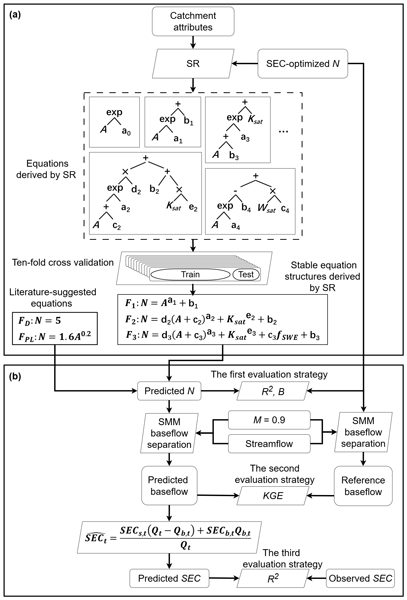
Understanding how baseflow contributes to river flow is essential for managing water resources. We studied a widely used method for separating baseflow and found that a key parameter was often estimated too simply. Using symbolic regression and data from 855 catchments, we uncovered new formulas that greatly improve accuracy and reveal how soil, snow, and catchment size jointly influence baseflow estimation.
Fang Li, David M. Lawrence, Brendan M. Rogers, Chantelle Burton, Huilin Huang, Yiquan Jiang, Johannes W. Kaiser, Matthew Kasoar, Hanna Lee, Ruby Leung, Lars Nieradzik, Aihui Wang, Daniel S. Ward, Ligeer Ce, Yangchun Li, Zhongda Lin, Apostolos Voulgarakis, and Yongkang Xue
Geosci. Model Dev., 19, 3989–4007, https://doi.org/10.5194/gmd-19-3989-2026, https://doi.org/10.5194/gmd-19-3989-2026, 2026
Short summary
Short summary
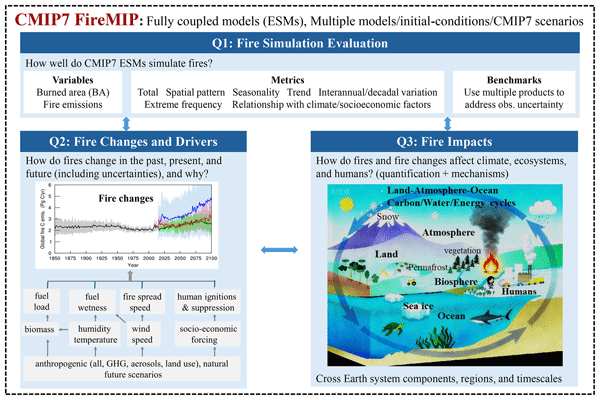
Extreme fire events are increasing, and fires are projected to rise across most regions, posing growing risks to ecosystems and society. As a key Earth system process, fire is now modeled in most Earth System Models (ESMs). FireMIP (Fire Modeling Intercomparison Project) within CMIP7 will evaluate fire simulations in state‑of‑the‑art ESMs, project future fire changes, and provide quantitative, process‑based understanding of fire's role in the Earth system.
Changlong Li, Lan Cuo, Yongxin Zhang, Xuefeng Zhang, Xuan Li, Mei Hou, Aihui Wang, and Liqiao Liang
EGUsphere, https://doi.org/10.5194/egusphere-2025-4849, https://doi.org/10.5194/egusphere-2025-4849, 2025
Preprint archived
Short summary
Short summary
We developed a novel snow simulation framework and applied it over the Tibetan and Pamir Plateaus to study snow mass components. The analysis reveals that in 1962–2019 sublimation and evaporation dominate the snow budget, leading to snow contributing more to atmospheric water vapor than to water resources annually. Snow components exhibit spatially varying but regionally declining trends. Climate factors also show regionally varying effects. This framework can be applied to other alpine regions.
Lorenzo Alfieri, Andrea Libertino, Lorenzo Campo, Francesco Dottori, Simone Gabellani, Tatiana Ghizzoni, Alessandro Masoero, Lauro Rossi, Roberto Rudari, Nicola Testa, Eva Trasforini, Ahmed Amdihun, Jully Ouma, Luca Rossi, Yves Tramblay, Huan Wu, and Marco Massabò
Nat. Hazards Earth Syst. Sci., 24, 199–224, https://doi.org/10.5194/nhess-24-199-2024, https://doi.org/10.5194/nhess-24-199-2024, 2024
Short summary
Short summary
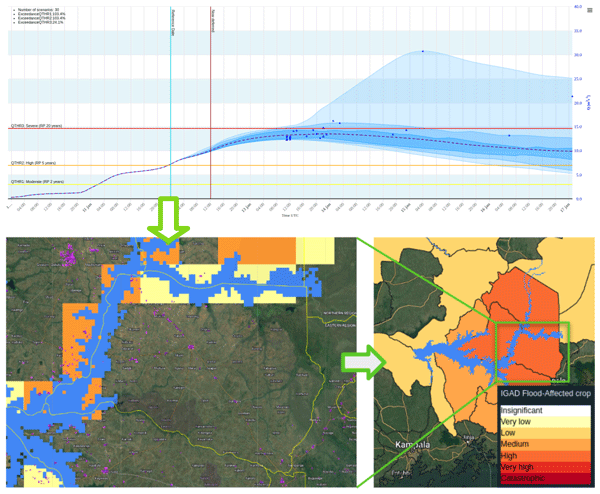
This work describes Flood-PROOFS East Africa, an impact-based flood forecasting system for the Greater Horn of Africa. It is based on hydrological simulations, inundation mapping, and estimation of population and assets exposed to upcoming river floods. The system supports duty officers in African institutions in the daily monitoring of hydro-meteorological disasters. A first evaluation shows the system performance for the catastrophic floods in the Nile River basin in summer 2020.
Lorenzo Alfieri, Francesco Avanzi, Fabio Delogu, Simone Gabellani, Giulia Bruno, Lorenzo Campo, Andrea Libertino, Christian Massari, Angelica Tarpanelli, Dominik Rains, Diego G. Miralles, Raphael Quast, Mariette Vreugdenhil, Huan Wu, and Luca Brocca
Hydrol. Earth Syst. Sci., 26, 3921–3939, https://doi.org/10.5194/hess-26-3921-2022, https://doi.org/10.5194/hess-26-3921-2022, 2022
Short summary
Short summary
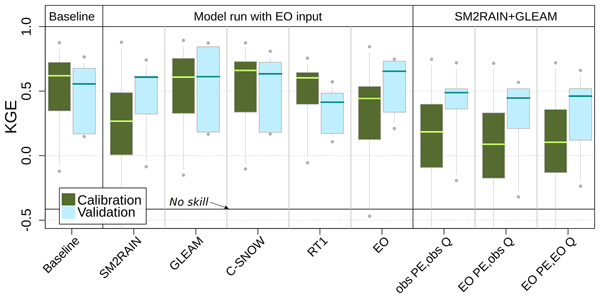
This work shows advances in high-resolution satellite data for hydrology. We performed hydrological simulations for the Po River basin using various satellite products, including precipitation, evaporation, soil moisture, and snow depth. Evaporation and snow depth improved a simulation based on high-quality ground observations. Interestingly, a model calibration relying on satellite data skillfully reproduces observed discharges, paving the way to satellite-driven hydrological applications.
Cited articles
Ahmadalipour, A. and Moradkhani, H.: A data-driven analysis of flash flood hazard, fatalities, and damages over the CONUS during 1996-2017, J. Hydrol., 578, https://doi.org/10.1016/j.jhydrol.2019.124106, 2019.
Alexander, L. V., Zhang, X., Peterson, T. C., Caesar, J., Gleason, B., Tank, A., Haylock, M., Collins, D., Trewin, B., Rahimzadeh, F., Tagipour, A., Kumar, K. R., Revadekar, J., Griffiths, G., Vincent, L., Stephenson, D. B., Burn, J., Aguilar, E., Brunet, M., Taylor, M., New, M., Zhai, P., Rusticucci, M., and Vazquez-Aguirre, J. L.: Global observed changes in daily climate extremes of temperature and precipitation, J. Geophys. Res.-Atmos., 111, https://doi.org/10.1029/2005jd006290, 2006.
Allan, R. P. and Soden, B. J.: Atmospheric warming and the amplification of precipitation extremes, Science, 321, 1481–1484, https://doi.org/10.1126/science.1160787, 2008.
Anderson, B. J., Slater, L. J., Dadson, S. J., Blum, A. G., and Prosdocimi, I.: Statistical Attribution of the Influence of Urban and Tree Cover Change on Streamflow: A Comparison of Large Sample Statistical Approaches, Water Resour. Res., 58, https://doi.org/10.1029/2021wr030742, 2022.
Archfield, S. A., Hirsch, R. M., Viglione, A., and Bloeschl, G.: Fragmented patterns of flood change across the United States, Geophys. Res. Lett., 43, 10232–10239, https://doi.org/10.1002/2016gl070590, 2016.
Balaguru, K., Xu, W., Chang, C.-C., Leung, L. R., Judi, D. R., Hagos, S. M., Wehner, M. F., Kossin, J. P., and Ting, M.: Increased US coastal hurricane risk under climate change, Science Advances, 9, https://doi.org/10.1126/sciadv.adf0259, 2023.
Barendrecht, M. H., Matano, A., Mendoza, H., Weesie, R., Rohse, M., Koehler, J., de Ruiter, M., Garcia, M., Mazzoleni, M., Aerts, J., Ward, P. J., Di Baldassarre, G., Day, R., and Van Loon, A. F.: Exploring drought-to-flood interactions and dynamics: A global case review, WIREs Water, 11, https://doi.org/10.1002/wat2.1726, 2024.
Beck, H. E., Zimmermann, N. E., McVicar, T. R., Vergopolan, N., Berg, A., and Wood, E. F.: Present and future Koppen-Geiger climate classification maps at 1-km resolution, Sci. Data, 5, https://doi.org/10.1038/sdata.2018.214, 2018.
Bergstra, J., Bardenet, R., Bengio, Y., and Kégl, B.: Algorithms for hyper-parameter optimization, Adv. Neur. In., 24, 2546–2554, 2011.
Bloeschl, G., Hall, J., Parajka, J., Perdigao, R. A. P., Merz, B., Arheimer, B., Aronica, G. T., Bilibashi, A., Bonacci, O., Borga, M., Canjevac, I., Castellarin, A., Chirico, G. B., Claps, P., Fiala, K., Frolova, N., Gorbachova, L., Gul, A., Hannaford, J., Harrigan, S., Kireeva, M., Kiss, A., Kjeldsen, T. R., Kohnova, S., Koskela, J. J., Ledvinka, O., Macdonald, N., Mavrova-Guirguinova, M., Mediero, L., Merz, R., Molnar, P., Montanari, A., Murphy, C., Osuch, M., Ovcharuk, V., Radevski, I., Rogger, M., Salinas, J. L., Sauquet, E., Sraj, M., Szolgay, J., Viglione, A., Volpi, E., Wilson, D., Zaimi, K., and Zivkovic, N.: Changing climate shifts timing of European floods, Science, 357, 588–590, https://doi.org/10.1126/science.aan2506, 2017.
Blum, A. G., Ferraro, P. J., Archfield, S. A., and Ryberg, K. R.: Causal Effect of Impervious Cover on Annual Flood Magnitude for the United States, Geophys. Res. Lett., 47, https://doi.org/10.1029/2019gl086480, 2020.
Borga, M., Stoffel, M., Marchi, L., Marra, F., and Jakob, M.: Hydrogeomorphic response to extreme rainfall in headwater systems: Flash floods and debris flows, J. Hydrol., 518, 194–205, https://doi.org/10.1016/j.jhydrol.2014.05.022, 2014.
Breiman, L.: Random forests, Mach. Learn., 45, 5–32, https://doi.org/10.1023/a:1010933404324, 2001.
Brunner, M. I., Swain, D. L., Wood, R. R., Willkofer, F., Done, J. M., Gilleland, E., and Ludwig, R.: An extremeness threshold determines the regional response of floods to changes in rainfall extremes, Commun. Earth Environ., 2, https://doi.org/10.1038/s43247-021-00248-x, 2021.
Carmen Llasat, M., Marcos, R., Turco, M., Gilabert, J., and Llasat-Botija, M.: Trends in flash flood events versus convective precipitation in the Mediterranean region: The case of Catalonia, J. Hydrol., 541, 24–37, https://doi.org/10.1016/j.jhydrol.2016.05.040, 2016.
Cherkauer, K. A., Bowling, L. C., and Lettenmaier, D. P.: Variable infiltration capacity cold land process model updates, Global Planet. Change, 38, 151–159, https://doi.org/10.1016/s0921-8181(03)00025-0, 2003.
Dai, A., Trenberth, K. E., and Qian, T. T.: A global dataset of Palmer Drought Severity Index for 1870–2002: Relationship with soil moisture and effects of surface warming, J. Hydrometeorol., 5, 1117–1130, https://doi.org/10.1175/jhm-386.1, 2004.
De Niel, J. and Willems, P.: Climate or land cover variations: what is driving observed changes in river peak flows? A data-based attribution study, Hydrol. Earth Syst. Sci., 23, 871–882, https://doi.org/10.5194/hess-23-871-2019, 2019.
Debbage, N. and Shepherd, J. M.: The Influence of Urban Development Patterns on Streamflow Characteristics in the Charlanta Megaregion, Water Resour. Res., 54, 3728–3747, https://doi.org/10.1029/2017wr021594, 2018.
Do, H. X., Westra, S., and Leonard, M.: A global-scale investigation of trends in annual maximum streamflow, J. Hydrol., 552, 28–43, https://doi.org/10.1016/j.jhydrol.2017.06.015, 2017.
Emanuel, K.: Increasing destructiveness of tropical cyclones over the past 30 years, Nature, 436, 686–688, https://doi.org/10.1038/nature03906, 2005.
Frans, C., Istanbulluoglu, E., Mishra, V., Munoz-Arriola, F., and Lettenmaier, D. P.: Are climatic or land cover changes the dominant cause of runoff trends in the Upper Mississippi River Basin?, Geophys. Res. Lett., 40, 1104–1110, https://doi.org/10.1002/grl.50262, 2013.
Gaume, E. and Borga, M.: Post-flood field investigations in upland catchments after major flash floods: proposal of a methodology and illustrations, J. Flood Risk Manag., 1, 175–189, https://doi.org/10.1111/j.1753-318X.2008.00023.x, 2008.
Gelaro, R., McCarty, W., Suarez, M. J., Todling, R., Molod, A., Takacs, L., Randles, C. A., Darmenov, A., Bosilovich, M. G., Reichle, R., Wargan, K., Coy, L., Cullather, R., Draper, C., Akella, S., Buchard, V., Conaty, A., da Silva, A. M., Gu, W., Kim, G.-K., Koster, R., Lucchesi, R., Merkova, D., Nielsen, J. E., Partyka, G., Pawson, S., Putman, W., Rienecker, M., Schubert, S. D., Sienkiewicz, M., and Zhao, B.: The Modern-Era Retrospective Analysis for Research and Applications, Version 2 (MERRA-2), J. Climate, 30, 5419–5454, https://doi.org/10.1175/jcli-d-16-0758.1, 2017.
Gourley, J. J., Hong, Y., Flamig, Z. L., Arthur, A., Clark, R., Calianno, M., Ruin, I., Ortel, T., Wieczorek, M. E., Kirstetter, P.-E., Clark, E., and Krajewski, W. F.: A Unified Flash Flood Database across the United States, B. Am. Meteorol. Soc., 94, 799–805, https://doi.org/10.1175/bams-d-12-00198.1, 2013.
Hall, J., Arheimer, B., Borga, M., Brázdil, R., Claps, P., Kiss, A., Kjeldsen, T. R., Kriaučiūnienė, J., Kundzewicz, Z. W., Lang, M., Llasat, M. C., Macdonald, N., McIntyre, N., Mediero, L., Merz, B., Merz, R., Molnar, P., Montanari, A., Neuhold, C., Parajka, J., Perdigão, R. A. P., Plavcová, L., Rogger, M., Salinas, J. L., Sauquet, E., Schär, C., Szolgay, J., Viglione, A., and Blöschl, G.: Understanding flood regime changes in Europe: a state-of-the-art assessment, Hydrol. Earth Syst. Sci., 18, 2735–2772, https://doi.org/10.5194/hess-18-2735-2014, 2014.
Hapuarachchi, H. A. P., Wang, Q. J., and Pagano, T. C.: A review of advances in flash flood forecasting, Hydrol. Process., 25, 2771–2784, https://doi.org/10.1002/hyp.8040, 2011.
Hodgkins, G. A., Dudley, R. W., Archfield, S. A., and Renard, B.: Effects of climate, regulation, and urbanization on historical flood trends in the United States, J. Hydrol., 573, 697–709, https://doi.org/10.1016/j.jhydrol.2019.03.102, 2019.
Hou, A. Y., Kakar, R. K., Neeck, S., Azarbarzin, A. A., Kummerow, C. D., Kojima, M., Oki, R., Nakamura, K., and Iguchi, T.: The global precipitation measurement mission, B. Am. Meteorol. Soc., 95, 701–722, https://doi.org/10.1175/bams-d-13-00164.1, 2014.
Hu, Y., Wu, H., Alfieri, L., Gu, G., Yilmaz, K. K., Li, C., Jiang, L., Huang, Z., Chen, W., Wu, W., and Han, Q.: A time-space varying distributed unit hydrograph (TS-DUH) for operational flash flood forecasting using publicly-available datasets, J. Hydrol., 642, 131785, https://doi.org/10.1016/j.jhydrol.2024.131785, 2024.
Huang, Z., Wu, H., Adler, R. F., Schumann, G., Gourley, J. J., Kettner, A., and Nanding, N.: Multisourced Flood Inventories over the Contiguous United States for Actual and Natural Conditions, B. Am. Meteorol. Soc., 102, E1133–E1149, https://doi.org/10.1175/bams-d-20-0001.1, 2021.
Huang, Z., Wu, H., Gu, G., Li, X., Nanding, N., Adler, R. F., Yilmaz, K. K., Alfieri, L., and Chen, S.: Paired Satellite and NWP Precipitation for Global Flood Forecasting, J. Hydrometeorol., 24, 2191–2205, https://doi.org/10.1175/jhm-d-23-0044.1, 2023.
Ivancic, T. J. and Shaw, S. B.: Examining why trends in very heavy precipitation should not be mistaken for trends in very high river discharge, Climatic Change, 133, 681–693, https://doi.org/10.1007/s10584-015-1476-1, 2015.
Jiang, L., Wu, H., Tao, J., Kimball, J. S., Alfieri, L., and Chen, X.: Satellite-based evapotranspiration in hydrological model calibration, Remote Sens., 12, 428, https://doi.org/10.3390/rs12030428, 2020.
Jiang, S., Bevacqua, E., and Zscheischler, J.: River flooding mechanisms and their changes in Europe revealed by explainable machine learning, Hydrol. Earth Syst. Sci., 26, 6339–6359, https://doi.org/10.5194/hess-26-6339-2022, 2022.
Kemter, M., Marwan, N., Villarini, G., and Merz, B.: Controls on Flood Trends Across the United States, Water Resour. Res., 59, https://doi.org/10.1029/2021wr031673, 2023.
Kendall, M. G.: Rank correlation methods, Charles Griffin & Co., London,, 1948.
Khajehei, S., Ahmadalipour, A., Shao, W., and Moradkhani, H.: A Place-based Assessment of Flash Flood Hazard and Vulnerability in the Contiguous United States, Sci. Rep., 10, https://doi.org/10.1038/s41598-019-57349-z, 2020.
Kirschbaum, D. B., Huffman, G. J., Adler, R. F., Braun, S., Garrett, K., Jones, E., McNally, A., Skofronick-Jackson, G., Stocker, E., Wu, H., and Zaitchik, B. F.: NASA's remotely sensed precipitation: A reservoir for applications users, B. Am. Meteorol. Soc., 98, 1169–1184, https://doi.org/10.1175/bams-d-15-00296.1, 2017.
Lang, M., Ouarda, T., and Bobée, B.: Towards operational guidelines for over-threshold modeling, J. Hydrol., 225, 103–117, https://doi.org/10.1016/s0022-1694(99)00167-5, 1999.
Lenderink, G. and van Meijgaard, E.: Linking increases in hourly precipitation extremes to atmospheric temperature and moisture changes, Environ. Res. Lett., 5, https://doi.org/10.1088/1748-9326/5/2/025208, 2010.
Li, S., Wang, G., Zhu, C., Lu, J., Ullah, W., Hagan, D. F. T., Kattel, G., and Peng, J.: Attribution of global evapotranspiration trends based on the Budyko framework, Hydrol. Earth Syst. Sci., 26, 3691–3707, https://doi.org/10.5194/hess-26-3691-2022, 2022.
Liang, X., Lettenmaier, D. P., and Wood, E. F.: One-dimensional statistical dynamic representation of subgrid spatial variability of precipitation in the two-layer variable infiltration capacity model, J. Geophys. Res., 101, 21403–21422, https://doi.org/10.1029/96jd01448, 1996.
Liu, J., Feng, S., Gu, X., Zhang, Y., Beck, H. E., Zhang, J., and Yan, S.: Global changes in floods and their drivers, J. Hydrol., 128553–128553, https://doi.org/10.1016/j.jhydrol.2022.128553, 2022.
Mallakpour, I. and Villarini, G.: The changing nature of flooding across the central United States, Nat. Clim. Change, 5, 250–254, https://doi.org/10.1038/nclimate2516, 2015.
Mann, H. B.: Nonparametric tests against trend, Econometrica, 13, 245–259, https://doi.org/10.2307/1907187, 1945.
Merz, B., Vorogushyn, S., Uhlemann, S., Delgado, J., and Hundecha, Y.: HESS Opinions “More efforts and scientific rigour are needed to attribute trends in flood time series”, Hydrol. Earth Syst. Sci., 16, 1379–1387, https://doi.org/10.5194/hess-16-1379-2012, 2012.
Merz, B., Bloesch, G., Vorogushyn, S., Dottori, F., Aerts, J. C. J. H., Bates, P., Bertola, M., Kemter, M., Kreibich, H., Lall, U., and Macdonald, E.: Causes, impacts and patterns of disastrous river floods, Nat. Rev. Earth Environ., 2, 592–609, https://doi.org/10.1038/s43017-021-00195-3, 2021.
Milly, P. C. D., Betancourt, J., Falkenmark, M., Hirsch, R. M., Kundzewicz, Z. W., Lettenmaier, D. P., and Stouffer, R. J.: Climate change - Stationarity is dead: Whither water management?, Science, 319, 573–574, https://doi.org/10.1126/science.1151915, 2008.
Nanding, N., Wu, H., Tao, J., Maggioni, V., Beck, H. E., Zhou, N., Huang, M., and Huang, Z.: Assessment of Precipitation Error Propagation in Discharge Simulations over the Contiguous United States, J. Hydrometeorol., 22, 1987–2008, https://doi.org/10.1175/jhm-d-20-0213.1, 2021.
Saharia, M., Kirstetter, P.-E., Vergara, H., Gourley, J. J., Hong, Y., and Giroud, M.: Mapping Flash Flood Severity in the United States, J. Hydrometeorol., 18, 397–411, https://doi.org/10.1175/jhm-d-16-0082.1, 2017.
Schaperow, J. R., Li, D., Margulis, S. A., and Lettenmaier, D. P.: A near-global, high resolution land surface parameter dataset for the variable infiltration capacity model, Sci. Data, 8, https://doi.org/10.1038/s41597-021-00999-4, 2021.
Sharma, A., Wasko, C., and Lettenmaier, D. P.: If Precipitation Extremes Are Increasing, Why Aren't Floods?, Water Resour. Res., 54, 8545–8551, https://doi.org/10.1029/2018wr023749, 2018.
Slater, L. J. and Villarini, G.: Recent trends in US flood risk, Geophys. Res. Lett., 43, 12428–12436, https://doi.org/10.1002/2016gl071199, 2016.
Slater, L. J., Anderson, B., Buechel, M., Dadson, S., Han, S., Harrigan, S., Kelder, T., Kowal, K., Lees, T., Matthews, T., Murphy, C., and Wilby, R. L.: Nonstationary weather and water extremes: a review of methods for their detection, attribution, and management, Hydrol. Earth Syst. Sci., 25, 3897–3935, https://doi.org/10.5194/hess-25-3897-2021, 2021.
Wagener, T., Sivapalan, M., Troch, P. A., McGlynn, B. L., Harman, C. J., Gupta, H. V., Kumar, P., Rao, P. S. C., Basu, N. B., and Wilson, J. S.: The future of hydrology: An evolving science for a changing world, Water Resour. Res., 46, https://doi.org/10.1029/2009wr008906, 2010.
Wang, A., Miao, Y., Kong, X., and Wu, H.: Future Changes in Global Runoff and Runoff Coefficient From CMIP6 Multi-Model Simulation Under SSP1-2.6 and SSP5-8.5 Scenarios, Earths Future, 10, https://doi.org/10.1029/2022ef002910, 2022.
Wang, D. and Hejazi, M.: Quantifying the relative contribution of the climate and direct human impacts on mean annual streamflow in the contiguous United States, Water Resour. Res., 47, https://doi.org/10.1029/2010wr010283, 2011.
Wasko, C. and Nathan, R.: Influence of changes in rainfall and soil moisture on trends in flooding, J. Hydrol., 575, 432–441, https://doi.org/10.1016/j.jhydrol.2019.05.054, 2019.
Wasko, C. and Sharma, A.: Global assessment of flood and storm extremes with increased temperatures, Sci. Rep., 7, https://doi.org/10.1038/s41598-017-08481-1, 2017.
Westra, S., Alexander, L. V., and Zwiers, F. W.: Global Increasing Trends in Annual Maximum Daily Precipitation, J. Climate, 26, 3904–3918, https://doi.org/10.1175/jcli-d-12-00502.1, 2013.
Winkler, K., Fuchs, R., Rounsevell, M., and Herold, M.: Global land use changes are four times greater than previously estimated, Nat. Commun., 12, https://doi.org/10.1038/s41467-021-22702-2, 2021.
Wu, H., Kimball, J. S., Mantua, N., and Stanford, J.: Automated upscaling of river networks for macroscale hydrological modeling, Water Resour. Res., 47, https://doi.org/10.1029/2009wr008871, 2011.
Wu, H., Adler, R. F., Hong, Y., Tian, Y., and Policelli, F.: Evaluation of Global Flood Detection Using Satellite-Based Rainfall and a Hydrologic Model, J. Hydrometeorol., 13, 1268–1284, https://doi.org/10.1175/jhm-d-11-087.1, 2012a.
Wu, H., Kimball, J. S., Li, H., Huang, M., Leung, L. R., and Adler, R. F.: A new global river network database for macroscale hydrologic modeling, Water Resour. Res., 48, https://doi.org/10.1029/2012wr012313, 2012b.
Wu, H., Adler, R. F., Tian, Y., Huffman, G. J., Li, H., and Wang, J.: Real-time global flood estimation using satellite-based precipitation and a coupled land surface and routing model, Water Resour. Res., 50, 2693–2717, https://doi.org/10.1002/2013wr014710, 2014.
Wu, H., Adler, R. F., Tian, Y., Gu, G., and Huffman, G. J.: Evaluation of Quantitative Precipitation Estimations through Hydrological Modeling in IFloodS River Basins, J. Hydrometeorol., 18, 529–553, https://doi.org/10.1175/jhm-d-15-0149.1, 2017.
Wu, H., Kimball, J. S., Zhou, N., Alfieri, L., Luo, L., Du, J., and Huang, Z.: Evaluation of real-time global flood modeling with satellite surface inundation observations from SMAP, Remote Sens. Environ., 233, https://doi.org/10.1016/j.rse.2019.111360, 2019.
Xia, Y., Mitchell, K., Ek, M., Cosgrove, B., Sheffield, J., Luo, L., Alonge, C., Wei, H., Meng, J., Livneh, B., Duan, Q., and Lohmann, D.: Continental-scale water and energy flux analysis and validation for North American Land Data Assimilation System project phase 2 (NLDAS-2): 2. Validation of model-simulated streamflow, J. Geophys. Res.-Atmos., 117, https://doi.org/10.1029/2011jd016051, 2012.
Yan, Y., Wu, H., Gu, G., Huang, Z., Alfieri, L., Li, X., Nanding, N., Pan, X., and Tang, Q.: Climatology and Interannual Variability of Floods during the TRMM Era (1998-2013), J. Climate, 33, 3289–3305, https://doi.org/10.1175/jcli-d-19-0415.1, 2020.
Yin, J., Gentine, P., Zhou, S., Sullivan, S. C., Wang, R., Zhang, Y., and Guo, S.: Large increase in global storm runoff extremes driven by climate and anthropogenic changes, Nat. Commun., 9, https://doi.org/10.1038/s41467-018-06765-2, 2018.
Yuan, X., Wang, Y. M., Ji, P., Wu, P. L., Sheffield, J., and Otkin, J. A.: A global transition to flash droughts under climate change, Science, 380, 187–191, https://doi.org/10.1126/science.abn6301, 2023.
Zhang, S., Zhou, L., Zhang, L., Yang, Y., Wei, Z., Zhou, S., Yang, D., Yang, X., Wu, X., Zhang, Y., Li, X., and Dai, Y.: Reconciling disagreement on global river flood changes in a warming climate, Nat. Clim. Change, 12, 1160–1167, https://doi.org/10.1038/s41558-022-01539-7, 2022.
Zhang, X., Liu, L., Chen, X., Gao, Y., Xie, S., and Mi, J.: GLC_FCS30: global land-cover product with fine classification system at 30 m using time-series Landsat imagery, Earth Syst. Sci. Data, 13, 2753–2776, https://doi.org/10.5194/essd-13-2753-2021, 2021.
Short summary
Our analysis of United States river data explains why more heavy rain has not led to more flash floods. Only 17.3 % of basins see more frequent events, and 6.5 % see sharper, more intense flash floods. A key finding is that the warming climate counteracts rainfall's impact, reducing potential increases in flood frequency by 3.6 % and intensity by 8.0 % since the 1980s. While national land cover has remained stable, local urbanization remains a crucial factor driving flood risk.
Our analysis of United States river data explains why more heavy rain has not led to more flash...
Altmetrics
Final-revised paper
Preprint