Articles | Volume 26, issue 7
https://doi.org/10.5194/nhess-26-3523-2026
© Author(s) 2026. This work is distributed under
the Creative Commons Attribution 4.0 License.
https://doi.org/10.5194/nhess-26-3523-2026
© Author(s) 2026. This work is distributed under
the Creative Commons Attribution 4.0 License.
Dynamic and thermal analysis of dust storm processes based on vertical observation data

Yifei Wang
Institute of Desert Meteorology, China Meteorological Administration, Urumqi 830002, China
College of Geography and Remote Sensing Sciences, Xinjiang University, Urumqi 830046, China
National Observation and Research Station of Desert Meteorology, Taklimakan Desert of Xinjiang, Urumqi 830002, China
Taklimakan Desert Meteorology Field Experiment Station, China Meteorological Administration, Urumqi 830002, China
Xinjiang Key Laboratory of Desert Meteorology and Sandstorm, Urumqi 830002, China
Institute of Desert Meteorology, China Meteorological Administration, Urumqi 830002, China
National Observation and Research Station of Desert Meteorology, Taklimakan Desert of Xinjiang, Urumqi 830002, China
Taklimakan Desert Meteorology Field Experiment Station, China Meteorological Administration, Urumqi 830002, China
Xinjiang Key Laboratory of Desert Meteorology and Sandstorm, Urumqi 830002, China
Yongqiang Liu
Institute of Desert Meteorology, China Meteorological Administration, Urumqi 830002, China
College of Geography and Remote Sensing Sciences, Xinjiang University, Urumqi 830046, China
National Observation and Research Station of Desert Meteorology, Taklimakan Desert of Xinjiang, Urumqi 830002, China
Taklimakan Desert Meteorology Field Experiment Station, China Meteorological Administration, Urumqi 830002, China
Xinjiang Key Laboratory of Desert Meteorology and Sandstorm, Urumqi 830002, China
Mayibaier Maihamuti
Institute of Desert Meteorology, China Meteorological Administration, Urumqi 830002, China
College of Geography and Remote Sensing Sciences, Xinjiang University, Urumqi 830046, China
National Observation and Research Station of Desert Meteorology, Taklimakan Desert of Xinjiang, Urumqi 830002, China
Taklimakan Desert Meteorology Field Experiment Station, China Meteorological Administration, Urumqi 830002, China
Xinjiang Key Laboratory of Desert Meteorology and Sandstorm, Urumqi 830002, China
Fan Yang
Institute of Desert Meteorology, China Meteorological Administration, Urumqi 830002, China
National Observation and Research Station of Desert Meteorology, Taklimakan Desert of Xinjiang, Urumqi 830002, China
Taklimakan Desert Meteorology Field Experiment Station, China Meteorological Administration, Urumqi 830002, China
Xinjiang Key Laboratory of Desert Meteorology and Sandstorm, Urumqi 830002, China
Chenglong Zhou
Institute of Desert Meteorology, China Meteorological Administration, Urumqi 830002, China
National Observation and Research Station of Desert Meteorology, Taklimakan Desert of Xinjiang, Urumqi 830002, China
Taklimakan Desert Meteorology Field Experiment Station, China Meteorological Administration, Urumqi 830002, China
Xinjiang Key Laboratory of Desert Meteorology and Sandstorm, Urumqi 830002, China
Xinghua Yang
Institute of Desert Meteorology, China Meteorological Administration, Urumqi 830002, China
National Observation and Research Station of Desert Meteorology, Taklimakan Desert of Xinjiang, Urumqi 830002, China
Taklimakan Desert Meteorology Field Experiment Station, China Meteorological Administration, Urumqi 830002, China
Xinjiang Key Laboratory of Desert Meteorology and Sandstorm, Urumqi 830002, China
School of Geographical Sciences, Shanxi Normal University, Taiyuan 030031, China
Ali Mamtimin
Institute of Desert Meteorology, China Meteorological Administration, Urumqi 830002, China
National Observation and Research Station of Desert Meteorology, Taklimakan Desert of Xinjiang, Urumqi 830002, China
Taklimakan Desert Meteorology Field Experiment Station, China Meteorological Administration, Urumqi 830002, China
Xinjiang Key Laboratory of Desert Meteorology and Sandstorm, Urumqi 830002, China
Related authors
No articles found.
Honglin Pan, Jianping Huang, Jiming Li, Zhongwei Huang, Minzhong Wang, Ali Mamtimin, Wen Huo, Fan Yang, Tian Zhou, and Kanike Raghavendra Kumar
Earth Syst. Sci. Data, 16, 1185–1207, https://doi.org/10.5194/essd-16-1185-2024, https://doi.org/10.5194/essd-16-1185-2024, 2024
Short summary
Short summary
We applied several correction procedures and rigorously checked for data quality constraints during the long observation period spanning almost 14 years (2007–2020). Nevertheless, some uncertainties remain, mainly due to technical constraints and limited documentation of the measurements. Even though not completely accurate, this strategy is expected to at least reduce the inaccuracy of the computed characteristic value of aerosol optical parameters.
Yaozhi Jiang, Kun Yang, Youcun Qi, Xu Zhou, Jie He, Hui Lu, Xin Li, Yingying Chen, Xiaodong Li, Bingrong Zhou, Ali Mamtimin, Changkun Shao, Xiaogang Ma, Jiaxin Tian, and Jianhong Zhou
Earth Syst. Sci. Data, 15, 621–638, https://doi.org/10.5194/essd-15-621-2023, https://doi.org/10.5194/essd-15-621-2023, 2023
Short summary
Short summary
Our work produces a long-term (1979–2020) high-resolution (1/30°, daily) precipitation dataset for the Third Pole (TP) region by merging an advanced atmospheric simulation with high-density rain gauge (more than 9000) observations. Validation shows that the produced dataset performs better than the currently widely used precipitation datasets in the TP. This dataset can be used for hydrological, meteorological and ecological studies in the TP.
Chenglong Zhou, Yuzhi Liu, Qingzhe Zhu, Qing He, Tianliang Zhao, Fan Yang, Wen Huo, Xinghua Yang, and Ali Mamtimin
Atmos. Chem. Phys., 22, 5195–5207, https://doi.org/10.5194/acp-22-5195-2022, https://doi.org/10.5194/acp-22-5195-2022, 2022
Short summary
Short summary
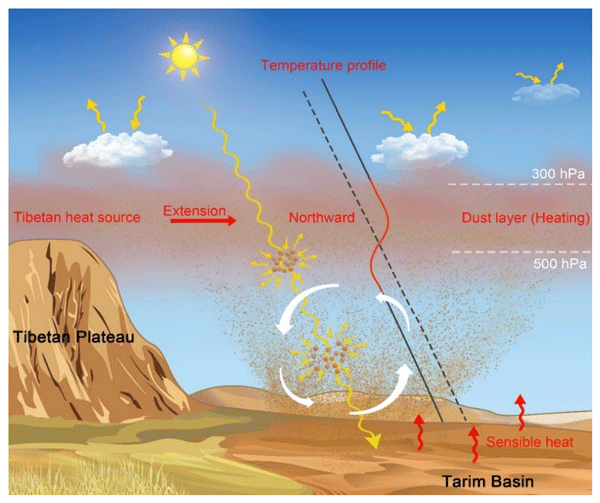
Based on the radiosonde observations, an anomalously warm layer is measured at altitudes between 500 and 300 hPa over the Tarim Basin (TB) with an average intensity of 2.53 and 1.39 K in the spring and summer, respectively. The heat contributions of dust to this anomalously warm atmospheric layer in spring and summer were 13.77 and 10.25 %, respectively. Topographically, the TB is adjacent to the Tibetan Plateau; we propose the concept of the Tibetan heat source’s northward extension.
Cited articles
Achakulwisut, P., Mickley, L. J., and Anenberg, S. C.: Drought-sensitivity of fine dust in the US Southwest: Implications for air quality and public health under future climate change, Environ. Res. Lett., 13, 054025, https://doi.org/10.1088/1748-9326/aabf20, 2018.
Aili, A., Xu, H., Kasim, T., and Abulikemu, A.: Origin and Transport Pathway of Dust Storm and Its Contribution to Particulate Air Pollution in Northeast Edge of Taklimakan Desert, China, Atmosphere, 12, 113, https://doi.org/10.3390/atmos12010113, 2021.
Aili, A., Xu, H., Xu, Q., and Liu, K.: Aeolian dust movement and deposition under local atmospheric circulation in a desert-oasis transition zone of the northeastern Taklimakan desert, Ecol. Indic., 157, 111289, https://doi.org/10.1016/j.ecolind.2023.111289, 2023.
Aili, A., Waheed, A., Zhao, X., and Xu, H.: Establishing an Early Warning System for Dust Storms in Peri-Desert Regions, Environments, 11, 61, https://doi.org/10.3390/environments11040061, 2024.
Bao, C. and Fang, C.: Water resources constraint force on urbanization in water deficient regions: A case study of the Hexi Corridor, arid area of NW China, Ecol. Econ., 62, 508–517, https://doi.org/10.1016/j.ecolecon.2006.07.013, 2007.
Bao, T., Xi, G., Hao, Y., Chang, I.-S., Wu, J., Xue, Z., Jin, E., Zhang, W., and Bao, Y.: The Transport Path and Vertical Structure of Dust Storms in East Asia and the Impacts on Cities in Northern China, Remote Sens.-Basel, 15, 3183, https://doi.org/10.3390/rs15123183, 2023.
Bi, J., Li, Z., Zuo, D., Yang, F., Li, B., Ma, J., Huang, Z., and He, Q.: Dust Aerosol Vertical Profiles in the Hinterland of Taklimakan Desert During Summer 2019, Front. Environ. Sci., 10, 851915, https://doi.org/10.3389/fenvs.2022.851915, 2022.
Chen, S., Zhao, D., Huang, J., He, J., Chen, Y., Chen, J., Bi, H., Lou, G., Du, S., Zhang, Y., and Yang, F.: Mongolia Contributed More than 42 % of the Dust Concentrations in Northern China in March and April 2023, Adv. Atmos. Sci., 40, 1549–1557, https://doi.org/10.1007/s00376-023-3062-1, 2023a.
Chen, Y., An, J., Qu, Y., Xie, F., and Ma, S.: Dust radiation effect on the weather and dust transport over the Taklimakan Desert, China, Atmos. Res., 284, 106600, https://doi.org/10.1016/j.atmosres.2022.106600, 2023b.
Gao, X., Ding, D., and Gao, H.: Dominant circulation pattern and moving path of the Mongolian Cyclone for the severe sand and dust storm in China, Atmos. Res., 301, 107272, https://doi.org/10.1016/j.atmosres.2024.107272, 2024.
Ge, J. M., Huang, J. P., Xu, C. P., Qi, Y. L., and Liu, H. Y.: Characteristics of Taklimakan dust emission and distribution: A satellite and reanalysis field perspective: Taklimakan dust Characteristics, J. Geophys. Res.-Atmos., 119, 11772–11783, https://doi.org/10.1002/2014JD022280, 2014.
Gillette, D. A. and Passi, R.: Modeling dust emission caused by wind erosion, J. Geophys. Res., 93, 14233–14242, https://doi.org/10.1029/JD093iD11p14233, 1988.
Iversen, J. D. and White, B. R.: Saltation threshold on Earth, Mars and Venus, Sedimentology, 29, 111–119, https://doi.org/10.1111/j.1365-3091.1982.tb01713.x, 1982.
Kai, Z. and Huiwang, G.: The characteristics of Asian-dust storms during 2000–2002: From the source to the sea, Atmos. Environ., 41, 9136–9145, https://doi.org/10.1016/j.atmosenv.2007.08.007, 2007.
Kok, J. F., Storelvmo, T., Karydis, V. A., Adebiyi, A. A., Mahowald, N. M., Evan, A. T., He, C., and Leung, D. M.: Mineral Dust Aerosol Impacts on Global Climate and Climate Change, Nat. Rev. Earth Environ., 4, 71–86, https://doi.org/10.1038/s43017-022-00379-5, 2023.
Li, J., Han, Y., Liu, W., Cao, L., and Lu, Z.: Contributions of gust under stationary weather conditions to the dust aerosol budget in northwestern China, Atmos. Res., 293, 106914, https://doi.org/10.1016/j.atmosres.2023.106914, 2023.
Liu, X., Yin, Z., Zhang, X., and Yang, X.: Analyses of the spring dust storm frequency of northern China in relation to antecedent and concurrent wind, precipitation, vegetation, and soil moisture conditions, J. Geophys. Res., 109, 2004JD004615, https://doi.org/10.1029/2004JD004615, 2004.
Manisalidis, I., Stavropoulou, E., Stavropoulos, A., and Bezirtzoglou, E.: Environmental and Health Impacts of Air Pollution: A Review, Front. Public Health, 8, 14, https://doi.org/10.3389/fpubh.2020.00014, 2020.
Marticorena, B. and Bergametti, G.: Modeling the atmospheric dust cycle: 1. Design of a soil-derived dust emission scheme, J. Geophys. Res., 100, 16415–16430, https://doi.org/10.1029/95JD00690, 1995.
Mu, F. and Fiedler, S.: How much do atmospheric depressions and Mongolian cyclones contribute to spring dust activities in East Asia?, npj Clim. Atmos. Sci., 8, 51, https://doi.org/10.1038/s41612-025-00929-w, 2025.
Prospero, J. M.: Long-range transport of mineral dust in the global atmosphere: Impact of African dust on the environment of the southeastern United States, P. Natl. Acad. Sci. USA, 96, 3396–3403, https://doi.org/10.1073/pnas.96.7.3396, 1999.
Raupach, M. R.: Drag and drag partition on rough surfaces, Bound.-Lay. Meteorol., 60, 375–395, https://doi.org/10.1007/BF00155203, 1992.
Shao, Y. and Dong, C. H.: A review on East Asian dust storm climate, modelling and monitoring, Global Planet. Change, 52, 1–22, https://doi.org/10.1016/j.gloplacha.2006.02.011, 2006.
Stein, A. F., Draxler, R. R., Rolph, G. D., Stunder, B. J. B., Cohen, M. D., and Ngan, F.: NOAA's HYSPLIT Atmospheric Transport and Dispersion Modeling System, B. Am. Meteorol. Soc., 96, 2059–2077, https://doi.org/10.1175/BAMS-D-14-00110.1, 2015.
Su, L., Lu, C., Yuan, J., Wang, X., He, Q., and Xia, H.: Measurement report: The promotion of low-level jet and thermal-effect on development of deep convective boundary layer at the southern edge of the Taklimakan Desert, EGUsphere [preprint], https://doi.org/10.5194/egusphere-2024-1010, 2024.
Sun, J. and Liu, T.: The Age of the Taklimakan Desert, Science, 312, 1621–1621, https://doi.org/10.1126/science.1124616, 2006.
Tong, D., Feng, I., Gill, T. E., Schepanski, K., and Wang, J.: How Many People Were Killed by Windblown Dust Events in the United States?, B. Am. Meteorol. Soc., 104, E1067–E1084, https://doi.org/10.1175/BAMS-D-22-0186.1, 2023.
Wang, B., Ji, H., Zhang, Z., Liang, J., Zhang, L., Li, M., Qiu, R., Luo, H., An, W., Tian, P., and Amonov, M. O.: Surface-Dependent Meteorological Responses to a Taklimakan Dust Event During Summer near the Northern Slope of the Tibetan Plateau, Remote Sens.-Basel, 17, 1561, https://doi.org/10.3390/rs17091561, 2025.
Wang, H., Jia, X., Li, K., and Li, Y.: Horizontal wind erosion flux and potential dust emission in arid and semiarid regions of China: A major source area for East Asia dust storms, CATENA, 133, 373–384, https://doi.org/10.1016/j.catena.2015.06.011, 2015.
Wang, X., Zhai, P., and Wang, C.: Variations in extratropical cyclone activity in northern East Asia, Adv. Atmos. Sci., 26, 471–479, https://doi.org/10.1007/s00376-009-0471-8, 2009.
Wen, H.-J., Wang, S.-L., Wu, C.-D., and Liang, M.-C.: Association of Asian dust storms and PM2.5 with clinical visits for respiratory diseases in children, Atmos. Environ., 333, 120631, https://doi.org/10.1016/j.atmosenv.2024.120631, 2024.
Xing, Y., Chen, Y., Yan, S., Cao, X., Zhou, Y., Zhang, X., Shi, T., Niu, X., Wu, D., Cui, J., Zhou, Y., Wang, X., and Pu, W.: Dust storms from the Taklamakan Desert significantly darken snow surface on surrounding mountains, Atmos. Chem. Phys., 24, 5199–5219, https://doi.org/10.5194/acp-24-5199-2024, 2024.
Xiong, Z., Xu, X., Yang, Y., and Luo, T.: Diurnal vertical distribution and transport of dust aerosol over and around Tibetan Plateau from lidar on International Space Station, Atmos. Res., 294, 106939, https://doi.org/10.1016/j.atmosres.2023.106939, 2023.
Xu, C., Guan, Q., Lin, J., Luo, H., Yang, L., Tan, Z., Wang, Q., Wang, N., and Tian, J.: Spatiotemporal variations and driving factors of dust storm events in northern China based on high-temporal-resolution analysis of meteorological data (1960–2007), Environ. Pollut., 260, 114084, https://doi.org/10.1016/j.envpol.2020.114084, 2020.
Yang, X., Shen, S., Yang, F., He, Q., Ali, M., Huo, W., and Liu, X.: Spatial and temporal variations of blowing dust events in the Taklimakan Desert, Theor. Appl. Climatol., 125, 669–677, https://doi.org/10.1007/s00704-015-1537-4, 2016.
Yuan, T., Chen, S., Huang, J., Wu, D., Lu, H., Zhang, G., Ma, X., Chen, Z., Luo, Y., and Ma, X.: Influence of Dynamic and Thermal Forcing on the Meridional Transport of Taklimakan Desert Dust in Spring and Summer, J. Climate, 32, 749–767, https://doi.org/10.1175/JCLI-D-18-0361.1, 2019.
Zhang, L., Zhang, H., Cai, X., Song, Y., Mamtimin, A., and He, Q.: Physical Mechanisms of Deep Convective Boundary Layer Leading to Dust Emission in the Taklimakan Desert, Geophys. Res. Lett., 51, e2024GL108521, https://doi.org/10.1029/2024gl108521, 2024.
Zhang, X., Wang, T., Wang, S., Jiao, Y., Tang, J., Li, J., Yang, F., Amonov, M. O., and Abdullaev, S. F.: Conducive circulation patterns and transport mechanisms for spring dust from Taklimakan Desert to the Tibetan Plateau, Environ. Int., 197, 109356, https://doi.org/10.1016/j.envint.2025.109356, 2025.
Short summary
Dust storms threaten health, travel and farming, but the conditions that prepare them may change with season. We studied eight 2024 storms in the Taklimakan Desert using two towers, weather records and air-path tracking. Spring storms were mainly prepared by strong regional pressure differences, while summer storms showed stronger early ground heating, followed by rising winds just before they began. Local terrain altered these signals. The results may improve seasonal dust-storm warnings.
Dust storms threaten health, travel and farming, but the conditions that prepare them may change...
Altmetrics
Final-revised paper
Preprint