
Articles | Volume 26, issue 7
https://doi.org/10.5194/nhess-26-3417-2026
© Author(s) 2026. This work is distributed under
the Creative Commons Attribution 4.0 License.
the Creative Commons Attribution 4.0 License.
https://doi.org/10.5194/nhess-26-3417-2026
© Author(s) 2026. This work is distributed under
the Creative Commons Attribution 4.0 License.
the Creative Commons Attribution 4.0 License.
Research article
| 
22 Jul 2026
Research article |
| 22 Jul 2026
| 22 Jul 2026
Deep Learning Emulation of Multivariate Climate Indices: A Case Study of the Fire Weather Index in the Iberian Peninsula
Óscar Mirones
Instituto de Física de Cantabria (IFCA), CSIC-Universidad de Cantabria, Santander, Spain
Joaquín Bedia
Dept. Matemática Aplicada y Ciencias de la Computación (MACC), Universidad de Cantabria, Santander, Spain
Grupo de Meteorología y Computación, Universidad de Cantabria, Unidad Asociada al CSIC, Santander, Spain
Pedro M. M. Soares
Instituto Dom Luiz (IDL) – Faculdade de Ciências da Universidade de Lisboa (FCUL), Campo Grande Edifício C8, Piso 3, 1749-016 Lisboa, Portugal
José M. Gutiérrez
Instituto de Física de Cantabria (IFCA), CSIC-Universidad de Cantabria, Santander, Spain
Instituto de Física de Cantabria (IFCA), CSIC-Universidad de Cantabria, Santander, Spain
Center for Western Weather and Water Extremes, Scripps Institution of Oceanography, University of California San Diego, San Diego, CA, USA
Related authors

Óscar Mirones, Joaquín Bedia, Sixto Herrera, Maialen Iturbide, and Jorge Baño Medina
Hydrol. Earth Syst. Sci., 29, 799–822, https://doi.org/10.5194/hess-29-799-2025, https://doi.org/10.5194/hess-29-799-2025, 2025
Short summary
Short summary
We devised an adaptive method for calibrating remote sensing precipitation in the South Pacific. By classifying data into weather types and applying varied techniques, we achieve improved calibration. Results showed enhanced accuracy in mean and extreme precipitation indices across locations. The method offers customization options and effectively addresses intense rainfall events. Its versatility allows for application in diverse scenarios, supporting a better understanding of climate impacts.
Óscar Mirones, Joaquín Bedia, Sixto Herrera, Maialen Iturbide, and Jorge Baño Medina
Hydrol. Earth Syst. Sci., 29, 799–822, https://doi.org/10.5194/hess-29-799-2025, https://doi.org/10.5194/hess-29-799-2025, 2025
Short summary
Short summary
We devised an adaptive method for calibrating remote sensing precipitation in the South Pacific. By classifying data into weather types and applying varied techniques, we achieve improved calibration. Results showed enhanced accuracy in mean and extreme precipitation indices across locations. The method offers customization options and effectively addresses intense rainfall events. Its versatility allows for application in diverse scenarios, supporting a better understanding of climate impacts.
João António Martins Careto, Rita Margarida Cardoso, Ana Russo, Daniela Catarina André Lima, and Pedro Miguel Matos Soares
Geosci. Model Dev., 17, 8115–8139, https://doi.org/10.5194/gmd-17-8115-2024, https://doi.org/10.5194/gmd-17-8115-2024, 2024
Short summary
Short summary
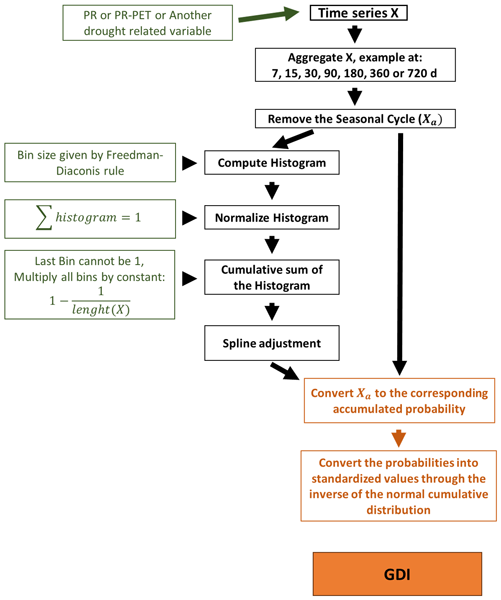
This study proposes a new daily drought index, the generalised drought index (GDI). The GDI not only identifies the same events as established indices but is also capable of improving their results. The index is empirically based and easy to compute, not requiring fitting the data to a probability distribution. The GDI can detect flash droughts and longer-term events, making it a versatile tool for drought monitoring.
Piers M. Forster, Christopher J. Smith, Tristram Walsh, William F. Lamb, Robin Lamboll, Mathias Hauser, Aurélien Ribes, Debbie Rosen, Nathan Gillett, Matthew D. Palmer, Joeri Rogelj, Karina von Schuckmann, Sonia I. Seneviratne, Blair Trewin, Xuebin Zhang, Myles Allen, Robbie Andrew, Arlene Birt, Alex Borger, Tim Boyer, Jiddu A. Broersma, Lijing Cheng, Frank Dentener, Pierre Friedlingstein, José M. Gutiérrez, Johannes Gütschow, Bradley Hall, Masayoshi Ishii, Stuart Jenkins, Xin Lan, June-Yi Lee, Colin Morice, Christopher Kadow, John Kennedy, Rachel Killick, Jan C. Minx, Vaishali Naik, Glen P. Peters, Anna Pirani, Julia Pongratz, Carl-Friedrich Schleussner, Sophie Szopa, Peter Thorne, Robert Rohde, Maisa Rojas Corradi, Dominik Schumacher, Russell Vose, Kirsten Zickfeld, Valérie Masson-Delmotte, and Panmao Zhai
Earth Syst. Sci. Data, 15, 2295–2327, https://doi.org/10.5194/essd-15-2295-2023, https://doi.org/10.5194/essd-15-2295-2023, 2023
Short summary
Short summary
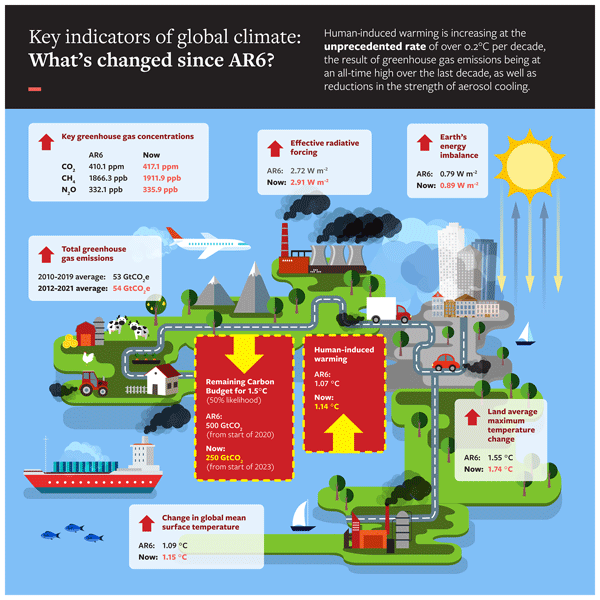
This is a critical decade for climate action, but there is no annual tracking of the level of human-induced warming. We build on the Intergovernmental Panel on Climate Change assessment reports that are authoritative but published infrequently to create a set of key global climate indicators that can be tracked through time. Our hope is that this becomes an important annual publication that policymakers, media, scientists and the public can refer to.

Jorge Baño-Medina, Rodrigo Manzanas, Ezequiel Cimadevilla, Jesús Fernández, Jose González-Abad, Antonio S. Cofiño, and José Manuel Gutiérrez
Geosci. Model Dev., 15, 6747–6758, https://doi.org/10.5194/gmd-15-6747-2022, https://doi.org/10.5194/gmd-15-6747-2022, 2022
Short summary
Short summary
Deep neural networks are used to produce downscaled regional climate change projections over Europe for temperature and precipitation for the first time. The resulting dataset, DeepESD, is analyzed against state-of-the-art downscaling methodologies, reproducing more accurately the observed climate in the historical period and showing plausible future climate change signals with low computational requirements.
Cited articles
Abatzoglou, J. T., Williams, A. P., Boschetti, L., Zubkova, M., and Kolden, C. A.: Global patterns of interannual climate–fire relationships, Global Change Biol., 24, 5164–5175, https://doi.org/10.1111/gcb.14405, 2018. a
Baño-Medina, J., Manzanas, R., Cimadevilla, E., Fernández, J., González-Abad, J., Cofiño, A. S., and Gutiérrez, J. M.: Downscaling multi-model climate projection ensembles with deep learning (DeepESD): contribution to CORDEX EUR-44, Geosci. Model Dev., 15, 6747–6758, https://doi.org/10.5194/gmd-15-6747-2022, 2022. a, b, c, d
Baño-Medina, J., Iturbide, M., Fernández, J., and Gutiérrez, J. M.: Transferability and Explainability of Deep Learning Emulators for Regional Climate Model Projections: Perspectives for Future Applications, Artificial Intelligence for the Earth Systems, 3, https://doi.org/10.1175/AIES-D-23-0099.1, 2024. a
Baño-Medina, J., Sengupta, A., Doyle, J. D., Reynolds, C. A., Watson-Parris, D., and Monache, L. D.: Are AI weather models learning atmospheric physics? A sensitivity analysis of cyclone Xynthia, npj Clim. Atmos. Sci., 8, 1–9, https://doi.org/10.1038/s41612-025-00949-6, 2025. a
Bedia, J., Herrera, S., and Gutiérrez, J. M.: Assessing the predictability of fire occurrence and area burned across phytoclimatic regions in Spain, Nat. Hazards Earth Syst. Sci., 14, 53–66, https://doi.org/10.5194/nhess-14-53-2014, 2014b. a
Bedia, J., Herrera, S., Gutierrez, J., Benali, A., Brands, S., Mota, B., and Moreno, J.: Global patterns in the sensitivity of burned area to fire-weather: implications for climate change, Agr. Forest Meteorol., 214–215, 369–379, https://doi.org/10.1016/j.agrformet.2015.09.002, 2015. a
Bedia, J., Golding, N., Casanueva, A., Iturbide, M., Buontempo, C., and Gutiérrez, J. M.: Seasonal predictions of Fire Weather Index: Paving the way for their operational applicability in Mediterranean Europe, Clim. Services, 9, 101–110, https://doi.org/10.1016/j.cliser.2017.04.001, 2018. a
Bedia, J., Baño-Medina, J., Legasa, M. N., Iturbide, M., Manzanas, R., Herrera, S., Casanueva, A., San-Martín, D., Cofiño, A. S., and Gutiérrez, J. M.: Statistical downscaling with the downscaleR package (v3.1.0): contribution to the VALUE intercomparison experiment, Geosci. Model Dev., 13, 1711–1735, https://doi.org/10.5194/gmd-13-1711-2020, 2020. a
Bento, V. A., Lima, D. C. A., Santos, L. C., Lima, M. M., Russo, A., Nunes, S. A., DaCamara, C. C., Trigo, R. M., and Soares, P. M. M.: The future of extreme meteorological fire danger under climate change scenarios for Iberia, Weather Clim. Extrem., 42, 100623, https://doi.org/10.1016/j.wace.2023.100623, 2023. a, b, c
Bowman, D. M. J. S., Balch, J. K., Artaxo, P., Bond, W. J., Carlson, J. M., Cochrane, M. A., D'Antonio, C. M., DeFries, R. S., Doyle, J. C., Harrison, S. P., Johnston, F. H., Keeley, J. E., Krawchuk, M. A., Kull, C. A., Marston, J. B., Moritz, M. A., Prentice, I. C., Roos, C. I., Scott, A. C., Swetnam, T. W., van der Werf, G. R., and Pyne, S. J.: Fire in the Earth System, Science, 324, 481–484, https://doi.org/10.1126/science.1163886, 2009. a
Bowman, D. M. J. S., Williamson, G. J., Abatzoglou, J. T., Kolden, C. A., Cochrane, M. A., and Smith, A. M. S.: Human exposure and sensitivity to globally extreme wildfire events, Nat. Ecol. Evolut., 1, 0058, https://doi.org/10.1038/s41559-016-0058, 2017. a
Buontempo, C., Burgess, S. N., Dee, D., Pinty, B., Thépaut, J.-N., Rixen, M., Almond, S., Armstrong, D., Brookshaw, A., Alos, A. L., Bell, B., Bergeron, C., Cagnazzo, C., Comyn-Platt, E., Damasio-Da-Costa, E., Guillory, A., Hersbach, H., Horányi, A., Nicolas, J., Obregon, A., Ramos, E. P., Raoult, B., Muñoz-Sabater, J., Simmons, A., Soci, C., Suttie, M., Vamborg, F., Varndell, J., Vermoote, S., Yang, X., and Marcilla, J. G. d.: The Copernicus Climate Change Service: Climate Science in Action, B. Am. Meteorol. Soc., 103, E2669–E2687, https://doi.org/10.1175/BAMS-D-21-0315.1, 2022. a
Bushenkova, A., Soares, P. M. M., Johannsen, F., and Lima, D. C. A.: Towards an improved representation of the urban heat island effect: A multi-scale application of XGBoost for madrid, Urban Clim., 55, 101982, https://doi.org/10.1016/j.uclim.2024.101982, 2024. a
Camia, A. and Amatulli, G.: Weather Factors and Fire Danger in the Mediterranean, in: Earth Observation of Wildland Fires in Mediterranean Ecosystems, edited by: Chuvieco, E., pp. 71–82, Springer, Berlin, Heidelberg, https://doi.org/10.1007/978-3-642-01754-4_6, 2009. a
Cinquini, L., Crichton, D., Mattmann, C., Harney, J., Shipman, G., Wang, F., Ananthakrishnan, R., Miller, N., Denvil, S., Morgan, M., Pobre, Z., Bell, G. M., Doutriaux, C., Drach, R., Williams, D., Kershaw, P., Pascoe, S., Gonzalez, E., Fiore, S., and Schweitzer, R.: The Earth System Grid Federation: An open infrastructure for access to distributed geospatial data, Future Gener. Comp. Sy., 36, 400–417, https://doi.org/10.1016/j.future.2013.07.002, 2014. a
Costa, H., De Rigo, D., Libertà, G., Houston Durrant, T., and San-Miguel-Ayanz, J.: European wildfire danger and vulnerability in a changing climate – Towards integrating risk dimensions – JRC PESETA IV project – Task 9 – forest fires, European Commission and Joint Research Centre, Publications Office of the European Union, https://doi.org/10.2760/46951, 2020. a
DaCamara, C. C., Bento, V. A., Nunes, S. A., Lemos, G., Soares, P. M. M., and Trigo, R. M.: Impacts of fire prevention strategies in a changing climate: an assessment for Portugal, Environ. Res.-Clim., 3, 045002, https://doi.org/10.1088/2752-5295/ad574f, 2024. a
Di Giuseppe, F., Vitolo, C., Krzeminski, B., Barnard, C., Maciel, P., and San-Miguel, J.: Fire Weather Index: the skill provided by the European Centre for Medium-Range Weather Forecasts ensemble prediction system, Nat. Hazards Earth Syst. Sci., 20, 2365–2378, https://doi.org/10.5194/nhess-20-2365-2020, 2020. a
Doury, A., Somot, S., and Gadat, S.: On the suitability of a convolutional neural network based RCM-emulator for fine spatio-temporal precipitation, Clim. Dynam., 62, 8587–8613, https://doi.org/10.1007/s00382-024-07350-8, 2024. a
Dramsch, J. S., Kuglitsch, M. M., Fernández-Torres, M. A., Toreti, A., Albayrak, R. A., Nava, L., Ghaffarian, S., Cheng, X., Ma, J., Samek, W., Venguswamy, R., Koul, A., Muthuregunathan, R., and Hrast Essenfelder, A.: Explainability can foster trust in artificial intelligence in geoscience, Nat. Geosci., 18, 112–114, https://doi.org/10.1038/s41561-025-01639-x, 2025. a
Duffy, K., Vandal, T. J., Wang, W., Nemani, R. R., and Ganguly, A. R.: A Framework for Deep Learning Emulation of Numerical Models With a Case Study in Satellite Remote Sensing, IEEE T. Neural Network. Learn. Syst., 34, 3345–3356, https://doi.org/10.1109/TNNLS.2022.3169958, 2023. a
Dupuy, J.-l., Fargeon, H., Martin-StPaul, N., Pimont, F., Ruffault, J., Guijarro, M., Hernando, C., Madrigal, J., and Fernandes, P.: Climate change impact on future wildfire danger and activity in southern Europe: a review, Ann. For. Sci., 77, 1–24, https://doi.org/10.1007/s13595-020-00933-5, 2020. a
Fugioka, F. M., Gill, A., Viegas, D. X., and Wotton, B.: Fire Danger and Fire Behavior Modeling Systems in Australia, Europe, and North America, in: Developments in Environmental Science, edited by: Bytnerowicz, A., Arbaugh, M., Riebau, A., and Andersen, C., Elsevier B.V., The Netherlands, https://doi.org/10.1016/s1474-8177(08)00021-1, 2009. a
Gincheva, A., Pausas, J. G., Torres-Vázquez, M. A., Bedia, J., Vicente-Serrano, S. M., Abatzoglou, J. T., Sánchez-Espigares, J. A., Chuvieco, E., Jerez, S., Provenzale, A., Trigo, R. M., and Turco, M.: The Interannual Variability of Global Burned Area Is Mostly Explained by Climatic Drivers, Earth's Fut., 12, e2023EF004334, https://doi.org/10.1029/2023EF004334, 2024. a
Glorot, X. and Bengio, Y.: Understanding the difficulty of training deep feedforward neural networks, in: Proceedings of the Thirteenth International Conference on Artificial Intelligence and Statistics, JMLR Workshop and Conference Proceedings, iSSN: 1938-7228, 249–256, https://proceedings.mlr.press/v9/glorot10a.html (last access: 17 July 2026), 2010. a
González-Abad, J. and Gutiérrez, J. M.: Are Deep Learning Methods Suitable for Downscaling Global Climate Projections? Review and Intercomparison of Existing Models, arXiv:2411.05850 [physics], https://doi.org/10.48550/arXiv.2411.05850, 2024. a
González-Abad, J., Baño-Medina, J., and Gutiérrez, J. M.: Using Explainability to Inform Statistical Downscaling Based on Deep Learning Beyond Standard Validation Approaches, J. Adv. Model. Earth Syst., 15, e2023MS003641, https://doi.org/10.1029/2023MS003641, 2023. a, b, c
Herrera, S., Bedia, J., Gutierrez, J. M., Fernandez, J., and Moreno, J. M.: On the projection of future fire danger conditions with various instantaneous/mean-daily data sources, Clim. Change, 118, 827–840, https://doi.org/10.1007/s10584-012-0667-2, 2013. a, b
Hersbach, H., Bell, B., Berrisford, P., Hirahara, S., Horányi, A., Muñoz‐Sabater, J., Nicolas, J., Peubey, C., Radu, R., Schepers, D., Simmons, A., Soci, C., Abdalla, S., Abellan, X., Balsamo, G., Bechtold, P., Biavati, G., Bidlot, J., Bonavita, M., Chiara, G., Dahlgren, P., Dee, D., Diamantakis, M., Dragani, R., Flemming, J., Forbes, R., Fuentes, M., Geer, A., Haimberger, L., Healy, S., Hogan, R. J., Hólm, E., Janisková, M., Keeley, S., Laloyaux, P., Lopez, P., Lupu, C., Radnoti, G., Rosnay, P., Rozum, I., Vamborg, F., Villaume, S., and Thépaut, J.: The ERA5 global reanalysis, Q. J. Roy. Meteorol. Soc., 146, 1999–2049, https://doi.org/10.1002/qj.3803, 2020. a
Hogan, R. J. and Mason, I. B.: Deterministic Forecasts of Binary Events, chap. 3, pp. 31–59, John Wiley & Sons, Ltd, ISBN 9781119960003, https://doi.org/10.1002/9781119960003.ch3, 2011. a
Iturbide, M., Bedia, J., Herrera, S., Baño-Medina, J., Fernández, J., Frías, M., Manzanas, R., San-Martín, D., Cimadevilla, E., Cofiño, A., and Gutiérrez, J.: The R-based climate4R open framework for reproducible climate data access and post-processing, Environ. Modell. Softw., 111, 42–54, https://doi.org/10.1016/j.envsoft.2018.09.009, 2019. a
Jain, P., Castellanos-Acuna, D., Coogan, S. C. P., Abatzoglou, J. T., and Flannigan, M. D.: Observed increases in extreme fire weather driven by atmospheric humidity and temperature, Nat. Clim. Change, 12, 63–70, https://doi.org/10.1038/s41558-021-01224-1, 2022. a
Johannsen, F., Soares, P. M. M., and Langendijk, G. S.: On the deep learning approach for improving the representation of urban climate: The Paris urban heat island and temperature extremes, Urban Clim., 56, 102039, https://doi.org/10.1016/j.uclim.2024.102039, 2024. a
Jolly, W. M., Cochrane, M. A., Freeborn, P. H., Holden, Z. A., Brown, T. J., Williamson, G. J., and Bowman, D. M. J. S.: Climate-induced variations in global wildfire danger from 1979 to 2013, Nat. Commun., 6, 7537, https://doi.org/10.1038/ncomms8537, 2015. a
Kondylatos, S., Prapas, I., Ronco, M., Papoutsis, I., Camps-Valls, G., Piles, M., Fernández-Torres, M.-A., and Carvalhais, N.: Wildfire Danger Prediction and Understanding With Deep Learning, Geophys. Res. Lett., 49, e2022GL099368, https://doi.org/10.1029/2022GL099368 2022. a
Li, S., Wan, H., Yu, Q., and Wang, X.: Downscaling of ERA5 reanalysis land surface temperature based on attention mechanism and Google Earth Engine, Sci. Rep., 15, 675, https://doi.org/10.1038/s41598-024-83944-w, 2025. a
Mamalakis, A., Barnes, E. A., and Hurrell, J. W.: Using Explainable Artificial Intelligence to Quantify “Climate Distinguishability” After Stratospheric Aerosol Injection, Geophys. Res. Lett., 50, e2023GL106137, https://doi.org/10.1029/2023GL106137, 2023. a
Matteo, A., Garnés-Morales, G., Moreno, A., Andreia, R., Azorín-Molina, C., Bedia, J., Giuseppe, F. D., Dunn, R. J. H., Herrera, S., Provenzale, A., Quilcaille, Y., Vázquez, M. A. T., and Turco, M.: Challenges in assessing Fire Weather changes in a warming climate, arXiv:2503.01818 [physics], https://doi.org/10.48550/arXiv.2503.01818, 2025. a, b, c
McGovern, A., Lagerquist, R., Gagne, D. J., Jergensen, G. E., Elmore, K. L., Homeyer, C. R., and Smith, T.: Making the Black Box More Transparent: Understanding the Physical Implications of Machine Learning, B. Am. Meteorol. Soc., 100, 2175–2199, https://doi.org/10.1175/BAMS-D-18-0195.1, 2019. a
Mirones, O., Baño-Medina, J., Brands, S., and Bedia, J.: Toward Spatio-Temporally Consistent Multi-Site Fire Danger Downscaling With Explainable Deep Learning, J. Geophys. Res.-Machine Learn. Comput., 2, e2024JH000331, https://doi.org/10.1029/2024JH000331, 2025. a, b, c, d
Mirones, Ó., Bedia Jiménez, J., and Baño-Medina, J.: Toy Dataset for Emulating the Fire Weather Index (FWI) Using Deep Learning Techniques, Zenodo [data set], https://doi.org/10.5281/zenodo.15075367, 2025. a
Muñoz-Sabater, J., Dutra, E., Agustí-Panareda, A., Albergel, C., Arduini, G., Balsamo, G., Boussetta, S., Choulga, M., Harrigan, S., Hersbach, H., Martens, B., Miralles, D. G., Piles, M., Rodríguez-Fernández, N. J., Zsoter, E., Buontempo, C., and Thépaut, J.-N.: ERA5-Land: a state-of-the-art global reanalysis dataset for land applications, Earth Syst. Sci. Data, 13, 4349–4383, https://doi.org/10.5194/essd-13-4349-2021, 2021. a
Pausas, J. G. and Keeley, J. E.: Wildfires and global change, Front. Ecol. Environ., 19, 387–395, https://doi.org/10.1002/fee.2359, 2021. a
Prince, S. J.: Understanding Deep Learning, The MIT Press, http://udlbook.com (last access: March 2025), 2023. a
Rampal, N., Hobeichi, S., Gibson, P. B., Abramowitz, G., Beucler, T., Gonz, J., Chapman, W., Harder, P., and Guti, M.: Enhancing Regional Climate Downscaling through Advances in Machine Learning, IEEE T. Neural Netw. Learn. Syst., 3, https://doi.org/10.1175/AIES-D-23-0066.1, 2024. a
San-Miguel-Ayanz, J., Schulte, E., Schmuck, G., and Camia, A.: The European Forest Fire Information System in the context of environmental policies of the European Union, For. Pol. Econom., 29, 19–25, https://doi.org/10.1016/j.forpol.2011.08.012, 2013. a
SantanderMetGroup: DeepFWI, GitHub [data set], https://github.com/SantanderMetGroup/DeepFWI, 2025. a
Santos, L. C., Lima, M. M., Bento, V. A., Nunes, S. A., DaCamara, C. C., Russo, A., Soares, P. M. M., and Trigo, R. M.: An Evaluation of the Atmospheric Instability Effect on Wildfire Danger Using ERA5 over the Iberian Peninsula, Fire, 6, 120, https://doi.org/10.3390/fire6030120, 2023. a, b
Soares, P. M. M., Johannsen, F., Lima, D. C. A., Lemos, G., Bento, V. A., and Bushenkova, A.: High-resolution downscaling of CMIP6 Earth system and global climate models using deep learning for Iberia, Geosci. Model Dev., 17, 229–259, https://doi.org/10.5194/gmd-17-229-2024, 2024. a
Stocks, B. J., Lawson, B. D., Alexander, M. E., Wagner, C. E. V., McAlpine, R. S., Lynham, T. J., and Dubé, D. E.: The Canadian Forest Fire Danger Rating System: An Overview, The Forestry Chronicle, 65, 450–457, https://doi.org/10.5558/tfc65450-6, 1989. a, b
Toms, B. A., Kashinath, K., Prabhat, and Yang, D.: Testing the reliability of interpretable neural networks in geoscience using the Madden–Julian oscillation, Geosci. Model Dev., 14, 4495–4508, https://doi.org/10.5194/gmd-14-4495-2021, 2021. a, b
Wotton, B. M.: Interpreting and using outputs from the Canadian Forest Fire Danger Rating System in research applications, Environ. Ecol. Stat., 16, 107–131, https://doi.org/10.1007/s10651-007-0084-2, 2009. a
Yang, R., Hu, J., Li, Z., Mu, J., Yu, T., Xia, J., Li, X., Dasgupta, A., and Xiong, H.: Interpretable machine learning for weather and climate prediction: A review, Atmos. Environ., 338, 120797, https://doi.org/10.1016/j.atmosenv.2024.120797, 2024. a
Yu, G., Feng, Y., Wang, J., and Wright, D. B.: Performance of Fire Danger Indices and Their Utility in Predicting Future Wildfire Danger Over the Conterminous United States, Earth's Fut., 11, e2023EF003823, https://doi.org/10.1029/2023EF003823, 2023. a
Short summary
Wildfire danger is usually measured with a formula needing weather data from a specific time of day, often missing in climate simulations. Scientists have relied on a rough substitute that can be inaccurate. We trained artificial intelligence models on Iberian Peninsula weather records to recreate the proper measure using only common daily data. This proved far more accurate than the usual substitute, even without rainfall data, easing wildfire risk assessment for climate research and planning.
Wildfire danger is usually measured with a formula needing weather data from a specific time of...


Altmetrics
Final-revised paper
Preprint