
the Creative Commons Attribution 4.0 License.
the Creative Commons Attribution 4.0 License.
 | 23 Jun 2026
Brief communication: “Multi-hazard-to-health-outcome” (MH2O) pathways: the known, the unknown, and ten most urgent priorities
Qiuhua Liang
Lee Bosher
John Atanbori
Mark Gussy
Amogh Mudbhatkal
Joe Swift
Jaspreet Phull
Kirsten Guy
Lynsey Collinson
Andy Penny
Maria Athanassiadou
Kaja Milczewska
Ebenezer Amankwaa
Lucy Kennedy
Edward Hanna
Gregory Sutton
Bartholomew Hill
Colin Hopkirk
Climate-driven hazards like heat and flooding have complex impacts on human health. Most research considers the impact of individual hazards (e.g., heatwaves) on discrete health outcomes (e.g., heatstroke). However, climate-driven hazards often precipitate additional hazards with cumulative health impacts, such as the compound effect of drought and heatwaves on the physical and mental health of farming communities. Little is known about “multi-hazard-to-health-outcome” (MH2O) pathways. We engaged multi-sectorial and international stakeholders through the newly established MH2O Working Group and report our co-developed ten most urgent priorities for guiding research, policy and practice towards preparing our global One Community for future uncertainty.
- Article
(347 KB) - Full-text XML
- BibTeX
- EndNote


Natural hazards including unusually high and low temperatures, flooding and extreme storms, impact human health across multiple temporal and geospatial scales, and via direct and indirect mechanistic pathways (Romanello et al., 2024). Direct pathways include heatwaves causing heatstroke, while indirect pathways often involve impacts on capital and economic productivity, such as high rates of male suicide in agricultural areas exposed to prolonged drought and economic decline (Austin and Kiem, 2025). The impact of natural hazards, including climate-driven hazards, on human health has been of interest to the research community and policy makers for more than 50 years, with substantial leaps forward following globally significant environmental crises (Nohrstedt and Parker, 2024), including floods (Nohrstedt and Parker, 2024), droughts (Gbegbelegbe et al., 2024), and wildfires (Bryant et al., 2014). Traditionally, the study of natural hazards has been aligned with, or “siloed” within (AghaKouchak et al., 2020)) specialist research fields; geoscientists examine landslide impacts while environmental scientists consider flooding and drought. However, climate change predictions indicate that altered meteorological conditions will precipitate increasingly extreme weather events involving complex, inter-related and co-occurring “multi-hazards” (Boult et al., 2022; Ridder et al., 2020) with consequences for human health. Thus, understanding transitions between single and multiple hazards, the multi-risks resulting from compound and consecutive or cascading multi-hazards (Claassen et al., 2023), and specifically “multi-hazard-to-health-outcomes” (MH2O) is central to climate adaptation.
The importance of quantifying multi-hazard impacts, as opposed to singular hazard-impact pathways, is not a novel observation. More than 30 years ago, Lewis (1984) considered the cumulative impact of natural multi-hazards on societies and evaluated the effectiveness of colonial era administration for responding to earthquakes, droughts, and hurricanes impacting the island country of Antigua. Lewis (1984) observed that, “To isolate for study each of these as they occur, would be to over-simplify the inter-relationships between the after-effects of one and the occurrence and the effects of the next.” (Lewis, 1984, p. 190). Arguably, this reflection is even more relevant today than >30 years ago, particularly in the context of human induced climate change and co-occurring climate-driven hazards. Rural and urban areas of countries including Australia (Chapman et al., 2025) are routinely exposed to high temperatures, drought conditions, and extreme flooding in rapid succession, precipitated by inter-related meteorological conditions (Guerreiro et al., 2018). Coastal and rural communities in the UK regularly experience ground, surface, and coastal flooding resulting from tidal surges, pluvial, and fluvial processes simultaneously (Hendry et al., 2019). The complexity of these inter-relationships will intensify as a result of climate change.
Despite the early origins of multi-hazard research, most innovations in the field have occurred relatively recently.
A preliminary scoping search on Web of Science identified more than 120 000 studies about environmental or natural hazards published from 1970 onward. Of these, 4096 referred to “multi-hazards”, or “cascading hazards” with the majority (85 %) published in the last decade. Studies published in the 1990s mostly consider engineering challenges associated with the compound effect of natural hazards like earthquakes and storms on infrastructure (e.g., Chiu and Chock, 1998). More recent publications tend to focus on vulnerability and impact mapping (e.g., Yiran et al., 2017), and adaptation (Mulyani et al., 2015).
Only 674 studies were identified related to “multi-hazards', or “cascading hazards” and “health”, with the earliest specific mention of “multi-hazards and health” (Spencer et al., 2005) examining the impacts of volcanic eruptions, and notably appearing in this journal. More than 80 % of studies on multi-hazards and health were published between 2016 and 2025; 15 % of the studies addressed challenges associated with climate change, and most considered impacts on physical health with a focus on contagious disease, while only eight of the studies explored “multi-hazard-to-health pathways” for psychiatric and psychological health. Given the paucity of research investigating “multi-hazards-to-health-outcomes” (MH2Os), this emerging frontier represents a significant gap in our global knowledge about the likely consequences of climate change on societies.
In February 2025, we launched the Multi-Hazard-to-Health-Outcomes (MH2O) Working Group, an international, multi-sectorial, and interdisciplinary community of academic researchers, policy-makers, community advocates, health service providers, funding organisations, environmental agencies, lived experience experts, and clinical practitioners. A summary of the event, including attendees and presentations is documented on our website (https://me-net.blogs.lincoln.ac.uk/our-events/, last access: 4 June 2026). Following our inaugural meeting, we synthesized the most urgent priorities co-developed by our MH2O community. Here, we report our ten recommendations for rapidly progressing evidence generation in the field of multi-hazard-to-health-outcomes.
The MH2O Working Group aims to synthesise existing evidence and generate new evidence about the impact that multi-hazards have on health outcomes. Our first mission is to bring together the MH2O community to identify what is known, what is not known, and to address most urgent priorities for immediate action towards supporting most vulnerable groups and regions to prepare for increasingly extreme climatic conditions through rapidly advancing research, policy, and practice.
The initial interest, and indeed request for a collaborative space to better understand the impacts of multi-hazards on health outcomes was identified during the delivery of stakeholder engagement through a multi-region (UK, Ghana) research project about the role of methane in severe respiratory and mental health outcomes (Wellcome Trust 228267/Z/23/Z). Core members (HM, JA, EA, EH, MG) of the Methane Early-Warning Network (ME-NET) research team facilitated Innovation Labs with interdisciplinary and international stakeholder groups, including representatives of climate and health institutes, communities, and government agencies. The ME-NET research aims and methods are reported elsewhere (Moore et al., 2024).
The opportunity to form the MH2O Working Group arose through consultation with climate and health stakeholders about the complex inter-relationships between meteorological conditions (e.g., temperature, wind speed, wind direction), atmospheric pollutants (e.g., greenhouse gases), secondary pollutants (e.g., ground-level ozone), and the escalation of underlying health conditions (e.g., asthma, depression) to acute situations requiring emergency medical attention. In the UK, there are good examples of collaboration between government bodies to produce and delivery public health alerts relating to heatwaves and air pollution, such as those issued jointly by the Met Office and the UK Health Security Agency (UKHSA), which are further disseminated through local authorities to the public. For example, the annual Adverse Weather and Health Plan (AWHP) is a product of cross-government collaboration to deliver evidence-based guidance and weather and health alerts. However, there is much more that could be done to further increase collaborative working on multiple hazards both within and between sectors including executive government agencies, academia, and policy. The “siloing”of policy-making about individual hazards has been recognized elsewhere (e.g., Leiren and Jacobsen, 2018) and is not surprising; planning for compound and co-occurring hazards is an emerging frontier compared to traditional disaster risk management (Ishiwatari and Hirai, 2024).
The overwhelming support for breaking down traditional “silos” in the UK is evidenced in the breadth of attendees for the inaugural Working Group meeting, details of which are recorded elsewhere. Here, we are concerned with the co-created outcomes of the meeting; ten urgent priorities for research, policy and practice, and most importantly, the co-production of an international community with shared vision and purpose towards understanding MH2O pathways.
Paradigms of participation (Chambers, 1994), engagement, inclusion, and co-production (Jasanoff, 2004; Norström et al., 2020) have emerged in response to the increasing complexity of phenomena defining human history, including the impact of natural hazards on the health and wellbeing of societies, decolonial (Lenette, 2022) and social-ecological justice narratives (Forsyth, 2008). While these approaches have shaped research methodology (e.g., stakeholder engagement), the paradigm of co-production also recognizes that creating new knowledge in response to challenges at the nexus of environmental and social processes, involves establishing new institutions with global credibility, scientific legitimacy (Miller, 2004), and representation beyond academia, including diverse communities of practice. Seen in this light, forming the MH2O Working Group, arranging and conducting our inaugural meeting, was an exercise in co-creating an interdisciplinary global community with representation from agencies and institutes in 11 countries across the UK, Europe, Asia and Africa as much as it was a process of co-producing a mission, purpose and most urgent priorities.
The inaugural meeting involved an introduction to the state of knowledge about MH2Os, invited presentations, and co-creative problem-solving activities. In the months preceding the event, the Working Group coordinator (redacted) facilitated virtual collaborative engagements with invited presenters and panellists to co-produce the event agenda and the wider narrative connecting the perspectives, lived experiences, and most urgent challenges at the frontier of preparing for, and responding to MH2Os. Presenters included not-for-profit advocacy groups (e.g., developmentPlus), NHS Trusts (e.g., the Lincolnshire Integrated Care Board NHS Trust), national agencies (e.g., Environment Agency, UKHSA, Met Office), international higher education institutes (e.g., University of Ghana) and representatives of the European private remote sensing sector (e.g., EARSC, SPOTTITT). Presentations involved sharing expert knowledge and experiences about MH2O pathways, with an agreed aim to highlight impacts on most vulnerable communities, those groups, regions and areas with the greatest multi-hazard exposures and least capacity to engage with health protection options, including poor social and physical service access and low socio-economic mobility, resulting in constrained agency. Presenters were asked to consult their wider agencies and communities about most urgent priorities for dissemination during their presentations. Following the event, the core MH2O research team (redacted) synthesised the shared mission, purpose and most urgent priorities presented and discussed during the in-person event, and captured through virtual tools (e.g., polls) for on-line attendees. Of 86 attendees, 33 responded to a follow-up survey inviting Working Group members to vote on the ten most urgent priorities for MH2O research, policy and practice. Thus, co-production informed the purpose and scope for the MH2O Working Group, as well as the future focus of our global community towards climate and health adaptation.
The MH2O Working Group aims to synthesise existing evidence and generate new evidence about the impact that multi-hazards have on health outcomes. Our first mission is to bring together the MH2O community to identify what is known, what is not known, and to address most urgent priorities for immediate action towards supporting most vulnerable groups and regions to prepare for increasingly extreme climatic conditions through rapidly advancing research, policy, and practice. Based on the feedback of Working Group members, our most urgent priorities are presented in Table 1 in order of importance.
Table 1Top ten most urgent priorities (P) for MH2O research, policy and practice.
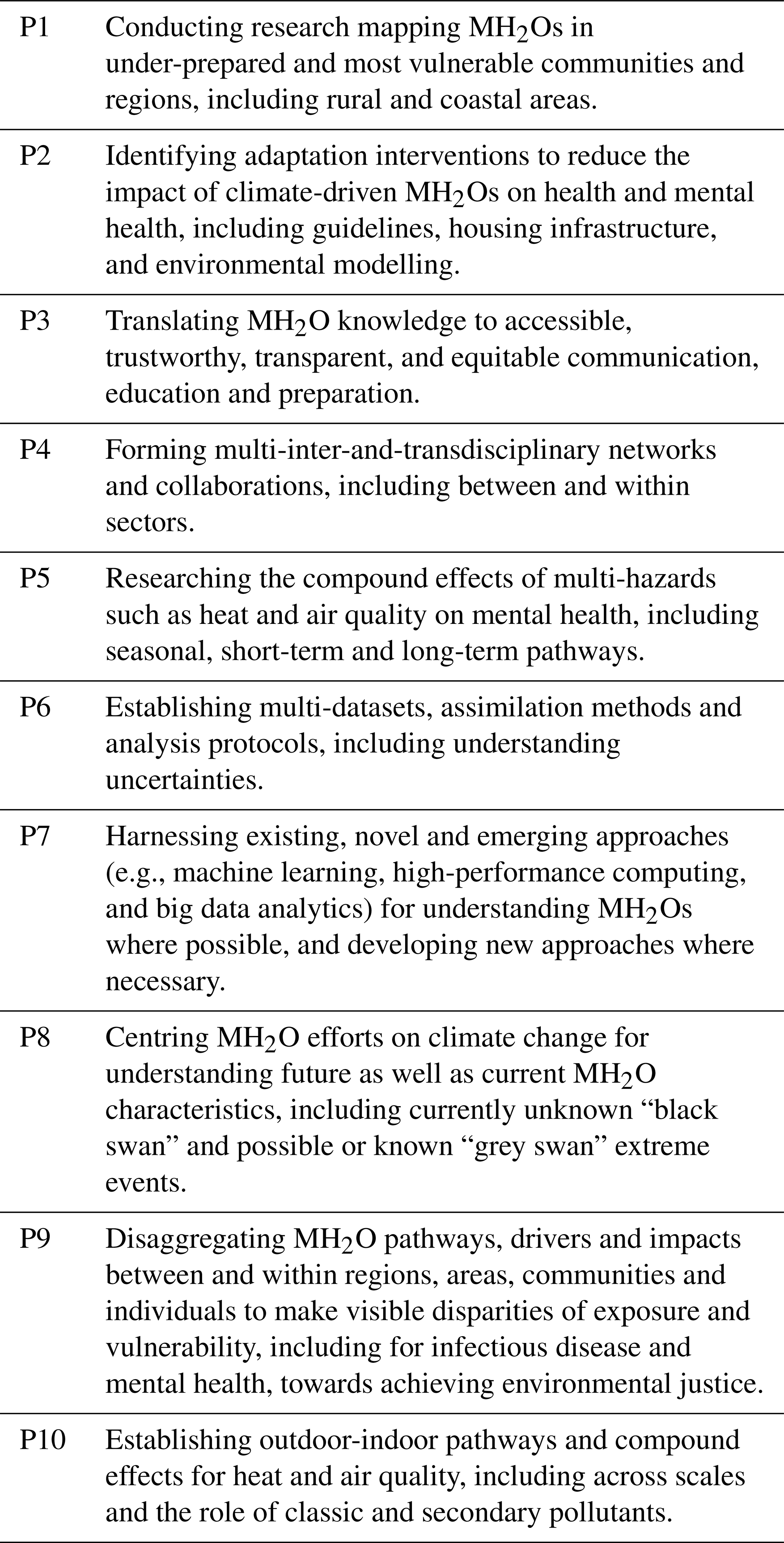
These focal points represent research frontiers, some of which relate to methodological processes (e.g., P6, P7) like the appropriate and responsible use of machine learning (Ferrario et al., 2025), and others reflecting substantial research gaps about specific MH2O pathways (e.g., P5, P10) and most vulnerable groups, regions, and geographic areas (e.g., P1, P9). In our view, developing climate and health multi-datasets and analytical protocols (P6) underlies most other MH2O priority research areas. To date, progress in this area has been constrained by data scarcity of important variables (e.g., Kolstad and Johansson, 2010), and challenges with synthesising complex data across varying geospatial and temporal scales (Massazza et al., 2022). Overcoming multi-data complexities will require multi-inter-and-transdisciplinary collaboration (P4) (Kappes et al., 2012) to ensure the meaningful integration of climate and health datasets and vulnerability metrics (Gallina et al., 2016).
All priorities are symbiotic with international agreements (e.g., Paris Agreement), frameworks (e.g., the Sendai Framework), and goals, including goals and targets supported by the 2030 Agenda for Sustainable Development (United Nations, 2015) about reducing deaths and illnesses from hazards such as air pollution (3.9), reducing communicable (3.3) and non-communicable disease and improving mental health and wellbeing (3.4), and strengthening capacity for early warning and risk reduction related to national and global health (3.d). The coordinated generation of novel evidence, multi-datasets, and methodologies is central to achieving these targets and supporting global efforts towards climate resilience and disaster risk reduction.
Over the past three decades, research about natural hazards and societies has evolved from a focus on singular hazard-society pathways, to the cumulative effect of inter-related, co-occurring, and cascading hazards on infrastructure in built environments, and most recently the impact of multi-hazards on health outcomes. Currently, little is understood about the cumulative, compounding and cascading impacts of multi-hazards on physical and mental health, and even less about impacts on most vulnerable groups, regions and individuals. It is likely that MH2O pathways will vary over shorter and longer timeframes, across heterogeneous urban, rural and coastal landscapes, and between as well as within diverse communities with critical environment and health knowledges. Beyond traditional scientific evidence generation, MH2O pathway development must engage lived experience, including local and indigenous understandings of place-and-space-based resilience, positioning community and decolonial forms of knowledge production alongside formal institutional systems. Unpacking these geospatial and temporal nuances will require sophisticated methods and frameworks, and novel collaborations between physical scientists with different specialisations (e.g., meteorology, hydrology and geomorphology), physical and social scientists across broad ranging specialisations, and between researchers, policy-makers, and the diverse communities we strive to support . Importantly, the voices and lived experiences of those most vulnerable to multi-hazard exposures, and least able to embrace adaptation measures should be positioned centrally to the co-production process, from defining problems to delivering and evaluating solutions. It is probable that current siloing obscures the true vulnerability of regions and people exposed to complex co-occurring hazards. Lived experience may shed light on vulnerability “blindspots”, enabling more effective disaster risk reduction.
Writing of the multiple natural hazards impacting Antigua, Lewis' (1984) concludes, “It is a simple matter to abstract these observations but it is the inter-relationships of issues which is of predominant importance – and which a separation of studies would obscure.” (p.196). We echo this contention and advocate for the urgent prioritisation of multi-sectorial, interdisciplinary, and international collaborations to rapidly advance the field of “multi-hazard-to-health-outcomes” towards preparing our global community for an uncertain future.
No code was involved in the production of this manuscript. Data includes social survey responses of the MH2O Working Group about top ten priorities. Summary data is included in the manuscript. No additional data was involved in the preparation of this manuscript.
HM contributed to conceptualisation, data curation, formal analysis, funding acquisition, methodology, project management, writing, drafting, review and editing. QL, LB, MA,KM,EH,JP,LC,CHandKGcontributedtoconceptualisation, drafting, reviewing and editing. JA, MG, AM, JS, GS and BH contributed to conceptualisation and project management.
The contact author has declared that none of the authors has any competing interests.
Publisher's note: Copernicus Publications remains neutral with regard to jurisdictional claims made in the text, published maps, institutional affiliations, or any other geographical representation in this paper. The authors bear the ultimate responsibility for providing appropriate place names. Views expressed in the text are those of the authors and do not necessarily reflect the views of the publisher.
This article is part of the special issue “The convergence of disasters, diseases, and health impacts (NHESS/ESD/GC inter-journal SI)”. It is not associated with a conference.
The research was supported by the Lincoln Institute for Rural and Coastal Health ( Research England E3 funded institute) who hosted the Inaugural Multi-Hazards-to-Health-Outcomes (MH2O) Working Group meeting. Preliminary steps towards forming the Working Group, and follow-up investigations after the inaugural meeting were conducted in conjunction with the delivery of the Methane Early Warning Network (ME-NET) project. Contributors to the vision described in this manuscript comprise the members of the Working Group who at tended the inaugural meeting, including representatives from the University of Lincoln, East Midlands Ambulance Service NHS Trust (EMAS), Every-One (Lincolnshire), Kenyatta University (Kenya), Science and Education Development Institute (Nigeria), and Dennis Osadebay University (Nigeria). Co-creation of the ten most urgent MH2O priorities reported here was undertaken by Working Group members who completed the follow-up survey. The views expressed are those of the author(s) and not necessarily those of the UK Health Security Agency or the Department of Health and Social Care.
This research has been supported by the Wellcome Trust (grant no. 228267/Z/23/Z).
This paper was edited by Christos Giannaros and reviewed by Marleen de Ruiter and Molly Gilmour.
AghaKouchak, A., Chiang, F., Huning, L. S., Love, C. A., Mallakpour, I., Mazdiyasni, O., Moftakhari, H., Papalexiou, S. M., Ragno, E., and Sadegh, M.: Climate extremes and compound hazards in a warming world, Ann. Rev. Earth Planet. Sci., 48, 519–548, 2020.
Austin, E. K. and Kiem, A. S.: A review of the relationship between mental health, wellbeing and drought resilience in rural, regional and remote communities, Psychiatry J., 16, p. 1528573, https://doi.org/10.3389/fpsyt.2025.1528573, 2025.
Boult, V. L., Black, E., Abdillahi, H. S., Bailey, M., Harris, C., Kilavi, M., Kniveton, D., MacLeod, D., Mwangi, E., Otieno, G., and Rees, E.: Towards drought impact-based forecasting in a multi-hazard context, Clim. Risk Manage., 35, 100402, https://doi.org/10.1016/j.crm.2022.100402, 2022.
Bryant, R. A., Waters, E., Gibbs, L., Gallagher, H. C., Pattison, P., Lusher, D., MacDougall, C., Harms, L., Block, K., Snowdon, E., and Sinnott, V.: Psychological outcomes following the Victorian Black Saturday bushfires, Aust. NZ J. Psychiatry, 48, 634–643, https://doi.org/10.1177/0004867414534476, 2014.
Chambers, R.: Paradigm shifts and the Practice of Participatory Research and Development. Institute of Development Studies Working Paper 2, https://hdl.handle.net/20.500.12413/3712 (last access: 21 June 2026), 1994.
Chapman, S., Trancoso, R., Syktus, J., Eccles, R., and Toombs, N.: Impacts on compound drought heatwave events in Australia per global warming level, Environ. Res. Lett., 20, 054070, https://doi.org/10.1088/1748-9326/adc8bd, 2025.
Chiu, G. L. and Chock, G. Y.: Multihazard performance based objective design for managing natural hazards damage, IFAC Proc. Vol, 31, 159–164, https://doi.org/10.1016/S1474-6670(17)38490-2, 1998.
Claassen, J. N., Ward, P. J., Daniell, J., Koks, E. E., Tiggeloven, T., and de Ruiter, M. C.: A new method to compile global multi-hazard event sets, Sci. Rep., 13, p.13808, https://doi.org/10.1038/s41598-023-40400-5, 2023.
Ferrario, D. M., Sanò, M., Maraschini, M., Critto, A., and Torresan, S.: Review article: Harnessing Machine Learning methods for climate multi-hazard and multi-risk assessment, EGUsphere [preprint], https://doi.org/10.5194/egusphere-2025-670, 2025.
Forsyth, T.: Political ecology and the epistemology of social justice, Geoforum, 39, 756–764, 2008.
Gallina, V., Torresan, S., Critto, A., Sperotto, A., Glade, T., and Marcomini, A.: A review of multi-risk methodologies for natural hazards: Consequences and challenges for a climate change impact assessment, J. Environ. Man., 168, 123–132, https://doi.org/10.1016/j.jenvman.2015.11.011, 2016.
Gbegbelegbe, S., Chikoye, D., Alene, A., Kyei-Boahen, S., and Chigeza, G.: Strategic Foresight analysis of droughts in southern Africa and implications for food security, Front. Sustain. Food Syst., 7, 1159901, https://doi.org/10.3389/fsufs.2023.1159901, 2024.
Guerreiro, S. B., Dawson, R. J., Kilsby, C., Lewis, E., and Ford, A.: Future heat-waves, droughts and floods in 571 European cities, Environ. Res. Lett., 13, 034009, https://doi.org/10.1088/1748-9326/aaaad3, 2018.
Hendry, A., Haigh, I. D., Nicholls, R. J., Winter, H., Neal, R., Wahl, T., Joly-Laugel, A., and Darby, S. E.: Assessing the characteristics and drivers of compound flooding events around the UK coast, Hydrol. Earth Syst. Sci., 23, 3117–3139, https://doi.org/10.5194/hess-23-3117-2019, 2019.
Ishiwatari, M. and Hirai, H.: Challenges in Promoting All-Hazard Approach in Japan: Institutional Arrangements for Managing Cascading Effects, in: All-Hazards Approach: Towards Resilience Building, edited by: Izumi, T., pp. 191–205, Springer Nature Singapore, Singapore, https://doi.org/10.1007/978-981-97-1860-3_13, 2024.
Jasanoff, S.: The idiom of co-production, in: States of Knowledge, edited by: Jasanoff, S., pp. 1–12, Routledge, London, https://doi.org/10.4324/9780203413845, 2004.
Kappes, M. S., Keiler, M., von Elverfeldt, K., and Glade, T.: Challenges of analyzing multi-hazard risk: a review, Nat. Hazards, 64, 1925–1958, 2012.
Kolstad, E. W. and Johansson, K. A.: Uncertainties associated with quantifying climate change impacts on human health: a case study for diarrhea, Environ. Health Perspect., 119, p. 299, 2010.
Leiren, M. D. and Jacobsen, J. K. S.: Silos as barriers to public sector climate adaptation and preparedness: insights from road closures in Norway, Local Gov. Stud., 44, 492–511, https://doi.org/10.1080/03003930.2018.1465933, 2018.
Lenette, C.: Participatory action research: Ethics and decolonization. Oxford University Press, https://doi.org/10.1093/oso/9780197512456.001.0001, 2022.
Lewis, J.: A multi‐hazard history of Antigua, Disasters, 8, 190–197, 1984.
Massazza, A., Teyton, A., Charlson, F., Benmarhnia, T., and Augustinavicius, J. L.: Quantitative methods for climate change and mental health research: Current trends and future directions, Lancet Planet. Health, 6, e613–e627, https://doi.org/10.1016/S2542-5196(22)00120-6, 2022.
Miller, C. A.: Climate science and the making of a global political order, in: States of Knowledge, edited by: Jasanoff, S., pp. 46–66, Routledge, London, https://doi.org/10.4324/9780203413845, 2004.
Moore, H. E., Atanbori, J., Amankwaa, E. F., Gussy, M., Siriwardena, A. N., and Hanna, E.: Interdisciplinary methods for researching climate-mental health links through the Methane Early Warning Network (ME-NET): improving “visibility” and integrating complex multi-datasets, Research Directions: Depression, 1, p. e24, https://doi.org/10.1017/dep.2024.4, 2024.
Mulyani, R., Ahmadi, R., Pilakoutas, K., and Hajirasouliha, I.: A multi-hazard risk assessment of buildings in Padang city, Procedia Eng., 125, 1094–1100, https://doi.org/10.1016/j.proeng.2015.11.093, 2015.
Nohrstedt, D. and Parker, C. F.: Revisiting the role of disasters in climate policy-making, Clim. Policy, 24, 428–439, https://doi.org/10.1080/14693062.2024.2301781, 2024.
Norström, A. V., Cvitanovic, C., Löf, M. F., West, S., Wyborn, C., Balvanera, P., Bednarek, A. T., Bennett, E. M., Biggs, R., de Bremond, A., and Campbell, B. M.: Principles for knowledge co-production in sustainability research, Nat. Sustain., 3, 182–190, https://doi.org/10.1038/s41893-019-0448-2, 2020.
Ridder, N. N., Pitman, A. J., Westra, S., Ukkola, A., Do, H. X., Bador, M., Hirsch, A. L., Evans, J. P., Di Luca, A., and Zscheischler, J.: Global hotspots for the occurrence of compound events, Nat. Commun., 11, p. 5956, https://doi.org/10.1038/s41467-020-19639-3, 2020.
Romanello, M., Walawender, M., Hsu, S. C., Moskeland, A., Palmeiro-Silva, Y., Scamman, D., Ali, Z., Ameli, N., Angelova, D., Ayeb-Karlsson, S., and Basart, S.: The 2024 report of the Lancet Countdown on health and climate change: facing record-breaking threats from delayed action, Lancet, 404, 1847–1896, https://doi.org/10.1016/S0140-6736(24)01822-1, 2024.
Spence, R. J. S., Kelman, I., Baxter, P. J., Zuccaro, G., and Petrazzuoli, S.: Residential building and occupant vulnerability to tephra fall, Nat. Hazards Earth Syst. Sci., 5, 477–494, https://doi.org/10.5194/nhess-5-477-2005, 2005.
United Nations: Transforming our world: the 2030 agenda for sustainable development, A/RES/70/1, p. 35, https://documents-dds-ny.un.org/doc/UNDOC/GEN/N15/291/89/PDF/N1529189.pdf?OpenElement (last access: 5 April 2026), 2015.
Yiran, G. A., Stringer, L. C., Attua, E. M., Evans, A. J., Challinor, A. J., and Gyasi, E. A.: Mapping vulnerability to multiple hazards in the savannah Ecosystem in Ghana, Reg. Environ. Change, 17, 665–676, https://doi.org/10.1007/s10113-016-1054-8, 2017.
- Abstract
- Introduction
- Multi-Hazards-to-Health-Outcomes (MH2O) Working Group
- Iterative co-production
- Mission, purpose and ten most urgent priorities
- Closing remarks
- Code and data availability
- Author contributions
- Competing interests
- Disclaimer
- Special issue statement
- Acknowledgements
- Financial support
- Review statement
- References
- Abstract
- Introduction
- Multi-Hazards-to-Health-Outcomes (MH2O) Working Group
- Iterative co-production
- Mission, purpose and ten most urgent priorities
- Closing remarks
- Code and data availability
- Author contributions
- Competing interests
- Disclaimer
- Special issue statement
- Acknowledgements
- Financial support
- Review statement
- References