
the Creative Commons Attribution 4.0 License.
the Creative Commons Attribution 4.0 License.
 | 16 Jun 2026
Brief communication: Drought economic assessments must include human health impacts
Alexandre Cunha Costa
Francisco Gildemir Ferreira da Silva
Rafaella Pessoa Moreira
Eduardo Sávio Passos Rodrigues Martins
Luewton Lemos Felício Agostinho
Pieter Richard van Oel
Drought economic assessments tend to focus on productive sectors, such as agriculture, livestock and industry, while providing limited attention to human-health effects of drought. The economic valuation of drought-related health interventions reveals that ensuring groundwater access during severe droughts could avert significant losses in Northeast Brazil. Estimated benefits from reduced diarrhea hospitalizations and mortality total 9.92 % of local GDP. When scaled to state level, avoidable losses may reach USD 1.15 billion, which are comparable to the economic drought's impacts on productive sectors, underscoring the macroeconomic relevance of investing in resilient water infrastructure in a health-promoting perspective.
- Article
(460 KB) - Full-text XML
- BibTeX
- EndNote


Numerous studies underline the economic impacts of droughts, highlighting losses experienced in productive sectors, such as agriculture, industry, energy production, and navigation (Naumann et al., 2021; Mishra et al., 2025). Surprisingly, economic consequences of droughts for human health have not been widely reported (Schmitt et al., 2016; Fleming-Muñoz et al., 2023; Sarmiento et al., 2023). Apart from costs of medical treatment, a blind spot seems especially present with regard to the economic benefits of implementing salutogenic (i.e., health-promoting) protective measures against human-health effects of drought, such as equipping poor communities with alternative drinking-water supply systems (Costa et al., 2025).
Recent analysis of secondary data and hydro-epidemiological modelling showed that groundwater access reduced diarrhea hospitalizations during severe drought (2012–2020) in part of the drought-affected drylands of Northeast Brazil (De Sousa et al., 2025). In this study, using this model, we estimated the number of diarrhea hospitalizations averted by groundwater access during the severe drought. Then, we estimated the associated economic benefits, adjusting values for 2025, using secondary health data and supporting literature. Finally, we translated our findings to a much larger drought-affected region. This allowed us to estimate the economic costs of having interrupted access to clean water during the recent period of drought (2012–2020).
2.1 Study area and data availability
The study of was conducted in the state of Ceará (Fig. 1), where 90 % of the territory lies within Brazil's semi-arid region. The state of Ceará is home to over 9 million people, distributed across 184 municipalities, and is dependent on scarce water resources. Since 2012, the population of this region has been affected by the most severe drought to be recorded in Northeast Brazil. This drought has highlighted the need for large-scale water supply and public health measures to overcome the impact of drought-related waterborne diseases, such as diarrhea (Costa et al., 2025).
The Brazilian Ministry of Health publishes data on the number of diarrhea hospitalizations, days of hospitalization, hospitalization costs, and hospitalization mortality at municipality and monthly scales for the whole Brazil (Ministério da Saúde, 2025). However, its database, called DATASUS, can compromise uncertainties due to dependence on filling out of forms in the executing hospitals, which generates the possibility of bias in the reporting of information, with a probability of including multiple or wrong diagnoses in the database, in addition to the risk of underreporting (Viana et al., 2023). Despite these uncertainties, DATASUS remains a valuable, large-scale source for observational studies when the research results are treated with caution in a conservative manner.
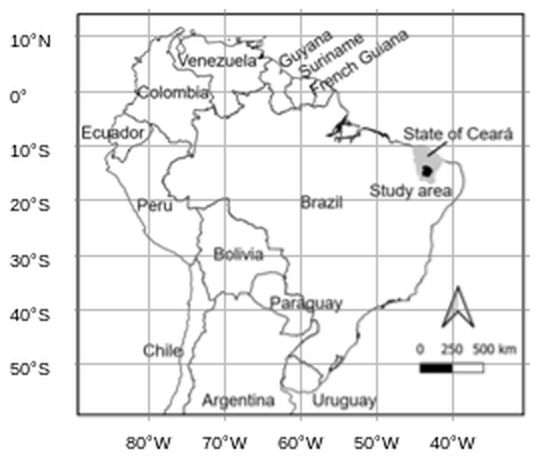
Figure 1Location of the study area.
2.2 Hydro-epidemiological modelling
With the aim to analyze the impact of severe drought and groundwater access on water security and the prevalence of diarrhea-related hospitalizations in a large tropical semi-arid region of Brazil, De Sousa et al. (2025) adjusted a hydro-epidemiological modelling for ten municipalities in Ceará (the black-coloured region in Fig. 1), which have similar socio-economic and sanitation infrastructure comparing to other municipalities of the same large dryland region. The studied municipalities belong to the same health administrative superintendency region and have a rather variable amount of groundwater use for human consumption, ranging from 0.03 % to 99.63 % of total water for this end (De Sousa et al., 2025).
In this hydro-epidemiological modelling, the diarrhea hospitalizations' rate (CP) was a function of both groundwater access and drought severity. This modelling was based on a multiple linear regression model (Eq. 1; ; p<0.01). They considered the number of groundwater-use licenses for drinking water (GWL) as a measure of groundwater access whereas drought severity was estimated by drought duration (DD) and magnitude (DM), using a drought index. The time horizon of the targeted and explanatory variables was the whole meteorological drought (2012–2017) and drought recovery (2018–2020) period prior to the covid-19 pandemic outbreak in Ceará state. Therefore, the values of the variables were accumulated over 2012–2020.
GWL (95 % CI: −0.841, −0.001; ; p<0.05), DD (95 % CI: 0.085, 1.095; t=2.861; p<0.05) and DM (95 % CI: −1.581, −0.569; ; p<0.01) were significant predictors in the model (Eq. 1), showing values of variance inflation factor smaller than 2.5, suggesting that there was weak collinearity among covariates. During a recent long-lasting period of drought (2012–2020), the hydro-epidemiological modelling revealed that access to groundwater was associated with fewer hospitalizations, while prolonged but less severe droughts were linked to increased hospitalizations. The magnitude of the drought had an approximately twofold greater impact, in absolute terms, than drought duration or groundwater access. Nevertheless, access to groundwater remained a critical factor in counteracting the health impacts of drought, particularly in reducing diarrhea-related hospitalizations in the studied municipalities.
2.3 Economic valuation of avoided morbidity and mortality
In this study, using the hydro-epidemiological modelling, we estimated the number of diarrhea hospitalizations averted by groundwater access for the ten studied municipalities, during the severe drought. Given the reported mortality rate of diarrhea hospitalizations (Ministério da Saúde, 2025), we could also estimate the average number of deaths averted. Then, with the number of diarrhea hospitalizations averted, the economic valuation of avoided morbidity was carried out taking into account (a) the average diarrhea hospitalization cost (Ministério da Saúde, 2025), and (b) the absence in workplace due to adult hospitalizations, but also to assist children and elderly in the hospitals, based on days of hospitalization and an average income equal to minimum wage in Brazil. Finally, with the number of the deaths averted, the economic valuation of avoided mortality was based on the average Brazilian value of statistical life (Stivali, 2024). We also translated the economic estimates for these specific municipalities to a much larger drought-affected region, covering the whole state of Ceará, assuming similar economic and drought conditions, which allows a broader estimation of the economic costs of having interrupted access to clean water during the recent period of drought (2012–2020).
3.1 Health and economic impacts of groundwater access during drought
During the severe drought, we estimated that the average number of diarrhea hospitalizations averted would be 3822 (95 % CI: 2180–5482; p<0.05) by groundwater access. Since the reported mortality rate of diarrhea hospitalizations is equal to 1.64 %, the average number of deaths averted is 63 (95 % CI: 36–90; p<0.05). The economic benefits from averted hospitalizations are USD 0.31 million (95 % CI: USD 0.18–0.45 million; p<0.05), considering a diarrhea hospitalization cost of USD 80.64. The economic benefits from averted deaths are USD 68.67 million (95 % CI: USD 39.24–98.10 million; p<0.05), considering the average Brazilian value of statistical life of USD 1.09 million. Moreover, we could estimate an economic benefit of USD 0.12 million (95 % CI: USD 0.07–0.18 million; p<0.05) due to the absence in workplace.
3.2 Upscaling regional health impacts to the state level
Therefore, the total economic benefit of the reduction of diarrhea hospitalizations by groundwater access during the studied severe drought is USD 69.10 million (95 % CI: USD 39.49–98.73 million; p<0.05) cumulative over 2012–2020, which is equivalent to 9.92 % of GDP of the ten studied municipalities (Instituto Brasileiro de Geografia e Estatística, 2021). Since 63 % of the municipalities have experienced drinking water shortage during the worst period of the drought (Costa et al., 2025), we assumed there was a potential economic loss for 116 municipalities in the state of Ceara alone (63 % of 184 municipalities in total), because of avoidable diarrhea hospitalizations by implementing non-interrupted access to clean water, such as groundwater access. Considering a loss like the impact found previously for the sample of ten municipalities, the estimated economic loss for the whole state of Ceara would be USD 801.60 million (95 % CI: USD 458.07–1145.28 million; p<0.05), which is equivalent to 2.15 % of state's GDP (Instituto Brasileiro de Geografia e Estatística, 2021).
These findings present huge economic impacts from the implementation of water-supply-based protective measures related to diarrhea hospitalizations during severe droughts, which is comparable to economic drought's impacts on productive sectors in the same large dryland region (Ministério do Desenvolvimento Regional, 2024; Fig. 2). Therefore, investments in reliable water supply are not only important for public health, but also highly relevant from a macroeconomic perspective, and that the true costs of drought are underestimated when health effects are excluded.
Moreover, these findings are likely be relevant to other drylands, where about 2 billion people live (UNCCD, 2017), because exposure to mild or severe drought is significantly associated with an increased diarrhea risk among children under five in 51 low- and middle-income countries, being stronger in dry zones (Wang et al., 2022).
Figure 2Annual drought economic impacts on productive sectors (agriculture, livestock, industry, services, and commerce) and on the health sector related to diarrhea hospitalizations in the state of Ceara, 2012–2020.
3.3 Conservative nature and limitations of the estimates
It is important to acknowledge that our economic estimations represent a conservative assessment, as they are necessarily bounded by data availability and methodological scope. The calculated benefits focus on direct, quantifiable costs associated with averted hospitalizations, lost productivity from caregivers, and the statistical value of lost lives. However, they do not capture other significant indirect and intangible additional economic impacts. These unaccounted effects include productivity losses from individuals missing work or education due to non-hospitalized illness, the long-term economic burden of psychological distress and its impact on workforce participation, and the costs associated with permanent or temporary migration away from affected areas. Consequently, these broader societal disruptions might substantially contribute to a greater economic impact of drought than the values reported here. On the other hand, in drought-affected and resource-constrained areas, some cases may not reach formal health facilities, which could lead to measurement error and potential underestimation of impacts. Furthermore, the translation of impacts from ten municipalities to the entire state under severe drought impacts (116 municipalities), while informative, assumes a uniformity of effect that may not fully reflect local socioeconomic and infrastructural heterogeneities, which may not be completely captured by sample size and selection. For instance, it is expected that municipalities serving with a much better sanitation coverage are more resilient against human-health effects of drought.
The findings suggest that this topic should be investigated broadly and deeply to improve our understanding of the economic effects of drought in relation to the health sector, which could support investment decision making in water and sanitation policies in underdeveloped drought-affected drylands. Moreover, there are many other drought-induced or drought-modified human health impacts, such as vector-borne, respiratory, and cardiovascular diseases (e.g. Moreira et al., 2020, 2024), which may also have relevant economic impacts and demand measures and policies far beyond the water management alone.
The data used in this study are not publicly available because they were obtained by governmental institutions. Data may be made available upon reasonable request.
Writing: ACC, FGFS, PRO. Conceptualization, methodology, data collection and analysis: ACC, FGFS, RPM, PRO. All authors were involved in the reviewing and editing process.
The contact author has declared that none of the authors has any competing interests.
Publisher's note: Copernicus Publications remains neutral with regard to jurisdictional claims made in the text, published maps, institutional affiliations, or any other geographical representation in this paper. The authors bear the ultimate responsibility for providing appropriate place names. Views expressed in the text are those of the authors and do not necessarily reflect the views of the publisher.
This article is part of the special issue “The convergence of disasters, diseases, and health impacts (NHESS/ESD/GC inter-journal SI)”. It is not associated with a conference.
This study was supported by grants the National Council for Scientific and Technological Development from Brazil (CNPq) (reference numbers 402514/2021-1; 406348/2025-1; 302409/2022-0; 306380/2023-4), and from the Dutch Research Council (NWO) (reference number W 07.30323.007).
This paper was edited by Robert Sakic Trogrlic and reviewed by Raquel Guimaraes and one anonymous referee.
Costa, A. C., Cavalcante, T. F., de Oliveira, A. S. S., Lima Neto, I. E., Ribeiro Neto, G. G., van Oel, P. R., and Moreira, R. P.: Sharp decline of diarrhea hospitalizations despite historical drought in Brazil: The potential role of local water supply and public health measures, J. Water Health, 23, 743–756, https://doi.org/10.2166/wh.2025.392, 2025.
De Sousa, T. C., Costa, A. C., Moreira, R. P., and van Oel, P. R.: Groundwater access reduces water insecurity and diarrhea hospitalizations in the drought-affected tropical drylands of Ceará, Brazil. Hydrogeol. J., https://doi.org/10.1007/s10040-025-02961-9, 2025.
Fleming-Muñoz, D. A., Whitten, S., and Bonnett, G. D.: The economics of drought: A review of impacts and costs, Aust. J. Agr. Resour. Ec., 67, 501–523, https://doi.org/10.1111/1467-8489.12527, 2023.
Instituto Brasileiro de Geografia e Estatística: Produto Interno Bruto – PIB, https://www.ibge.gov.br/explica/pib.php (last access: 1 December 2025), 2021.
Ministério da Saúde: DATASUS – Sistema de Informações Hospitalares, https://datasus.saude.gov.br, last access: 2025.
Ministério do Desenvolvimento Regional: Atlas Digital de Desastres no Brasil, https://atlasdigital.mdr.gov.br/paginas/graficos.xhtml# (last access: 1 December 2025), 2024.
Mishra, A., Delk, J., Mishra, A., and Zilberman, D.: Drought has varying impacts on the national economy, Stoch. Env. Res. Risk A., 39, 925–936, https://doi.org/10.1007/s00477-024-02892-z, 2025.
Moreira, R. P., Costa, A. C., Gomes, T. F., and Ferreira, G. de O.: Climate and climate-sensitive diseases in semi-arid regions: a systematic review, Int. J. Public Health, 65, 1749–1761, https://doi.org/10.1007/s00038-020-01464-6, 2020.
Moreira, R. P., da Silva, C. B. C., de Sousa, T. C., Leitão, F. L. B. F., Morais, H. C. C., de Oliveira, A. S. S., Duarte-Clíments, G., Gómez, M. B. S, Cavalcante, T. F., and Costa, A. C.: The Influence of Climate, Atmospheric Pollution, and Natural Disasters on Cardiovascular Diseases and Diabetes Mellitus in Drylands: A Scoping Review, Public Health Rev., 45, 1607300, https://doi.org/10.3389/phrs.2024.1607300, 2024.
Naciones Unidas Convención de Lucha contra la Desertificación (UNCCD): Perspectiva Global de la tierra, Bonn, UNCCD, https://www.unccd.int/sites/default/files/documents/2017-09/GLO_Full_Report_low_res_Spanish.pdf (last access: 15 November 2025), 2017.
Naumann, G., Cammalleri, C., Mentaschi, L., and Feyen, L.: Increased economic drought impacts in Europe with anthropogenic warning, Nat. Clim. Change, 11, 485–491, https://doi.org/10.1038/s41558-021-01044-3, 2021.
Sarmiento, J. H., Melo, O., Ortiz-Alvarado, L., Vallejos, C. P., and Reyes-Mandujano, I. F.: Economic impacts associated with the health effects of climate change in South America: a scoping review, Lancet Reg. Health Am., 26, 100606, https://doi.org/10.1016/j.lana.2023.100606, 2023.
Schmitt, L. H. M., Graham, H. M., and White, P. C. L.: Economic evaluations of the health impacts of weather-related extreme events: a scoping review, Int. J. Env. Res. Pub. He., 13, 1105, https://doi.org/10.3390/ijerph13111105, 2016.
Stivali, M.: Valoração estatística da vida no Brasil, Planejamento e Políticas Públicas, 66, 193–226, https://doi.org/10.38116/ppp66art7, 2024.
Viana, S. W., Faleiro, M. D., Mendes, A. L. F., Torquato, A. C., Tavares, C. P. O., Feres, B., Fernandez, M. G., Sobreira, I. R. M., De Aquino, C. M., Abib, S. de C. V., and Botelho, F.: Limitations of using the DATASUS database as a primary source of data in surgical research: a scoping review, Rev. Col. Bras. Cir., 50, e20233545, https://doi.org/10.1590/0100-6991e-20233545-en, 2023.
Wang, P., Asare, E., Pitzer, V. E., Dubrow, R., and Chen, K.: Associations between long-term drought and diarrhea among children under five in low- and middle-income countries, Nat. Commun., 13, 3661, https://doi.org/10.1038/s41467-022-31291-7, 2022.