
Articles | Volume 26, issue 6
https://doi.org/10.5194/nhess-26-2561-2026
© Author(s) 2026. This work is distributed under
the Creative Commons Attribution 4.0 License.
the Creative Commons Attribution 4.0 License.
https://doi.org/10.5194/nhess-26-2561-2026
© Author(s) 2026. This work is distributed under
the Creative Commons Attribution 4.0 License.
the Creative Commons Attribution 4.0 License.
Research article
| 
03 Jun 2026
Research article |
| 03 Jun 2026
| 03 Jun 2026
Capturing the complete landslide–debris-rich flood continuum for accurate inventory, susceptibility and exposure mapping – lessons from Cyclone Idai
Antoine Dille
CORRESPONDING AUTHOR

Department of Earth Sciences, Royal Museum for Central Africa, Tervuren, Belgium
Olivier Dewitte
Department of Earth Sciences, Royal Museum for Central Africa, Tervuren, Belgium
Jente Broeckx
Vlaamse Instelling voor Technologisch Onderzoek (VITO), Mol, Belgium
Koen Verbist
UNESCO, Intergovernmental Hydrological Programme, Paris, France
Andile Sindiso Dube
School of Biological, Earth and Environmental Sciences, University College Cork, Cork, Ireland
Jean Poesen
Department of Earth and Environmental Sciences, KU Leuven, Leuven, Belgium
Faculty of Earth Sciences and Spatial Management, Maria-Curie Sklodowska University, Lublin, Poland
Matthias Vanmaercke
Department of Earth and Environmental Sciences, KU Leuven, Leuven, Belgium
Related authors
Aida Alvera-Azcárate, Dimitry Van der Zande, Alexander Barth, Antoine Dille, Joppe Massant, and Jean-Marie Beckers
Ocean Sci., 21, 787–805, https://doi.org/10.5194/os-21-787-2025, https://doi.org/10.5194/os-21-787-2025, 2025
Short summary
Short summary
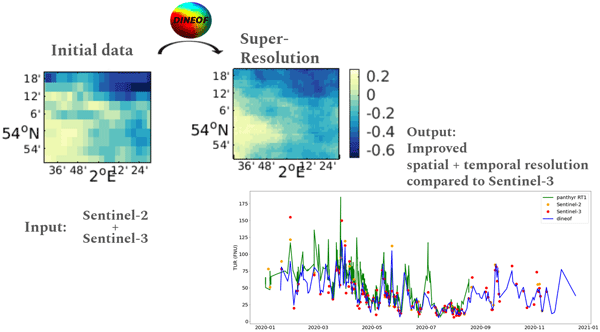
This work presents an approach for increasing the spatial resolution of satellite data and interpolating gaps due to cloud cover, using a method called DINEOF (data-interpolating empirical orthogonal functions). The method is tested on turbidity and chlorophyll-a concentration data in the Belgian coastal zone and the North Sea. The results show that we are able to improve the spatial resolution of these data in order to perform analyses of spatial and temporal variability in coastal regions.
Derrick Muheki, Koen Hufkens, Kim Jacobsen, Hans Verbeeck, Pascal Boeckx, Dominique Kankonde Ntumba, Olivier Kapalay Moulasa, Bas Vercruysse, Julie M. Birkholz, Christophe Verbruggen, Ed Hawkins, Seppe Lampe, Emmanuel Kasongo Yakusu, Fils Makanzu Imwangana, José Mbifo, Théophile Besango Likwela, Félicien Meunier, Olivier Dewitte, Peter Thorne, and Wim Thiery
Earth Syst. Dynam., 17, 1455–1511, https://doi.org/10.5194/esd-17-1455-2026, https://doi.org/10.5194/esd-17-1455-2026, 2026
Short summary
Short summary
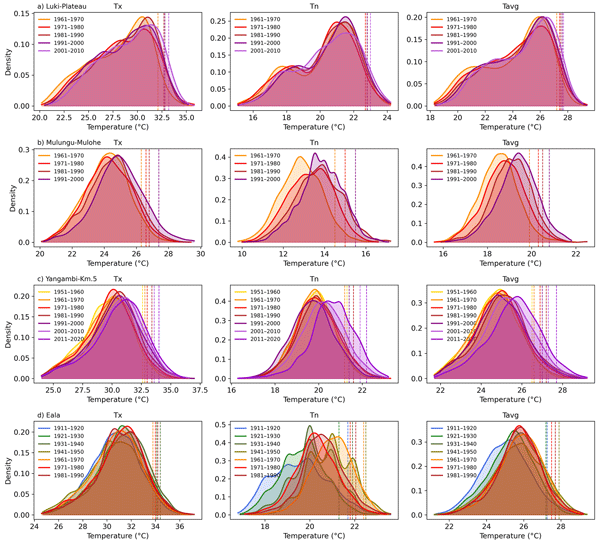
The Congo Basin is one of the least studied regions for climate change due to limited accessible data, despite large volumes of historical records stored on paper in archives. In this study, we digitised over 9000 sheets from 37 stations in the Democratic Republic of the Congo, producing more than one million daily weather observations. The results show clear warming since the 1960s, with more hot days and fewer cold days, highlighting the importance of data rescue in data-sparse regions.
Hendrik Wouters, Jente Broeckx, Francisco Pereira, Boucary Dara, Afoussatou Diarra, Robin Houdmeyers, and Dirk Lauwaet
Geosci. Model Dev., 19, 5805–5825, https://doi.org/10.5194/gmd-19-5805-2026, https://doi.org/10.5194/gmd-19-5805-2026, 2026
Short summary
Short summary
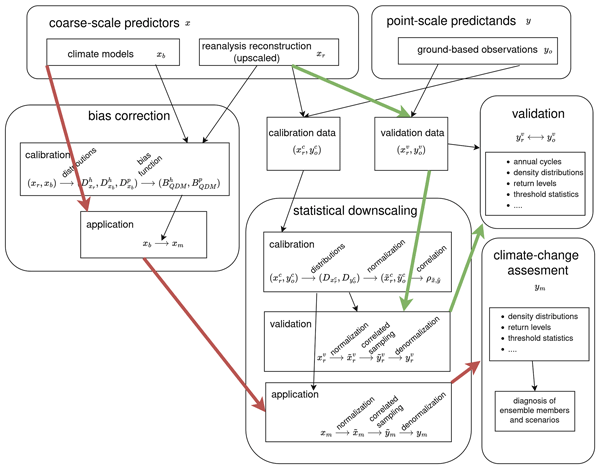
Predicting shifts in local extreme weather under global warming is key for climate adaptation, but climate projections lack detail. A new tool, EXSoDOS (DOwnScaling of weather EXtremes Shifts), combines ground measurements, reanalysis data, and climate models to improve estimates of extreme weather, aiding better risk planning. Tested in five regions, it accurately captures temperature, rainfall, and wind extremes including their past changes, outperforming raw model data. Results show worsening heat (stress) and precipitation by 2100.
Eric Lutete Landu, Guy Ilombe Mawe, Elise Dujardin, Fils Makanzu Imwangana, Charles Bielders, Olivier Dewitte, Jean Poesen, Caroline Michellier, Aurélia Hubert, and Matthias Vanmaercke
EGUsphere, https://doi.org/10.5194/egusphere-2026-1774, https://doi.org/10.5194/egusphere-2026-1774, 2026
Short summary
Short summary
Urban gullies are a major problem in Kinshasa, caused by poor planning, fragile soils, and heavy rainfall. They destroy homes, disrupt services, and reduce land value, increasing poverty. A study of 802 households near 183 gullies and 12 brokers shows severe damage and high costs, with property losses estimated at 979 million dollars. Many people underestimate risks, and local solutions are often ineffective, highlighting the urgent need for better planning, prevention and coordinated action.
Bram Valkenborg, Olivier Dewitte, and Benoît Smets
EGUsphere, https://doi.org/10.5194/egusphere-2026-722, https://doi.org/10.5194/egusphere-2026-722, 2026
Short summary
Short summary
Data gaps in datasets on floods, landslides, and flash floods influence our understanding of these hazards. We present HazMiner, a new method to extract their location, timing, and impacts from online news articles. We applied HazMiner at the global scale to 6,366,905 news articles published from 2017 through 2024. This resulted in the detection of 21,411 floods, 7,659 landslides, and 3,606 flash floods. HazMiner outperforms current hazard datasets, especially in data-scarce regions.
Aida Alvera-Azcárate, Dimitry Van der Zande, Alexander Barth, Antoine Dille, Joppe Massant, and Jean-Marie Beckers
Ocean Sci., 21, 787–805, https://doi.org/10.5194/os-21-787-2025, https://doi.org/10.5194/os-21-787-2025, 2025
Short summary
Short summary
This work presents an approach for increasing the spatial resolution of satellite data and interpolating gaps due to cloud cover, using a method called DINEOF (data-interpolating empirical orthogonal functions). The method is tested on turbidity and chlorophyll-a concentration data in the Belgian coastal zone and the North Sea. The results show that we are able to improve the spatial resolution of these data in order to perform analyses of spatial and temporal variability in coastal regions.
Oscar M. Baez-Villanueva, Mauricio Zambrano-Bigiarini, Diego G. Miralles, Hylke E. Beck, Jonatan F. Siegmund, Camila Alvarez-Garreton, Koen Verbist, René Garreaud, Juan Pablo Boisier, and Mauricio Galleguillos
Hydrol. Earth Syst. Sci., 28, 1415–1439, https://doi.org/10.5194/hess-28-1415-2024, https://doi.org/10.5194/hess-28-1415-2024, 2024
Short summary
Short summary
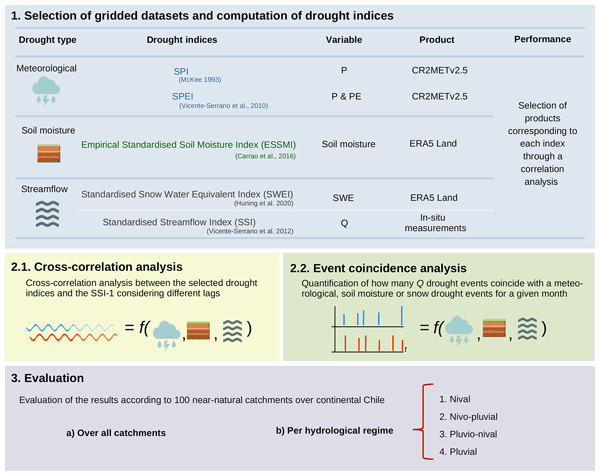
Various drought indices exist, but there is no consensus on which index to use to assess streamflow droughts. This study addresses meteorological, soil moisture, and snow indices along with their temporal scales to assess streamflow drought across hydrologically diverse catchments. Using data from 100 Chilean catchments, findings suggest that there is not a single drought index that can be used for all catchments and that snow-influenced areas require drought indices with larger temporal scales.
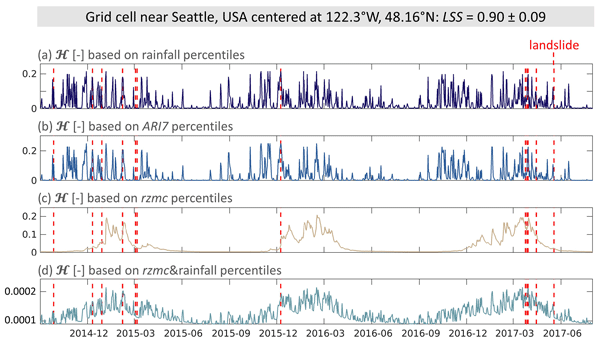
Anne Felsberg, Zdenko Heyvaert, Jean Poesen, Thomas Stanley, and Gabriëlle J. M. De Lannoy
Nat. Hazards Earth Syst. Sci., 23, 3805–3821, https://doi.org/10.5194/nhess-23-3805-2023, https://doi.org/10.5194/nhess-23-3805-2023, 2023
Short summary
Short summary
The Probabilistic Hydrological Estimation of LandSlides (PHELS) model combines ensembles of landslide susceptibility and of hydrological predictor variables to provide daily, global ensembles of hazard for hydrologically triggered landslides. Testing different hydrological predictors showed that the combination of rainfall and soil moisture performed best, with the lowest number of missed and false alarms. The ensemble approach allowed the estimation of the associated prediction uncertainty.

Jean-Claude Maki Mateso, Charles L. Bielders, Elise Monsieurs, Arthur Depicker, Benoît Smets, Théophile Tambala, Luc Bagalwa Mateso, and Olivier Dewitte
Nat. Hazards Earth Syst. Sci., 23, 643–666, https://doi.org/10.5194/nhess-23-643-2023, https://doi.org/10.5194/nhess-23-643-2023, 2023
Short summary
Short summary
This research highlights the importance of human activities on the occurrence of landslides and the need to consider this context when studying hillslope instability patterns in regions under anthropogenic pressure. Also, this study highlights the importance of considering the timing of landslides and hence the added value of using historical information for compiling an inventory.
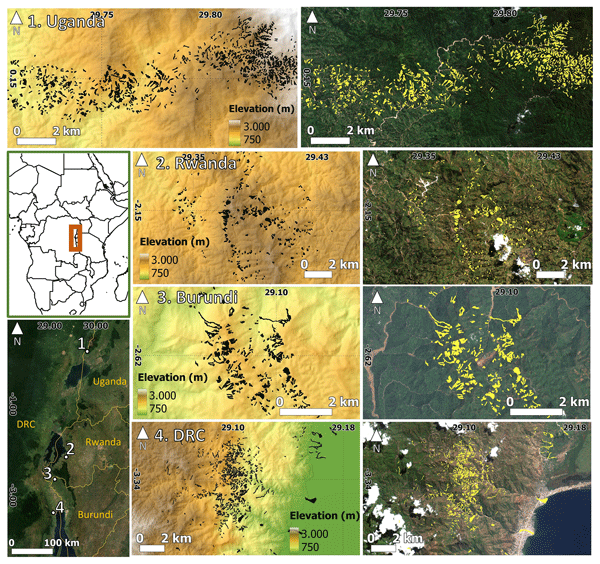
Axel A. J. Deijns, Olivier Dewitte, Wim Thiery, Nicolas d'Oreye, Jean-Philippe Malet, and François Kervyn
Nat. Hazards Earth Syst. Sci., 22, 3679–3700, https://doi.org/10.5194/nhess-22-3679-2022, https://doi.org/10.5194/nhess-22-3679-2022, 2022
Short summary
Short summary
Landslides and flash floods are rainfall-induced processes that often co-occur and interact, generally very quickly. In mountainous cloud-covered environments, determining when these processes occur remains challenging. We propose a regional methodology using open-access satellite radar images that allow for the timing of landslide and flash floods events, in the contrasting landscapes of tropical Africa, with an accuracy of up to a few days. The methodology shows potential for transferability.
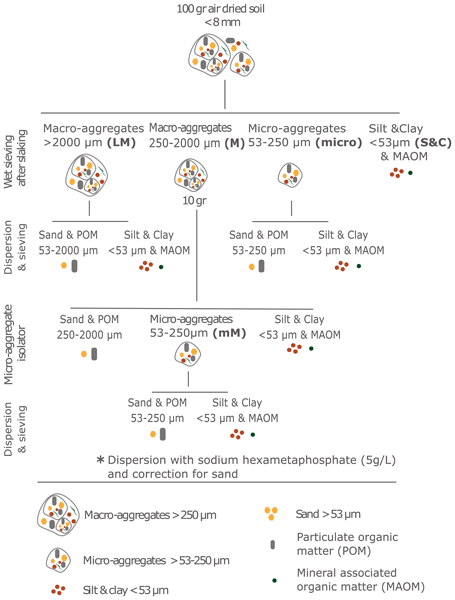
Ioanna S. Panagea, Antonios Apostolakis, Antonio Berti, Jenny Bussell, Pavel Čermak, Jan Diels, Annemie Elsen, Helena Kusá, Ilaria Piccoli, Jean Poesen, Chris Stoate, Mia Tits, Zoltan Toth, and Guido Wyseure
SOIL, 8, 621–644, https://doi.org/10.5194/soil-8-621-2022, https://doi.org/10.5194/soil-8-621-2022, 2022
Short summary
Short summary
The potential to reverse the negative effects caused in topsoil by inversion tillage, using alternative agricultural practices, was evaluated. Reduced and no tillage, and additions of manure/compost, improved topsoil structure and OC content. Residue retention had a positive impact on structure. We concluded that the negative effects of inversion tillage can be mitigated by reducing tillage intensity or adding organic materials, optimally combined with non-inversion tillage.
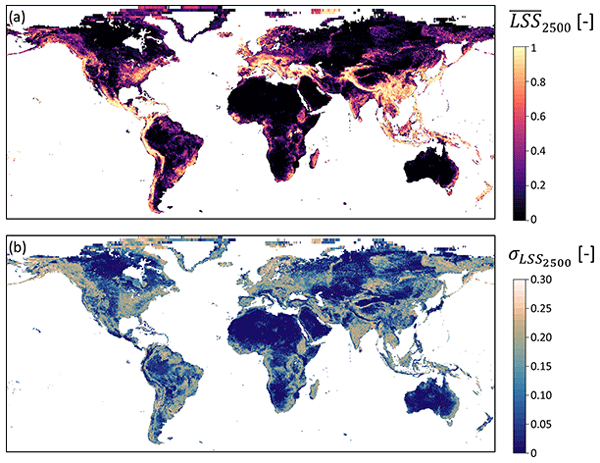
Anne Felsberg, Jean Poesen, Michel Bechtold, Matthias Vanmaercke, and Gabriëlle J. M. De Lannoy
Nat. Hazards Earth Syst. Sci., 22, 3063–3082, https://doi.org/10.5194/nhess-22-3063-2022, https://doi.org/10.5194/nhess-22-3063-2022, 2022
Short summary
Short summary
In this study we assessed global landslide susceptibility at the coarse 36 km spatial resolution of global satellite soil moisture observations to prepare for a subsequent combination of the two. Specifically, we focus therefore on the susceptibility of hydrologically triggered landslides. We introduce ensemble techniques, common in, for example, meteorology but not yet in the landslide community, to retrieve reliable estimates of the total prediction uncertainty.
Cited articles
Amatya, P., Scheip, C., Déprez, A., Malet, J. P., Slaughter, S. L., Handwerger, A. L., Emberson, R., Kirschbaum, D., Jean-Baptiste, J., Huang, M. H., Clark, M. K., Zekkos, D., Huang, J. R., Pacini, F., and Boissier, E.: Learnings from rapid response efforts to remotely detect landslides triggered by the August 2021 Nippes earthquake and Tropical Storm Grace in Haiti, Nat. Hazards, https://doi.org/10.1007/s11069-023-06096-6, 2023.
Arango-Carmona, M. I., Voit, P., Hürlimann, M., Aristizábal, E., and Korup, O.: Hillslope torrential hazard cascades in tropical mountains, Nat. Hazards Earth Syst. Sci., 25, 3641–3663, https://doi.org/10.5194/nhess-25-3641-2025, 2025.
Bennett, G. L., Panici, D., Rengers, F. K., Kean, J. W., and Rathburn, S. L.: Landslide-channel feedbacks amplify channel widening during floods, npj Nat. Hazards, 2, 7, https://doi.org/10.1038/s44304-025-00059-6, 2025.
Bhuyan, K., Rana, K., Ozturk, U., Nava, L., Rosi, A., Meena, S. R., Fan, X., Floris, M., van Westen, C., and Catani, F.: Towards automatic delineation of landslide source and runout, Eng. Geol., 345, 107866, https://doi.org/10.1016/j.enggeo.2024.107866, 2025.
Brenna, A., Surian, N., Ghinassi, M., and Marchi, L.: Sediment–water flows in mountain streams: Recognition and classification based on field evidence, Geomorphology, 371, https://doi.org/10.1016/j.geomorph.2020.107413, 2020.
Brenna, A., Marchi, L., Borga, M., Zaramella, M., and Surian, N.: What drives major channel widening in mountain rivers during floods? The role of debris floods during a high-magnitude event, Geomorphology, 430, 108650, https://doi.org/10.1016/j.geomorph.2023.108650, 2023.
Brenning, A.: Improved Spatial Analysis and Prediction of Landslide Susceptibility: Practical Recommendations, in: Landslides and Engineered Slopes: Protecting Society Through Improved Understanding, edited by: Eberhardt, E., Froese, C., Turner, K., and Leroueil, S., CRC Press, 789–795, ISBN 0415621232, 2012.
Broeckx, J., Vanmaercke, M., Duchateau, R., and Poesen, J.: A data-based landslide susceptibility map of Africa, Earth-Science Rev., 185, 102–121, https://doi.org/10.1016/j.earscirev.2018.05.002, 2018.
Chanza, N., Siyongwana, P. Q., Williams-Bruinders, L., Gundu-Jakarasi, V., Mudavanhu, C., Sithole, V. B., and Manyani, A.: Closing the Gaps in Disaster Management and Response: Drawing on Local Experiences with Cyclone Idai in Chimanimani, Zimbabwe, Int. J. Disaster Risk Sci., 11, 655–666, https://doi.org/10.1007/s13753-020-00290-x, 2020.
Chatiza, K.: Cyclone Idai in Zimbabwe – An analysis of policy implications for post-disaster institutional development to strengthen disaster risk management, 30 pp., https://doi.org/10.21201/2019.5273, 2019.
Church, M. and Jakob, M.: What Is a Debris Flood?, Water Resour. Res., 56, 1–17, https://doi.org/10.1029/2020WR027144, 2020.
Croissant, T., Lague, D., Steer, P., and Davy, P.: Rapid post-seismic landslide evacuation boosted by dynamic river width, Nat. Geosci., 10, 680–684, https://doi.org/10.1038/ngeo3005, 2017.
Cutter, S. L.: Compound, Cascading, or Complex Disasters: What's in a Name?, Environ. Sci. Policy Sustain. Dev., 60, 16–25, https://doi.org/10.1080/00139157.2018.1517518, 2018.
Dahal, A. and Lombardo, L.: Explainable artificial intelligence in geoscience: a glimpse into the future of landslide susceptibility modeling [Preprint], Comput. Geosci., 176, 105364, https://doi.org/10.1016/j.cageo.2023.105364, 2023.
Das, R. and Wegmann, K. W.: Evaluation of machine learning-based algorithms for landslide detection across satellite sensors for the 2019 Cyclone Idai event, Chimanimani District, Zimbabwe, Landslides, 19, 2965–2981, https://doi.org/10.1007/s10346-022-01912-9, 2022.
De Angeli, S., Malamud, B. D., Rossi, L., Taylor, F. E., Trasforini, E., and Rudari, R.: A multi-hazard framework for spatial-temporal impact analysis, Int. J. Disaster Risk Reduct., 73, 102829, https://doi.org/10.1016/j.ijdrr.2022.102829, 2022.
Depicker, A., Jacobs, L., Mboga, N., Smets, B. B., Van Rompaey, A., Lennert, M., Wolff, E., Kervyn, F. F., Michellier, C., Dewitte, O., Govers, G., Rompaey, A. Van, Lennart, M., Kervyn, F. F., Michellier, C., Dewitte, O., and Govers, G.: Historical dynamics of landslide risk from population and forest-cover changes in the Kivu Rift, Nat. Sustain., 4, 965–974, https://doi.org/10.1038/s41893-021-00757-9, 2021a.
Depicker, A., Govers, G., Jacobs, L., Campforts, B., Uwihirwe, J., and Dewitte, O.: Interactions between deforestation, landscape rejuvenation, and shallow landslides in the North Tanganyika–Kivu rift region, Africa, Earth Surf. Dyn., 9, 445–462, https://doi.org/10.5194/esurf-9-445-2021, 2021b.
Deprez, A., Marc, O., Malet, J.-P., Stumpf, A., and Michéa, D.: ALADIM – A change detection on-line service for landslide detection from EO imagery, in: EGU General Assembly 2022, https://doi.org/10.5194/egusphere-egu22-3536, 2022.
Devi, S.: Cyclone Idai: 1 month later, devastation persists, Lancet, World Rep., 393, 1585, https://doi.org/10.1016/S0140-6736(19)30892-X, 2019.
de Vilder, S., Kelly, S., Buxton, R., Allan, S., and Glassey, P.: Landslide planning guidance reducing landslide risk through land-use planning, GNS Scienc., GNS Science, Lower Hutt, 77 pp., https://doi.org/10.21420/R2X8-FJ49, 2024.
Dewitte, O., Dille, A., Depicker, A., Kubwimana, D., Maki Mateso, J. -C., Mugaruka Bibentyo, T., Uwihirwe, J., and Monsieurs, E.: Constraining landslide timing in a data-scarce context: from recent to very old processes in the tropical environment of the North Tanganyika-Kivu Rift region, Landslides, 18, 161–177, https://doi.org/10.1007/s10346-020-01452-0, 2021.
Dewitte, O., Depicker, A., Moeyersons, J., and Dille, A.: Mass Movements in Tropical Climates, Treatise Geomorphol., 338–349, https://doi.org/10.1016/B978-0-12-818234-5.00118-8, 2022.
Di Napoli, M., Di Martire, D., Bausilio, G., Calcaterra, D., Confuorto, P., Firpo, M., Pepe, G., and Cevasco, A.: Rainfall-induced shallow landslide detachment, transit and runout susceptibility mapping by integrating machine learning techniques and gis-based approaches, Water (Switzerland), 13, 11–14, https://doi.org/10.3390/w13040488, 2021.
Dubey, S., Sattar, A., Goyal, M. K., Allen, S., Frey, H., Haritashya, U. K., and Huggel, C.: Mass Movement Hazard and Exposure in the Himalaya, Earth's Futur., 11, 1–18, https://doi.org/10.1029/2022EF003253, 2023.
Emberson, R., Kirschbaum, D., and Stanley, T.: New Global Characterization of Landslide Exposure, Nat. Hazards Earth Syst. Sci., 30, 1–21, https://doi.org/10.5194/nhess-2019-434, 2020.
Emberson, R., Kirschbaum, D. B., Amatya, P., Tanyas, H., and Marc, O.: Insights from the topographic characteristics of a large global catalog of rainfall-induced landslide event inventories, Nat. Hazards Earth Syst. Sci., 22, 1129–1149, https://doi.org/10.5194/nhess-22-1129-2022, 2022.
Fan, L., Lehmann, P., McArdell, B., and Or, D.: Linking rainfall-induced landslides with debris flows runout patterns towards catchment scale hazard assessment, Geomorphology, 280, 1–15, https://doi.org/10.1016/j.geomorph.2016.10.007, 2017.
Fan, X., Juang, C. H., Wasowski, J., Huang, R., Xu, Q., Scaringi, G., van Westen, C. J., and Havenith, H. B.: What we have learned from the 2008 Wenchuan Earthquake and its aftermath: A decade of research and challenges, Eng. Geol., 241, 25–32, https://doi.org/10.1016/j.enggeo.2018.05.004, 2018.
Gill, J. C. and Malamud, B. D.: Reviewing and visualizing the interactions of natural hazards, Rev. Geophys., 52, 680–722, https://doi.org/10.1002/2013RG000445, 2014.
Gill, J. C., Malamud, B. D., Barillas, E. M., and Guerra Noriega, A.: Construction of regional multi-hazard interaction frameworks, with an application to Guatemala, Nat. Hazards Earth Syst. Sci., 20, 149–180, https://doi.org/10.5194/nhess-20-149-2020, 2020.
Hansen, M. C., Potapov, P. V., Moore, R., Hancher, M., Turubanova, S. A., Tyukavina, A., Thau, D., Stehman, S. V., Goetz, S. J., Loveland, T. R., Kommareddy, A., Egorov, A., Chini, L., Justice, C. O., and Townshend, J. R. G.: High-Resolution Global Maps of 21st-Century Forest Cover Change, Science, 342, 850–853, https://doi.org/10.1126/science.1244693, 2013.
Highland, L. M. and Bobrowsky, P.: The Landslide Handbook – A Guide to Understanding Landslides, Landslides, 129, ISBN 978-141132226-4, 2008.
Hungr, O., Leroueil, S., and Picarelli, L.: The Varnes classification of landslide types, an update, Landslides, 11, 167–194, https://doi.org/10.1007/s10346-013-0436-y, 2014.
IFRC: Zimbabwe: Tropical Cycle Idai – Final Report, International Federation of Red Cross and Red Crescent Societies, 1–13, https://reliefweb.int/report/zimbabwe/zimbabwe-tropical-cyclone-idai-final-report-dref-operation (last access: 2 June 2026), 2020.
Iverson, R. M. and Ouyang, C.: Entrainment of bed material by Earth-surface mass flows: Review and reformulation of depth-integrated theory, Rev. Geophys., 53, 27–58, https://doi.org/10.1002/2013RG000447, 2015.
Iverson, R. M., Reid, M. E., and LaHusen, R. G.: Debris-flow mobilization from landslides, Annu. Rev. Earth Planet. Sci., 25, 85–138, 1997.
Iverson, R. M. M., George, D. L. L., Allstadt, K., Reid, M. E. E., Collins, B. D. D., Vallance, J. W., Schilling, S. P., Godt, J. W. W., Cannon, C. M. M., Magirl, C. S. S., Baum, R. L. L., Coe, J. a. A., Schulz, W. H. H., and Bower, J. B. B.: Landslide mobility and hazards: Implications of the 2014 Oso disaster, Earth Planet. Sci. Lett., 412, 197–208, https://doi.org/10.1016/j.epsl.2014.12.020, 2015.
Jacobs, L., Maes, J., Mertens, K., Sekajugo, J., Thiery, W., van Lipzig, N., Poesen, J., Kervyn, M., and Dewitte, O.: Reconstruction of a flash flood event through a multi-hazard approach: focus on the Rwenzori Mountains, Uganda, Nat. Hazards, 84, 851–876, https://doi.org/10.1007/s11069-016-2458-y, 2016.
Keck, J., Istanbulluoglu, E., Campforts, B., Tucker, G., and Horner-Devine, A.: A landslide runout model for sediment transport, landscape evolution, and hazard assessment applications, Earth Surf. Dynam., 12, 1165–1191, https://doi.org/10.5194/esurf-12-1165-2024, 2024.
Kritikos, T. and Davies, T.: Assessment of rainfall-generated shallow landslide/debris-flow susceptibility and runout using a GIS-based approach: application to western Southern Alps of New Zealand, Landslides, 12, 1051–1075, https://doi.org/10.1007/s10346-014-0533-6, 2015.
Lee, R., White, C. J., Adnan, M. S. G., Douglas, J., Mahecha, M. D., O'Loughlin, F. E., Patelli, E., Ramos, A. M., Roberts, M. J., Martius, O., Tubaldi, E., van den Hurk, B., Ward, P. J., and Zscheischler, J.: Reclassifying historical disasters: From single to multi-hazards, Sci. Total Environ., 912, 169120, https://doi.org/10.1016/j.scitotenv.2023.169120, 2024.
Legros, F.: The mobility of long-runout landslides, Eng. Geol., 63, 301–331, https://doi.org/10.1016/S0013-7952(01)00090-4, 2002.
Lin, Q., Steger, S., Pittore, M., Zhang, Y., Zhang, J., Zhou, L., Wang, L., Wang, Y., and Jiang, T.: Contrasting Population Projections to Induce Divergent Estimates of Landslides Exposure Under Climate Change, Earth's Futur., 11, 1–21, https://doi.org/10.1029/2023EF003741, 2023.
Maki Mateso, J.-C., Bielders, C. L., Monsieurs, E., Depicker, A., Smets, B., Tambala, T., Bagalwa Mateso, L., and Dewitte, O.: Characteristics and causes of natural and human-induced landslides in a tropical mountainous region: the rift flank west of Lake Kivu (Democratic Republic of the Congo), Nat. Hazards Earth Syst. Sci., 23, 643–666, https://doi.org/10.5194/nhess-23-643-2023, 2023.
Marc, O. and Hovius, N.: Amalgamation in landslide maps: effects and automatic detection, Nat. Hazards Earth Syst. Sci., 15, 723–733, https://doi.org/10.5194/nhess-15-723-2015, 2015.
Marc, O., Stumpf, A., Malet, J.-P., Gosset, M., Uchida, T., and Chiang, S.-H.: Initial insights from a global database of rainfall-induced landslide inventories: the weak influence of slope and strong influence of total storm rainfall, Earth Surf. Dynam., 6, 903–922, https://doi.org/10.5194/esurf-6-903-2018, 2018.
McGuire, L. A., Ebel, B. A., Rengers, F. K., Vieira, D. C. S., and Nyman, P.: Fire effects on geomorphic processes, Nat. Rev. Earth Environ., 41–79, https://doi.org/10.1038/s43017-024-00557-7, 2024.
Melo, R., Zêzere, J. L., Rocha, J., and Oliveira, S. C.: Combining data-driven models to assess susceptibility of shallow slides failure and run-out, Landslides, 16, 2259–2276, https://doi.org/10.1007/s10346-019-01235-2, 2019.
Merghadi, A., Yunus, A. P., Dou, J., Whiteley, J., ThaiPham, B., Bui, D. T., Avtar, R., and Abderrahmane, B.: Machine learning methods for landslide susceptibility studies: A comparative overview of algorithm performance, Earth-Science Rev., 207, 103225, https://doi.org/10.1016/j.earscirev.2020.103225, 2020.
Mergili, M., Emmer, A., Juřicová, A., Cochachin, A., Fischer, J. T., Huggel, C., and Pudasaini, S. P.: How well can we simulate complex hydro-geomorphic process chains? The 2012 multi-lake outburst flood in the Santa Cruz Valley (Cordillera Blanca, Perú), Earth Surf. Process. Landforms, 43, 1373–1389, https://doi.org/10.1002/esp.4318, 2018.
Mergili, M., Schwarz, L., and Kociu, A.: Combining release and runout in statistical landslide susceptibility modeling, Landslides, 16, 2151–2165, https://doi.org/10.1007/s10346-019-01222-7, 2019.
Merz, B., Blöschl, G., Vorogushyn, S., Dottori, F., Aerts, J. C. J. H., Bates, P., Bertola, M., Kemter, M., Kreibich, H., Lall, U., and Macdonald, E.: Causes, impacts and patterns of disastrous river floods, Nat. Rev. Earth Environ., 2, 592–609, https://doi.org/10.1038/s43017-021-00195-3, 2021.
Milledge, D. G., Densmore, A. L., Bellugi, D., Rosser, N. J., Watt, J., Li, G., and Oven, K. J.: Simple rules to minimise exposure to coseismic landslide hazard, Nat. Hazards Earth Syst. Sci., 19, 837–856, https://doi.org/10.5194/nhess-19-837-2019, 2019.
Nohrstedt, D., Mazzoleni, M., Parker, C. F., and Di Baldassarre, G.: Exposure to natural hazard events unassociated with policy change for improved disaster risk reduction, Nat. Commun., 12, https://doi.org/10.1038/s41467-020-20435-2, 2021.
Pedregosa, F., Varoquaux, G., Gramfort, A., Michel, V., Thirion, B., Grisel, O., Blondel, M., Prettenhofer, P., Weiss, R., Dubourg, V., and Vanderplas, J.: Scikit-learn: Machine Learning in Python, J. Mach. Learn. Res., 1, 2815–2830, 2011.
Pudasaini, S. P. and Krautblatter, M.: The mechanics of landslide mobility with erosion, Nat. Commun., 12, https://doi.org/10.1038/s41467-021-26959-5, 2021.
Reichenbach, P., Rossi, M., Malamud, B. D., Mihir, M., and Guzzetti, F.: A review of statistically-based landslide susceptibility models, Earth-Science Rev., 180, 60–91, https://doi.org/10.1016/j.earscirev.2018.03.001, 2018.
Roback, K., Clark, M. K., West, A. J., Zekkos, D., Li, G., Gallen, S. F., Chamlagain, D., and Godt, J. W.: The size, distribution, and mobility of landslides caused by the 2015 Mw7.8 Gorkha earthquake, Nepal, Geomorphology, 301, 121–138, https://doi.org/10.1016/j.geomorph.2017.01.030, 2018.
Royal Museum for Central Africa: Landslide Susceptibility and Exposure Assesment – Chimanimani and Chipinge districts, Zimbabwe, UNESCO [data set], https://doi.org/10.63253/nii4g2ac, 2026.
Scheip, C. M. and Wegmann, K. W.: HazMapper: a global open-source natural hazard mapping application in Google Earth Engine, Nat. Hazards Earth Syst. Sci., 21, 1495–1511, https://doi.org/10.5194/nhess-21-1495-2021, 2021.
Sekajugo, J., Kagoro-Rugunda, G., Mutyebere, R., Kabaseke, C., Mubiru, D., Kanyiginya, V., Vranken, L., Jacobs, L., Dewitte, O., and Kervyn, M.: Exposure and physical vulnerability to geo-hydrological hazards in rural environments: A field-based assessment in East Africa, Int. J. Disaster Risk Reduct., 102, 104282, https://doi.org/10.1016/j.ijdrr.2024.104282, 2024.
Sharma, S., Talchabhadel, R., Nepal, S., Ghimire, G. R., Rakhal, B., Panthi, J., Adhikari, B. R., Pradhanang, S. M., Maskey, S., and Kumar, S.: Increasing risk of cascading hazards in the central Himalayas, Nat. Hazards, 119, 1117–1126, https://doi.org/10.1007/s11069-022-05462-0, 2023.
Sirko, W., Kashubin, S., Ritter, M., Annkah, A., Bouchareb, Y. S. E., Dauphin, Y., Keysers, D., Neumann, M., Cisse, M., and Quinn, J.: Continental-Scale Building Detection from High Resolution Satellite Imagery, 1–15, https://doi.org/10.48550/arXiv.2107.12283, 2021.
Slater, L. J., Singer, M. B., and Kirchner, J. W.: Hydrologic versus geomorphic drivers of trends in flood hazard, Geophys. Res. Lett., 42, 370–376, https://doi.org/10.1002/2014GL062482, 2015.
Stanley, T. and Kirschbaum, D. B.: A heuristic approach to global landslide susceptibility mapping, Nat. Hazards, 87, 145–164, https://doi.org/10.1007/s11069-017-2757-y, 2017.
Tanyaş, H., van Westen, C. J., Allstadt, K. E., Anna Nowicki Jessee, M., Görüm, T., Jibson, R. W., Godt, J. W., Sato, H. P., Schmitt, R. G., Marc, O., and Hovius, N.: Presentation and Analysis of a Worldwide Database of Earthquake-Induced Landslide Inventories, J. Geophys. Res. Earth Surf., 122, 1991–2015, https://doi.org/10.1002/2017JF004236, 2017.
Tiecke, T. G., Liu, X., Zhang, A., Gros, A., Li, N., Yetman, G., Kilic, T., Murray, S., Blankespoor, B., Prydz, E. B., and Dang, H.-A. H.: Mapping the World Population One Building at a Time. World Bank, https://doi.org/10.1596/33700, 2017.
Tilloy, A., Malamud, B. D., Winter, H., and Joly-Laugel, A.: A review of quantification methodologies for multi-hazard interrelationships, Earth-Science Rev., 196, 102881, https://doi.org/10.1016/j.earscirev.2019.102881, 2019.
UNESCO Intergovernmental Hydrological Program: Comprehensive resilience building in the Chimanimani and Chipinge Districts, Paris, France, https://ihp-wins.unesco.org/dataset/comprehensive-resilience-building-in-the-chimanimani (last access: 2 June 2026), 2021.
van den Bout, B., Tang, C., van Westen, C., and Jetten, V.: Physically based modeling of co-seismic landslide, debris flow, and flood cascade, Nat. Hazards Earth Syst. Sci., 22, 3183–3209, https://doi.org/10.5194/nhess-22-3183-2022, 2022.
Vanmaercke, M., Chen, Y., Haregeweyn, N., De Geeter, S., Campforts, B., Heyndrickx, W., Tsunekawa, A., and Poesen, J.: Predicting gully densities at sub-continental scales: a case study for the Horn of Africa, Earth Surf. Process. Landforms, 45, 3763–3779, https://doi.org/10.1002/esp.4999, 2020.
van Westen, C. J., Van Asch, T. W. J. J., and Soeters, R.: Landslide hazard and risk zonation – why is it still so difficult?, Bull. Eng. Geol. Environ., 65, 167–184, https://doi.org/10.1007/s10064-005-0023-0, 2006.
Wallace, C. S., Santi, P. M., and Walton, G.: Scoring system to predict landslide runout in the Pacific Northwest, USA, Landslides, 19, 1449–1461, https://doi.org/10.1007/s10346-021-01839-7, 2022.
Weiss, A.: Topographic position and landforms analysis, ESRI User Conference, 227–245, https://env761.github.io/assets/files/tpi-poster-tnc_18x22.pdf (last access: last access: 2 June 2026), 2000.
Wohl, E., Brierley, G., Cadol, D., Coulthard, T. J., Covino, T., Fryirs, K. A., Grant, G., Hilton, R. G., Lane, S. N., Magilligan, F. J., Meitzen, K. M., Passalacqua, P., Poeppl, R. E., Rathburn, S. L., and Sklar, L. S.: Connectivity as an emergent property of geomorphic systems, Earth Surf. Process. Landforms, 44, 4–26, https://doi.org/10.1002/esp.4434, 2019.
Yanites, B. J., Clark, M. K., Roering, J. J., West, A. J., Zekkos, D., Baldwin, J. W., Cerovski-Darriau, C., Gallen, S. F., Horton, D. E., Kirby, E., Leshchinsky, B. A., Mason, H. B., Moon, S., Barnhart, K. R., Booth, A., Czuba, J. A., McCoy, S., McGuire, L., Pfeiffer, A., and Pierce, J.: Cascading land surface hazards as a nexus in the Earth system, Science, 388, https://doi.org/10.1126/science.adp9559, 2025.
Zêzere, J. L., Pereira, S., Melo, R., Oliveira, S. C., and Garcia, R. A. C.: Mapping landslide susceptibility using data-driven methods, Sci. Total Environ., 589, 250–267, https://doi.org/10.1016/j.scitotenv.2017.02.188, 2017.
Zhou, W., Qiu, H., Wang, L., Pei, Y., Tang, B., Ma, S., Yang, D., and Cao, M.: Combining rainfall-induced shallow landslides and subsequent debris flows for hazard chain prediction, Catena, 213, 106199, https://doi.org/10.1016/j.catena.2022.106199, 2022.
Zimbabwe National Statistics Agency: Population and housing census 2022, 163 pp., http://www.zimstat.co.zw/wp-content/uploads/Census/Zimbabwe_2022_PHC_Gender_thematic_FINAL_DRAFT_Jan_25.pdf (last access: 2 June 2026), 2022.
Short summary
In mountain regions, intense rainfall can trigger thousands of landslides within hours. Yet, while most efforts focus on where landslides start, the worst impacts often occur far downstream because slope material can mix with large runoffs. Studying Cyclone Idai’s impacts in eastern Zimbabwe, we found that landslide sources explain only one-fifth of total population exposure, highlighting the need to consider the full landslide–flood continuum to better protect people and plan safer landscapes.
In mountain regions, intense rainfall can trigger thousands of landslides within hours. Yet,...


Altmetrics
Final-revised paper
Preprint