Articles | Volume 26, issue 6
https://doi.org/10.5194/nhess-26-2525-2026
© Author(s) 2026. This work is distributed under
the Creative Commons Attribution 4.0 License.
https://doi.org/10.5194/nhess-26-2525-2026
© Author(s) 2026. This work is distributed under
the Creative Commons Attribution 4.0 License.
Multi-level assessment of flood risk perception and flood behaviour

Rocío Coloma
Department of Civil Engineering, Faculty of Engineering, Universidad de Concepción, Concepción, Chile
Vicente Saenger
Department of Civil Engineering, Faculty of Engineering, Universidad de Concepción, Concepción, Chile
Center for Interdisciplinary Research on Disaster Risk, Resilience and Recovery, CIGIDEN R+, Chile
Felipe Link
Instituto de Estudios Urbanos y Territoriales, Pontificia Universidad Católica de Chile, Santiago, Chile
Department of Civil Engineering, Faculty of Engineering, Universidad de Concepción, Concepción, Chile
Center for Interdisciplinary Research on Disaster Risk, Resilience and Recovery, CIGIDEN R+, Chile
Related authors
No articles found.
Alonso Pizarro, Oscar Link, and Demetris Koutsoyiannis
EGUsphere, https://doi.org/10.5194/egusphere-2025-6530, https://doi.org/10.5194/egusphere-2025-6530, 2026
This preprint is open for discussion and under review for Natural Hazards and Earth System Sciences (NHESS).
Short summary
Short summary
We explored why bridge foundations erode over time and why floods alone do not explain this risk. Using many simulated river flows linked to a model that includes erosion and sediment refilling, we found that scour is highly variable, persistent, and only weakly linked to flood extremes. Sediment coming from upstream strongly alters erosion patterns. These results show that common design methods can misjudge risk, highlighting the need to account for uncertainty in safer bridge design.
Angel Monsalve and Oscar Link
EGUsphere, https://doi.org/10.5194/egusphere-2025-4327, https://doi.org/10.5194/egusphere-2025-4327, 2025
Short summary
Short summary
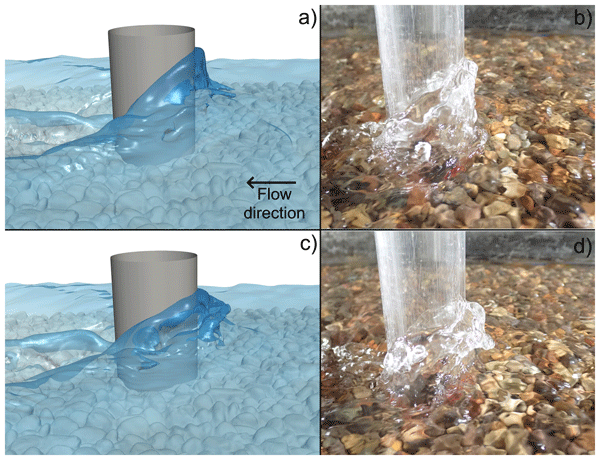
Mountain rivers create fast-flowing water that behaves differently around obstacles compared to slower flows. We used computer simulations and digital bed representation to study how rough riverbeds affect water flow. Our research shows individual grains completely change water movement, creating chaotic patterns instead of organized flows. This makes forces on riverbeds much more variable than previously thought, important for understanding how mountain rivers shape landscapes.
Cited articles
Abdi, H. and Williams, L. J.: Principal component analysis, Wiley Interdiscip. Rev. Comput. Stat., 2, 433–459, 2010.
Abunyewah, M., Erdiaw-Kwasie, M. O., Okyere, S. A., Thayaparan, G., Byrne, M., Lassa, J., Zander, K. K., Fatemi, M. N., and Maund, K.: Influence of personal and collective social capital on flood preparedness and community resilience: Evidence from Old Fadama, Ghana, Int. J. Disast. Risk Re., 94, 103790, https://doi.org/10.1016/j.ijdrr.2023.103790, 2023.
Adikari, Y. and Yoshitani, J.: Global trends in water-related disasters: An insight for policymakers, UNESCO: United Nations Educational, Scientific and Cultural Organisation, France, COI: 20.500.12592/zgkjrp, https://coilink.org/20.500.12592/zgkjrp (last access: 28 May 2026), 2009.
Alcayaga, H., Link, O., Mendoza Leal, C., and Arriagada, P.: The practically ungaugeable and damaging storms of the Atacama Desert, Chile, Nat. Hazards, https://doi.org/10.1007/s11069-025-07337-6, 2025.
Ali, A., Rana, I. A., Ali, A., and Najam, F. A.: Flood risk perception and communication: The role of hazard proximity, J. Environ. Manage., 316, 115309, https://doi.org/10.1016/j.jenvman.2022.115309, 2022.
Alkire, S. and Foster, J.: Counting and multidimensional poverty measurement, OPHI Working Paper No. 7, Oxford Poverty and Human Development Initiative, University of Oxford, Oxford, UK, 2007.
Ashenefe, B., Wubshet, M., and Shimeka, A.: Household flood preparedness and associated factors in the flood-prone community of Dembia district, Amhara National Regional State, northwest Ethiopia, Risk Manag. Healthc. Policy, 10, 95–106, https://doi.org/10.2147/RMHP.S127511, 2017.
Barendrecht, M. H., Viglione, A., and Blöschl, G.: A dynamic framework for flood risk, Water Secur., 1, 3–11, 2017.
Barendrecht, M. H., Viglione, A., Kreibich, H., Merz, B., Vorogushyn, S., and Blöschl, G.: The value of empirical data for estimating the parameters of a sociohydrological flood risk model, Water Resour. Res., 55, 1312–1336, https://doi.org/10.1029/2018WR024128, 2019.
Becker, G., Aerts, J. C., and Huitema, D.: Influence of flood risk perception and other factors on risk-reducing behaviour: a survey of municipalities along the Rhine, J. Flood Risk Manag., 7, 16–30, 2014.
Bin-Husayn, A. R., Abdullah, M., and Rimmel, G.: The relationship between risk perception and risk management: a systematic literature review, J. Risk Res., 27, 1290–1307, 2024.
Birkholz, S., Muro, M., Jeffrey, P., and Smith, H. M.: Rethinking the relationship between flood risk perception and flood management, Sci. Total Environ., 478, 12–20, 2014.
Blokland, T.: Community as urban practice, Polity Press, Cambridge, UK, ISBN 978-1-5095-0481-7, ISBN 978-1-5095-0482-4, 2017.
Blöschl, G.: Three hypotheses on changing river flood hazards, Hydrol. Earth Syst. Sci., 26, 5015–5033, https://doi.org/10.5194/hess-26-5015-2022, 2022.
Bodoque, J. M., Guardiola-Albert, C., Aroca-Jiménez, E., Eguibar, M. A., and Martinez-Chenoll, L.: Flood damage analysis: First floor elevation uncertainty resulting from LiDAR-derived digital surface models, Remote Sens., 8, 604, https://doi.org/10.3390/rs8070604, 2016.
Bourdieu, P.: La miseria del mundo, Fondo de Cultura Económica, México, ISBN 978-950-557-270-0, 1999.
Bradford, R. A., O'Sullivan, J. J., van der Craats, I. M., Krywkow, J., Rotko, P., Aaltonen, J., Bonaiuto, M., De Dominicis, S., Waylen, K., and Schelfaut, K.: Risk perception – issues for flood management in Europe, Nat. Hazards Earth Syst. Sci., 12, 2299–2309, https://doi.org/10.5194/nhess-12-2299-2012, 2012.
Bronfman, N. C., Cisternas, P. C., Repetto, P. B., and Castañeda, J. V.: Natural disaster preparedness in a multi-hazard environment: Characterizing the sociodemographic profile of those better (worse) prepared, PLoS One, 14, e0214249, https://doi.org/10.1371/journal.pone.0214249, 2019.
Cao, W., Yang, Y., Huang, J., Sun, D., and Liu, G.: Influential factors affecting protective coping behaviors of flood disaster: A case study in Shenzhen, China, Int. J. Environ. Res. Pub. He., 17, 5945, https://doi.org/10.3390/ijerph17165945, 2020.
Cutter, S. L., Boruff, B. J., and Shirley, W. L.: Social vulnerability to environmental hazards, Soc. Sci. Quart., 84, 242–261, 2003.
Cutter, S. L., Emrich, C. T., Morath, D. P., and Dunning, C. M.: Integrating social vulnerability into federal flood risk management planning, J. Flood Risk Manage., 6, 332–344, 2013.
Damper, R. I.: Editorial for the special issue on “Emergent Properties of Complex Systems”: Emergence and levels of abstraction, Kybernetes, 29, 1440–1453, https://doi.org/10.1080/002077200406543, 2000.
De Moel, H., Jongman, B., Kreibich, H., Merz, B., Penning-Rowsell, E., and Ward, P. J.: Flood risk assessments at different spatial scales, Mitig. Adapt. Strat. Gl., 20, 865–890, 2015.
Dirección General de Aguas (DGA): Inventario de cuencas, subcuencas y sub–subcuencas de Chile, http://sad.dga.cl (last access: 28 May 2026), 2014.
Dirección General de Aguas (DGA): Streamflow gauges (SFG), https://dga.mop.gob.cl/servicioshidrometeorologicos/Paginas/default.aspx (last access: 28 May 2026), 2021.
Di Baldassarre, G., Viglione, A., Carr, G., Kuil, L., Yan, K., Brandimarte, L., and Blöschl, G.: Debates – Perspectives on socio-hydrology: Capturing feedbacks between physical and social processes, Water Resour. Res., 51, 4770–4781, 2015.
Di Baldassarre, G.: Socio-hydrology of floods, Oxford Res. Encycl. Nat. Hazard Sci., https://doi.org/10.1093/acrefore/9780199389407.013.264, 2017.
Díez-Herrero, A., Laín-Huerta, L., and Llorente-Isidro, M. A.: Handbook on flood hazard mapping methodologies, Spain Geological Survey, Madrid, ISBN 978-84-7840-813-9, 2009.
Działek, J., Biernacki, W., Konieczny, R., Fiedeń, Ł., Franczak, P., Grzeszna, K., and Listwan-Franczak, K.: Understanding flood preparedness: flood memories, social vulnerability and risk communication in Southern Poland, Springer, https://doi.org/10.1007/978-3-030-04594-4, 2019.
Egli, T. and Wehner, K.: Non-structural flood plain management: measures and their effectiveness, International Commission for the Protection of the Rhine (ICPR), ISBN 3-935324-47-2, 2002.
Georgiou, I: The idea of emergent property, J. Oper. Res. Soc., 54, 239–247, https://doi.org/10.1057/palgrave.jors.2601509, 2003.
Gower, J. C. and Hand, D. J.: Biplots, Vol. 54, CRC Press, ISBN 0-412-71630-5, 1995.
Gower, J. C. and Hand, D. J.: Biplots, Monographs on Statistics and Applied Probability 54, Chapman & Hall, London, UK, ISBN 0-412-71630-5, 1996.
Gray-Scholz, D., Haney, T. J., and MacQuarrie, P.: Out of sight, out of mind? Geographic and social predictors of flood risk awareness, Risk Anal., 39, 2543–2558, https://doi.org/10.1111/risa.13357, 2019.
Haer, T., Botzen, W. W., and Aerts, J. C.: The effectiveness of flood risk communication strategies and the influence of social networks – insights from an agent-based model, Environ. Sci. Pol,, 60, 44–52, 2016.
Houston, J.: Variability of precipitation in the Atacama Desert: its causes and hydrological impact, Int. J. Climatol., 26, 2181–2198, 2006.
Instituto Nacional de Estadísticas (INE): Censo de Población y Vivienda 2017, http://resultados.censo2017.cl (last access: 28 May 2026), 2017.
Instituto Nacional de Estadísticas (INE): Censo de Población y Vivienda 2024, https://censo2024.ine.gob.cl/ (last access: 28 May 2026), 2002.
Instituto Nacional de Estadísticas (INE): Censo de Población y Vivienda 2024, https://censo2024.ine.gob.cl/ (last access: 28 May 2026), 2024.
Jonkman, S. N. and Penning-Rowsell, E.: Human instability in flood flows, J. Am. Water Resour. Assoc., 44, 1208–1218, 2008.
Karunarathne, A. Y. and Lee, G.: The geographies of the dynamic evolution of social networks for the flood disaster response and recovery, Appl. Geogr., 125, 102274, https://doi.org/10.1016/j.apgeog.2020.102274, 2020.
Kerstholt, J., Duijnhoven, H., and Paton, D.: Flooding in The Netherlands: How people’s interpretation of personal, social and institutional resources influences flooding preparedness, Int. J. Disaster Risk Reduct., 24, 52–57, https://doi.org/10.1016/j.ijdrr.2017.05.013, 2017.
Koks, E. E., Jongman, B., Husby, T. G., and Botzen, W. J.: Combining hazard, exposure and social vulnerability to provide lessons for flood risk management, Environ. Sci. Pol., 47, 42–52, 2015.
Krellenberg, K., Link, F., Welz, J., Harris, J., Barth, K., and Irarrazaval, F.: Supporting local adaptation: The contribution of socio-environmental fragmentation to urban vulnerability, Appl. Geogr., 55, 61–70, 2014.
Kuhlicke, C., Seebauer, S., Hudson, P., Begg, C., Bubeck, P., Dittmer, C., Grothmann, T., Heidenreich, A., Kreibich, H., Lorenz, D. F., Masson, T., Reiter, J., Thaler, T., Thieken, A. H., and Bamberg, S.: The behavioral turn in flood risk management, its assumptions and potential implications, Wiley Interdiscip. Rev. Water, 7, e1418, https://doi.org/10.1002/wat2.1418, 2020.
Lechowska, E.: What determines flood risk perception? A review of factors of flood risk perception and relations between its basic elements, Nat. Hazards, 94, 1341–1366, 2018.
Lechowska, E.: Approaches in research on flood risk perception and their importance in flood risk management: a review, Nat. Hazards, 111, 2343–2378, 2022.
Leong, C.: The role of narratives in sociohydrological models of flood behaviors, Water Resour. Res., 54, 3100–3121, 2018.
Lin, S., Shaw, D., and Ho, M.-C.: Why are flood and landslide victims less willing to take mitigation measures than the public?, Nat. Hazards, 44, 305–314, 2008.
Link, O., Brox-Escudero, L. M., González, J., Aguayo, M., Torrejón, F., Montalva, G., and Eguibar-Galán, M. Á.: A paleo-hydro-geomorphological perspective on urban flood risk assessment, Hydrol. Process., 33, 3169–3183, 2019.
Martín-Vide, J. P.: Ingeniería fluvial, Univ. Politèc. de Catalunya, Barcelona, ISBN 978-84-8301-722-7, 2009.
Mavhura, E., Manyangadze, T., Mudavanhu, C., and Pedzisai, E.: An assessment of riparian communities' preparedness to flood risk: The case of Mbire communities in Zimbabwe, GeoJournal, 87, 1671–1693, 2022.
Mazzoleni, M., Mondino, E., Matanó, A., Van Loon, A. F., and Barendrecht, M. H.: Modelling the role of multiple risk attitudes in implementing adaptation measures to reduce drought and flood losses, J. Hydrol., 636, 131305, https://doi.org/10.1016/j.jhydrol.2024.131305, 2024.
Mazzorana, B., Simoni, S., Scherer, C., Gems, B., Fuchs, S., and Keiler, M.: A physical approach on flood risk vulnerability of buildings, Hydrol. Earth Syst. Sci., 18, 3817–3836, https://doi.org/10.5194/hess-18-3817-2014, 2014.
Ministry of Social Development and Family: Encuesta de Caracterización Socioeconómica Nacional (CASEN) 2022, https://observatorio.ministeriodesarrollosocial.gob.cl/encuesta-casen-2022 (last access: 28 May 2026), 2023.
Mendoza Leal, C., Coloma, R., Ponce, D., Alarcón, B., Guerra, M., Stehr, A., Carrasco, J. A., Alcayaga, H., Rojas, O., Link, F., and Link, O.: The status quo effect in the sociohydrology of floods, Hydrol. Sci. J., 69, 2423–2435, 2024.
Mondino, E., Scolobig, A., Borga, M., and Di Baldassarre, G.: The role of experience and different sources of knowledge in shaping flood risk awareness, Water, 12, 2130, https://doi.org/10.3390/w12082130, 2020.
Observatorio de Ciudades UC: Observatorio de Ciudades UC, https://observatoriodeciudades.com/ (last access: 28 May 2026), 2019.
O'Neill, E., Brereton, F., Shahumyan, H., and Clinch, J. P.: The impact of perceived flood exposure on flood-risk perception: The role of distance, Risk Anal., 36, 2158–2186, 2016.
Poussin, J. K., Botzen, W. W., and Aerts, J. C.: Factors of influence on flood damage mitigation behaviour by households, Environ. Sci. Policy, 40, 69–77, 2014.
Raaijmakers, R., Krywkow, J., and van der Veen, A.: Flood risk perceptions and spatial multi-criteria analysis: an exploratory research for hazard mitigation, Nat. Hazards, 46, 307–322, 2008.
Reuter, H., Hölker, F., Middelhoff, U., Jopp, F., Eschenbach, C., and Breckling, B.: The concepts of emergent and collective properties in individual-based models – summary and outlook of the Bornhöved case studies, Ecol. Model., 186, 489–501, 2005.
Rosas Araya, M.: ismtchile: Territorial Socio-Material Index for Chile, https://ismtchile.geocoded.dev/home (last access: 28 May 2026), 2025.
Rufat, S., Fekete, A., Armaş, I., Hartmann, T., Kuhlicke, C., Prior, T., Thaler, T., and Wisner, B.: Swimming alone? Why linking flood risk perception and behavior requires more than “it's the individual, stupid”, Wiley Interdiscip. Rev. Water, 7, e1462, https://doi.org/10.1002/wat2.1462, 2020.
Santos, P. P., Pereira, S., Zêzere, J. L., Tavares, A. O., Reis, E., Garcia, R. A., and Oliveira, S. C.: A comprehensive approach to understanding flood risk drivers at the municipal level, J. Environ. Manage., 260, 110127, https://doi.org/10.1016/j.jenvman.2020.110127, 2020.
Sarricolea, P., Meseguer Ruiz, O., and Romero-Aravena, H.: Tendencias de la precipitación en el norte grande de Chile y su relación con las proyecciones de cambio climático, Diálogo Andino, 54, 41–50, 2017.
Scolobig, A., De Marchi, B., and Borga, M.: The missing link between flood risk awareness and preparedness: findings from case studies in an Alpine Region, Nat. Hazards, 63, 499–520, 2012.
Shah, A. A., Ye, J., Abid, M., and Ullah, R.: Determinants of flood risk mitigation strategies at household level: a case of Khyber Pakhtunkhwa (KP) province, Pakistan, Nat. Hazards, 88, 415–430, 2017.
Sivapalan, M., Savenije, H. H., and Blöschl, G.: Socio-hydrology: A new science of people and water, Hydrol. Process., 26, 1270–1276, 2012.
Sivapalan, M. and Blöschl, G.: Time scale interactions and the coevolution of humans and water, Water Resour. Res., 51, 6988–7022, https://doi.org/10.1002/2015WR017896, 2015.
Stephenson, V. and D'Ayala, D.: A new approach to flood vulnerability assessment for historic buildings in England, Nat. Hazards Earth Syst. Sci., 14, 1035–1048, https://doi.org/10.5194/nhess-14-1035-2014, 2014.
SUBDERE: Sistema Nacional de Información Municipal (SINIM), Subsecretaría de Desarrollo Regional y Administrativo, https://datos.sinim.gov.cl/ (last access: 28 May 2026), 2022.
Takao, K., Motoyoshi, T., Sato, T., Fukuzondo, T., Seo, K., and Ikeda, S.: Factors determining residents' preparedness for floods in modern megalopolises: the case of the Tokai flood disaster in Japan, J. Risk Res., 7, 775–787, 2004.
Terpstra, T.: Emotions, trust, and perceived risk: Affective and cognitive routes to flood preparedness behavior, Risk Anal., 31, 1658–1675, https://doi.org/10.1111/j.1539-6924.2011.01616.x, 2011.
Veloso, C., Flores, E., Noguera, I., Faúndez, R., Arriagada, P., Rojas, O., Carrasco, J. A., and Link, O.: Preparedness against floods in nearly pristine socio-hydrological systems, Hydrol. Sci. J., 67, 319–327, 2022.
Wachinger, G., Renn, O., Begg, C., and Kuhlicke, C.: The risk perception paradox – implications for governance and communication of natural hazards, Risk Anal., 33, 1049–1065, 2013.
Xia, J., Falconer, R. A., Lin, B., and Tan, G.: Numerical assessment of flood hazard risk to people and vehicles in flash floods, Environ. Model. Softw., 26, 987–998, 2011.
Short summary
Based on a survey of 1007 residents in four different localities of Chile exposed to river floods, this study builds and applies a framework for assessment of flood risk perception and flood behaviour at the individual, household, neighbourhood and municipality levels. Obtained results suggest that risk communication and risk management strategies should be adapted to focus on the needs of specific neighbourhoods exposed to floods.
Based on a survey of 1007 residents in four different localities of Chile exposed to river...
Altmetrics
Final-revised paper
Preprint