
Articles | Volume 26, issue 5
https://doi.org/10.5194/nhess-26-2387-2026
© Author(s) 2026. This work is distributed under
the Creative Commons Attribution 4.0 License.
the Creative Commons Attribution 4.0 License.
https://doi.org/10.5194/nhess-26-2387-2026
© Author(s) 2026. This work is distributed under
the Creative Commons Attribution 4.0 License.
the Creative Commons Attribution 4.0 License.
Research article
| 
27 May 2026
Research article |
| 27 May 2026
| 27 May 2026
Evaluating the effects of preprocessing, method selection, and hyperparameter tuning on SAR-based flood mapping and water depth estimation
Jean-Paul Travert
CORRESPONDING AUTHOR
EDF R&D, Laboratoire National d’Hydraulique et Environnement (LNHE), Chatou, France
Laboratoire d’Hydraulique Saint-Venant (LHSV), ENPC, Institut Polytechnique de Paris, EDF R&D, Chatou, France
Cédric Goeury
EDF R&D, Laboratoire National d’Hydraulique et Environnement (LNHE), Chatou, France
Laboratoire d’Hydraulique Saint-Venant (LHSV), ENPC, Institut Polytechnique de Paris, EDF R&D, Chatou, France
Sébastien Boyaval
Laboratoire d’Hydraulique Saint-Venant (LHSV), ENPC, Institut Polytechnique de Paris, EDF R&D, Chatou, France
Inria, Paris, France
Vito Bacchi
EDF R&D, Laboratoire National d’Hydraulique et Environnement (LNHE), Chatou, France
Fabrice Zaoui
EDF R&D, Laboratoire National d’Hydraulique et Environnement (LNHE), Chatou, France
Related authors
No articles found.
Fabien Souillé, Cédric Goeury, and Rem-Sophia Mouradi
The Cryosphere, 17, 1645–1674, https://doi.org/10.5194/tc-17-1645-2023, https://doi.org/10.5194/tc-17-1645-2023, 2023
Short summary
Short summary
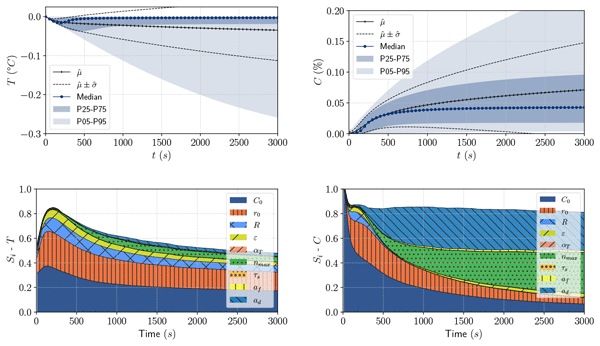
Models that can predict temperature and ice crystal formation (frazil) in water are important for river and coastal engineering. Indeed, frazil has direct impact on submerged structures and often precedes the formation of ice cover. In this paper, an uncertainty analysis of two mathematical models that simulate supercooling and frazil is carried out within a probabilistic framework. The presented methodology offers new insight into the models and their parameterization.
Cited articles
Akiba, T., Sano, S., Yanase, T., Ohta, T., and Koyama, M.: Optuna: A next-generation hyperparameter optimization framework, in: Proceedings of the 25th ACM SIGKDD international conference on knowledge discovery & data mining, pp. 2623–2631, https://doi.org/10.1145/3292500.3330701, 2019. a
Ashman, K. M., Bird, C. M., and Zepf, S. E.: Detecting bimodality in astronomical datasets, arXiv preprint astro-ph/9408030, https://doi.org/10.1086/117248, 1994. a
Bates, P. D.: Integrating remote sensing data with flood inundation models: how far have we got?, Hydrol. Process., 26, 2515–2521, https://doi.org/10.1002/hyp.9374, 2012. a
Bazi, Y., Bruzzone, L., and Melgani, F.: An unsupervised approach based on the generalized Gaussian model to automatic change detection in multitemporal SAR images, IEEE T. Geosci. Remote, 43, 874–887, https://doi.org/10.1109/TGRS.2004.842441, 2005. a
Bentivoglio, R., Isufi, E., Jonkman, S. N., and Taormina, R.: Deep learning methods for flood mapping: a review of existing applications and future research directions, Hydrol. Earth Syst. Sci., 26, 4345–4378, https://doi.org/10.5194/hess-26-4345-2022, 2022. a, b
Besnard, A. and Goutal, N.: Comparaison de modèles 1D à casiers et 2D pour la modélisation hydraulique d’une plaine d’inondation–Cas de la Garonne entre Tonneins et La Réole, La Houille Blanche, pp. 42–47, https://doi.org/10.1051/lhb/2011031, 2011. a, b
Bhattacharyya, A.: On a measure of divergence between two statistical populations defined by their probability distribution, Bull. Calcutta Math. S., 35, 99–110, 1943. a
Bonafilia, D., Tellman, B., Anderson, T., and Issenberg, E.: Sen1Floods11: A georeferenced dataset to train and test deep learning flood algorithms for sentinel-1, in: Proceedings of the IEEE/CVF Conference on Computer Vision and Pattern Recognition Workshops, pp. 210–211, https://doi.org/10.1109/CVPRW50498.2020.00113, 2020. a, b, c
Bovolo, F. and Bruzzone, L.: A split-based approach to unsupervised change detection in large-size multitemporal images: Application to tsunami-damage assessment, IEEE T. Geosci. Remote, 45, 1658–1670, https://doi.org/10.1109/TGRS.2007.895835, 2007. a
Breiman, L.: Random forests, Mach. Learn., 45, 5–32, https://doi.org/10.1023/A:1010933404324, 2001. a
Brown, K. M., Hambidge, C. H., and Brownett, J. M.: Progress in operational flood mapping using satellite synthetic aperture radar (SAR) and airborne light detection and ranging (LiDAR) data, Prog. Phys. Geog., 40, 196–214, https://doi.org/10.1177/0309133316633570, 2016. a
Bruniquel, J. and Lopes, A.: Multi-variate optimal speckle reduction in SAR imagery, Int. J. Remote Sens., 18, 603–627, https://doi.org/10.1080/014311697218962, 1997. a
Chan, T. F. and Vese, L. A.: Active contours without edges, IEEE T. Image Process., 10, 266–277, https://doi.org/10.1109/83.902291, 2001. a
Chini, M., Hostache, R., Giustarini, L., and Matgen, P.: A hierarchical split-based approach for parametric thresholding of SAR images: Flood inundation as a test case, IEEE T. Geosci. Remote S., 55, 6975–6988, https://doi.org/10.1109/tgrs.2017.2737664, 2017. a, b, c, d
Chow, V. T., Maidment, D. R., and Mays, L. W.: Applied hydrology, McGraw-Hill Book Company, https://ponce.sdsu.edu/Applied_Hydrology_Chow_1988.pdf (last access: 26 May 2026), 1988. a
Clement, M. A., Kilsby, C., and Moore, P.: Multi-temporal synthetic aperture radar flood mapping using change detection, J. Flood Risk Manag., 11, 152–168, https://doi.org/10.1111/jfr3.12303, 2018. a
Cohen, S., Brakenridge, G. R., Kettner, A., Bates, B., Nelson, J., McDonald, R., Huang, Y.-F., Munasinghe, D., and Zhang, J.: Estimating floodwater depths from flood inundation maps and topography, JAWRA J. Am. Water Resour. Assoc., 54, 847–858, https://doi.org/10.1111/1752-1688.12609, 2018. a, b
Cohen, S., Raney, A., Munasinghe, D., Loftis, J. D., Molthan, A., Bell, J., Rogers, L., Galantowicz, J., Brakenridge, G. R., Kettner, A. J., Huang, Y.-F., and Tsang, Y.-P.: The Floodwater Depth Estimation Tool (FwDET v2.0) for improved remote sensing analysis of coastal flooding, Nat. Hazards Earth Syst. Sci., 19, 2053–2065, https://doi.org/10.5194/nhess-19-2053-2019, 2019. a, b, c, d
Dalsasso, E., Denis, L., and Tupin, F.: SAR2SAR: A semi-supervised despeckling algorithm for SAR images, IEEE J. Sel. Top. Appl., 14, 4321–4329, https://doi.org/10.1109/JSTARS.2021.3071864, 2021. a, b, c
Dasgupta, A., Hostache, R., Ramsankaran, R., Schumann, G. J.-P., Grimaldi, S., Pauwels, V. R., and Walker, J. P.: A mutual information-based likelihood function for particle filter flood extent assimilation, Water Resour. Res., 57, e2020WR027859, https://doi.org/10.1029/2020WR027859, 2021. a
Deledalle, C.-A., Denis, L., Tupin, F., Reigber, A., and Jäger, M.: NL-SAR: A unified nonlocal framework for resolution-preserving (Pol)(In) SAR denoising, IEEE T. Geosci. Remote S., 53, 2021–2038, https://doi.org/10.1109/TGRS.2014.2352555, 2014. a
Di Baldassarre, G., Schumann, G., and Bates, P. D.: A technique for the calibration of hydraulic models using uncertain satellite observations of flood extent, J. Hydrol., 367, 276–282, https://doi.org/10.1016/j.jhydrol.2009.01.020, 2009. a, b
El Garroussi, S., de Lozzo, M., Ricci, S., Lucor, D., Goutal, N., Goeury, C., and Boyaval, S.: Uncertainty quantification in a two-dimensional river hydraulic model, in: International Conference on Uncertainty Quantification in Computational Sciences and Engineering, https://doi.org/10.7712/120219.6339.18380, 2019. a
Frost, V. S., Stiles, J. A., Shanmugan, K. S., and Holtzman, J. C.: A model for radar images and its application to adaptive digital filtering of multiplicative noise, IEEE T. Pattern Anal., 4, pp. 157–166, https://doi.org/10.1109/TPAMI.1982.4767223, 1982. a, b
Ghosh, B., Garg, S., Motagh, M., and Martinis, S.: Automatic flood detection from Sentinel-1 data using a nested UNet model and a NASA benchmark dataset, PFG – Journal of Photogrammetry, Remote Sensing and Geoinformation Science, 92, 1–18, https://doi.org/10.1007/s41064-024-00275-1, 2024. a, b
Giustarini, L., Matgen, P., Hostache, R., Montanari, M., Plaza, D., Pauwels, V. R. N., De Lannoy, G. J. M., De Keyser, R., Pfister, L., Hoffmann, L., and Savenije, H. H. G.: Assimilating SAR-derived water level data into a hydraulic model: a case study, Hydrol. Earth Syst. Sci., 15, 2349–2365, https://doi.org/10.5194/hess-15-2349-2011, 2011. a
Giustarini, L., Hostache, R., Matgen, P., Schumann, G. J.-P., Bates, P. D., and Mason, D. C.: A change detection approach to flood mapping in urban areas using TerraSAR-X, IEEE T. Geosci. Remote S., 51, 2417–2430, https://doi.org/10.1109/TGRS.2012.2210901, 2012. a
Goodman, J. W.: Some fundamental properties of speckle, JOSA, 66, 1145–1150, https://doi.org/10.1364/JOSA.66.001145, 1976. a
Grimaldi, S., Li, Y., Pauwels, V., and Walker, J. P.: Remote sensing-derived water extent and level to constrain hydraulic flood forecasting models: Opportunities and challenges, Surv. Geophys., 37, 977–1034, https://doi.org/10.1007/s10712-016-9378-y, 2016. a
Henry, J.-B., Chastanet, P., Fellah, K., and Desnos, Y.-L.: Envisat multi-polarized ASAR data for flood mapping, Int. J. Remote Sens., 27, 1921–1929, https://doi.org/10.1080/01431160500486724, 2006. a
Hervouet, J.-M.: Hydrodynamics of free surface flows: modelling with the finite element method, John Wiley & Sons, https://doi.org/10.1002/9780470319628, 2007. a
Horritt, M.: A statistical active contour model for SAR image segmentation, Image Vision Comput., 17, 213–224, https://doi.org/10.1016/S0262-8856(98)00101-2, 1999. a, b
Hostache, R., Matgen, P., Schumann, G., Puech, C., Hoffmann, L., and Pfister, L.: Water level estimation and reduction of hydraulic model calibration uncertainties using satellite SAR images of floods, IEEE T. Geosci. Remote, 47, 431–441, https://doi.org/10.1109/tgrs.2008.2008718, 2009. a, b, c, d
Hostache, R., Lai, X., Monnier, J., and Puech, C.: Assimilation of spatially distributed water levels into a shallow-water flood model. Part II: Use of a remote sensing image of Mosel River, J. Hydrol., 390, 257–268, https://doi.org/10.1016/j.jhydrol.2010.07.003, 2010. a
Hostache, R., Matgen, P., and Wagner, W.: Change detection approaches for flood extent mapping: How to select the most adequate reference image from online archives?, Int. J. Appl. Earth Observ. Geoinfo., 19, 205–213, https://doi.org/10.1016/j.jag.2012.05.003, 2012. a
Huang, T. and Merwade, V.: Beyond a fixed number: Investigating uncertainty in popular evaluation metrics of ensemble flood modeling using bootstrapping analysis, J. Flood Risk Manag., 17, e12982, https://doi.org/10.1111/jfr3.12982, 2024. a
Hunter, N. M.: Development and assessment of dynamic storage cell codes for flood inundation modelling, Ph.D. thesis, University of Bristol, https://hdl.handle.net/1983/c8858588-ee07-4810-aacc-4f1d74d7643a (26 May 2026), 2005. a
Kittler, J. and Illingworth, J.: Minimum error thresholding, Pattern Recogn., 19, 41–47, https://doi.org/10.1016/0031-3203(86)90030-0, 1986. a
Lai, X., Liang, Q., Yesou, H., and Daillet, S.: Variational assimilation of remotely sensed flood extents using a 2-D flood model, Hydrol. Earth Syst. Sci., 18, 4325–4339, https://doi.org/10.5194/hess-18-4325-2014, 2014. a
Landuyt, L., Van Wesemael, A., Schumann, G. J.-P., Hostache, R., Verhoest, N. E., and Van Coillie, F. M.: Flood mapping based on synthetic aperture radar: An assessment of established approaches, IEEE T. Geosci. Remote, 57, 722–739, https://doi.org/10.1109/tgrs.2018.2860054, 2018. a, b, c, d
Landwehr, T., Dasgupta, A., and Waske, B.: Towards robust validation strategies for EO flood maps, Remote Sens. Environ., 315, 114439, https://doi.org/10.1016/j.rse.2024.114439, 2024. a
LeCun, Y., Bengio, Y., and Hinton, G.: Deep learning, Nature, 521, 436–444, https://doi.org/10.1038/nature14539, 2015. a
Lee, J.-S.: Digital image enhancement and noise filtering by use of local statistics, IEEE T. Pattern Anal., pp. 165–168, https://doi.org/10.1109/TPAMI.1980.4766994, 1980. a, b
Lee, J.-S.: Digital image smoothing and the sigma filter, Lect. Notes Comput. Sc., 24, 255–269, https://doi.org/10.1016/0734-189X(83)90047-6, 1983. a, b
Lee, J.-S. and Pottier, E.: Polarimetric radar imaging: from basics to applications, CRC press, https://doi.org/10.1201/9781420054989, 2017. a
Lee, J.-S., Jurkevich, L., Dewaele, P., Wambacq, P., and Oosterlinck, A.: Speckle filtering of synthetic aperture radar images: A review, Remote Sens. Rev., 8, 313–340, https://doi.org/10.1080/02757259409532206, 1994. a
Lee, J.-S., Wen, J.-H., Ainsworth, T. L., Chen, K.-S., and Chen, A. J.: Improved sigma filter for speckle filtering of SAR imagery, IEEE T. Geosci. Remote, 47, 202–213, https://doi.org/10.1109/TGRS.2008.2002881, 2008. a, b, c
Li, Y., Martinis, S., Plank, S., and Ludwig, R.: An automatic change detection approach for rapid flood mapping in Sentinel-1 SAR data, Int. J. Appl. Earth Obs., 73, 123–135, https://doi.org/10.1016/j.jag.2018.05.023, 2018. a
Manning, R., Griffith, J. P., Pigot, T., and Vernon-Harcourt, L. F.: On the flow of water in open channels and pipes, 20, 161–207, 1890. a
Martinis, S.: Automatic near real-time flood detection in high resolution X-band synthetic aperture radar satellite data using context-based classification on irregular graphs, Ph.D. thesis, lmu, https://doi.org/10.5282/edoc.12373, 2010. a
Martinis, S., Twele, A., and Voigt, S.: Towards operational near real-time flood detection using a split-based automatic thresholding procedure on high resolution TerraSAR-X data, Nat. Hazards Earth Syst. Sci., 9, 303–314, https://doi.org/10.5194/nhess-9-303-2009, 2009. a
Martinis, S., Kersten, J., and Twele, A.: A fully automated TerraSAR-X based flood service, ISPRS J. Photogramm., 104, 203–212, https://doi.org/10.1016/j.isprsjprs.2014.07.014, 2015a. a
Martinis, S., Kuenzer, C., Wendleder, A., Huth, J., Twele, A., Roth, A., and Dech, S.: Comparing four operational SAR-based water and flood detection approaches, Int. J. Remote S., 36, 3519–3543, https://doi.org/10.1080/01431161.2015.1060647, 2015b. a
Martinis, S., Groth, S., Wieland, M., Knopp, L., and Rättich, M.: Towards a global seasonal and permanent reference water product from Sentinel-1/2 data for improved flood mapping, Remote Sens. Environ., 278, 113077, https://doi.org/10.1016/j.rse.2022.113077, 2022. a
Mason, D., Schumann, G.-P., Neal, J., Garcia-Pintado, J., and Bates, P.: Automatic near real-time selection of flood water levels from high resolution Synthetic Aperture Radar images for assimilation into hydraulic models: A case study, Remote Sens. Environ., 124, 705–716, https://doi.org/10.1016/j.rse.2012.06.017, 2012. a
Mason, D. C., Speck, R., Devereux, B., Schumann, G. J.-P., Neal, J. C., and Bates, P. D.: Flood detection in urban areas using TerraSAR-X, IEEE T. Geosci. Remote, 48, 882–894, https://doi.org/10.1109/TGRS.2009.2029236, 2009. a
Mateo-Garcia, G., Veitch-Michaelis, J., Smith, L., Oprea, S. V., Schumann, G., Gal, Y., Baydin, A. G., and Backes, D.: Towards global flood mapping onboard low cost satellites with machine learning, Sci. Rep., 11, 1–12, https://doi.org/10.1038/s41598-021-86650-z, 2021. a
Montanari, M., Hostache, R., Matgen, P., Schumann, G., Pfister, L., and Hoffmann, L.: Calibration and sequential updating of a coupled hydrologic-hydraulic model using remote sensing-derived water stages, Hydrol. Earth Syst. Sci., 13, 367–380, https://doi.org/10.5194/hess-13-367-2009, 2009. a
Morvan, H., Knight, D., Wright, N., Tang, X., and Crossley, A.: The concept of roughness in fluvial hydraulics and its formulation in 1D, 2D and 3D numerical simulation models, J. Hydraul. Res., 46, 191–208, https://doi.org/10.1080/00221686.2008.9521855, 2008. a
Mumford, D. B. and Shah, J.: Optimal approximations by piecewise smooth functions and associated variational problems, Commun. Pure Appl. Math., https://doi.org/10.1002/cpa.3160420503, 1989. a
Nguyen, T. H., Ricci, S., Piacentini, A., Fatras, C., Kettig, P., Blanchet, G., Peña Luque, S., and Baillarin, S.: Dual State-Parameter Assimilation of SAR-derived Wet Surface Ratio for Improving Fluvial Flood Reanalysis, 58, e2022WR033155, Water Resour. Res., https://doi.org/10.1029/2022WR033155, 2022. a
Oberstadler, R., Hönsch, H., and Huth, D.: Assessment of the mapping capabilities of ERS-1 SAR data for flood mapping: a case study in Germany, Hydrol. Process., 11, 1415–1425, https://doi.org/10.1002/(SICI)1099-1085(199708)11:10<1415::AID-HYP532>3.0.CO;2-2, 1997. a
openTELEMAC Consortium: openTELEMAC, version v8p5r0, GitLab [code], https://gitlab.pam-retd.fr/otm/telemac-mascaret/-/tree/v8p5r0 (last access: 26 May 2026), 2024. a
Otsu, N.: A threshold selection method from gray-level histograms, IEEE T. Syst. Man Cyb., 9, 62–66, https://doi.org/10.1109/tsmc.1979.4310076, 1979. a
Pulvirenti, L., Marzano, F. S., Pierdicca, N., Mori, S., and Chini, M.: Discrimination of water surfaces, heavy rainfall, and wet snow using COSMO-SkyMed observations of severe weather events, IEEE T. Geosci. Remote, 52, 858–869, https://doi.org/10.1109/tgrs.2013.2244606, 2013. a
Ronneberger, O., Fischer, P., and Brox, T.: U-net: Convolutional networks for biomedical image segmentation, in: Medical image computing and computer-assisted intervention–MICCAI 2015: 18th international conference, Munich, Germany, October 5-9, 2015, proceedings, part III 18, pp. 234–241, Springer, https://doi.org/10.1007/978-3-319-24574-4_28, 2015. a
Schumann, G., Hostache, R., Puech, C., Hoffmann, L., Matgen, P., Pappenberger, F., and Pfister, L.: High-resolution 3-D flood information from radar imagery for flood hazard management, IEEE T. Geosci. Remote, 45, 1715–1725, https://doi.org/10.1109/tgrs.2006.888103, 2007. a, b, c
Schumann, G., Pappenberger, F., and Matgen, P.: Estimating uncertainty associated with water stages from a single SAR image, Adv. Water Res., 31, 1038–1047, https://doi.org/10.1016/j.advwatres.2008.04.008, 2008. a
Schumann, G., Di Baldassarre, G., Alsdorf, D., and Bates, P.: Near real-time flood wave approximation on large rivers from space: Application to the River Po, Italy, Water Resour. Res., 46, https://doi.org/10.1029/2008WR007672, 2010. a
Sezgin, M. and Sankur, B. l.: Survey over image thresholding techniques and quantitative performance evaluation, J. Electron. Imaging, 13, 146–168, https://doi.org/10.1117/1.1631315, 2004. a
Tarpanelli, A. and Benveniste, J.: On the potential of altimetry and optical sensors for monitoring and forecasting river discharge and extreme flood events, in: Extreme Hydroclimatic Events and Multivariate Hazards in a Changing Environment, pp. 267–287, Elsevier, https://doi.org/10.1016/B978-0-12-814899-0.00011-0, 2019. a
Travert, J.-P., Boyaval, S., Goeury, C., Bacchi, V., and Zaoui, F.: Evaluation of Performance Measures for Comparing Flood Models With Satellite Observations, Water Resour. Res., https://doi.org/10.1029/2024WR038506, 2025. a, b
Travert, J.-P., Goeury, C., Boyaval, S., Bacchi, V., and Zaoui, F.: jtravert/sar-flood-evaluation-framework: SAR Flood Evaluation Framework v1.0.0, Zenodo [data set], https://doi.org/10.5281/zenodo.20209044, 2026. a, b
Tupas, M. E., Roth, F., Bauer-Marschallinger, B., and Wagner, W.: An intercomparison of Sentinel-1 based change detection algorithms for flood mapping, Remote Sens., 15, 1200, https://doi.org/10.3390/rs15051200, 2023. a, b, c
Twele, A., Cao, W., Plank, S., and Martinis, S.: Sentinel-1-based flood mapping: a fully automated processing chain, Int. J. Remote Se., 37, 2990–3004, https://doi.org/10.1080/01431161.2016.1192304, 2016. a
Wagner, W., Bauer-Marschallinger, B., Roth, F., Raiger-Stachl, T., Reimer, C., McCormick, N., Matgen, P., Chini, M., Li, Y., Martinis, S., et al.: The fully-automatic Sentinel-1 Global Flood Monitoring service: Scientific challenges and future directions, Remote Sens. Environ., 333, 115108, https://doi.org/10.1016/j.rse.2025.115108, 2026. a
Zhao, G., Bates, P., Neal, J., and Pang, B.: Design flood estimation for global river networks based on machine learning models, Hydrol. Earth Syst. Sci., 25, 5981–5999, https://doi.org/10.5194/hess-25-5981-2021, 2021. a
Short summary
This study presents the impact of various processing methods on flood maps and water depth estimates derived from Synthetic Aperture Radar (SAR) satellite data. The results suggest that the choice of methods and parameters at each processing step has a strong influence on the outputs. This study emphasizes the importance of evaluating the entire processing pipeline to quantify the uncertainties which may hinder the capability to calibrate or validate hydrodynamic models.
This study presents the impact of various processing methods on flood maps and water depth...


Altmetrics
Final-revised paper
Preprint