
Articles | Volume 26, issue 5
https://doi.org/10.5194/nhess-26-2291-2026
© Author(s) 2026. This work is distributed under
the Creative Commons Attribution 4.0 License.
the Creative Commons Attribution 4.0 License.
https://doi.org/10.5194/nhess-26-2291-2026
© Author(s) 2026. This work is distributed under
the Creative Commons Attribution 4.0 License.
the Creative Commons Attribution 4.0 License.
Research article
| 
19 May 2026
Research article |
| 19 May 2026
| 19 May 2026
Detection of atmospheric rivers affecting the western Mediterranean and producing extreme rainfall over northern-central Italy

Dipartimento di Scienze della Terra “A. Desio”, Università degli Studi di Milano, Milan, 20133, Italy
Institute of Atmospheric Sciences and Climate, National Research Council of Italy, CNR-ISAC, Bologna, 40129, Italy
Isacco Sala
Dipartimento di Scienze della Terra “A. Desio”, Università degli Studi di Milano, Milan, 20133, Italy
Alessandro Comunian
Dipartimento di Scienze della Terra “A. Desio”, Università degli Studi di Milano, Milan, 20133, Italy
Daniele Mastrangelo
Institute of Atmospheric Sciences and Climate, National Research Council of Italy, CNR-ISAC, Bologna, 40129, Italy
Mario Marcello Miglietta
Institute of Atmospheric Sciences and Climate, National Research Council of Italy, CNR-ISAC, Padua, 35127, Italy
Lucia Drago Pitura
Institute of Atmospheric Sciences and Climate, National Research Council of Italy, CNR-ISAC, Bologna, 40129, Italy
now at: 3B Meteo S.r.l., Bergamo, 24036, Italy
Federico Grazzini
ARPAE, Hydro-Meteorological and Climate Service, Bologna, 40122, Italy
Related authors

Mario Marcello Miglietta, Elenio Avolio, Alessandro Bracci, Massimiliano Burlando, Francesco Cairo, Federico Canepa, Vincenzo Capozzi, Sebastiano Carpentari, Federico Cassola, Alessandro Ceppi, Silvio Davolio, Francesco De Martin, Giorgio Doglioni, Costanza Di Felice Fabrizi, Luca Di Liberto, Francesco Domenichini, Stefano Federico, Massimo Enrico Ferrario, Federico Grazzini, Antonio Iengo, Sante Laviola, Agostino Manzato, Paolo Paganini, Antonio Parodi, Alessandro Pavan, Andrea Piazza, Arturo Pucillo, Giovanni Ravezzani, Francesco Sioni, Barbara Turato, Gianfranco Vulpiani, Marco Zanatta, and Dino Zardi
Nat. Hazards Earth Syst. Sci., 26, 3395–3415, https://doi.org/10.5194/nhess-26-3395-2026, https://doi.org/10.5194/nhess-26-3395-2026, 2026
Short summary
Short summary
This paper represents a summary of the contribution that the Italian meteorological community is willing to provide to the forthcoming European field campaign on Thunderstorm Intensification from Mountains to plains, planned in 2028–2030. Critical issues regard both the available instrumentation and the accuracy of numerical models. These limitations, in the context of climate change making severe convective episodes more frequent, make the need for a dedicated field campaign urgent.
Paolo Stocchi, Francesco Cavalleri, Mohsin Tariq, Michele Brunetti, Stefania Camici, Daniele Mastrangelo, Fabio Di Sante, and Silvio Davolio
Earth Syst. Sci. Data Discuss., https://doi.org/10.5194/essd-2025-789, https://doi.org/10.5194/essd-2025-789, 2026
Preprint under review for ESSD
Short summary
Short summary
The MORE (MOLOCH Reanalysis over Italy) dataset provides high-resolution (~1.7 km) hourly weather data for Italy from 1990 to today, including precipitation, near-surface temperature, and 40 atmospheric variables. Validation shows it accurately reproduces local rainfall, temperature patterns, and extreme events, outperforming coarser datasets. MORE enables improved climate studies, flood risk assessment, and serves as a reference for climate services and advanced modeling applications.
Emmanouil Flaounas, Stavros Dafis, Silvio Davolio, Davide Faranda, Christian Ferrarin, Katharina Hartmuth, Assaf Hochman, Aristeidis Koutroulis, Samira Khodayar, Mario Marcello Miglietta, Florian Pantillon, Platon Patlakas, Michael Sprenger, and Iris Thurnherr
Weather Clim. Dynam., 6, 1515–1538, https://doi.org/10.5194/wcd-6-1515-2025, https://doi.org/10.5194/wcd-6-1515-2025, 2025
Short summary
Short summary
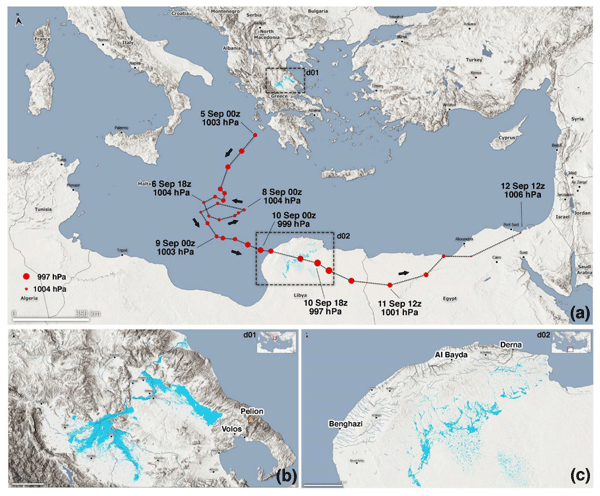
Storm Daniel (2023) is one of the most catastrophic storms ever documented in the Mediterranean. Our results highlight the different dynamics and therefore the different predictability skill of precipitation, its extremes and impacts that have been produced in Greece and Libya, the two most affected countries. Our approach concerns an analysis of the storm by articulating dynamics, weather prediction, hydrological and oceanographic implications, climate extremes, and attribution theory.
Claudio Sánchez, Suzanne Gray, Ambrogio Volonté, Florian Pantillon, Ségolène Berthou, and Silvio Davolio
Weather Clim. Dynam., 5, 1429–1455, https://doi.org/10.5194/wcd-5-1429-2024, https://doi.org/10.5194/wcd-5-1429-2024, 2024
Short summary
Short summary
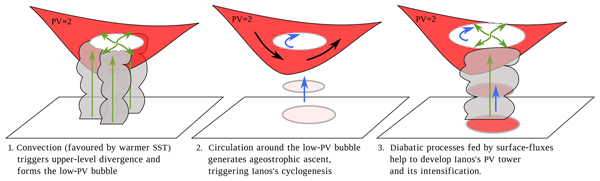
Medicane Ianos was a very intense cyclone that led to harmful impacts over Greece. We explore what processes are important for the forecasting of Medicane Ianos, with the use of the Met Office weather model. There was a preceding precipitation event before Ianos’s birth, whose energetics generated a bubble in the tropopause. This bubble created the necessary conditions for Ianos to emerge and strengthen, and the processes are enhanced in simulations with a warmer Mediterranean Sea.
Florian Pantillon, Silvio Davolio, Elenio Avolio, Carlos Calvo-Sancho, Diego Saul Carrió, Stavros Dafis, Emanuele Silvio Gentile, Juan Jesus Gonzalez-Aleman, Suzanne Gray, Mario Marcello Miglietta, Platon Patlakas, Ioannis Pytharoulis, Didier Ricard, Antonio Ricchi, Claudio Sanchez, and Emmanouil Flaounas
Weather Clim. Dynam., 5, 1187–1205, https://doi.org/10.5194/wcd-5-1187-2024, https://doi.org/10.5194/wcd-5-1187-2024, 2024
Short summary
Short summary
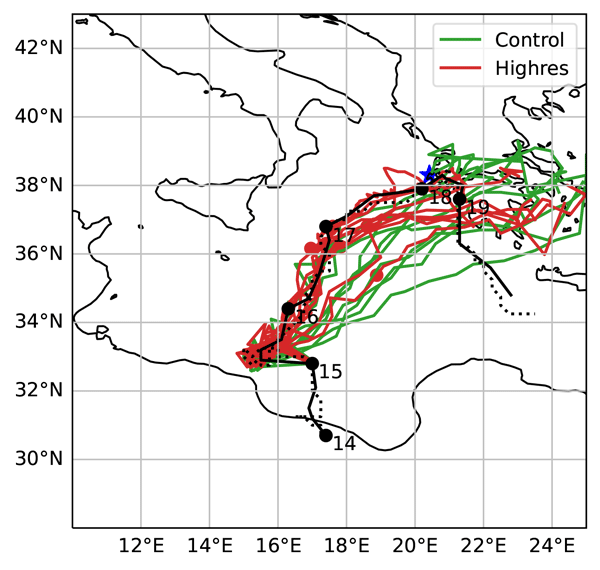
Cyclone Ianos of September 2020 was a high-impact but poorly predicted medicane (Mediterranean hurricane). A community effort of numerical modelling provides robust results to improve prediction. It is found that the representation of local thunderstorms controlled the interaction of Ianos with a jet stream at larger scales and its subsequent evolution. The results help us understand the peculiar dynamics of medicanes and provide guidance for the next generation of weather and climate models.
Christian Ferrarin, Florian Pantillon, Silvio Davolio, Marco Bajo, Mario Marcello Miglietta, Elenio Avolio, Diego S. Carrió, Ioannis Pytharoulis, Claudio Sanchez, Platon Patlakas, Juan Jesús González-Alemán, and Emmanouil Flaounas
Nat. Hazards Earth Syst. Sci., 23, 2273–2287, https://doi.org/10.5194/nhess-23-2273-2023, https://doi.org/10.5194/nhess-23-2273-2023, 2023
Short summary
Short summary
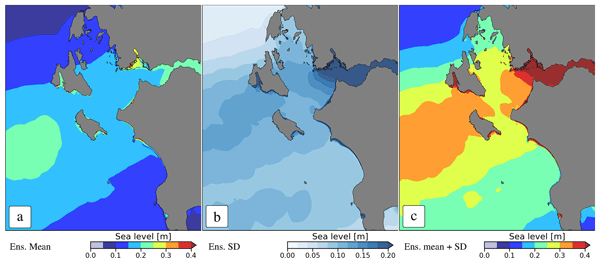
The combined use of meteorological and ocean models enabled the analysis of extreme sea conditions driven by Medicane Ianos, which hit the western coast of Greece on 18 September 2020, flooding and damaging the coast. The large spread associated with the ensemble highlighted the high model uncertainty in simulating such an extreme weather event. The different simulations have been used for outlining hazard scenarios that represent a fundamental component of the coastal risk assessment.
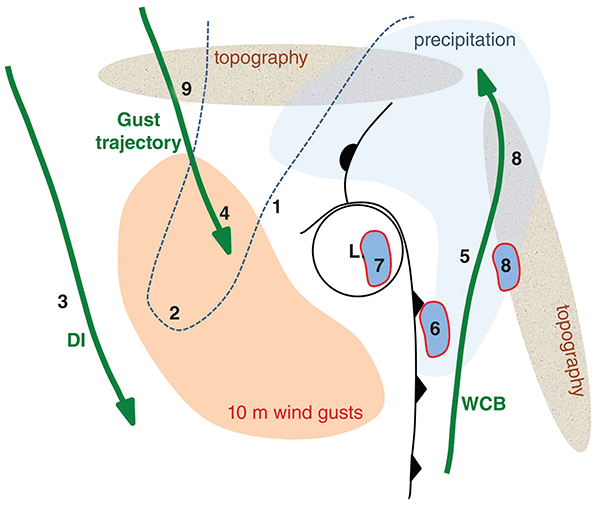
Emmanouil Flaounas, Silvio Davolio, Shira Raveh-Rubin, Florian Pantillon, Mario Marcello Miglietta, Miguel Angel Gaertner, Maria Hatzaki, Victor Homar, Samira Khodayar, Gerasimos Korres, Vassiliki Kotroni, Jonilda Kushta, Marco Reale, and Didier Ricard
Weather Clim. Dynam., 3, 173–208, https://doi.org/10.5194/wcd-3-173-2022, https://doi.org/10.5194/wcd-3-173-2022, 2022
Short summary
Short summary
This is a collective effort to describe the state of the art in Mediterranean cyclone dynamics, climatology, prediction (weather and climate scales) and impacts. More than that, the paper focuses on the future directions of research that would advance the broader field of Mediterranean cyclones as a whole. Thereby, we propose interdisciplinary cooperation and additional modelling and forecasting strategies, and we highlight the need for new impact-oriented approaches to climate prediction.
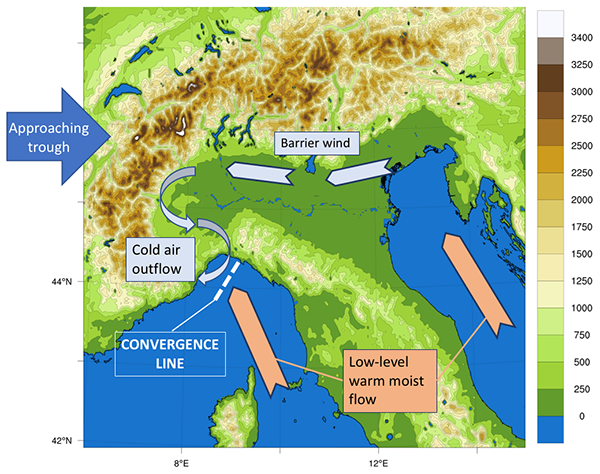
Mario Marcello Miglietta and Silvio Davolio
Hydrol. Earth Syst. Sci., 26, 627–646, https://doi.org/10.5194/hess-26-627-2022, https://doi.org/10.5194/hess-26-627-2022, 2022
Short summary
Short summary
The main results emerging from the HyMeX SOP1 campaign and in the subsequent research activity in three Italian target areas are highlighted through conceptual models and through the identification of the relevant mesoscale environmental characteristics conducive to heavy rain events.
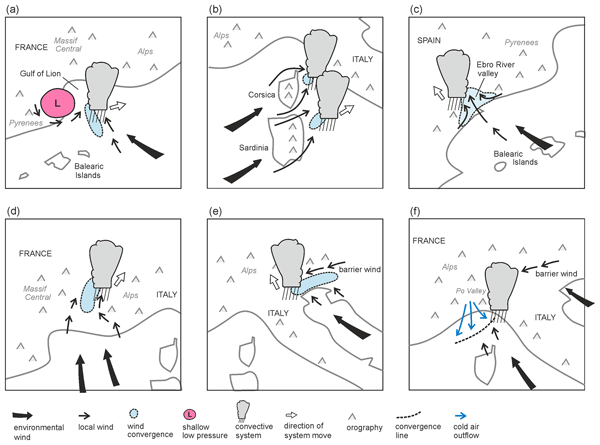
Samira Khodayar, Silvio Davolio, Paolo Di Girolamo, Cindy Lebeaupin Brossier, Emmanouil Flaounas, Nadia Fourrie, Keun-Ok Lee, Didier Ricard, Benoit Vie, Francois Bouttier, Alberto Caldas-Alvarez, and Veronique Ducrocq
Atmos. Chem. Phys., 21, 17051–17078, https://doi.org/10.5194/acp-21-17051-2021, https://doi.org/10.5194/acp-21-17051-2021, 2021
Short summary
Short summary
Heavy precipitation (HP) constitutes a major meteorological threat in the western Mediterranean. Every year, recurrent events affect the area with fatal consequences. Despite this being a well-known issue, open questions still remain. The understanding of the underlying mechanisms and the modeling representation of the events must be improved. In this article we present the most recent lessons learned from the Hydrological Cycle in the Mediterranean Experiment (HyMeX).
Matteo Berton, Elenio Avolio, and Mario Marcello Miglietta
EGUsphere, https://doi.org/10.5194/egusphere-2026-2573, https://doi.org/10.5194/egusphere-2026-2573, 2026
Short summary
Short summary
To understand the 2022 Marche flood, we used a high-resolution weather numerical model. We found that the Apennine mountains anchored the storm, causing continuous, extreme rainfall. Furthermore, our tests reveal the storm's extreme sensitivity to initial and boundary conditions. We show that a slight timing mismatch between the low-level incoming moisture and upper-level dynamics produces completely different rain patterns, making these catastrophic events incredibly difficult to predict.
Mario Marcello Miglietta, Elenio Avolio, Alessandro Bracci, Massimiliano Burlando, Francesco Cairo, Federico Canepa, Vincenzo Capozzi, Sebastiano Carpentari, Federico Cassola, Alessandro Ceppi, Silvio Davolio, Francesco De Martin, Giorgio Doglioni, Costanza Di Felice Fabrizi, Luca Di Liberto, Francesco Domenichini, Stefano Federico, Massimo Enrico Ferrario, Federico Grazzini, Antonio Iengo, Sante Laviola, Agostino Manzato, Paolo Paganini, Antonio Parodi, Alessandro Pavan, Andrea Piazza, Arturo Pucillo, Giovanni Ravezzani, Francesco Sioni, Barbara Turato, Gianfranco Vulpiani, Marco Zanatta, and Dino Zardi
Nat. Hazards Earth Syst. Sci., 26, 3395–3415, https://doi.org/10.5194/nhess-26-3395-2026, https://doi.org/10.5194/nhess-26-3395-2026, 2026
Short summary
Short summary
This paper represents a summary of the contribution that the Italian meteorological community is willing to provide to the forthcoming European field campaign on Thunderstorm Intensification from Mountains to plains, planned in 2028–2030. Critical issues regard both the available instrumentation and the accuracy of numerical models. These limitations, in the context of climate change making severe convective episodes more frequent, make the need for a dedicated field campaign urgent.
Paolo Stocchi, Francesco Cavalleri, Mohsin Tariq, Michele Brunetti, Stefania Camici, Daniele Mastrangelo, Fabio Di Sante, and Silvio Davolio
Earth Syst. Sci. Data Discuss., https://doi.org/10.5194/essd-2025-789, https://doi.org/10.5194/essd-2025-789, 2026
Preprint under review for ESSD
Short summary
Short summary
The MORE (MOLOCH Reanalysis over Italy) dataset provides high-resolution (~1.7 km) hourly weather data for Italy from 1990 to today, including precipitation, near-surface temperature, and 40 atmospheric variables. Validation shows it accurately reproduces local rainfall, temperature patterns, and extreme events, outperforming coarser datasets. MORE enables improved climate studies, flood risk assessment, and serves as a reference for climate services and advanced modeling applications.
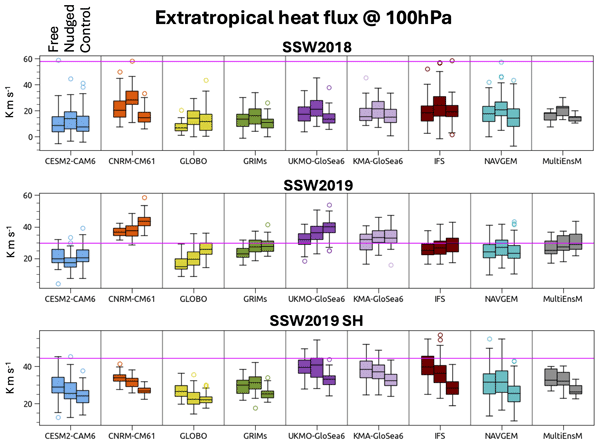
Blanca Ayarzagüena, Amy H. Butler, Peter Hitchcock, Chaim I. Garfinkel, Zac D. Lawrence, Wuhan Ning, Philip Rupp, Zheng Wu, Hilla Afargan-Gerstman, Natalia Calvo, Alvaro de la Cámara, Martin Jucker, Gerbrand Koren, Daniel De Maeseneire, Gloria L. Manney, Marisol Osman, Masakazu Taguchi, Cory Barton, Dong-Chan Hong, Yu-Kyung Hyun, Hera Kim, Jeff Knight, Piero Malguzzi, Daniele Mastrangelo, Jiyoung Oh, Inna Polichtchouk, Jadwiga H. Richter, Isla R. Simpson, Seok-Woo Son, Damien Specq, and Tim Stockdale
Weather Clim. Dynam., 7, 411–437, https://doi.org/10.5194/wcd-7-411-2026, https://doi.org/10.5194/wcd-7-411-2026, 2026
Short summary
Short summary
Sudden Stratospheric Warmings (SSWs) are known to follow a sustained wave dissipation in the stratosphere, which depends on both the tropospheric and stratospheric states. However, the relative role of each state is still unclear. Using a new set of subseasonal to seasonal forecasts, we show that the stratospheric state does not drastically affect the precursors of three recent SSWs, but modulates the stratospheric wave activity, with impacts depending on SSW features.
Emmanouil Flaounas, Stavros Dafis, Silvio Davolio, Davide Faranda, Christian Ferrarin, Katharina Hartmuth, Assaf Hochman, Aristeidis Koutroulis, Samira Khodayar, Mario Marcello Miglietta, Florian Pantillon, Platon Patlakas, Michael Sprenger, and Iris Thurnherr
Weather Clim. Dynam., 6, 1515–1538, https://doi.org/10.5194/wcd-6-1515-2025, https://doi.org/10.5194/wcd-6-1515-2025, 2025
Short summary
Short summary
Storm Daniel (2023) is one of the most catastrophic storms ever documented in the Mediterranean. Our results highlight the different dynamics and therefore the different predictability skill of precipitation, its extremes and impacts that have been produced in Greece and Libya, the two most affected countries. Our approach concerns an analysis of the storm by articulating dynamics, weather prediction, hydrological and oceanographic implications, climate extremes, and attribution theory.
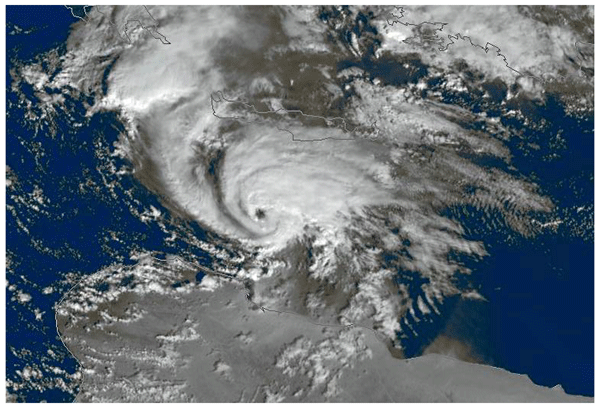
Kerry Emanuel, Tommaso Alberti, Stella Bourdin, Suzana J. Camargo, Davide Faranda, Emmanouil Flaounas, Juan Jesus Gonzalez-Aleman, Chia-Ying Lee, Mario Marcello Miglietta, Claudia Pasquero, Alice Portal, Hamish Ramsay, Marco Reale, and Romualdo Romero
Weather Clim. Dynam., 6, 901–926, https://doi.org/10.5194/wcd-6-901-2025, https://doi.org/10.5194/wcd-6-901-2025, 2025
Short summary
Short summary
Storms strongly resembling hurricanes are sometimes observed to form well outside the tropics, even in polar latitudes. They behave capriciously, developing very rapidly and then dying just as quickly. We show that strong dynamical processes in the atmosphere can sometimes cause it to become much colder locally than the underlying ocean, creating the conditions for hurricanes to form but only over small areas and for short times. We call the resulting storms "CYCLOPs".
Claudio Sánchez, Suzanne Gray, Ambrogio Volonté, Florian Pantillon, Ségolène Berthou, and Silvio Davolio
Weather Clim. Dynam., 5, 1429–1455, https://doi.org/10.5194/wcd-5-1429-2024, https://doi.org/10.5194/wcd-5-1429-2024, 2024
Short summary
Short summary
Medicane Ianos was a very intense cyclone that led to harmful impacts over Greece. We explore what processes are important for the forecasting of Medicane Ianos, with the use of the Met Office weather model. There was a preceding precipitation event before Ianos’s birth, whose energetics generated a bubble in the tropopause. This bubble created the necessary conditions for Ianos to emerge and strengthen, and the processes are enhanced in simulations with a warmer Mediterranean Sea.
Florian Pantillon, Silvio Davolio, Elenio Avolio, Carlos Calvo-Sancho, Diego Saul Carrió, Stavros Dafis, Emanuele Silvio Gentile, Juan Jesus Gonzalez-Aleman, Suzanne Gray, Mario Marcello Miglietta, Platon Patlakas, Ioannis Pytharoulis, Didier Ricard, Antonio Ricchi, Claudio Sanchez, and Emmanouil Flaounas
Weather Clim. Dynam., 5, 1187–1205, https://doi.org/10.5194/wcd-5-1187-2024, https://doi.org/10.5194/wcd-5-1187-2024, 2024
Short summary
Short summary
Cyclone Ianos of September 2020 was a high-impact but poorly predicted medicane (Mediterranean hurricane). A community effort of numerical modelling provides robust results to improve prediction. It is found that the representation of local thunderstorms controlled the interaction of Ianos with a jet stream at larger scales and its subsequent evolution. The results help us understand the peculiar dynamics of medicanes and provide guidance for the next generation of weather and climate models.
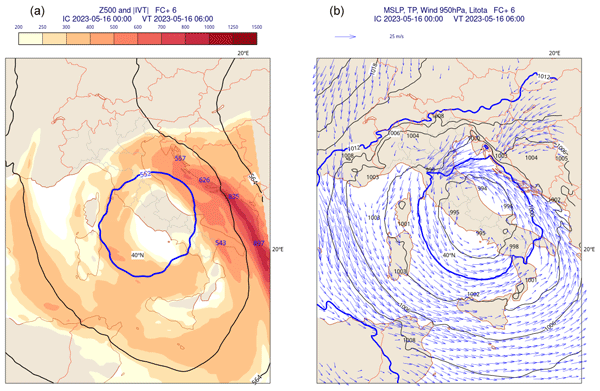
Joshua Dorrington, Marta Wenta, Federico Grazzini, Linus Magnusson, Frederic Vitart, and Christian M. Grams
Nat. Hazards Earth Syst. Sci., 24, 2995–3012, https://doi.org/10.5194/nhess-24-2995-2024, https://doi.org/10.5194/nhess-24-2995-2024, 2024
Short summary
Short summary
Extreme rainfall is the leading weather-related source of damages in Europe, but it is still difficult to predict on long timescales. A recent example of this was the devastating floods in the Italian region of Emiglia Romagna in May 2023. We present perspectives based on large-scale dynamical information that allows us to better understand and predict such events.
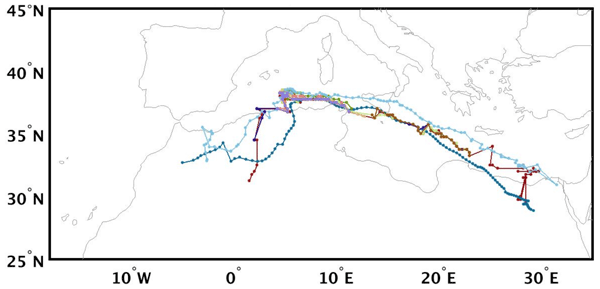
Emmanouil Flaounas, Leonardo Aragão, Lisa Bernini, Stavros Dafis, Benjamin Doiteau, Helena Flocas, Suzanne L. Gray, Alexia Karwat, John Kouroutzoglou, Piero Lionello, Mario Marcello Miglietta, Florian Pantillon, Claudia Pasquero, Platon Patlakas, María Ángeles Picornell, Federico Porcù, Matthew D. K. Priestley, Marco Reale, Malcolm J. Roberts, Hadas Saaroni, Dor Sandler, Enrico Scoccimarro, Michael Sprenger, and Baruch Ziv
Weather Clim. Dynam., 4, 639–661, https://doi.org/10.5194/wcd-4-639-2023, https://doi.org/10.5194/wcd-4-639-2023, 2023
Short summary
Short summary
Cyclone detection and tracking methods (CDTMs) have different approaches in defining and tracking cyclone centers. This leads to disagreements on extratropical cyclone climatologies. We present a new approach that combines tracks from individual CDTMs to produce new composite tracks. These new tracks are shown to correspond to physically meaningful systems with distinctive life stages.
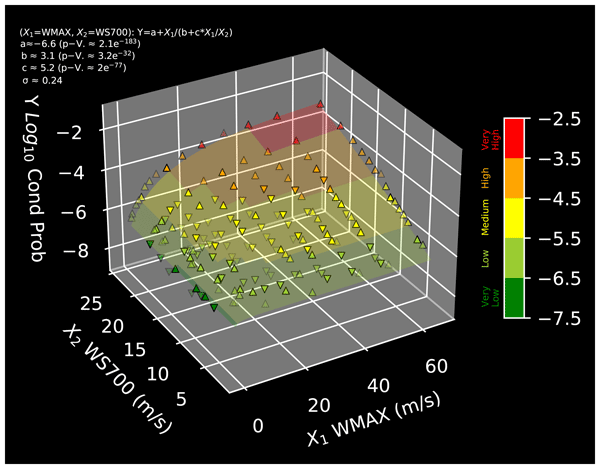
Roberto Ingrosso, Piero Lionello, Mario Marcello Miglietta, and Gianfausto Salvadori
Nat. Hazards Earth Syst. Sci., 23, 2443–2448, https://doi.org/10.5194/nhess-23-2443-2023, https://doi.org/10.5194/nhess-23-2443-2023, 2023
Short summary
Short summary
Tornadoes represent disruptive and dangerous weather events. The prediction of these small-scale phenomena depends on the resolution of present weather forecast and climatic projections. This work discusses the occurrence of tornadoes in terms of atmospheric variables and provides analytical expressions for their conditional probability. These formulas represent a tool for tornado alert systems and for estimating the future evolution of tornado frequency and intensity in climate projections.
Christian Ferrarin, Florian Pantillon, Silvio Davolio, Marco Bajo, Mario Marcello Miglietta, Elenio Avolio, Diego S. Carrió, Ioannis Pytharoulis, Claudio Sanchez, Platon Patlakas, Juan Jesús González-Alemán, and Emmanouil Flaounas
Nat. Hazards Earth Syst. Sci., 23, 2273–2287, https://doi.org/10.5194/nhess-23-2273-2023, https://doi.org/10.5194/nhess-23-2273-2023, 2023
Short summary
Short summary
The combined use of meteorological and ocean models enabled the analysis of extreme sea conditions driven by Medicane Ianos, which hit the western coast of Greece on 18 September 2020, flooding and damaging the coast. The large spread associated with the ensemble highlighted the high model uncertainty in simulating such an extreme weather event. The different simulations have been used for outlining hazard scenarios that represent a fundamental component of the coastal risk assessment.
Peter Hitchcock, Amy Butler, Andrew Charlton-Perez, Chaim I. Garfinkel, Tim Stockdale, James Anstey, Dann Mitchell, Daniela I. V. Domeisen, Tongwen Wu, Yixiong Lu, Daniele Mastrangelo, Piero Malguzzi, Hai Lin, Ryan Muncaster, Bill Merryfield, Michael Sigmond, Baoqiang Xiang, Liwei Jia, Yu-Kyung Hyun, Jiyoung Oh, Damien Specq, Isla R. Simpson, Jadwiga H. Richter, Cory Barton, Jeff Knight, Eun-Pa Lim, and Harry Hendon
Geosci. Model Dev., 15, 5073–5092, https://doi.org/10.5194/gmd-15-5073-2022, https://doi.org/10.5194/gmd-15-5073-2022, 2022
Short summary
Short summary
This paper describes an experimental protocol focused on sudden stratospheric warmings to be carried out by subseasonal forecast modeling centers. These will allow for inter-model comparisons of these major disruptions to the stratospheric polar vortex and their impacts on the near-surface flow. The protocol will lead to new insights into the contribution of the stratosphere to subseasonal forecast skill and new approaches to the dynamical attribution of extreme events.
Emmanouil Flaounas, Silvio Davolio, Shira Raveh-Rubin, Florian Pantillon, Mario Marcello Miglietta, Miguel Angel Gaertner, Maria Hatzaki, Victor Homar, Samira Khodayar, Gerasimos Korres, Vassiliki Kotroni, Jonilda Kushta, Marco Reale, and Didier Ricard
Weather Clim. Dynam., 3, 173–208, https://doi.org/10.5194/wcd-3-173-2022, https://doi.org/10.5194/wcd-3-173-2022, 2022
Short summary
Short summary
This is a collective effort to describe the state of the art in Mediterranean cyclone dynamics, climatology, prediction (weather and climate scales) and impacts. More than that, the paper focuses on the future directions of research that would advance the broader field of Mediterranean cyclones as a whole. Thereby, we propose interdisciplinary cooperation and additional modelling and forecasting strategies, and we highlight the need for new impact-oriented approaches to climate prediction.
Mario Marcello Miglietta and Silvio Davolio
Hydrol. Earth Syst. Sci., 26, 627–646, https://doi.org/10.5194/hess-26-627-2022, https://doi.org/10.5194/hess-26-627-2022, 2022
Short summary
Short summary
The main results emerging from the HyMeX SOP1 campaign and in the subsequent research activity in three Italian target areas are highlighted through conceptual models and through the identification of the relevant mesoscale environmental characteristics conducive to heavy rain events.
Samira Khodayar, Silvio Davolio, Paolo Di Girolamo, Cindy Lebeaupin Brossier, Emmanouil Flaounas, Nadia Fourrie, Keun-Ok Lee, Didier Ricard, Benoit Vie, Francois Bouttier, Alberto Caldas-Alvarez, and Veronique Ducrocq
Atmos. Chem. Phys., 21, 17051–17078, https://doi.org/10.5194/acp-21-17051-2021, https://doi.org/10.5194/acp-21-17051-2021, 2021
Short summary
Short summary
Heavy precipitation (HP) constitutes a major meteorological threat in the western Mediterranean. Every year, recurrent events affect the area with fatal consequences. Despite this being a well-known issue, open questions still remain. The understanding of the underlying mechanisms and the modeling representation of the events must be improved. In this article we present the most recent lessons learned from the Hydrological Cycle in the Mediterranean Experiment (HyMeX).
Cited articles
Acordon, V. and Cat Berro D.: Tempesta Alex, 2–3 ottobre 2020: alluvioni al nord-ovest italiano e sulle Alpi Marittime francesi, Nimbus, 92, 78–111, 2024.
ARPA Piemonte: Rapporto d'evento: Precipitazioni intense 19–21 ottobre 2023, A cura del Dipartimento Rischi Naturali e Ambientali, 48 pp., https://www.arpa.piemonte.it/sites/default/files/media/2023-11/Rapporto_finale19_21_10_23.pdf (last access: 19 June 2025), 2023.
ARPAE: Rapporto degli eventi meteorologici di piena e di frana dal 2 al 5 novembre 2023, 47 pp., https://www.arpae.it/it/temi-ambientali/meteo/report-meteo/rapporti-post-evento/rapporto_meteo_idro_20231102-05/@@display-file/file/Rapporto_meteo_idro_20231102-05.pdf (last access: 20 June 2025), 2023.
Benedict, I., Odemark, K., Nipen, T., and Moore, R.: Large-scale flow patterns associated with extreme precipitation and atmospheric rivers over Norway, Mon. Weather Rev., 147, 1415–1428, https://doi.org/10.1175/MWR-D-18-0362.1, 2019.
Buzzi, A. and Foschini, L.: Mesoscale meteorological features associated with heavy precipitation in the southern Alpine region, Meteorol. Atmos. Phys., 72, 131–146, 2000.
Buzzi, A., Davolio, S., Malguzzi, P., Drofa, O., and Mastrangelo, D.: Heavy rainfall episodes over Liguria in autumn 2011: numerical forecasting experiments, Nat. Hazards Earth Syst. Sci., 14, 1325–1340, https://doi.org/10.5194/nhess-14-1325-2014, 2014.
Cavaleri, L., Bajo, M., Barbariol, F., Bastianin, M., Benetazzo, A., Bertotti, L., Chiggiato, J., Davolio, S., Ferrarin, C., Magnusson, L., Papa, A., Pezzutto, P., Pomaro, A., and Umgeisser, G.: The October 29, 2018 storm in Northern Italy – An exceptional event and its modeling, Prog. Oceanogr., 178, 102178, https://doi.org/10.1016/j.pocean.2019.102178, 2019.
Davolio, S.: Replication data for: “Detection of atmospheric rivers affecting the Mediterranean and producing extreme rainfall over northern-central Italy”, V1, UNIMI Dataverse [data set], https://doi.org/10.13130/RD_UNIMI/GR9D83, 2026.
Davolio, S., Della Fera, S., Laviola, S., Miglietta, M. M., and Levizzani, V.: Heavy precipitation over Italy from the Mediterranean storm “Vaia” in October 2018: Assessing the role of an atmospheric river, Mon. Weather Rev., 148, 3571–3588, 2020.
Davolio, S., Vercellino, M., Miglietta, M. M., Drago Pitura, L., Laviola, S., and Levizzani, V.: The influence of an atmospheric river on a heavy precipitation event over the Alps, Wea. Clim. Extremes, 39, 100542, https://doi.org/10.1016/j.wace.2022.100542, 2023.
DeFlorio, M. J., Waliser, D. E., Ralph, F. M., Guan, B., Goodman, A., Gibson, P. B., Asharaf, S., Delle Monache, L., Zhang, Z., Subramanian, A. C., Vitart, F., Lin, H., and Kumar A.: Experimental Subseasonal-to-Seasonal (S2S) forecasting of atmospheric rivers over the Western United States, J. Geophys. Res.-Atmos., 124, 11242–11265, https://doi.org/10.1029/2019JD031200, 2019.
De Zolt, S., Lionello, P., Nuhu, A., and Tomasin, A.: The disastrous storm of 4 November 1966 on Italy, Nat. Hazards Earth Syst. Sci., 6, 861–879, https://doi.org/10.5194/nhess-6-861-2006, 2006.
Doiteau, B., Dournaux, M., Montoux, N., and Baray, J. L.: Atmospheric rivers and associated precipitation over France and western Europe: 1980–2020 climatology and case study, Atmosphere, 12, 1075, https://doi.org/10.3390/atmos12081075, 2021.
Ducrocq, V., Braud, I., Davolio, S., Ferretti, R., Flamant, C., Jansa, A., Kalthoff, N., Richard, E., Taupier-Letage, I., Ayral, P.-A., Belamari, S., Berne, A., Borga, M., Boudevillain, B., Bock, O., Boichard, J.-L., Bouin, M.-N., Bousquet, O., Bouvier, C., Chiggiato, J., Cimini, D., Corsmeier, U., Coppola, L., Cocquerez, P., Defer, E., Drobinski, P., Dufournet, Y., Fourrié, N., Gourley, J. J., Labatut, L., Lambert, D., Le Coz, J., Marzano, F. S., Molinié, G., Montani, A., Nord, G., Nuret, M., Ramage, K., Rison, B., Roussot, O., Said, F., Schwarzenboeck, A., Testor, P., Van Baelen, J., Vincendon, B., Aran, M., and Tamayo, J.: HyMeX SOP1, the field campaign dedicated to heavy precipitation and flash flooding in the northwestern Mediterranean, B. Am. Meteorol. Soc., 95, 1083–1100, https://doi.org/10.1175/BAMS-D-12-00244.1, 2014.
Ezber, Y., Bozkurt, D., and Sen, O. L.: Impact of atmospheric rivers on the winter snowpack in the headwaters of Euphrates-Tigris basin, Clim. Dynam., 62, 7095–7110, https://doi.org/10.1007/s00382-024-07267-2, 2024.
Ferretti, R., Pichelli, E., Gentile, S., Maiello, I., Cimini, D., Davolio, S., Miglietta, M. M., Panegrossi, G., Baldini, L., Pasi, F., Marzano, F. S., Zinzi, A., Mariani, S., Casaioli, M., Bartolini, G., Loglisci, N., Montani, A., Marsigli, C., Manzato, A., Pucillo, A., Ferrario, M. E., Colaiuda, V., and Rotunno, R.: Overview of the first HyMeX Special Observation Period over Italy: observations and model results, Hydrol. Earth Syst. Sci., 18, 1953–1977, https://doi.org/10.5194/hess-18-1953-2014, 2014.
Francis, D., Fonseca, R., Nelli, N., Bozkurt, D., Picard, G., and Guan, B.: Atmospheric river drive exceptional Saharan dust transport towards Europe, Atmos. Res., 266, 105959, https://doi.org/10.1016/j.atmosres.2021.105959, 2022.
Francis, D., Fonseca, R., Bozkurt, D., Nelli, N., and Guan, B.: Atmospheric river rapids and their role in the extreme rainfall event of April 2023 in the Middle East, Geophys. Res. Lett., 51, e2024GL109446, https://doi.org/10.1029/2024GL109446, 2024.
Gershunov, A., Shulgina, T., Ralph, F. M., Lavers, D. A., and Rutz, J. J.: Assessing the climate-scale variability of atmospheric rivers affecting western North America, Geophys. Res. Lett., 44, 7900–7908, https://doi.org/10.1002/2017GL074175, 2017.
Gimeno, L., Nieto, R., Vázquez, M., and Lavers, D. A.: Atmospheric rivers: a mini-review, Front. Earth Sci., 2, https://doi.org/10.3389/feart.2014.00002, 2014.
Gimeno, L., Dominguez, F., Nieto, R., Trigo, R., Drumond, A., Reason, C. J. C., Taschetto, A. S., Ramos, A. M., Kumar, R., and Marengo, J.: Major mechanisms of atmospheric moisture transport and their role in extreme precipitation events, Ann. Rev. Environ. Resour., 41, 117–141, https://doi.org/10.1146/annurev-environ-110615-085558, 2016.
Giovannini, L., Davolio, S., Zaramella, M., Zardi, D., and Borga, M.: Multi-model convection-resolving simulations of the October 2018 Vaia storm over Northeastern Italy, Atmos. Res., 253, 105455, https://doi.org/10.1016/j.atmosres.2021.105455, 2021.
Grazzini, F., Craig, G. C., Keil, C., Antolini, G., and Pavan, V.: Extreme precipitation events over northern Italy. Part I: A systematic classification with machine-learning techniques, Q. J. Roy. Meteor. Soc., 146, 69–85, 2020.
Grazzini, F, Fragkoulidis, G., Teubler, F., Wirth, V., and Craig, G. C.: Extreme precipitation events over northern Italy. Part II: Dynamical precursors, Q. J. Roy. Meteor. Soc., 147, 1237–1257. https://doi.org/10.1002/qj.3969, 2021.
Grazzini, F., Dorrington, J., Grams, C. M., Craig, G. C., Magnusson, L., and Vitart, F.: Improving forecasts of precipitation extremes over northern and central Italy using machine learning, Q. J. Roy. Meteor. Soc., 150, 3167–3181, https://doi.org/10.1002/qj.4755, 2024.
Guan, B. and Waliser, D. E.: Detection of atmospheric rivers—evaluation and application of an algorithm for global studies, J. Geophys. Res.-Atmos., 120, 12514–12535, https://doi.org/10.1002/2015JD024257, 2015.
Guan, B. and Waliser, D. E.: A regionally refined quarter-degree global atmospheric rivers database based on ERA5, Sci. Data 11, 440, https://doi.org/10.1038/s41597-024-03258-4, 2024.
Hersbach, H., Bell, B., Berrisford, P., Hirahara, S., Horányi, A., Muñoz‐Sabater, J., Nicolas, J., Peubey, C., Radu, R., Schepers, D., Simmons, A., Soci, C., Abdalla, S., Abellan, X., Balsamo, G., Bechtold, P., Biavati, G., Bidlot, J., Bonavita, M., De Chiara, G., Dahlgren, P., Dee, D., Diamantakis, M., Dragani, R., Flemming, J., Forbes, R., Fuentes, M., Geer, A., Haimberger, L., Healy, S., Hogan, R.J., Hólm, E., Janisková, M., Keeley, S., Laloyaux, P., Lopez, P., Lupu, C., Radnoti, G., de Rosnay, P., Rozum, I., Vamborg, F., Villaume, S., and Thépaut, J.-N.: Complete ERA5 from 1940: Fifth generation of ECMWF atmospheric reanalyses of the global climate, Copernicus Climate Change Service (C3S) Data Store (CDS) [data set], https://doi.org/10.24381/cds.143582cf, 2017.
Hersbach, H., Bell, B., Berrisford, P., Hirahara, S., Horányi, A., Muñoz-Sabater, J., Nicolas, J., Peubey, C., Radu, R., Schepers, D., Simmons, A., Soci, C., Abdalla, S., Abellan, X., Balsamo, G., Bechtold, P., Biavati, G., Bidlot, J., Bonavita, M., De Chiara, G., Dahlgren, P., Dee, D., Diamantakis, M., Dragani, R., Flemming, J., Forbes, R., Fuentes, M., Geer, A., Haimberger, L., Healy, S., Hogan, R. J., Hólm, E., Janisková, M., Keeley, S., Laloyaux, P., Lopez, P., Lupu, C., Radnoti, G., de Rosnay, P., Rozum, I., Vamborg, F., Villaume, S., and Thépaut, J.-N.: The ERA5 global reanalysis, Q. J. Roy. Meteor. Soc., 146, 1999–2049, https://doi.org/10.1002/qj.3803, 2020.
Huang, H., Patricola, C. M., Bercos-Hickey, E., Zhou, Y., Rhoades, A., Risser, M. D., and Collins, W. D.: Sources of subseasonal-to-seasonal predictability of atmospheric rivers and precipitation in the western United States, J. Geophys. Res.-Atmos., 126, e2020JD034053, 2021.
Insua-Costa, D., Senande-Rivera, M., Llasat, M. C., and Miguez-Macho, G.: A global perspective on western Mediterranean precipitation extremes, npj Clim. Atmos. Sci., 5, 9, https://doi.org/10.1038/s41612-022-00234-w, 2022.
Ionita, M., Nagavciuc, V., and Guan, B.: Rivers in the sky, flooding on the ground: the role of atmospheric rivers in inland flooding in central Europe, Hydrol. Earth Syst. Sci., 24, 5125–5147, https://doi.org/10.5194/hess-24-5125-2020, 2020.
Krichak, S. O., Barkan, J., Breitgand, J. S., Gualdi, S., and Feldstein, S. B.: The role of the export of tropical moisture into midlatitudes for extreme precipitation events in the Mediterranean region, Theor. Appl. Climatol., 121, 499–515, https://doi.org/10.1007/s00704-014-1244-6, 2015:.
LaMMA: Report meteorologico: evento 2 novembre 2023, 7 pp., https://www.lamma.toscana.it/clima/report/eventi/evento_02112023.pdf (last access 20 June 2025), 2023.
Lavers, D. A. and Villarini, G.: The nexus between atmospheric rivers and extreme precipitation across Europe, Geophys. Res. Lett., 40, 3259–3264, 2013.
Lavers, D. A., Allan, R. P., Wood, E. F., Villarini, G., Brayshaw, D. J., and Wade, A. J.: Winter floods in Britain are connected to atmospheric rivers, Geophys. Res. Lett., 38, L23803, https://doi.org/10.1029/2011GL049783, 2011.
Lavers, D. A., Villarini, G., Allan, R. P., Wood, E. F., and Wade, A. J.: The detection of atmospheric rivers in atmospheric reanalyses and their links to British winter floods and the large-scale climatic circulation, J. Geophys. Res., 117, D20106. https://doi.org/10.1029/2012JD018027, 2012.
Lavers, D. A., Wilson, A. M., Ralph, F. M., Tallapragada, V., Pappenberger, F., Reynolds, C., Doyle, G. D., Delle Monache, L., Davis, C., Subramanian, A., Torn, R. D., Cordeira, J. M., Centurioni, L., Haase, J. S.: Advancing atmospheric river science and inspiring future development of the atmospheric river reconnaissance program, B. Am. Meteorol. Soc., 105, E75–E83, https://doi.org/10.1175/BAMS-D-23-0278.1, 2024.
Lee, S. H., Polvani, L. M., and Guan, B.: Modulation of atmospheric rivers by the Arctic stratospheric polar vortex, Geophys. Res. Lett., 49, e2022GL100381, https://doi.org/10.1029/2022GL100381, 2022.
Lorente-Plazas, R., Montavez, J. P., Ramos, A. M., Jerez, S., Trigo, R. M., and Jimenez-Guerrero, P.: Unusual atmospheric-river-like structures coming from Africa induced extreme precipitation over the western Mediterranean Sea, J. Geophys. Res.-Atmos., 125, e2019JD031280, https://doi.org/10.1029/2019JD031280, 2019.
Magnusson, L., Hewson, T., and Lavers, D.: Windstorm Alex affected large parts of Europe, ECMWF Newsletter, 166, 2021.
Malguzzi, P., Grossi, G., Buzzi, A., Ranzi, R., and Buizza, R.: The 1966 “century” flood in Italy: A meteorological and hydrological revisitation, J. Geophys. Res.-Atmos., 111, D24106, https://doi.org/10.1029/2006JD007111, 2006.
Martinković, M., Strelec Mahović, N,. Mikuš Jurković, P., Renko, T., Pelajić, I., and Smiljanić, I.: Relationship between atmospheric rivers and extreme precipitation events, in: Perspectives on Atmospheric Sciences, edited by: Karacostas, T., Bais, A., and Nastos, P., Springer Atmospheric Sciences, Springer, Cham,. https://doi.org/10.1007/978-3-319-35095-0_54, 2017.
Mastrangelo, D., Ghinassi, P., and Davolio, S.: Subseasonal prediction of two extreme precipitation events over Italy, in: EMS Annual Meeting 2025, Ljubljana, Slovenia, 7–12 September 2025, EMS2025-548, https://doi.org/10.5194/ems2025-548, 2025.
MeteoFrance: Épisodes cévenol du 18 au 19 et méditerranéen sur l'est de PACA du 19 au 20, Bulletin Climatique October 2023, 7, https://donneespubliques.meteofrance.fr/donnees_libres/bulletins/BCM/202310.pdf (last access: 19 June 2025), 2023.
Miglietta, M. M. and Davolio, S.: Dynamical forcings in heavy precipitation events over Italy: lessons from the HyMeX SOP1 campaign, Hydrol. Earth Syst. Sci., 26, 627–646, https://doi.org/10.5194/hess-26-627-2022, 2022.
Neiman, P. J., Schick, L. J, Ralph, F. M., Hughes, M., and Wick, G. A.: Flooding in Western Washington: the connection to atmospheric rivers, J. Hydrometeorol., 12, 1337–1358, https://doi.org/10.1175/2011jhm1358.1, 2011.
Pavan, V., Antolini, G., Barbiero, R., Berni, N., Brunier, F., Cacciamani, C., Cagnati, A., Cazzuli, O., Cicogna, A., Luigi, C., Carlo, E., Francioni, M., Maraldo, L., Marigo, G., Micheletti, S., Onorato, L., Panettieri, E., Pellegrini, U., Pelosini, R., and Torrigiani Malaspina, T.: High resolution climate precipitation analysis for north-central Italy, 1961–2015, Clim. Dynam., 52, 3435–3453, https://doi.org/10.1007/s00382-018-4337-6, 2019.
Provincia Autonoma TN: Relazione sull'evento alluvionale del 20 settembre 1999, 28 pp., http://www.protezionecivile.tn.it/binary/pat_protezione_civile/alluvionipiene/Relaz_alluvione20_9_1999.1304668230.pdf (last access: 20 June 2025), 1999.
Ralph, F. M., Neiman, P. J., and Wick G. A.: Satellite and CALJET aircraft observations of atmospheric rivers over the eastern North Pacific Ocean during the winter of 1997/98, Mon. Weather Rev., 132, 1721–1745, 2004.
Ralph, F. M., Neiman, P. J., and Rotunno, R.: Dropsonde observations in low-level jets over the northeastern Pacific Ocean from CALJET-1998 and PACJET-2001: mean vertical-profile and atmospheric-river characteristics, Mon. Weather Rev., 133, 889–910, 2005.
Ralph, F. M., Neiman, P. J., Wick, G. A., Gutman, S. I., Dettinger, M. D., Cayan, D. R., and White, A. B.: Flooding on California's Russian River: the role of atmospheric rivers, Geophys. Res. Lett., 33, L13801, https://doi.org/10.1029/2006GL026689, 2006.
Ralph, F. M., Intrieri, J., Andra Jr., D., Atlas, R., Boukabara, S., Bright, D., Davidson, P., Entwistle, B., Gaynor, J., Goodman, S., Jiing, J.-G., Harless, A., Huang, J., Jedlovec, G., Kain, J., Koch, S., Kuo, B., Levit, J., Murillo, S., Riishojgaard, L. P., Schneider, T., Schneider, R., Smith, T., and Weiss, S.: The emergence of weather-focused testbeds linking research and forecasting operations, B. Am. Meteorol. Soc., 94, 1187–1210, 2013.
Ralph, F. M., Iacobellis, S. F., Neiman, P. J., Cordeira, J. M., Spackman, J. R., Waliser, D. E., Wick, G. A., White, A. B., and Fairall, C.: Dropsonde observations of total integrated water vapor transport within North Pacific atmospheric rivers, J. Hydrometeorl., 18, 2577–2596, https://doi.org/10.1175/JHM-D-17-0036.1, 2017.
Ralph, F. M., Dettinger, M. D., Cairns, M. M., Galarneau, T. J., and Eylander, J.: Defining “atmospheric river”: how the Glossary of Meteorology helped resolve a debate, B. Am. Meteorol. Soc. 99, 837–839, https://doi.org/10.1175/BAMS-D-17-0157.1, 2018.
Ralph, F. M., Wilson, A. M., Shulgina, T., Kawzenuk, B., Sellars, S., Rutz, J. J., Lamjiri, M. A., Barnes, E. A., Gershunov, A., Guan, B., Nardi, K. M., Osborne, T., and Wick, G. A.: ARTMIP-early start comparison of atmospheric river detection tools: how many atmospheric rivers hit northern California's Russian River watershed?, Clim. Dynam., 52, 4973–4994, https://doi.org/10.1007/s00382-018-4427-5, 2019.
Ramos, A. M., Trigo, R. M., Liberato, M. L. R., and Tomeì, R.: Daily precipitation extreme events in the Iberian Peninsula and its association with atmospheric rivers, J. Hydrometeorol., 16, 579–597, https://doi. org/10.1175/JHM-D-14-0103.1, 2015.
Reid, K. J., King, A. D., Lane, T. P., and Short, E.: The sensitivity of Atmospheric River identification to integrated water vapor transport thresholds, resolution and regridding method, J. Geophys. Res.-Atmos., 125, e2020JD032897, https://doi.org/10.1029/2020JD032897, 2020.
Reid, K. J., Hudson, D., King, A. D., Lane, T. P., and Marshall, A. G.: Atmospheric water vapour transport in ACCESS-S2 and the potential for enhancing skill of subseasonal forecasts of precipitation, Q. J. Roy. Meteor. Soc., 150, 68–80, https://doi.org/10.1002/qj.4585, 2024.
Rössler, O., Froidevaux, P., Börst, U., Rickli, R., Martius, O., and Weingartner, R.: Retrospective analysis of a nonforecasted rain-on-snow flood in the Alps – a matter of model limitations or unpredictable nature?, Hydrol. Earth Syst. Sci., 18, 2265–2285, https://doi.org/10.5194/hess-18-2265-2014, 2014.
Rutz, J. J., Steenburgh, W. J., and Ralph, F. M.: Climatological characteristics of atmospheric rivers and their inland penetration over the western United States, Mon. Weather Rev., 142, 905–921, https://doi.org/10.1175/MWR-D-13-00168.1, 2014.
Rutz, J. J., Shields, C. A., Lora, J. M., Payne, A. E., Guan, B., Ullrich, P., O'Brien, T., Leung, L. R., Ralph, F. M., Wehner, M., Brands, S., Collow, A., Goldenson, N., Gorodetskaya, I., Griffith, H., Kashinath, K., Kawzenuk, B., Krishnan, H., Kurlin, V., Lavers, D., Magnusdottir, G., Mahoney, K., McClenny, E., Muszynski, G., Nguyen, P. D., Prabhat, M., Qian, Y., Ramos, A. M., Sarangi, C., Sellars, S., Shulgina, T., Tome, R., Waliser, D., Walton, D., Wick, G., Wilson, A. M., and Viale, M.: The Atmospheric River Tracking Method Intercomparison Project (ARTMIP): quantifying uncertainties in atmospheric river climatologies, J. Geophys. Res.-Atmos., 124, 13777–13802, https://doi.org/10.1029/2019JD030936, 2019.
Shields, C. A., Rutz, J. J., Leung, L.-Y., Ralph, F. M., Wehner, M., Kawzenuk, B., Lora, J. M., McClenny, E., Osborne, T., Payne, A. E., Ullrich, P., Gershunov, A., Goldenson, N., Guan, B., Qian, Y., Ramos, A. M., Sarangi, C., Sellars, S., Gorodetskaya, I., Kashinath, K., Kurlin, V., Mahoney, K., Muszynski, G., Pierce, R., Subramanian, A. C., Tome, R., Waliser, D., Walton, D., Wick, G., Wilson, A., Lavers, D., Prabhat, Collow, A., Krishnan, H., Magnusdottir, G., and Nguyen, P.: Atmospheric River Tracking Method Intercomparison Project (ARTMIP): project goals and experimental design, Geosci. Model Dev., 11, 2455–2474, https://doi.org/10.5194/gmd-11-2455-2018, 2018.
Sioni, F., Davolio, S., Grazzini, F., and Giovannini, L.: Revisiting the atmospheric dynamics of the two century floods over north-eastern Italy, Atmos. Res., 286, 106662, https://doi.org/10.1016/j.atmosres.2023.106662, 2023.
Stohl, A., Forster, C., and Sodemann, H.: Remote sources of water vapor forming precipitation on the Norwegian west coast at 60° N: a tale of hurricanes and an atmospheric river, J. Geophys. Res.-Atmos., 113, D05102, https://doi.org/10.1029/2007JD009006, 2008.
Vallejo-Bernal, S. M., Braun, T., Marwan, N., and Kurths, J.: Pikart: a comprehensive global catalog of atmospheric rivers, J. Geophys. Res.-Atmos., 130, e2024JD041869, https://doi.org/10.1029/2024JD041869, 2025.
Zheng, M., Delle Monache, L., Wu, X., Kawzenuk, B., Ralph, F. M., Zhu, Y., Torn, R., Tallapragada, V. S., Zhang, Z., Wu, K., and Wang, J.: Impact of atmospheric river reconnaissance dropsonde data on the assimilation of satellite radiance data in GFS, J. Atmos. Ocean. Tech., 41, 819–832, https://doi.org/10.1175/JTECH-D-23-0167.1, 2024.
Zhu, Y. and Newell, R. E.: A proposed algorithm for moisture fluxes from atmospheric rivers, Mon. Weather Rev., 126, 725–735, https://doi.org/10.1175/1520-0493(1998)126<0725:APAFMF>2.0.CO;2, 1998.
Short summary
Atmospheric rivers, narrow and long corridors of intense horizontal moisture transport, may produce heavy precipitation where they are forced to rise over the orography. This has been recently shown to occur also in the Mediterranean basin, especially over the Alps and Apennines in Italy. The present study analyses the presence of atmospheric rivers in this area, in the period 1961–2024, and reveals a strong connection with extreme rainfall over northern-central Italy.
Atmospheric rivers, narrow and long corridors of intense horizontal moisture transport, may...


Altmetrics
Final-revised paper
Preprint