
the Creative Commons Attribution 4.0 License.
the Creative Commons Attribution 4.0 License.
 | 27 Apr 2026
The deadliest sudden weather-related events in the Czech Lands, 1851–2025 CE
Rudolf Brázdil
Kateřina Chromá
Miloslav Müller
Jan Lhoták
Kateřina Skripniková
Extreme weather-related events can be accompanied not only by extensive material damage, but also by many fatalities. The question is: what is the long-term context of the deadliest weather events with respect to the increasing severity and frequency of weather extremes accompanying recent climate change? This paper presents the sudden weather-related events with the highest numbers of fatalities (≥20) over the territory of the Czech Lands (now the Czech Republic) in the 1851–2025 CE period, which were connected to or influenced by floods, windstorms, convective storms, thunderstorms, snow, and fog. For each of the 13 selected events, meteorological conditions, their course, accompanying circumstances, and selected fatality characteristics such as sex and age are described in detail. Six events occurred in the second half of the 19th century, three in the first half of the 20th century, four in its second half, and none after 2000. Although floods were the most frequent cause of high fatality numbers in six cases, two train and two airplane accidents connected with snow and fog also appeared among the deadliest events selected. The flash flood in western Bohemia from 25–26 May 1872, claiming 244 lives, was the most tragic documented event over the Czech territory since 1851 CE. Only the flood event in Moravia and Silesia in July 1997, with 58 fatalities, occurred during the period of recent climate change characterized by the highest temperature increase since the 1980s. The results show that the effects of long-term changes in the environmental, socioeconomic, and societal situation in the country, directed toward more effective risk management and rescue activities, aimed at increased saving lives in extreme weather events during past 175 years, including recent climate change. The detail description of the historical investigation allows future replication of such research in other countries.
- Article
(26275 KB) - Full-text XML
- BibTeX
- EndNote


Although recent global warming has led to an unprecedented increase in the number of related fatalities in Europe – from 9953 fatalities in the 3 decades between 1970 and 1999 to 149 485 fatalities in the 2 decades following the year 2000 (WMO, 2021), particularly as a consequence of heat waves in 2003 over Western Europe (e.g., Robine et al., 2008; García-Herrera et al., 2010) and in 2010 over Russia (e.g., Grumm, 2011; Otto et al., 2012) – other weather-related events with high fatality counts should also be considered. Of particular interest was, for example, the disastrous floods of July 2021 in Germany with at least 189 fatalities, 135 of whom died in the Ahr River catchment (e.g., Kahle et al., 2022; Thieken et al., 2023; Roggenkamp et al., 2024; Rhein and Kreibich, 2025; Silva et al., 2025). Flood events in Central Europe are traditionally natural phenomena that result in a high number of fatalities, as seen in the July 1997 flood with 61 fatalities in the Czech Republic (Brázdil et al., 2023) and 54 in Poland (Kundzewicz et al., 1999). Information about flood fatalities in Europe can be found in various databases at national or international levels, along with other flood-related information, such as for the European Union (Barredo, 2007), at the pan-European scale (Paprotny et al., 2018, 2024), for the Mediterranean region (Petrucci et al., 2019b), for the Euro-Mediterranean region (Petrucci et al., 2019a; Papagiannaki et al., 2022), or for individual European countries or areas (e.g., Diakakis and Deligiannakis, 2017; Pereira et al., 2017; Špitalar et al., 2020; Vinet et al., 2022; Diakakis et al., 2023). Death tolls from coastal flooding due to storm surges are comparable to those from inland flooding, as documented in many examples around the North and Baltic Seas (e.g., Gerritsen, 2005; Jensen and Müller-Navarra, 2008; Jochner et al., 2013; Choi et al., 2018; Hallin et al., 2021).
Besides flood and storm surge fatalities, other weather-related fatalities in Europe have also been collected at national levels. Corresponding results were presented for events such as lightning strikes (e.g., Elsom, 2001; Elsom and Webb, 2014; Antonescu and Cărbunaru, 2018; Kühne et al., 2025), tornadoes (e.g., Taszarek and Gromadzki, 2017; Holzer et al., 2018), as well as for several hazardous events combined (e.g., Hilker et al., 2009; Badoux et al., 2016; Pilorz et al., 2023). Antofie et al. (2025) found a relatively high correlation (Spearman correlation r=0.59) between statistically significant multi-hazard hotspots and fatalities at the pan-European level.
Regarding the territory of the Czech Republic, fatalities attributed to hydrometeorological extremes have generally been analysed for the last 100 years. Covering various time intervals, these analyses were based particularly on the specific database of the Institute of Geography, Masaryk University in Brno, created from various documentary evidence (Brázdil et al., 2019, 2023), mortality data from published demographic yearbooks (Brázdil et al., 2024), or documentary data complemented by detailed information from the Czech Statistical Office since 1994 (Brázdil et al., 2021). Mortality during traffic accidents connected with adverse weather has also been considered (Brázdil et al., 2022a, b).
Although some of the cited Czech papers reported very deadly events in various forms, extending the analyzed data back to the mid-19th century has revealed further important events. The aim of this paper is to present a comprehensive view of the deadliest events attributed to floods, windstorms, convective storms, thunderstorms, snow, and fog that occurred over the territory of the Czech Republic in the 1851–2025 CE period. Each of the presented case studies focuses not only on the meteorological or hydrological situation but particularly on describing the locations and circumstances leading to the loss of human lives, including the sex and age of the fatalities.
2.1 Czech Republic
The Czech Republic (further as CR) is located in Central Europe (Fig. 1), covering an area of 78 866 km2. The territory comprises various geographic units, from lowlands to mountains, with an average altitude of 390 m a.s.l. (with an altitudinal range from 115 to 1603 m). The western part of the CR belongs to the Labe (Elbe) catchment, the eastern part particularly to the Morava catchment and Odra (Oder) catchment. Three historical lands, namely Bohemia in the western part and Moravia with southern Silesia in the eastern part of the CR, were historically considered as Czech Lands. Until 28 October 1918 they formed Kingdom of Bohemia, being part of the Austrian empire (Austrian-Hungarian empire from 1867), followed by Czechoslovakia, when Slovakia and Transcarpathian Ukraine joint Czech Lands. After the Munich Agreement on 30 September 1938, the Czech Lands lost the Sudetenland, and following Nazi occupation on 15 March 1939, they became the Protectorate of Bohemia and Moravia (with Slovakia separating), existing until the end of the World War II in 1945. From 1948 to the so-called Velvet Revolution in 1989 Czechoslovakia was a communist country. From 1 January 1993 Czechoslovakia was split into the Czech and Slovak Republics. In 2004, the CR joined the European Union. During the whole 1850–2025 period, Praha (Prague) was a capital of the country. While the population of the Czech Lands to 1 July 1850 CE was 6 826 465, to 1 July 2025 the number of CR inhabitants achieved 10 886 878, with continuously growing proportion of urban population (Czech Statistical Office, 2026). But the population density within Czech Lands was uneven. On average, the highest concentration of inhabitants was found in the industrial areas of the northern half of the territory in the foothills of the border mountains, where a denser urban and railway network was consequently created. The southern half remained more sparsely populated, less urbanized, and more oriented towards agriculture (Kárníková, 1965; Srb, 2004).
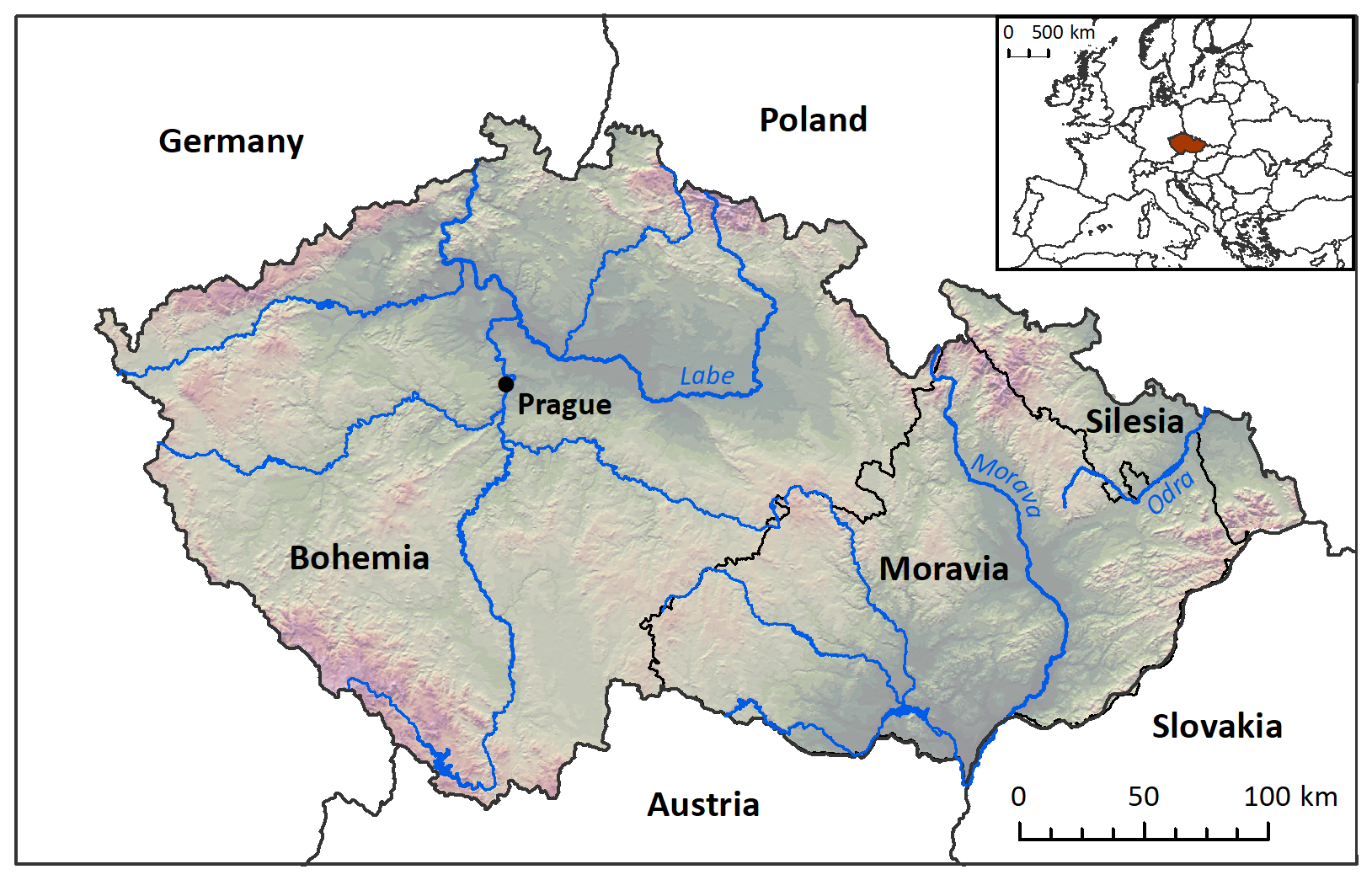
Figure 1Location of the Czech Republic in Central Europe, its historical parts and physical-geographic patterns (data source: ArcCR 500 v2.0).
2.2 Fatality sources
Information on weather-related fatalities over the territory of the Czech Republic (hereafter CR) can be extracted from various types of documentary evidence, which include the following data sources:
2.2.1 Newspapers and magazines
Newspapers and magazines, that covered the whole analyzed period, have always been interested in publishing reports about hydrometeorological extremes, describing in varying degrees of detail not only their course and the damage caused but also fatalities and injuries. This is especially true concerning extraordinary events in terms of human memory or their impacts on society in material damage and fatalities. For example, Moravské noviny (17 December 1868, p. 604) reported on 2 deaths during a windstorm on 7 December 1868 (for locations not specified in the following figures, see Fig. A1):
On the same day, when the windstorm horribly raged over Moravia, in Annín at Tovačov a misfortune befell several day labourers who were threshing grain in a barn. Due to the horrible windstorm, they were not able to open the barn gate and leave the barn before it collapsed. One of the labourers died immediately; the second one died soon due to serious injury; the third, with broken arms and legs, barely survives; only the fourth man escaped through a hole that opened in the ruins of the barn.
2.2.2 Registers of deaths
Registers of deaths were official records of deaths for state purposes and were kept by Catholic and Protestant priests at individual parishes and usually collected information about the name, sex, age, cause, and place of death. These are particularly valuable for finding additional detailed information when other documentary sources have incomplete information or report only the total number of deaths. For example, “lung paralysis due to drowning in flood” was mentioned on 16 May 1889 in Příchovice as the cause of death for the three children of the miner Matěj Suchý, namely his son Josef (12 years) and daughters Marie (6 years) and Barbora (9 years) (archival source AS2). On 17 May 1906, a lightning strike killed 24-year-old Marie Štěrbová at home in Ostrožská Nová Ves (AS1). Registers of deaths were maintained by church offices until 1949, when based on the act No. 268/1949 Coll. (Sbírka zákonů, 1949) this agenda was transferred to the state administration.
2.2.3 Epigraphic sources
Many weather-related fatalities are documented in epigraphic sources. These are represented particularly by memorial plaques commemorating such events, located on special memorials, buildings, crosses, or natural surfaces like rocks or stones. These monuments primarily memorialize those killed by lightning and floods, as well as in train or plane accidents, among other causes. For example, Fig. 2 shows various memorials to 3 further considered disastrous events in the Czech Lands.
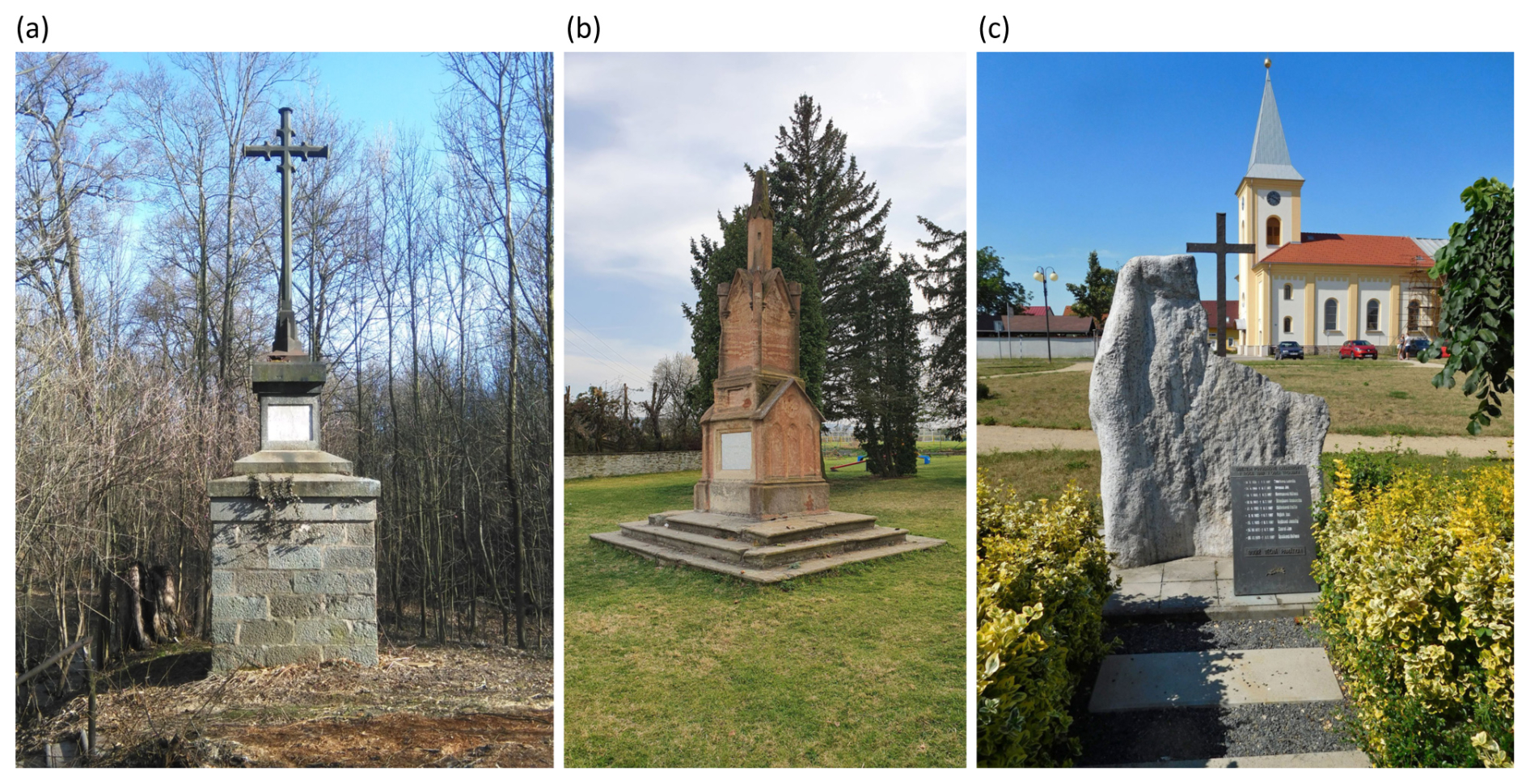
Figure 2Memorials to fatalities of disastrous events: (a) flood of 25–26 May 1872: the stone cross of seven victims in Stebno (Prudký, 2017); (b) snow of 10 November 1868: the memorial of 22 victims of the train crash in Cerhovice (source: Mapy.com – Mapy, 2025a); (c) flood of July 1997: the memorial of 9 victims in Troubky (source: Mapy.com – Mapy, 2025c).
2.2.4 Professional papers
Extreme hydrometeorological events with significant damage and fatalities have always been reported in specialized papers or reports. For example, the “Agency for Statistics of Field and Forest Management in the Bohemian Kingdom” reported on the meteorological, hydrological, and damage features of the 25–26 May 1872 flash flood in western Bohemia (Bernat, 1872; Kořistka, 1872). Other disastrous floods were reflected in special publications, such as those in Bohemia from 3–4 September 1890 (e.g., Benešovský-Veselý, 1890; Augustin, 1891) or 30–31 July 1897 (e.g., Anonymous, 1897a, b, c). Cyroň and Kotrnec (2000) focused on the flash flood in the Šardice region from 9 June 1970, and Matějíček and Hladný (1999) described the floods from July 1997 in the eastern part of the CR.
2.2.5 Internet sources
Using appropriate keywords, information about disastrous fatal events can be found on the internet. While some particularly disastrous events are frequently discussed on Wikipedia, other unknown local sources explaining detailed aspects of such events can be found elsewhere online. For example, the flash flood of 17 May 1889 in the Přeštice region was described in detail, citing newspaper reports, on the Facebook page of SJV 79 (2013). The most deadly railway accident in the CR, which occurred in dense fog on 14 November 1960 near Stéblová, was reported in detail by Strejcová (2025).
2.3 Meteorological and hydrological data
To characterize circulation/synoptic patterns related to the selected deadliest events, maps of sea level pressure, air temperature at the 850 hPa level, and in some cases wind speed for the corresponding days and hours were used. The maps were downloaded from Wetterzentrale webpage (Wetterzentrale, 2026); they visualize the Twentieth Century Reanalysis NOAA-CIRES-DOE 20CRv3 (Slivinski et al., 2019). This version 3 of the Twentieth Century Reanalysis covers the period 1836–2015 CE and can reliably be used for atmospheric estimates on scales ranging from single weather events to long-term climatic trends (Slivinski et al., 2021). As for in-situ meteorological data (precipitation totals, wind speed, air temperature), they were obtained from measurements by meteorological stations of the Czech Hydrometeorological Institute (CHMI) or its predecessors, spatially covering the area of the analyzed event. In a few cases, peak discharges of selected rivers from CHMI hydrological stations were also used. These data were supplemented with information from published papers.
The internal database of the Institute of Geography, Masaryk University in Brno, contains information on weather-related fatalities collected from various documentary sources from 1851 CE to the present. For each fatality, it includes: date of the event; location; type of event; time of day; name of the casualty; sex; age; cause of death; place of death; type of fatality; behavior of the fatality; and source of information. For some fatalities, however, characteristics may be incomplete. This database allowed for the selection of the 13 deadliest events (with at least 20 fatalities each) attributed to sudden weather phenomena, namely rainy floods (25–26 May 1872; 17 May 1889; 3–4 September 1890; 30–31 July 1897; 9 June 1970; July 1997), windstorm (7 December 1868), convective storm (4 July 1929), thunderstorm (17 May 1906), snow (10 November 1868), and fog (23 February 1945; 14 November 1960; 30 October 1975).
Each selected event was described by its meteorological pattern (synoptic map) leading to the event, its course, and the circumstances, with a focus on the number, spatial distribution, and characteristic features of the fatalities regarding their sex and age. While synoptic maps show situations at various times in Universal Time Coordinated (UTC), other exact times during the day are expressed in local mean time (LMT) or Central European Time (CET, i.e., UTC + 1 h). The geographical data from ArcCR 500 v2.0 were used for creation of maps showing in figures municipalities with fatalities. The level of detail in description of each selected events depends on the availability of sources, an acceptable style of presentation, and the scope of this article.
4.1 Floods
Floods originating from long-lasting continuous rain or from shorter heavy torrential rain (flash floods) most commonly cause fatalities due to collapsing houses and bridges, by drowning in water torrents, mudflows, heart attacks, and incidents occurring during rescue operations, among other causes. Flash floods, with their sudden onset in areas outside the core triggering rainfall, have had many fatalities, particularly in night, when people were already sleeping at home.
4.1.1 The flood of 25–26 May 1872
The synoptic situation of 25 May 1872 was determined by an upper-level trough extending from the north over Western Europe and a significant temperature boundary between cold and warm air over Western and Eastern Europe, respectively. At this stationary front, a wave deepened into a cyclone with its center moving from the southwest over central Bohemia (Fig. 3a). Thus, substantial wind shear appeared over western Bohemia, with northeast and southwest winds at the ground and aloft, respectively (Müller and Kakos, 2004). The vertical wind shear contributed to the longevity and only slow movement of convective storms, so in some places it rained intensely for up to 12 h with breaks. While the highest daily totals at standard meteorological stations around the most affected region reached no more than 48 mm in Příbram (474 m a.s.l.) (Fig. 3b), based on water levels in open containers, as much as 237 mm likely fell in ca. 90 min in Mladotice and 289 mm in ca. 12 h in Měcholupy (Kořistka, 1872). Despite the lack of systematic hydrological measurements at that time in western Bohemia (Elleder et al., 2020), extreme precipitation totals led on 25–26 May to a flash flood that was the largest known not only on small streams (as indicated by flood marks and documentary sources) but also on the Berounka River, which has a catchment of almost 9000 km2. The collapse of many ponds contributed to the magnitude of the disaster.
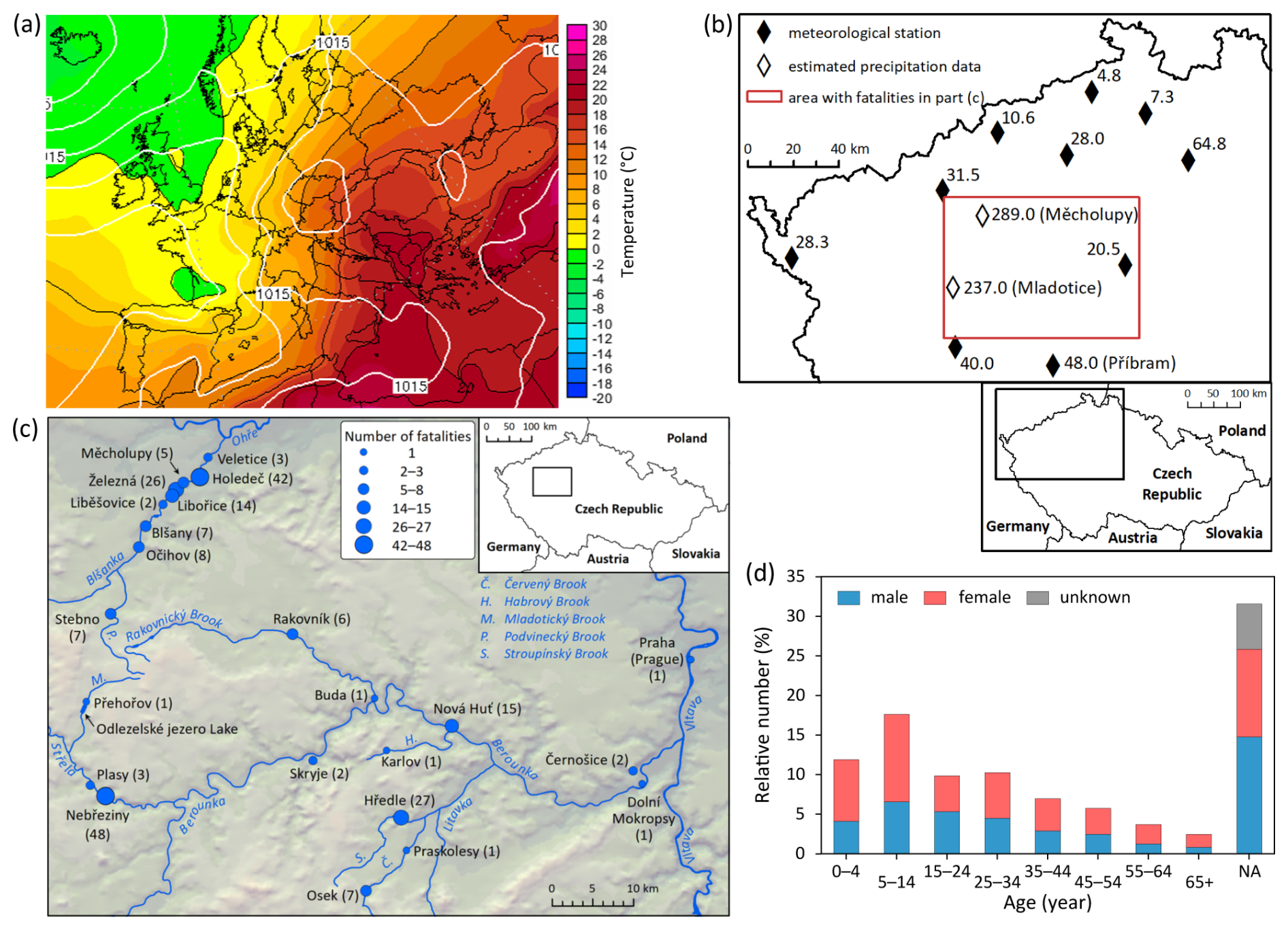
Figure 3The flash flood of 25–26 May 1872 in western Bohemia: (a) sea level pressure (hPa) and air temperature at the 850 hPa level on 25 May at 12:00 UTC (Wetterzentrale, 2026); (b) daily precipitation totals (mm) on 25 May; (c) municipalities with the number of fatalities according to Bernat (1872); (d) distribution of fatalities according to sex and age.
Bernat (1872) reported only briefly a figure of 230 fatalities in 24 municipalities in the Berounka and Blšanka catchments. The highest number, 48 fatalities, was reported for Nebřeziny, followed by 42 in Holedeč, 27 in Hředly, and 26 in Železná (Fig. 3c). In addition, 5 corpses swept away by water were reported in Siřem and 3 in Libořice. Extracting information from newspapers and registers of deaths allowed for the identification of 244 fatalities (Fig. 3d), of whom 99 (40.6 %) were female, 68 (27.9 %) were male and for 77 (31.5 %), the sex of the victims remained unknown. Children accounted nearly to 30 % of fatalities (17.6 % aged 5–14 years and 11.9 % aged 0–4 years), while above the 25–34 age category (10.2 %) proportions gradually declined toward the 65+ category (2.5 %). For 63 fatalities the age remained unknown (36 males and 27 females). Further, age and sex of 14 victims (5.7 %), specified as “family members”, were unknown.
This tragic flash flood destroyed or partially damaged buildings, agricultural objects, bridges, roads, etc. (visualized on 68 drawings by E. Herold in Světozor between 7 June and 13 September 1872), and the financial cost was calculated at 8.855 million guldens (for comparison: in 1871, the cost of a planned 38 km-long single-track railway in southern Bohemia was 4.298 million guldens). Extreme precipitation totals contributed to a landslide that created a barrier for the origin of the Odlezelské jezero Lake, unique in the Czech Massif during historical times (Janský, 1976, 1977). The May 1872 flood was analyzed in many papers (besides those cited above, see e.g., Skrejšovský, 1872; Harlacher, 1873; Elleder et al., 2012) and was also reflected in a shopkeeper song entitled “A new song about the ruptures of the clouds and the great flood in Bohemia on 25 May 1872” (Krejza, 1872).
4.1.2 The flood of 17 May 1889
On 16 May 1889, atmospheric conditions were determined by a high-pressure system over Scandinavia and a shallow depression over the Mediterranean. From there, warm and moist air penetrated Central Europe (Fig. 4a). The thunderstorms that caused the flood formed in a weak easterly flow. Under such circulation patterns, storm systems tend to be stationary, so intense precipitation can fall for several hours in the same area. This occurred on the night of 16/17 May in the Přeštice region in western Bohemia, where precipitation totals of more than 50 mm were recorded over an area of several hundred km2 (Fig. 4b). The highest total of 180 mm was measured at the Kbel station (445 m a.s.l.) within 2.5 h. The subsequent flash flood appeared particularly on the otherwise small Vlčí and Příchovický potok Brooks and their tributaries (Plzeňské noviny, 21 May 1889, pp. 1–2; SJV 79, 2013) (Fig. 4c). Because 16 May is the feast day of Jan Nepomucký (St John of Nepomuk), a patron saint of Bohemia, the flood was called Janská povodeň (John's Flood).
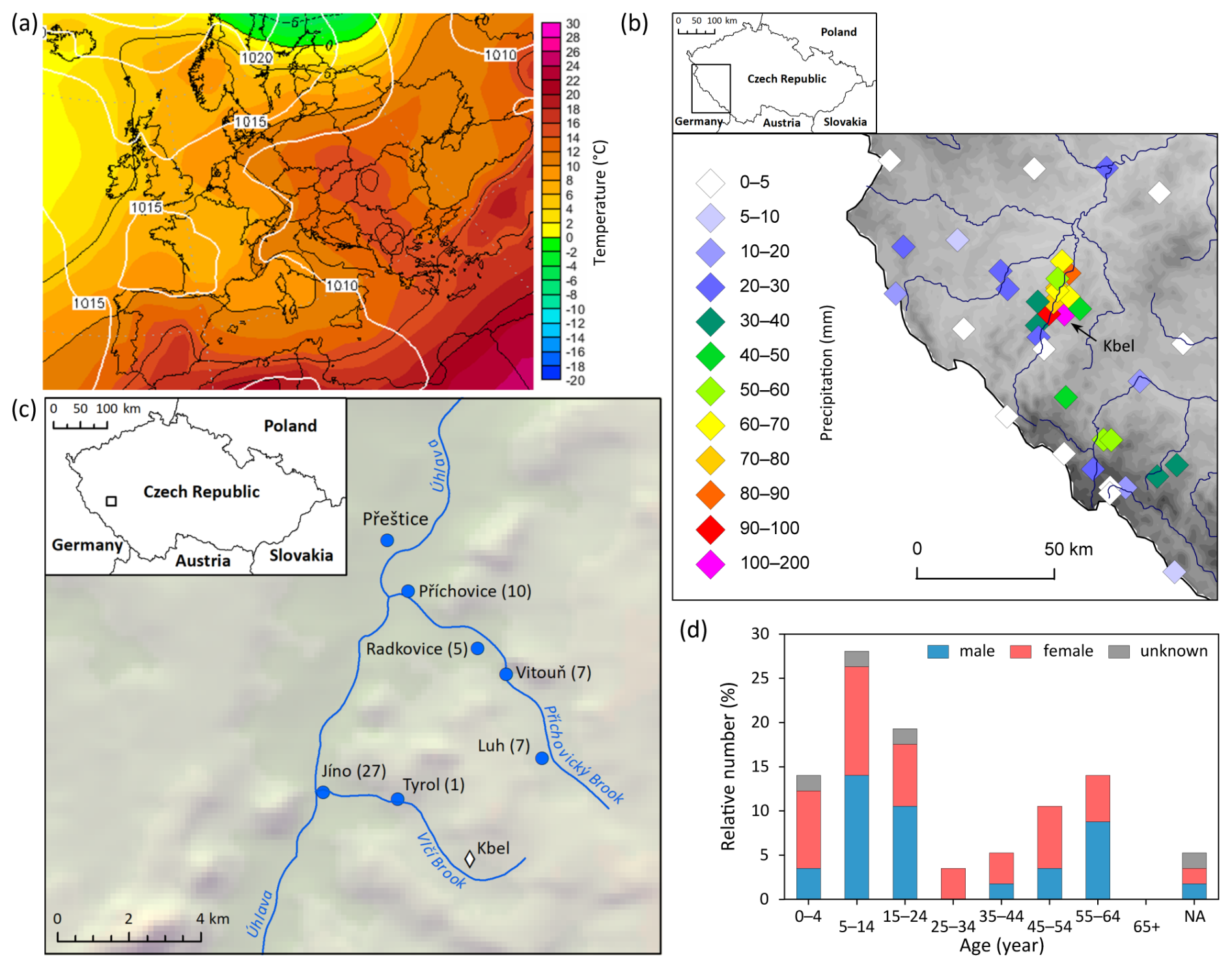
Figure 4The flash flood of 17 May 1889 in the Přeštice region: (a) sea level pressure (hPa) and air temperature at the 850 hPa level on 16 May at 18:00 UTC (Wetterzentrale, 2026); (b) daily precipitation totals on 16 May; (c) municipalities with the number of fatalities; (d) distribution of fatalities according to sex and age.
The nighttime occurrence of the triggering rainfall and flash flood meant that many victims were caught in their beds. In the most affected municipality, Jíno, 27 people died in collapsing houses (7 houses destroyed, 20 damaged, water reached a height of ca. 2 m) or were swept away by floodwaters (Fig. 4c). 7 persons died in a destroyed sawmill owned by Count Harrach in Luh, and the same number died in the destroyed Libštejnský Mill near Vitouň. Another 10 fatalities at the Příchovický potok Brook were reported in Příchovice and 5 in Radkovice. Of the 57 documented fatalities, females slightly prevailed (28, i.e., 49.1 %) compared to males (25, i.e., 43.9 %), while the sex was not specified for 4 victims (7.0 %) (Fig. 4d). High proportions of fatalities concerned children's categories (28.1 % for 5–14 years and 14.0 % for 0–4 years) and young people (19.3 % for 15–24 years). Besides fatalities, the broader area suffered damage to houses, agricultural objects, bridges, roads, ponds, and fields, as well as the drowning of livestock and domestic animals and so forth.
4.1.3 The flood of 3–4 September 1890
On 25–26 August 1890 and again on 29–30 August, the Vltava basin in Bohemia was on the cold side of a wavy front separating cold and warm air masses over Northwestern and Southeastern Europe, respectively. Frontal waves moving along the boundary to the northeast brought precipitation of several tens of millimeters to the basin and increased its saturation to twice the normal level. At the end of August, zonal flow over the northeast Atlantic was blocked by a high anticyclone, along the front of which cold air flowed to the western Mediterranean and formed a cut-off low in the higher troposphere. On 1 September, a surface cyclone formed at the edge of the cold drop over northern Italy and moved to the northeast along the so-called Vb track (van Bebber, 1881). In the cold sector of the cyclone with northern winds (Fig. 5a), persistent precipitation fell and was highest in southern Bohemia (Fig. 5b). Although the maximum daily total reached only 97.6 mm on 2 September at the Kopce station (590 m a.s.l.), the three-day rains combined with the previously saturated basin led to heavy flooding, mainly on the Vltava River (with peak discharge corresponding to a 100-year return period – Brázdil et al., 2005) and its tributaries.
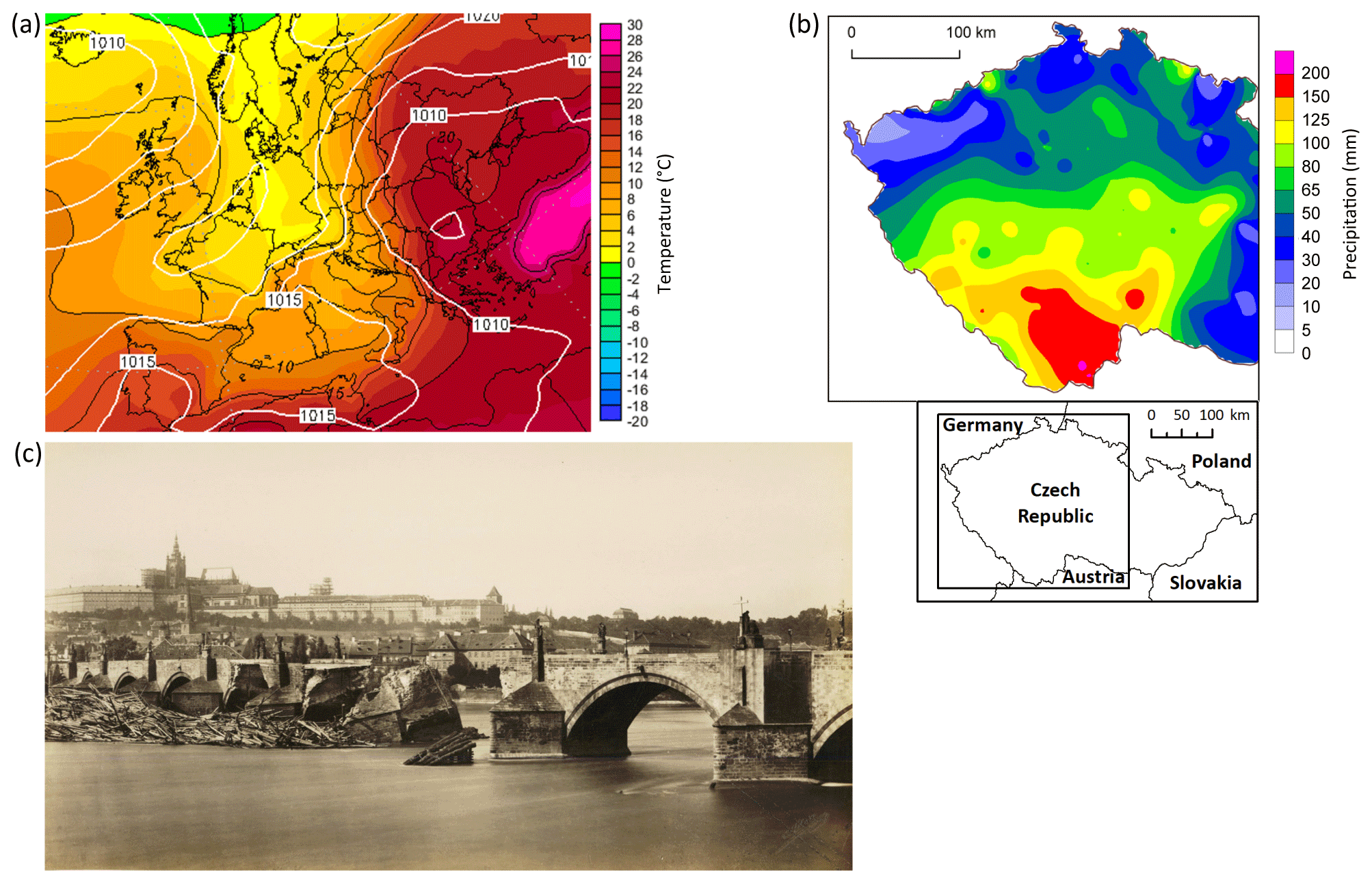
Figure 5The flood of the Vltava River on 3–4 September 1890 in Bohemia: (a) sea level pressure (hPa) and air temperature at the 850 hPa level on 2 September at 12:00 UTC (Wetterzentrale, 2026); (b) precipitation totals on 1–3 September 1890 in Bohemia; (c) the damaged Charles Bridge on the Vltava River in Prague (source: from the J. Eckert studio, Museum of Prague, catalogue no. H 029.416; cropped).
On 3 September 1890, as the water level of the Vltava in Prague rose, army pioneers worked on a pontoon for dismantling of an exercise bridge. Unfortunately, the pontoon was swept away under part of the stone Charles Bridge, resulting in the deaths of 20 soldiers (Národní listy odpolední, 3 September 1890, p. 2; ibid., 4 September 1890, p. 2; Národní listy, 4 September 1890, p. 3). Another four people drowned in the Vltava after a section of the Charles Bridge collapsed (Fig. 5c) at 05:30 LMT on 4 September, when the river reached its peak flow: an 18-year-old workman, two confectionery apprentices who came to see the floodwaters, and a woman bringing milk to Prague (Národní listy, 5 Sep. 1890, p. 1, 2). It was only the third case since the construction of the bridge in 1357–1432 CE that any part of it collapsed during a flood (the previous cases were on the night of 30/31 July 1432 and on 28 February 1784). To the 24 fatalities recorded in Prague, one must add a man who drowned in Vrchlice Stream in Kutná Hora.
4.1.4 The flood of 30–31 July 1897
On 28 July 1897, cold air flowed into the western Mediterranean and formed a cut-off low. A surface cyclone formed at the edge of the cold drop over northern Italy and moved along the Vb track into Central Europe. However, its further movement to the northeast was blocked by an anticyclone over Eastern Europe, which made the cyclone stationary above southeastern Poland on 29 July (Fig. 6a). Warm, moist air from the eastern Mediterranean flowed around the cyclone and reached its cold sector, where strong northerly winds blew due to the extreme pressure gradient between the cyclone and another anticyclone over Western Europe. Thus, persistent rains in the cold sector were significantly enhanced in the zonally oriented mountains of northern Bohemia (Fig. 6b). Extreme daily precipitation totals were recorded on 29 July 1897: 345.1 mm at Nová Louka (780 m a.s.l.) and 300 mm at Jizerka (870 m a.s.l.) in the Jizerské hory Mts., 266 mm at Pec pod Sněžkou (812 m a.s.l.), and 239 mm at Sněžka Mt. (1605 m a.s.l.) in the Krkonoše Mts. (Munzar et al., 2008). The total of 345.1 mm remained the highest recorded daily total in the CR until 14 September 2024, when a new maximum of 385.6 mm was recorded at the Loučná nad Desnou-Švýcárna station (1306 m a.s.l.) in the Hrubý Jeseník Mts. (Lipina et al., 2024). Steep slopes and high soil moisture from previous rains triggered subsequent disastrous floods on mountain rivers.
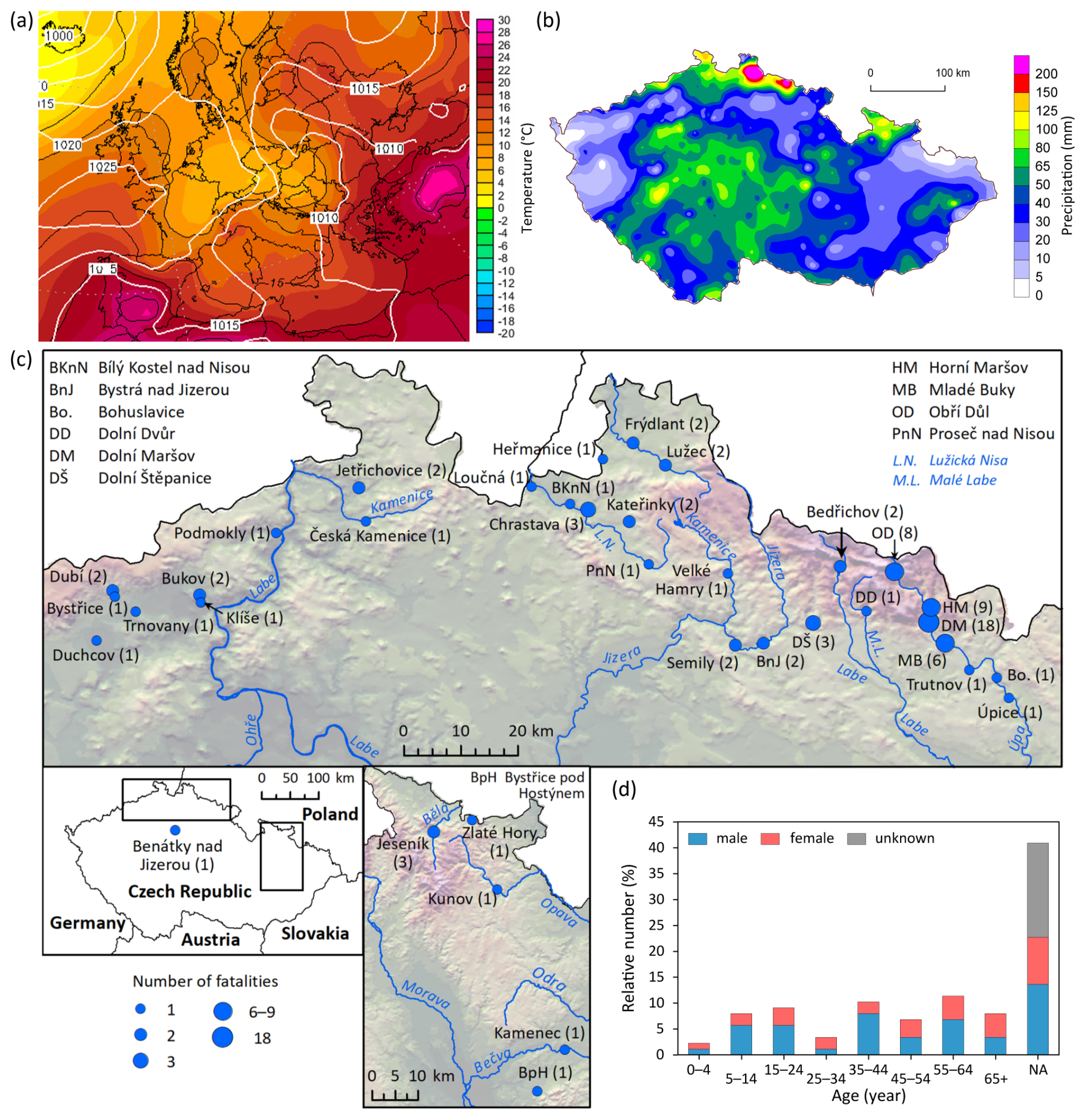
Figure 6The flood of 30–31 July 1897 in the Czech Lands: (a) sea level pressure (hPa) and air temperature at the 850 hPa level on 29 July at 18:00 UTC (Wetterzentrale, 2026); (b) daily precipitation totals over the Czech Lands on 29 July; (c) municipalities with the number of fatalities; (d) distribution of fatalities according to sex and age.
Because papers dealing with the 1897 flood (e.g., Anonymous, 1897a, b, c) focused mainly on detailed descriptions of damage, particularly in northern Bohemia, descriptions of fatalities are incomplete and less detailed. Among 36 municipalities with victims (Fig. 6c), the most tragic situation occurred in the Krkonoše Mts. For example, 17 people preparing for a wedding in the “Breiter House” in Dolní Maršov died when the house collapsed under the pressure of torrential water from the Úpa River. Furthermore, a mudflow caused by heavy rainfall killed 8 people in 3 homesteads on the slope of “Obří důl” within the cadastre of Pec pod Sněžkou. Documentary sources identified 88 fatalities, of whom 43 (48.9 %) were male, 29 (32.9 %) female, and in 16 cases (18.2 %), the sex was unspecified (Fig. 6d). Age was identified for 52 victims (59.1 %), with the highest proportions in the 55–64 (10, i.e., 11.4 %) and 35–44 (9, i.e., 10.2 %) age categories. Beyond the Czech Lands, this flood also affected Upper and Lower Austria, Germany, and Poland; at least 167 fatalities were reported across Central Europe during this event (Munzar et al., 2008).
4.1.5 The flood of 9 June 1970
On the afternoon of 9 June 1970, thunderstorms with torrential rain developed in warm, moist air approaching Central Europe from the southeast between a high over Northern Europe and a shallow low over the western Mediterranean (Fig. 7a). According to convective parameters calculated from pseudo-soundings of the reanalysis ERA5 (Hersbach et al., 2020), conditions were slightly favorable for the development of deep convection. As in May 1889 (see Sect. 4.1.2), convective storms did not move significantly for several hours. Thus, high precipitation totals occurred at some locations (Fig. 7b). Cyroň and Kotrnec (2000) estimated a total of ca. 195 mm during 2 h in the core area. Ždánice (228 m a.s.l.), the only CHMI station in the core region, recorded 133.6 mm between 16:40 and 19:20 CET. Other CHMI stations measured much lower totals (39.3 mm at Kyjov, 200 m a.s.l., located to the southeast, and 34.3 mm at Koryčany, 290 m a.s.l., located to the northeast).
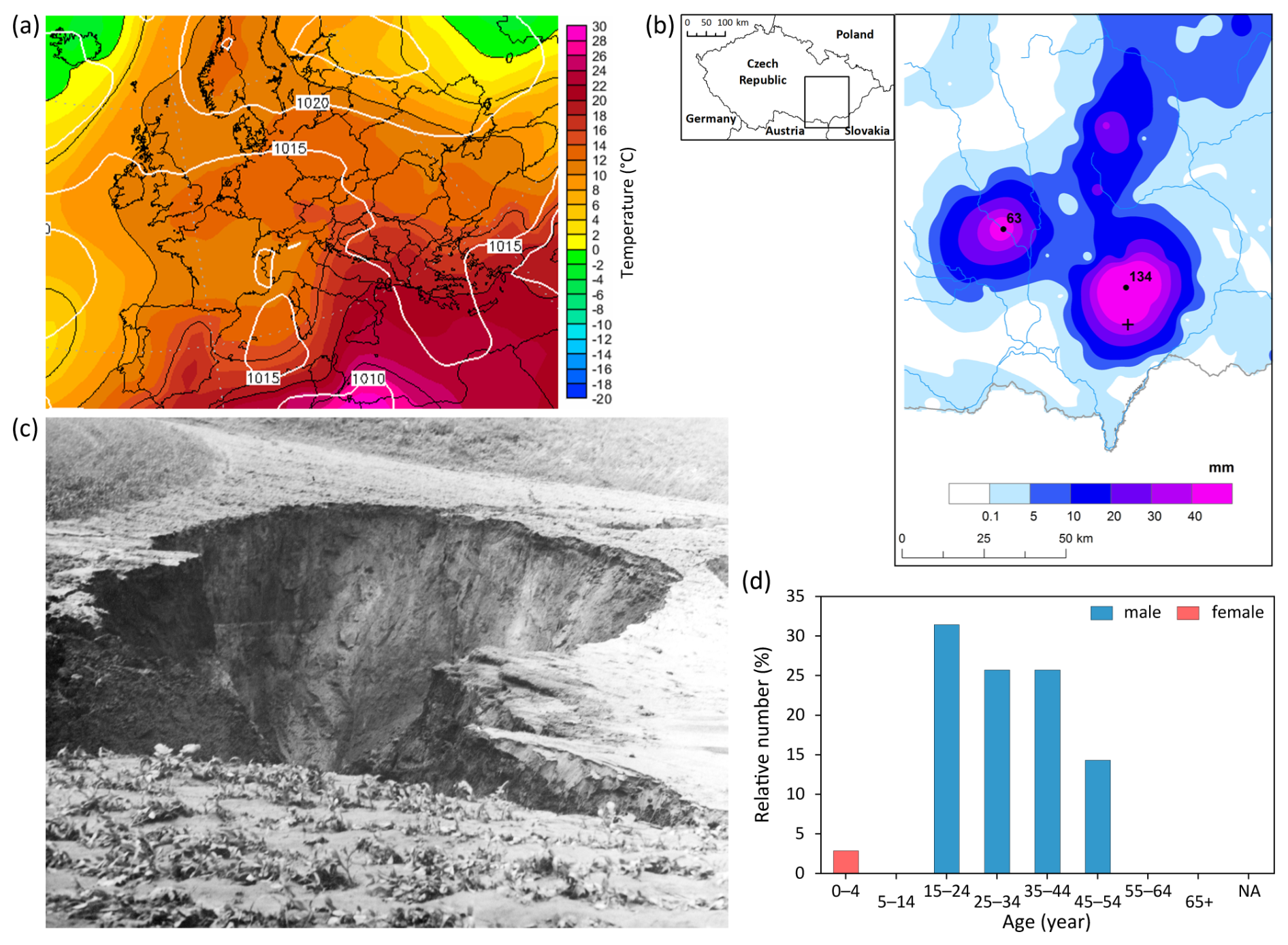
Figure 7The flash flood of 9 June 1970 in southeastern Moravia: (a) sea level pressure (hPa) and air temperature at the 850 hPa level on 9 June at 18:00 UTC (Wetterzentrale, 2026); (b) daily precipitation totals in southeastern Moravia (maximum totals in 2 core areas: 63 mm at Brno-Kníničky (240 m a.s.l.), 134 mm at Ždánice; the + symbol indicates Šardice) (Brázdil et al., 2019); (c) a crater created by the collapse of the upper part of the Dukla mine at Šardice (Cyroň and Kotrnec, 2000); (d) distribution of fatalities according to sex and age.
The subsequent flash flood of small streams in southeastern Moravia resulted in a disaster at the Dukla lignite mine in Šardice. An extreme volume of water led to the formation of a large lake at the mine, 2 m deep and c. 100 m wide, followed by a sudden burst of water, mud, and sand into the mine galleries (Mika and Hurt, 1986). In total, 32 km of corridors and shafts, together with all the workplaces and machinery, were flooded. The undermined ground collapsed in many places, creating broad and deep craters (Fig. 7c). Despite the concentrated efforts of over 200 rescuers, 34 miners from 13 municipalities aged between 19 and 53 died in the flooded mine: 11 men (31.4 %) were in the 15–24 age category and 9 (25.7 %) in each of the 25–34 and 35–44 categories (Fig. 7d). Besides the 34 miners, a 3-year-old girl drowned in Kyjov when she fell into a flooded cellar (Rudé Právo, 11 June 1970, p. 1). In the affected area of approximately 50 km2, encompassing 22 municipalities, significant damage occurred to 680 houses, 6000 ha of farmland, sewer systems, watercourses, domestic animals, and other assets (Rovnost, 17 June 1970, p. 1).
4.1.6 The flood of July 1997
Long and intense regional rains in July 1997 fell in the cold sector of a Mediterranean cyclone that passed along the Vb track over Central Europe. However, the cyclone remained in the same position for several days (Fig. 8a), so extremely high precipitation totals lasted from 5 to 8 July in Moravia and Silesia. Due to the large pressure gradient west of the cyclone's centre, precipitation was significantly enhanced in the mountains, particularly in the Hrubý Jeseník Mts. and the Moravskoslezské Beskydy Mts. (Fig. 8b). On 6 July, 4 stations recorded more than 200 mm (daily maximum of 233.8 mm at Lysá hora Mt., 1324 m a.s.l.) and 9 other stations more than 150 mm each. Extreme precipitation caused flooding on many rivers with peak discharges on 7–8 July (Fig. 8b). On 7 July, peak discharges corresponding to a return period >Q100 were achieved at 16 CHMI hydrological stations, Q100 at one station, and >Q50 at 2 stations. On 8 July, discharges >Q100 occurred at 7 stations, Q100 at 2 stations, >Q50 at one, and Q50 at 2 other stations. Over the following days, discharges of >Q100 appeared downstream along the River Morava (Matějíček and Hladný, 1999).
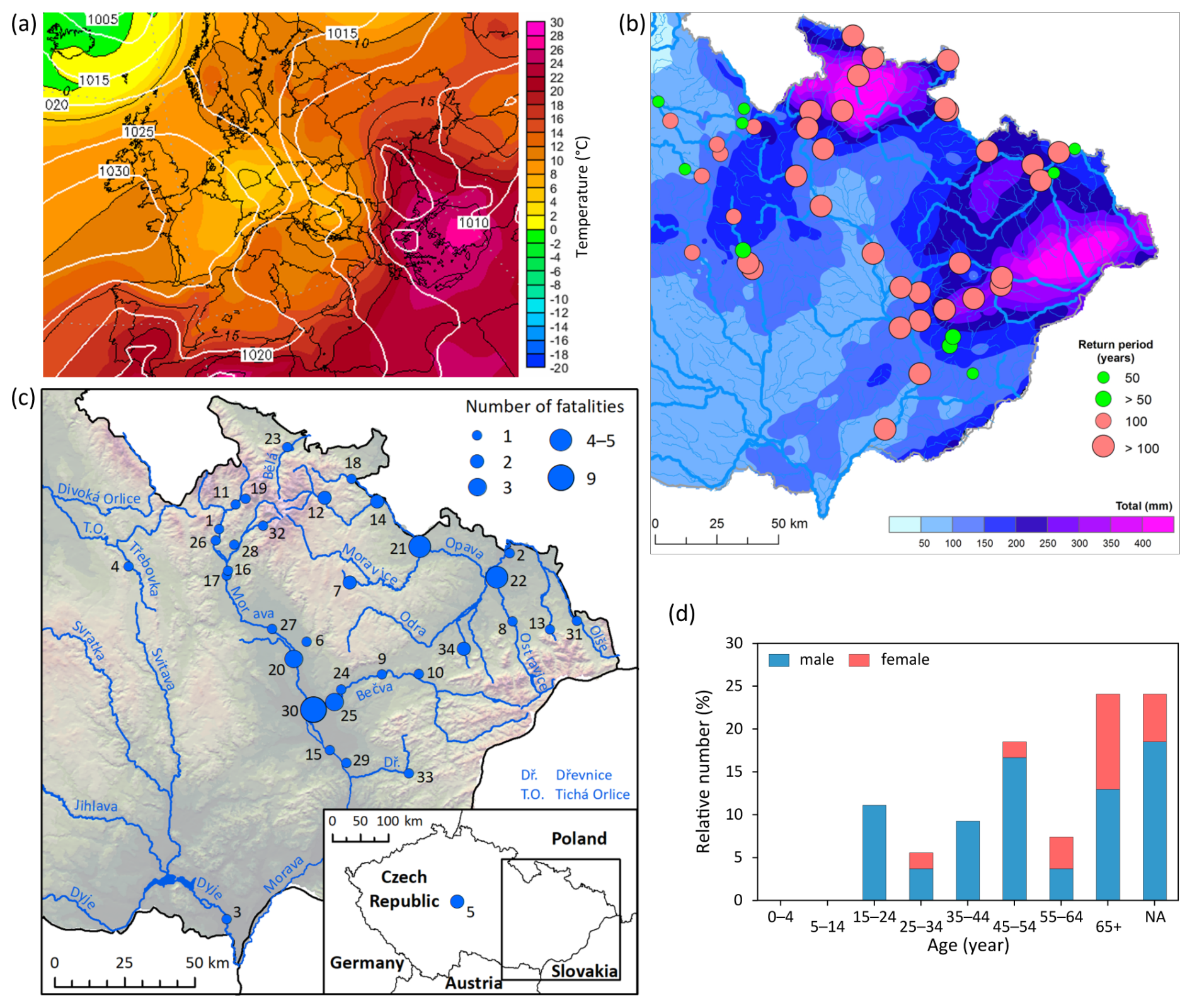
Figure 8The flood of July 1997 in the eastern part of the Czech Republic: (a) sea level pressure (hPa) and air temperature at the 850 hPa level on 6 July at 18:00 UTC (Wetterzentrale, 2026); (b) precipitation totals on 5–8 July 1997 and N-year return period of peak discharges QN≥50 years for hydrological stations of the CHMI (Brázdil et al., 2019); (c) municipalities with fatalities (number in brackets): 1 – Bohdíkov (1), 2 – Bohumín (1), 3 – Břeclav (1), 4 – Česká Třebová (1), 5 – Český Šternberk (2), 6 – Dolany (1), 7 – Dvorce (2), 8 – Frýdek-Místek (1), 9 – Hranice (1), 10 – Hustopeče nad Bečvou (1), 11 – Jindřichov (1), 12 – Karlovice (2), 13 – Komorní Lhotka (1), 14 – Krnov (2), 15 – Kroměříž (1), 16 – Lesnice (1), 17 – Leština (1), 18 – Město Albrechtice (1), 19 – Nové Losiny (1), 20 – Olomouc (3), 21 – Opava (4), 22 – Ostrava (5), 23 – Písečná (1), 24 – Prosenice (1), 25 – Přerov (3), 26 – Ruda nad Moravou (1), 27 – Střeň (1), 28 – Šumperk (1), 29 – Tlumačov (1), 30 – Troubky (9), 31 – Třinec (1), 32 – Vernířovice (1), 33 – Zádveřice-Raková (1), 34 – Závišice (2); (d) distribution of fatalities according to sex and age.
The disastrous flood claimed a total of 58 fatalities, located in 32 municipalities in Moravia and Silesia and in 2 localities in Bohemia (Fig. 8c). The most tragic situation was in Troubky on the River Bečva, where 9 people died during the night of 7/8 July (see Fig. 2c), followed by 5 victims in Ostrava and 4 in Opava. Sex and age were identified for 54 fatalities, of whom 41 were men (70.7 %) and 13 were women (22.4 %), while for 4 other reported victims (6.9 %) no such details were available (Fig. 8d). The maximum of 13 fatalities occurred in the 65+ age category (24.1 %), and the same proportion characterized fatalities with unknown age. The second age category was 45–54 years with a proportion of 18.5 %, and the third was 15–24 years with 11.1 %. Three additional suicides were also connected with this flood, meaning the total number of fatalities reached 61.
4.2 Windstorms
Strong winds can be connected either to windstorms caused by large horizontal pressure gradients, with a duration ranging from a few hours to several days, or to convective storms accompanying the formation of cumulonimbus (Cb) clouds, with high winds of shorter duration (e.g., squalls, tornadoes, downbursts). Related fatalities are attributed particularly to people being killed by falling objects (tree branches, uprooted trees, beams) and destroyed structures (collapse of a barn, chimney, parts of roofs, roofing tiles), but also to people being struck by wind on the ground, capsized boats, fallen power lines, among other causes.
4.2.1 The windstorm of 7 December 1868
Since 5 December 1868, the Czech Lands had been located in warm air south of a stationary atmospheric front extending from the British Isles over the North and Baltic Seas to the east. Individual frontal waves moved along this boundary from west to east. One of them deepened over Denmark on the night of 6/7 December, significantly increasing the horizontal pressure gradient between the frontal cyclone and the high over the Mediterranean. On the morning of 7 December, the flow of warm air into the Czech territory peaked, as evidenced by a temperature of 14.5 °C reached at 07:00 CET at the Prague-Klementinum station (191 m a.s.l.). The maximum wind speed was reached in the warm sector of the cyclone and in connection with the subsequent passage of a rapidly advancing cold front from the northwest (Fig. 9a, b). A severe windstorm hit the Czech territory on 7 December, when hurricane-force winds raged especially between 09:00 and 16:00 LMT.
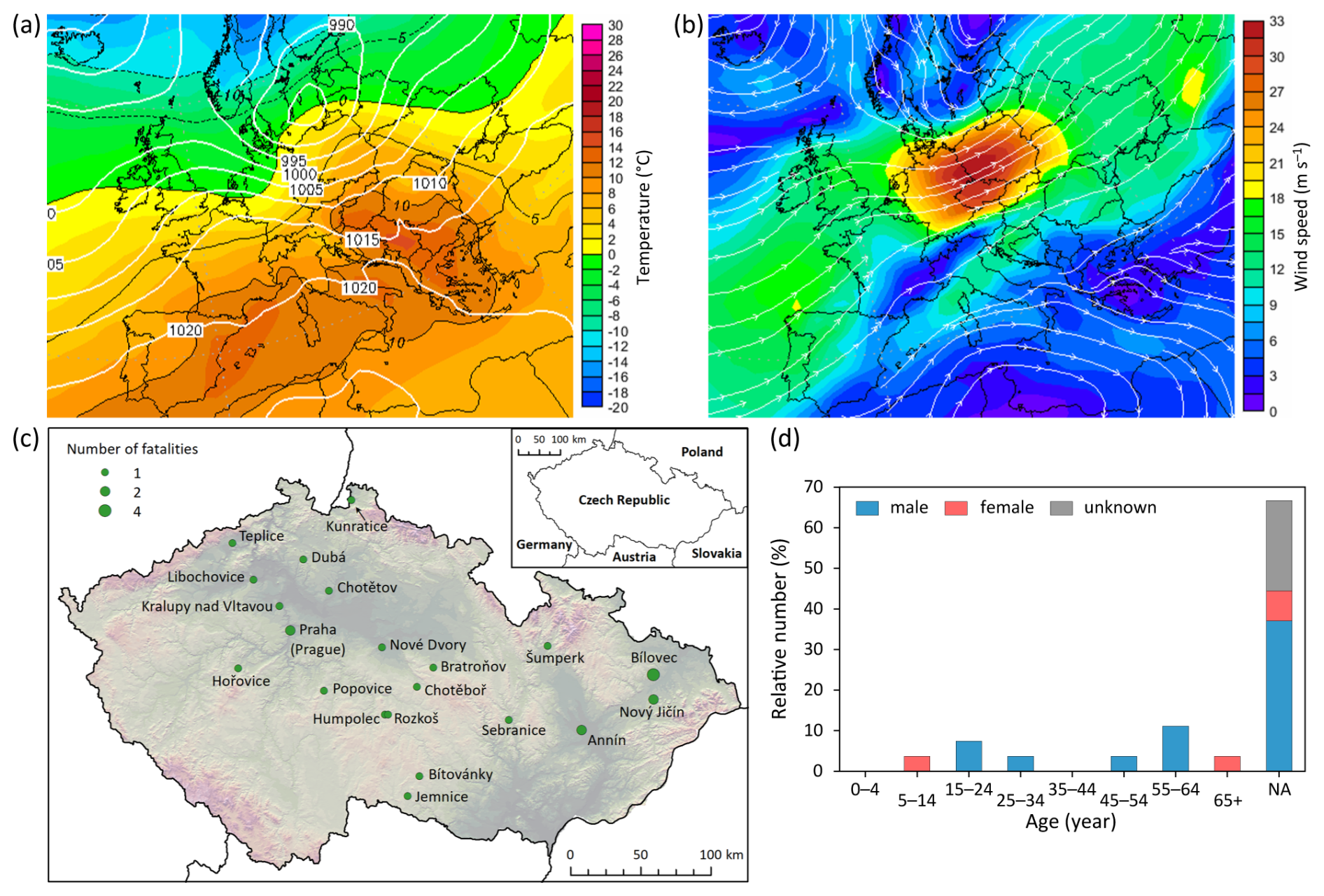
Figure 9The windstorm of 7 December 1868 in the Czech Lands: (a) sea level pressure (hPa), air temperature and (b) wind speed at the 850 hPa level at 12:00 UTC (Wetterzentrale, 2026); (c) municipalities with fatalities; (d) distribution of fatalities according to sex and age.
Of the 27 fatalities during this windstorm, recorded in 21 municipalities over the whole country (Fig. 9c), 4 people were killed in Bílovec by falling beams and roofing tiles (Bohemia, 11 December 1868, p. 3854), and 2 people died in each of 3 other places: Annín (see Sect. 2.2.1), Nový Jičín, and Prague. Regarding sex, 17 victims (63.0 %) were male, 4 were female (14.8 %), and the sex of the 6 remaining fatalities (22.2 %) was not reported in newspapers (Fig. 9d). It was only possible to find the age for 9 fatalities (33.3 %), 3 of whom were in the 55–64 age category. At least 38 people were also injured, many seriously (Brázdil et al., 2017).
The severity of the windstorm was evident from 237 identified locations with damage to buildings and other structures, trees, telegraph lines, railway equipment, and so forth. Forests were particularly damaged; Hošek (1981) reported damage to 6 million m3 of solid wood, while a more careful analysis by Brázdil et al. (2017), based on data from 273 forest districts throughout the Czech territory, calculated 4.89 million m3. Damage and fatalities during this windstorm were also reported in the broader territory extending from the British Isles, over the Netherlands, Belgium, and Germany, to Austria and Poland.
4.2.2 The convective storm of 4 July 1929
On 4 July 1929, an upper-level trough over the North Atlantic and a high-pressure ridge over Southeastern Europe drove the flow of warm air from the southwest into Central Europe (Fig. 10a). A significant cold front was located west of Bohemia, where maximum air temperatures rose to 30–35 °C. Strong convective activity followed in the evening, with thunderstorms moving along the frontal boundary from the southwest to the northeast. Thunderstorms were reported in central Bohemia (Prague) at 19:00 CET and in Moravia between 20:00 and 22:00 CET. They were accompanied by a heavy windstorm, hail, and/or downpours. Several tornadoes also occurred. The only meteorological station measuring wind gusts at that time, Prague-Karlov (260 m a.s.l.), recorded a maximum of 28.9 m s−1, which was not exceptionally high.
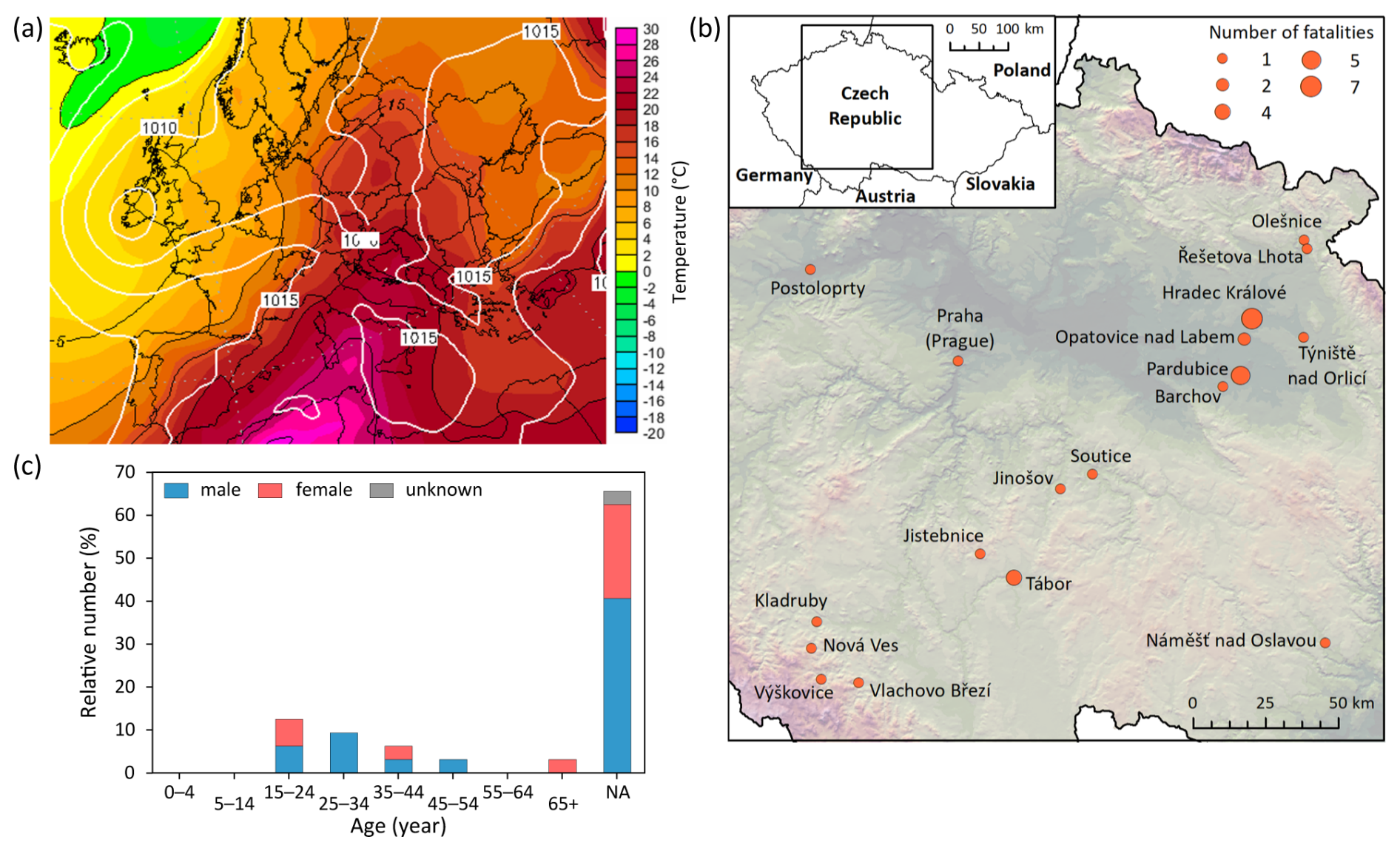
Figure 10The convective storm of 4 July 1929 in the Czech Lands: (a) sea level pressure (hPa) and air temperature at the 850 hPa level at 18:00 UTC (Wetterzentrale, 2026); (b) municipalities with fatalities; (c) distribution of fatalities according to sex and age.
While in Prague one man was killed after picking up a phone wire thrown by the storm onto a power line, stronger winds in other parts of the country were responsible for a total of 32 fatalities and dozens of seriously and slightly injured people. With the exception of Náměšt' nad Oslavou, these were concentrated in 17 municipalities in Bohemia, particularly its eastern part (7 fatalities in Hradec Králové and 5 in Pardubice), though 4 deaths were also mentioned by newspapers in Tábor in the southern part (Fig. 10b). The affected municipalities formed a belt extending across Bohemia from the southwest to the northeast, clearly indicating the position of the cold front with the deadliest impacts. Although people died primarily as a consequence of high winds, 2 people also died from lightning strikes. A total of 20 male fatalities, representing 62.5 % of all victims, was numerous than that of female (11, i.e. 34.4 %); the sex was unknown for one person (3.1 %) (Fig. 10c). Age information was available for only 11 individuals (34.4 %), with the highest proportion of deaths in the 15–24 age category (4 fatalities, i.e., 12.5 %).
A broad range of damage during this storm affected forests (ca. 3.018 million m3 of damaged wood – Hošek, 1981), buildings, churches, industrial and other structures, fruit trees and gardens, railway transport, power cables, and telephone lines. This damaging event was also reported in Austria, Germany, and Switzerland (Brázdil et al., 2017). More specific, according to European Severe Weather Laboratory (2026), the affected area stretched from the region of Lake Constance up to the Wielkopolskie region in Poland, and from the Vienna area up to northern Brandenburg region in Germany.
4.3 The thunderstorms of 17 May 1906
On 17 May 1906, the Czech Lands were affected by many thunderstorms. They originated in warm air expanding into Central Europe from the east within the northern sector of a shallow cyclone centred over the Mediterranean (Fig. 11a). Under these conditions, Moravia and Silesia were most susceptible to thunderstorms.
At the Evangelical cemetery at Koňákov (now part of Český Těšín), about 70 people attending an afternoon burial were surprised by a sudden thunderstorm. Some sheltered in a bell tower, which was subsequently hit by a lightning strike (Lidové noviny, 18 May 1906, p. 4; Rovnost, 21 May 1906, p. 5; Opavský týdenník, 23 May 1906, p. 4). A total of 13 people were killed on the spot and 23 others were injured. Among the victims were 8 men between 35 and 71 years old, 4 women between 21 and 40 years old, and an 8-year-old boy (Fig. 11b). 7 other people from 6 municipalities were killed by lightning strikes on the afternoon of the same day during field or forest work, on their way back from fields, or directly inside of buildings (Fig. 11c). This means that a total of 20 people died due to lightning strikes on 17 May: 13 men (65 %) and 7 women (35 %). One quarter of them (25 %) were in the 35–44 age category, and one fifth (20 %) were in the 15–24 category (where women were more numerous), followed by 15 % in the 45–54 and 55–64 age categories (Fig. 11d).
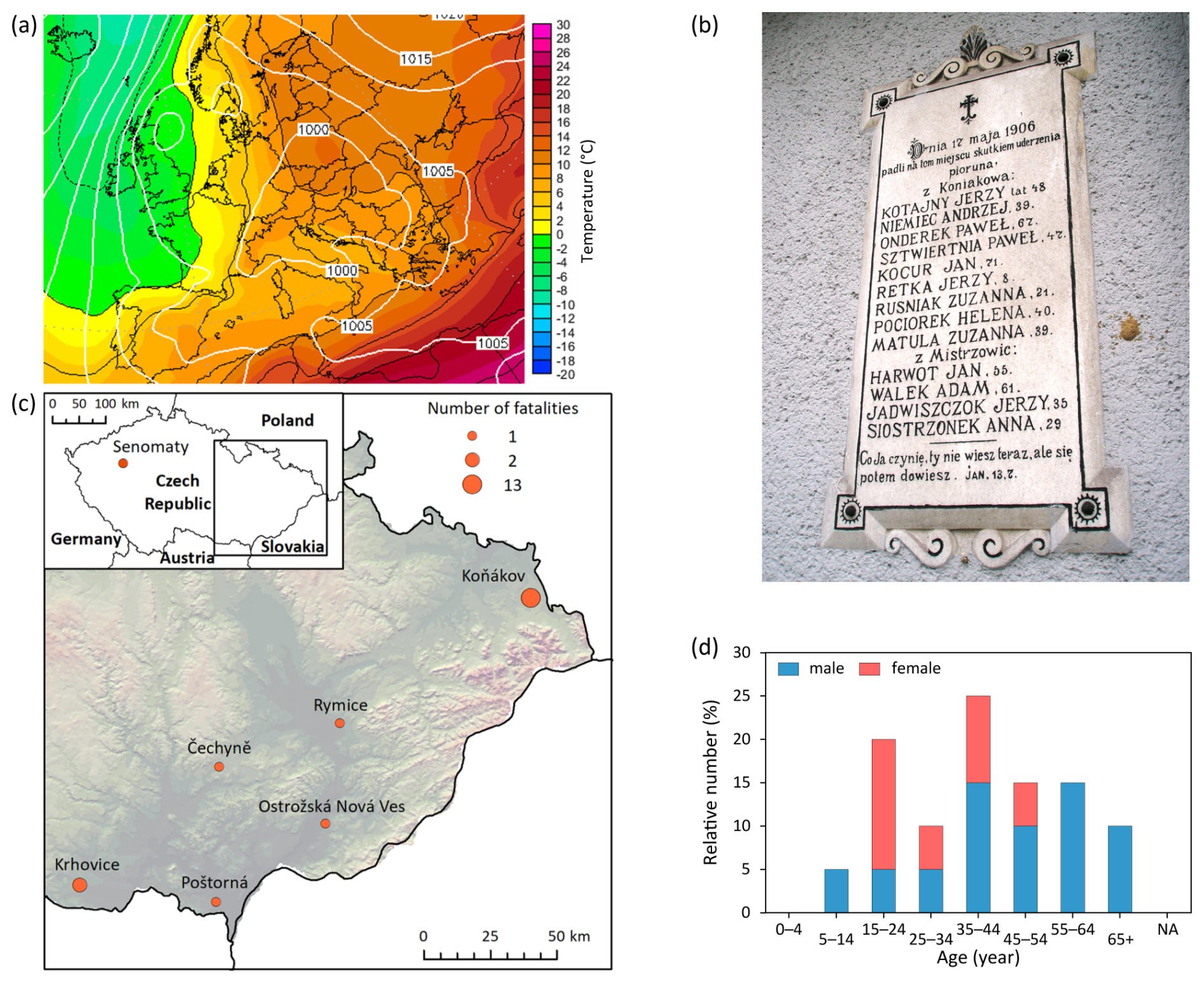
Figure 11The thunderstorms of 17 May 1906 in the Czech Lands: (a) sea level pressure (hPa) and air temperature at the 850 hPa level at 12:00 UTC (Wetterzentrale, 2026); (b) memorial plaque of 13 lightning fatalities at the Koňákov cemetery (Qasinka, 2009); (c) municipalities with fatalities; (d) distribution of fatalities according to sex and age.
4.4 The snow of 10 November 1868
From 5 November 1868, cold air penetrated Western Europe from the north, leading to the formation of a stationary atmospheric front extending from southern Spain through Central Europe to the Baltic. A frontal cyclone formed over the western Mediterranean and moved northeastward along the Vb track on the night of 8/9 November. Warm, moist air flowed into Eastern Europe from the Mediterranean on the front side of the cyclone, circled around its centre, and penetrated the Czech territory at higher levels (Fig. 12a, b). The southwestern part of the Czech territory lay in the cold rear sector of the cyclone near a retrograde warm front, which produced heavy precipitation. The Prague-Klementinum station recorded 52.6 mm between the mornings of 9 and 10 November (the highest daily total of the winter half-year from 1804 CE to the present). In Plzeň, it snowed from the evening of 8 November to the morning of 11 November, with daily precipitation totals of 24.8 and 19.4 mm on 9 and 10 November, respectively. Temperatures between 1 and 3 °C during these days in Prague and Plzeň explain the extraordinary amount of snow falling in the hilly area between the two cities.
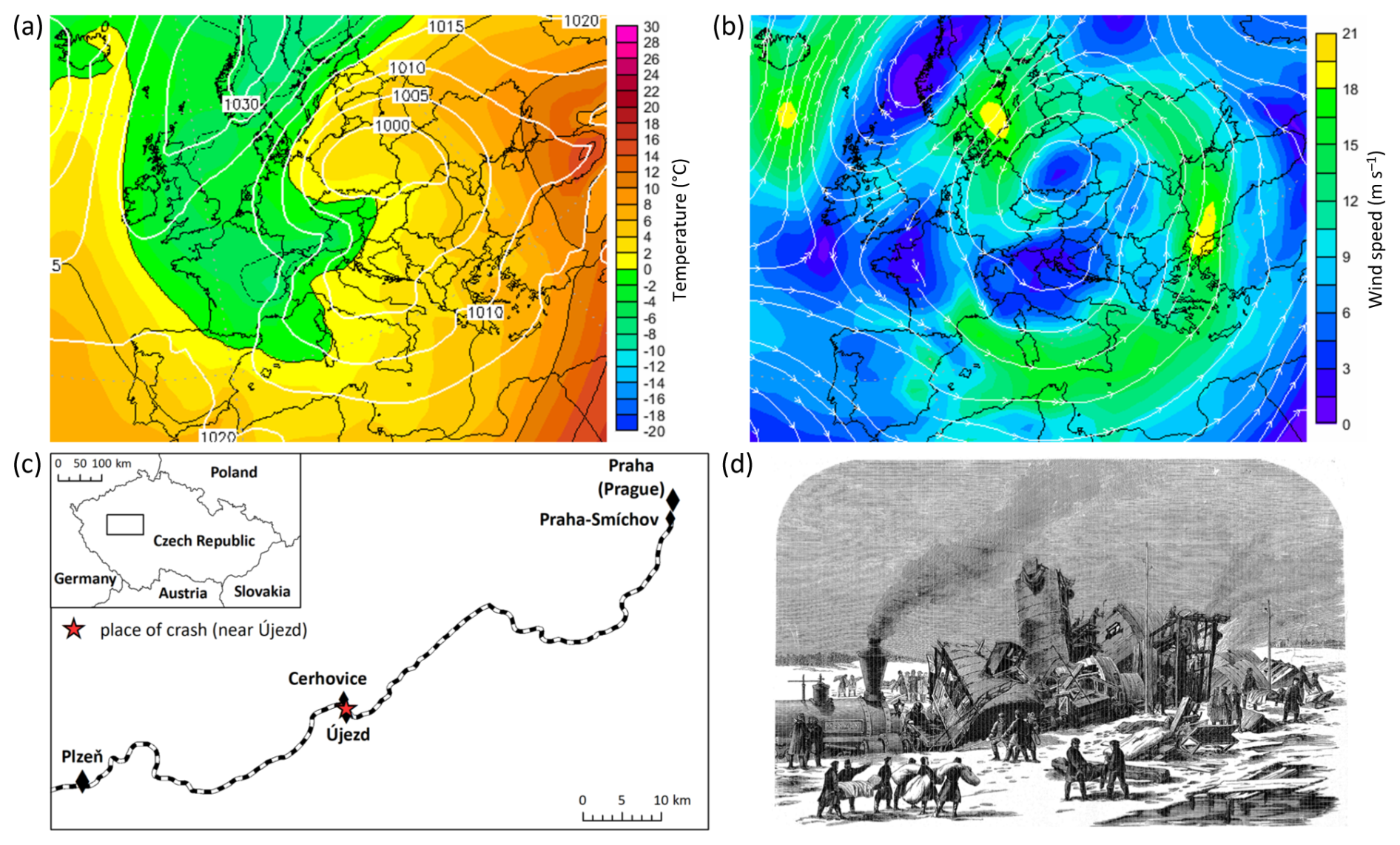
Figure 12A tragic train crash in Újezd at Cerhovice on 10 November 1868: (a) sea level pressure (hPa), air temperature and (b) wind speed at the 850 hPa level at 00:00 UTC (Wetterzentrale, 2026); (c) geographic situation of train crash; (d) drawing of the crash by F. Chalupa from Světozor (20 November 1868, p. 443).
On 10 November 1868 at 04:00 LMT, an ordinary passenger train departed from Plzeň in western Bohemia bound for Prague (Fig. 12c). 281 passengers, of whom 244 were men of a Hungarian infantry regiment (Slovaks and Hungarians) returning from an Italian expedition and going on holiday, were travelling in the last 4 carriages. Large snowdrifts caused the train to stop in Újezd at Cerhovice. Around 06:00 LMT, a freight train, which had been following behind, collided with the stationary passenger train (Fig. 12d). 22 soldiers died during the crash and were buried in Cerhovice (see Fig. 2b). Another 61 heavily injured men were transported to the military hospital in Prague, where 9 more died later, resulting in a total of 31 (Zahradník, 2013). Information about total fatalities, however, differs according to various sources: for example, Světozor (20 November 1868, p. 444) mentioned 35 victims, while Plzeňské listy (14 November 1868, no pagination) mentioned even 59.
4.5 Fog
Significantly decreased visibility during thick fog, combined with human error, contributed to the deadliest train accident and 2 of the deadliest plane accidents in the territory of the CR.
4.5.1 The fog of 23 February 1945
On the night of 23 February 1945, during World War II, an overloaded German military plane, a Junkers JU 52 with 8 crew members (including 4 from a plane that had crashed the same night at the airport in Breslau, now Wrocław, Poland) and 20 injured soldiers, flew from besieged Breslau toward the Dresden-Klotzsche airport (Germany) (Krejčí, 2014). Given the location of the war front to the west, the plane likely flew a roundabout route over Czech territory (Fig. 13b), which was still occupied by the German army. It thus approached the main ridge of the Krkonoše Mts. from the southeast. There were reports of strong winds and snowfall, but this is confirmed neither by the synoptic situation (Fig. 13a) nor by data from the meteorological station on the highest peak, Sněžka Mt. (1605 m a.s.l.): no snowfall was recorded and the mean wind speed was only 12–15 m s−1. Nevertheless, the station recorded visibility of only 400 m due to fog and blowing snow throughout the night.
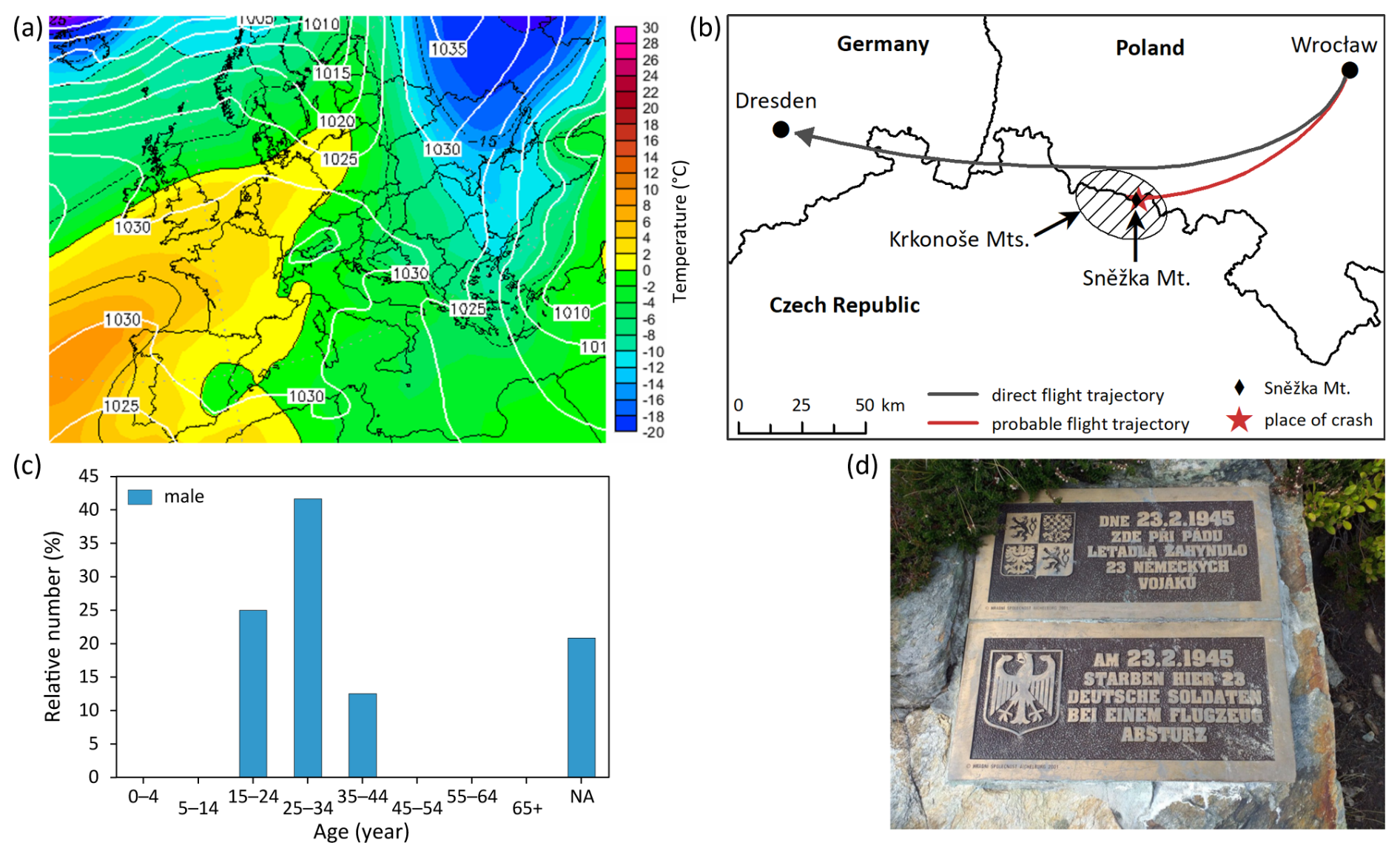
Figure 13The air crash at “Sluneční jáma” in the Krkonoše Mts. on 23 February 1945: (a) sea level pressure (hPa) and air temperature at the 850 hPa level at 00:00 UTC (Wetterzentrale, 2026); (b) the scheduled flight lane and place of crash; (c) distribution of fatalities according to sex and age; (d) the memorial plaque with the inscription: “On 23 February 1945, 23 German soldiers died here in the fall of a plane” (source: Mapy.com – Mapy, 2025b).
Due to a combination of a navigation error and low visibility, the aircraft crashed at 03:45 LMT on the slope of “Sluneční jáma” in the Krkonoše Mts. at an altitude of ca. 1360 m a.s.l. A total of 24 soldiers died in the crash itself, froze to death afterward, or died from exhaustion. The majority were in the 25–34 age category (10 men, i.e., 41.7 %), followed by 6 (25.0 %) in the 15–24 age category (Fig. 13c). Age was not identified for 5 soldiers (20.8 %). In terms of the number of fatalities, it was the largest aircraft crash over Czech territory during the Second World War, and has been commemorated since 2001 by a memorial plaque (Fig. 13d; Krejčí, 2014; Archa Krkonoš, 2026).
4.5.2 The fog of 14 November 1960
On 14 November 1960, a high-pressure ridge extended over Central Europe from the southwest (Fig. 14a). Radiative fogs formed in lowlands overnight, as evidenced by 100 % air humidity at the Prague-Ruzyně aerological station on 15 November at 00:00 UTC.
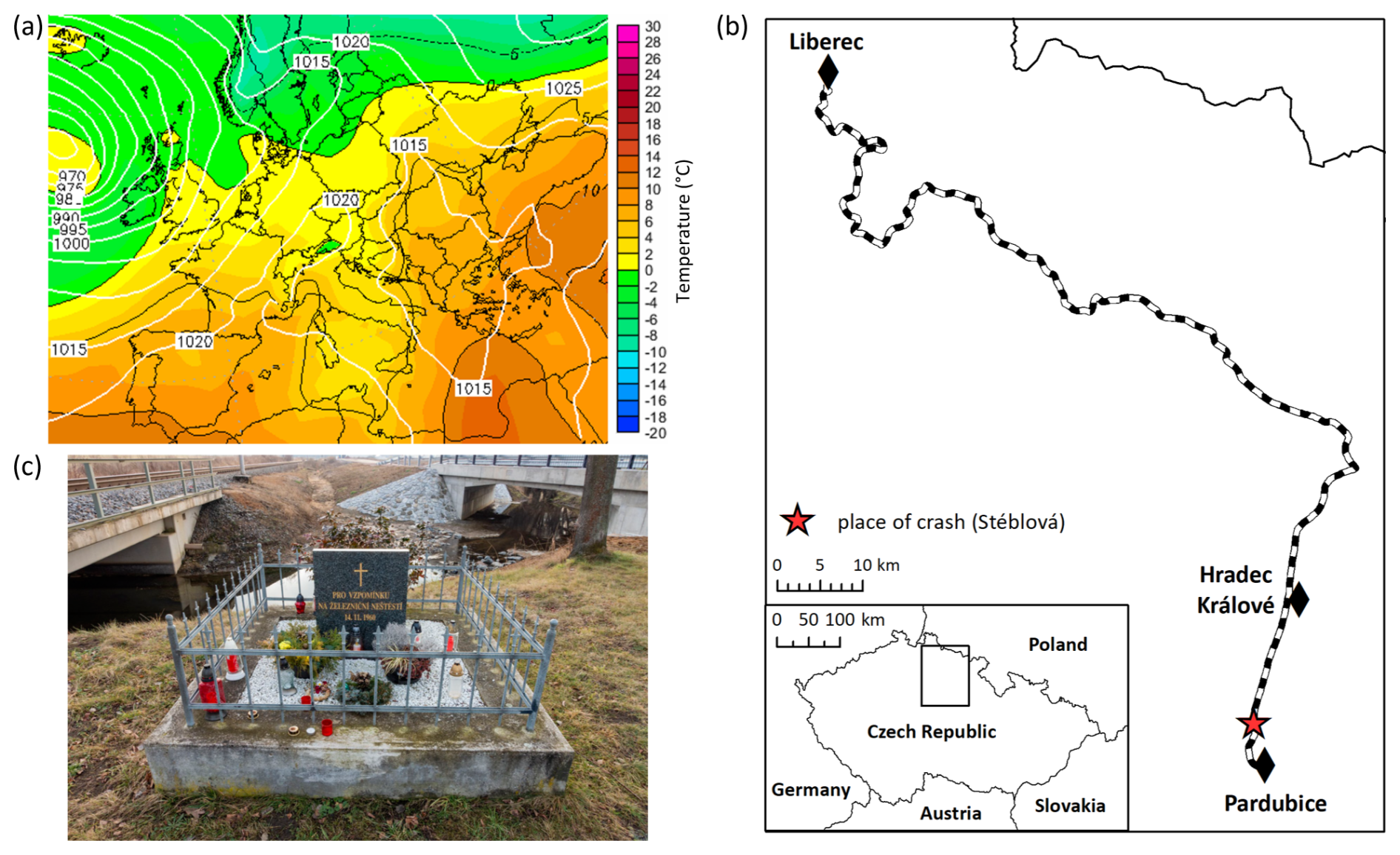
Figure 14The train accident of 14 November 1960 near Stéblová: (a) sea level pressure (hPa) and temperature at the 850 hPa level at 18:00 UTC (Wetterzentrale, 2026); (b) geographic situation; (c) memorial to victims of the accident near Stéblová (source: Mapy.com – Mapy, 2025d).
Under conditions of low visibility near Stéblová in eastern Bohemia (Fig. 14b), a passenger train from Liberec to Pardubice, pulled by a steam locomotive, collided head-on with a motor passenger train from Pardubice to Hradec Králové (Bébar, 2020). The accident occurred because the passenger train left the Stéblová station without permission. A guard, who allegedly saw a flash of green light in the fog, gave the engine driver the instruction to depart. Because of the dense fog, however, their communication was only verbal. The engine driver did not recognize the stop instruction on the semaphore or the railroad switch, which was not set in the train's direction. At 17:43 CET, ca. 1.5 km from Stéblová, the drivers of both trains saw each other in the dense fog at a distance of ca. 80 m, by which time it was impossible to stop. The wagons of the motor passenger train were especially damaged; some travellers died not from the crash itself, but from a fire which started when fuel from the motor train was ignited by glowing coal from the steam locomotive. The accident claimed 118 lives (3 persons missing) and caused 110 injuries (Strejcová, 2025), representing the deadliest railway accident since the beginning of rail transport in the CR (Fig. 14c). The main communist newspaper Rudé Právo included this tragedy on the front page of the 16 November issue as a report from the Czechoslovak government. The article briefly summarized the accident, noting 110 deaths and 108 injuries, the politicians visiting the scene, and the establishment of a governmental investigation commission, but it did not revisit the event in detail in subsequent issues.
4.5.3 The fog of 30 October 1975
On 30 October 1975, a Yugoslavian plane, McDonnell Douglas DC-9, was transporting primarily Czech tourists from the seaside resort of Tivat (now Montenegro) to the Prague-Ruzyně airport. On this day, Bohemia was in the warm air within the northern sector of a large high-pressure system (Fig. 15a). A west-northwest wind was blowing aloft. Therefore, the plane was landing from the ENE on a runway oriented in a WSW–ENE direction (Fig. 15c). At 06:00 UTC, a significant radiation inversion was recorded at the Prague-Libuš aerological station (302 m a.s.l.). The air temperature at the station was only 0 °C, while 600 m higher it was 14 °C (Fig. 15b). The station was in fog with relative humidity of almost 100 %. The vertical extent of the fog remains a question, as other data on air humidity in the inversion layer are missing. Based on the dew point of 4.4 °C measured at 12:00 UTC at an altitude of 958 m a.s.l., the thickness of the fog can be estimated at several hundred meters. High relative humidity in the 6–11.5 km air layer revealed high cloud cover, which apparently hindered the process of fog dissolution in the morning.
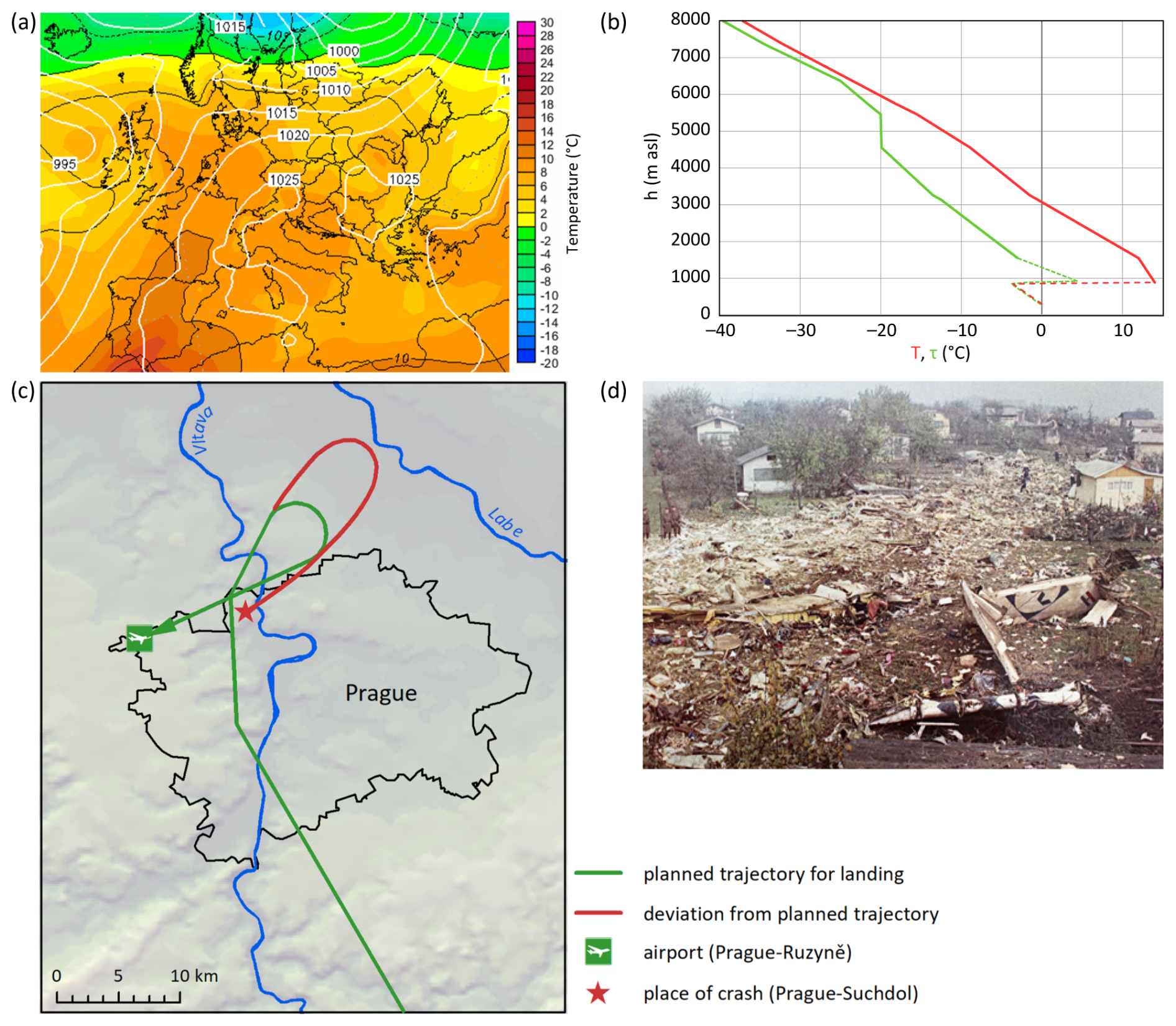
Figure 15The air crash in fog of 30 October 1975 in Prague: (a) sea level pressure (hPa) and air temperature at the 850 hPa level at 06:00 UTC (Wetterzentrale, 2026); (b) vertical profile of the air temperature (T) and the dew point (τ) at the Prague-Libuš station at 06:00 UTC – the reconstruction of both elements in the boundary layer using the dew point value at 12:00 UTC is shown by the dashed line (source: Integrated Global Radiosonde Archive, NOAA, https://www.ncei.noaa.gov/data/integrated-global-radiosonde-archive, last access: 16 December 2025); (c) planned trajectory of the plane for landing and the actual trajectory before the crash (Krupka, 2020); (d) place of the air crash in the cottage colony (photo: Národní archiv, Fond Úřadu pro civilní letectví – letecké nehody, in Poláček and Švec, 2024).
Flying in fog, the 40-year-old captain and 49-year-old co-pilot made the mistake of flying too low, failing to maintain the flight altitude profile. Shortly before landing, at 09:20 CET, the plane crashed into a cottage colony located on a promontory above the River Vltava in Prague–Suchdol (Fig. 15d). In total, 75 people died on the spot and 4 more afterwards in the hospital (among them 4 crew members). 40 other passengers and one stewardess survived the crash. The total number of fatalities reached 80, as an older woman also died in a garden in the cottage colony where the plane struck (Krupka, 2020; Poláček and Švec, 2024). Had the accident not happened on a Thursday but during the weekend, the number of victims in the cottage colony would certainly have been higher.
Although Europe generally does not belong to the continents with extremely high numbers of fatalities during individual extreme weather events (e.g., WMO, 2021, 2023), in some cases such numbers may reach very high values. Excluding many fatalities related to weather extremes of longer duration, such as heatwaves in summer or coldwaves in winter (though victims of coldwaves are surprisingly not accounted for in reported fatalities by WMO, 2021, 2023), floods are the deadliest sudden weather-related events in Central Europe (e.g., Kundzewicz et al., 1999; Barredo, 2007; Choryński et al., 2012; Brönnimann et al., 2018).
Except for a single case involving a shipwreck (1890), all other deadliest floods in the CR were characterized by exceptionally high rainfall intensity, caused either by convective storms (1872, 1889, 1970) or by orographic enhancement of stratiform precipitation (1897, 1997) (see Sect. 4.1). The flood of May 1872, characterized by the highest known short-term rainfall intensity over the territory of the CR, caused the most casualties. This event alone is comparable to cases from Southern Europe and the Mediterranean, where hundreds of people have repeatedly died in flash floods. For example, several flash floods occurred on the night of 22/23 September 1874 in many catchments in the eastern Ebro River basin (Catalonia, Spain), resulting in 575 casualties (Ruiz-Bellet et al., 2015). Similarly, heavy rainfall of less than 3 h on 25 September 1962, followed by a flash flood in the River Llobregat catchment (Catalonia, Spain), resulted in 441 deaths and 374 missing persons (Llasat et al., 2003). On 29 October 2024, torrential rainfall exceeding 300 mm locally in less than 24 h led to flash floods in the Valencia province (Spain), claiming 228 lives (Muñoz et al., 2025; Rombeek et al., 2025). In southern Italy, catastrophic rains caused floods on 24–25 October 1910 in a coastal area between Salerno and Conca dei Marii with 200 deaths, and on 25–26 October 1954 in the area of Salerno, Nocera, and Amalfi with 318 deaths (Esposito et al., 2003). In Portugal, heavy rainfall during a storm on 25–26 November 1967 led to flash floods in small river catchments around the Lisbon metropolitan area, which peaked between 22:30 and 02:30 UTC and resulted in at least 522 fatalities (Trigo et al., 2016). Choryński et al. (2012) cited among the 20 deadliest European floods since 1900 CE particularly Italy with 10 events and Spain and Romania with three events each.
Besides floods, a high number of fatalities in Europe have been connected with storm surges causing coastal flooding, particularly around the North and Baltic Seas. For example, an extreme coastal flood in the south Baltic Sea on 12–13 November 1872 was accompanied by 99 deaths in Denmark and 172 in Germany, while 23 people died during that storm in Sweden (Hallin et al., 2021). The storm surge on 31 January–1 February 1953, which claimed 307 lives in southeast England (58 on Canvey Island alone), 1836 in the Netherlands (Zuid-Holland, Nord Brabant and particularly Zeeland), 22 in Belgium, and several in Germany (Gerritsen, 2005; Choi et al., 2018), is one of the most devastating natural disasters in Western Europe during the 20th century. In Germany, a storm surge with consecutive flooding during the night of 16/17 February 1962 caused the deaths of 315 people in Hamburg and a further 35 along the North Sea coast (Jensen and Müller-Navarra, 2008; Jochner et al., 2013).
Regarding fatalities related to individual windstorms or convective storms in the CR (see Sect. 4.2), their numbers generally remained below those connected with the flooding events described above. A similar situation applies to such events on a European scale, where higher numbers are reached by combining fatalities from several events occurring in short succession (e.g., 4 windstorms between 25 January and 1 March 1990 with 272 fatalities and 2 storms, Lothar and Martin, on 26–28 December 1999 with 140 victims in Europe – Münchener Rück, 2001) or from several countries along a storm's track over Europe (e.g., storm Kyrill on 17–19 January 2007 with 55 fatalities – Fink et al., 2009). However, information on deaths during these events in publications is often limited to a number of fatalities, in contrast to very broad overall analyses with a special focus on material damage. In the CR, the killing of 13 people by a single lightning strike during a thunderstorm on 17 May 1906 in Koňákov was exceptional (see Sect. 4.3). For example, Kühne et al. (2025) reported no more than 4 deaths by a single lightning strike in Europe during 2001–2020, even though this occurred on 6 different occasions in Turkey (3 events), Poland (2 events) and Germany (1 event).
In terms of causal synoptic conditions for sudden weather events in the CR, three main types can be distinguished. The first is characterized by the slow movement of a Mediterranean cyclone travelling along the Vb track (van Bebber, 1881; Mudelsee et al., 2004; Messmer et al., 2015), which caused 3 catastrophic floods (1890, 1897, and 1997) as well as the snow that contributed to the 1868 railway accident. The second type of causal condition is the presence of a shallow pressure depression over the western Mediterranean, along the front of which warm and humid air flowed, leading to the formation of stationary convective storms (1889, 1906, 1970). The third type of synoptic condition also led to the formation of convective storms, which in this case formed on the warm side of a significant temperature boundary (1872, 1929). Only the windstorm of December 1868, caused by a cyclone of Atlantic origin moving across the Baltic Sea, does not fall into any of these three types.
High numbers of sudden weather-related fatalities do not necessarily correlate only with weather extremes in the statistical sense, as documented by the results of our study. While in the case of floods, windstorms, convective storms, and thunderstorms such a relationship is usually very close (see Sect. 4.1–4.3), relatively non-exceptional weather phenomena like snow or fog can sometimes create obstacles for transport or significantly decrease visibility. Combined with human error or behavior and other circumstances, these can result in tragic train or plane accidents, as documented for Bohemia in Sect. 4.4–4.5. Taszarek et al. (2020) identified limited visibility, thunderstorms, low-level wind shear, and snowfall as hazardous weather conditions for European airports (see also Jarošová and Janošková, 2023 for the CR). Adverse weather in the US contributed to 35 % of fatal aviation accidents between 1982 and 2013; although weather-related general aviation accidents and fatalities have decreased since the 1980s, they were still responsible for nearly 100 fatalities per year (Fultz and Ashley, 2016). Mazon et al. (2018) documented a worldwide increase in the proportion of weather-related annual aircraft accidents from about 40 % in 1967 to almost 50 % in 2010, with a significant decrease in absolute numbers of fatalities and injuries but a slight increase in their relative expression. Nita et al. (2024), analysing more than 8000 aviation accidents in the US between 2000 and 2020, attributed ca. 67 % of weather-related severe accidents to relative humidity, temperature, visibility, or total cloud fraction.
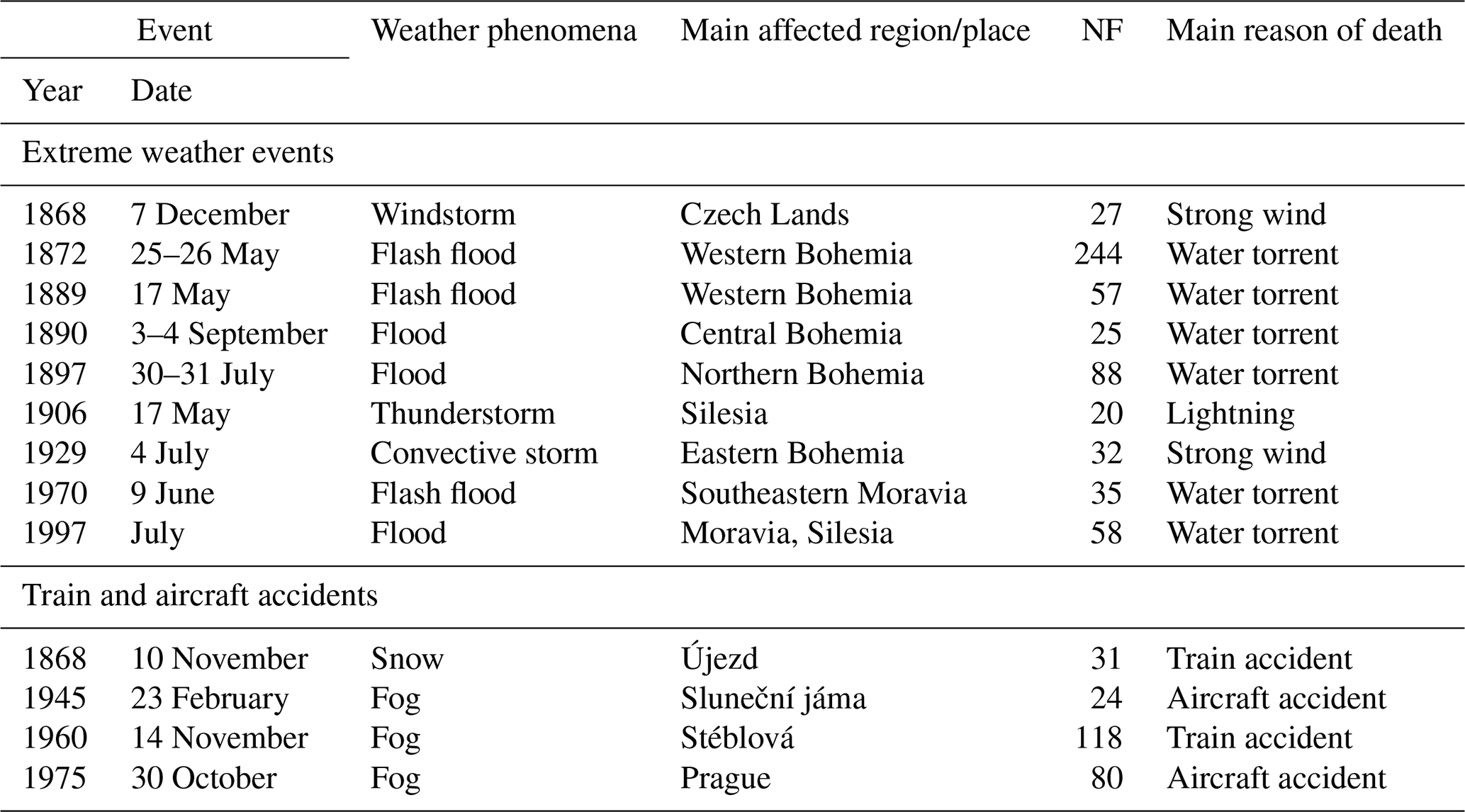
While material damage in documentary sources is usually described in great detail, information on fatalities often lacks detail or may be limited to vague numbers that are difficult to confirm from other sources. This means we must account for uncertainty and consider the number of fatalities attributed to these 9 events (floods, windstorms, and thunderstorm) as lower estimates. Their total number reached 586, compared to 253 fatalities occurring in 4 train or aircraft accidents connected with snow and fog (Table A1). Although the transport fatalities concerned only Bohemia, in the 9 sudden weather events, victims in Bohemia clearly predominated over those in Moravia and Silesia (457, i.e., 78 % compared to 129, i.e., 22 %). Regarding sex structure, males died more frequently than females (54.8 % to 37.5 %), while for 7.7 % the sex was not specified. As for age, the most frequent fatalities appeared in the 5–14 and 15–24 age categories (11.6 % and 12.1 %, respectively). However, the distribution of fatalities according to sex and age was also strongly influenced by the type of event, time of day, location, human activity, or other circumstances. For example, while flash floods in May 1872 and 1889 were dominated by fatalities in the 5–14 age category (see Figs. 3 and 4), in the July 1997 flood, fatalities in the 65+ age category were the most frequent (see Fig. 8).
Because floods represented the most important natural disasters in the Czech Lands, they were considered on the land or regional levels for a long time. Warning to floods of the Vltava River in Prague appeared already in the issue of anti-flood instruction from 28 January 1799 CE, followed by anti-flood ordinance from 12 January 1823 (Munzar, 2001). After floods in May 1872 and severe drought in 1874, Hydrographic Commission of the Kingdom of Bohemia was created in 1875, that started to organise regular hydrological measurements in Bohemia (Elleder, 2025). Similar body in Moravia, Land Hydrological Branch of Central Hydrographic Bureau in Vienna, was established in Brno as far as in 1893. Several anti-flood instructions and ordinances were produced for Prague as well as both lands Bohemia and Moravia also in subsequent years (Munzar, 2001). Besides anti-flood warnings, organisation of saving flood activities and flood forecasts, human intervention in river catchments became a significant factor affecting floods. It concerned particularly the building of water related structures like dams or reservoirs, where protection against flood was important factor of their building, and modifications in river channels (e.g., elimination of bends and meanders with the intention of accelerating runoff during floods) (Brázdil et al., 2012). For example, the disastrous flood on 30–31 July 1897 (see Sect. 4.1.4) led to the creation of Land Commission for River Adjustment of the Kingdom of Bohemia in 1903 (existing until 1931) and to the building of three dams on the upper and middle Elbe, finished in the 1910s (Šámalová, 2017). From the second half of the 20th century, permanently created state or regional flood commissions were responsible for organising all saving activities during floods (Brázdil et al., 2005).
Generally, the higher number of deaths in the CR related to floods and storms in the second half of the 19th century compared to subsequent deadly events (75.3 % to 24.7 %) can be attributed to changing environmental, socioeconomic, and societal patterns, including lifestyle. For example, there has been a significant decrease in the proportion of people working in agriculture or forestry, who were more frequently exposed to the outdoors and an open landscape. There has also been important progress in the organization of rescue activities, together with vast improvements in medical services and an increase in the availability of emergency help and rapid transport to hospitals. Technical progress in train and aircraft transport has significantly strengthened safety in adverse or extreme weather. Also important are improved forecasts of extreme weather phenomena as well as increased public awareness in the media regarding how to behave during such events, despite the underestimation of warnings by some people, as in the case of floods (e.g., Bubeck et al., 2025).
The main results of the analysis of the deadliest sudden weather-related events in the CR between 1851 and 2025 can be summarized as follows:
- (i)
Floods, particularly flash floods, represent the deadliest sudden weather events in the territory of the CR. 4 such events occurred during the second half of the 19th century in Bohemia and 2 in the second half of the 20th century in Moravia and Silesia. Although it was not possible to identify the sex and age of all 507 fatalities (60.4 % of all 13 events considered), available data show a clear preponderance of male victims compared to female victims. Among the age categories, deaths in the 5–14 and 15–24 ranges were most numerous.
- (ii)
Sudden weather extremes represented by windstorms, convective storms, and thunderstorms that occurred between 1851 and 1950, with 79 fatalities (9.4 %), fell behind the deadliest floods in terms of both the number of fatalities and frequency of occurrence. Male fatalities were more numerous than female fatalities, and deaths in the 15–24 age category were the most frequent.
- (iii)
Snow and fog, combined with human error and other circumstances, contributed to 2 disastrous train accidents and 2 aircraft crashes in Bohemia, resulting in 253 fatalities (30.2 %). With few exceptions, the nature of the fatality data did not allow for an analysis of the sex and age structure of these victims.
- (iv)
Of the 13 deadliest weather-related events in the CR, 6 occurred in the second half of the 19th century, 3 in the first half of the 20th century, and 4 in the second half of the 20th century, while no such event was identified after 2000. The numbers and structure of fatalities between 1851 and 2025 indicate the effects of long-term changes in the environmental, socioeconomic, and societal situation in the country, directed toward more effective risk management and rescue activities aimed at increased saving lives connected with extreme weather events during past 175 years, including recent climate change. These non-meteorological factors also influenced the final selection of the deadliest events analyzed. This study simultaneously documented importance of historical investigations for better understanding and evaluation of recent impacts of climate change on weather-related fatalities. The presented methodology and the use of historical data can be replicated in studies of the past and recent weather-related fatalities in other countries.
- AS1:
Moravský zemský archiv Brno, fond Sbírka matrik Jihomoravského kraje, Římskokatolický farní úřad Ostrožská Nová Ves, kniha č. 11795.
- AS2:
Státní oblastní archiv Plzeň, fond Sbírka matrik západních Čech, Římskokatolický farní úřad Přeštice, sign. Přeštice 61.
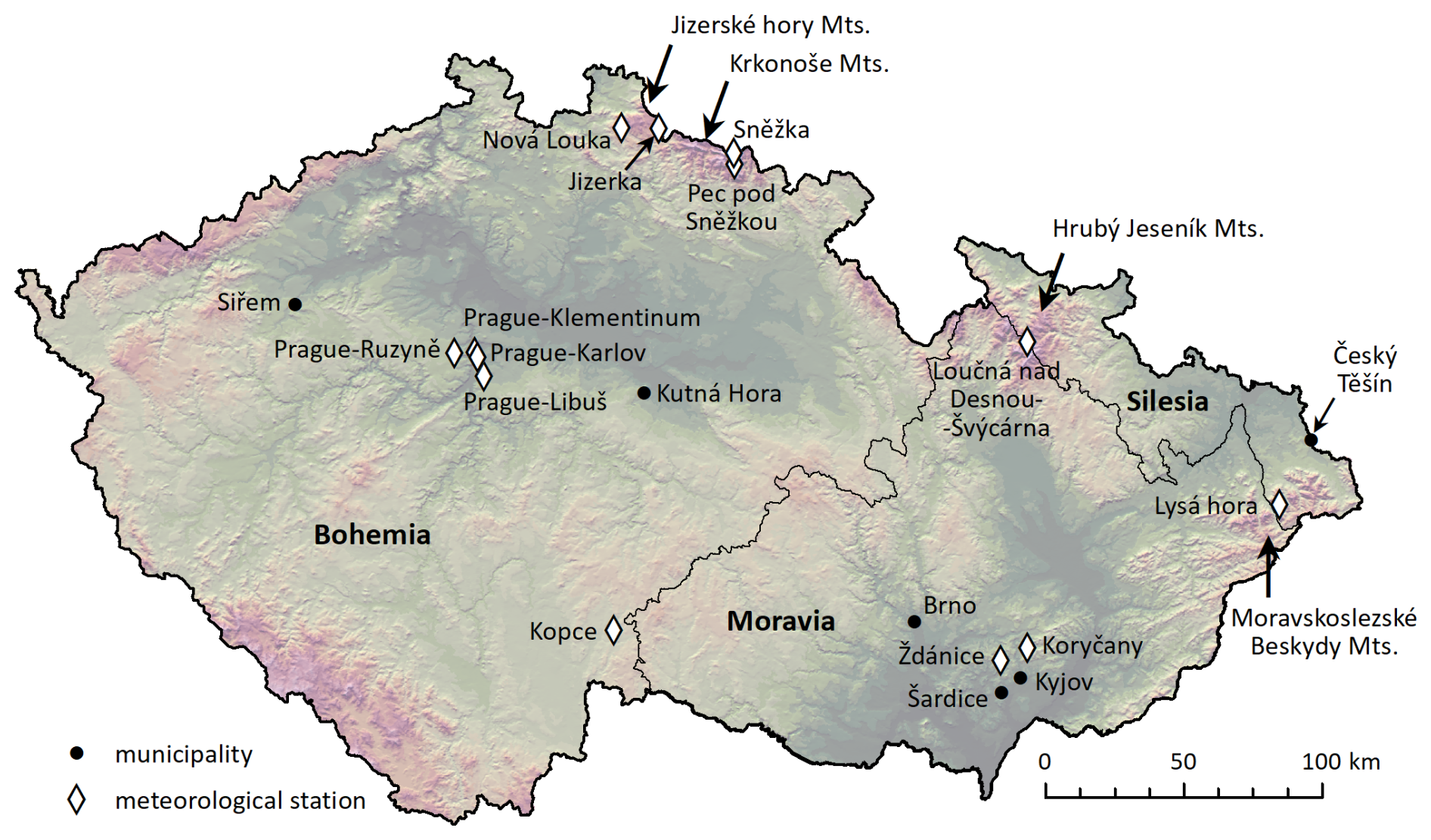
Figure A1Locations in the Czech Republic cited in the main text and not shown in particular figures documenting individual disastrous events (data source: ArcCR 500 v2.0).
Table A1Overview of the deadliest sudden weather-related events in the Czech Lands in 1851–2025 CE (NF – number of fatalities).
The datasets used in this article are available from https://doi.org/10.5281/zenodo.18459422 (Brázdil et al., 2026).
RB participated in extraction and collection of data, worked with literature sources, designed the study, and wrote the paper with contributions from all co-authors. KC participated in extraction and collection of data, made basic analyses of fatalities and finalised all figures. MM and KS contributed by analyses of meteorological situation for all selected events. JL participated in extraction and collection of fatality data.
The contact author has declared that none of the authors has any competing interests.
Publisher's note: Copernicus Publications remains neutral with regard to jurisdictional claims made in the text, published maps, institutional affiliations, or any other geographical representation in this paper. The authors bear the ultimate responsibility for providing appropriate place names. Views expressed in the text are those of the authors and do not necessarily reflect the views of the publisher.
Laughton Chandler (Charleston, SC) is acknowledged for his assistance with English style corrections. Mariano Barriendos (Barcelona) helped with references for the 2024 event in the Valencia province. Two anonymous referees are acknowledged for critical comments to the article.
This research was supported by the Johannes Amos Comenius Programme (P JAC), project no. CZ.02.01.01/00/22_008/0004605, Natural and anthropogenic georisks.
This paper was edited by Olga Petrucci and reviewed by two anonymous referees.
Anonymous: Die Hochwasser-Katastrophe im Aupa und Elbethale vom 29. zum 30. Juli 1897, Verlag von Alfred Vatter, Johannisbad, Bohemia, 25 pp., 1897a.
Anonymous: Die Hochwasserkatastrophe vom 30. und 31. Juli 1897 im Gebiete des Iser- und Riesengebirges etc., Verlag von Gebrüder Stiepel, Reichenberg, Bohemia, 123 pp., 1897b.
Anonymous: Veliká povodeň v Čechách ve dnech 29.–31. července 1897 (The Large Flood in Bohemia on 29–31 July 1897), Nákladem Aloisa Hynka, Praha, Bohemia, 47 pp., 1897c.
Antofie, T.-E., Luoni, S., Tilloy, A., Sibilia, A., Salari, S., Eklund, G., Rodomonti, D., Bountzouklis, C., and Corbane, C.: Spatial identification of regions exposed to multi-hazards at the pan-European level, Nat. Hazards Earth Syst. Sci., 25, 287–304, https://doi.org/10.5194/nhess-25-287-2025, 2025.
Antonescu, B. and Cărbunaru, F.: Lightning-related fatalities in Romania from 1999 to 2015, Weather Clim. Soc., 10, 241–252, https://doi.org/10.1175/WCAS-D-17-0091.1, 2018.
Archa Krkonoš: HMU havárie letadla JU-52 1945 (HMU accident of the JU-52 plane, 1945), https://archakrkonos.cz/udalosti/59-hmu-havarie-letadla-ju-52-1945/, last access: 4 March 2026.
Augustin, F.: Povodeň v Čechách roku 1890 (The Flood in Bohemia in 1890), Nákladem důchodů obce pražské, Praha, Bohemia, 35 pp., 1891.
Badoux, A., Andres, N., Techel, F., and Hegg, C.: Natural hazard fatalities in Switzerland from 1946 to 2015, Nat. Hazards Earth Syst. Sci., 16, 2747–2768, https://doi.org/10.5194/nhess-16-2747-2016, 2016.
Barredo, J. I.: Major flood disasters in Europe: 1950–2005, Nat. Hazards, 42, 125–148, https://doi.org/10.1007/s11069-006-9065-2, 2007.
Bébar, J.: 60 let od tragédie u Stéblové (60 year from the tragedy at Stéblová), https://www.vlaky.net/zeleznice/spravy/7878-60-let-od-tragedie-u-Steblove/ (last access: 11 October 2025), 2020.
Bernat, J.: Popis škod povodní ze dne 25. a 26. května 1872 v jednotlivých obcích způsobených (Description of flood damage from 25th and 26th May 1872 caused to individual municipalities), in: Zprávy kanceláře pro statistiku polního a lesního hospodářství v království Českém za rok 1872, Sešit 1, Zpráva o povodni 25. a 26. května 1872 v Čechách, J. G. Calve, Praha, Bohemia, 17–62, 1872.
Benešovský-Veselý, J.: Velká povodeň v Čechách ve dnech 2. až 5. září 1890 (The Large Flood in Bohemia From 2nd to 5th September 1890), Nákladem Aloisa Hynka, Praha, Bohemia, 53 pp., 1890.
Brázdil, R., Dobrovolný, P., Elleder, L., Kakos, V., Kotyza, O., Květoň, V., Macková, J., Müller, M., Štekl, J., Tolasz, R., and Valášek, H.: Historické a současné povodně v České republice (Historical and Recent Floods in the Czech Republic), Masarykova univerzita, Český hydrometeorologický ústav, Brno, Praha, Czech Republic, 370 pp., ISBN 80-210-3864-0, 2005.
Brázdil, R., Řezníčková, L., Havlíček, M., and Elleder, L.: Floods in the Czech Republic, in: Changes in Flood Risk in Europe, edited by Kundzewicz, Z. W., IAHS Special Publication 10, IAHS Press and CRC Press/Balkema, Wallingford, UK, 178–198, ISBN 978-1-907161-28-5, 2012.
Brázdil, R., Szabó, P., Stucki, P., Dobrovolný, P., Řezníčková, L., Kotyza, O., Valášek, H., Melo, M., Suchánková, S., Dolák, L., and Chromá, K.: The extraordinary windstorm of 7 December 1868 in the Czech Lands and its central European context, Int. J. Climatol., 37 (Suppl. 1), 14–29, https://doi.org/10.1002/joc.4973, 2017.
Brázdil, R., Chromá, K., Řehoř, J., Zahradníček, P., Dolák, L., Řezníčková, L., and Dobrovolný, P.: Potential of documentary evidence to study fatalities of hydrological and meteorological events in the Czech Republic, Water, 11, 2014, https://doi.org/10.3390/w11102014, 2019.
Brázdil, R., Chromá, K., Dolák, L., Řehoř, J., Řezníčková, L., Zahradníček, P., and Dobrovolný, P.: Fatalities associated with the severe weather conditions in the Czech Republic, 2000–2019, Nat. Hazards Earth Syst. Sci., 21, 1355–1382, https://doi.org/10.5194/nhess-21-1355-2021, 2021.
Brázdil, R., Chromá, K., Zahradníček, P., Dobrovolný, P., and Dolák, L.: Weather and traffic accidents in the Czech Republic, 1979–2020, Theor. Appl. Climatol., 149, 153–167, https://doi.org/10.1007/s00704-022-04042-3, 2022a.
Brázdil, R., Chromá, K., Zahradníček, P., Dobrovolný, P., Dolák, L., Řehoř, J., and Řezníčková, L.: Changes in weather-related fatalities in the Czech Republic during the 1961–2020 period, Atmosphere, 13, 688, https://doi.org/10.3390/atmos13050688, 2022b.
Brázdil, R., Chromá, K., Dolák, L., Zahradníček, P., Řehoř, J., Dobrovolný, P., and Řezníčková, L.: The 100-year series of weather-related fatalities in the Czech Republic: interactions of climate, environment and society, Water, 15, 1965, https://doi.org/10.3390/w15101965, 2023.
Brázdil, R., Chromá, K., and Zahradníček, P.: Demographic yearbooks as a source of weather-related fatalities: the Czech Republic, 1919–2022, Nat. Hazards Earth Syst. Sci., 24, 1437–1457, https://doi.org/10.5194/nhess-24-1437-2024, 2024.
Brázdil, R., Chroma, K., Muller, M., Lhoták, J., and Skripnikova, K.: The deadliest sudden weather-related events in the Czech Lands, 1851–2025 CE, Zenodo [data set], https://doi.org/10.5281/zenodo.18459422, 2026.
Brönnimann, S., Rohr, C., Stucki, P., Summermatter, S., Bandhauer, M., Barton, Y., Fischer, A., Froidevaux, P., Germann, U., Grosjean, M., Hupfer, F., Ingold, K., Isotta, F., Keiler, M., Martius, O., Messmer, M., Mülchi, R., Panziera, L., Pfister, L., Raible, C. C., Reist, T., Rössler, O., Röthlisberger, V., Scherrer, S., Weingartner, R., Zappa, M., Zimmermann, M., and Zischg, A. P.: 1868 – the flood that changed Switzerland: Causes, consequences and lessons for the future, Geogr. Bern., G94, 52 pp., https://doi.org/10.4480/GB2018.G94.04, 2018.
Bubeck, P., Ozturk, U., Aristizabal, E., Thieken, A. H., and Wagener, T.: Mortality reduction despite changing climate extremes requires better understanding of human behavioral response to warnings, Environ. Res. Lett., 20, 101004, https://doi.org/10.1088/1748-9326/ae034f, 2025.
Choi, B. H., Kim, K. O., Yuk, J.-H., and Lee, H. S.: Simulation of the 1953 storm surge in the North Sea, Ocean Dyn., 68, 1759–1777, https://doi.org/10.1007/s10236-018-1223-z, 2018.
Choryński, A., Pińskwar, I., Kron, W., Brakenridge, G. R., and Kundzewicz, Z. W.: Catalogue of large floods in Europe in the 20th century, in: Changes in Flood Risk in Europe, edited by: Kundzewicz, Z. W., IAHS Press and CRC Press/Balkema, Wallingford, UK, 27–54, ISBN 978-1-907161-28-5, 2012.
Cyroň, J. and Kotrnec, J.: Protrhlo se nebe i země... Šardice 9. 6. 1970 (Earth and Sky Did Burst... Šardice, 9 June 1970), Obec Šardice, Šardice, Czechoslovakia, 132 pp., ISBN 80-238-6128-X, 2000.
Czech Statistical Office: Public database – Long-term time series, https://vdb.czso.cz/vdbvo2/faces/en/index.jsf?page=statistiky#katalog=33157, last access: 4 March 2026.
Diakakis, M. and Deligiannakis, G.: Flood fatalities in Greece: 1970–2010, J. Flood Risk Manag., 10, 115–123, https://doi.org/10.1111/jfr3.12166, 2017.
Diakakis, M., Papagiannaki, K., and Fouskaris, M.: The occurrence of catastrophic multiple-fatality flash floods in the Eastern Mediterranean region, Water, 15, 119, https://doi.org/10.3390/w15010119, 2023.
Elleder, L.: Hydrografická komise Království českého, její význam, důvody a okolnosti vzniku roku 1875 (Hydrographic Commission of the Kingdom of Bohemia, its importance, reasons and circumstances of its constitution in 1875), Živa, 73, LXXV–LXXVII, 2025.
Elleder, L., Kulasová, B., and Daňhelka, J.: Přívalová povodeň 25. a 26. května 1872 a možnost protipovodňové ochrany (Flash flood on 25 and 26 May 1872 and a flood protection perspective), in: Vybrané kapitoly z historie povodní a hydrologické služby na území ČR, edited by: Daňhelka, J. and Elleder, L., Český hydrometeorologický ústav, Praha, Czech Republic, 25–99, ISBN 978-80-87577-12-7, 2012.
Elleder, L., Krejčí, J., Racko, S., Daňhelka, J., Šírová, J., and Kašpárek, L.: Reliability check of flash-flood in Central Bohemia on May 25, 1872, Glob. Planet. Change, 187, 103094, https://doi.org/10.1016/j.gloplacha.2019.103094, 2020.
Elsom, D. M.: Deaths and injuries caused by lightning in the United Kingdom: analyses of two databases, Atmos. Res., 56, 325–334, https://doi.org/10.1016/S0169-8095(00)00083-1, 2001.
Elsom, D. M. and Webb, J. D. C.: Deaths and injuries from lightning in the UK, 1988–2012, Weather, 69, 221–226, https://doi.org/10.1002/wea.2254, 2014.
Esposito, E., Porfido, S., Volante, C., and Alaia, F.: Disaster induced by historical floods in a selected coastal area (southern Italy), in: Palaeofloods, Historical Data and Climatic Variability: Applications in Flood Risk Assessment, edited by: Thorndycraft, V. R., Benito, G., Barriendos, M., and Llasat, M. C., CSIC – Centro de Ciencias Medioambientales, Madrid, Spain, 143–148, ISBN 84-921958-2-7, 2003.
European Severe Weather Laboratory: European Severe Weather Database, https://eswd.eu/en, last access: 4 March 2026.
Fink, A. H., Brücher, T., Ermert, V., Krüger, A., and Pinto, J. G.: The European storm Kyrill in January 2007: synoptic evolution, meteorological impacts and some considerations with respect to climate change, Nat. Hazards Earth Syst. Sci., 9, 405–423, https://doi.org/10.5194/nhess-9-405-2009, 2009.
Fultz, A. J. and Ashley, W. S.: Fatal weather-related general aviation accidents in the United States, Phys. Geogr., 37, 291–312, https://doi.org/10.1080/02723646.2016.1211854, 2016.
García-Herrera, R., Díaz, J., Trigo, R. M., Luterbacher, J., and Fischer, E. M.: A review of the European summer heat wave of 2003, Crit. Rev. Environ. Sci. Technol., 40, 267–306, https://doi.org/10.1080/10643380802238137, 2010.
Gerritsen, H.: What happened in 1953? The Big Flood in the Netherlands in retrospect, Phil. Trans. R. Soc. A., 363, 1271–1291, https://doi.org/10.1098/rsta.2005.1568, 2005.
Grumm, R. H.: The Central European and Russian heat event of July–August 2010, B. Am. Meteorol. Soc., 92, 1285–1296, 2011.
Hallin, C., Hofstede, J. L. A., Martinez, G., Jensen, J., Baron, N., Heimann, T., Kroon, A., Arns, A., Almström, B., Sørensen, P., and Larson, M.: A comparative study of the effects of the 1872 storm and coastal flood risk management in Denmark, Germany, and Sweden, Water, 13, 1697, https://doi.org/10.3390/w13121697, 2021.
Harlacher, A. R.: Die Überschwemmung in Böhmen Ende Mai 1872 und das damit verbundene Hochwasser der Moldau und Elbe, Lotos, 23, 1–31, 1873.
Hersbach, H., Bell, B., Berrisford, P., Hirahara, S., Horányi, A., Muñoz-Sabater, J., Nicolas, J., Peubey, C., Radu, R., Schepers, D., Simmons, A., Soci, C., Abdalla, S., Abellan, X., Balsamo, G., Bechtold, P., Biavati, G., Bidlot, J., Bonavita, M., De Chiara, G., Dahlgren, P., Dee, D., Diamantakis, M., Dragani, R., Flemming, J., Forbes, R., Fuentes, M., Geer, A., Haimberger, L., Healy, S., Hogan, R. J., Hólm, E., Janisková, M., Keeley, S., Laloyaux, P., Lopez, P., Lupu, C., Radnoti, G., De Rosnay, P., Rozum, I., Vamborg, F., Villaume, S., and Thépaut, J.: The ERA5 global reanalysis, Quart. J. Royal Meteorol. Soc., 146, 1999–2049, https://doi.org/10.1002/qj.3803, 2020.
Hilker, N., Badoux, A., and Hegg, C.: The Swiss flood and landslide damage database 1972–2007, Nat. Hazards Earth Syst. Sci., 9, 913–925, https://doi.org/10.5194/nhess-9-913-2009, 2009.
Holzer, A. M., Schreiner, T. M. E., and Púčik, T.: A forensic re-analysis of one of the deadliest European tornadoes, Nat. Hazards Earth Syst. Sci., 18, 1555–1565, https://doi.org/10.5194/nhess-18-1555-2018, 2018.
Hošek, E.: Studie o výskytu kalamit na území ČSR od roku 1900 (A Study of Calamity Occurrence Over the Territory of ČSR Since 1900), Lesprojekt, Brandýs nad Labem, Czechoslovakia, 105 pp., 1981.
Janský, B.: Mladotické hrazené jezero – geomorfologie sesuvných území (The Mladotice landslide lake – geomorphology of landslide areas), Acta Univ. Carol. – Geogr., 11, 3–18, 1976.
Janský, B.: Mladotické hrazené jezero – morfografické a hydrografické poměry (The Mladotice landslide lake – morphographic and hydrographic patterns), Acta Univ. Carol. – Geogr., 12, 31–46, 1977.
Jarošová, M. and Janošková, A.: Meteorological causes of air accidents, Transp. Res. Procedia, 75, 183–188, https://doi.org/10.1016/j.trpro.2023.12.021, 2023.
Jensen, J. and Müller-Navarra, S. H.: Storm surges on the German coast, Die Küste, 74 ICCE, 92–124, 2008.
Jochner, M., Schwander, M., and Brönnimann, S.: Reanalysis of the Hamburg storm surge of 1962, in: Weather extremes during the past 140 years, edited by: Brönnimann, S. and Martius, O., Geogr. Bern., G89, 19–26, https://doi.org/10.4480/GB2013.G89.02, 2013.
Kahle, M., Kempf, M., Brice, M., and Glaser, R.: Classifying the 2021 `Ahrtal' flood event using hermeneutic interpretation, natural language processing, and instrumental data analyses, Environ. Res. Commun., 4, 051002, https://doi.org/10.1088/2515-7620/ac6657, 2022.
Kárníková, L.: Vývoj obyvatelstva v českých zemích 1754–1914 (Development of Population in the Czech Lands 1754–1914), Nakladatelství Československé akademie věd, Praha, Czechoslovakia, 401 pp., 1965.
Kořistka, K.: Všeobecný nástin meteorologických a vodopisných poměrů, jakož i škod na vzdělané půdě a komunikacích za povodně dne 25. a 26. května 1872 (General outline of meteorological and hydrographical patterns, as well as damage to arable land and roads during the flood on 25th and 26th May 1872), in: Zprávy kanceláře pro statistiku polního a lesního hospodářství v království Českém za rok 1872, Sešit 1, Zpráva o povodni 25. a 26. května 1872 v Čechách, J. G. Calve, Praha, Bohemia, 3–16, 1872.
Krejčí, P.: Letecká badatelna – havárie a sestřely (Air research room – accidents and bring downs), http://www.leteckabadatelna.cz/havarie-a-sestrely/detail/123/ (last access: 14 March 2024), 2014.
Krejza, V. J.: Nová píseň o protržení se mračen a velké povodni v Čechách, dne 25. května 1872 (A new song about the rupture of the clouds and the great flood in Bohemia on 25 May 1872), Z tiskárny Jana Spurného, Praha, Bohemia, 2 pp., 1872.
Krupka, J.: Jsou to jatka, volali zdravotníci. Pád letadla v Suchdole nepřežily desítky lidí (Paramedics called, it is carnage. Tens of people did not survive the fall of aircraft in Suchdol), https://zdarsky.denik.cz/zpravy-z-ceska/havarie-letadla-v-suchdole.html (last access: 5 May 2025), 2020.
Kundzewicz, Z. W., Szamalek, K., and Kowalczyk, P.: The great flood of 1997 in Poland, Hydrol. Sci. J., 44, 855–870, https://doi.org/10.1080/02626669909492285, 1999.
Kühne, T., Antonescu, B., Groenemeijer, P., and Púčik, T.: Lightning fatalities in Europe (2001–20), Weather Clim. Soc., 17, 205–215, https://doi.org/10.1175/WCAS-D-24-0038.1, 2025.
Lipina, P., Tolasz, R., Šustková, V., Řepka, M., and Brzezina, J.: Nové denní srážkové maximum v Česku (The new daily precipitation maximum in Czechia), http://www.cmes.cz/web/2024/10/11/nove-denni-srazkove-maximum-v-cesku/ (last access: 1 June 2025), 2024.
Llasat, M. del C., Rigo, T., and Barriendos, M.: The “Montserrat-2000” flash-flood event: a comparison with the floods that have occurred in the northeastern Iberian Peninsula since the 14th century, Int. J. Climatol., 23, 453–469, https://doi.org/10.1002/joc.888, 2003.
Mapy: Památník obětem železničního neštěstí (Memorial to victims of railway accident), https://mapy.com/cs/zakladni?source=base&id=1982242&gallery=1&sourcep=foto&idp=4812130&x=13.8332277&y=49.8491573&z=17 (last access: 5 December 2025), 2025a.
Mapy: Pomník havárie letadla (Memorial to aircraft accident), https://mapy.com/cs/zakladni?source=base&id=2263728&gallery=1&sourcep=foto&idp=2813770&x=15.7545477&y=50.7395998&z=17 (last access: 16 December 2025), 2025b.
Mapy: Pomník obětem povodně (Memorial to flood victims), https://mapy.com/cs/zakladni?source=base&id=2222035&gallery=1&sourcep=foto&idp=1381384&x=17.3452800&y=49.4310041&z=17 (last access: 5 December 2025), 2025c.
Mapy: Pomník železničního neštěstí 1960 (Memorial to train accident in 1960), https://mapy.com/cs/zakladni?source=base&id=2131622&ds=2&gallery=1&sourcep=foto&idp=4297793&x=15.7499561&y=50.0929421&z=17 (last access: 16 December 2025), 2025d.
Matějíček, J. and Hladný, J.: Povodňová katastrofa 20. století na území České republiky (Flood Disaster of the 20th Century on the Territory of the Czech Republic), Ministerstvo životního prostředí České republiky, Praha, Czech Republic, 60 pp., ISBN 80-7212-130-8, 1999.
Mazon, J., Rojas, J. I., Lozano, M., Pino, D., Prats, X., and Miglietta, M. M.: Influence of meteorological phenomena on worldwide aircraft accidents, 1967–2010, Meteorol. Appl., 25, 236–245, https://doi.org/10.1002/met.1686, 2018.
Messmer, M., Gómez-Navarro, J. J., and Raible, C. C.: Climatology of Vb cyclones, physical mechanisms and their impact on extreme precipitation over Central Europe, Earth Syst. Dynam., 6, 541–553, https://doi.org/10.5194/esd-6-541-2015, 2015.
Mika, O. and Hurt, R.: Šardice. 700 let obce (Šardice. 700 Years of a Village), Muzejní a vlastivědná společnost, Místní národní výbor a Jednotné zemědělské družstvo Osvobození v Šardicích, Brno, Czechoslovakia, 202 pp., 1986.
Mudelsee, M., Börngen, M., Tetzlaff, G., and Grünewald, U.: Extreme floods in Central Europe over the past 500 years: Role of cyclone pathway “Zugstrasse Vb”, J. Geophys. Res.-Atmos., 109, D23101, https://doi.org/10.1029/2004JD005034, 2004.
Müller, M. and Kakos, V.: Extrémní konvekční bouře v Čechách 25.–26. května 1872 (The extreme convective storms in Bohemia on May 25–26, 1872), Meteorol. Zpr., 57, 69–77, 2004.
Münchener Rück: Winterstürme in Europa (II). Schadenanalyse 1999 – Schadenpotenziale, Münchener Rückversicherungs-Gesellschaft, München, Germany, 72 pp., 2001.
Muñoz, R., Molner, J. V., Campillo-Tamarit, N., and Soria, J.: Estimating peak flows in streams during the flash flood event of 29 October 2024 in Spain: An empirical approach, Water, 17, 3177, https://doi.org/10.3390/w17213177, 2025.
Munzar, J.: Protipovodňové instrukce v Českých zemích v minulosti (Flood instructions in the Czech Lands during the past), Hist. Geogr., 31, 163–189, 2001.
Munzar, J., Ondráček, S., Elleder, L., and Sawicki, K.: Disastrous floods in central Europe at the end of July 1897 and the lessons learnt, Morav. Geogr. Rep., 16, 27–40, 2008.
Nita, I.-A., Radu, C., Cheval, S., and Birsan, M.-V.: Aviation accidents related to atmospheric instability in the United States (2000–2020), Theor. Appl. Climatol., 155, 5483–5497, https://doi.org/10.1007/s00704-024-04968-w, 2024.
Otto, F. E. L., Massey, N., van Oldenborgh, G. J., Jones, R. G., and Allen, M. R.: Reconciling two approaches to attribution of the 2010 Russian heat wave, Geophys. Res. Lett., 39, L04702, https://doi.org/10.1029/2011GL050422, 2012.
Papagiannaki, K., Petrucci, O., Diakakis, M., Kotroni, V., Aceto, L., Bianchi, C., Brázdil, R., Grimalt Gelabert, M., Inbar, M., Kahraman, A., Kılıç, Ö., Krahn, A., Kreibich, H., Llasat, M. C., Llasat-Botija, M., Macdonald, N., Madruga de Brito, M., Mercuri, M., Pereira, S., Řehoř, J., Rossello Geli, J., Salvati, P., Vinet, F., and Zêzere, J. L.: Developing a large-scale dataset of flood fatalities for territories in the Euro-Mediterranean region, FFEM-DB, Sci. Data, 9, 166, https://doi.org/10.1038/s41597-022-01273-x, 2022.
Paprotny, D., Morales-Nápoles, O., and Jonkman, S. N.: HANZE: a pan-European database of exposure to natural hazards and damaging historical floods since 1870, Earth Syst. Sci. Data, 10, 565–581, https://doi.org/10.5194/essd-10-565-2018, 2018.
Paprotny, D., Terefenko, P., and Śledziowski, J.: HANZE v2.1: an improved database of flood impacts in Europe from 1870 to 2020, Earth Syst. Sci. Data, 16, 5145–5170, https://doi.org/10.5194/essd-16-5145-2024, 2024.
Pereira, S., Diakakis, M., Deligiannakis, G., and Zêzere, J. L.: Comparing flood mortality in Portugal and Greece (Western and Eastern Mediterranean), Int. J. Disaster Risk Reduct., 22, 147–157, https://doi.org/10.1016/j.ijdrr.2017.03.007, 2017.
Petrucci, O., Aceto, L., Bianchi, C., Bigot, V., Brázdil, R., Pereira, S., Kahraman, A., Kiliç, Ö., Kotroni, V., Llasat, M. C., Llasat-Botija, M., Papagiannaki, K., Pasqua, A. A., Řehoř, J., Geli, J. R., Salvati, P., Vinet, F., and Zêzere, J. L.: Flood fatalities in Europe, 1980–2018: variability, features, and lessons to learn, Water, 11, 1682, https://doi.org/10.3390/w11081682, 2019a.
Petrucci, O., Papagiannaki, K., Aceto, L., Boissier, L., Kotroni, V., Grimalt, M., Llasat, M. C., Llasat-Botija, M., Rosselló, J., Pasqua, A. A., and Vinet, F.: MEFF: The database of MEditerranean Flood Fatalities (1980 to 2015), J. Flood Risk Manag., 12, e12461, https://doi.org/10.1111/jfr3.12461, 2019b.
Pilorz, W., Laskowski, I., Surowiecki, A., and Łupikasza, E.: Fatalities related to sudden meteorological events across Central Europe from 2010 to 2020, Int. J. Disast. Risk Reduct., 88, 103622, https://doi.org/10.1016/j.ijdrr.2023.103622, 2023.
Poláček, D. and Švec, P.: Fatální chyba v mlze. Jak se odehrála největší letecká katastrofa v historii Česka (A fatal mistake in fog. How happen the largest aircraft disaster in Czechia history), https://zpravy.aktualne.cz/domaci/foto-unikatni-snimky-uplynulo-45-let-co-prazsky-suchdol-zdev/r\textasciitilde0d10bfd01ab411eb9d74ac1f6b220ee8/ (last access: 5 May 2025), 2024.
Prudký, M.: Pomník obětem povodní – Stebno (Memorial to flood victims – Stebno), https://commons.wikimedia.org/wiki/File:Pomnik_obetem_povodni_-_Stebno.jpg (last access: 5 December 2025), 2017.
Qasinka: Pamětní deska obětí úderu blesku v Koňakově v roce 1906 (Plaque commemorating people killed by lightning in Koňakov in 1906), https://cs.wikipedia.org/wiki/Soubor:Lightning_plaque_Konakov.JPG (last access: 12 December 2025), 2009.
Rhein, B. and Kreibich, H.: Causes of the exceptionally high number of fatalities in the Ahr valley, Germany, during the 2021 flood, Nat. Hazards Earth Syst. Sci., 25, 581–589, https://doi.org/10.5194/nhess-25-581-2025, 2025.
Robine, J.-M., Cheung, S. L. K., Le Roy, S., Van Oyen, H., Griffiths, C., Michel, J.-P., and Herrmann, F. R.: Death toll exceeded 70,000 in Europe during the summer of 2003, Comptes Rendus Biol., 331, 171–178, https://doi.org/10.1016/j.crvi.2007.12.001, 2008.
Roggenkamp, T., Herget, J., and Roggenkamp, T.: Flood reconstruction – The unexpected rather frequent event at River Ahr in July 2021, Glob. Planet. Change, 240, 104541, https://doi.org/10.1016/j.gloplacha.2024.104541, 2024.
Rombeek, N., Hrachowitz, M., and Uijlenhoet, R.: Torrential rainfall in Valencia, Spain, recorded by personal weather stations preceding and during the 29 October 2024 floods, Hydrol. Earth Syst. Sci., 29, 6715–6733, https://doi.org/10.5194/hess-29-6715-2025, 2025.
Ruiz-Bellet, J. L., Balasch, J. C., Tuset, J., Barriendos, M., Mazon, J., and Pino, D.: Historical, hydraulic, hydrological and meteorological reconstruction of 1874 Santa Tecla flash floods in Catalonia (NE Iberian Peninsula), J. Hydrol., 524, 279–295, https://doi.org/10.1016/j.jhydrol.2015.02.023, 2015.
Sbírka zákonů: Sbírka zákonů republiky Československé, Rok 1949 (Collection of Acts of the Czechoslovakian Republic, 1949 Year), Praha, Czechoslovakia, 1949.
Silva, A. F. R., Eleutério, J. C., Apel, H., and Kreibich, H.: Assessing the impact of early warning and evacuation on human losses during the 2021 Ahr Valley flood in Germany using agent-based modelling, Nat. Hazards Earth Syst. Sci., 25, 1501–1520, https://doi.org/10.5194/nhess-25-1501-2025, 2025.
SJV 79: Zapomenutá tragédie – Jánská povodeň 1889 (A forgotten disaster – John's flood 1889), http://klatoviny.blogspot.com/2013/08/zapomenuta-tragedie-janska-povoden-1889.html (last access: 13 June 2024), 2013.
Skrejšovský, F.: Zhoubná povodeň v Čechách dne 25. a 26. května r. 1872 (The Disastrous Flood in Bohemia on 25 and 26 May 1872), Nákladem dra. F. Skrejšovského, Praha, Bohemia, 142 pp., 1872.
Slivinski, L. C., Compo, G. P., Whitaker, J. S., Sardeshmukh, P. D., Giese, B. S., McColl, C., Allan, R., Yin, X., Vose, R., Titchner, H., Kennedy, J., Spencer, L. J., Ashcroft, L., Brönnimann, S., Brunet, M., Camuffo, D., Cornes, R., Cram, T. A., Crouthamel, R., Domínguez-Castro, F., Freeman, J. E., Gergis, J., Hawkins, E., Jones, P. D., Jourdain, S., Kaplan, A., Kubota, H., Blancq, F. L., Lee, T., Lorrey, A., Luterbacher, J., Maugeri, M., Mock, C. J., Moore, G. W. K., Przybylak, R., Pudmenzky, C., Reason, C., Slonosky, V. C., Smith, C. A., Tinz, B., Trewin, B., Valente, M. A., Wang, X. L., Wilkinson, C., Wood, K., and Wyszyński, P.: Towards a more reliable historical reanalysis: Improvements for version 3 of the Twentieth Century Reanalysis system, Q. J. Roy. Meteorol. Soc., 145, 2876–2908, https://doi.org/10.1002/qj.3598, 2019.
Slivinski, L. C., Compo, G. P., Sardeshmukh, P. D., Whitaker, J. S., McColl, C., Allan, R. J., Brohan, P., Yin, X., Smith, C. A., Spencer, L. J., Vose, R. S., Rohrer, M., Conroy, R. P., Schuster, D. C., Kennedy, J. J., Ashcroft, L., Brönnimann, S., Brunet, M., Camuffo, D., Cornes, R., Cram, T. A., Domínguez-Castro, F., Freeman, J. E., Gergis, J., Hawkins, E., Jones, P. D., Kubota, H., Lee, T. C., Lorrey, A. M., Luterbacher, J., Mock, C. J., Przybylak, R. K., Pudmenzky, C., Slonosky, V. C., Tinz, B., Trewin, B., Wang, X. L., Wilkinson, C., Wood, K., and Wyszyński, P.: An evaluation of the performance of the Twentieth Century Reanalysis Version 3, J. Climate, 34, 1417–1438, https://doi.org/10.1175/JCLI-D-20-0505.1, 2021.
Srb, V.: 1000 let obyvatelstva českých zemí (1000 Years of Population in the Czech Lands), Karolinum, Praha, Czech Republic, 275 pp., ISBN 80-246-0712-3, 2004.
Strejcová, H.: Nejtragičtější železniční nehoda v Československu: Tajemné zelené světlo a strašlivá smrt v mlze (The most tragic railway accident in Czechoslovakia: Mysterious green light and terrible death in fog), https://medium.seznam.cz/clanek/hana-strejcova-nejtragictejsi-zeleznicni-nehoda-v (last access: 5 May 2025), 2025.
Šámalová, Z.: Sto let od dokončení přehrady Labská ve Špindlerově Mlýně (Hundred years from finishing of the Labská dam in Špindlerův Mlýn), Vodní hospodářství, 67, 24–27, 2017.
Špitalar, M., Brilly, M., Kos, D., and Žiberna, A.: Analysis of flood fatalities – Slovenian illustration, Water, 12, 64, https://doi.org/10.3390/w12010064, 2020.
Taszarek, M. and Gromadzki, J.: Deadly tornadoes in Poland from 1820 to 2015, Mon. Weather Rev., 145, 1221–1243, https://doi.org/10.1175/MWR-D-16-0146.1, 2017.
Taszarek, M., Kendzierski, S., and Pilguj, N.: Hazardous weather affecting European airports: Climatological estimates of situations with limited visibility, thunderstorm, low-level wind shear and snowfall from ERA5, Weather Clim. Extrem., 28, 100243, https://doi.org/10.1016/j.wace.2020.100243, 2020.
Thieken, A., Zenker, M.-L., and Bubeck, P.: Fatal incidents during the flood of July 2021 in North Rhine-Westphalia, Germany: what can be learnt for future flood risk management?, J. Coastal Riverine Flood Risk, 2, 5, https://doi.org/10.59490/jcrfr.2023.0005, 2023.
Trigo, R. M., Ramos, C., Pereira, S. S., Ramos, A. M., Zêzere, J. L., and Liberato, M. L. R.: The deadliest storm of the 20th century striking Portugal: Flood impacts and atmospheric circulation, J. Hydrol., 541A, 597–610, https://doi.org/10.1016/j.jhydrol.2015.10.036, 2016.
van Bebber, W. J.: Die geographische Vertheilung und Bewegung, das Enstehen und Verschwinden der barometrischen Minima in den Jahren 1876 bis 1880, Z. Österreichischen Gesellschaft Meteorol., 16, 414–419, 1881.
Vinet, F., Cherel, J.-P., Weiss, K., Lewandowski, M., and Boissier, L.: Flood related mortality in the French Mediterranean region (1980–2020), LHB Hydrosci. J., 108, 2097022, https://doi.org/10.1080/27678490.2022.2097022, 2022.
Wetterzentrale: Reanalysis archive, https://www.wetterzentrale.de/en/reanalysis.php?model=noaa, last access: 4 March 2026.
WMO: Atlas of Mortality and Economic Losses from Weather, Climate and Water Extremes (1970–2019), WMO-No. 1267, World Meteorological Organization, Geneva, Switzerland, 90 pp., ISBN 978-92-63-11267-5, 2021.
WMO: Status of Mortality and Economic Losses due to Weather, Climate and Water Extremes (1970–2021), World Meteorological Organization, https://storymaps.arcgis.com/stories/8df884dbd4e849c89d4b1128fa5dc1d6 (last access: 3 May 2025), 2023.
Zahradník, J.: Hořovice 1868: železniční neštěstí, vina a trest (Hořovice 1868: train accident, guilt and punishment), Minulostí Berounska, 16, 125–173, 2013.