Articles | Volume 26, issue 3
https://doi.org/10.5194/nhess-26-1621-2026
© Author(s) 2026. This work is distributed under
the Creative Commons Attribution 4.0 License.
https://doi.org/10.5194/nhess-26-1621-2026
© Author(s) 2026. This work is distributed under
the Creative Commons Attribution 4.0 License.
Reconstruction and forecasting of slow-moving landslide displacement using a Kalman Filter approach

Mohit Mishra
Univ. Grenoble Alpes, CNRS, Grenoble INP – Institute of Engineering, GIPSA-Lab, 38000, Grenoble, France
Gildas Besançon
CORRESPONDING AUTHOR
Univ. Grenoble Alpes, CNRS, Grenoble INP – Institute of Engineering, GIPSA-Lab, 38000, Grenoble, France
Guillaume Chambon
Univ. Grenoble Alpes, CNRS INRAE, IRD, Grenoble INP – Institute of Engineering, IGE, Grenoble, France
Laurent Baillet
Univ. Grenoble Alpes, CNRS, ISTerre, Grenoble, France
Related authors
No articles found.
Simon Filhol, Clément Misset, Noélie Bontemps, Diego Cusicanqui, Emmanuel Paquet, Marie Dumont, Olivier Gagliardini, Pascal Lacroix, Simon Gascoin, Guillaume Thirel, Julien Brondex, Pascal Hagenmuller, Eric Larose, Philipp Schoeneich, Denis Roy, Emmanuel Thibert, Nicolas Eckert, Félix de Montety, Robin Mainieri, Alexandre Hauet, Frédéric Gottardi, Johan Berthet, Alexandre Baratier, Frédéric Liébault, Małgorzata Chmiel, Guillaume Piton, Guillaume Chambon, Guillaume James, Philippe Frey, Philip Deline, Laurent Astrade, Christian Vincent, Dominique Laigle, Alain Recking, Fatima Karbou, Adrien Mauss, Mylène Bonnefoy-Demongeot, Firmin Fontaine, Mickael Langlais, Etienne Berthier, and Antoine Blanc
EGUsphere, https://doi.org/10.5194/egusphere-2026-971, https://doi.org/10.5194/egusphere-2026-971, 2026
This preprint is open for discussion and under review for Natural Hazards and Earth System Sciences (NHESS).
Short summary
Short summary
On June 21 2024, the village of La Bérarde, in the French Alps, was devastated by a flood destroying centuries old buildings. This study is an interdisciplinary work to decipher the causes and chronology of the event. The flood started with decadal rain falling on a thick snowpack. A lake observed on top of a glacier few days prior, had drained post event. With climate change, should we expect more similar compound events for alpine communities?
Lucie Armand, Guillaume Chambon, Olivier Cerdan, Yannick Thiery, Nathalie Marçot, Louis Ferradou, Nicolas Saby, and Séverine Bernardie
EGUsphere, https://doi.org/10.5194/egusphere-2026-458, https://doi.org/10.5194/egusphere-2026-458, 2026
This preprint is open for discussion and under review for Natural Hazards and Earth System Sciences (NHESS).
Short summary
Short summary
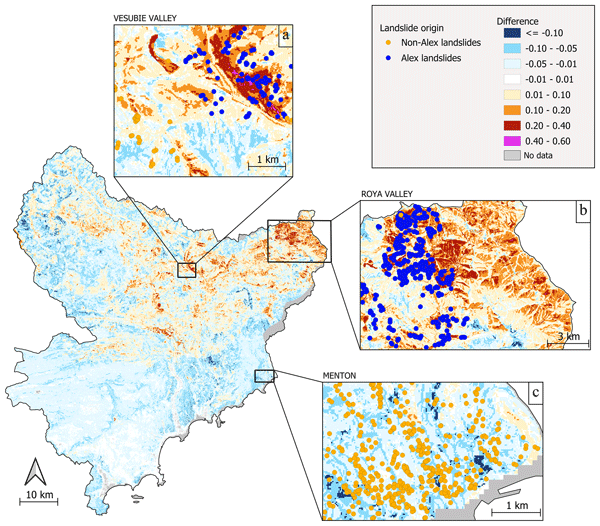
This research examines how extreme-rainfall-induced landslides affect predictive tools for shallow landslides. Focusing on Storm Alex (France), we compared predictions with and without Alex-induced landslides. Results show that Alex-induced landslides do not follow the same triggering conditions as those observed during more frequent rainfalls, leading to different rainfall thresholds and susceptibility maps. This highlights the importance of accounting for rare events when predicting landslide.
Anna Wirbel, Felix Oesterle, Guillaume Chambon, Thierry Faug, Johan Gaume, Julia Glaus, Stefan Hergarten, Dieter Issler, Yoichi Ito, Marco Martini, Martin Mergili, Matthias Rauter, Jörg Robl, Giorgio Rosatti, Kae Tsunematsu, Christian Tollinger, Hervé Vicari, Daniel Zugliani, and Jan-Thomas Fischer
EGUsphere, https://doi.org/10.5194/egusphere-2025-6053, https://doi.org/10.5194/egusphere-2025-6053, 2026
This preprint is open for discussion and under review for Geoscientific Model Development (GMD).
Short summary
Short summary
We present the first extended intercomparison of snow avalanche flow simulation tools. In this pilot-study, simulation results of mainly thickness/depth-integrated shallow flow models are compared for three simple test cases representative of standard applications. This analysis serves as a first quantitative assessment of the uncertainty introduced by the different implementation workflows (e.g., numerical schemes, ad-hoc treatments, geo-data handling, curvature treatment, etc.).
Suzanne Lapillonne, Georgios Fourtakas, Vincent Richefeu, Guillaume Piton, and Guillaume Chambon
Geosci. Model Dev., 18, 7059–7075, https://doi.org/10.5194/gmd-18-7059-2025, https://doi.org/10.5194/gmd-18-7059-2025, 2025
Short summary
Short summary
Debris flows are fast-flowing events that are saturated with granular material. They naturally occur in steep creeks and are a threat to local communities. Scientists have turned to numerical models to better understand how they behave. We investigate the accuracy of a numerical model that relies on modelling the debris flow as a mixture of a granular phase and a fluid phase. We focus on a demonstration of the capacity of the model to reliably represent the behaviour of the flow at different scales.
Clémence Herny, Pascal Hagenmuller, Guillaume Chambon, Isabel Peinke, and Jacques Roulle
The Cryosphere, 18, 3787–3805, https://doi.org/10.5194/tc-18-3787-2024, https://doi.org/10.5194/tc-18-3787-2024, 2024
Short summary
Short summary
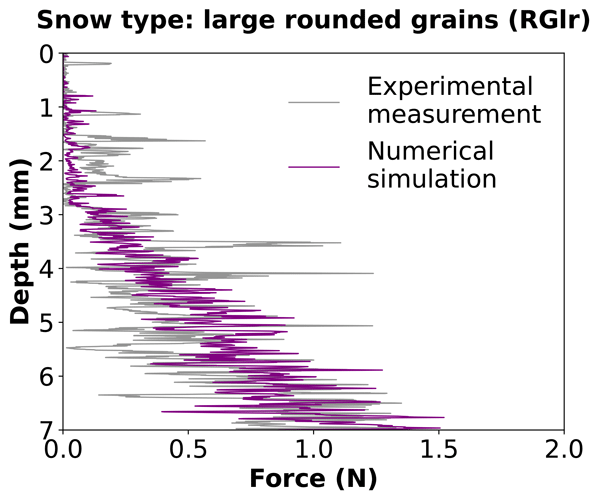
This paper presents the evaluation of a numerical discrete element method (DEM) by simulating cone penetration tests in different snow samples. The DEM model demonstrated a good ability to reproduce the measured mechanical behaviour of the snow, namely the force evolution on the cone and the grain displacement field. Systematic sensitivity tests showed that the mechanical response depends not only on the microstructure of the sample but also on the mechanical parameters of grain contacts.
Saoirse Robin Goodwin, Thierry Faug, and Guillaume Chambon
Nat. Hazards Earth Syst. Sci. Discuss., https://doi.org/10.5194/nhess-2024-123, https://doi.org/10.5194/nhess-2024-123, 2024
Preprint withdrawn
Short summary
Short summary
This paper considers how we can objectivity define stoppage of numerically-modelled snow avalanches. When modelling real topographies, numerically-modelled avalanche snow velocities typically do not converge to 0, so stoppage is defined with arbitrary criteria, which must be tuned on a case-by-case basis. We propose a new objective arrest criterion based on local flow properties, in tandem with a newly-implemented physical yielding criterion.
Mathieu Le Breton, Éric Larose, Laurent Baillet, Yves Lejeune, and Alec van Herwijnen
The Cryosphere, 17, 3137–3156, https://doi.org/10.5194/tc-17-3137-2023, https://doi.org/10.5194/tc-17-3137-2023, 2023
Short summary
Short summary
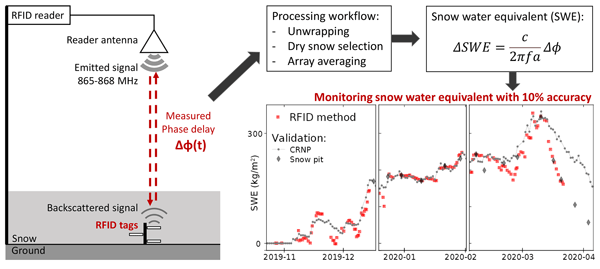
We monitor the amount of snow on the ground using passive radiofrequency identification (RFID) tags. These small and inexpensive tags are wirelessly read by a stationary reader placed above the snowpack. Variations in the radiofrequency phase delay accurately reflect variations in snow amount, known as snow water equivalent. Additionally, each tag is equipped with a sensor that monitors the snow temperature.
Antoine Guillemot, Alec van Herwijnen, Eric Larose, Stephanie Mayer, and Laurent Baillet
The Cryosphere, 15, 5805–5817, https://doi.org/10.5194/tc-15-5805-2021, https://doi.org/10.5194/tc-15-5805-2021, 2021
Short summary
Short summary
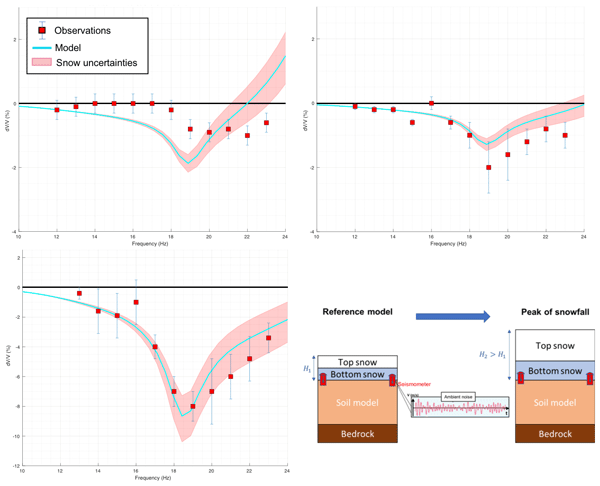
Ambient noise correlation is a broadly used method in seismology to monitor tiny changes in subsurface properties. Some environmental forcings may influence this method, including snow. During one winter season, we studied this snow effect on seismic velocity of the medium, recorded by a pair of seismic sensors. We detected and modeled a measurable effect during early snowfalls: the fresh new snow layer modifies rigidity and density of the medium, thus decreasing the recorded seismic velocity.
Cited articles
Acar, M., Ozludemir, M. T., Erol, S., Celik, R. N., and Ayan, T.: Kinematic landslide monitoring with Kalman filtering, Nat. Hazards Earth Syst. Sci., 8, 213–221, https://doi.org/10.5194/nhess-8-213-2008, 2008. a
Ali, A., Huang, J., Lyamin, A., Sloan, S., Griffiths, D., Cassidy, M., and Li, J. L.: Simplified quantitative risk assessment of rainfall-induced landslides modelled by infinite slopes, Engineering Geology, 179, https://doi.org/10.1016/j.enggeo.2014.06.024, 2014. a
Alvioli, M., Guzzetti, F., and Rossi, M.: Scaling Properties of Rainfall-Induced Landslides Predicted by a Physically Based Model, Geomorphology, 213, 38, https://doi.org/10.1016/j.geomorph.2013.12.039, 2014. a
Anderson, B. and Moore, J.: Optimal Filtering, Prentice-Hall, ISBN 0-13-638122-7, 1979. a
Angeli, M., Buma, J., Gasparetto, P., and Pasuto, A.: A combined hillslope hydrology/stability model for low-gradient clay slopes in the Italian Dolomites, Engineering Geology, 49, 1–13, https://doi.org/10.1016/S0013-7952(97)00033-1, 1998. a
Angeli, M.-G., Pasuto, A., and Silvano, S.: A critical review of landslide monitoring experiences, Engineering Geology, 55, 133–147, https://doi.org/10.1016/S0013-7952(99)00122-2, 2000. a
Asch, T. and Genuchten, P.: A comparison between theoretical and measured creep profiles of landslides, Geomorphology, 3, 45–55, https://doi.org/10.1016/0169-555X(90)90031-K, 1990. a
Bottelin, P., Baillet, L., Larose, E., Jongmans, D., Hantz, D., Brenguier, O., Cadet, H., and Helmstetter, A.: Monitoring rock reinforcement works with ambient vibrations: La Bourne case study (Vercors, France), Engineering Geology, 226, 136–145, https://doi.org/10.1016/j.enggeo.2017.06.002, 2017. a
Breton, M. L., Baillet, L., Larose, E., Rey, E., Benech, P., Jongmans, D., Guyoton, F., and Jaboyedoff, M.: Passive radio-frequency identification ranging, a dense and weather-robust technique for landslide displacement monitoring, Engineering Geology, 250, 1–10, https://doi.org/10.1016/j.enggeo.2018.12.027, 2019. a
Bui, D. T., Tsangaratos, P., Nguyen, V.-T., Liem, N. V., and Trinh, P. T.: Comparing the prediction performance of a Deep Learning Neural Network model with conventional machine learning models in landslide susceptibility assessment, CATENA, 188, 104426, https://doi.org/10.1016/j.catena.2019.104426, 2020. a
Caine, N.: The Rainfall Intensity: Duration Control of Shallow Landslides and Debris Flows, Geografiska Annaler – Series A, Physical Geography, 62, 23–27, 1980. a
Capparelli, G. and Tiranti, D.: Application of the MoniFLaIR early warning system for rainfall-induced landslides in Piedmont region (Italy), Landslides, 7, 401–410, https://doi.org/10.1007/s10346-009-0189-9, 2010. a
Capparelli, G. and Versace, P.: FLaIR and SUSHI: two mathematical models for early warning of landslides induced by rainfall, Landslides, 8, 67–79, https://doi.org/10.1007/s10346-010-0228-6, 2011. a
Casagli, N., Intrieri, E., Tofani, V., G. G., and Raspini, F.: Landslide detection, monitoring and prediction with remote-sensing techniques, Nat. Rev. Earth Environ., 4, 51–64, 2023. a
Chae, B.-G., Park, H.-J., Catani, F., Simoni, A., and Berti, M.: Landslide prediction, monitoring and early warning: a concise review of state-of-the-art, Geosciences Journal, 21, 1033–1070, https://doi.org/10.1007/s12303-017-0034-4, 2017. a
Dikshit, A., Satyam, N., and Pradhan, B.: Estimation of Rainfall-Induced Landslides Using the TRIGRS Model, Earth Systems and Environment, 3, 575–584, https://doi.org/10.1007/s41748-019-00125-w, 2019. a
Froude, M. J. and Petley, D. N.: Global fatal landslide occurrence from 2004 to 2016, Nat. Hazards Earth Syst. Sci., 18, 2161–2181, https://doi.org/10.5194/nhess-18-2161-2018, 2018. a
Gili, J. A., Corominas, J., and Rius, J.: Using Global Positioning System techniques in landslide monitoring, Engineering Geology, 55, 167–192, https://doi.org/10.1016/S0013-7952(99)00127-1, 2000. a
Gnanadesikan, R. and Kettenring, J. R.: Robust Estimates, Residuals, and Outlier Detection with Multiresponse Data, Biometrics, 28, 81–124, 1972. a
Guzzetti, F., Peruccacci, S., Rossi, M., and Stark, C. P.: The rainfall intensity-duration control of shallow landslides and debris flows: an update, Landslides, 5, 3–17, 2008. a
Guzzetti, F., Gariano, S. L., Peruccacci, S., Brunetti, M. T., Marchesini, I., Rossi, M., and Melillo, M.: Geographical landslide early warning systems, Earth-Science Reviews, 200, 102973, https://doi.org/10.1016/j.earscirev.2019.102973, 2020. a
Hutchinson, J. N.: A sliding-consolidation model for flow slides, Canadian Geotechnical Journal, 23, 115–126, 1986. a
Iverson, R. M.: Landslide triggering by rain infiltration, Water Resour. Res., 36, 1897–1910, 2000. a
Kalman, R. E.: A New Approach to Linear Filtering and Prediction Problems, Transactions of the ASME – Journal of Basic Engineering, 82, 35–45, 1960. a
Kim, M., Onda, Y., Uchida, T., and Kim, J. K.: Effects of soil depth and subsurface flow along the subsurface topography on shallow landslide predictions at the site of a small granitic hillslope, Geomorphology, 271, https://doi.org/10.1016/j.geomorph.2016.07.031, 2016. a
Kjekstad, O. and Highland, L.: Economic and social impacts of landslides, pp. 573–587, Springer Berlin Heidelberg, Berlin, Heidelberg, ISBN 978-3-540-69970-5, https://doi.org/10.1007/978-3-540-69970-5_30, 2009. a
Kumar, P., Sihag, P., Sharma, A., Pathania, A., Singh, R., Chaturvedi, P., Mali, N., Uday, K. ., and Dutt, V.: Prediction of Real-World Slope Movements via Recurrent and Non-recurrent Neural Network Algorithms: A Case Study of the Tangni Landslide, Indian Geotech Journal, 51, 788–810, 2021. a
Larose, E., Carrière, S., Voisin, C., Bottelin, P., Baillet, L., Guéguen, P., Walter, F., Jongmans, D., Guillier, B., Garambois, S., Gimbert, F., and Massey, C.: Environmental seismology: What can we learn on earth surface processes with ambient noise?, Journal of Applied Geophysics, 116, 62–74, https://doi.org/10.1016/j.jappgeo.2015.02.001, 2015. a
Larsen, M. C. and Simon, A.: A Rainfall Intensity-Duration Threshold for Landslides in a Humid-Tropical Environment, Puerto Rico, Geografiska Annaler – Series A, Physical Geography, 75, 13–23, 1993. a
Lu, F. and Zeng, H.: Application of Kalman Filter Model in the landslide deformation forecast, Scientific Reports, 10, 1028, https://doi.org/10.1038/s41598-020-57881-3, 2020. a
Malet, J.-P., Laigle, D., Remaître, A., and Maquaire, O.: Triggering conditions and mobility of debris flows associated to complex earthflows, Geomorphological hazard and human impact in mountain environments, 66, 215–235, 2005. a
Mayoraz, F. and Vulliet, L.: Neural networks for slope movement prediction, Int. J. Geomech., 2, 153–173, 2002. a
Mishra, M., Besançon, G., Chambon, G., and Baillet, L.: Optimal parameter estimation in a landslide motion model using the adjoint method, in: 2020 European Control Conference (ECC), pp. 226–231, https://doi.org/10.23919/ECC51009.2020.9143819, 2020a. a
Mishra, M., Besançon, G., Chambon, G., and Baillet, L.: Observer design for state and parameter estimation in a landslide model, IFAC-PapersOnLine, 21th IFAC World Congress, 53, 16709–16714, https://doi.org/10.1016/j.ifacol.2020.12.1116, 2020b. a
Pearson, K. F.: On the criterion that a given system of deviations from the probable in the case of a correlated system of variables, The London, Edinburgh, and Dublin Philosophical Magazine and Journal of Science, 50, 157–175, https://doi.org/10.1080/14786440009463897, 1900. a
Petley, D.: Global patterns of loss of life from landslides, Geology, 40, 927–930, 2012. a
Pradhan, A. and Kim, Y.-T.: Application and comparison of shallow landslide susceptibility models in weathered granite soil under extreme rainfall events, Environmental Earth Sciences, https://doi.org/10.1007/s12665-014-3829-x, 2014. a
Pradhan, S., Vishal, V., and Singh, T. (Eds.): Landslides: Theory, practice and Modelling, Advances in Natural and Technological Hazards Research, vol. 50, Springer, https://doi.org/10.1007/978-3-319-77377-3, 2019. a
Savitzky, A. and Golay, M. J.: Smoothing and differentiation of data by simplified least squares procedures, Analytical Chemistry, 36, 1627–1639, 1964. a
Sharifi, S., Hendry, M. T., Macciotta, R., and Evans, T.: Evaluation of filtering methods for use on high-frequency measurements of landslide displacements, Nat. Hazards Earth Syst. Sci., 22, 411–430, https://doi.org/10.5194/nhess-22-411-2022, 2022. a
Springman, S., Thielen, A., Kienzler, P., and Friedel, S.: A long-term field study for the investigation of rainfall-induced landslides, Géotechnique, 63, 1177–1193, https://doi.org/10.1680/geot.11.P.142, 2013. a
Teixeira, M., Bateira, C., Marques, F., and Vieira, B.: Physically based shallow translational landslide susceptibility analysis in Tibo catchment, NW of Portugal, Landslides, https://doi.org/10.1007/s10346-014-0494-9, 2014. a
Travelletti, J. and Malet, J.-P.: Characterization of the 3D geometry of flow-like landslides: A methodology based on the integration of heterogeneous multi-source data, Engineering Geology, 128, 30–48, https://doi.org/10.1016/j.enggeo.2011.05.003, 2012. a
Van Asch, T., Van Beek, L., and Bogaard, T.: Problems in predicting the mobility of slow-moving landslides, Engineering Geology, 91, 46–55, https://doi.org/10.1016/j.enggeo.2006.12.012, slope Transport Processes and Hydrology, 2007. a
Westen, C.: Geo-Information tools for landslide risk assessment: an overview of recent developments, in: 9th International Symposium on Landslides, Rio de Jeneiro, https://doi.org/10.1201/b16816-6, 2004. a
Yang, B., Yin, K., Lacasse, S., and Liu, Z.: Time series analysis and long short-term memory neural network to predict landslide displacement, Landslides, 16, 677–694, https://doi.org/10.1007/s10346-018-01127-x, 2019. a
Zuo, S., Zhao, L., Deng, D., Wang, Z., and Zhao, Z.: Reliability back analysis of landslide shear strength parameters based on a general nonlinear failure criterion, International Journal of Rock Mechanics and Mining Sciences, 126, 104189, https://doi.org/10.3969/j.issn.1000-565X.2016.06.019, 2020. a
Short summary
This work was initiated in the context of a large interdisciplinary research project about Risk at Grenoble University, France. It relates to the challenging topic of landslide monitoring, and combines geotechnical sciences with techniques from control system engineering. Considering a specific modelling approach, the study provides a methodology towards estimation of some landslide parameters and their use in motion prediction. This could then be extended to the design of alert systems.
This work was initiated in the context of a large interdisciplinary research project about Risk...
Altmetrics
Final-revised paper
Preprint