
Articles | Volume 26, issue 3
https://doi.org/10.5194/nhess-26-1269-2026
© Author(s) 2026. This work is distributed under
the Creative Commons Attribution 4.0 License.
the Creative Commons Attribution 4.0 License.
https://doi.org/10.5194/nhess-26-1269-2026
© Author(s) 2026. This work is distributed under
the Creative Commons Attribution 4.0 License.
the Creative Commons Attribution 4.0 License.
Research article
| 
10 Mar 2026
Research article |
| 10 Mar 2026
| 10 Mar 2026
Assessing the ability of the ECMWF seasonal prediction model to forecast extreme September–November rainfall events over Equatorial Africa
Hermann Ngueyon Nana
CORRESPONDING AUTHOR

Laboratory for Environmental Modelling and Atmospheric Physics (LEMAP), Physics Department, University of Yaounde 1, P.O. Box 812, Yaounde, Cameroon
Roméo Stève Tanessong
Department of Meteorology and Climatology; Higher Institute of Agriculture, Forestry, Water and Environment, University of Ebolowa, P.O. Box 118, Ebolowa, Cameroon
Laboratory for Environmental Modelling and Atmospheric Physics (LEMAP), Physics Department, University of Yaounde 1, P.O. Box 812, Yaounde, Cameroon
Masilin Gudoshava
IGAD Climate Prediction and Applications Centre (ICPAC), Nairobi, Kenya
Derbetini Appolinaire Vondou
Laboratory for Environmental Modelling and Atmospheric Physics (LEMAP), Physics Department, University of Yaounde 1, P.O. Box 812, Yaounde, Cameroon
Related authors
Hermann N. Nana, Masilin Gudoshava, Roméo S. Tanessong, Alain T. Tamoffo, and Derbetini A. Vondou
Weather Clim. Dynam., 6, 741–756, https://doi.org/10.5194/wcd-6-741-2025, https://doi.org/10.5194/wcd-6-741-2025, 2025
Short summary
Short summary
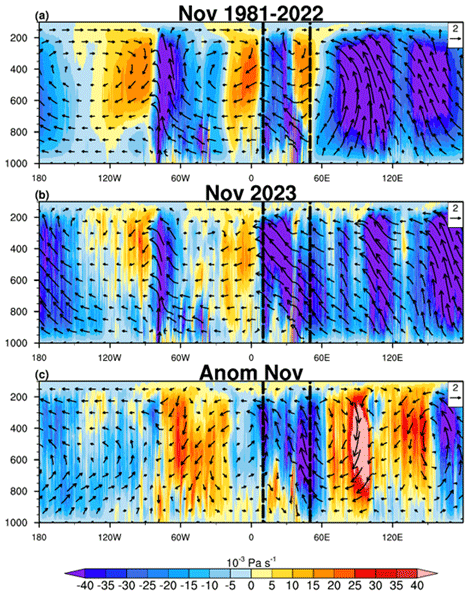
The results of this study show that extreme rainfall in November 2023 over Equatorial Africa was controlled by several factors, including strong sea-surface-temperature anomalies in the Niño-3.4, North Tropical Atlantic, Equatorial Atlantic and Indian Ocean Dipole regions; changes in zonal winds; the Walker circulation; the moisture flux and its divergence; and the easterly jets. The information we derive can be used to support risk assessment in the region and to improve our resilience to ongoing climate change.
William Wandji Nyamsi, Ville Leinonen, Antti Lipponen, Else van den Besselaar, Santtu Mikkonen, Arturo Sanchez-Lorenzo, Martin Wild, Doris Folini, Tero Mielonen, Harri Kokkola, Antti Kukkurainen, Neus Sabater, Rei Kudo, Ben Liley, Raghav Srinivasan, Bruce W. Forgan, Alexandru Dumitrescu, Grzegorz Urban, Michał K. Kowalewski, Márcia Akemi Yamasoe, Nilton Évora do Rosário, Dimitra Founda, Stelios Kazadzis, Veronica Manara, Derbetini A. Vondou, Christian Gueymard, Anders V. Lindfors, Atsumu Ohmura, and Antti Arola
Atmos. Chem. Phys., 26, 10767–10788, https://doi.org/10.5194/acp-26-10767-2026, https://doi.org/10.5194/acp-26-10767-2026, 2026
Short summary
Short summary
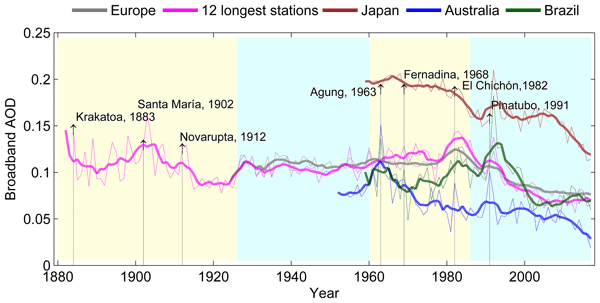
Worldwide reconstructed historical aerosol load reveals that during the period of:
- 1900–1959: the atmosphere became cleaner in most European cities;
- 1960–1985: anthropogenic aerosols were responsible for the dimming phenomenon in Europe. AOD increased over Southeast Brazil and decreased noticeably over Japan while a small negative trend was found over Oceania;
- 1986–2015: generally, the atmosphere has become much cleaner everywhere after the reversal trend around 1980s mainly observed in Europe.
Sinclair Chinyoka, Masilin Gudoshava, Hussen Seid Endris, Shingirai Shepard Nangombe, Jordi Vila-Guerau De Arellano, and Gert-Jan Steeneveld
EGUsphere, https://doi.org/10.5194/egusphere-2026-2832, https://doi.org/10.5194/egusphere-2026-2832, 2026
This preprint is open for discussion and under review for Weather and Climate Dynamics (WCD).
Short summary
Short summary
Rainfall from March to May is vital for farming, water supply, and disaster planning in East Africa (EA)8, but it remains difficult to predict. We used climate data and machine learning to identify early signs that influence wet and dry seasons. The results show that EA rainfall is shaped by linked ocean, land, air temperature, and pressure patterns across several regions. This approach improves forecast skill and can support earlier, clearer warnings for climate-sensitive communities.
Hermann N. Nana, Masilin Gudoshava, Roméo S. Tanessong, Alain T. Tamoffo, and Derbetini A. Vondou
Weather Clim. Dynam., 6, 741–756, https://doi.org/10.5194/wcd-6-741-2025, https://doi.org/10.5194/wcd-6-741-2025, 2025
Short summary
Short summary
The results of this study show that extreme rainfall in November 2023 over Equatorial Africa was controlled by several factors, including strong sea-surface-temperature anomalies in the Niño-3.4, North Tropical Atlantic, Equatorial Atlantic and Indian Ocean Dipole regions; changes in zonal winds; the Walker circulation; the moisture flux and its divergence; and the easterly jets. The information we derive can be used to support risk assessment in the region and to improve our resilience to ongoing climate change.
Cited articles
Abid, M. A., Kucharski, F., Molteni, F., and Almazroui, M.: Predictability of Indian Ocean precipitation and its North Atlantic teleconnections during early winter, npj Clim. Atmos. Sci., 6, 17, https://doi.org/10.1038/s41612-023-00328-z, 2022.
Attada, R., Ehsan, M. A., and Pillai, P. A.: Evaluation of potential predictability of indian summer monsoon rainfall in ecmwf's fifth-generation seasonal forecast system (SEAS5), Pure Appl. Geophys., 179, 4639–4655, https://doi.org/10.1007/s00024-022-03184-9, 2022.
Cai, W., van Rensch, P., Cowan, T., and Hendon, H. H.: Teleconnection pathways of ENSO and the IOD and the mechanisms for impacts on australian rainfall, J. Climate, 24, 3910–3923, https://doi.org/10.1175/2011jcli4129.1, 2011.
Cook, K. H. and Vizy, E. K.: Hydrodynamics of regional and seasonal variations in Congo Basin precipitation, Clim. Dynam., 59, 1775–1797, https://doi.org/10.1007/s00382-021-06066-3, 2021.
Dezfuli, A. K. and Nicholson, S. E.: The relationship of rainfall variability in Western Equatorial Africa to the tropical oceans and atmospheric circulation. Part II: The Boreal Autumn, J. Climate, 26, 66–84, https://doi.org/10.1175/jcli-d-11-00686.1, 2013.
Dinku, T., Funk, C., Peterson, P., Maidment, R., Tadesse, T., Gadain, H., and Ceccato, P.: Validation of the CHIRPS satellite rainfall estimates over eastern Africa, Q. J. Roy. Meteor. Soc., 144, 292–312, https://doi.org/10.1002/qj.3244, 2018.
Ehsan, M. A., Tippett, M. K., Robertson, A. W., Almazroui, M., Ismail, M., Dinku, T., Acharya, N., Siebert, A., Ahmed, J. S., and Teshome, A.: Seasonal predictability of Ethiopian Kiremt rainfall and forecast skill of ECMWF's SEAS5 model, Clim. Dynam., 57, 3075–3091, 2021.
Feudjio Tchinda, A., Tanessong, R. S., Mamadou, O., Tchida Diffo, V., Djomou Yepdo, Z., and Chabi Orou, J. B.: Predictive skill of North American Multi-Model Ensemble seasonal forecasts for the climate rainfall over Central Africa, Meteorol. Appl., 29, https://doi.org/10.1002/met.2074, 2022.
Funk, C., Peterson, P., Landsfeld, M., Pedreros, D., Verdin, J., Shukla, S., Husak, G., Rowland, J., Harrison, L., Hoell, A., and Michaelsen, J.: The climate hazards infrared precipitation with stations – a new environmental record for monitoring extremes, Sci. Data, 2, https://doi.org/10.1038/sdata.2015.66, 2015.
Gebrechorkos, S. H., Pan, M., Beck, H. E., and Sheffield, J.: Performance of state-of- the-art C3S european seasonal climate forecast models for mean and extreme precipitation over africa, Water Resour. Res., 58, https://doi.org/10.1029/2021wr031480, 2022.
Gleixner, S., Demissie, T., and Diro, G. T.: Did ERA5 improve temperature and precipitation reanalysis over east africa?, Atmosphere, 11, 996, https://doi.org/10.3390/atmos11090996, 2020.
Gudoshava, M., Wainwright, C., Hirons, L., Endris, H. S., Segele, Z. T., Woolnough, S., Atheru, Z., and Artan, G.: Atmospheric and oceanic conditions associated with early and late onset for Eastern Africa short rains, Int. J. Climatol., 42, 6562–6578, https://doi.org/10.1002/joc.7627, 2022a.
Gudoshava, M., Wanzala, M., Thompson, E., Mwesigwa, J., Endris, H. S., Segele, Z., Hirons, L., Kipkogei, O., Mumbua, C., Njoka, W., Baraibar, M., de Andrade, F., Woolnough, S., Atheru, Z., and Artan, G.: Application of real time S2S forecasts over Eastern Africa in the co-production of climate services, Clim. Services, 27, 100319, https://doi.org/10.1016/j.cliser.2022.100319, 2022b.
Gudoshava, M., Nyinguro, P., Talib, J., Wainwright, C., Mwanthi, A., Hirons, L., de Andrade, F., Mutemi, J., Gitau, W., Thompson, E., Gacheru, J., Marsham, J., Endris, H. S., Woolnough, S., Segele, Z., Atheru, Z., and Artan, G.: Drivers of sub- seasonal extreme rainfall and their representation in ECMWF forecasts during the Eastern African March-to-May seasons of 2018–2020, Meteorol. Appl., 31, https://doi.org/10.1002/met.70000, 2024.
Hersbach, H., Bell, B., Berrisford, P., Hirahara, S., Horányi, A., Muñoz-Sabater, J., Nicolas, J., Peubey, C., Radu, R., Schepers, D., Simmons, A., Soci, C., Abdalla, S., Abellan, X., Balsamo, G., Bechtold, P., Biavati, G., Bidlot, J., Bonavita, M., De Chiara, G., Dahlgren, P., Dee, D., Diamantakis, M., Dragani, R., Flemming, J., Forbes, R., Fuentes, M., Geer, A., Haimberger, L., Healy, S., Hogan, R. J., Hólm, E., Janisková, M., Keeley, S., Laloyaux, P., Lopez, P., Lupu, C., Radnoti, G., de Rosnay, P., Rozum, I., Vamborg, F., Villaume, S., and Thépaut, J.: The ERA5 global reanalysis, Q. J. Roy. Meteor. Soc., 146, 1999–2049, https://doi.org/10.1002/qj.3803, 2020.
Huang, B., Thorne, P. W., Banzon, V. F., Boyer, T., Chepurin, G., Lawrimore, J. H., Menne, M. J., Smith, T. M., Vose, R. S., and Zhang, H.-M.: Extended reconstructed sea surface temperature, version 5 (ersstv5): Upgrades, validations, and intercomparisons, J. Climate, 30, 8179–8205, https://doi.org/10.1175/jcli-d-16-0836.1, 2017.
Husak, G. J., Michaelsen, J., and Funk, C.: Use of the gamma distribution to represent monthly rainfall in Africa for drought monitoring applications, Int. J. Climatol., 27, 935–944, https://doi.org/10.1002/joc.1441, 2006.
Ibebuchi, C. C.: Revisiting the 1992 severe drought episode in South Africa: The role of El Niño in the anomalies of atmospheric circulation types in Africa south of the equator, Theor. Appl. Climatol., 146, 723–740, https://doi.org/10.1007/s00704-021-03741-7, 2021.
Johnson, S. J., Stockdale, T. N., Ferranti, L., Balmaseda, M. A., Molteni, F., Magnusson, L., Tietsche, S., Decremer, D., Weisheimer, A., Balsamo, G., Keeley, S. P. E., Mogensen, K., Zuo, H., and Monge-Sanz, B. M.: SEAS5: the new ECMWF seasonal forecast system, Geosci. Model Dev., 12, 1087–1117, https://doi.org/10.5194/gmd-12-1087-2019, 2019.
Kang, I. S. and Shukla, J.: Dynamic seasonal prediction and predictability of the monsoon, in: The Asian Monsoon, Springer Praxis Books. Springer, Berlin, Heidelberg, https://doi.org/10.1007/3-540-37722-0_15, 2006.
Kenfack, K., Marra, F., Djomou, Z. Y., Tchotchou, L. A. D., Tamoffo, A. T., and Vondou, D. A.: Dynamic and thermodynamic contribution to the October 2019 exceptional rainfall in western central Africa, Weather Clim. Dynam., 5, 1457–1472, https://doi.org/10.5194/wcd-5-1457-2024, 2024.
Kolstad, E. W., Parker, D. J., MacLeod, D. A., Wainwright, C. M., and Hirons, L. C.: Beyond the regional average: Drivers of geographical rainfall variability during East Africa's short rains, Q. J. Roy. Meteor. Soc., 150, 4550–4566, https://doi.org/10.1002/qj.4829, 2024.
Kuete, G., Pokam Mba, W., and Washington, R.: African Easterly Jet South: Control, maintenance mechanisms and link with Southern subtropical waves, Clim. Dynam., 54, 1539–1552, https://doi.org/10.1007/s00382-019-05072-w, 2019.
Longandjo, G.-N. T. and Rouault, M.: On the structure of the regional-scale circulation over Central Africa: Seasonal evolution, variability, and mechanisms, J. Climate, 33, 145–162, https://doi.org/10.1175/jcli-d-19-0176.1, 2020.
Longandjo, G.-N. T. and Rouault, M.: Revisiting the seasonal cycle of rainfall over Central Africa, J. Climate, 37, 1015–1032, https://doi.org/10.1175/jcli-d-23-0281.1, 2024.
Moihamette, F., Pokam, W. M., Diallo, I., and Washington, R.: Response of regional circulation features to the Indian Ocean dipole and influence on Central Africa climate, Clim. Dynam., 62, 1–21, https://doi.org/10.1007/s00382-024-07251-w, 2024.
Mwangi, E., Wetterhall, F., Dutra, E., Di Giuseppe, F., and Pappenberger, F.: Forecasting droughts in East Africa, Hydrol. Earth Syst. Sci., 18, 611–620, https://doi.org/10.5194/hess-18-611-2014, 2014.
Nana, H. N., Tanessong, R. S., Tchotchou, L. A. D., Tamoffo, A. T., Moihamette, F., and Vondou, D. A.: Influence of strong South Atlantic Ocean Dipole on the Central African rainfall's system, Clim. Dynam., 62, 1–16, https://doi.org/10.1007/s00382-023-06892-7, 2023.
Nana, H. N., Tamoffo, A. T., Kaissassou, S., Djiotang Tchotchou, L. A., Tanessong, R. S., Kamsu-Tamo, P. H., Kenfack, K., and Vondou, D. A.: Performance-based evaluation of NMME and C3S models in forecasting the June–August Central African rainfall under the influence of the South Atlantic Ocean Dipole, Int. J. Climatol., 44, 2462–2483, https://doi.org/10.1002/joc.8463, 2024.
Nana, H. N., Gudoshava, M., Tanessong, R. S., Tamoffo, A. T., and Vondou, D. A.: Diverse causes of extreme rainfall in November 2023 over Equatorial Africa, Weather Clim. Dynam., 6, 741–756, https://doi.org/10.5194/wcd-6-741-2025, 2025.
Nicholson, S. E.: Long-term variability of the East African `short rains' and its links to large-scale factors, Int. J. Climatol., 35, 3979–3990, https://doi.org/10.1002/joc.4259, 2015.
Nicholson, S. E. and Grist, J. P.: The seasonal evolution of the atmospheric circulation over west africa and equatorial africa, J. Climate, 16, 1013–1030, https://doi.org/10.1175/1520-0442(2003)016<1013:tseota>2.0.co;2, 2003.
Okoola R. E., Camberlin P., and Ininda J. M.: Wet periods along the East African Coast and the extreme wet spell of October 1997, J. Kenya Meteorol. Soc., 2, 67–83, 2008.
Palmer, P. I., Wainwright, C. M., Dong, B., Maidment, R. I., Wheeler, K. G., Gedney, N., Hickman, J. E., Madani, N., Folwell, S. S., Abdo, G., Allan, R. P., Black, E. C. L., Feng, L., Gudoshava, M., Haines, K., Huntingford, C., Kilavi, M., Lunt, M. F., Shaaban, A., and Turner, A. G.: Drivers and impacts of Eastern African rainfall variability, Nat. Rev. Earth Environ., 4, 254–270, https://doi.org/10.1038/s43017-023-00397-x, 2023.
Pokam, W. M., Djiotang, L. A. T., and Mkankam, F. K.: Erratum to: Atmospheric water vapor transport and recycling in Equatorial Central Africa through NCEP/NCAR reanalysis data, Clim. Dynam., 42, 553–553, https://doi.org/10.1007/s00382-013-1977-4, 2013.
Pokam, W. M., Bain, C. L., Chadwick, R. S., Graham, R., Sonwa, D. J., and Kamga, F. M.: Identification of processes driving low-level westerlies in west equatorial africa, J. Climate, 27, 4245–4262, https://doi.org/10.1175/jcli-d-13-00490.1, 2014.
Preethi, B., Sabin, T. P., Adedoyin, J. A., and Ashok, K.: Impacts of the ENSO Modoki and other Tropical Indo-Pacific Climate-Drivers on African Rainfall, Sci. Rep., 5, https://doi.org/10.1038/srep16653, 2015.
Rowell, D. P., Folland, C. K., Maskell, K., and Ward, N. M.: Variability of summer rainfall over tropical north Africa (1906–92): Observations and modelling, Q. J. Roy. Meteor. Soc., 121, 669–704, https://doi.org/10.1256/smsqj.52310, 1995.
Roy, I. and Troccoli, A.: Identifying important drivers of East African October to December rainfall season, Sci. Total Environ., 914, 169615, https://doi.org/10.1016/j.scitotenv.2023.169615, 2024.
Saji, N. H., Goswami, B. N., Vinayachandran, P. N., and Yamagata, T.: A dipole mode in the tropical Indian Ocean, Nature, 401, 360–363, https://doi.org/10.1038/43854, 1999.
Tanessong, R. S., Vondou, D. A., Djomou, Z. Y., and Igri, P. M.: WRF high resolution simulation of an extreme rainfall event over Douala (Cameroon): A case study, Model, Earth Syst. Environ., 3, 927–942, https://doi.org/10.1007/s40808-017-0343-7, 2017.
Tanessong, R. S., Fotso-Nguemo, T. C., Kaissassou, S., Guenang, G. M., Komkoua Mbienda, A. J., Djiotang Tchotchou, L. A., Tchinda, A. F., Vondou, D. A., Pokam, W. M., Igri, P. M., and Yepdo, Z. D.: Climate forecast skill and teleconnections on seasonal time scales over Central Africa based on the North American Multi- Model Ensemble (NMME), Meteorol. Atmos. Phys., 136, https://doi.org/10.1007/s00703-024-01018-y, 2024.
Tefera, A. K., Liguori, G., Cabos, W., and Navarra, A.: Seasonal forecasting of East African short rains, Sci. Rep., 15, https://doi.org/10.1038/s41598-025-86564-0, 2025.
The NCAR Command Language: (Version 6.6.2), Boulder, Colorado: UCAR/NCAR/CISL/TDD [code], https://doi.org/10.5065/D6WD3XH5, 2019.
Trenberth, K. E.: The definition of El Niño, B. Am. Meteorol. Soc., 78, 2771–2777, https://doi.org/10.1175/1520-0477(1997)078<2771:tdoeno>2.0.co;2, 1997.
Wilks, D. S.: “The Stippling Shows Statistically Significant Grid Points”: How Research Results are Routinely Overstated and Overinterpreted, and What to Do about It, B. Am. Meteorol. Soc., 97, 2263–2273, https://doi.org/10.1175/bams-d-15-00267.1, 2016.
Short summary
The results of this study reveal that the seasonal forecast model used here successfully reproduces the observed annual precipitation cycle and seasonal spatial pattern of rainfall over the region for both September and August initial conditions, with notably better skills for September, compared to August. In addition, the model effectively captures the teleconnections between rainfall and tropical sea surface temperature, including the Indian Ocean dipole and El Niño-Southern Oscillation.
The results of this study reveal that the seasonal forecast model used here successfully...


Altmetrics
Final-revised paper
Preprint