
Articles | Volume 26, issue 3
https://doi.org/10.5194/nhess-26-1059-2026
© Author(s) 2026. This work is distributed under
the Creative Commons Attribution 4.0 License.
the Creative Commons Attribution 4.0 License.
https://doi.org/10.5194/nhess-26-1059-2026
© Author(s) 2026. This work is distributed under
the Creative Commons Attribution 4.0 License.
the Creative Commons Attribution 4.0 License.
Research article
| 
04 Mar 2026
Research article |
| 04 Mar 2026
| 04 Mar 2026
Changing drivers of regional large magnitude avalanche frequency throughout Colorado, USA

U.S. Geological Survey, Northern Rocky Mountain Science Center, West Glacier, Montana, United States
Justin T. Martin
U.S. Geological Survey, Northern Rocky Mountain Science Center, West Glacier, Montana, United States
Ethan M. Greene
Colorado Avalanche Information Center, Leadville, Colorado, United States
Nicolas Eckert
Univ. Grenoble Alpes, INRAE, CNRS, IRD, Grenoble INP, IGE, Grenoble, France
Adrien Favillier
Dendrolab.ch, Department of Earth Sciences, University of Geneva, Geneva, Switzerland
Jason Konigsberg
Colorado Avalanche Information Center, Leadville, Colorado, United States
Nickolas Kichas
U.S. Geological Survey, Northern Rocky Mountain Science Center, West Glacier, Montana, United States
Daniel K. Stahle
U.S. Geological Survey, Northern Rocky Mountain Science Center, West Glacier, Montana, United States
Karl W. Birkeland
Birkeland Snow and Avalanche Scientific, Bozeman, Montana, United States
Kelly Elder
U.S.D.A. Forest Service Rocky Mountain Research Station, Fort Collins, Colorado, United States
Gregory T. Pederson
U.S. Geological Survey, Northern Rocky Mountain Science Center, West Glacier, Montana, United States
Related authors

Zachary S. Miller, Erich H. Peitzsch, Eric A. Sproles, Karl W. Birkeland, and Ross T. Palomaki
The Cryosphere, 16, 4907–4930, https://doi.org/10.5194/tc-16-4907-2022, https://doi.org/10.5194/tc-16-4907-2022, 2022
Short summary
Short summary
Snow depth varies across steep, complex mountain landscapes due to interactions between dynamic natural processes. Our study of a winter time series of high-resolution snow depth maps found that spatial resolutions greater than 0.5 m do not capture the complete patterns of snow depth spatial variability at a couloir study site in the Bridger Range of Montana, USA. The results of this research have the potential to reduce uncertainty associated with snowpack and snow water resource analysis.

François Doussot, Léo Viallon-Galinier, Nicolas Eckert, and Pascal Hagenmuller
Nat. Hazards Earth Syst. Sci., 26, 4383–4406, https://doi.org/10.5194/nhess-26-4383-2026, https://doi.org/10.5194/nhess-26-4383-2026, 2026
Short summary
Short summary
Avalanches are sensitive to climate warming, but long and reliable records are rare. We combined avalanche observations with weather and snow simulations in the Haute-Maurienne valley (French Alps). This allowed us to reconstruct past avalanche activity and explore future changes. The results show a strong long-term decline in avalanche occurrence, especially in spring, while extreme events decrease more slowly. This study provides quantitative insights to support mountain risk management.
Simon Filhol, Clément Misset, Noélie Bontemps, Diego Cusicanqui, Emmanuel Paquet, Marie Dumont, Olivier Gagliardini, Pascal Lacroix, Simon Gascoin, Guillaume Thirel, Julien Brondex, Pascal Hagenmuller, Eric Larose, Philipp Schoeneich, Denis Roy, Emmanuel Thibert, Nicolas Eckert, Félix de Montety, Robin Mainieri, Alexandre Hauet, Frédéric Gottardi, Johan Berthet, Alexandre Baratier, Frédéric Liébault, Małgorzata Chmiel, Guillaume Piton, Guillaume Chambon, Guillaume James, Philippe Frey, Philip Deline, Laurent Astrade, Christian Vincent, Dominique Laigle, Alain Recking, Fatima Karbou, Adrien Mauss, Mylène Bonnefoy-Demongeot, Firmin Fontaine, Mickael Langlais, Etienne Berthier, and Antoine Blanc
EGUsphere, https://doi.org/10.5194/egusphere-2026-971, https://doi.org/10.5194/egusphere-2026-971, 2026
Short summary
Short summary
On June 21 2024, the village of La Bérarde, in the French Alps, was devastated by a flood destroying centuries old buildings. This study is an interdisciplinary work to decipher the causes and chronology of the event. The flood started with decadal rain falling on a thick snowpack. A lake observed on top of a glacier few days prior, had drained post event. With climate change, should we expect more similar compound events for alpine communities?
Louise Dallons Thanneur, Florie Giacona, Nicolas Eckert, and Philippe Frey
Nat. Hazards Earth Syst. Sci., 25, 4881–4906, https://doi.org/10.5194/nhess-25-4881-2025, https://doi.org/10.5194/nhess-25-4881-2025, 2025
Short summary
Short summary
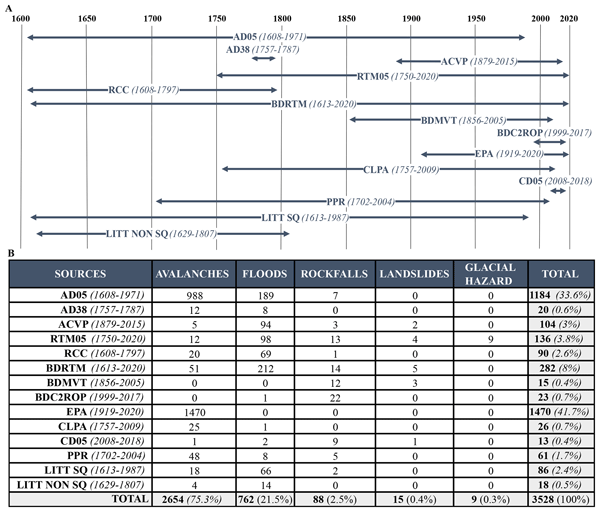
This paper proposes a methodology to develop a long-range multirisk database. Combining scattered pre-existing records and intensive research in historical archives provides a 1600–2020 record of past events in a valley of the French Alps. It goes far beyond any inventory existing in terms of number of events, temporal coverage and detailed description of events characteristics in a mountain context. Spatio-temporal patterns are analysed, opening perspective for multirisk assessment.
Bastian Bergfeld, Karl W. Birkeland, Valentin Adam, Philipp L. Rosendahl, and Alec van Herwijnen
Nat. Hazards Earth Syst. Sci., 25, 321–334, https://doi.org/10.5194/nhess-25-321-2025, https://doi.org/10.5194/nhess-25-321-2025, 2025
Short summary
Short summary
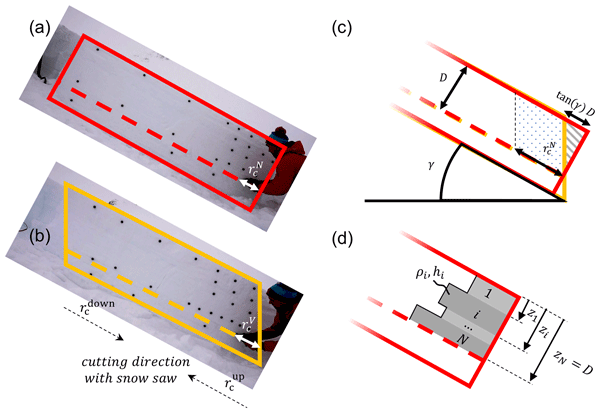
To release a slab avalanche, a crack in a weak snow layer beneath a cohesive slab has to propagate. Information on that is essential for assessing avalanche risk. In the field, information can be gathered with the propagation saw test (PST). However, there are different standards on how to cut the PST. In this study, we experimentally investigate the effect of these different column geometries and provide models to correct for imprecise field test geometry effects on the critical cut length.
Tate G. Meehan, Ahmad Hojatimalekshah, Hans-Peter Marshall, Elias J. Deeb, Shad O'Neel, Daniel McGrath, Ryan W. Webb, Randall Bonnell, Mark S. Raleigh, Christopher Hiemstra, and Kelly Elder
The Cryosphere, 18, 3253–3276, https://doi.org/10.5194/tc-18-3253-2024, https://doi.org/10.5194/tc-18-3253-2024, 2024
Short summary
Short summary
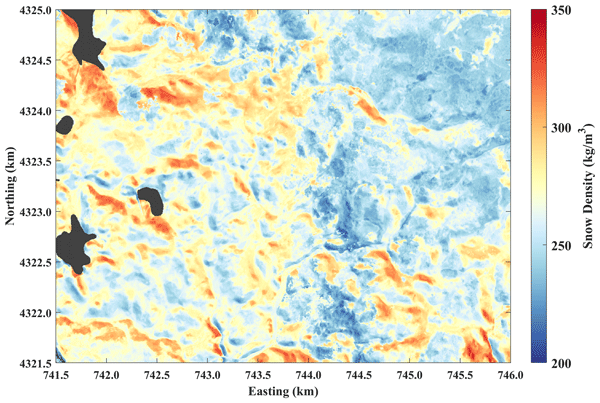
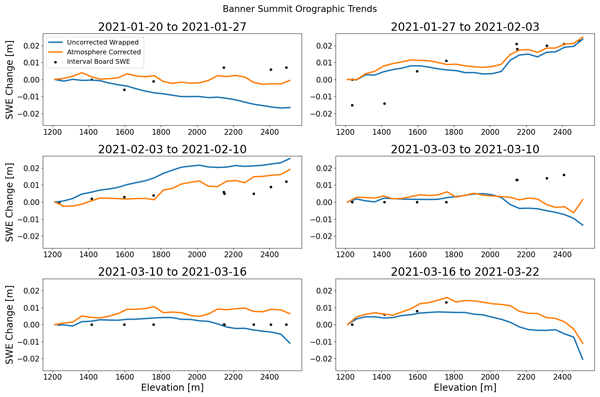
Snow water equivalent (SWE) is a critical parameter for yearly water supply forecasting and can be calculated by multiplying the snow depth by the snow density. We combined high-spatial-resolution snow depth information with ground-based radar measurements to solve for snow density. Extrapolated density estimates over our study area resolved detailed patterns that agree with the known interactions of snow with wind, terrain, and vegetation and were utilized in the calculation of SWE.
James Dillon, Christopher Donahue, Evan Schehrer, Karl Birkeland, and Kevin Hammonds
The Cryosphere, 18, 2557–2582, https://doi.org/10.5194/tc-18-2557-2024, https://doi.org/10.5194/tc-18-2557-2024, 2024
Short summary
Short summary
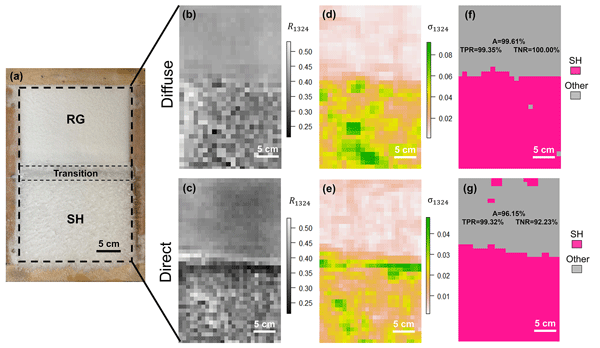
Surface hoar crystals are snow grains that form when vapor deposits on a snow surface. They create a weak layer in the snowpack that can cause large avalanches to occur. Thus, determining when and where surface hoar forms is a lifesaving matter. Here, we developed a means of mapping surface hoar using remote-sensing technologies. We found that surface hoar displayed heightened texture, hence the variability of brightness. Using this, we created surface hoar maps with an accuracy upwards of 95 %.
Zachary Hoppinen, Shadi Oveisgharan, Hans-Peter Marshall, Ross Mower, Kelly Elder, and Carrie Vuyovich
The Cryosphere, 18, 575–592, https://doi.org/10.5194/tc-18-575-2024, https://doi.org/10.5194/tc-18-575-2024, 2024
Short summary
Short summary
We used changes in radar echo travel time from multiple airborne flights to estimate changes in snow depths across Idaho for two winters. We compared our radar-derived retrievals to snow pits, weather stations, and a 100 m resolution numerical snow model. We had a strong Pearson correlation and root mean squared error of 10 cm relative to in situ measurements. Our retrievals also correlated well with our model, especially in regions of dry snow and low tree coverage.
Erwan Le Roux, Guillaume Evin, Raphaëlle Samacoïts, Nicolas Eckert, Juliette Blanchet, and Samuel Morin
The Cryosphere, 17, 4691–4704, https://doi.org/10.5194/tc-17-4691-2023, https://doi.org/10.5194/tc-17-4691-2023, 2023
Short summary
Short summary
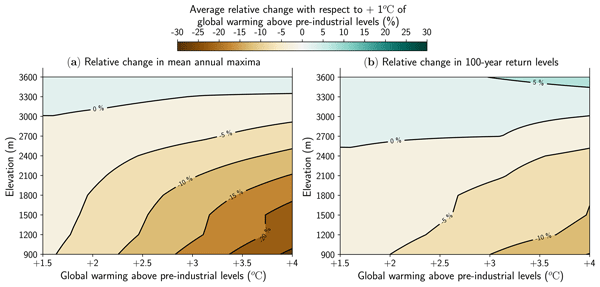
We assess projected changes in snowfall extremes in the French Alps as a function of elevation and global warming level for a high-emission scenario. On average, heavy snowfall is projected to decrease below 3000 m and increase above 3600 m, while extreme snowfall is projected to decrease below 2400 m and increase above 3300 m. At elevations in between, an increase is projected until +3 °C of global warming and then a decrease. These results have implications for the management of risks.
Léo Viallon-Galinier, Pascal Hagenmuller, and Nicolas Eckert
The Cryosphere, 17, 2245–2260, https://doi.org/10.5194/tc-17-2245-2023, https://doi.org/10.5194/tc-17-2245-2023, 2023
Short summary
Short summary
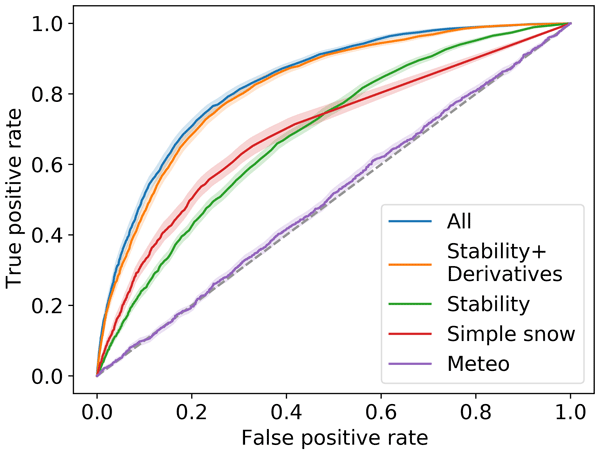
Avalanches are a significant issue in mountain areas where they threaten recreationists and human infrastructure. Assessments of avalanche hazards and the related risks are therefore an important challenge for local authorities. Meteorological and snow cover simulations are thus important to support operational forecasting. In this study we combine it with mechanical analysis of snow profiles and find that observed avalanche data improve avalanche activity prediction through statistical methods.
Cécile Duvillier, Nicolas Eckert, Guillaume Evin, and Michael Deschâtres
Nat. Hazards Earth Syst. Sci., 23, 1383–1408, https://doi.org/10.5194/nhess-23-1383-2023, https://doi.org/10.5194/nhess-23-1383-2023, 2023
Short summary
Short summary
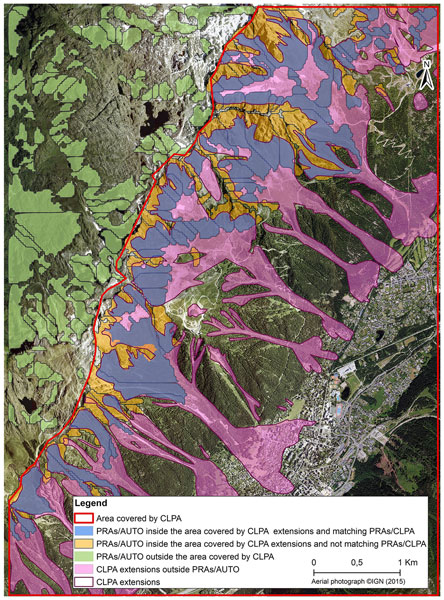
This study develops a method that identifies individual potential release areas (PRAs) of snow avalanches based on terrain analysis and watershed delineation and demonstrates its efficiency in the French Alps context using an extensive cadastre of past avalanche limits. Results may contribute to better understanding local avalanche hazard. The work may also foster the development of more efficient PRA detection methods based on a rigorous evaluation scheme.
Zachary S. Miller, Erich H. Peitzsch, Eric A. Sproles, Karl W. Birkeland, and Ross T. Palomaki
The Cryosphere, 16, 4907–4930, https://doi.org/10.5194/tc-16-4907-2022, https://doi.org/10.5194/tc-16-4907-2022, 2022
Short summary
Short summary
Snow depth varies across steep, complex mountain landscapes due to interactions between dynamic natural processes. Our study of a winter time series of high-resolution snow depth maps found that spatial resolutions greater than 0.5 m do not capture the complete patterns of snow depth spatial variability at a couloir study site in the Bridger Range of Montana, USA. The results of this research have the potential to reduce uncertainty associated with snowpack and snow water resource analysis.
Erwan Le Roux, Guillaume Evin, Nicolas Eckert, Juliette Blanchet, and Samuel Morin
Earth Syst. Dynam., 13, 1059–1075, https://doi.org/10.5194/esd-13-1059-2022, https://doi.org/10.5194/esd-13-1059-2022, 2022
Short summary
Short summary
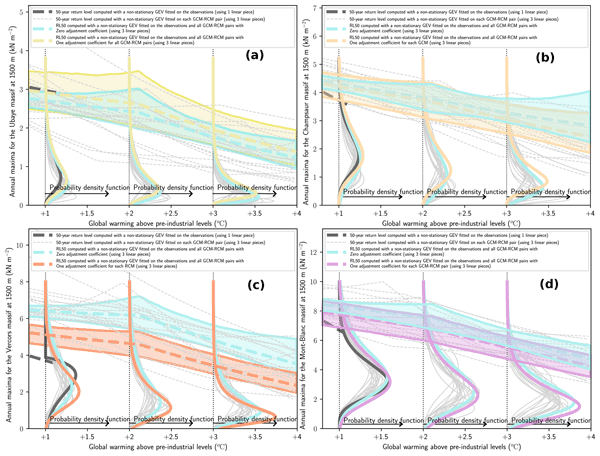
Anticipating risks related to climate extremes is critical for societal adaptation to climate change. In this study, we propose a statistical method in order to estimate future climate extremes from past observations and an ensemble of climate change simulations. We apply this approach to snow load data available in the French Alps at 1500 m elevation and find that extreme snow load is projected to decrease by −2.9 kN m−2 (−50 %) between 1986–2005 and 2080–2099 for a high-emission scenario.
Luuk Dorren, Frédéric Berger, Franck Bourrier, Nicolas Eckert, Charalampos Saroglou, Massimiliano Schwarz, Markus Stoffel, Daniel Trappmann, Hans-Heini Utelli, and Christine Moos
Nat. Hazards Earth Syst. Sci. Discuss., https://doi.org/10.5194/nhess-2022-32, https://doi.org/10.5194/nhess-2022-32, 2022
Publication in NHESS not foreseen
Short summary
Short summary
In the daily practice of rockfall hazard analysis, trajectory simulations are used to delimit runout zones. To do so, the expert needs to separate "realistic" from "unrealistic" simulated groups of trajectories. This is often done on the basis of reach probability values. This paper provides a basis for choosing a reach probability threshold value for delimiting the rockfall runout zone, based on recordings and simulations of recent rockfall events at 18 active rockfall sites in Europe.
Cited articles
Armstrong, R. L. and Armstrong, B. R.: Snow and avalanche climates of the western United States: A comparison of maritime, intermountain, and continental conditions, in: Davos Symposium, September, 1986, Avalanche Formation, Movement and Effects, IAHS Publication, 162, 281–294, 1987.
Ballesteros-Canovas, J. A., Trappmann, D., Madrigal-Gonzalez, J., Eckert, N., and Stoffel, M.: Climate warming enhances snow avalanche risk in the Western Himalayas, P. Natl. Acad. Sci. USA, 115, 3410–3415, dpo:10.1073/pnas.1716913115, 2018.
Birkeland, K. W. and Mock, C. J.: The major snow avalanche cycle of February 1986 in the western United States, Nat. Hazards, 24, 75–95, 2001.
CAIC: Colorado Avalanche Information Center Avalanche Explorer Tool, https://forecasts.avalanche.state.co.us/explorer/ (last access: 3 January 2025), 2025a.
CAIC: About the CAIC, https://avalanche.state.co.us/about-us, (last access: 3 January 2025), 2025b.
Castebrunet, H., Eckert, N., Giraud, G., Durand, Y., and Morin, S.: Projected changes of snow conditions and avalanche activity in a warming climate: the French Alps over the 2020–2050 and 2070–2100 periods, The Cryosphere, 8, 1673–1697, https://doi.org/10.5194/tc-8-1673-2014, 2014.
Corona, C., Lopez Saez, J., Stoffel, M., Bonnefoy, M., Richard, D., Astrade, L., and Berger, F.: How much of the real avalanche activity can be captured with tree rings? An evaluation of classic dendrogeomorphic approaches and comparison with historical archives, Cold Reg. Sci. Technol., https://doi.org/10.1016/j.coldregions.2012.01.003, 2012.
Dkengne Sielenou, P., Viallon-Galinier, L., Hagenmuller, P., Naveau, P., Morin, S., Dumont, M., Verfaillie, D., and Eckert, N.: Combining random forests and class-balancing to discriminate between three classes of avalanche activity in the French Alps, Cold Reg. Sci. Technol., 187, 103276, https://doi.org/10.1016/j.coldregions.2021.103276, 2021.
Eckert, N., Baya, H., and Deschatres, M.: Assessing the response of snow avalanche runout altitudes to climate fluctuations using hierarchical modeling: application to 61 winters of data in France, J. Climate, 23, 3157–3180, 2010.
Eckert, N., Keylock, C. J., Castebrunet, H., Lavigne, A., and Naaim, M.: Temporal trends in avalanche activity in the French Alps and subregions: from occurrences and runout altitudes to unsteady return periods, J. Glaciol., 59, 93–114, https://doi.org/10.3189/2013JoG12J091, 2013.
Eckert, N., Corona, C., Giacona, F., Gaume, J., Mayer, S., van Herwijnen, A., Hagenmuller, P., and Stoffel, M.: Climate change impacts on snow avalanche activity and related risks, Nature Reviews Earth & Environment, https://doi.org/10.1038/s43017-024-00540-2, 2024.
ESRI: Topographic [basemap], World Topographic Map, 4 February 2025, https://www.arcgis.com/home/item.html?id=7dc6cea0b1764a1f9af2e679f642f0f5, last access: 1 May 2025.
Favillier, A., Guillet, S., Morel, P., Corona, C., Lopez Saez, J., Eckert, N., Ballesteros Cánovas, J. A., Peiry, J.-L., and Stoffel, M.: Disentangling the impacts of exogenous disturbances on forest stands to assess multi-centennial tree-ring reconstructions of avalanche activity in the upper Goms Valley (Canton of Valais, Switzerland), Quat. Geochronol., 42, 89–104, https://doi.org/10.1016/j.quageo.2017.09.001, 2017.
Favillier, A., Guillet, S., Trappmann, D., Morel, P., Lopez-Saez, J., Eckert, N., Zenhäusern, G., Peiry, J.-L., Stoffel, M., and Corona, C.: Spatio-temporal maps of past avalanche events derived from tree-ring analysis: A case study in the Zermatt valley (Valais, Switzerland), Cold Reg. Sci. Technol., 154, 9–22, https://doi.org/10.1016/j.coldregions.2018.06.004, 2018.
Favillier, A., Guillet, S., Lopez-Saez, J., Giacona, F., Eckert, N., Zenhäusern, G., Peiry, J. L., Stoffel, M., and Corona, C.: Identifying and interpreting regional signals in tree-ring based reconstructions of snow avalanche activity in the Goms valley (Swiss Alps), Quaternary Sci. Rev., 307, https://doi.org/10.1016/j.quascirev.2023.108063, 2023.
García-Sellés, C., Peña, J. C., Martí, G., Oller, P., and Martínez, P.: WeMOI and NAOi influence on major avalanche activity in the Eastern Pyrenees, Cold Reg. Sci. Technol., 64, 137–145, https://doi.org/10.1016/j.coldregions.2010.08.003, 2010.
Giacona, F., Eckert, N., Corona, C., Mainieri, R., Morin, S., Stoffel, M., Martin, B., and Naaim, M.: Upslope migration of snow avalanches in a warming climate, P. Natl. Acad. Sci. USA, 118, https://doi.org/10.1073/pnas.2107306118, 2021.
Haegeli, P., Shandro, B., and Mair, P.: Using avalanche problems to examine the effect of large-scale atmosphere–ocean oscillations on avalanche hazard in western Canada, The Cryosphere, 15, 1567–1586, https://doi.org/10.5194/tc-15-1567-2021, 2021.
ITRDB: International Tree Ring Data Bank (ITRDB), https://www.ncei.noaa.gov/products/paleoclimatology/tree-ring (last access: 1 May 2025), 2022.
Kruyt, B., Wever, N., Mayer, S., Vergara, J. T., and Schar, C.: Avalanche activity in a changing climate: Changes in wet and dry slab avalanches based on climate simulations over Switzerland, in: Proceedings of the International Snow Science Workshop, 9–13 October 2023, Bend, Oregon, United States, edited by: Peitzsch, E., Marshall, H. P., Savage, S., and Trautman, S., 566–571, 2023.
Lavigne, A., Eckert, N., Bel, L., and Parent, E.: Adding expert contributions to the spatiotemporal modelling of avalanche activity under different climatic influences, J. Roy. Stat. Soc. C-App., 64, 651–671, https://doi.org/10.1111/rssc.12095, 2015.
Lazar, B.: Colorado Avalanche Information Center Season Summary, The Avalanche Review, 38, 42–44, 2019.
Lazar, B. and Williams, M.: Climate change in western ski areas: Potential changes in the timing of wet avalanches and snow quality for the Aspen ski area in the years 2030 and 2100, Cold Reg. Sci. Technol., 51, 219–228, https://doi.org/10.1016/j.coldregions.2007.03.015, 2008.
Marienthal, A., Hendrikx, J., Birkeland, K., and Irvine, K. M.: Meteorological variables to aid forecasting deep slab avalanches on persistent weak layers, Cold Reg. Sci. Technol., 120, 227–236, https://doi.org/10.1016/j.coldregions.2015.08.007, 2015.
Marraccini, B. J., Lazar, B., and Greene, E.: Climate-scale maps of cold-season precipitation in the mountainous areas of Colorado for operational forecasting applications, in: Proceedings of the 2014 International Snow Science Workshop, Banff, Alberta, Canada, 29 September–3 October 2014, edited by: Haegeli, P., 461–464, 2014.
Martinelli, M. and Leaf, C. F.: Historic Avalanches in the Northern Front Range and the Central and Northern Mountains of Colorado, United States Department of Agriculture Forest Service, General Technical Report RMRS-GTR-38, September 1999, 1999.
Mayer, S., Hendrick, M., Michel, A., Richter, B., and van Herwijnen, A.: Projected impact of climate warming on avalanche activity at two sites in the Swiss Alps, in: Proceedings of the International Snow Science Workshop 9–13 October 2023, Bend, Oregon, United States, edited by: Peitzsch, E., Marshall, H. P., Savage, S., and Trautman, S., 573–576, 2023.
Mayer, S., Hendrick, M., Michel, A., Richter, B., Schweizer, J., Wernli, H., and van Herwijnen, A.: Impact of climate change on snow avalanche activity in the Swiss Alps, The Cryosphere, 18, 5495–5517, https://doi.org/10.5194/tc-18-5495-2024, 2024.
McClung, D. M.: The effects of El Nino and La Nina on snow and avalanche patterns in British Columbia, Canada, and central Chile, J. Glaciol., 59, 783–792, https://doi.org/10.3189/2013JoG12J192, 2013.
Mock, C. J. and Birkeland, K. W.: Snow Avalanche Climatology of the Western United States Mountain Ranges, B. Am. Meteorol. Soc., 81, 2367–2392, https://doi.org/10.1175/1520-0477(2000)081<2367:Sacotw>2.3.Co;2, 2000.
Mock, C. J., Carter, K. C., and Birkeland, K. W.: Some Perspectives on Avalanche Climatology, Ann. Am. Assoc. Geogr., 1–10, https://doi.org/10.1080/24694452.2016.1203285, 2016.
Naaim, M., Eckert, N., Giraud, G., Faug, T., Chambon, G., Naaim-Bouvet, F., and Richard, D.: Impact du réchauffement climatique sur l'activité avalancheuse et multiplication des avalanches humides dans les Alpes françaises, Houille Blanche, 102, 12–20, https://doi.org/10.1051/lhb/2016055, 2016.
NRCS: Snow Telemetry (SNOTEL) and Snow Course Data and Products, United States Department of Agriculture, Natural Resources Conservation Service (NRCS), https://www.wcc.nrcs.usda.gov/snow/ (last access: 1 May 2025), 2024.
Peitzsch, E. H., Pederson, G. T., Birkeland, K. W., Hendrikx, J., and Fagre, D. B.: Climate drivers of large magnitude snow avalanche years in the U.S. northern Rocky Mountains, Sci. Rep., 11, https://doi.org/10.1038/s41598-021-89547-z, 2021a.
Peitzsch, E., Hendrikx, J., Stahle, D., Pederson, G., Birkeland, K., and Fagre, D.: A regional spatiotemporal analysis of large magnitude snow avalanches using tree rings, Nat. Hazards Earth Syst. Sci., 21, 533–557, https://doi.org/10.5194/nhess-21-533-2021, 2021b.
Peitzsch, E. H., Milone, K. M., Greene, E., Konigsberg, J., Kichas, N., Stahle, D., Birkeland, K., and Elder, K.: Tree ring dataset for a regional avalanche chronology in Colorado 1319–2022, U.S. Geological Survey data release [data set], https://doi.org/10.5066/P1353HSN, 2024.
Pérez-Guillén, C., Techel, F., Hendrick, M., Volpi, M., van Herwijnen, A., Olevski, T., Obozinski, G., Pérez-Cruz, F., and Schweizer, J.: Data-driven automated predictions of the avalanche danger level for dry-snow conditions in Switzerland, Nat. Hazards Earth Syst. Sci., 22, 2031–2056, https://doi.org/10.5194/nhess-22-2031-2022, 2022.
Pielmeier, C., Techel, F., Marty, C., and Stucki, T.: Wet snow avalnache activity in the Swiss Alps – trend analysis for mid-winter season, in: Proceedings of the International Snow Science Workshop, 7–13 October 2013, Grenoble, France, edited by: Naaim-Bouvet, F., Durand, Y., and Lambert, R., 1240–1246, 2013.
Reardon, B. A., Pederson, G. T., Caruso, C. J., and Fagre, D. B.: Spatial reconstructions and comparisons of historic snow avalanche frequency and extent using tree rings in Glacier National Park, Montana, U.S.A., Arct. Antarct. Alp. Res., 40, 148–160, 2008.
Reuter, B., Hagenmuller, P., and Eckert, N.: Snow and avalanche climates in the French Alps using avalanche problem frequencies, J. Glaciol., 69, 1292–1304, https://doi.org/10.1017/jog.2023.23, 2023.
Schweizer, J.: Snow avalanche formation, Rev. Geophys., 41, https://doi.org/10.1029/2002rg000123, 2003.
Stokes, M. A. and Smiley, T. L.: An Introduction to Tree-Ring Dating, The University of Arizona Press, Tucson, ISBN 9780816516803, 1996.
Viallon-Galinier, L., Hagenmuller, P., and Eckert, N.: Combining modelled snowpack stability with machine learning to predict avalanche activity, The Cryosphere, 17, 2245–2260, https://doi.org/10.5194/tc-17-2245-2023, 2023.
Vose, R. S., Applequist, S., Squires, M., Durre, I., Menne, M. J., Williams, C. N., Fenimore, C., Gleason, K., and Arndt, D.: NOAA Monthly U.S. Climate Gridded Dataset (NClimGrid), Version 1, NOAA National Centers for Environmental Information, https://doi.org/10.7289/V5SX6B56, 2014.
Wieczorek, M. E., Signell, R. P., McCabe, G. J., and Wolock, D. M.: USGS monthly water balance model inputs and outputs for the conterminous United States, 1895–2020, based on ClimGrid data: U.S. Geological Survey data release, https://doi.org/10.5066/P9JTV1T6, 2022.
Short summary
Snow avalanches pose substantial risks to communities and public safety in Colorado. We studied tree growth patterns impacted by avalanches from 1698 to 2020 alongside meteorological data. We found variations in avalanche frequency revealing a decline in regional avalanche activity and shifts in the causes of these types of large and widespread avalanche events. This knowledge can enhance avalanche safety measures and infrastructure design.
Snow avalanches pose substantial risks to communities and public safety in Colorado. We studied...


Altmetrics
Final-revised paper
Preprint