Articles | Volume 25, issue 12
https://doi.org/10.5194/nhess-25-4807-2025
© Author(s) 2025. This work is distributed under
the Creative Commons Attribution 4.0 License.
https://doi.org/10.5194/nhess-25-4807-2025
© Author(s) 2025. This work is distributed under
the Creative Commons Attribution 4.0 License.
Brief communication: How extreme was the thunderstorm rain in Vienna on 17 August 2024? A temporal and spatial analysis

GeoSphere Austria, Vienna, Austria
Johannes Laimighofer
CORRESPONDING AUTHOR
Institute of Statistics, BOKU University, Vienna, Austria
Fabian Lehner
CORRESPONDING AUTHOR
GeoSphere Austria, Vienna, Austria
Institute of Meteorology and Climatology, BOKU University, Vienna, Austria
Related authors
No articles found.
Philipp Maier, Caroline Ehrendorfer, Sophie Lücking, Thomas Pulka, Fabian Lehner, Mathew Herrnegger, Herbert Formayer, and Franziska Koch
EGUsphere, https://doi.org/10.5194/egusphere-2025-6382, https://doi.org/10.5194/egusphere-2025-6382, 2026
This preprint is open for discussion and under review for Hydrology and Earth System Sciences (HESS).
Short summary
Short summary
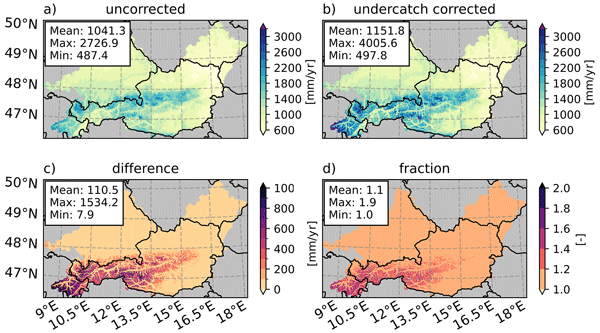
Snow and rainfall measurements in mountain regions often underestimate the true amounts. We developed a method to correct Austrian precipitation data using weather stations and terrain features. The corrected data greatly improves runoff, snow and glacier modeling. This work shows that considering measurement errors is important for accurately assessing water resources, which is increasingly relevant as climate change affects alpine water systems supplying hydropower and downstream communities.
Daniel Issel, Gregor Laaha, Johannes Laimighofer, Johann G. Zaller, Richard Zink, Daniel Dörler, and Florian Heigl
Web Ecol., 25, 177–188, https://doi.org/10.5194/we-25-177-2025, https://doi.org/10.5194/we-25-177-2025, 2025
Short summary
Short summary
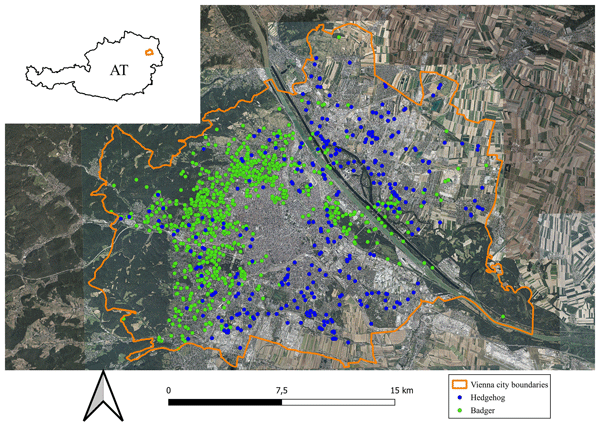
Our study analyzed the distribution of 356 hedgehog and 918 badger sightings from 2012 to 2023 in Vienna, Austria. Both species were reported in areas with a mix of built-up spaces and green areas but not arable land, which can have ecological and methodological reasons. Moreover, hedgehogs and badgers were mostly reported from different areas. Our findings suggest that citizen science can be a good data source to analyze urban human–wildlife interactions.
Johannes Laimighofer, Michael Melcher, and Gregor Laaha
Hydrol. Earth Syst. Sci., 26, 4553–4574, https://doi.org/10.5194/hess-26-4553-2022, https://doi.org/10.5194/hess-26-4553-2022, 2022
Short summary
Short summary
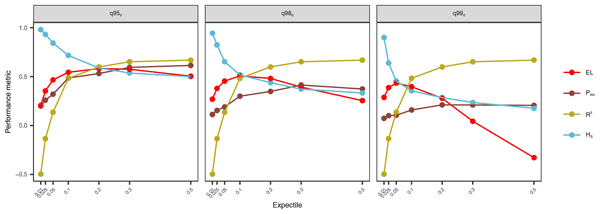
Our study uses a statistical boosting model for estimating low flows on a monthly basis, which can be applied to estimate low flows at sites without measurements. We use an extensive dataset of 260 stream gauges in Austria for model development. As we are specifically interested in low-flow events, our method gives specific weight to such events. We found that our method can considerably improve the predictions of low-flow events and yields accurate estimates of the seasonal low-flow variation.
Johannes Laimighofer, Michael Melcher, and Gregor Laaha
Hydrol. Earth Syst. Sci., 26, 129–148, https://doi.org/10.5194/hess-26-129-2022, https://doi.org/10.5194/hess-26-129-2022, 2022
Short summary
Short summary
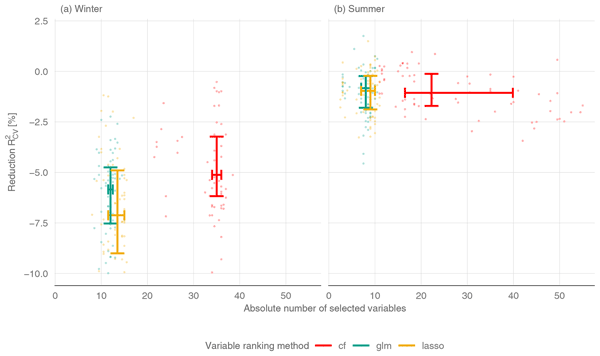
This study aims to predict long-term averages of low flow on a hydrologically diverse dataset in Austria. We compared seven statistical learning methods and included a backward variable selection approach. We found that separating the low-flow processes into winter and summer low flows leads to good performance for all the models. Variable selection results in more parsimonious and more interpretable models. Linear approaches for prediction and variable selection are sufficient for our dataset.
Cited articles
Amorim, R. and Villarini, G.: Impacts of Urbanization on the Riverine Flooding in Major Cities Across the Eastern United States, Hydrological Processes, 38, e70027, https://doi.org/10.1002/hyp.70027, 2024. a
Asquith, W. H.: lmomco – L-moments, censored L-moments, trimmed L-moments, L-comoments, and many distributions, r package version 2.5.1, https://doi.org/10.32614/CRAN.package.lmomco, 2024. a
dpa: Rekordregen in Wien – Frau unter Bus geschwemmt, ZEIT ONLINE, https://www.zeit.de/news/2024-08/17/rekordregen-in-wien-frau-unter-bus-geschwemmt (last access: 25 November 2025), 2024. a
Formayer, H. and Fritz, A.: Temperature dependency of hourly precipitation intensities – surface versus cloud layer temperature: PRECIPITATION INTENSITIES: SURFACE VERSUS CLOUD LAYER TEMPERATURE, International Journal of Climatology, 37, 1–10, https://doi.org/10.1002/joc.4678, 2016. This research has been supported by the Austrian Climate and Energy Fund under the program “ACRP13” (grant no. KR20AC0K17974). a
GeoSphere Austria: Measurement Networks, https://www.geosphere.at/en/data/data-basis/measurement-networks (last access: 25 November 2025), 2025. a
Goudenhoofdt, E. and Delobbe, L.: Evaluation of radar-gauge merging methods for quantitative precipitation estimates, Hydrol. Earth Syst. Sci., 13, 195–203, https://doi.org/10.5194/hess-13-195-2009, 2009. a
Haiden, T., Kann, A., Wittmann, C., Pistotnik, G., Bica, B., and Gruber, C.: The Integrated Nowcasting through Comprehensive Analysis (INCA) System and Its Validation over the Eastern Alpine Region, Weather and Forecasting, 26, 166–183, https://doi.org/10.1175/2010WAF2222451.1, 2011. a
Haslinger, K., Breinl, K., Pavlin, L., Pistotnik, G., Bertola, M., Olefs, M., Greilinger, M., Schöner, W., and Blöschl, G.: Increasing hourly heavy rainfall in Austria reflected in flood changes, Nature, 639, 667–672, https://doi.org/10.1038/s41586-025-08647-2, 2025. a, b
Hersbach, H., Bell, B., Berrisford, P., Hirahara, S., Horányi, A., Muñoz-Sabater, J., Nicolas, J., Peubey, C., Radu, R., Schepers, D., Simmons, A., Soci, C., Abdalla, S., Abellan, X., Balsamo, G., Bechtold, P., Biavati, G., Bidlot, J., Bonavita, M., De Chiara, G., Dahlgren, P., Dee, D., Diamantakis, M., Dragani, R., Flemming, J., Forbes, R., Fuentes, M., Geer, A., Haimberger, L., Healy, S., Hogan, R. J., Hólm, E., Janisková, M., Keeley, S., Laloyaux, P., Lopez, P., Lupu, C., Radnoti, G., de Rosnay, P., Rozum, I., Vamborg, F., Villaume, S., and Thépaut, J.-N.: The ERA5 global reanalysis, Quarterly Journal of the Royal Meteorological Society, 146, 1999–2049, https://doi.org/10.1002/qj.3803, 2020. a
Hosking, J. R. M.: Regional Frequency Analysis using L-Moments, r package, version 3.8, https://CRAN.R-project.org/package=lmomRFA (last access: 25 November 2025), https://doi.org/10.32614/CRAN.package.lmomRFA, 2024. a
Isotta, F. A., Frei, C., Weilguni, V., Perčec Tadić, M., Lassègues, P., Rudolf, B., Pavan, V., Cacciamani, C., Antolini, G., Ratto, S. M., Munari, M., Micheletti, S., Bonati, V., Lussana, C., Ronchi, C., Panettieri, E., Marigo, G., and Vertačnik, G.: The Climate of Daily Precipitation in the Alps: Development and Analysis of a High-resolution Grid Dataset from pan-Alpine Rain-gauge Data, International Journal of Climatology, 34, 1657–1675, https://doi.org/10.1002/joc.3794, 2014. a
Kaltenböck, R.: New generation of dual polarized weather radars in Austria, in: Extended abstracts of the 7th European conference on radar in meteorology and hydrology, Toulouse, France, http://www.meteo.fr/cic/meetings/2012/ERAD/extended_abs/NET_166_ext_abs.pdf (last access: 25 November 2025), 2012. a
Klaus, V. and Laimighofer, J.: katelbach/precipAnalysis: v1.0 (v1.0), https://doi.org/10.5281/zenodo.17701181, [data set], 2025. a
Lehner, F., Laimighofer, J., and Klaus, V.: How extreme was the thunderstorm rain in Vienna on 17 August 2024? INCA Data and station data, https://doi.org/10.5281/zenodo.14500708, [data set], 2024. a
Lengfeld, K., Kirstetter, P.-E., Fowler, H. J., Yu, J., Becker, A., Flamig, Z., and Gourley, J.: Use of Radar Data for Characterizing Extreme Precipitation at Fine Scales and Short Durations, Environmental Research Letters, 15, 085003, https://doi.org/10.1088/1748-9326/ab98b4, 2020. a, b
Lewis, E., Fowler, H., Alexander, L., Dunn, R., McClean, F., Barbero, R., Guerreiro, S., Li, X.-F., and Blenkinsop, S.: GSDR: A Global Sub-Daily Rainfall Dataset, Journal of Climate, 32, 4715–4729, https://doi.org/10.1175/JCLI-D-18-0143.1, 2019. a
McLeod, J., Shepherd, M., and Konrad, C. E.: Spatio-temporal rainfall patterns around Atlanta, Georgia and possible relationships to urban land cover, Urban Climate, 21, 27–42, https://doi.org/10.1016/j.uclim.2017.03.004, 2017. a
Meyer, J., Neuper, M., Mathias, L., Zehe, E., and Pfister, L.: Atmospheric conditions favouring extreme precipitation and flash floods in temperate regions of Europe, Hydrol. Earth Syst. Sci., 26, 6163–6183, https://doi.org/10.5194/hess-26-6163-2022, 2022. a
Önöz, B. and Bayazit, M.: Block bootstrap for Mann–Kendall trend test of serially dependent data, Hydrological Processes, 26, 3552–3560, https://doi.org/10.1002/hyp.8438, 2012. a
Panziera, L., Gabella, M., Zanini, S., Hering, A., Germann, U., and Berne, A.: A radar-based regional extreme rainfall analysis to derive the thresholds for a novel automatic alert system in Switzerland, Hydrol. Earth Syst. Sci., 20, 2317–2332, https://doi.org/10.5194/hess-20-2317-2016, 2016. a, b
R Core Team: R: A Language and Environment for Statistical Computing, R Foundation for Statistical Computing, Vienna, Austria, https://www.R-project.org/ (last access: 25 November 2025), 2024. a
Rosin, T., Marra, F., and Morin, E.: Exploring patterns in precipitation intensity–duration–area–frequency relationships using weather radar data, Hydrol. Earth Syst. Sci., 28, 3549–3566, https://doi.org/10.5194/hess-28-3549-2024, 2024. a
Schmetz, J., Pili, P., Tjemkes, S., Just, D., Kerkmann, J., Rota, S., and Ratier, A.: An Introduction to Meteosat Second Generation (MSG), Bulletin of the American Meteorological Society, 83, 992–992, https://doi.org/10.1175/BAMS-83-7-Schmetz-2, 2002. a
Seneviratne, S., Zhang, X., Adnan, M., Badi, W., Dereczynski, C., Di Luca, A., Ghosh, S., Iskandar, I., Kossin, J., Lewis, S., Otto, F., Pinto, I., Satoh, M., Vicente-Serrano, S., Wehner, M., and Zhou, B.: Weather and Climate Extreme Events in a Changing Climate, in: Climate Change 2021: The Physical Science Basis. Contribution of Working Group I to the Sixth Assessment Report of the Intergovernmental Panel on Climate Change, edited by: Masson-Delmotte, V., Zhai, P., Pirani, A., Connors, S. L., Péan, C., Berger, S., Caud, N., Chen, Y., Goldfarb, L., Gomis, M. I., Huang, M., Leitzell, K., Lonnoy, E., Matthews, J. B. R., Maycock, T. K., Waterfield, T., Yelekçi, O., Yu, R., and Zhou, B., book section 11, 1513–1765 pp., Cambridge University Press, Cambridge, UK and New York, NY, USA, https://doi.org/10.1017/9781009157896.013, 2021. a
Torelló‐Sentelles, H., Marra, F., Koukoula, M., Villarini, G., and Peleg, N.: Intensification and Changing Spatial Extent of Heavy Rainfall in Urban Areas, Earth's Future, 12, e2024EF004505, https://doi.org/10.1029/2024EF004505, 2024. a
Umlauf, N., Klein, N., and Zeileis, A.: BAMLSS: Bayesian Additive Models for Location, Scale and Shape (and Beyond), Journal of Computational and Graphical Statistics, 27, 612–627, https://doi.org/10.1080/10618600.2017.1407325, 2018. a
Wan, N., Lin, X., Pielke Sr., R. A., Zeng, X., and Nelson, A. M.: Global total precipitable water variations and trends over the period 1958–2021, Hydrol. Earth Syst. Sci., 28, 2123–2137, https://doi.org/10.5194/hess-28-2123-2024, 2024. a
Short summary
On 17 August 2024, a thunderstorm in Vienna led to a record-breaking rainfall of 107 mm in two hours. An analysis of the exceptionally long hourly rain gauge time series (since 1941) estimates this event's return period at 700 years. The extremity of the event is further confirmed by neighboring weather stations and rain-radar data. Linking the return period to atmospheric temperature shows that such events might occur more often with rising temperatures.
On 17 August 2024, a thunderstorm in Vienna led to a record-breaking rainfall of 107 mm in two...
Altmetrics
Final-revised paper
Preprint