
Articles | Volume 25, issue 1
https://doi.org/10.5194/nhess-25-429-2025
© Author(s) 2025. This work is distributed under
the Creative Commons Attribution 4.0 License.
the Creative Commons Attribution 4.0 License.
https://doi.org/10.5194/nhess-25-429-2025
© Author(s) 2025. This work is distributed under
the Creative Commons Attribution 4.0 License.
the Creative Commons Attribution 4.0 License.
Research article
| 
29 Jan 2025
Research article |
| 29 Jan 2025
| 29 Jan 2025
Assimilation of temperature and relative humidity observations from personal weather stations in AROME-France
Alan Demortier
CORRESPONDING AUTHOR

CNRM, Université de Toulouse, Météo-France, CNRS, Toulouse, France
Marc Mandement
CNRM, Université de Toulouse, Météo-France, CNRS, Toulouse, France
Vivien Pourret
CNRM, Université de Toulouse, Météo-France, CNRS, Toulouse, France
Olivier Caumont
CNRM, Université de Toulouse, Météo-France, CNRS, Toulouse, France
Direction des opérations pour la prévision, Météo-France, Toulouse, France
Related authors
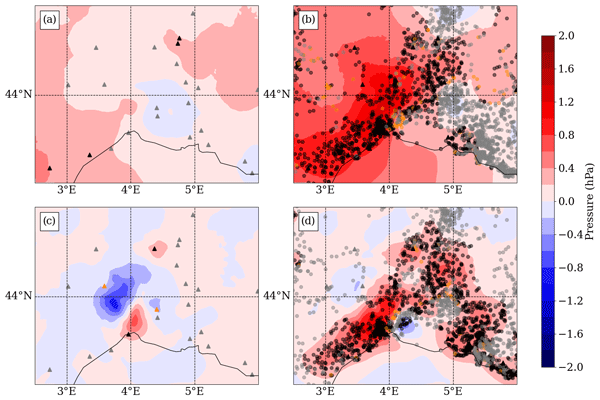
Alan Demortier, Marc Mandement, Vivien Pourret, and Olivier Caumont
Nat. Hazards Earth Syst. Sci., 24, 907–927, https://doi.org/10.5194/nhess-24-907-2024, https://doi.org/10.5194/nhess-24-907-2024, 2024
Short summary
Short summary
Improvements in numerical weather prediction models make it possible to warn of hazardous weather situations. The incorporation of new observations from personal weather stations into the French limited-area model is evaluated. It leads to a significant improvement in the modelling of the surface pressure field up to 9 h ahead. Their incorporation improves the location and intensity of the heavy precipitation event that occurred in the South of France in September 2021.
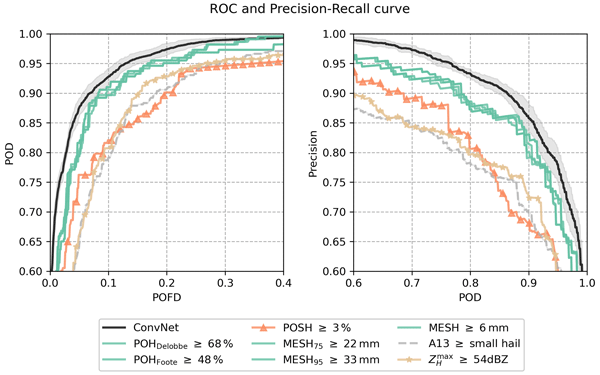
Vincent Forcadell, Clotilde Augros, Olivier Caumont, Kévin Dedieu, Maxandre Ouradou, Cloé David, Jordi Figueras i Ventura, Olivier Laurantin, and Hassan Al-Sakka
Atmos. Meas. Tech., 17, 6707–6734, https://doi.org/10.5194/amt-17-6707-2024, https://doi.org/10.5194/amt-17-6707-2024, 2024
Short summary
Short summary
This study demonstrates the potential of enhancing severe-hail detection through the application of convolutional neural networks (CNNs) to dual-polarization radar data. It is shown that current methods can be calibrated to significantly enhance their performance for severe-hail detection. This study establishes the foundation for the solution of a more complex problem: the estimation of the maximum size of hailstones on the ground using deep learning applied to radar data.
Alan Demortier, Marc Mandement, Vivien Pourret, and Olivier Caumont
Nat. Hazards Earth Syst. Sci., 24, 907–927, https://doi.org/10.5194/nhess-24-907-2024, https://doi.org/10.5194/nhess-24-907-2024, 2024
Short summary
Short summary
Improvements in numerical weather prediction models make it possible to warn of hazardous weather situations. The incorporation of new observations from personal weather stations into the French limited-area model is evaluated. It leads to a significant improvement in the modelling of the surface pressure field up to 9 h ahead. Their incorporation improves the location and intensity of the heavy precipitation event that occurred in the South of France in September 2021.
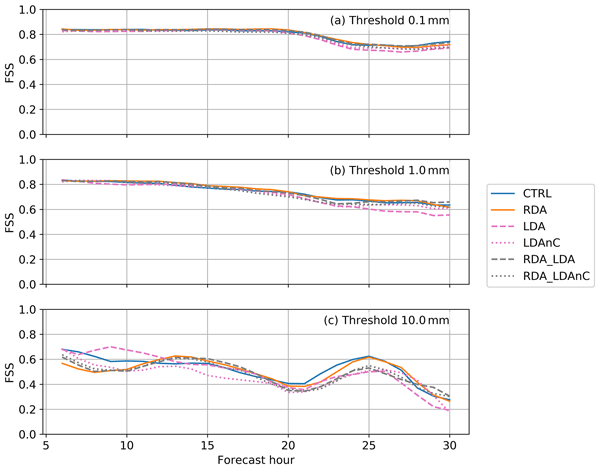
Felix Erdmann, Olivier Caumont, and Eric Defer
Nat. Hazards Earth Syst. Sci., 23, 2821–2840, https://doi.org/10.5194/nhess-23-2821-2023, https://doi.org/10.5194/nhess-23-2821-2023, 2023
Short summary
Short summary
This work develops a novel lightning data assimilation (LDA) technique to make use of Meteosat Third Generation (MTG) Lightning Imager (LI) data in a regional, convection-permitting numerical weather prediction model. The approach combines statistical Bayesian and 3-dimensional variational methods. Our LDA can promote missing convection and suppress spurious convection in the initial state of the model, and it has similar skill to the operational radar data assimilation for rainfall forecasts.
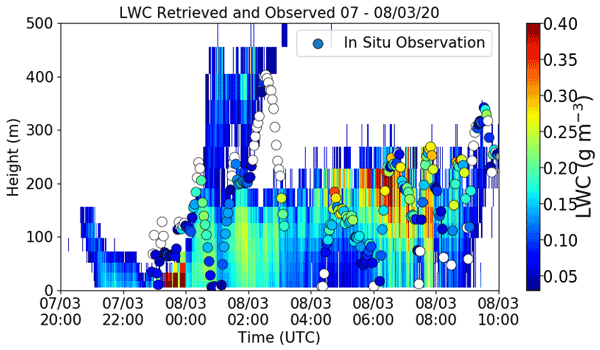
Alistair Bell, Pauline Martinet, Olivier Caumont, Frédéric Burnet, Julien Delanoë, Susana Jorquera, Yann Seity, and Vinciane Unger
Atmos. Meas. Tech., 15, 5415–5438, https://doi.org/10.5194/amt-15-5415-2022, https://doi.org/10.5194/amt-15-5415-2022, 2022
Short summary
Short summary
Cloud radars and microwave radiometers offer the potential to improve fog forecasts when assimilated into a high-resolution model. As this process can be complex, a retrieval of model variables is sometimes made as a first step. In this work, results from a 1D-Var algorithm for the retrieval of temperature, humidity and cloud liquid water content are presented. The algorithm is applied first to a synthetic dataset and then to a dataset of real measurements from a recent field campaign.
Pauline Combarnous, Felix Erdmann, Olivier Caumont, Éric Defer, and Maud Martet
Nat. Hazards Earth Syst. Sci., 22, 2943–2962, https://doi.org/10.5194/nhess-22-2943-2022, https://doi.org/10.5194/nhess-22-2943-2022, 2022
Short summary
Short summary
The objective of this study is to prepare the assimilation of satellite lightning data in the French regional numerical weather prediction system. The assimilation of lightning data requires an observation operator, based on empirical relationships between the lightning observations and a set of proxies derived from the numerical weather prediction system variables. We fit machine learning regression models to our data to yield those relationships and to investigate the best proxy for lightning.
Cited articles
Båserud, L., Lussana, C., Nipen, T. N., Seierstad, I. A., Oram, L., and Aspelien, T.: TITAN automatic spatial quality control of meteorological in-situ observations, Adv. Sci. Res., 17, 153–163, https://doi.org/10.5194/asr-17-153-2020, 2020. a, b, c
Beele, E., Reyniers, M., Aerts, R., and Somers, B.: Quality control and correction method for air temperature data from a citizen science weather station network in Leuven, Belgium, Earth Syst. Sci. Data, 14, 4681–4717, https://doi.org/10.5194/essd-14-4681-2022, 2022. a, b
Bell, A., Martinet, P., Caumont, O., Burnet, F., Delanoë, J., Jorquera, S., Seity, Y., and Unger, V.: An optimal estimation algorithm for the retrieval of fog and low cloud thermodynamic and micro-physical properties, Atmos. Meas. Tech., 15, 5415–5438, https://doi.org/10.5194/amt-15-5415-2022, 2022. a
Bell, S., Cornford, D., and Bastin, L.: How good are citizen weather stations? Addressing a biased opinion, Weather, 70, 75–84, https://doi.org/10.1002/wea.2316, 2015. a, b
Brousseau, P., Desroziers, G., Bouttier, F., and Chapnik, B.: A posteriori diagnostics of the impact of observations on the AROME-France convective-scale data assimilation system, Q. J. Roy. Meteor. Soc., 140, 982–994, https://doi.org/10.1002/qj.2179, 2014. a
Brousseau, P., Seity, Y., Ricard, D., and Léger, J.: Improvement of the forecast of convective activity from the AROME-France system, Q. J. Roy. Meteor. Soc., 142, 2231–2243, https://doi.org/10.1002/qj.2822, 2016. a, b
Büchau, Y. G.: Modelling Shielded Temperature Sensors: an Assessment of the Netatmo Citizen Weather Station, MSc Thesis, University of Hamburg, https://bis-erdsystem.de/fileadmin/user_upload/bise/Texte/MSC_Met_61-20180313.pdf (last access: 15 April 2024), 2018. a
Cardinali, C., Andersson, E., Viterbo, P., Thépaut, J.-N., and Vasiljevic, D.: Use of conventional surface observations in three-dimensional variational assimilation, ECMWF Technical Memoranda, p. 31, https://doi.org/10.21957/p6p470k5x, 1994. a
Caumont, O., Cimini, D., Löhnert, U., Alados-Arboledas, L., Bleisch, R., Buffa, F., Ferrario, M. E., Haefele, A., Huet, T., Madonna, F., and Pace, G.: Assimilation of humidity and temperature observations retrieved from ground-based microwave radiometers into a convective-scale NWP model, Q. J. Roy. Meteor. Soc., 142, 2692–2704, https://doi.org/10.1002/qj.2860, 2016. a
Clark, M. R., Webb, J. D. C., and Kirk, P. J.: Fine-scale analysis of a severe hailstorm using crowd-sourced and conventional observations, Meteorol. Appl., 25, 472–492, https://doi.org/10.1002/met.1715, 2018. a, b
Coney, J., Pickering, B., Dufton, D., Lukach, M., Brooks, B., and Neely III, R. R.: How useful are crowdsourced air temperature observations? An assessment of Netatmo stations and quality control schemes over the United Kingdom, Meteorol. Appl., 29, e2075, https://doi.org/10.1002/met.2075, 2022. a
Cornes, R. C., Dirksen, M., and Sluiter, R.: Correcting citizen-science air temperature measurements across the Netherlands for short wave radiation bias, Meteorol. Appl., 27, e1814, https://doi.org/10.1002/met.1814, 2019. a
Courtier, P., Andersson, E., Heckley, W., Vasiljevic, D., Hamrud, M., Hollingsworth, A., Rabier, F., Fisher, M., and Pailleux, J.: The ECMWF implementation of three-dimensional variational assimilation (3D-Var). I: Formulation, Q. J. Roy. Meteor. Soc., 124, 1783–1807, https://doi.org/10.1002/qj.49712455002, 1998. a
Demortier, A., Mandement, M., Pourret, V., and Caumont, O.: Assimilation of surface pressure observations from personal weather stations in AROME-France, Nat. Hazards Earth Syst. Sci., 24, 907–927, https://doi.org/10.5194/nhess-24-907-2024, 2024. a
Derrien, M. and Le Gléau, H.: Improvement of cloud detection near sunrise and sunset by temporal-differencing and region-growing techniques with real-time SEVIRI, Int. J. Remote Sens., 31, 1765–1780, https://doi.org/10.1080/01431160902926632, 2010. a
Desroziers, G., Berre, L., Chapnik, B., and Poli, P.: Diagnosis of observation, background and analysis-error statistics in observation space, Q. J. Roy. Meteor. Soc., 131, 3385–3396, https://doi.org/10.1256/qj.05.108, 2005. a
Dumas, G., Masson, V., Hidalgo, J., Edouart, V., Hanna, A., and Poujol, G.: Co-construction of climate services based on a weather stations network: Application in Toulouse agglomeration local authority, Climate Services, 24, 100274, https://doi.org/10.1016/j.cliser.2021.100274, 2021. a
ECMWF: IFS Documentation CY48R1 – Part I: Observations, chap. 1, ECMWF, https://www.ecmwf.int/en/elibrary/81367-ifs-documentation-cy48r1-part-i-observations (last access: 17 January 2025), 2023. a
EUMETSAT: Hourly Surface Solar Irradiance (netCDF) – MSG, https://user.eumetsat.int/catalogue/EO:EUM:DAT:MSG:OSI-304-H/overview (last access: 31 March 2024), 2017. a
EUMETSAT: EUMETSAT Data Services: Rapid Scan High Rate SEVIRI Level 1.5 Image Data – MSG, https://data.eumetsat.int/data/map/EO:EUM:DAT:MSG:MSG15-RSS (last access: 15 April 2024), 2024. a
Feichtinger, M., de Wit, R., Goldenits, G., Kolejka, T., Hollósi, B., Žuvela-Aloise, M., and Feigl, J.: Case-study of neighborhood-scale summertime urban air temperature for the City of Vienna using crowd-sourced data, Urban Climate, 32, 100597, https://doi.org/10.1016/j.uclim.2020.100597, 2020. a
Fenner, D., Bechtel, B., Demuzere, M., Kittner, J., and Meier, F.: CrowdQC+ – A Quality-Control for Crowdsourced Air-Temperature Observations Enabling World-Wide Urban Climate Applications, Frontiers in Environmental Science, 9, 720747, https://doi.org/10.3389/fenvs.2021.720747, 2021. a, b, c
Flamant, C., Chazette, P., Caumont, O., Di Girolamo, P., Behrendt, A., Sicard, M., Totems, J., Lange, D., Fourrié, N., Brousseau, P., Augros, C., Baron, A., Cacciani, M., Comerón, A., De Rosa, B., Ducrocq, V., Genau, P., Labatut, L., Muñoz-Porcar, C., Rodríguez-Gómez, A., Summa, D., Thundathil, R., and Wulfmeyer, V.: A network of water vapor Raman lidars for improving heavy precipitation forecasting in southern France: introducing the WaLiNeAs initiative, Bulletin of Atmospheric Science and Technology, 2, 1–10, https://doi.org/10.1007/s42865-021-00037-6, 2021. a
Garcelon, L., Brana, S., Didez, J., and Ameye, F.: StatIC : un réseau d'observation au service d'une information de proximité et de vulgarisation scientifique, La Météorologie, 122, 37–46, https://doi.org/10.37053/lameteorologie-2023-0071, 2023. a, b
Giard, D. and Bazile, E.: Implementation of a New Assimilation Scheme for Soil and Surface Variables in a Global NWP Model, Mon. Weather Rev., 128, 997–1015, https://doi.org/10.1175/1520-0493(2000)128<0997:IOANAS>2.0.CO;2, 2000. a
Gouttevin, I., Vionnet, V., Seity, Y., Boone, A., Lafaysse, M., Deliot, Y., and Merzisen, H.: To the Origin of a Wintertime Screen-Level Temperature Bias at High Altitude in a Kilometric NWP Model, J. Hydrometeorol., 24, 53–71, https://doi.org/10.1175/JHM-D-21-0200.1, 2023. a
Guillet, O., Weaver, A. T., Vasseur, X., Michel, Y., Gratton, S., and Gürol, S.: Modelling spatially correlated observation errors in variational data assimilation using a diffusion operator on an unstructured mesh, Q. J. Roy. Meteor. Soc., 145, 1947–1967, 2019. a
Gustafsson, N., Janjić, T., Schraff, C., Leuenberger, D., Weissmann, M., Reich, H., Brousseau, P., Montmerle, T., Wattrelot, E., Bučánek, A., Mile, M., Hamdi, R., Lindskog, M., Barkmeijer, J., Dahlbom, M., Macpherson, B., Ballard, S., Inverarity, G., Carley, J., Alexander, C., Dowell, D., Liu, S., Ikuta, Y., and Fujita, T.: Survey of data assimilation methods for convective-scale numerical weather prediction at operational centres, Q. J. Roy. Meteor. Soc., 144, 1218–1256, https://doi.org/10.1002/qj.3179, 2018. a
Hintz, K. S., Vedel, H., and Kaas, E.: Collecting and processing of barometric data from smartphones for potential use in numerical weather prediction data assimilation, Meteorol. Appl., 26, 733–746, https://doi.org/10.1002/met.1805, 2019. a
Infoclimat: Open data – données météo – Infoclimat, https://www.infoclimat.fr/opendata/ (last access: 16 April 2024), 2024. a
Leroy, M.: Note technique N° 35B : Classification d’un site, https://www.infoclimat.fr/stations/DSO_35B.pdf (last access: 17 January 2025), 2014. a
Li, J. and Shibata, K.: On the Effective Solar Pathlength, J. Atmos. Sci., 63, 1365–1373, https://doi.org/10.1175/JAS3682.1, 2006. a
Marquès, E.: Étude à fine échelle de l'îlot de chaleur urbain par modélisation bayésienne à partir de données opportunes, PhD thesis, Institut National Polytechnique de Toulouse, http://www.theses.fr/2023INPT0016 (last access: 17 January 2025), 2023. a
Masson, V., Le Moigne, P., Martin, E., Faroux, S., Alias, A., Alkama, R., Belamari, S., Barbu, A., Boone, A., Bouyssel, F., Brousseau, P., Brun, E., Calvet, J.-C., Carrer, D., Decharme, B., Delire, C., Donier, S., Essaouini, K., Gibelin, A.-L., Giordani, H., Habets, F., Jidane, M., Kerdraon, G., Kourzeneva, E., Lafaysse, M., Lafont, S., Lebeaupin Brossier, C., Lemonsu, A., Mahfouf, J.-F., Marguinaud, P., Mokhtari, M., Morin, S., Pigeon, G., Salgado, R., Seity, Y., Taillefer, F., Tanguy, G., Tulet, P., Vincendon, B., Vionnet, V., and Voldoire, A.: The SURFEXv7.2 land and ocean surface platform for coupled or offline simulation of earth surface variables and fluxes, Geosci. Model Dev., 6, 929–960, https://doi.org/10.5194/gmd-6-929-2013, 2013. a
Meier, F., Fenner, D., Grassmann, T., Otto, M., and Scherer, D.: Crowdsourcing air temperature from citizen weather stations for urban climate research, Urban Climate, 19, 170–191, https://doi.org/10.1016/j.uclim.2017.01.006, 2017. a
Michel, Y. and Brousseau, P.: A Square-Root, Dual-Resolution 3DEnVar for the AROME Model: Formulation and Evaluation on a Summertime Convective Period, Mon. Weather Rev., 149, 3135–3153, https://doi.org/10.1175/MWR-D-21-0026.1, 2021. a
Montmerle, T., Michel, Y., Arbogast, E., Ménétrier, B., and Brousseau, P.: A 3D ensemble variational data assimilation scheme for the limited-area AROME model: Formulation and preliminary results, Q. J. Roy. Meteor. Soc., 144, 2196–2215, https://doi.org/10.1002/qj.3334, 2018. a
Météo-France: Données de modèle AROME, https://donneespubliques.meteofrance.fr/?fond=produit&id_produit=131&id_rubrique=51 (last access: 5 April 2024), 2024a. a
Météo-France: Observations du réseau sol de France, https://donneespubliques.meteofrance.fr/?fond=produit&id_produit=93&id_rubrique=32 (last access: 5 April 2024), 2024b. a
Météo-France: Observations en mer (messages SHIP, BUOY), https://donneespubliques.meteofrance.fr/?fond=produit&id_produit=95&id_rubrique=32 (last access: 5 April 2024), 2024c. a
Météo-France: Données SYNOP essentielles OMM, https://donneespubliques.meteofrance.fr/?fond=produit&id_produit=90&id_rubrique=32 (last access: 5 April 2024), 2024d. a
Netatmo: Weather API Documentation, https://dev.netatmo.com/apidocumentation/weather (last access: 5 April 2024), 2024. a
Netatmo: Netatmo Connect APIs Terms of Use!, https://dev.netatmo.com/legal (last access: 17 January 2025), 2025. a
Nipen, T. N., Seierstad, I. A., Lussana, C., Kristiansen, J., and Hov, Ø.: Adopting Citizen Observations in Operational Weather Prediction, B. Am. Meteorol. Soc., 101, E43–E57, https://doi.org/10.1175/BAMS-D-18-0237.1, 2020. a, b, c
Orlanski, I.: A Rational Subdivision of Scales for Atmospheric Processes, B. Am. Meteorol. Soc., 56, 527–530, https://doi.org/10.1175/1520-0477-56.5.527, 1975. a
Pergaud, J., Masson, V., Malardel, S., and Couvreux, F.: A Parameterization of Dry Thermals and Shallow Cumuli for Mesoscale Numerical Weather Prediction., Bound.-Lay. Meteorol., 132, 83–106, https://doi.org/10.1007/s10546-009-9388-0, 2009. a
Potgieter, J., Nazarian, N., Lipson, M. J., Hart, M. A., Ulpiani, G., Morrison, W., and Benjamin, K.: Combining High-Resolution Land Use Data With Crowdsourced Air Temperature to Investigate Intra-Urban Microclimate, Frontiers in Environmental Science, 9, 720323, https://doi.org/10.3389/fenvs.2021.720323, 2021. a
Pourret, V., Šavli, M., Mahfouf, J.-F., Raspaud, D., Doerenbecher, A., Bénichou, H., and Payan, C.: Operational assimilation of Aeolus winds in the Météo-France global NWP model ARPEGE, Q. J. Roy. Meteor. Soc., 148, 2652–2671, https://doi.org/10.1002/qj.4329, 2022. a, b
Sassi, M. Z., Fourrié, N., Guidard, V., and Birman, C.: Use of Infrared Satellite Observations for the Surface Temperature Retrieval over Land in a NWP Context, Remote Sensing, 11, 2371, https://doi.org/10.3390/rs11202371, 2019. a, b
Schmetz, J., Pili, P., Tjemkes, S., Just, D., Kerkmann, J., Rota, S., and Ratier, A.: An Introduction to Meteosat Second Generation (MSG), B. Am. Meteor. Soc., 83, 977–992, https://doi.org/10.1175/1520-0477(2002)083<0977:AITMSG>2.3.CO;2, 2002. a
Seity, Y., Brousseau, P., Malardel, S., Hello, G., Bénard, P., Bouttier, F., Lac, C., and Masson, V.: The AROME-France Convective-Scale Operational Model, Mon. Weather Rev., 139, 976–991, https://doi.org/10.1175/2010MWR3425.1, 2011. a, b
Sgoff, C., Acevedo, W., Paschalidi, Z., Ulbrich, S., Bauernschubert, E., Kratzsch, T., and Potthast, R.: Assimilation of crowd-sourced surface observations over Germany in a regional weather prediction system, Q. J. Roy. Meteor. Soc., 148, 1752–1767, https://doi.org/10.1002/qj.4276, 2022. a, b, c, d, e, f, g, h, i, j
Stoffelen, A.: Toward the true near-surface wind speed: Error modeling and calibration using triple collocation, J. Geophys. Res.-Oceans, 103, 7755–7766, https://doi.org/10.1029/97JC03180, 1998. a
Stull, R. B.: Mean Boundary Layer Characteristics, Springer Netherlands, Dordrecht, 1–27, ISBN 978-94-009-3027-8, https://doi.org/10.1007/978-94-009-3027-8_1, 1988. a
Toulouse Métropole: Portail d'ouverture des données publiques de Toulouse Métropole – Open Data Toulouse Métropole, https://data.toulouse-metropole.fr/explore/?sort=modified&refine.keyword=m% C3% A9t% C3% A9o (last access: 16 April 2024), 2024. a
Varentsov, M. I., Konstantinov, P. I., Shartova, N. V., Samsonov, T. E., Kargashin, P. E., Varentsov, A. I., Fenner, D., and Meier, F.: Urban heat island of the Moscow megacity: the long-term trends and new approaches for monitoring and research based on crowdsourcing data, IOP Conf. Ser. Earth Environ., 606, 012063, https://doi.org/10.1088/1755-1315/606/1/012063, 2020. a, b
Vasiljevic, D., Cardinali, C., and Undén, P.: ECMWF 3D variational data assimilation of conventional observations, in: Workshop on variational assimilation, with special emphasis on three-dimensional Aspects, 9–12 November 1992, ECMWF, Shinfield Park, Reading, 389–436, https://www.ecmwf.int/sites/default/files/elibrary/1992/76806-ecmwf-3d-variational-data-assimilation-conventional-observations_0.pdf (last access: 17 January 2025), 1992. a
Venter, Z. S., Brousse, O., Esau, I., and Meier, F.: Hyperlocal mapping of urban air temperature using remote sensing and crowdsourced weather data, Remote Sens. Environ., 242, 111791, https://doi.org/10.1016/j.rse.2020.111791, 2020. a
Virtanen, P., Gommers, R., Oliphant, T. E., Haberland, M., Reddy, T., Cournapeau, D., Burovski, E., Peterson, P., Weckesser, W., Bright, J., van der Walt, S. J., Brett, M., Wilson, J., Millman, K. J., Mayorov, N., Nelson, A. R. J., Jones, E., Kern, R., Larson, E., Carey, C. J., Polat, İ., Feng, Y., Moore, E. W., VanderPlas, J., Laxalde, D., Perktold, J., Cimrman, R., Henriksen, I., Quintero, E. A., Harris, C. R., Archibald, A. M., Ribeiro, A. H., Pedregosa, F., van Mulbregt, P., and SciPy 1.0 Contributors: SciPy 1.0: Fundamental Algorithms for Scientific Computing in Python, Nat. Meth., 17, 261–272, https://doi.org/10.1038/s41592-019-0686-2, 2020. a
Vural, J., Merker, C., Löffler, M., Leuenberger, D., Schraff, C., Stiller, O., Schomburg, A., Knist, C., Haefele, A., and Hervo, M.: Improving the representation of the atmospheric boundary layer by direct assimilation of ground-based microwave radiometer observations, Q. J. Roy. Meteor. Soc., 150, 1012–1028, https://doi.org/10.1002/qj.4634, 2024. a
World Meteorological Organization: Guide to Instruments and Methods of Observation, Volume I – Measurement of Meteorological Variables (WMO-No. 8), World Meteorological Organization, ISBN 9789263100085, https://library.wmo.int/idurl/4/68695 (last access: 17 January 2025), 2023. a
Zumwald, M., Knüsel, B., Bresch, D. N., and Knutti, R.: Mapping urban temperature using crowd-sensing data and machine learning, Urban Climate, 35, 100739, https://doi.org/10.1016/j.uclim.2020.100739, 2021. a
Short summary
The use of numerical weather prediction models enables the forecasting of hazardous weather situations. The incorporation of new temperature and relative humidity observations from personal weather stations into the French limited-area model is evaluated in this study. This leads to the improvement of the associated near-surface variables of the model during the first hours of the forecast. Examples are provided for a sea breeze case during a heatwave and a fog episode.
The use of numerical weather prediction models enables the forecasting of hazardous weather...


Altmetrics
Final-revised paper
Preprint