
Articles | Volume 25, issue 1
https://doi.org/10.5194/nhess-25-335-2025
© Author(s) 2025. This work is distributed under
the Creative Commons Attribution 4.0 License.
the Creative Commons Attribution 4.0 License.
https://doi.org/10.5194/nhess-25-335-2025
© Author(s) 2025. This work is distributed under
the Creative Commons Attribution 4.0 License.
the Creative Commons Attribution 4.0 License.
Research article
| 
23 Jan 2025
Research article |
| 23 Jan 2025
| 23 Jan 2025
Multi-scale hydraulic graph neural networks for flood modelling
Roberto Bentivoglio
CORRESPONDING AUTHOR

Department of Water Management, Faculty of Civil Engineering and Geosciences, Delft University of Technology, Delft, the Netherlands
Elvin Isufi
Department of Intelligent Systems, Faculty of Electrical Engineering, Mathematics and Computer Science, Delft University of Technology, Delft, the Netherlands
Sebastiaan Nicolas Jonkman
Department of Hydraulic Engineering, Faculty of Civil Engineering and Geosciences, Delft University of Technology, Delft, the Netherlands
Riccardo Taormina
Department of Water Management, Faculty of Civil Engineering and Geosciences, Delft University of Technology, Delft, the Netherlands
Related authors
Roberto Bentivoglio, Sebastiaan Nicolas Jonkman, Elvin Isufi, and Riccardo Taormina
Nat. Hazards Earth Syst. Sci., 26, 2089–2109, https://doi.org/10.5194/nhess-26-2089-2026, https://doi.org/10.5194/nhess-26-2089-2026, 2026
Short summary
Short summary
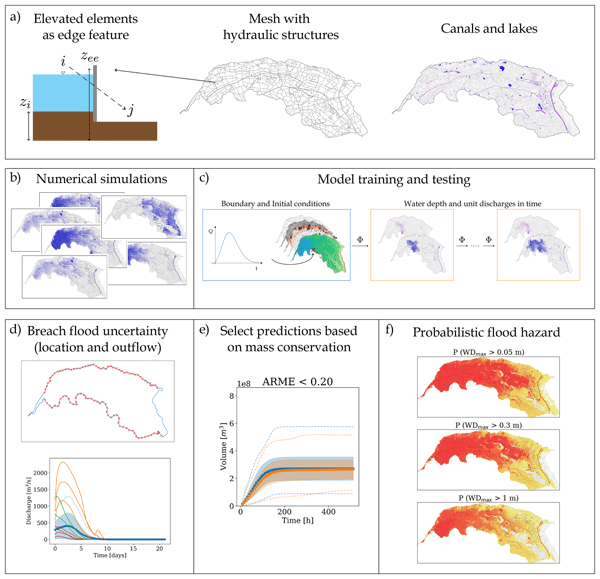
Obtaining probabilistic flood maps with numerical models is very time-consuming. Deep learning models can speed this up, but their predictions are difficult to verify without reference data, and they ignore structures like dikes or canals. This work introduces a mass-based validation measure to assess prediction plausibility and adapts a graph-based model to include hydraulic structures, enabling realistic, large-scale probabilistic flood mapping in the Netherlands.
Roberto Bentivoglio, Elvin Isufi, Sebastiaan Nicolas Jonkman, and Riccardo Taormina
Hydrol. Earth Syst. Sci., 27, 4227–4246, https://doi.org/10.5194/hess-27-4227-2023, https://doi.org/10.5194/hess-27-4227-2023, 2023
Short summary
Short summary
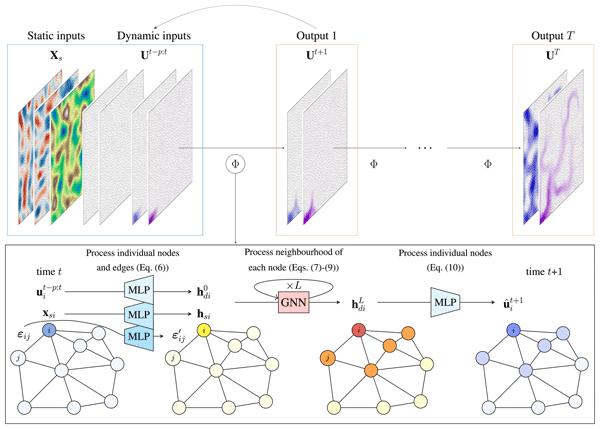
To overcome the computational cost of numerical models, we propose a deep-learning approach inspired by hydraulic models that can simulate the spatio-temporal evolution of floods. We show that the model can rapidly predict dike breach floods over different topographies and breach locations, with limited use of ground-truth data.
Roberto Bentivoglio, Elvin Isufi, Sebastian Nicolaas Jonkman, and Riccardo Taormina
Hydrol. Earth Syst. Sci., 26, 4345–4378, https://doi.org/10.5194/hess-26-4345-2022, https://doi.org/10.5194/hess-26-4345-2022, 2022
Short summary
Short summary
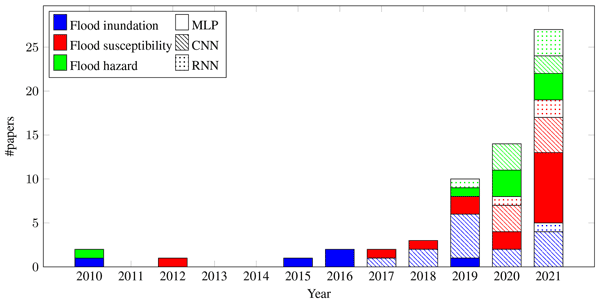
Deep learning methods have been increasingly used in flood management to improve traditional techniques. While promising results have been obtained, our review shows significant challenges in building deep learning models that can (i) generalize across multiple scenarios, (ii) account for complex interactions, and (iii) perform probabilistic predictions. We argue that these shortcomings could be addressed by transferring recent fundamental advancements in deep learning to flood mapping.
Roberto Bentivoglio, Elvin Isufi, Sebastian Nicolaas Jonkman, and Riccardo Taormina
Hydrol. Earth Syst. Sci. Discuss., https://doi.org/10.5194/hess-2021-614, https://doi.org/10.5194/hess-2021-614, 2021
Manuscript not accepted for further review
Short summary
Short summary
Deep Learning methods have been increasingly used in flood mapping as an alternative to traditional modeling techniques. While promising results have been obtained, our review shows significant challenges in building Deep Learning models that can generalize across multiple scenarios, account for complex interactions, and provide probabilistic predictions. We argue that these shortcomings could be addressed by transferring recent fundamental advancements in Deep Learning.
Jérôme Enagnon Ahouandjinou, Aymar Yaovi Bossa, Jean Hounkpè, and Riccardo Taormina
EGUsphere, https://doi.org/10.5194/egusphere-2026-4749, https://doi.org/10.5194/egusphere-2026-4749, 2026
Short summary
Short summary
Floods threaten many West African communities, yet the river data needed to predict them are scarce. We taught a computer model to forecast river flow in Benin by first learning from thousands of rivers worldwide, then adapting it locally. We found that choosing rivers with a similar climate matters more than using many rivers. This offers a low-cost way to improve flood warnings where local measurements are limited.
Roberto Bentivoglio, Sebastiaan Nicolas Jonkman, Elvin Isufi, and Riccardo Taormina
Nat. Hazards Earth Syst. Sci., 26, 2089–2109, https://doi.org/10.5194/nhess-26-2089-2026, https://doi.org/10.5194/nhess-26-2089-2026, 2026
Short summary
Short summary
Obtaining probabilistic flood maps with numerical models is very time-consuming. Deep learning models can speed this up, but their predictions are difficult to verify without reference data, and they ignore structures like dikes or canals. This work introduces a mass-based validation measure to assess prediction plausibility and adapts a graph-based model to include hydraulic structures, enabling realistic, large-scale probabilistic flood mapping in the Netherlands.
Laurie van Gijzen, Alexander M. Bakker, and Sebastiaan N. Jonkman
EGUsphere, https://doi.org/10.5194/egusphere-2025-5801, https://doi.org/10.5194/egusphere-2025-5801, 2025
Preprint archived
Short summary
Short summary
Future sea level rise will likely challenge many low-lying deltas in the world. A possible mitigation strategy discharging the incoming river discharge with large pump-sluice stations. In this study we determine the required pump and sluice capacity by including the new concept of operational discharge capacity. We found that including operational discharge capacity led to an significant increase in flood frequency, making it crucial to account for in the design of pump-sluice stations.
Nienke Tempel, Laurène Bouaziz, Riccardo Taormina, Ellis van Noppen, Jasper Stam, Eric Sprokkereef, and Markus Hrachowitz
Hydrol. Earth Syst. Sci., 28, 4577–4597, https://doi.org/10.5194/hess-28-4577-2024, https://doi.org/10.5194/hess-28-4577-2024, 2024
Short summary
Short summary
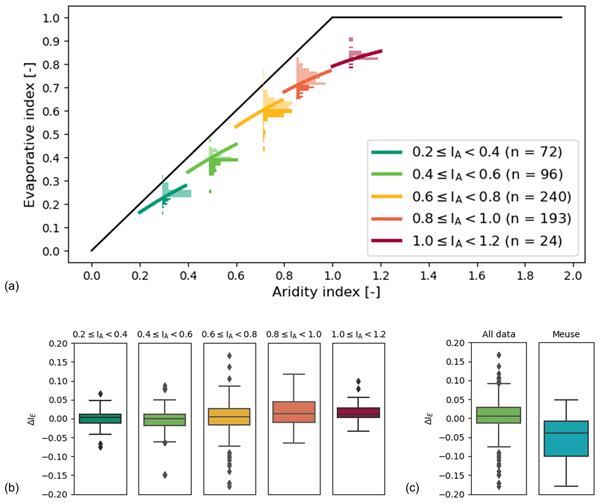
This study explores the impact of climatic variability on root zone water storage capacities and, thus, on hydrological predictions. Analysing data from 286 areas in Europe and the US, we found that, despite some variations in root zone storage capacity due to changing climatic conditions over multiple decades, these changes are generally minor and have a limited effect on water storage and river flow predictions.
Tim Hans Martin van Emmerik, Tim Willem Janssen, Tianlong Jia, Thank-Khiet L. Bui, Riccardo Taormina, Hong-Q. Nguyen, and Louise Jeanne Schreyers
EGUsphere, https://doi.org/10.5194/egusphere-2024-2270, https://doi.org/10.5194/egusphere-2024-2270, 2024
Preprint archived
Short summary
Short summary
Plastic pollution has negative effects on the environment. Tropical rivers around the world suffer from both plastic pollution and invasive water hyacinths. Water hyacinths grow rapidly and form dense floating mats. Using drones, cameras and AI, we show that along the Saigon river, Vietnam, the majority of floating plastic pollution is carried by water hyacinths. Better understanding water hyacinth-plastic trapping supports improving pollution monitoring and management strategies.
Hanqing Xu, Elisa Ragno, Sebastiaan N. Jonkman, Jun Wang, Jeremy D. Bricker, Zhan Tian, and Laixiang Sun
Hydrol. Earth Syst. Sci., 28, 3919–3930, https://doi.org/10.5194/hess-28-3919-2024, https://doi.org/10.5194/hess-28-3919-2024, 2024
Short summary
Short summary
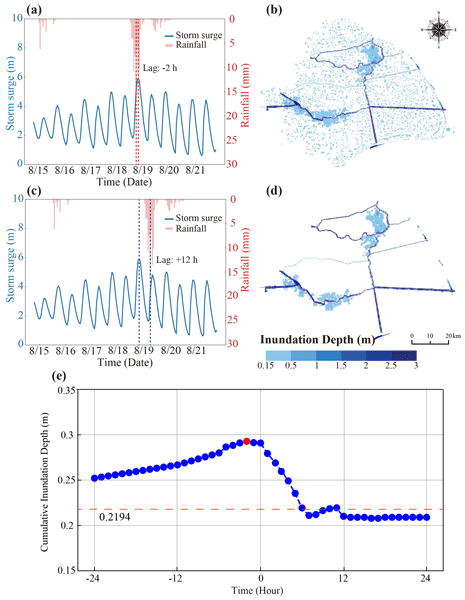
A coupled statistical–hydrodynamic model framework is employed to quantitatively evaluate the sensitivity of compound flood hazards to the relative timing of peak storm surges and rainfall. The findings reveal that the timing difference between these two factors significantly affects flood inundation depth and extent. The most severe inundation occurs when rainfall precedes the storm surge peak by 2 h.
Roberto Bentivoglio, Elvin Isufi, Sebastiaan Nicolas Jonkman, and Riccardo Taormina
Hydrol. Earth Syst. Sci., 27, 4227–4246, https://doi.org/10.5194/hess-27-4227-2023, https://doi.org/10.5194/hess-27-4227-2023, 2023
Short summary
Short summary
To overcome the computational cost of numerical models, we propose a deep-learning approach inspired by hydraulic models that can simulate the spatio-temporal evolution of floods. We show that the model can rapidly predict dike breach floods over different topographies and breach locations, with limited use of ground-truth data.
Roberto Bentivoglio, Elvin Isufi, Sebastian Nicolaas Jonkman, and Riccardo Taormina
Hydrol. Earth Syst. Sci., 26, 4345–4378, https://doi.org/10.5194/hess-26-4345-2022, https://doi.org/10.5194/hess-26-4345-2022, 2022
Short summary
Short summary
Deep learning methods have been increasingly used in flood management to improve traditional techniques. While promising results have been obtained, our review shows significant challenges in building deep learning models that can (i) generalize across multiple scenarios, (ii) account for complex interactions, and (iii) perform probabilistic predictions. We argue that these shortcomings could be addressed by transferring recent fundamental advancements in deep learning to flood mapping.

Julius Schlumberger, Christian Ferrarin, Sebastiaan N. Jonkman, Manuel Andres Diaz Loaiza, Alessandro Antonini, and Sandra Fatorić
Nat. Hazards Earth Syst. Sci., 22, 2381–2400, https://doi.org/10.5194/nhess-22-2381-2022, https://doi.org/10.5194/nhess-22-2381-2022, 2022
Short summary
Short summary
Flooding has serious impacts on the old town of Venice. This paper presents a framework combining a flood model with a flood-impact model to support improving protection against future floods in Venice despite the recently built MOSE barrier. Applying the framework to seven plausible flood scenarios, it was found that individual protection has a significant damage-mediating effect if the MOSE barrier does not operate as anticipated. Contingency planning thus remains important in Venice.
Manuel Andres Diaz Loaiza, Jeremy D. Bricker, Remi Meynadier, Trang Minh Duong, Rosh Ranasinghe, and Sebastiaan N. Jonkman
Nat. Hazards Earth Syst. Sci., 22, 345–360, https://doi.org/10.5194/nhess-22-345-2022, https://doi.org/10.5194/nhess-22-345-2022, 2022
Short summary
Short summary
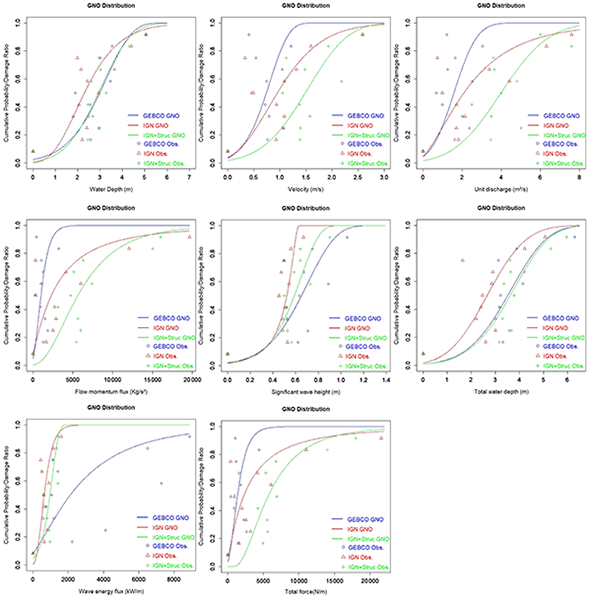
Extratropical cyclones are one of the major causes of coastal floods in Europe and the world. Understanding the development process and the flooding of storm Xynthia, together with the damages that occurred during the storm, can help to forecast future losses due to other similar storms. In the present paper, an analysis of shallow water variables (flood depth, velocity, etc.) or coastal variables (significant wave height, energy flux, etc.) is done in order to develop damage curves.
Christopher H. Lashley, Sebastiaan N. Jonkman, Jentsje van der Meer, Jeremy D. Bricker, and Vincent Vuik
Nat. Hazards Earth Syst. Sci., 22, 1–22, https://doi.org/10.5194/nhess-22-1-2022, https://doi.org/10.5194/nhess-22-1-2022, 2022
Short summary
Short summary
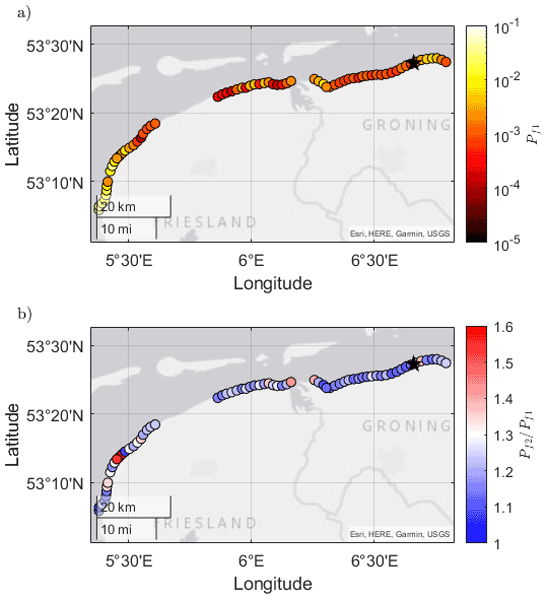
Many coastlines around the world have shallow foreshores (e.g. salt marshes and mudflats) that reduce storm waves and the risk of coastal flooding. However, most of the studies that tried to quantify this effect have excluded the influence of very long waves, which often dominate in shallow water. Our newly developed framework addresses this oversight and suggests that safety along these coastlines may be overestimated, since these very long waves are largely neglected in flood risk assessments.
Roberto Bentivoglio, Elvin Isufi, Sebastian Nicolaas Jonkman, and Riccardo Taormina
Hydrol. Earth Syst. Sci. Discuss., https://doi.org/10.5194/hess-2021-614, https://doi.org/10.5194/hess-2021-614, 2021
Manuscript not accepted for further review
Short summary
Short summary
Deep Learning methods have been increasingly used in flood mapping as an alternative to traditional modeling techniques. While promising results have been obtained, our review shows significant challenges in building Deep Learning models that can generalize across multiple scenarios, account for complex interactions, and provide probabilistic predictions. We argue that these shortcomings could be addressed by transferring recent fundamental advancements in Deep Learning.
Cited articles
Bentivoglio, R.: Raw datasets for paper “Multi-scale hydraulic graph neural networks for flood modelling”, Zenodo [data set], https://doi.org/10.5281/zenodo.13326595, 2024. a
Bentivoglio, R.: Code Repository for paper ”Multi-scale hydraulic graph neural networks for flood modelling”, GitHub [code], https://github.com/RBTV1/mSWE-GNN, last access: 28 November 2024. a
Bentivoglio, R.: RBTV1/mSWE-GNN: Published version (1.0), Zenodo [code], https://doi.org/10.5281/zenodo.14673842, 2025. a
Bentivoglio, R., Isufi, E., Jonkman, S. N., and Taormina, R.: Deep learning methods for flood mapping: a review of existing applications and future research directions, Hydrol. Earth Syst. Sci., 26, 4345–4378, https://doi.org/10.5194/hess-26-4345-2022, 2022. a
Berkhahn, S. and Neuweiler, I.: Data driven real-time prediction of urban floods with spatial and temporal distribution, J. Hydrol. X, 22, 100167, https://doi.org/10.1016/j.hydroa.2023.100167, 2024. a
Bhunya, P., Panda, S., and Goel, M.: Synthetic unit hydrograph methods: a critical review, The Open Hydrology Journal, 5, 1–8, https://doi.org/10.2174/1874378101105010001, 2011. a
Bomers, A., Mathias, R., Schielen, J., and Hulscher, S. J. M. H.: The influence of grid shape and grid size on hydraulic river modelling performance, Environ. Fluid Mech., 19, 1273–1294, https://doi.org/10.1007/s10652-019-09670-4, 2019. a
Boon, M. J. J. and Witteveen+Bos: Veiligheid Nederland in Kaart 2 Overstromingsrisico dijkring 15: Lopiker- en Krimpenerwaard, https://open.rijkswaterstaat.nl/open-overheid/@160853/veiligheid-nederland-kaart-2-4/ (last access: 20 November 2024), 2011. a
Bronstein, M. M., Bruna, J., Cohen, T., and Veličković, P.: Geometric deep learning: Grids, groups, graphs, geodesics, and gauges, arXiv [preprint], https://doi.org/10.48550/arXiv.2104.13478, 2021. a, b
Burrichter, B., Hofmann, J., Koltermann da Silva, J., Niemann, A., and Quirmbach, M.: A Spatiotemporal Deep Learning Approach for Urban Pluvial Flood Forecasting with Multi-Source Data, Water, 15, 1760, https://doi.org/10.3390/w15091760, 2023. a
Cache, T., Gomez, M. S., Beucler, T., Blagojevic, J., Leitao, J. P., and Peleg, N.: Enhancing generalizability of data-driven urban flood models by incorporating contextual information, Hydrol. Earth Syst. Sci., 28, 5443–5458, https://doi.org/10.5194/hess-28-5443-2024, 2024. a, b
Caviedes-Voullième, D., Morales-Hernández, M., Norman, M. R., and Özgen-Xian, I.: SERGHEI (SERGHEI-SWE) v1.0: a performance-portable high-performance parallel-computing shallow-water solver for hydrology and environmental hydraulics, Geosci. Model Dev., 16, 977–1008, https://doi.org/10.5194/gmd-16-977-2023, 2023. a
Delft High Performance Computing Centre (DHPC): DelftBlue Supercomputer (Phase 1), https://www.tudelft.nl/dhpc/ark:/44463/DelftBluePhase1 (last access: 20 November 2024), 2022. a
Deltares: MeshKernel, https://deltares.github.io/MeshKernel/ (last access: 20 November 2024), 2024. a
do Lago, C. A., Giacomoni, M. H., Bentivoglio, R., Taormina, R., Gomes, M. N., and Mendiondo, E. M.: Generalizing rapid flood predictions to unseen urban catchments with conditional generative adversarial networks, J. Hydrol., 618, 129276, https://doi.org/10.1016/j.jhydrol.2023.129276, 2023. a
do Lago, C., Brasil, J. A. T., Nóbrega Gomes, M., Mendiondo, E. M., and Giacomoni, M. H.: Improving pluvial flood mapping resolution of large coarse models with deep learning, Hydrolog. Sci. J., 69, 607–621, https://doi.org/10.1080/02626667.2024.2329268, 2024. a
D'Oria, M., Mignosa, P., Tanda, M. G., and Todaro, V.: Estimation of levee breach discharge hydrographs: comparison of inverse approaches, Hydrolog. Sci. J., 67, 54–64, https://doi.org/10.1080/02626667.2021.1996580, 2022. a
Fey, M. and Lenssen, J. E.: Fast graph representation learning with PyTorch Geometric, arXiv [preprint], https://doi.org/10.48550/arXiv.1903.02428, 2019. a
Fortunato, M., Pfaff, T., Wirnsberger, P., Pritzel, A., and Battaglia, P.: Multiscale meshgraphnets, 2nd AI4Science Workshop at the 39th International Conference on Machine Learning (ICML), arXiv [preprint], https://doi.org/10.48550/arXiv.2210.00612, 2022. a
Gao, H. and Ji, S.: Graph u-nets, in: international conference on machine learning, 2083–2092, PMLR, arXiv [preprint], https://doi.org/10.48550/arXiv.1905.05178, 2019. a
Garzón, A., Kapelan, Z., Langeveld, J., and Taormina, R.: Transferable and data efficient metamodeling of storm water system nodal depths using auto-regressive graph neural networks, Water Res., 266, 122396, https://doi.org/10.1016/j.watres.2024.122396, 2024. a
Guo, Z., Leitao, J. P., Simões, N. E., and Moosavi, V.: Data-driven flood emulation: Speeding up urban flood predictions by deep convolutional neural networks, J. Flood Risk Manag., 14, e12684, https://doi.org/10.1111/jfr3.12684, 2021. a
Guo, Z., Moosavi, V., and Leitão, J. P.: Data-driven rapid flood prediction mapping with catchment generalizability, J. Hydrol., 609, 127726, https://doi.org/10.1016/j.jhydrol.2022.127726, 2022. a
He, J., Zhang, L., Xiao, T., Wang, H., and Luo, H.: Deep learning enables super-resolution hydrodynamic flooding process modeling under spatiotemporally varying rainstorms, Water Res., 239, 120057, https://doi.org/10.1016/j.watres.2023.120057, 2023. a
Kabir, S., Patidar, S., Xia, X., Liang, Q., Neal, J., and Pender, G.: A deep convolutional neural network model for rapid prediction of fluvial flood inundation, J. Hydrol., 590, 125481, https://doi.org/10.1016/j.jhydrol.2020.125481, 2020. a
Kingma, D. P. and Ba, J.: Adam: A method for stochastic optimization, arXiv [preprint], https://doi.org/10.48550/arXiv.1412.6980, 2014. a
Knowles, S.: Graphcore, in: 2021 IEEE Hot Chips 33 Symposium (HCS), 1–25, IEEE, https://www.graphcore.ai/ (last access: 20 November 2024), 2021. a
Kreibich, H., Piroth, K., Seifert, I., Maiwald, H., Kunert, U., Schwarz, J., Merz, B., and Thieken, A. H.: Is flow velocity a significant parameter in flood damage modelling?, Nat. Hazards Earth Syst. Sci., 9, 1679–1692, https://doi.org/10.5194/nhess-9-1679-2009, 2009. a
Li, Z., Kovachki, N., Azizzadenesheli, K., Liu, B., Bhattacharya, K., Stuart, A., and Anandkumar, A.: Fourier neural operator for parametric partial differential equations, arXiv [preprint], https://doi.org/10.48550/arXiv.2010.08895, 2020. a
Liao, Y., Wang, Z., Chen, X., and Lai, C.: Fast simulation and prediction of urban pluvial floods using a deep convolutional neural network model, J. Hydrol., 624, 129945, https://doi.org/10.1016/j.jhydrol.2023.129945, 2023. a
Lino, M., Fotiadis, S., Bharath, A. A., and Cantwell, C. D.: Multi-scale rotation-equivariant graph neural networks for unsteady Eulerian fluid dynamics, Phys. Fluids, 34, 087110, https://doi.org/10.1063/5.0097679, 2022. a, b, c
Löwe, R., Böhm, J., Jensen, D. G., Leandro, J., and Rasmussen, S. H.: U-FLOOD – Topographic deep learning for predicting urban pluvial flood water depth, J. Hydrol., 603, 126898, https://doi.org/10.1016/j.jhydrol.2021.126898, 2021. a
Maeland, E.: On the comparison of interpolation methods, IEEE T. Med. Imaging, 7, 213–217, https://doi.org/10.1109/42.7784, 1988. a
Palmitessa, R., Grum, M., Engsig-Karup, A. P., and Löwe, R.: Accelerating hydrodynamic simulations of urban drainage systems with physics-guided machine learning, Water Research, 223, 118972, https://doi.org/10.1016/j.watres.2022.118972, 2022. a
Paszke, A., Gross, S., Massa, F., Lerer, A., Bradbury, J., Chanan, G., Killeen, T., Lin, Z., Gimelshein, N., Antiga, L., Desmaison, A., Kopf, A., Yang, E., DeVito, Z., Raison, M., Tejani, A., Chilamkurthy, S., Steiner, B., Fang, L., Bai, J., and Chintala, S.: PyTorch: An Imperative Style, High-Performance Deep Learning Library, Advances in Neural Information Processing Systems 32, Curran Associates, Inc., 8024–8035, http://papers.neurips.cc/paper/9015-pytorch-an-imperative-style-high-performance-deep-learning-library.pdf (last access: 20 November 2024), 2019. a, b
Pianforini, M., Dazzi, S., Pilzer, A., and Vacondio, R.: Real-time flood maps forecasting for dam-break scenarios with a transformer-based deep learning model, J. Hydrol., 635, 131169, https://doi.org/10.1016/j.jhydrol.2024.131169, 2024. a
Raissi, M., Perdikaris, P., and Karniadakis, G.: Physics-informed neural networks: A deep learning framework for solving forward and inverse problems involving nonlinear partial differential equations, J. Comput. Phys., 378, 686–707, https://doi.org/10.1016/j.jcp.2018.10.045, 2019. a
Rijkswaterstaat: Veiligheid Nederland in Kaart, https://www.helpdeskwater.nl/onderwerpen/waterveiligheid/programma-projecten/veiligheid-nederland/, (last access: 3 July 2024), 2014. a
Ronneberger, O., Fischer, P., and Brox, T.: U-Net: Convolutional Networks for Biomedical Image Segmentation, in: Medical Image Computing and Computer-Assisted Intervention – MICCAI 2015, edited by: Navab, N., Hornegger, J., Wells, W., and Frangi, A., MICCAI 2015, Lecture Notes in Computer Science, 9351, Springer, Cham, https://doi.org/10.1007/978-3-319-24574-4_28, 2015. a
Shustikova, I., Neal, J. C., Domeneghetti, A., Bates, P. D., Vorogushyn, S., and Castellarin, A.: Levee breaching: a new extension to the LISFLOOD-FP model, Water, 12, 942, https://doi.org/10.3390/w12040942, 2020. a
Teng, J., Jakeman, A. J., Vaze, J., Croke, B. F., Dutta, D., and Kim, S.: Flood inundation modelling: A review of methods, recent advances and uncertainty analysis, Environ. Modell. Softw., 90, 201–216, https://doi.org/10.1016/j.envsoft.2017.01.006, 2017. a
Van den Bout, B., Jetten, V., van Westen, C. J., and Lombardo, L.: A breakthrough in fast flood simulation, Environ. Modell. Softw., 168, 105787, https://doi.org/10.1016/j.envsoft.2023.105787, 2023. a
Vorogushyn, S., Merz, B., Lindenschmidt, K.-E., and Apel, H.: A new methodology for flood hazard assessment considering dike breaches, Water Resour. Res., 46, 8, https://doi.org/10.1029/2009WR008475, 2010. a
Wei, G., Xia, W., He, B., and Shoemaker, C.: Quick large-scale spatiotemporal flood inundation computation using integrated Encoder-Decoder LSTM with time distributed spatial output models, J. Hydrol., 634, 130993, https://doi.org/10.1016/j.jhydrol.2024.130993, 2024. a
Xu, Q., Shi, Y., Bamber, J. L., Ouyang, C., and Zhu, X. X.: Large-scale flood modeling and forecasting with FloodCast, Water Research, 264, 122162, https://doi.org/10.1016/j.watres.2024.122162, 2024. a
Yin, Y., Kirchmeyer, M., Franceschi, J.-Y., Rakotomamonjy, A., and Gallinari, P.: Continuous pde dynamics forecasting with implicit neural representations, The Eleventh International Conference on Learning Representations, International Conference on Representation Learning, arXiv [preprint], https://doi.org/10.48550/arXiv.2209.14855, 2023. a
Short summary
Deep learning methods are increasingly used as surrogates for spatio-temporal flood models but struggle with generalization and speed. Here, we propose a multi-resolution approach using graph neural networks that predicts dike breach floods across different meshes, topographies, and boundary conditions with high accuracy and up to 1000× speed-ups. The model also generalizes to larger more complex case studies with just one additional simulation for fine-tuning.
Deep learning methods are increasingly used as surrogates for spatio-temporal flood models but...


Altmetrics
Final-revised paper
Preprint