
Articles | Volume 21, issue 5
https://doi.org/10.5194/nhess-21-1583-2021
© Author(s) 2021. This work is distributed under
the Creative Commons Attribution 4.0 License.
the Creative Commons Attribution 4.0 License.
https://doi.org/10.5194/nhess-21-1583-2021
© Author(s) 2021. This work is distributed under
the Creative Commons Attribution 4.0 License.
the Creative Commons Attribution 4.0 License.
Research article
| 
25 May 2021
Research article |
| 25 May 2021
| 25 May 2021
Atmospheric conditions leading to an exceptional fatal flash flood in the Negev Desert, Israel
Uri Dayan
CORRESPONDING AUTHOR
Department of Geography, The Hebrew University of Jerusalem, Jerusalem, 9070227, Israel
Itamar M. Lensky
Department of Geography and Environment, Bar-Ilan University, Ramat-Gan, 5290002, Israel
Baruch Ziv
Department of Natural Sciences, The Open University of Israel, Raanana, 4353701, Israel
Pavel Khain
Israel Meteorological Service, Beit Dagan, 5025001, Israel
Related authors
Baruch Ziv, Uri Dayan, Lidiya Shendrik, and Elyakom Vadislavsky
Nat. Hazards Earth Syst. Sci., 24, 3267–3277, https://doi.org/10.5194/nhess-24-3267-2024, https://doi.org/10.5194/nhess-24-3267-2024, 2024
Short summary
Short summary
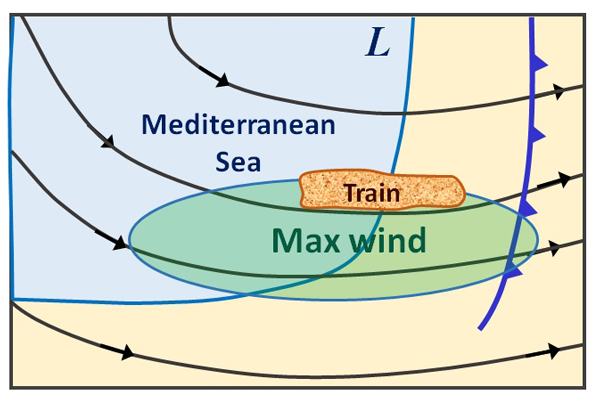
The train effect is related to convective cells that pass over the same place. Trains produce heavy rainfall and sometimes floods and are reported in North America during spring and summer. In Israel, 17 trains associated with Cyprus lows were identified by radar images and were found within the cold sector south of the low center and in the left flank of a maximum wind belt; they cross the Israeli coast, with a mean length of 45 km; last 1–3 h; and yield 35 mm of rainfall up to 60 mm.
Baruch Ziv, Uri Dayan, Lidiya Shendrik, and Elyakom Vadislavsky
Nat. Hazards Earth Syst. Sci., 24, 3267–3277, https://doi.org/10.5194/nhess-24-3267-2024, https://doi.org/10.5194/nhess-24-3267-2024, 2024
Short summary
Short summary
The train effect is related to convective cells that pass over the same place. Trains produce heavy rainfall and sometimes floods and are reported in North America during spring and summer. In Israel, 17 trains associated with Cyprus lows were identified by radar images and were found within the cold sector south of the low center and in the left flank of a maximum wind belt; they cross the Israeli coast, with a mean length of 45 km; last 1–3 h; and yield 35 mm of rainfall up to 60 mm.
Dor Sandler, Hadas Saaroni, Baruch Ziv, Talia Tamarin-Brodsky, and Nili Harnik
Weather Clim. Dynam., 5, 1103–1116, https://doi.org/10.5194/wcd-5-1103-2024, https://doi.org/10.5194/wcd-5-1103-2024, 2024
Short summary
Short summary
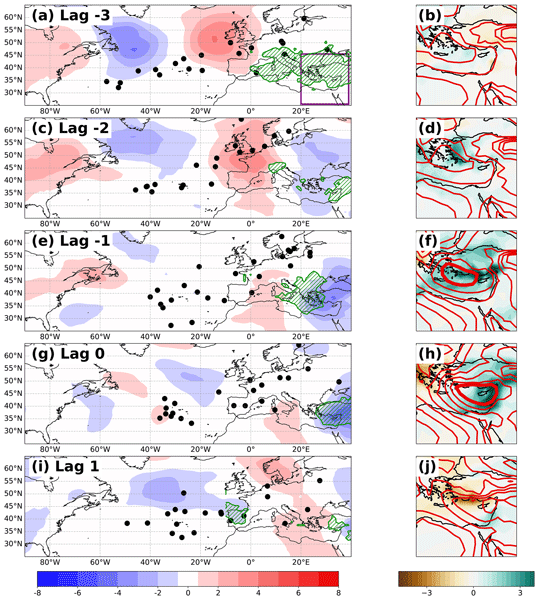
The North Atlantic region serves as a source of moisture and energy for Mediterranean storms. Its impact over the Levant region remains an open question due to its smaller weather systems and their longer distance from the ocean. We find an optimal circulation pattern which allows North Atlantic influence to reach farther into the eastern Mediterranean, thus making storms stronger and rainier. This may be relevant for future Mediterranean climate, which is projected to become much drier.
Emmanouil Flaounas, Leonardo Aragão, Lisa Bernini, Stavros Dafis, Benjamin Doiteau, Helena Flocas, Suzanne L. Gray, Alexia Karwat, John Kouroutzoglou, Piero Lionello, Mario Marcello Miglietta, Florian Pantillon, Claudia Pasquero, Platon Patlakas, María Ángeles Picornell, Federico Porcù, Matthew D. K. Priestley, Marco Reale, Malcolm J. Roberts, Hadas Saaroni, Dor Sandler, Enrico Scoccimarro, Michael Sprenger, and Baruch Ziv
Weather Clim. Dynam., 4, 639–661, https://doi.org/10.5194/wcd-4-639-2023, https://doi.org/10.5194/wcd-4-639-2023, 2023
Short summary
Short summary
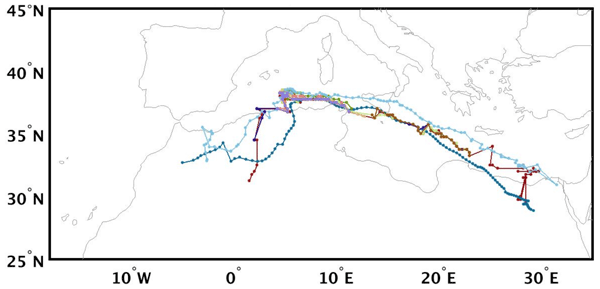
Cyclone detection and tracking methods (CDTMs) have different approaches in defining and tracking cyclone centers. This leads to disagreements on extratropical cyclone climatologies. We present a new approach that combines tracks from individual CDTMs to produce new composite tracks. These new tracks are shown to correspond to physically meaningful systems with distinctive life stages.
Yair Rinat, Francesco Marra, Moshe Armon, Asher Metzger, Yoav Levi, Pavel Khain, Elyakom Vadislavsky, Marcelo Rosensaft, and Efrat Morin
Nat. Hazards Earth Syst. Sci., 21, 917–939, https://doi.org/10.5194/nhess-21-917-2021, https://doi.org/10.5194/nhess-21-917-2021, 2021
Short summary
Short summary
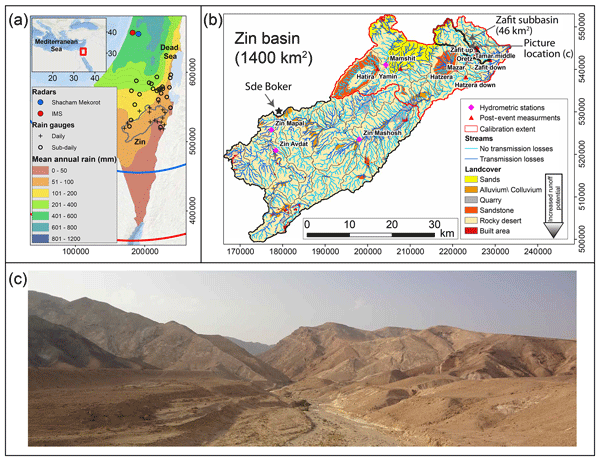
Flash floods are among the most devastating and lethal natural hazards worldwide. The study of such events is important as flash floods are poorly understood and documented processes, especially in deserts. A small portion of the studied basin (1 %–20 %) experienced extreme rainfall intensities resulting in local flash floods of high magnitudes. Flash floods started and reached their peak within tens of minutes. Forecasts poorly predicted the flash floods mostly due to location inaccuracy.
Cited articles
Alpert, P. and Ziv, B.: The Sharav cyclone – observations and some theoretical considerations, J. Geophys. Res.-Atmos., 94, 18495–18514, https://doi.org/10.1029/JD094iD15p18495, 1989.
Alpert, P., Osetinsky, I., Ziv, B., and Shafir, H.: Semi-objective classification for daily synoptic systems, Application to the Eastern Mediterranean climate change, Int. J. Climatol., 24, 1001–1011, https://doi.org/10.1002/joc.1036, 2004.
Altaratz, O., Levin, Z., and Yair, Y.: Winter thunderstorms in Israel: A study with lightning location systems and weather radar, Mon. Weather Rev., 129, 1259–1266, 2001.
Armon, M., Morin, E., and Enzel, Y.: Overview of modern atmospheric patterns controlling rainfall and floods into the Dead Sea: Implications for the lake's sedimentology and paleohydrology, Quaternary Sci. Rev., 216, 58–73, https://doi.org/10.1016/j.quascirev.2019.06.005, 2019.
Ashbel, D.: Great floods in Sinai Peninsula, Palestine, Syria and the Syrian Desert, and the influence of the Red Sea on their formation, Q. J. Roy. Meteror. Soc., 64, 635–639, 1938.
Bardossy, A. and Filiz, F.: Identification of flood producing atmospheric circulation patterns, J. Hydrol., 313, 4857, https://doi.org/10.1016/j.jhydrol.2005.02.006, 2005.
Becker, J. S., Taylor, H. L., Doody, B. J., Wright, K. C., Gruntfest, E., and Webber, D.: A review of people's behavior in and around floodwater, Weather Clim. Soc., 7, 321–332, https://doi.org/10.1175/WCAS-D-14-00030.1, 2015.
Copernicus: Welcome to the Climate Data Store, available at: https://cds.climate.copernicus.eu, last access: 25 December 2019.
Copernicus Climate Change Service (C3S): ERA5: Fifth generation of ECMWF atmospheric reanalyses of the global climate, Copernicus Climate Change Service Climate Data Store (CDS), https://cds.climate.copernicus.eu/cdsapp#!/home (last access: 25 December 2019), 2017.
Corfidi, S. F., Merritt, J. H., and Fritsch, J. M.: Predicting the movement of mesoscale convective complexes, Weather Forecast., 11, 41–46, 1996.
Dayan, U. and Morin, E.: Flash Flood-Producing rainstorms over the Dead Sea, Israel: A Review, in: New Frontiers in Dead Sea paleo-environmental research, edited by: Enzel, Y., Agnon, A., and Stein, M., Geol. S. Am. S., 401, 53–62, https://doi.org/10.1130/2006.2401(04), 2006.
Dayan, U. and Sharon, D.: Meteorological Parameters for Discriminating Between Widespread and Spotty Storms in the Negev, Israel J. Earth Sci., 29, 253–256, 1980.
Dayan, U., Ziv, B., Margalit, A., Morin, E., and Sharon, D.: A severe autumn storm over the middle-east: synoptic and meso-scale convection analysis, Theor. Appl. Climatol., 69, 103–122, 2001.
Diakakis, M., Priskos, G. and Skordoulis, M.: Public perception of flood risk in flash flood prone areas of Eastern Mediterranean: the case of Attica Region in Greece, Int. J. Disast. Risk Re., 28, 404–413, https://doi.org/10.1016/j.ijdrr.2018.03.018, 2018.
Doswell, C.: The Distinction between Large-Scale and Mesoscale Contribution to Severe Convection: A Case Study Example, Weather Forecast., 2, 3–16, https://doi.org/10.1175/1520-0434(1987)002<0003:TDBLSA>2.0.CO;2, 1987.
Flocas, H. A., Maheras, M. P., Karacostas, T. S., Patrikas, I., and Anagnostopoulos, C.: A 40 year climatological study of relative vorticity distribution over the Mediterranean, Int. J. Climatol., 21, 1759–1778, https://doi.org/10.1002/joc.705, 2001.
Fragoso, M., Tildes Gomes, P.: Classification of daily abundant rainfall patterns and associated large-scale atmospheric circulation types in Southern Portugal, Int. J. Climatol., 28, 537–544, https://doi.org/10.1002/joc.1564, 2008.
Galway, J. G.: The lifted index as a predictor of latent instability, B. Am. Meteorol. Soc., 37, 528–529, 1956.
Geer, I. W.: Glossary of Weather and Climate, American Meteorological Society, Boston, USA, 272 pp., 1996.
Haiden, T., Kann A., Wittmann C., Pistotnik G., Bica B., and Gruber C.: The Integrated Nowcasting through Comprehensive Analysis (INCA) System and Its Validation over the Eastern Alpine Region, Weather Forecast., 26, 166–183, https://doi.org/10.1175/2010WAF2222451.1, 2011.
Harats, N., Ziv, B., Yair, Y., Kotroni, V., and Dayan, U.: Dynamic and thermodynamic predictors for lightning and flash floods in the Mediterranean, Adv. Geophys., 23, 57–64, 2010.
HMSO: Weather in the Mediterranean I: General Meteorology, 2nd ed., Her Majesty's Stationery Office, London, 362, 1962.
Holton, J. R.: An Introduction to Dynamic Meteorology, 2nd Edn., Academic Press, Massachusetts, USA, 507 pp., 1992.
Hoskins, B. J., McIntyre, M. E., and Robertson, A. W.: On the use and significance of isentropic potential vorticity maps, Q. J. Roy. Meteor. Soc., 877–946, https://doi.org/10.1002/qj.49711147002, 1985.
Jacobeit, J., Homann, M., Philipp, A., and Beck, C.: Atmospheric circulation types and extreme areal precipitation in southern central Europe, Adv. Sci. Res., 14, 71–75, 2017.
Kahana, R.: Synoptic Hydro-climatology of Major Floods in the Negev and Arava, Southern Israel, MSc Thesis, Institute of Earth Sciences, The Hebrew University of Jerusalem, Jerusalem,1999.
Kahana, R., Ziv, B., Enzel, Y., and Dayan, U.: Synoptic climatology of major floods in the Negev Desert, Israel, Int. J. Climatol., 22, 867–882, https://doi.org/10.1002/joc.766, 2002.
Kalnay, E., Kanamitsu, M., Kistler, R., Collins, W., Deaven, D., Gandin, L., Iredell, M., Saha, S., White, G., Woollen, J., Zhu, Y., Chelliah, M., Ebisuzaki, W., Higgins, W., Janowiak, J., Mo, K. C., Ropelewski, C., Wang, J., Leetmaa, A., Reynolds, R., Jenne, R., and Joseph, D.: The NCEP/NCAR 40 years reanalysis project, B. Am. Meteorol. Soc., 77, 437–472, https://doi.org/10.1175/1520-0477(1996)077<0437:TNYRP>2.0.CO;2, 1996.
Kerkmann, J.: Applications of Meteosat Second Generation – Meteorological use of the SEVIRI IR3.9 Channel, EUMETSAT, European Organisation for the Exploitation of Meteorological Satellites, available at: http://www.eumetsat.int, last access: 1 June 2019.
Khain, P., Levi, Y., Shtivelman, A., Vadislavsky, E., Brainin, E., and Stav, N.: Improving the precipitation forecast over the Eastern Mediterranean using a smoothed time-lagged ensemble, Meteorol. Appl., 27, e1840, https://doi.org/10.1002/met.1840, 2020.
Khain, P., Levi, Y., Muskatel, H., Shtivelman, A., Vadislavsky, E., and Stav, N.: Effect of shallow convection parametrization on cloud resolving NWP forecasts over the Eastern Mediterranean, Atmos. Res., 247, 105213, https://doi.org/10.1016/j.atmosres.2020.105213, 2021.
Kistler, R., Kalnay, E., Collins, W., Saha, S., White, G., Woollen, J., Chelliah, M., Ebisuzaki, W., Kanamitsu, M., Kousky, V., Van Den Dool, H., Jenne, R., and Fiorino, M.: The NCEP-NCAR 50 year Reanalysis: Monthly means CD-ROM and documentation, B. Am. Meteorol. Soc., 82, 247–267, https://doi.org/10.1175/1520-0477(2001)082<0247:TNNYRM>2.3.CO;2, 2001.
Kushnir, Y., Dayan U., Ziv B., Morin E., and Enzel Y.: Climate of the Levant: phenomena and mechanisms, in: Quaternary of the Levant: Environments, Climate Change, and Humans, edited by: Enzelm, Y. and Bar-Yosef, O., Cambridge University Press, London, 31–44, 2017.
Kutiel, H.: Spatial Coherence of Monthly Rainfall in Israel, Arch. Meteor. Geophy. B, 31, 353–367, 1982.
Lensky, I. M. and Rosenfeld, D.: Clouds-Aerosols-Precipitation Satellite Analysis Tool (CAPSAT), Atmos. Chem. Phys., 8, 6739–6753, https://doi.org/10.5194/acp-8-6739-2008, 2008.
Liu, W. T.: Statistical relation between monthly mean precipitable water and surface-level humidity over global oceans, Mon. Weather Rev., 114, 1591–1602, https://doi.org/10.1175/1520-0493(1986)114<1591:SRBMMP>2.0.CO;2, 1986.
Marra, F. and Morin, E.: Use of radar QPE for the derivation of Intensity–Duration–Frequency curves in a range of climatic regimes, J. Hydrol., 531, 427–440, https://doi.org/10.1016/j.jhydrol.2015.08.064, 2015.
Moncrieff, M. W. and Miller, M., J.: The dynamics and simulation of tropical cumulonimbus and squall lines, Q. J. Roy. Meteror. Soc., 102, 373–394, 1976.
Montz, B. E. and Gruntfest, E.: Flash flood mitigation: Recommendations for research and applications, Global Environmental Change Part B: Environmental Hazards, 4, 15–22, https://doi.org/10.1016/S1464-2867(02)00011-6, 2002.
Morin, E., Harats, N., Jacoby, Y., Arbel, S., Getker, M., Arazi, A., Grodek, T., Ziv, B., and Dayan, U.: Studying the extremes: hydrometeorological investigation of a flood-causing rainstorm over Israel, Adv. Geosci., 12, 107–114, https://doi.org/10.5194/adgeo-12-107-2007, 2007.
Porat, A., Halfon, N., and Forshpan, A.: Examining the exceptionality of 25–27 April 2018, in: IMS, 16 August 2018, Israel Meteorological Service, Beit Dagan, Israel, 2018.
Porcù, F., Carrassi, A., Medaglia, C. M., Prodi, F., and Mugnai, A.: A study on cut-off low vertical structure and precipitation in the Mediterranean region, Meteorol. Atmos. Phys., 96, 121–140, 2007.
Rinat, Y., Marra, F., Armon, M., Metzger, A., Levi, Y., Khain, P., Vadislavsky, E., Rosensaft, M., and Morin, E.: Hydrometeorological analysis and forecasting of a 3 d flash-flood-triggering desert rainstorm, Nat. Hazards Earth Syst. Sci., 21, 917–939, https://doi.org/10.5194/nhess-21-917-2021, 2021.
Rolph, G., Stein, A., and Stunder, B.: Real-time Environmental Applications and Display sYstem: READY, Environ. Model. Softw., 95, 210–228, 2017.
Saaroni, H., Halfon, N., Ziv, B., Alpert, P., and Kutiel, H.: Links between the rainfall regime in Israel and location and intensity of Cyprus lows, Int. J. Climatol., 30, 1014–1025, https://doi.org/10.1002/joc.1912, 2010.
Sharif, H., Jackson, T., Hossain, M., and Zane, D.: Analysis of flood fatalities in Texas, Nat. Hazards Rev., 16, 04014016, https://doi.org/10.1061/(ASCE)NH.1527-6996.0000145, 2015.
Sharon, D.: Rainfall Fields in Israel and Jordan and the Effect of Cloud Seeding on Them, J. Appl. Meteorol., 17, 40–48, 1978.
Sharon, D. and Kutiel, H.: The distribution of rainfall intensity in Israel, its regional and seasonal variations and its climatological evaluation, J. Climatol., 6, 277–291, https://doi.org/10.1002/joc.3370060304, 1986.
Shay-El, Y. and Alpert, P.: A diagnostic study of winter diabatic heating in the Mediterranean in relation to cyclones, Q. J. Roy. Meteor. Soc., 117, 715–747, https://doi.org/10.1002/qj.49711750004, 1991.
Showalter, A., K.: A Stability Index for Thunderstorm Forecasting, B. Am. Meteorol. Soc., 34, 25–252, 1953.
Stein, A. F., Draxler, R. R., Rolph, G. D., Stunder, B. J. B., Cohen, M. D., and Ngan, F.: NOAA's HYSPLIT atmospheric transport and dispersion modeling system, B. Am. Meteorol. Soc., 96, 2059–2077, https://doi.org/10.1175/BAMS-D-14-00110.1, 2015.
Stephan, K., Klink, S., and Schraff, C.: Assimilation of radar derived rain rates into the convective scale model COSMO-DE at DWD, Q. J. Roy. Meteor. Soc., 134, 1315–1326, 2008.
Terti, G., Ruin, I., Anquetin, S., and Gourley, J. J.: A situation-based analysis of flash flood fatalities in the united states, B. Am. Meteorol. Soc., 98, 333–345, https://doi.org/10.1175/BAMS-D-15-00276.1, 2017.
Tsvieli, Y. and Zangvil, A.: Synoptic climatological analysis of Red Sea Trough and non-Red Sea Trough rain situations over Israel, Adv. Geosci., 12, 137–143, https://doi.org/10.5194/adgeo-12-137-2007, 2007.
Uccellini, L. W. and Kocin, P. J.: The interaction of jet streak circulations during heavy snow events along the east coast of United States, Weather Forecast., 2, 289–308, 1987.
Uzan, L., Egert, S., Khain, P., Levi, Y., Vadislavsky, E., and Alpert, P.: Ceilometers as planetary boundary layer height detectors and a corrective tool for COSMO and IFS models, Atmos. Chem. Phys., 20, 12177–12192, https://doi.org/10.5194/acp-20-12177-2020, 2020.
Yamazaki, A. and Itoh, H.: Vortex-vortex interactions for the maintenance of blocking: Part I: The selective absorption mechanism and a case study, J. Atmos. Sci., 70, 725–742, https://doi.org/10.1175/JAS-D-11-0295.1, 2013.
Zappa, G., Hawcroft, M. K., Shaffrey, L., Black, E., and Brayshaw, O. J.: Extratropical cyclones and the projected decline of winter Mediterranean precipitation in the CMIP5 models, Clim. Dynam., 45, 1727–1738, https://doi.org/10.1007/s00382-014-2426-8, 2015.
Ziv, B., Dayan, U., Kushnir, Y., Roth, C., and Enzel, Y.: Regional and Global Atmospheric Patterns Governing Rainfall in the Southern Levant, Int. J. Climatol., 26, 55–73, 2006.
Ziv, B., Saaroni, H., Romem, M., Heifetz, E., Harnik, N., and Baharad, A.: Analysis of conveyor belts in winter, Mediterranean cyclones, Theor. Appl. Climatol., 99, 441–455, 2010.
Short summary
An intense rainstorm hit the Middle East between 24 and 27 April 2018. The storm reached its peak over Israel on 26 April when a heavy flash flood took the lives of 10 people. The rainfall was comparable to the long-term annual rainfall in the southern Negev. The timing was the end of the rainy season when rain is rare and spotty. The study analyses the dynamic and thermodynamic conditions that made this rainstorm one of the latest spring severe events in the region during the last 3 decades.
An intense rainstorm hit the Middle East between 24 and 27 April 2018. The storm reached its...


Altmetrics
Final-revised paper
Preprint