
Articles | Volume 26, issue 2
https://doi.org/10.5194/nhess-26-943-2026
© Author(s) 2026. This work is distributed under
the Creative Commons Attribution 4.0 License.
the Creative Commons Attribution 4.0 License.
https://doi.org/10.5194/nhess-26-943-2026
© Author(s) 2026. This work is distributed under
the Creative Commons Attribution 4.0 License.
the Creative Commons Attribution 4.0 License.
Research article
| 
27 Feb 2026
Research article |
| 27 Feb 2026
| 27 Feb 2026
First mapping of a tsunami wavefield by SWOT satellite: observation data and preliminary numerical simulation of the 19 May 2023 tsunami near the Loyalty Islands

Earth Sciences New Zealand, Earth Structure and Processes, Lower Hutt 5011, Aotearoa New Zealand
Yannice Faugère
Centre National d'Etudes Spatiale (CNES), Toulouse 31400, France
Hélène Hébert
CEA, DAM, DIF, Arpajon 91297, France
Antoine Delepoulle
Collecte Localisation Satellites (CLS), Ramonville-Saint-Agne 31520, France
Gérald Dibarboure
Centre National d'Etudes Spatiale (CNES), Toulouse 31400, France
Related authors
Jose Moratalla, David Burbidge, Jean Roger, Katie Jones, Angela Griffin, Christof Mueller, Uma Ashok, Finn Scheele, Yaseen Mahmood, and Edith Bretherton
EGUsphere, https://doi.org/10.5194/egusphere-2025-5884, https://doi.org/10.5194/egusphere-2025-5884, 2026
Short summary
Short summary
We developed a model that links earthquakes with related hazards such as tsunami, liquefaction, and landslides to show how they jointly affect buildings. Using large-scale computer simulations for the city of Napier in New Zealand, we produced maps and risk metrics that describe expected damage levels for individual hazards and for their combined effects across thousands of homes.
Jean H. M. Roger and Bernard Pelletier
Nat. Hazards Earth Syst. Sci., 24, 3461–3478, https://doi.org/10.5194/nhess-24-3461-2024, https://doi.org/10.5194/nhess-24-3461-2024, 2024
Short summary
Short summary
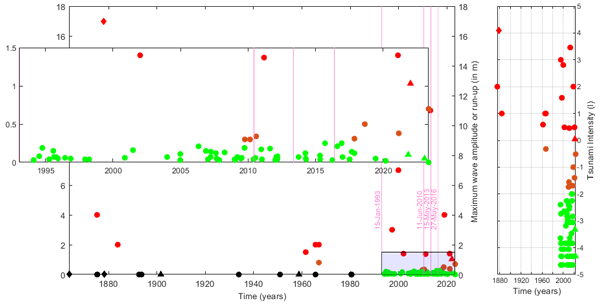
We present a catalogue of tsunamis that occurred in the Vanuatu Arc. It has been built based on the analysis of existing catalogues, historical documents, and sea-level data from five coastal tide gauges. Since 1863, 100 tsunamis of local, regional, or far-field origins have been listed; 15 of them show maximum wave amplitudes and/or run-up heights of above 1 m, and 8 are between 0.3 and 1 m. Details are provided for particular events, including debated events or events with no known origin(s).
Melody Philippon, Jean Roger, Jean-Frédéric Lebrun, Isabelle Thinon, Océane Foix, Stéphane Mazzotti, Marc-André Gutscher, Leny Montheil, and Jean-Jacques Cornée
Nat. Hazards Earth Syst. Sci., 24, 3129–3154, https://doi.org/10.5194/nhess-24-3129-2024, https://doi.org/10.5194/nhess-24-3129-2024, 2024
Short summary
Short summary
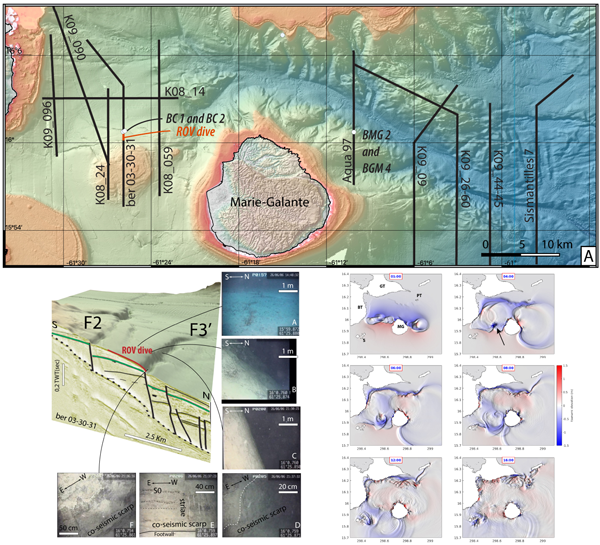
Using novel geophysical datasets, we reassess the slip rate of the Morne Piton fault (Lesser Antilles) at 0.2 mm yr−1 by dividing by four previous estimations and thus increasing the earthquake time recurrence and lowering the associated hazard. We evaluate a plausible magnitude for a potential seismic event of Mw 6.5 ± 0.5. Our multi-segment tsunami model representative of the worst-case scenario gives an overview of tsunami generation if all the fault segments ruptured together.
Jean Roger, Bernard Pelletier, Aditya Gusman, William Power, Xiaoming Wang, David Burbidge, and Maxime Duphil
Nat. Hazards Earth Syst. Sci., 23, 393–414, https://doi.org/10.5194/nhess-23-393-2023, https://doi.org/10.5194/nhess-23-393-2023, 2023
Short summary
Short summary
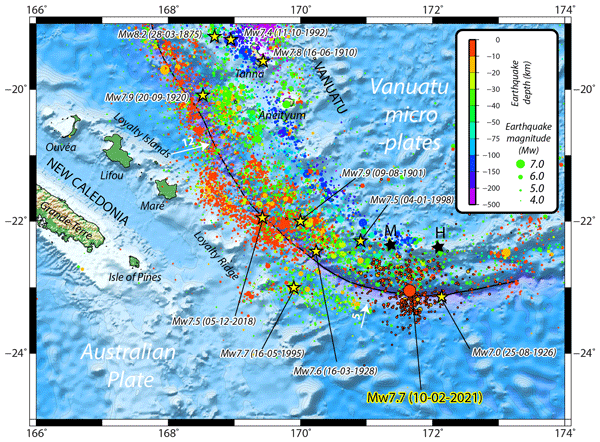
On 10 February 2021 a magnitude 7.7 earthquake occurring at the southernmost part of the Vanuatu subduction zone triggered a regional tsunami that was recorded on many coastal gauges and DART stations of the south-west Pacific region. Beginning with a review of the tectonic setup and its implication in terms of tsunami generation in the region, this study aims to show our ability to reproduce a small tsunami with different types of rupture models and to discuss a larger magnitude 8.2 scenario.
Jean Roger, Bernard Pelletier, Maxime Duphil, Jérôme Lefèvre, Jérôme Aucan, Pierre Lebellegard, Bruce Thomas, Céline Bachelier, and David Varillon
Nat. Hazards Earth Syst. Sci., 21, 3489–3508, https://doi.org/10.5194/nhess-21-3489-2021, https://doi.org/10.5194/nhess-21-3489-2021, 2021
Short summary
Short summary
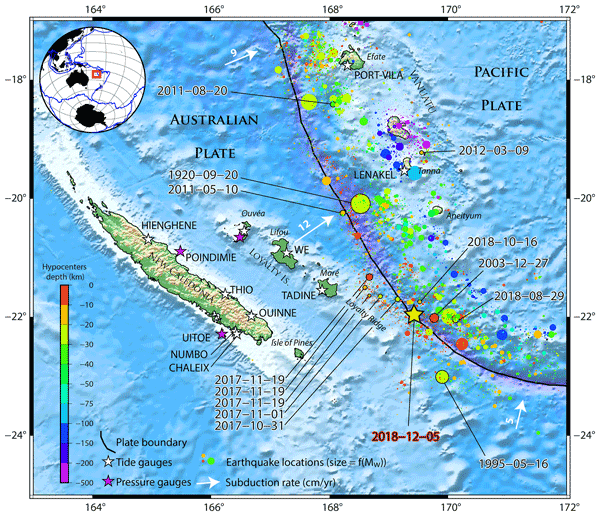
This study deals with the 5 December 2018 tsunami in New Caledonia and Vanuatu (southwestern Pacific) triggered by a Mw 7.5 earthquake that occurred southeast of Maré, Loyalty Islands, and was widely felt in the region. Numerical modeling results of the tsunami using a non-uniform and a uniform slip model compared to real tide gauge records and observations are globally well correlated for the uniform slip model, especially in far-field locations.
Juliette Gamot, Antoine Delepoulle, Francesco Nencioli, Marie-Isabelle Pujol, and Gerald Dibarboure
Earth Syst. Sci. Data, 18, 7043–7070, https://doi.org/10.5194/essd-18-7043-2026, https://doi.org/10.5194/essd-18-7043-2026, 2026
Short summary
Short summary
Mesoscale eddies are rotating ocean features that play a key role in transporting heat, salt, and biological material. This study presents a new global dataset derived from satellite observations to track these eddies and identify when they merge or split. By organizing them into interaction networks, we show that such events are frequent and strongly influence eddy evolution, leading to a more realistic description of ocean circulation.
Noémie Lalau, Michaël Ablain, Thomas Vaujour, François Boy, Gerald Dibarboure, and Alejandro Egido
Ocean Sci., 22, 2491–2501, https://doi.org/10.5194/os-22-2491-2026, https://doi.org/10.5194/os-22-2491-2026, 2026
Short summary
Short summary
We investigated how to maintain continuous sea level measurements between current Sentinel-3 constellation and the upcoming Sentinel-3 Next Generation Topography mission. Because of new satellite designs, a 4-hour delay will exists between observations during the calibration phase. By simulating this time lag, we found that, despite increased uncertainty, reliable calibration is possible. Extending this phase to one year ensures a stable, long-term record for climate and ocean monitoring.
Gwenael Jestin, Sara Fleury, Matthias Raynal, Marta Alves, Fanny Piras, Anaëlle Treboutte, François Boy, Inès Benabdillah, Louise Yu, and Gérald Dibarboure
EGUsphere, https://doi.org/10.5194/egusphere-2026-2569, https://doi.org/10.5194/egusphere-2026-2569, 2026
This preprint is open for discussion and under review for The Cryosphere (TC).
Short summary
Short summary
With its wide swath of 120 km, the SWOT altimeter offers unrivalled spatial and temporal coverage of the polar oceans. But frozen oceans are difficult to study because the ice cover only reveals the open ocean through cracks and polynyas. Whether studying the ice or the ocean, leads and floes must be distinguished. This classification is now available in the CNES L3 product at a resolution of 250 m. This paper outlines the methodology and improvements of the derived ice concentration maps.
Solène Jousset, Sandrine Mulet, Eric Greiner, John Wilkin, Lien Vidar, Léon Chafik, Roshin Raj, Antonio Bonaduce, Nicolas Picot, and Gérald Dibarboure
Earth Syst. Sci. Data, 18, 2285–2303, https://doi.org/10.5194/essd-18-2285-2026, https://doi.org/10.5194/essd-18-2285-2026, 2026
Short summary
Short summary
Satellite altimetry has revolutionized ocean observation, making it possible to track sea level with very good spatio-temporal coverage. However, only sea level anomalies are retrieved; to monitor the entire ocean signal, mean dynamic topography (MDT) must be added to these anomalies. In this study, an evaluation of the CNES-CLS22 MDT shows significant improvements in the Arctic. Over the globe, this new solution represents an incremental update to previous CNES-CLS18 MDT.
Chloé Goret, Ariane Koch-Larrouy, Fabius Kouogang, Carina Regina de Macedo, Amine M'Hamdi, Jorge M. Magalhães, José Carlos Bastos da Silva, Michel Tchilibou, Camila Artana, Isabelle Dadou, Antoine Delepoulle, Simon Barbot, Maxime Ballarotta, Loren Carrère, and Alex Costa da Silva
Ocean Sci., 22, 679–698, https://doi.org/10.5194/os-22-679-2026, https://doi.org/10.5194/os-22-679-2026, 2026
Short summary
Short summary
Using high-resolution satellite measurements, we observed how eddies off the Amazon shelf modify internal solitary waves. The results show that these waves can be deflected from their path, even split into two branches, and change their geometry when interacting with different types of eddies. This work provides new insight into the ocean’s complex dynamic interactions and could help guide future predictions of ocean behavior and its effects on coastal and marine ecosystems.
Jose Moratalla, David Burbidge, Jean Roger, Katie Jones, Angela Griffin, Christof Mueller, Uma Ashok, Finn Scheele, Yaseen Mahmood, and Edith Bretherton
EGUsphere, https://doi.org/10.5194/egusphere-2025-5884, https://doi.org/10.5194/egusphere-2025-5884, 2026
Short summary
Short summary
We developed a model that links earthquakes with related hazards such as tsunami, liquefaction, and landslides to show how they jointly affect buildings. Using large-scale computer simulations for the city of Napier in New Zealand, we produced maps and risk metrics that describe expected damage levels for individual hazards and for their combined effects across thousands of homes.
Cécile Kocha, Marine Liévin, Yann Pageot, Clémence Rubin, Victor Quet, Franck Octau, Marie-Isabelle Pujol, Pierre Prandi, Sabine Philipps, Gerald Dibarboure, Isabelino Denis, Carolina Nogueira Loddo, and François Bignalet-Cazalet
Earth Syst. Sci. Data Discuss., https://doi.org/10.5194/essd-2025-604, https://doi.org/10.5194/essd-2025-604, 2026
Revised manuscript under review for ESSD
Short summary
Short summary
30 years of satellite altimetry data were reprocessed in 2024, using state-of-the-art research algorithms and models. The so-called DT-2024 sea level dataset provides a homogenous and consistent set of observations from 15 satellites and 5 climate reference altimeters. This new dataset is shown to improve mesoscale quality and consistency, particularly over coastal and polar areas, as well as the long-term stability for climate research.
Clément Ubelmann, J. Thomas Farrar, Bertrand Chapron, Lucile Gaultier, Laura Gomez-Navarro, Marie-Hélène Rio, and Gérald Dibarboure
Ocean Sci., 21, 2915–2928, https://doi.org/10.5194/os-21-2915-2025, https://doi.org/10.5194/os-21-2915-2025, 2025
Short summary
Short summary
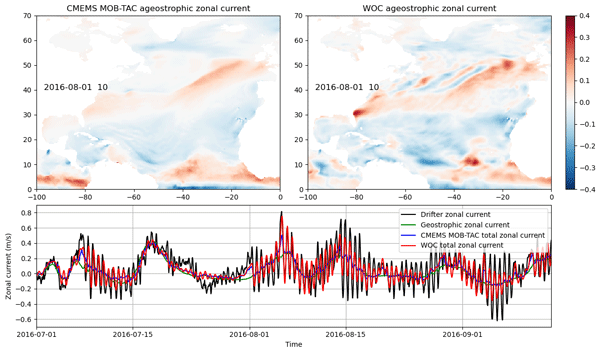
This study models wind-driven ocean currents using observed wind stress and an empirically estimated impulse response function based on drifting buoys. By convolving this function with wind forcing from ERA5, the estimates align well with independent observations across latitudes. Additionally, the response function serves as a valuable indicator of subsurface properties.
Michel Tchilibou, Simon Barbot, Loren Carrere, Ariane Koch-Larrouy, Gérald Dibarboure, and Clément Ubelmann
Ocean Sci., 21, 1469–1486, https://doi.org/10.5194/os-21-1469-2025, https://doi.org/10.5194/os-21-1469-2025, 2025
Short summary
Short summary
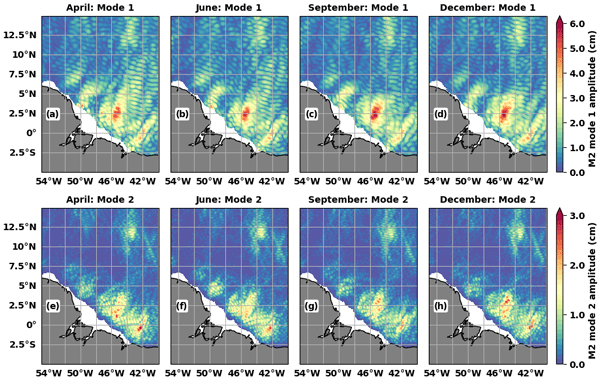
MIOST24 (Multivariate Inversion of Ocean Surface Topography 2024) annual and monthly internal tide (IT) atlases, based on 25 years of altimetry data and an updated wavelength database, are presented for the Indo-Philippine archipelago and the Amazon shelf. The atlases show monthly IT variability and a better correction of IT in altimetry data than with MIOST22 (MIOST 2022) and HRET (High-Resolution Empirical Tide). The results support the development of a global MIOST24.
Pierre-Yves Le Traon, Gérald Dibarboure, Jean-Michel Lellouche, Marie-Isabelle Pujol, Mounir Benkiran, Marie Drevillon, Yann Drillet, Yannice Faugère, and Elisabeth Remy
Ocean Sci., 21, 1329–1347, https://doi.org/10.5194/os-21-1329-2025, https://doi.org/10.5194/os-21-1329-2025, 2025
Short summary
Short summary
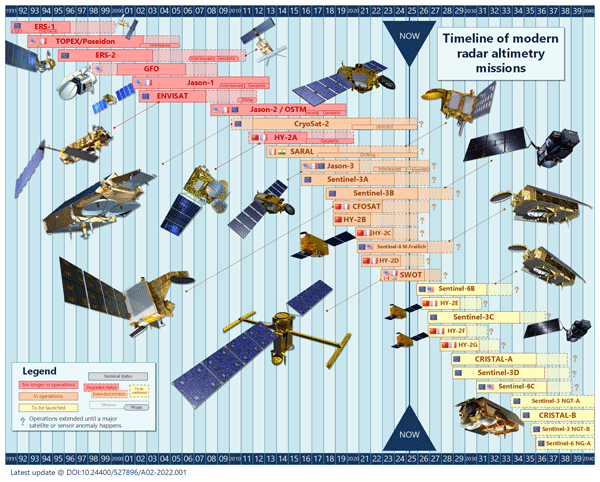
By providing all weather, global, and real-time observations of sea level, a key variable to constrain ocean analysis and forecasting systems, satellite altimetry has had a profound impact on the development of operational oceanography. This paper provides an overview of the development and evolution of satellite altimetry and operational oceanography over the past 20 years from the launch of Jason-1 in 2001 to the launch of SWOT (Surface Water and Ocean Topography) in 2022.
Hélène Etienne, Clément Ubelmann, Fabrice Ardhuin, and Gérald Dibarboure
EGUsphere, https://doi.org/10.5194/egusphere-2025-2890, https://doi.org/10.5194/egusphere-2025-2890, 2025
Preprint archived
Short summary
Short summary
This study analyzes near-inertial oscillations (NIOs) in ocean surface currents using drifter data and the LLC2160 ocean-atmosphere model. It finds that NIOs have a typical spatial decorrelation scale around 100 km, varying with latitude. The model accurately captures these patterns, supporting the ODYSEA concept mission's goal to measure surface currents via Doppler radar and reduce NIO-related data aliasing for better ocean monitoring.
Michaël Ablain, Noémie Lalau, Benoit Meyssignac, Robin Fraudeau, Anne Barnoud, Gérald Dibarboure, Alejandro Egido, and Craig Donlon
Ocean Sci., 21, 343–358, https://doi.org/10.5194/os-21-343-2025, https://doi.org/10.5194/os-21-343-2025, 2025
Short summary
Short summary
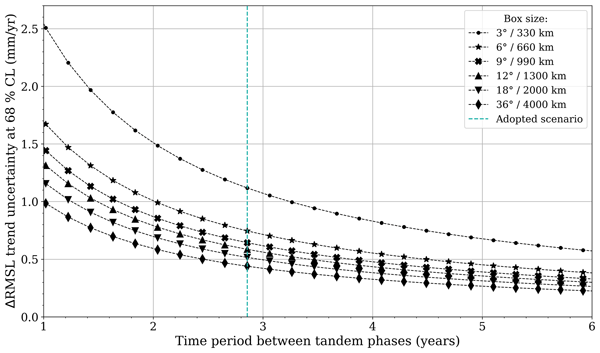
This study proposes a novel cross-validation method to assess the instrumental stability in sea level trends. The method involves implementing a second tandem flight phase between two successive altimeter missions a few years after the first phase. The trend in systematic instrumental differences made during the two tandem phases can be estimated below ± 0.1 mm yr-1 (16–84 % confidence level) on a global scale for time intervals between the tandem phases of 4 years or more.
Michel Tchilibou, Loren Carrere, Florent Lyard, Clément Ubelmann, Gérald Dibarboure, Edward D. Zaron, and Brian K. Arbic
Ocean Sci., 21, 325–342, https://doi.org/10.5194/os-21-325-2025, https://doi.org/10.5194/os-21-325-2025, 2025
Short summary
Short summary
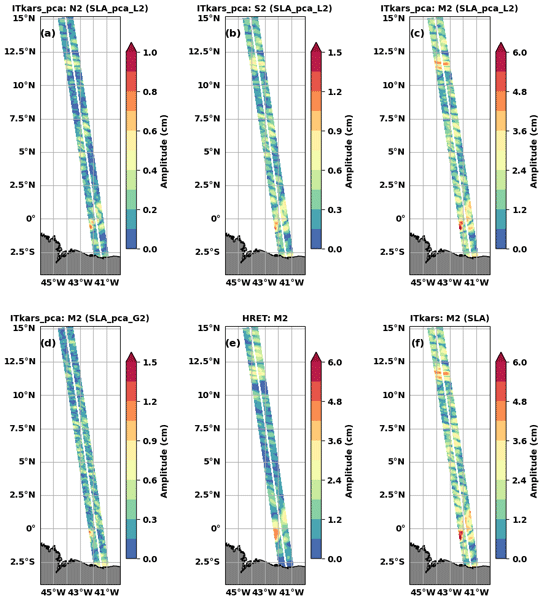
Sea level observations along the swaths of the new SWOT (Surface Water and Ocean Topography) mission were used to characterize internal tides at three semidiurnal frequencies off the Amazon shelf in the tropical Atlantic during the SWOT calibration/validation period. The atlases were derived using harmonic analysis and principal component analysis. The SWOT-derived internal tide atlas outperforms the reference atlas previously used to correct SWOT observations.
Gerald Dibarboure, Cécile Anadon, Frédéric Briol, Emeline Cadier, Robin Chevrier, Antoine Delepoulle, Yannice Faugère, Alice Laloue, Rosemary Morrow, Nicolas Picot, Pierre Prandi, Marie-Isabelle Pujol, Matthias Raynal, Anaelle Tréboutte, and Clément Ubelmann
Ocean Sci., 21, 283–323, https://doi.org/10.5194/os-21-283-2025, https://doi.org/10.5194/os-21-283-2025, 2025
Short summary
Short summary
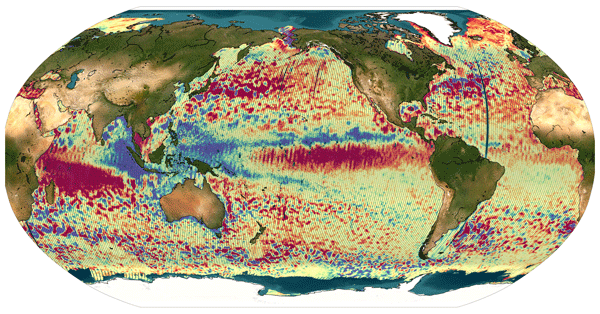
The Surface Water and Ocean Topography (SWOT) mission delivers unprecedented swath-altimetry products. In this paper, we describe how we extended the Level-3 algorithms to handle SWOT’s unique swath-altimeter data. We also illustrate and discuss the benefits, relevance, and limitations of Level-3 swath-altimeter products for various research domains.
Maxime Ballarotta, Clément Ubelmann, Valentin Bellemin-Laponnaz, Florian Le Guillou, Guillaume Meda, Cécile Anadon, Alice Laloue, Antoine Delepoulle, Yannice Faugère, Marie-Isabelle Pujol, Ronan Fablet, and Gérald Dibarboure
Ocean Sci., 21, 63–80, https://doi.org/10.5194/os-21-63-2025, https://doi.org/10.5194/os-21-63-2025, 2025
Short summary
Short summary
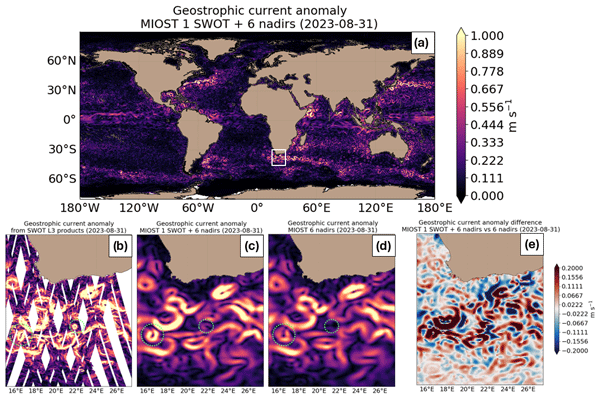
The Surface Water and Ocean Topography (SWOT) mission provides unprecedented swath altimetry data. This study examines SWOT's impact on mapping systems, showing a moderate effect with the current nadir altimetry constellation and a stronger impact with a reduced one. Integrating SWOT with dynamic mapping techniques improves the resolution of satellite-derived products, offering promising solutions for studying and monitoring sea-level variability at finer scales.
Jean H. M. Roger and Bernard Pelletier
Nat. Hazards Earth Syst. Sci., 24, 3461–3478, https://doi.org/10.5194/nhess-24-3461-2024, https://doi.org/10.5194/nhess-24-3461-2024, 2024
Short summary
Short summary
We present a catalogue of tsunamis that occurred in the Vanuatu Arc. It has been built based on the analysis of existing catalogues, historical documents, and sea-level data from five coastal tide gauges. Since 1863, 100 tsunamis of local, regional, or far-field origins have been listed; 15 of them show maximum wave amplitudes and/or run-up heights of above 1 m, and 8 are between 0.3 and 1 m. Details are provided for particular events, including debated events or events with no known origin(s).
Alice Laloue, Malek Ghantous, Yannice Faugère, Alice Dalphinet, and Lotfi Aouf
State Planet, 4-osr8, 6, https://doi.org/10.5194/sp-4-osr8-6-2024, https://doi.org/10.5194/sp-4-osr8-6-2024, 2024
Short summary
Short summary
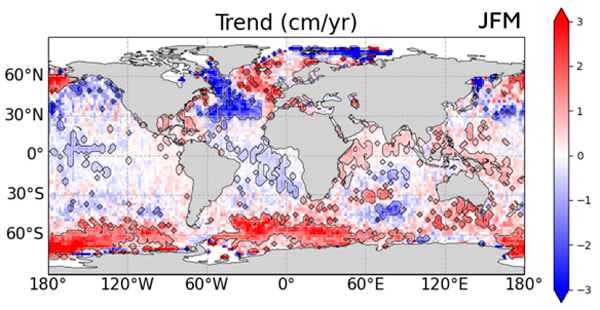
Satellite altimetry shows that daily mean significant wave heights (SWHs) and extreme SWHs have increased in the Southern Ocean, the South Atlantic, and the southern Indian Ocean over the last 2 decades. In winter in the North Atlantic, SWH has increased north of 45°N and decreased south of 45°N. SWHs likely to be exceeded every 100 years have also increased in the North Atlantic and the eastern tropical Pacific. However, this study also revealed the need for longer and more consistent series.
Melody Philippon, Jean Roger, Jean-Frédéric Lebrun, Isabelle Thinon, Océane Foix, Stéphane Mazzotti, Marc-André Gutscher, Leny Montheil, and Jean-Jacques Cornée
Nat. Hazards Earth Syst. Sci., 24, 3129–3154, https://doi.org/10.5194/nhess-24-3129-2024, https://doi.org/10.5194/nhess-24-3129-2024, 2024
Short summary
Short summary
Using novel geophysical datasets, we reassess the slip rate of the Morne Piton fault (Lesser Antilles) at 0.2 mm yr−1 by dividing by four previous estimations and thus increasing the earthquake time recurrence and lowering the associated hazard. We evaluate a plausible magnitude for a potential seismic event of Mw 6.5 ± 0.5. Our multi-segment tsunami model representative of the worst-case scenario gives an overview of tsunami generation if all the fault segments ruptured together.
Antonio Sánchez-Román, M. Isabelle Pujol, Yannice Faugère, and Ananda Pascual
Ocean Sci., 19, 793–809, https://doi.org/10.5194/os-19-793-2023, https://doi.org/10.5194/os-19-793-2023, 2023
Short summary
Short summary
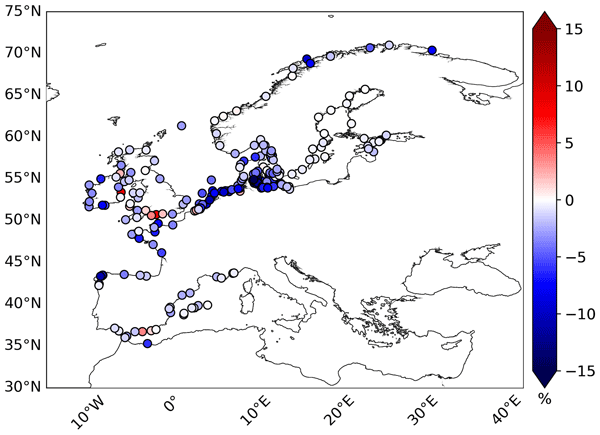
This paper assesses the performance of the latest version (DT2021) of global gridded altimetry products distributed through the CMEMS and C3S Copernicus programs on the retrieval of sea level in the coastal zone of the European seas with respect to the previous DT2018 version. This comparison is made using an external independent dataset. DT2021 sea level products better solve the signal in the coastal band.

Oscar Vergara, Rosemary Morrow, Marie-Isabelle Pujol, Gérald Dibarboure, and Clément Ubelmann
Ocean Sci., 19, 363–379, https://doi.org/10.5194/os-19-363-2023, https://doi.org/10.5194/os-19-363-2023, 2023
Short summary
Short summary
Recent advances allow us to observe the ocean from space with increasingly higher detail, challenging our knowledge of the ocean's surface height signature. We use a statistical approach to determine the spatial scale at which the sea surface height signal is no longer dominated by geostrophic turbulence but in turn becomes dominated by wave-type motions. This information helps us to better use the data provided by ocean-observing satellites and to gain knowledge on climate-driving processes.
Jean Roger, Bernard Pelletier, Aditya Gusman, William Power, Xiaoming Wang, David Burbidge, and Maxime Duphil
Nat. Hazards Earth Syst. Sci., 23, 393–414, https://doi.org/10.5194/nhess-23-393-2023, https://doi.org/10.5194/nhess-23-393-2023, 2023
Short summary
Short summary
On 10 February 2021 a magnitude 7.7 earthquake occurring at the southernmost part of the Vanuatu subduction zone triggered a regional tsunami that was recorded on many coastal gauges and DART stations of the south-west Pacific region. Beginning with a review of the tectonic setup and its implication in terms of tsunami generation in the region, this study aims to show our ability to reproduce a small tsunami with different types of rupture models and to discuss a larger magnitude 8.2 scenario.
Maxime Ballarotta, Clément Ubelmann, Pierre Veillard, Pierre Prandi, Hélène Etienne, Sandrine Mulet, Yannice Faugère, Gérald Dibarboure, Rosemary Morrow, and Nicolas Picot
Earth Syst. Sci. Data, 15, 295–315, https://doi.org/10.5194/essd-15-295-2023, https://doi.org/10.5194/essd-15-295-2023, 2023
Short summary
Short summary
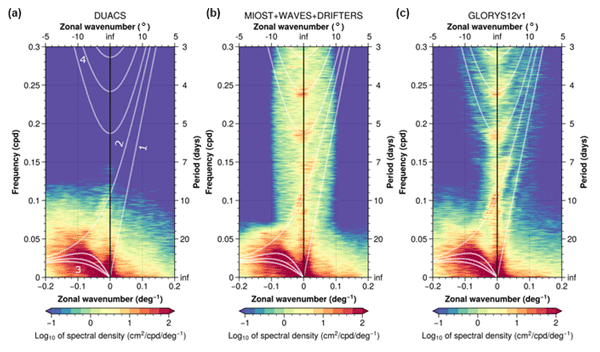
We present a new gridded sea surface height and current dataset produced by combining observations from nadir altimeters and drifting buoys. This product is based on a multiscale and multivariate mapping approach that offers the possibility to improve the physical content of gridded products by combining the data from various platforms and resolving a broader spectrum of ocean surface dynamic than in the current operational mapping system. A quality assessment of this new product is presented.
Marie-Isabelle Pujol, Stéphanie Dupuy, Oscar Vergara, Antonio Sánchez-Román, Yannice Faugère, Pierre Prandi, Mei-Ling Dabat, Quentin Dagneaux, Marine Lievin, Emeline Cadier, Gérald Dibarboure, and Nicolas Picot
Earth Syst. Sci. Data Discuss., https://doi.org/10.5194/essd-2022-292, https://doi.org/10.5194/essd-2022-292, 2022
Manuscript not accepted for further review
Short summary
Short summary
An altimeter sea level along-track level-3 product with a 5 Hz (~1.2 km) sampling is proposed. It takes advantage of recent advances in radar altimeter processing, and improvements made to different stages of the processing chain. Compared to the conventional 1 Hz (~7 km) product, it significantly improves the observability of the short wavelength signal in open ocean and near coast areas (> 5 km). It also contributes to improving high resolution numerical model outputs via data assimilation.
Mounir Benkiran, Pierre-Yves Le Traon, and Gérald Dibarboure
Ocean Sci., 18, 609–625, https://doi.org/10.5194/os-18-609-2022, https://doi.org/10.5194/os-18-609-2022, 2022
Short summary
Short summary
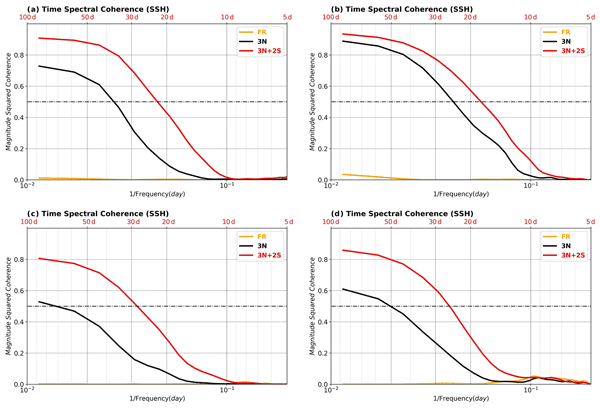
The SSH analysis and 7 d forecast error will be globally reduced by almost 50 %. Surface current forecast errors should be equivalent to today’s surface current analysis errors or alternatively will be improved (variance error reduction) by 30 % at the surface and 50 % for 300 m depth.
The resolution capabilities will be drastically improved and will be closer to 100 km wavelength as opposed to today where they are above 250 km (on average).
Clément Ubelmann, Loren Carrere, Chloé Durand, Gérald Dibarboure, Yannice Faugère, Maxime Ballarotta, Frédéric Briol, and Florent Lyard
Ocean Sci., 18, 469–481, https://doi.org/10.5194/os-18-469-2022, https://doi.org/10.5194/os-18-469-2022, 2022
Short summary
Short summary
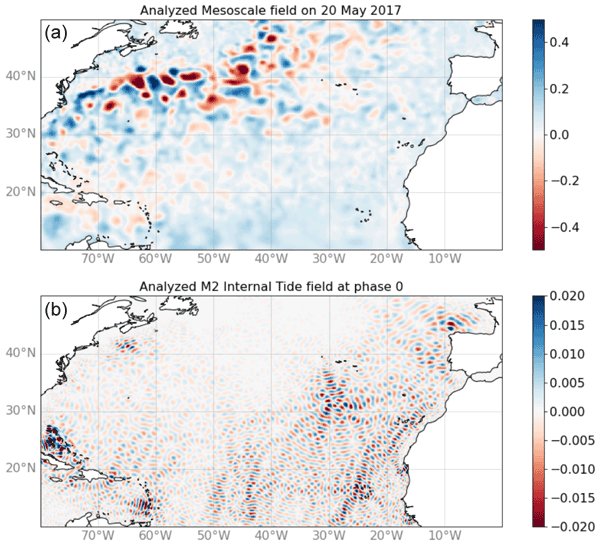
The signature of internal tides has become an important component for high-resolution altimetry over oceans. Several studies have proposed some solutions to resolve part of these internal tides based on the altimetry record. Following these studies, we propose here a new inversion approach aimed to mitigate aliasing with other dynamics. After a description of the methodology, the solution for the main tidal components has been successfully validated against independent observations.

Cori Pegliasco, Antoine Delepoulle, Evan Mason, Rosemary Morrow, Yannice Faugère, and Gérald Dibarboure
Earth Syst. Sci. Data, 14, 1087–1107, https://doi.org/10.5194/essd-14-1087-2022, https://doi.org/10.5194/essd-14-1087-2022, 2022
Short summary
Short summary
The new global Mesoscale Eddy Trajectory Atlases (META3.1exp) provide eddy identification and trajectories from altimetry maps. These atlases comprise an improvement to and continuation of the historical META2.0 product. Changes in the detection parameters and tracking were tested by comparing the eddies from the different datasets. In particular, the eddy contours available in META3.1exp are an asset for multi-disciplinary studies.
Pierre Prandi, Jean-Christophe Poisson, Yannice Faugère, Amandine Guillot, and Gérald Dibarboure
Earth Syst. Sci. Data, 13, 5469–5482, https://doi.org/10.5194/essd-13-5469-2021, https://doi.org/10.5194/essd-13-5469-2021, 2021
Short summary
Short summary
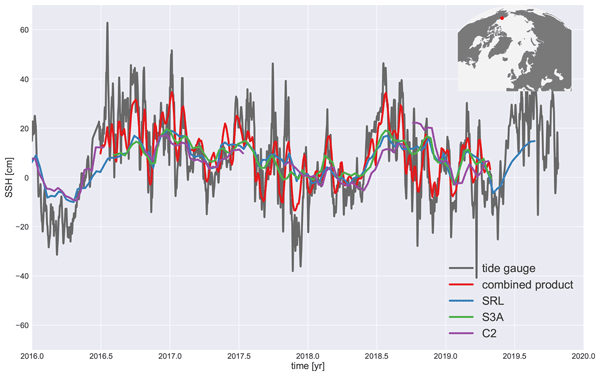
We investigate how mapping sea level in the Arctic Ocean can benefit from combining data from three satellite radar altimeters: CryoSat-2, Sentinel-3A and SARAL/AltiKa. A dedicated processing for SARAL/AltiKa provides a baseline for the cross-referencing of CryoSat-2 and Sentinel-3A before mapping. We show that by combining measurements coming from three missions, we are able to increase the resolution of gridded sea level fields in the ice-covered Arctic Ocean.
Jean Roger, Bernard Pelletier, Maxime Duphil, Jérôme Lefèvre, Jérôme Aucan, Pierre Lebellegard, Bruce Thomas, Céline Bachelier, and David Varillon
Nat. Hazards Earth Syst. Sci., 21, 3489–3508, https://doi.org/10.5194/nhess-21-3489-2021, https://doi.org/10.5194/nhess-21-3489-2021, 2021
Short summary
Short summary
This study deals with the 5 December 2018 tsunami in New Caledonia and Vanuatu (southwestern Pacific) triggered by a Mw 7.5 earthquake that occurred southeast of Maré, Loyalty Islands, and was widely felt in the region. Numerical modeling results of the tsunami using a non-uniform and a uniform slip model compared to real tide gauge records and observations are globally well correlated for the uniform slip model, especially in far-field locations.
Cited articles
Ablain, M., Dorandeu, J., Le Traon, P.-Y., and Sladen, A.: High resolution altimetry reveals new characteristics of the December 2004 Indian Ocean tsunami, Geophys. Res. Lett., 33, L21602, https://doi.org/10.1029/2006GL027533, 2006.
Archer, M., Wang, J., Klein, P., Dibarboure, G., and Fu, L.-L.: Wide-swath satellite altimetry unveils global submesoscale ocean dynamics, Nature, 640, 691–696, https://doi.org/10.1038/s41586-025-08722-8, 2025.
Ballarotta, M., Ubelmann, C., Pujol, M.-I., Taburet, G., Fournier, F., Legeais, J.-F., Faugère, Y., Delepoulle, A., Chelton, D., Dibarboure, G., and Picot, N.: On the resolutions of ocean altimetry maps, Ocean Sci., 15, 1091–1109, https://doi.org/10.5194/os-15-1091-2019, 2019.
Ballarotta, M., Ubelmann, C., Veillard, P., Prandi, P., Etienne, H., Mulet, S., Faugère, Y., Dibarboure, G., Morrow, R., and Picot, N.: Improved global sea surface height and current maps from remote sensing and in situ observations, Earth Syst. Sci. Data, 15, 295–315, https://doi.org/10.5194/essd-15-295-2023, 2023.
Bohé, A.: KaRIn LR Oceanography Products Status & Examples, 2023 SWOT Science Team meeting, Toulouse, https://swotst.aviso.altimetry.fr/fileadmin/user_upload/SWOTST2023/20230919_2_Karin_overview1/11h30-BOHE_plenary.pdf (last access: 12 March 2024), 2023.
Chen, C.: Features of KaRIn Data that Users Should be Aware of, 2023 SWOT Science Team meeting, Toulouse, https://swotst.aviso.altimetry.fr/fileadmin/user_upload/SWOTST2023/20230919_3_Karin_overview2/14h10-KaRInFeatures.pdf (last access: 12 March 2024), 2023.
Delepoulle, A., Roger, J., Hébert, H., and Fuentes, M.: Tsunami records with the NASA/CNES SWOT space altimeter, EaSy Data [data set], https://doi.org/10.57932/8b9996d3-c100-4a0a-ac67-05dd2e81155a, 2026.
Dibarboure, G., Anadon, C., Briol, F., Cadier, E., Chevrier, R., Delepoulle, A., Faugère, Y., Laloue, A., Morrow, R., Picot, N., Prandi, P., Pujol, M.-I., Raynal, M., Tréboutte, A., and Ubelmann, C.: Blending 2D topography images from the Surface Water and Ocean Topography (SWOT) mission into the altimeter constellation with the Level-3 multi-mission Data Unification and Altimeter Combination System (DUACS), Ocean Sci., 21, 283–323, https://doi.org/10.5194/os-21-283-2025, 2025.
Dziewonski, A. M., Chou, T.-A., and Woodhouse, J. H.: Determination of earthquake source parameters from waveform data for studies of global and regional seismicity, J. Geophys. Res., 86, 2825–2852, https://doi.org/10.1029/JB086iB04p02825, 1981.
Ekström, G., Nettles, M., and Dziewonski, A. M.: The global CMT project 2004–2010: Centroid-moment tensors for 13,017 earthquakes, Phys. Earth Planet. Inter., 200–201, 1–9, https://doi.org/10.1016/j.pepi.2012.04.002, 2012.
Faugère, Y., Husson, R., Busche, C., Dibarboure, G., Rolland, L., Sladen, A., and Munaibari, E.: The 2022 Honga Tonga Tsunami monitored by satellite altimetry and SAR, 2022 OSTST meeting, https://ostst.aviso.altimetry.fr/fileadmin/user_upload/OSTST2022/Presentations/APO2022-The_2022_Honga_Tonga_Tsunami_monitored_by_satellite_altimetry_and_SAR.pdf (last access: 24 February 2026), 2022.
Fjørtoft, R., Chen, C., Corben, A., Desai, S. D., Desroches, D., Picot, N., Pottier, C., Stuurman, C., Williams, B., and Wu, X.: SWOT Hydrology Products and Early Results, in: IGARSS 2024 – 2024 IEEE International Geoscience and Remote Sensing Symposium, IEEE, 1410–1413, https://doi.org/10.1109/IGARSS53475.2024.10642160, 2024.
Fu, L. L. and Rodriguez, E.: High-Resolution Measurement of Ocean Surface Topography by Radar Interferometry for Oceanographic and Geophysical Applications, in: The State of the Planet: Frontiers and Challenges in Geophysics, edited by: Sparks, R. S. J. and Hawkesworth, C. J., IUGG Geophysical Monograph, American Geophysical Union, Washington, DC, USA, 19, 209–224, https://doi.org/10.1029/150GM17, 2004.
Fu, L.-L., Pavelsky, T., Cretaux, J.-F., Morrow, R., Farrar, J. T., Vaze, P., Sengenes, P., Vinogradova-Shiffer, N., Sylvestre-Baron, A., Picto, N., and Dibarboure, G.: The Surface Water and Ocean Topography Mission: A breakthrough in radar remote sensing of the ocean and land surface water, Geophys. Res. Lett., 51, e2023GL107652, https://doi.org/10.1029/2023GL107652, 2024.
GEBCO Bathymetric Compilation Group 2023: The GEBCO_2023 Grid – a continuous terrain model of the global oceans and land, NERC EDS British Oceanographic Data Centre NOC [data set], https://doi.org/10.5285/f98b053b-0cbc-6c23-e053-6c86abc0af7b, 2023.
Godin, O. A., Irisov, V. G., Leben, R. R., Hamlington, B. D., and Wick, G. A.: Variations in sea surface roughness induced by the 2004 Sumatra-Andaman tsunami, Nat. Hazards Earth Syst. Sci., 9, 1135–1147, https://doi.org/10.5194/nhess-9-1135-2009, 2009.
Gower, J.: The 26 December 2004 tsunami measured by satellite altimetry, Int. J. Remote Sens., 28, 2897–2913, https://doi.org/10.1080/01431160601094484, 2007.
Hamlington, B. D., Leben, R. R., Godin, O. A., Legeais, J. F., Gica, E., and Titov, V. V.: Detection of the 2010 Chilean tsunami using satellite altimetry, Nat. Hazards Earth Syst. Sci., 11, 2391–2406, https://doi.org/10.5194/nhess-11-2391-2011, 2011.
Hamlington, B. D., Leben, R. R., Godin, O. A., Gica, E., Titov, V. V., Haines, B. J., and Desai, S. D.: Could satellite altimetry have improved early detection and warning of the 2011 Tohoku tsunami?, Geophys. Res. Lett., 39, L15605, https://doi.org/10.1029/2012GL052386, 2012.
Hayashi, Y.: Extracting the 2004 Indian Ocean tsunami signals from sea surface height data observed by satellite altimetry, J. Geophys. Res.-Oceans, 113, https://doi.org/10.1029/2007JC004177, 2008.
Hébert, H., Occhipinti, G., Schindelé, F., Gailler, A., Pinel-Puysségur, B., Gupta, H.K., Rolland, L., Lognonné, P., Lavigne, F., Meilianda, E., and Chapkanski, S.: Contributions of Space Missions to Better Tsunami Science: Observations, Models and Warnings, Surv. Geophys., 41, 1535–1581, https://doi.org/10.1007/s10712-020-09616-2, 2020.
Howe, B. M., Arbic, B. K., Aucan, J., Barnes, C. R., Bayliff, N., Becker, N., Butler, R., Doyle, L., Elipot, S., Johnson, G. C., Landerer, F., Lentz, S., Luther, D. S., Müller, M., Mariano, J., Panayotou, K., Rowe, C., Ota, H., Song, Y. T., Thomas, M., Thomas, P. N., Thompson, P., Tilmann, F., Weber, T., and Weinstein, S.: SMART Cables for Observing the Global Ocean: Science and Implementation, Front. Mar. Sci., 6, 1–27, https://doi.org/10.3389/fmars.2019.00424, 2019.
Laloue, A., Schaeffer, P., Pujol, M. I., Veillard, P., Andersen, O., Sandwell, D., Delepoulle, A., Dibarboure, G., and Faugère, Y.: Merging recent Mean Sea Surface into a 2023 Hybrid model (from Scripps, DTU, CLS and CNES), Authorea, https://doi.org/10.22541/au.171987154.42384510/v1, 2024.
Le Traon, P.-Y., Dibarboure, G., Lellouche, J.-M., Pujol, M.-I., Benkiran, M., Drevillon, M., Drillet, Y., Faugère, Y., and Remy, E.: Satellite altimetry and operational oceanography: from Jason-1 to SWOT, Ocean Sci., 21, 1329–1347, https://doi.org/10.5194/os-21-1329-2025, 2025.
Liu, P. L. F., Cho, Y.-S., Briggs, M. J., Synolakis, C. E., and Kanoglu, U.: Runup of solitary waves on a circular island, J. Fluid Mech., 302, 259–285, https://doi.org/10.1017/S0022112095004095, 1995.
Luis, J. F.: Mirone, A multi-purpose tool for exploring grid data, Comput. Geosci., 33, 31–41, https://doi.org/10.1016/j.cageo.2006.05.005, 2007.
Meinig, C., Eble, M. C., and Stalin, S. E.: System development and performance of the Deep-ocean Assessment and Reporting of Tsunamis (DART) system from 1997–2001, in: Proceedings of the International Tsunami Symposium 2001 (ITS 2001), NHTMP Review Session, R24, 235–242, https://www.pmel.noaa.gov/pubs/docs/ITS2001/R-24_Meinig.pdf (last access: 26 February 2026), 2001.
Monahan, T., Tang, T., Roberts, S., and Adcock, T. A. A.: Observations of the seiche that shook the world, Nat. Commun., 16, 1–14, https://doi.org/10.1038/s41467-025-59851-7, 2025.
Morrow, R., Fu, L.-L., Ardhuin, F., Benkiran, M., Chapron, B., Cosme, E., d'Ovidio, F., Farrar, J. T., Gille, S. T., Lapeyre, G., Le Traon, P.-Y., Pascual, A., Ponte, A., Qiu, B., Rascle, N., Ubelmann, C., Wang, J., and Zaron, E. D.: Global observations of fine-scale ocean surface topography with the surface water and ocean topography (SWOT) mission, Front. Mar. Sci., 6, https://doi.org/10.3389/fmars.2019.00232, 2019.
Okada, Y.: Surface deformation due to shear and tensile fault in a half-space, B. Seismol. Soc. Am., 75, 1135–1154, 1985.
Okal, E. A., Piatanesi, A., and Heinrich, P.: Tsunami detection by satellite altimetry, J. Geophys. Res.-Sol. Ea., 104, 599–615, https://doi.org/10.1029/1998JB000018, 1999.
Peral, E., Esteban-Fernández, D., Rodríguez, E., McWatters, D., De Bleser, J. W., Ahmed, R., Chen, A. C., Slimko, E., Somawardhana, R., Knarr, K., and Johnson, M.: KaRIn, the Ka-band radar interferometer of the SWOT mission: design and in-flight performance, IEEE T. Geosci. Remote, 62, 1–27, https://doi.org/10.1109/TGRS.2024.3405343, 2024.
Power, W. L., Fry, B., Gusman, A. R., Burbidge, D. R., Brewer, M., and Wang, X.: DART buoys network design. GNS Science consultancy report 2018/147, 53 pp., 2018.
Raynal, M., Dibarboure, G., Bohe, A., Bignalet-Cazalet, F., Picot, N., Prandi, P., Cadier, E., Nencioli, F., Briol, F., Delepoulle, A., Flamant, B., Denneulin, M., Picard, B., Ubelmann, C., Chen, C., and Stiles, B.: Early SWOT 21-day data assessment, 2023 SWOT Science Team meeting, Toulouse, https://swotst.aviso.altimetry.fr/fileadmin/user_upload/SWOTST2023/20230922_1_going_forward/09h10-RAYNAL_L2LR_CalVal_scienceOrbit.pdf (last access: 12 March 2024), 2023.
Robert, W. H., Yamazaki, Y., Cheung, K. F., and Lay, T.: Tsunami variability for the 2021 megathrust and 2023 outer rise MW 7.7 earthquakes southeast of the Loyalty Islands, J. Geophys. Res.-Oceans, 130, e2024JC021880, https://doi.org/10.1029/2024JC021880, 2025.
Roger, J., Pelletier, B., Gusman, A., Power, W., Wang, X., Burbidge, D., and Duphil, M.: Potential tsunami hazard of the southern Vanuatu subduction zone: tectonics, case study of the Matthew Island tsunami of 10 February 2021 and implication in regional hazard assessment, Nat. Hazards Earth Syst. Sci., 23, 393–414, https://doi.org/10.5194/nhess-23-393-2023, 2023.
Roger, J., Gusman, A., Faugère, Y., Rolland, L., Hébert, H., Delouis, B., and O'Kane, A.: The 2023 South Vanuatu doublet of earthquakes and tsunamis: observations, numerical simulations and gray areas, EGU General Assembly 2025, Vienna, Austria, 27 April–2 May 2025, EGU25-7571, https://doi.org/10.5194/egusphere-egu25-7571, 2025.
Roger, J. H. M. and Wang, X.: Impact of tsunamis in Porirua Harbour: focus on Mana Marina, GNS Science report 2023/31, 62 pp., https://doi.org/10.21420/WETZ-0X92, 2023.
Shrivastava, M. N., Sunil, A. S., Maurya, A. K., Aguilera, F., Orrego, S., Sunil, P. S., Cienfuegos, R., and Moreno, M.: Tracking tsunami propagation and Island's collapse after the Hunga Tonga Hunga Ha'apai 2022 volcanic eruption from multi-space observations, Sci. Rep., 13, 20109, https://doi.org/10.1038/s41598-023-46397-1, 2023.
Sladen, A. and Hébert, H.: On the use of satellite altimetry to infer the earthquake rupture characteristics: application to the 2004 Sumatra event, Geophys. J. Int., 172, 707–714, https://doi.org/10.1111/j.1365-246X.2007.03669.x, 2008.
Strasser, F. O., Arango, M. C., and Bommer, J. J.: Scaling of the source dimensions of interface and intraslab subduction-zone earthquakes with moment magnitude, Seismol. Res. Lett., 81, 941–950, https://doi.org/10.1785/gssrl.81.6.941, 2010.
Taburet, G., Sanchez-Roman, A., Ballarotta, M., Pujol, M.-I., Legeais, J.-F., Fournier, F., Faugere, Y., and Dibarboure, G.: DUACS DT2018: 25 years of reprocessed sea level altimetry products, Ocean Sci., 15, 1207–1224, https://doi.org/10.5194/os-15-1207-2019, 2019.
Ubelmann, C., Dibarboure, G., Gaultier, L., Ponte, A., Ardhuin, F., Ballarotta, M., and Faugère, Y.: Reconstructing ocean surface current combining altimetry and future spaceborne Doppler data, J. Geophys. Res.-Oceans, 126, e2020JC016560, https://doi.org/10.1029/2020JC016560, 2021.
Ubelmann, C., Carrere, L., Durand, C., Dibarboure, G., Faugère, Y., Ballarotta, M., Briol, F., and Lyard, F.: Simultaneous estimation of ocean mesoscale and coherent internal tide sea surface height signatures from the global altimetry record, Ocean Sci., 18, 469–481, https://doi.org/10.5194/os-18-469-2022, 2022.
Ubelmann, C., Dibarboure, G., Flamant, B., Delepoulle, A., Vayre, M., Faugère, Y., Prandi, P., Raynal, M., Briol, F., Bracher, G., and Cadier, E.: Data-driven calibration of SWOT's systematic errors: first in-flight assessment, Remote Sens., 16, 3558, https://doi.org/10.3390/rs16193558, 2024.
Vaze, P., Kaki, S., Limonadi, D., Esteban-Fernandez, D., and Zohar, G.: March. The surface water and ocean topography mission, in: 2018 IEEE Aerospace Conference, IEEE, 1–9, https://doi.org/10.1109/AERO.2018.8396504, 2018.
Wang, X.: Numerical modelling of surface and internal waves over shallow and intermediate water. PhD Thesis, Ithaca (NY), Cornell University, 245 pp., https://catalog.library.cornell.edu/catalog/6794450 (last access: 26 February 2026), 2008.
Wang, X. and Liu, P. L. F.: An analysis of 2004 Sumatra earthquake fault plane mechanisms and Indian Ocean tsunami, J. Hydraul. Res., 44, 147–154, https://doi.org/10.1080/00221686.2006.9521671, 2006.
Wang, X. and Power, W.: COMCOT: a tsunami generation, propagation and run-up model. GNS Science Report, 2011/43, GNS Science, Lower Hutt, New Zealand, 121 pp., https://shop.gns.cri.nz/sr_2011-043-pdf/ (last access: 26 February 2026), 2011.
Wang, X., Holden, C., Power, W., Liu, Y., and Mountjoy, J.: Seiche effects in Lake Tekapo, New Zealand, in an Mw8.2 Alpine Fault earthquake, Pure Appl. Geophys., 177, 5927–5942, https://doi.org/10.1007/s00024-020-02595-w, 2020.
Wells, D. L. and Coppersmith, K. J.: New empirical relationships among magnitude, rupture length, rupture width, rupture area, and surface displacement, B. Seismol. Soc. Am., 84, 974–1002, https://doi.org/10.1785/BSSA0840040974, 1994.
Short summary
Deployed in 2022, the SWOT (Surface Water Ocean Topography) satellite was flying over the Southwest Pacific on 19 May 2023 when it recorded the tsunami triggered by a magnitude 7.7 earthquake south of the Vanuatu arc. For the very first time, it provided a 2D image of a tsunami wavefield along a straight path. Comparison with numerical tsunami simulations reveals good phase agreement between the modeled wavefield and the SWOT record, but the simulated amplitudes are lower than the measurements.
Deployed in 2022, the SWOT (Surface Water Ocean Topography) satellite was flying over the...


Altmetrics
Final-revised paper
Preprint