
Articles | Volume 26, issue 11
https://doi.org/10.5194/nhess-26-6199-2026
© Author(s) 2026. This work is distributed under
the Creative Commons Attribution 4.0 License.
https://doi.org/10.5194/nhess-26-6199-2026
© Author(s) 2026. This work is distributed under
the Creative Commons Attribution 4.0 License.
Research article
| 
26 Nov 2026
Research article |
| 26 Nov 2026
An ensemble groundwater prediction (EGP) system to forecast groundwater levels in alluvial aquifers in Switzerland
Raoul A. Collenteur
CORRESPONDING AUTHOR

Eawag, Department Water Resources and Drinking Water (W+T), Ueberlandstr. 133, 8600 Duebendorf, Switzerland
Swiss Federal Research Institute WSL, Birmensdorf, Switzerland
now at: Collenteur Hydroconsult GmbH, Spiez, Switzerland
Konrad Bogner
Swiss Federal Research Institute WSL, Birmensdorf, Switzerland
Massimiliano Zappa
Swiss Federal Research Institute WSL, Birmensdorf, Switzerland
Mario Schirmer
Eawag, Department Water Resources and Drinking Water (W+T), Ueberlandstr. 133, 8600 Duebendorf, Switzerland
Laval University, Quebec City, Quebec, Canada
Christian Moeck
Eawag, Department Water Resources and Drinking Water (W+T), Ueberlandstr. 133, 8600 Duebendorf, Switzerland
Swiss Groundwater Network (CH-GNet), Duebendorf, Switzerland
Related authors
Raoul Alexandre Collenteur, Konrad Bogner, Christian Moeck, Massimiliano Zappa, and Mario Schirmer
Abstr. Int. Cartogr. Assoc., 9, 5, https://doi.org/10.5194/ica-abs-9-5-2025, https://doi.org/10.5194/ica-abs-9-5-2025, 2025
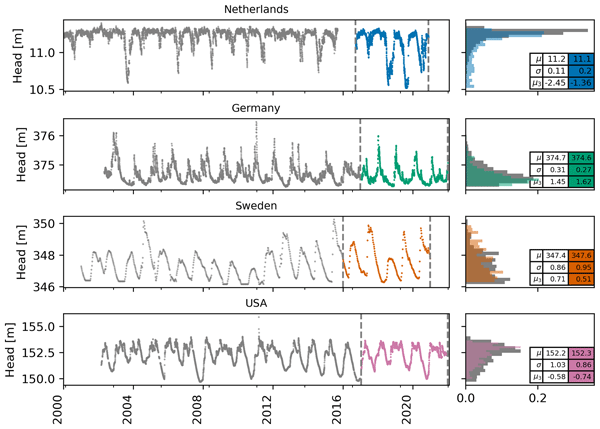
Raoul A. Collenteur, Ezra Haaf, Mark Bakker, Tanja Liesch, Andreas Wunsch, Jenny Soonthornrangsan, Jeremy White, Nick Martin, Rui Hugman, Ed de Sousa, Didier Vanden Berghe, Xinyang Fan, Tim J. Peterson, Jānis Bikše, Antoine Di Ciacca, Xinyue Wang, Yang Zheng, Maximilian Nölscher, Julian Koch, Raphael Schneider, Nikolas Benavides Höglund, Sivarama Krishna Reddy Chidepudi, Abel Henriot, Nicolas Massei, Abderrahim Jardani, Max Gustav Rudolph, Amir Rouhani, J. Jaime Gómez-Hernández, Seifeddine Jomaa, Anna Pölz, Tim Franken, Morteza Behbooei, Jimmy Lin, and Rojin Meysami
Hydrol. Earth Syst. Sci., 28, 5193–5208, https://doi.org/10.5194/hess-28-5193-2024, https://doi.org/10.5194/hess-28-5193-2024, 2024
Short summary
Short summary
We show the results of the 2022 Groundwater Time Series Modelling Challenge; 15 teams applied data-driven models to simulate hydraulic heads, and three model groups were identified: lumped, machine learning, and deep learning. For all wells, reasonable performance was obtained by at least one team from each group. There was not one team that performed best for all wells. In conclusion, the challenge was a successful initiative to compare different models and learn from each other.
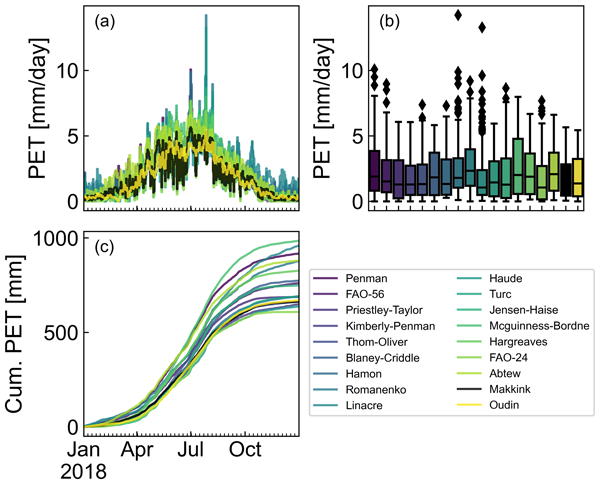
Matevž Vremec, Raoul A. Collenteur, and Steffen Birk
Geosci. Model Dev., 17, 7083–7103, https://doi.org/10.5194/gmd-17-7083-2024, https://doi.org/10.5194/gmd-17-7083-2024, 2024
Short summary
Short summary
Geoscientists commonly use various potential evapotranpiration (PET) formulas for environmental studies, which can be prone to errors and sensitive to climate change. PyEt, a tested and open-source Python package, simplifies the application of 20 PET methods for both time series and gridded data, ensuring accurate and consistent PET estimations suitable for a wide range of environmental applications.
Matevž Vremec, Raoul A. Collenteur, and Steffen Birk
Hydrol. Earth Syst. Sci. Discuss., https://doi.org/10.5194/hess-2022-417, https://doi.org/10.5194/hess-2022-417, 2023
Manuscript not accepted for further review
Short summary
Short summary
This paper introduced PyEt, a Python package for the estimation of daily potential evapotranspiration (PET). The package enables the inclusion of model uncertainty and climate change into the estimation of PET in a consistent, tested, and reproducible environment. With PyEt, users can estimate PET using 20 different methods for both 1D and 3D data, allowing a more sophisticated and comprehensive consideration of PET in hydrological studies, particularly those related to climate change.
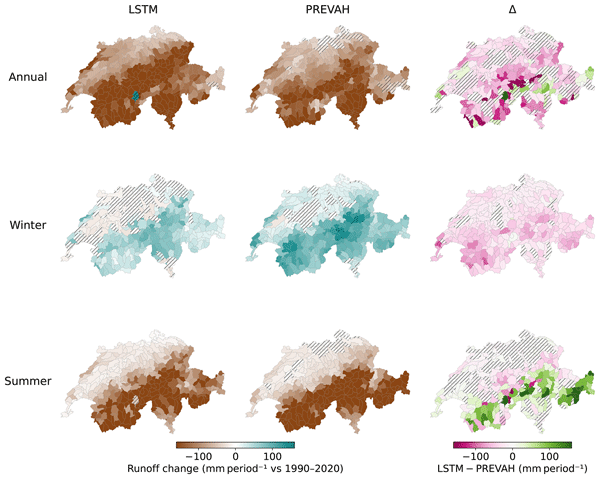
Fabien Courvoisier, Basil Kraft, Yann Yasser Haddad, Massimiliano Zappa, and Lukas Gudmundsson
Hydrol. Earth Syst. Sci., 30, 5873–5900, https://doi.org/10.5194/hess-30-5873-2026, https://doi.org/10.5194/hess-30-5873-2026, 2026
Short summary
Short summary
Climate change strongly modifies runoff in alpine regions like Switzerland, altering water supply and affecting both human sectors and natural ecosystems. We test whether a model that learns only from past observations can credibly project future runoff under climate scenarios. It captures major expected shifts and reveals known limits for extremes. Its speed and ability to generalize across catchments make it a promising tool for assessing climate impacts on water resources.
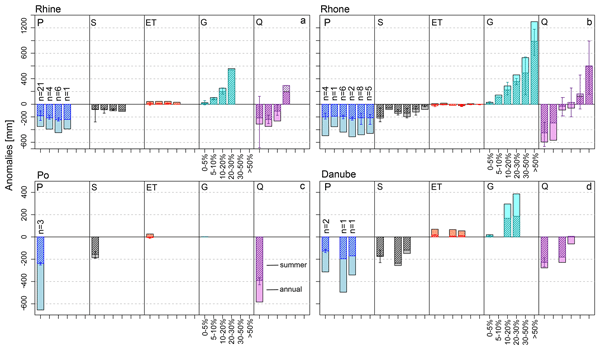
Marit van Tiel, Matthias Huss, Massimiliano Zappa, Tobias Jonas, and Daniel Farinotti
Hydrol. Earth Syst. Sci., 30, 23–43, https://doi.org/10.5194/hess-30-23-2026, https://doi.org/10.5194/hess-30-23-2026, 2026
Short summary
Short summary
The summer of 2022 was extremely warm and dry in Europe, severely impacting water availability. We calculated water balance anomalies for 88 glacierized catchments in Switzerland, showing that glaciers played a crucial role in alleviating the drought situation by melting at record rates, partially compensating for the lack of rain and snowmelt. By comparing 2022 with past extreme years, we show that while glacier meltwater remains essential during droughts, its contribution is declining.
Annie Y.-Y. Chang, Shaun Harrigan, Maria-Helena Ramos, Massimiliano Zappa, Christian M. Grams, Daniela I. V. Domeisen, and Konrad Bogner
EGUsphere, https://doi.org/10.5194/egusphere-2025-3411, https://doi.org/10.5194/egusphere-2025-3411, 2025
Short summary
Short summary
This study presents a machine learning-aided hybrid forecasting framework to improve early warnings of low flows in the European Alps. It combines weather regime information, streamflow observations, and model simulations (EFAS). Even using only weather regime data improves predictions over climatology, while integrating different data sources yields the best result, emphasizing the value of integrating diverse data sources.
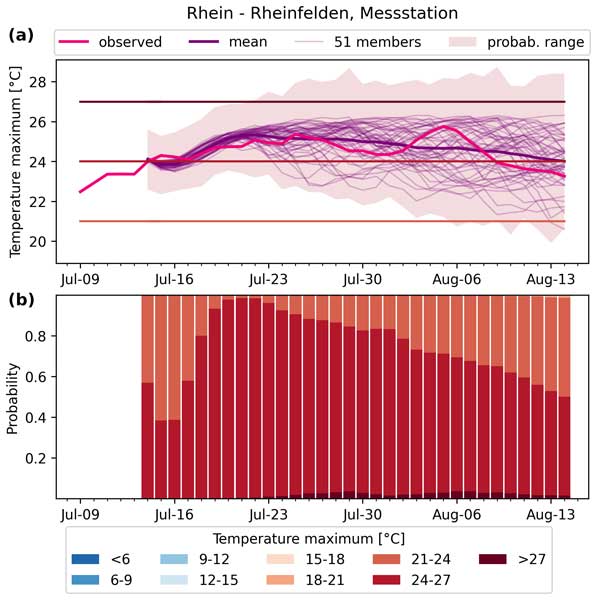
Ryan S. Padrón, Massimiliano Zappa, Luzi Bernhard, and Konrad Bogner
Hydrol. Earth Syst. Sci., 29, 1685–1702, https://doi.org/10.5194/hess-29-1685-2025, https://doi.org/10.5194/hess-29-1685-2025, 2025
Short summary
Short summary
We generate operational forecasts of daily maximum stream water temperature for 32 consecutive days at 54 stations in Switzerland with our best-performing data-driven model. The average forecast error is 0.38 °C for 1 d ahead and increases to 0.90 °C for 32 d ahead given the uncertainty in the meteorological variables influencing water temperature. Here we compare the skill of several models, how well they can forecast at new and ungauged stations, and the importance of different model inputs.
Raoul Alexandre Collenteur, Konrad Bogner, Christian Moeck, Massimiliano Zappa, and Mario Schirmer
Abstr. Int. Cartogr. Assoc., 9, 5, https://doi.org/10.5194/ica-abs-9-5-2025, https://doi.org/10.5194/ica-abs-9-5-2025, 2025
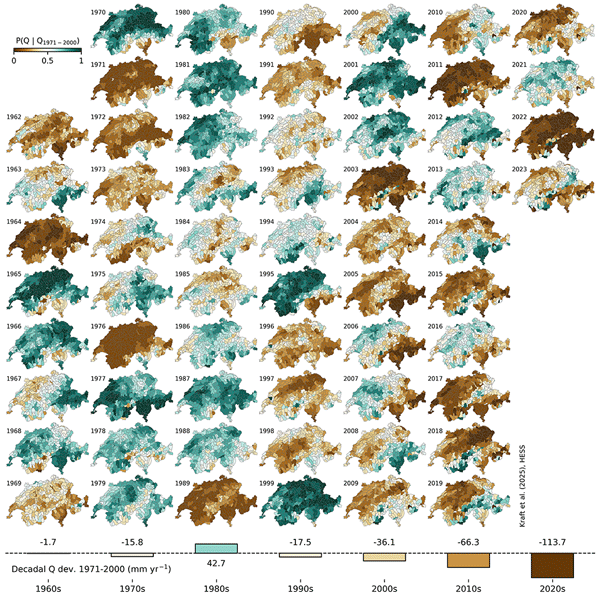
Basil Kraft, Michael Schirmer, William H. Aeberhard, Massimiliano Zappa, Sonia I. Seneviratne, and Lukas Gudmundsson
Hydrol. Earth Syst. Sci., 29, 1061–1082, https://doi.org/10.5194/hess-29-1061-2025, https://doi.org/10.5194/hess-29-1061-2025, 2025
Short summary
Short summary
This study reconstructs daily runoff in Switzerland (1962–2023) using a deep-learning model, providing a spatially contiguous dataset on a medium-sized catchment grid. The model outperforms traditional hydrological methods, revealing shifts in Swiss water resources, including more frequent dry years and declining summer runoff. The reconstruction is publicly available.
Raoul A. Collenteur, Ezra Haaf, Mark Bakker, Tanja Liesch, Andreas Wunsch, Jenny Soonthornrangsan, Jeremy White, Nick Martin, Rui Hugman, Ed de Sousa, Didier Vanden Berghe, Xinyang Fan, Tim J. Peterson, Jānis Bikše, Antoine Di Ciacca, Xinyue Wang, Yang Zheng, Maximilian Nölscher, Julian Koch, Raphael Schneider, Nikolas Benavides Höglund, Sivarama Krishna Reddy Chidepudi, Abel Henriot, Nicolas Massei, Abderrahim Jardani, Max Gustav Rudolph, Amir Rouhani, J. Jaime Gómez-Hernández, Seifeddine Jomaa, Anna Pölz, Tim Franken, Morteza Behbooei, Jimmy Lin, and Rojin Meysami
Hydrol. Earth Syst. Sci., 28, 5193–5208, https://doi.org/10.5194/hess-28-5193-2024, https://doi.org/10.5194/hess-28-5193-2024, 2024
Short summary
Short summary
We show the results of the 2022 Groundwater Time Series Modelling Challenge; 15 teams applied data-driven models to simulate hydraulic heads, and three model groups were identified: lumped, machine learning, and deep learning. For all wells, reasonable performance was obtained by at least one team from each group. There was not one team that performed best for all wells. In conclusion, the challenge was a successful initiative to compare different models and learn from each other.
Matevž Vremec, Raoul A. Collenteur, and Steffen Birk
Geosci. Model Dev., 17, 7083–7103, https://doi.org/10.5194/gmd-17-7083-2024, https://doi.org/10.5194/gmd-17-7083-2024, 2024
Short summary
Short summary
Geoscientists commonly use various potential evapotranpiration (PET) formulas for environmental studies, which can be prone to errors and sensitive to climate change. PyEt, a tested and open-source Python package, simplifies the application of 20 PET methods for both time series and gridded data, ensuring accurate and consistent PET estimations suitable for a wide range of environmental applications.
Michael Margreth, Florian Lustenberger, Dorothea Hug Peter, Fritz Schlunegger, and Massimiliano Zappa
Nat. Hazards Earth Syst. Sci. Discuss., https://doi.org/10.5194/nhess-2024-78, https://doi.org/10.5194/nhess-2024-78, 2024
Publication in NHESS not foreseen
Short summary
Short summary
Recession models (RM) are crucial for observing the low flow behavior of a catchment. We developed two novel RM, which are designed to represent slowly draining catchment conditions. With a newly designed low flow prediction procedure we tested the prediction capability of these two models and three others from literature. One of our novel products delivered the best results, because it best represents the slowly draining catchment conditions.
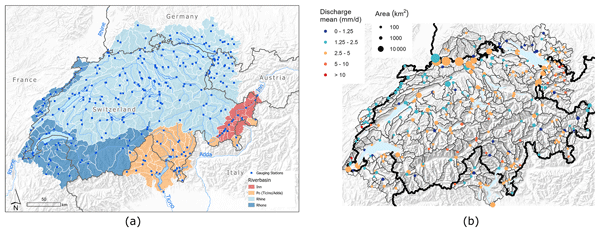
Marvin Höge, Martina Kauzlaric, Rosi Siber, Ursula Schönenberger, Pascal Horton, Jan Schwanbeck, Marius Günter Floriancic, Daniel Viviroli, Sibylle Wilhelm, Anna E. Sikorska-Senoner, Nans Addor, Manuela Brunner, Sandra Pool, Massimiliano Zappa, and Fabrizio Fenicia
Earth Syst. Sci. Data, 15, 5755–5784, https://doi.org/10.5194/essd-15-5755-2023, https://doi.org/10.5194/essd-15-5755-2023, 2023
Short summary
Short summary
CAMELS-CH is an open large-sample hydro-meteorological data set that covers 331 catchments in hydrologic Switzerland from 1 January 1981 to 31 December 2020. It comprises (a) daily data of river discharge and water level as well as meteorologic variables like precipitation and temperature; (b) yearly glacier and land cover data; (c) static attributes of, e.g, topography or human impact; and (d) catchment delineations. CAMELS-CH enables water and climate research and modeling at catchment level.
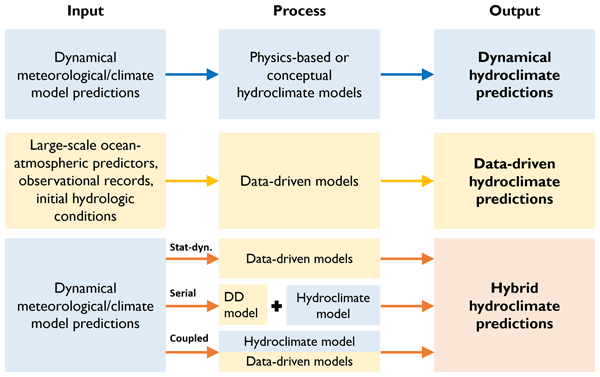
Louise J. Slater, Louise Arnal, Marie-Amélie Boucher, Annie Y.-Y. Chang, Simon Moulds, Conor Murphy, Grey Nearing, Guy Shalev, Chaopeng Shen, Linda Speight, Gabriele Villarini, Robert L. Wilby, Andrew Wood, and Massimiliano Zappa
Hydrol. Earth Syst. Sci., 27, 1865–1889, https://doi.org/10.5194/hess-27-1865-2023, https://doi.org/10.5194/hess-27-1865-2023, 2023
Short summary
Short summary
Hybrid forecasting systems combine data-driven methods with physics-based weather and climate models to improve the accuracy of predictions for meteorological and hydroclimatic events such as rainfall, temperature, streamflow, floods, droughts, tropical cyclones, or atmospheric rivers. We review recent developments in hybrid forecasting and outline key challenges and opportunities in the field.
Matevž Vremec, Raoul A. Collenteur, and Steffen Birk
Hydrol. Earth Syst. Sci. Discuss., https://doi.org/10.5194/hess-2022-417, https://doi.org/10.5194/hess-2022-417, 2023
Manuscript not accepted for further review
Short summary
Short summary
This paper introduced PyEt, a Python package for the estimation of daily potential evapotranspiration (PET). The package enables the inclusion of model uncertainty and climate change into the estimation of PET in a consistent, tested, and reproducible environment. With PyEt, users can estimate PET using 20 different methods for both 1D and 3D data, allowing a more sophisticated and comprehensive consideration of PET in hydrological studies, particularly those related to climate change.
Cited articles
BAFU: Gewässer in der Schweiz, Tech. Rep. Umwelt-Zustand Nr. 2207, Bundesamt für Umwelt BAFU, https://www.bafu.admin.ch/dam/en/sd-web/6GkXszrYc4jS/gewaesser-in-der-schweiz.pdf (last access: 25 November 2026), 2022. a
Bauer, V. M. and Scherrer, S. C.: The observed evolution of sub-daily to multi-day heavy precipitation in Switzerland, Atmos. Sci. Lett., 25, e1240, https://doi.org/10.1002/asl.1240, 2024. a
Blitzstein, J. K. and Hwang, J.: Introduction to Probability, 2nd edn., CRC Press, Boca Raton, FL, ISBN 978-1-138-36991-7, 2019. a
Bogner, K., Liechti, K., Bernhard, L., Monhart, S., and Zappa, M.: Skill of hydrological extended range forecasts for water resources management in Switzerland, Water Resour. Manag., 32, 969–984, https://doi.org/10.1007/s11269-017-1849-5, 2018. a
Bogner, K., Chang, A. Y.-Y., Bernhard, L., Zappa, M., Monhart, S., and Spirig, C.: Tercile forecasts for extending the horizon of skillful hydrological predictions, J. Hydrometeorol., 23, 521–539, https://doi.org/10.1175/JHM-D-21-0020.1, 2022. a
Brakenhoff, D. A., Vonk, M. A., Collenteur, R. A., Van Baar, M., and Bakker, M.: Application of time series analysis to estimate drawdown from multiple well fields, Front. Earth Sci., 10, https://doi.org/10.3389/feart.2022.907609, 2022. a
Brunner, M. I., Liechti, K., and Zappa, M.: Extremeness of recent drought events in Switzerland: dependence on variable and return period choice, Nat. Hazards Earth Syst. Sci., 19, 2311–2323, https://doi.org/10.5194/nhess-19-2311-2019, 2019. a
Cantone, C., Ivars Grape, H., El Habash, S., and Pechlivanidis, I. G.: A co-generation success story: improving drinking water management through hydro-climate services, Climate Services, 31, 100399, https://doi.org/10.1016/j.cliser.2023.100399, 2023. a
Collenteur, R. A., Bakker, M., Caljé, R., Klop, S. A., and Schaars, F.: Pastas: open source software for the analysis of groundwater time series, Groundwater, 57, 877–885, https://doi.org/10.1111/gwat.12925, 2019. a, b
Collenteur, R. A., Bakker, M., Klammler, G., and Birk, S.: Estimation of groundwater recharge from groundwater levels using nonlinear transfer function noise models and comparison to lysimeter data, Hydrol. Earth Syst. Sci., 25, 2931–2949, https://doi.org/10.5194/hess-25-2931-2021, 2021. a, b, c
Collenteur, R., Bogner, K., Zappa, M., and Moeck, C.: Data and scripts to “An ensemble groundwater prediction (EGP) system to forecast groundwater levels in alluvial aquifers in Switzerland”, Zenodo [code and data set], https://doi.org/10.5281/zenodo.17171933, 2025. a
Epting, J., Michel, A., Affolter, A., and Huggenberger, P.: Climate change effects on groundwater recharge and temperatures in Swiss alluvial aquifers, J. Hydrol., 11, 100071, https://doi.org/10.1016/j.hydroa.2020.100071, 2021. a
Gneiting, T., Raftery, A. E., Westveld, A. H., and Goldman, T.: Calibrated probabilistic forecasting using ensemble model output statistics and minimum CRPS estimation, Mon. Weather Rev., 133, 1098–1118, https://doi.org/10.1175/MWR2904.1, 2005. a
Halloran, L. J., Millwater, J., Hunkeler, D., and Arnoux, M.: Climate change impacts on groundwater discharge-dependent streamflow in an alpine headwater catchment, Sci. Total Environ., 902, 166009, https://doi.org/10.1016/j.scitotenv.2023.166009, 2023. a
Hersbach, H.: Decomposition of the continuous ranked probability score for ensemble prediction systems, Weather Forecast., 15, 559–570, https://doi.org/10.1175/1520-0434(2000)015<0559:DOTCRP>2.0.CO;2, 2000. a
Ho, C. K., Hawkins, E., Shaffrey, L., Bröcker, J., Hermanson, L., Murphy, J. M., Smith, D. M., and Eade, R.: Examining reliability of seasonal to decadal sea surface temperature forecasts: the role of ensemble dispersion, Geophys. Res. Lett., 40, 5770–5775, https://doi.org/10.1002/2013GL057630, 2013. a
Huang, J.-Y. and Shih, D.-S.: Assessing groundwater level with a unified seasonal outlook and hydrological modeling projection, Appl. Sci., 10, https://doi.org/10.3390/app10248882, 2020. a
Jolliffe, I. T. and Stephenson, D. B.: Forecast Verification: A practitioner's Guide in Atmospheric Science, John Wiley and Sons, ISBN 978-0-470-66071-3, 2012. a
Mackay, J., Jackson, C., Brookshaw, A., Scaife, A., Cook, J., and Ward, R.: Seasonal forecasting of groundwater levels in principal aquifers of the United Kingdom, J. Hydrol., 530, 815–828, https://doi.org/10.1016/j.jhydrol.2015.10.018, 2015. a, b
MeteoSwiss: RhiresD and TabsD gridded precipitation and temperature data sets, https://www.meteoswiss.admin.ch/home/climate/swiss-climate-in-detail/raeumliche-klimaanalysen.html?query=TabsD (last access: 25 November 2026), 2022. a
Moeck, C., Brunner, P., and Hunkeler, D.: The influence of model structure on groundwater recharge rates in climate-change impact studies, Hydrogeol. J., 24, 1171–1184, https://doi.org/10.1007/s10040-016-1367-1, 2016. a
Monhart, S., Spirig, C., Bhend, J., Bogner, K., Schär, C., and Liniger, M. A.: Skill of subseasonal forecasts in Europe: effect of bias correction and downscaling using surface observations, J. Geophys. Res.-Atmos., 123, 7999–8016, https://doi.org/10.1029/2017JD027923, 2018. a
Monhart, S., Zappa, M., Spirig, C., Schär, C., and Bogner, K.: Subseasonal hydrometeorological ensemble predictions in small- and medium-sized mountainous catchments: benefits of the NWP approach, Hydrol. Earth Syst. Sci., 23, 493–513, https://doi.org/10.5194/hess-23-493-2019, 2019. a, b, c
Neumann, J. L., Arnal, L., Emerton, R. E., Griffith, H., Hyslop, S., Theofanidi, S., and Cloke, H. L.: Can seasonal hydrological forecasts inform local decisions and actions? A decision-making activity, Geosci. Commun., 1, 35–57, https://doi.org/10.5194/gc-1-35-2018, 2018. a
Padrón, R. S., Zappa, M., Bernhard, L., and Bogner, K.: Extended-range forecasting of stream water temperature with deep-learning models, Hydrol. Earth Syst. Sci., 29, 1685–1702, https://doi.org/10.5194/hess-29-1685-2025, 2025. a, b
Padrón, R. S., Buchecker, M., Cremona, A., Farinotti, D., Gossner, M. M., Maidl, E., Pellissier, L., Pezzatti, G. B., Minetti, A., Bernhard, L., Zappa, M., and Bogner, K.: An operational platform for sub-seasonal forecasts of drought-related hazards, International Journal of Cartography, 1–22, https://doi.org/10.1080/23729333.2026.2702173, 2026. a
Prudhomme, C., Hannaford, J., Harrigan, S., Boorman, D., Knight, J., Bell, V., Jackson, C., Svensson, C., Parry, S., Bachiller-Jareno, N., Davies, H., Davis, R., Mackay, J., McKenzie, A., Rudd, A., Smith, K., Bloomfield, J., Ward, R., and Jenkins, A.: Hydrological outlook UK: an operational streamflow and groundwater level forecasting system at monthly to seasonal time scales, Hydrolog. Sci. J., 62, 2753–2768, https://doi.org/10.1080/02626667.2017.1395032, 2017. a
Robertson, D. E., Fu, G., Barron, O., Hodgson, G., and Schepen, A.: A new approach of coupled long-range forecasts for streamflow and groundwater level, J. Hydrol., 631, 130837, https://doi.org/10.1016/j.jhydrol.2024.130837, 2024. a, b, c, d
Rodell, M., Famiglietti, J. S., Wiese, D. N., Reager, J. T., Beaudoing, H. K., Landerer, F. W., and Lo, M.-H.: Emerging trends in global freshwater availability, Nature, 557, 651–659, https://doi.org/10.1038/s41586-018-0123-1, 2018. a
Scanlon, B. R., Fakhreddine, S., Rateb, A., de Graaf, I., Famiglietti, J., Gleeson, T., Grafton, R. Q., Jobbagy, E., Kebede, S., Kolusu, S. R., Konikow, L. F., Long, D., Mekonnen, M., Schmied, H. M., Mukherjee, A., MacDonald, A., Reedy, R. C., Shamsudduha, M., Simmons, C. T., Sun, A., Taylor, R. G., Villholth, K. G., Vörösmarty, C. J., and Zheng, C.: Global water resources and the role of groundwater in a resilient water future, Nature Reviews Earth and Environment, 4, 87–101, https://doi.org/10.1038/s43017-022-00378-6, 2023. a
Scherrer, S. C., Hirschi, M., Spirig, C., Maurer, F., and Kotlarski, S.: Trends and drivers of recent summer drying in Switzerland, Environmental Research Communications, 4, 025004, https://doi.org/10.1088/2515-7620/ac4fb9, 2022. a, b
Seabold, S. and Perktold, J.: Statsmodels: econometric and statistical modeling with Python, in: Proceedings of the 9th Python in Science Conference, Vol. 57, 61, https://doi.org/10.25080/Majora-92bf1922-011, 2010. a
Slater, L. J., Arnal, L., Boucher, M.-A., Chang, A. Y.-Y., Moulds, S., Murphy, C., Nearing, G., Shalev, G., Shen, C., Speight, L., Villarini, G., Wilby, R. L., Wood, A., and Zappa, M.: Hybrid forecasting: blending climate predictions with AI models, Hydrol. Earth Syst. Sci., 27, 1865–1889, https://doi.org/10.5194/hess-27-1865-2023, 2023. a
Treidel, H., Martin-Bordes, J. L., and Gurdak, J. J.: Climate change effects on groundwater resources: a global synthesis of findings and recommendations, 1st edn., CRC Press/Balkema, https://doi.org/10.1201/b11611, 2012. a
Tuel, A., Schaefli, B., Zscheischler, J., and Martius, O.: On the links between sub-seasonal clustering of extreme precipitation and high discharge in Switzerland and Europe, Hydrol. Earth Syst. Sci., 26, 2649–2669, https://doi.org/10.5194/hess-26-2649-2022, 2022. a
Van der Spek, J. E. and Bakker, M.: The influence of the length of the calibration period and observation frequency on predictive uncertainty in time series modeling of groundwater dynamics, Water Resour. Res., 53, 2294–2311, https://doi.org/10.1002/2016WR019704, 2017. a
Viel, C., Beaulant, A.-L., Soubeyroux, J.-M., and Céron, J.-P.: How seasonal forecast could help a decision maker: an example of climate service for water resource management, Adv. Sci. Res., 13, 51–55, https://doi.org/10.5194/asr-13-51-2016, 2016. a
von Asmuth, J. R. and Bierkens, M. F. P.: Modeling irregularly spaced residual series as a continuous stochastic process, Water Resour. Res., 41, W12404, https://doi.org/10.1029/2004WR003726, 2005. a, b
von Asmuth, J. R., Bierkens, M. F. P., and Maas, K.: Transfer function-noise modeling in continuous time using predefined impulse response functions, Water Resour. Res., 38, 23–1–23–12, https://doi.org/10.1029/2001WR001136, 2002. a
von Asmuth, J. R., Maas, K., Bakker, M., and Petersen, J.: Modeling time series of ground water head fluctuations subjected to multiple stresses, Groundwater, 46, 30–40, https://doi.org/10.1111/j.1745-6584.2007.00382.x, 2008. a
Vremec, M., Collenteur, R. A., and Birk, S.: PyEt v1.3.1: a Python package for the estimation of potential evapotranspiration, Geosci. Model Dev., 17, 7083–7103, https://doi.org/10.5194/gmd-17-7083-2024, 2024. a
Wahba, G.: Spline Models for Observational Data, SIAM, https://doi.org/10.1137/1.9781611970128, 1990. a
Wanders, N., Thober, S., Kumar, R., Pan, M., Sheffield, J., Samaniego, L., and Wood, E. F.: Development and evaluation of a pan-European multimodel seasonal hydrological forecasting system, J. Hydrometeorol., 20, 99–115, https://doi.org/10.1175/JHM-D-18-0040.1, 2019. a
White, C. J., Carlsen, H., Robertson, A. W., Klein, R. J., Lazo, J. K., Kumar, A., Vitart, F., Coughlan de Perez, E., Ray, A. J., Murray, V., Bharwani, S., MacLeod, D., James, R., Fleming, L., Morse, A. P., Eggen, B., Graham, R., Kjellström, E., Becker, E., Pegion, K. V., Holbrook, N. J., McEvoy, D., Depledge, M., Perkins-Kirkpatrick, S., Brown, T. J., Street, R., Jones, L., Remenyi, T. A., Hodgson-Johnston, I., Buontempo, C., Lamb, R., Meinke, H., Arheimer, B., and Zebiak, S. E.: Potential applications of subseasonal-to-seasonal (S2S) predictions, Meteorol. Appl., 24, 315–325, https://doi.org/10.1002/met.1654, 2017. a
Wunsch, A., Liesch, T., and Broda, S.: Feature-based groundwater hydrograph clustering using unsupervised self-organizing map-ensembles, Water Resour. Manag., 36, 39–54, https://doi.org/10.1007/s11269-021-03006-y, 2022. a
Short summary
Groundwater is vital for drinking water and farming, but recent droughts revealed it is less reliable than once believed. We developed and tested a new system in Switzerland that combines detailed weather forecasts with a groundwater model to anticipate changes weeks in advance. The system often predicted levels up to a month ahead well, though mountain regions proved harder to forecast. These results highlight both the promise and limits of such tools for improving future water planning.
Groundwater is vital for drinking water and farming, but recent droughts revealed it is less...


Altmetrics
Final-revised paper
Preprint