Articles | Volume 26, issue 11
https://doi.org/10.5194/nhess-26-6157-2026
© Author(s) 2026. This work is distributed under
the Creative Commons Attribution 4.0 License.
https://doi.org/10.5194/nhess-26-6157-2026
© Author(s) 2026. This work is distributed under
the Creative Commons Attribution 4.0 License.
Improved estimation of extreme sea levels via non-asymptotic statistical methods for coastal hazard assessment

Department of Civil, Environmental, and Architectural Engineering, University of Padova, Padova, 35131, Italy
Chiara Favaretto
Department of Civil, Environmental, and Architectural Engineering, University of Padova, Padova, 35131, Italy
Piero Ruol
Department of Civil, Environmental, and Architectural Engineering, University of Padova, Padova, 35131, Italy
Marco Marani
Department of Civil, Environmental, and Architectural Engineering, University of Padova, Padova, 35131, Italy
Research Center on Climate Change Impacts, University of Padova, Rovigo, 45100, Italy
Related authors
No articles found.
Antonio Annis, Fernando Nardi, and Marco Marani
EGUsphere, https://doi.org/10.5194/egusphere-2026-4418, https://doi.org/10.5194/egusphere-2026-4418, 2026
Short summary
Short summary
Floods harm crops very differently depending on when they happen: the same flooding can ruin a field at flowering but barely affect it after harvest. Risk studies usually overlook this timing. We built a method that simulates realistic rainstorms month by month, follows the water across the landscape, and links the flooding to how sensitive each crop is then. Timing changes expected yearly losses considerably, helping farmers and planners protect the right places at the right time.
Chiara Favaretto, Francesco Barbariol, Alvise Benetazzo, Luigi Cavaleri, Francesco Marcello Falcieri, Christian Ferrarin, Rossella Ferretti, Stefano Menegon, Matteo Nastasi, Gianluca Redaelli, Antonio Ricchi, and Piero Ruol
EGUsphere, https://doi.org/10.5194/egusphere-2026-2285, https://doi.org/10.5194/egusphere-2026-2285, 2026
Short summary
Short summary
Coastal flooding is becoming more frequent and damaging, but warnings often rely on single forecasts that miss important uncertainty. We developed and tested a new early warning approach that uses multiple weather scenarios to better describe possible flood outcomes, while reducing computing costs. Applied to severe storms in northern Italy, the method preserved key information and showed that reliable flood alerts can be produced efficiently, supporting practical early warning systems.
Alice Puppin, Davide Tognin, Massimiliano Ghinassi, Erica Franceschinis, Nicola Realdon, Marco Marani, and Andrea D'Alpaos
Biogeosciences, 21, 2937–2954, https://doi.org/10.5194/bg-21-2937-2024, https://doi.org/10.5194/bg-21-2937-2024, 2024
Short summary
Short summary
This study aims at inspecting organic matter dynamics affecting the survival and carbon sink potential of salt marshes, which are valuable yet endangered wetland environments. Measuring the organic matter content in marsh soils and its relationship with environmental variables, we observed that the organic matter accumulation varies at different scales, and it is driven by the interplay between sediment supply and vegetation, which are affected, in turn, by marine and fluvial influences.
Guillaume Goodwin, Marco Marani, Sonia Silvestri, Luca Carniello, and Andrea D'Alpaos
Biogeosciences, 20, 4551–4576, https://doi.org/10.5194/bg-20-4551-2023, https://doi.org/10.5194/bg-20-4551-2023, 2023
Short summary
Short summary
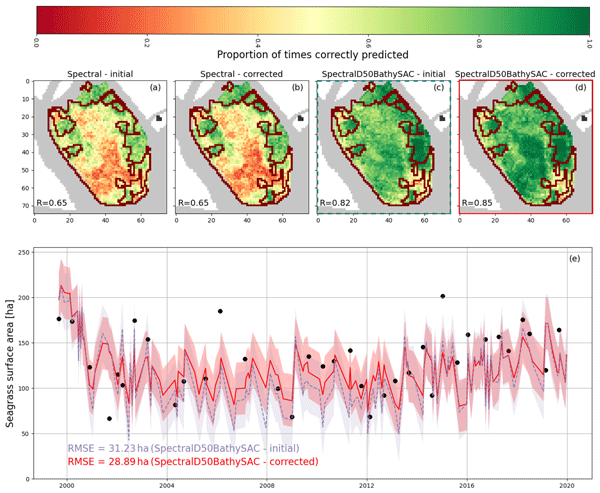
Seagrass meadows are an emblematic coastal habitat. Their sensitivity to environmental change means that it is essential to monitor their evolution closely. However, high costs make this endeavor a technical challenge. Here, we used machine learning to map seagrass meadows in 148 satellite images in the Venice Lagoon, Italy. We found that adding information such as depth of the seabed and known seagrass location improved our capacity to map temporal change in seagrass habitat.
T. Blount, S. Silvestri, M. Marani, and A. D’Alpaos
Int. Arch. Photogramm. Remote Sens. Spatial Inf. Sci., XLVIII-1-W1-2023, 57–62, https://doi.org/10.5194/isprs-archives-XLVIII-1-W1-2023-57-2023, https://doi.org/10.5194/isprs-archives-XLVIII-1-W1-2023-57-2023, 2023
Eleonora Dallan, Francesco Marra, Giorgia Fosser, Marco Marani, Giuseppe Formetta, Christoph Schär, and Marco Borga
Hydrol. Earth Syst. Sci., 27, 1133–1149, https://doi.org/10.5194/hess-27-1133-2023, https://doi.org/10.5194/hess-27-1133-2023, 2023
Short summary
Short summary
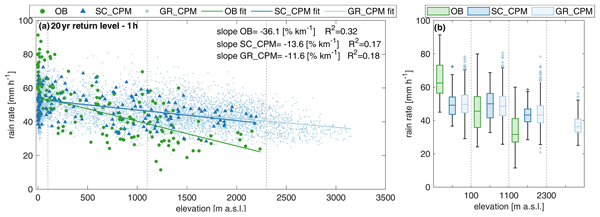
Convection-permitting climate models could represent future changes in extreme short-duration precipitation, which is critical for risk management. We use a non-asymptotic statistical method to estimate extremes from 10 years of simulations in an orographically complex area. Despite overall good agreement with rain gauges, the observed decrease of hourly extremes with elevation is not fully represented by the model. Climate model adjustment methods should consider the role of orography.
Maria Francesca Caruso and Marco Marani
Nat. Hazards Earth Syst. Sci., 22, 1109–1128, https://doi.org/10.5194/nhess-22-1109-2022, https://doi.org/10.5194/nhess-22-1109-2022, 2022
Short summary
Short summary
We comparatively evaluate the predictive performance of traditional and new approaches to estimate the probability distributions of extreme coastal water levels. The metastatistical approach maximizes the use of observational information and provides reliable estimates of high quantiles with respect to traditional methods. Leveraging the increased estimation accuracy afforded by this approach, we investigate future changes in the frequency of extreme total water levels.
Cited articles
Agilan, V., Umamahesh, N. V., and Mujumdar, P. P.: Influence of threshold selection in modeling peaks over threshold based nonstationary extreme rainfall series, J. Hydrol., 593, https://doi.org/10.1016/j.jhydrol.2020.125625, 2021.
Ali, E., Cramer, W., Carnicer, J., Georgopoulou, E., Hilmi, N. J. M., Le Cozannet, G., and Lionello, P.: Cross-Chapter Paper 4: Mediterranean Region, in: Climate Change 2022 – Impacts, Adaptation and Vulnerability, edited by: Tignor, M., Poloczanska, E. S., Mintenbeck, K., Alegría, A., Craig, M., Langsdorf, S., Löschke, S., Möller, V., Okem, A., and Rama, B., Cambridge University Press, Cambridge, UK and New York, NY, USA, 2233–2272, https://doi.org/10.1017/9781009325844.021, 2022.
Amarouche, K., Akpınar, A., and Semedo, A.: Wave storm events in the Western Mediterranean Sea over four decades, Ocean Model., 170, https://doi.org/10.1016/j.ocemod.2021.101933, 2022.
An, Y. and Pandey, M. D.: A comparison of methods of extreme wind speed estimation, J. Wind Eng. Ind. Aerod., 93, 535–545, https://doi.org/10.1016/j.jweia.2005.05.003, 2005.
Antunes, C., Rocha, C., and Catita, C.: Coastal flood assessment due to sea level rise and extreme storm events: A case study of the atlantic coast of Portugal's mainland, Geosciences, 9, https://doi.org/10.3390/geosciences9050239, 2019.
Bajo, M., Ferrarin, C., Umgiesser, G., Bonometto, A., and Coraci, E.: Modelling the barotropic sea level in the Mediterranean Sea using data assimilation, Ocean Sci., 19, 559–579, https://doi.org/10.5194/os-19-559-2023, 2023.
Batt, R. D., Carpenter, S. R., and Ives, A. R.: Extreme events in lake ecosystem time series, Limnol. Oceanogr. Lett., 2, https://doi.org/10.1002/lol2.10037, 2017.
Bernardara, P., Mazas, F., Kergadallan, X., and Hamm, L.: A two-step framework for over-threshold modelling of environmental extremes, Nat. Hazards Earth Syst. Sci., 14, 635–647, https://doi.org/10.5194/nhess-14-635-2014, 2014.
Bernier, N. B., Hemer, M., Mori, N., Appendini, C. M., Breivik, O., de Camargo, R., Casas-Prat, M., Duong, T. M., Haigh, I. D., Howard, T., Hernaman, V., Huizy, O., Irish, J. L., Kirezci, E., Kohno, N., Lee, J. W., McInnes, K. L., Meyer, E. M. I., Marcos, M., Marsooli, R., Martin Oliva, A., Menendez, M., Moghimi, S., Muis, S., Polton, J. A., Pringle, W. J., Ranasinghe, R., Saillour, T., Smith, G., Tadesse, M. G., Swail, V., Tomoya, S., Voukouvalas, E., Wahl, T., Wang, P., Weisse, R., Westerink, J. J., Young, I., and Zhang, Y. J.: Storm surges and extreme sea levels: Review, establishment of model intercomparison and coordination of surge climate projection efforts (SurgeMIP), Weather Clim. Extrem., 45, https://doi.org/10.1016/j.wace.2024.100689, 2024.
Besio, G., Briganti, R., Romano, A., Mentaschi, L., and De Girolamo, P.: Time clustering of wave storms in the Mediterranean Sea, Nat. Hazards Earth Syst. Sci., 17, 505–514, https://doi.org/10.5194/nhess-17-505-2017, 2017.
Borzì, A. M., Minio, V., De Plaen, R., Lecocq, T., Cannavò, F., Ciraolo, G., D'Amico, S., Re, C. Lo, Monaco, C., Picone, M., Scardino, G., Scicchitano, G., and Cannata, A.: Long-term analysis of microseism during extreme weather events: Medicanes and common storms in the Mediterranean Sea, Sci. Total Environ., 915, https://doi.org/10.1016/j.scitotenv.2024.169989, 2024.
Boumis, G., Moftakhari, H. R., and Moradkhani, H.: A metastatistical frequency analysis of extreme storm surge hazard along the US coastline, Coast. Eng. J., 66, 380–394, https://doi.org/10.1080/21664250.2024.2338323, 2024.
Breilh, J. F., Bertin, X., Chaumillon, É., Giloy, N., and Sauzeau, T.: How frequent is storm-induced flooding in the central part of the Bay of Biscay?, Glob. Planet. Change, 122, 161–175, https://doi.org/10.1016/j.gloplacha.2014.08.013, 2014.
Caruso, M. F. and Marani, M.: Extreme-coastal-water-level estimation and projection: a comparison of statistical methods, Nat. Hazards Earth Syst. Sci., 22, 1109–1128, https://doi.org/10.5194/nhess-22-1109-2022, 2022.
Chowdhury, J. U., Stedinger, J. R., and Lu, L.-H: Goodness-of-fit tests for regional generalized extreme value flood distributions, Water Resour. Res., 27, 1765–1776, https://doi.org/10.1029/91WR00077, 1991.
Cid, A., Menéndez, M., Castanedo, S., Abascal, A. J., Méndez, F. J., and Medina, R.: Long-term changes in the frequency, intensity and duration of extreme storm surge events in southern Europe, Clim. Dyn., 46, 1503–1516, https://doi.org/10.1007/s00382-015-2659-1, 2016.
Coles, S.: An Introduction to Statistical Modeling of Extreme Values, Springer London, London, https://doi.org/10.1007/978-1-4471-3675-0, 2001.
Coles, S. and Casson, E.: Extreme value modelling of hurricane wind speeds, Struct. Saf., 20, 283–296, 1998.
Coles, S. and Tawn, J.: Bayesian modelling of extreme surges on the UK east coast, Philos. T. Roy. Soc. A, 363, 1387–1406, https://doi.org/10.1098/rsta.2005.1574, 2005.
Conte, D. and Lionello, P.: Storm Surge Distribution Along the Mediterranean Coast: Characteristics and Evolution, Procedia Soc. Behav. Sci., 120, 110–115, https://doi.org/10.1016/j.sbspro.2014.02.087, 2014.
Davison, A. C. and Smith, R. L.: Models for Exceedances over High Thresholds, J. R. Statist. Soc. B, 52, 393–442, 1990.
Dias, J. M., Pereira, F., Picado, A., Lopes, C. L., Pinheiro, J. P., Lopes, S. M., and Pinho, P. G.: A comprehensive estuarine hydrodynamics-salinity study: Impact of morphologic changes on Ria de Aveiro (atlantic coast of Portugal), J. Mar. Sci. Eng., 9, 234, https://doi.org/10.3390/jmse9020234, 2021.
Fanjul, A. E., Gomez, B. P., Carretero, J. C., Rodriguez, I., and Arevalo, S.: Tide and surge dynamics along the Iberian Atlantic coast, Oceanol. Acta, 21, 131–143, 1998.
Ferrarin, C., Bellafiore, D., Sannino, G., Bajo, M., and Umgiesser, G.: Tidal dynamics in the inter-connected Mediterranean, Marmara, Black and Azov seas, Prog. Oceanogr., 161, 102–115, https://doi.org/10.1016/j.pocean.2018.02.006, 2018.
Fisher, R. A. and Tippett, L. H. C.: Limiting forms of the frequency distribution of the largest or smallest member of a sample, Math. Proc. Cambridge, 24, 180–190, https://doi.org/10.1017/S0305004100015681, 1928.
Fouad, S. S., Heggy, E., Amrouni, O., Hzami, A., Nijhuis, S., Mohamed, N., Saleh, I. H., Jomaa, S., Elsheshtawy, Y., and Weilacher, U.: Soaring Building Collapses in Southern Mediterranean Coasts: Hydroclimatic Drivers & Adaptive Landscape Mitigations, Earths Future, 13, https://doi.org/10.1029/2024EF004883, 2025.
Gao, H., Shao, Z., Wu, G., and Li, P.: Study of directional declustering for estimating extreme wave heights in the Yellow Sea, J. Mar. Sci. Eng., 8, https://doi.org/10.3390/JMSE8040236, 2020.
Gnedenko, P. B.: Sur la distribution limite du terme maximum d'une serie aleatoire, Ann. Math., 44, 423–453, 1943.
Greenwood, J. A., Landwehr, J. M., Matalas, N. C., and Wallis, J. R.: Probability weighted moments: Definition and relation to parameters of several distributions expressable in inverse form, Water Resour. Res., 15, 1049–1054, https://doi.org/10.1029/WR015i005p01049, 1979.
Haigh, I., Nicholls, R., and Wells, N.: Assessing changes in extreme sea levels: Application to the English Channel, 1900–2006, Cont. Shelf Res., 30, 1042–1055, https://doi.org/10.1016/j.csr.2010.02.002, 2010.
Hamdi, Y., Bardet, L., Duluc, C.-M., and Rebour, V.: Extreme storm surges: a comparative study of frequency analysis approaches, Nat. Hazards Earth Syst. Sci., 14, 2053–2067, https://doi.org/10.5194/nhess-14-2053-2014, 2014.
Hosking, J. R. M.: L-moments: Analysis and Estimation of Distributions using Linear Combinations of Order Statistics, J. Roy. Stat. Soc. B, 52, 105–124, 1990.
Ibáñez, C. and Caiola, N.: Sea-level rise, marine storms and the resilience of Mediterranean coastal wetlands: Lessons learned from the Ebro Delta, Mar. Freshw. Res., 73, 1246–1254, https://doi.org/10.1071/MF21140, 2021.
Jenkinson, A. F.: The frequency distribution of the annual maximum (or minimum) values of meteorological elements, Q. J. Roy. Meteor. Soc., 81, 158–171, https://doi.org/10.1002/qj.49708134804, 1955.
Kirezci, E., Young, I. R., Ranasinghe, R., Muis, S., Nicholls, R. J., Lincke, D., and Hinkel, J.: Projections of global-scale extreme sea levels and resulting episodic coastal flooding over the 21st Century, Sci. Rep., 10, https://doi.org/10.1038/s41598-020-67736-6, 2020.
Kirezci, E., Young, I. R., Ranasinghe, R., Lincke, D., and Hinkel, J.: Global-scale analysis of socioeconomic impacts of coastal flooding over the 21st century, Front. Mar. Sci., 9, https://doi.org/10.3389/fmars.2022.1024111, 2023.
Krit, M., Gaudoin, O., and Remy, E.: Goodness-of-fit tests for the Weibull and extreme value distributions: A review and comparative study, Commun. Stat. Simul. Comput., 50, https://doi.org/10.1080/03610918.2019.1594292, 2021.
Marani, M. and Ignaccolo, M.: A metastatistical approach to rainfall extremes, Adv. Water Resour., 79, 121–126, https://doi.org/10.1016/j.advwatres.2015.03.001, 2015.
Marcos, M., Tsimplis, M. N., and Shaw, A. G. P.: Sea level extremes in southern Europe, J. Geophys. Res.-Oceans, 114, https://doi.org/10.1029/2008JC004912, 2009.
Marra, F., Nikolopoulos, E. I., Anagnostou, E. N., and Morin, E.: Metastatistical Extreme Value analysis of hourly rainfall from short records: Estimation of high quantiles and impact of measurement errors, Adv. Water Resour., 117, 27–39, https://doi.org/10.1016/j.advwatres.2018.05.001, 2018.
Martín, A., Wahl, T., Enriquez, A. R., and Jane, R.: Storm surge time series de-clustering using correlation analysis, Weather Clim. Extrem., 45, https://doi.org/10.1016/j.wace.2024.100701, 2024.
Martins, E. S. and Stedinger, J. R.: Generalized maximum likelihood Pareto-Poisson estimators for partial duration series, Water Resour. Res., 37, 2551–2557, https://doi.org/10.1029/2001WR000367, 2001.
MedECC: Climate and Environmental Change in the Mediterranean Basin – Current Situation and Risks for the Future, First Mediterranean Assessment Report, edited by: Cramer, W., Guiot, J., and Marini, K., Union for the Mediterranean, Plan Bleu, UNEP/MAP, Marseille, France, 632 pp., ISBN: 978-2-9577416-0-1, 2020.
Međugorac, I., Pasarić, M., and Orlić, M.: Historical sea-level measurements at Bakar (east Adriatic), SEANOE [data set], https://doi.org/10.17882/85171, 2026.
Miniussi, A. and Marani, M.: Estimation of Daily Rainfall Extremes Through the Metastatistical Extreme Value Distribution: Uncertainty Minimization and Implications for Trend Detection, Water Resour. Res., 56, https://doi.org/10.1029/2019WR026535, 2020.
Nash, J. E. and Sutcliffe, J. V.: River flow forecasting through conceptual models part I – A discussion of principles, J. Hydrol., 10, 282–290, https://doi.org/10.1016/0022-1694(70)90255-6, 1970.
Pan, X., Rahman, A., Haddad, K., and Ouarda, T. B. M. J.: Peaks-over-threshold model in flood frequency analysis: a scoping review, Stoch. Env. Res. Risk A., 36, https://doi.org/10.1007/s00477-022-02174-6, 2022.
Pickands, J.: Statistical inference using extreme order statistics, Ann. Stat., 3, 119–131, 1975.
Potisomporn, P., Adcock, T. A. A., and Vogel, C. R.: Extreme value analysis of wind droughts in Great Britain, Renew. Energy, 221, https://doi.org/10.1016/j.renene.2023.119847, 2024.
Ribeiro, A., Barbosa, S. M., Scotto, M. G., and Donner, R. V.: Changes in extreme sea-levels in the Baltic Sea, Tellus A, 66, 20921, https://doi.org/10.3402/tellusa.v66.20921, 2014.
Seneviratne, S. I., Zhang, X., Adnan, M., Badi, W., Dereczynski, C., Di Luca, A., Ghosh, S., Iskandar, I., Kossin, J., Lewis, S., Otto, F., Pinto, I., Satoh, M., Vicente-Serrano, S. M., Wehner, M., and Zhou, B.: Weather and Climate Extreme Events in a Changing Climate, in: Climate Change 2021: The Physical Science Basis. Contribution of Working Group I to the Sixth Assessment Report of the Intergovernmental Panel on Climate Change, edited by: Masson-Delmotte, V., Zhai, P., Pirani, A., Connors, S. L., Péan, C., Berger, S., Caud, N., Chen, Y., Goldfarb, L., Gomis, M. I., Huang, M., Leitzell, K., Lonnoy, E., Matthews, J. B. R., Maycock, T. K., Waterfield, T., Yelekçi, O., Yu, R., and Zhou, B., Cambridge University Press, Cambridge University Press, Cambridge, United Kingdom and New York, NY, USA, 1513–1766, https://doi.org/10.1017/9781009157896.013, 2021.
Serinaldi, F. and Kilsby, C. G.: Rainfall extremes: Toward reconciliation after the battle of distributions, Water Resour. Res., 50, 336–352, https://doi.org/10.1002/2013WR014211, 2014.
Sithara, S., Pramada, S. K., and Thampi, S. G.: Quantifying uncertainty in future sea level projections downscaled from CMIP5 global climate models, Stoch. Env. Res. Risk A., 38, 2065–2079, https://doi.org/10.1007/s00477-024-02669-4, 2024.
Smirlis, Y., Tsioumas, V., Papadimitriou, S., and Tzannatos, E.: An extreme value analysis framework for the tanker market, WMU Journal of Maritime Affairs, https://doi.org/10.1007/s13437-025-00380-x, 2025.
Smith, R.: Extreme value statistics in meteorology and the environment, in: Environmental statistics, Department of Statistics, University of North Carolina, Chapel Hill, NC, USA, 300–377, 2001.
Smith, R. L.: Extreme Value Analysis of Environmental Time Series: An Application to Trend Detection in Ground-Level Ozone, Stat. Sci., 4, 367–377, 1989.
Solari, S., Egüen, M., Polo, M. J., and Losada, M. A.: Peaks Over Threshold (POT): A methodology for automatic threshold estimation using goodness of fit p-value, Water Resour. Res., 53, 2833–2849, https://doi.org/10.1002/2016WR019426, 2017.
Sousa, P. M., Trigo, R. M., Aizpurua, P., Nieto, R., Gimeno, L., and Garcia-Herrera, R.: Trends and extremes of drought indices throughout the 20th century in the Mediterranean, Nat. Hazards Earth Syst. Sci., 11, 33–51, https://doi.org/10.5194/nhess-11-33-2011, 2011.
Tebaldi, C., Ranasinghe, R., Vousdoukas, M., Rasmussen, D. J., Vega-Westhoff, B., Kirezci, E., Kopp, R. E., Sriver, R., and Mentaschi, L.: Extreme sea levels at different global warming levels, Nat. Clim. Chang., 11, 746–751, https://doi.org/10.1038/s41558-021-01127-1, 2021.
Toomey, T., Amores, A., Marcos, M., and Orfila, A.: Coastal sea levels and wind-waves in the Mediterranean Sea since 1950 from a high-resolution ocean reanalysis, Front. Mar. Sci., 9, https://doi.org/10.3389/fmars.2022.991504, 2022.
Toomey, T., Lira-Loarca, A., Marcos, M., Besio, G., and Orfila, A.: Future Wave Climate in the Mediterranean Sea and Associated Uncertainty From an Ensemble of 31 GCM-RCM Wave Simulations, Earths Future, 13, https://doi.org/10.1029/2024EF004992, 2025.
Tsimplis, M. N. and Shaw, A. G. P.: Seasonal sea level extremes in the Mediterranean Sea and at the Atlantic European coasts, Nat. Hazards Earth Syst. Sci., 10, 1457–1475, https://doi.org/10.5194/nhess-10-1457-2010, 2010.
UNEP/MAP: State of the environment and development in the mediterranean, United Nations Environment Programme/Mediterranean Action Plan (UNEP/MAP), ISBN 978-92-807-3796-7, 2020.
Valle-Levinson, A., Marani, M., Carniello, L., D'Alpaos, A., and Lanzoni, S.: Astronomic link to anomalously high mean sea level in the northern Adriatic Sea, Estuar. Coast. Shelf Sci., 257, https://doi.org/10.1016/j.ecss.2021.107418, 2021.
Von Mises, R.: La distribution de la plus grande de n valeurs (reprinted in: Selected Papers of Richard von Mises, Vol. II, American Mathematical Society, Providence, Rhode Island, 271–294, 1964), Rev. Math. Union Interbalcanique, 1, 141–160, 1936.
Vousdoukas, M. I., Voukouvalas, E., Annunziato, A., Giardino, A., and Feyen, L.: Projections of extreme storm surge levels along Europe, Clim. Dyn., 47, 3171–3190, https://doi.org/10.1007/s00382-016-3019-5, 2016.
Woodworth, P. L., Menéndez, M., and Gehrels, W. R.: Evidence for Century-Timescale Acceleration in Mean Sea Levels and for Recent Changes in Extreme Sea Levels, Surv. Geophys., 32, 603–618, https://doi.org/10.1007/s10712-011-9112-8, 2011.
Zorzetto, E., Botter, G., and Marani, M.: On the emergence of rainfall extremes from ordinary events, Geophys. Res. Lett., 43, 8076–8082, https://doi.org/10.1002/2016GL069445, 2016.
Short summary
Sea level records are often too short. The traditional asymptotic extreme value analysis fails to produce accurate results with short records. By leveraging the non-asymptotic Metastatistical Extreme Value Distribution via the integration of two novel independent event selection methodologies, along with a robust cross-validation procedure, we found that our methodology can accurately estimate the likelihood of long return period extreme sea level events in data-scarce settings.
Sea level records are often too short. The traditional asymptotic extreme value analysis fails...
Altmetrics
Final-revised paper
Preprint