Articles | Volume 26, issue 8
https://doi.org/10.5194/nhess-26-4071-2026
© Author(s) 2026. This work is distributed under
the Creative Commons Attribution 4.0 License.
https://doi.org/10.5194/nhess-26-4071-2026
© Author(s) 2026. This work is distributed under
the Creative Commons Attribution 4.0 License.
Assessing financial risk to property portfolios from physical rainfall extremes

Laura C. Dawkins
CORRESPONDING AUTHOR
Met Office, FitzRoy Road, Exeter, EX1 3PB, United Kingdom
Freya K. Garry
Met Office, FitzRoy Road, Exeter, EX1 3PB, United Kingdom
Dan J. Bernie
Met Office, FitzRoy Road, Exeter, EX1 3PB, United Kingdom
University of Bristol Medical School, Beacon House, Queens Road, Bristol, BS8 1QU, United Kingdom
Jason A. Lowe
Met Office, FitzRoy Road, Exeter, EX1 3PB, United Kingdom
Priestley International Centre for Climate, University of Leeds, Leeds, United Kingdom
Theodoros Economou
Met Office, FitzRoy Road, Exeter, EX1 3PB, United Kingdom
College of Engineering, Mathematics and Physical Sciences, University of Exeter, Exeter, United Kingdom
Related authors
No articles found.
Paula L. M. Gonzalez, Duncan Ackerley, Eloise Matthews, Dan Suri, Emily Wallace, Matthew Wheeler, Jason A. Lowe, and Daisy Harley-Nyang
Earth Syst. Sci. Data Discuss., https://doi.org/10.5194/essd-2026-181, https://doi.org/10.5194/essd-2026-181, 2026
Revised manuscript accepted for ESSD
Short summary
Short summary
The Named Storms Catalogue is the first dataset to systematically evaluate ten years of UK storm naming using carefully designed metrics developed with Met Office meteorologists. It reveals how storms evolved and the hazards they created, enabling unprecedented comparison, ranking, and insight. The work introduces the dataset, showcases three case studies, and explores current and future uses with a view to helping experts and responders better understand and manage storm impacts.
Detlef P. Van Vuuren, Brian C. O'Neill, Claudia Tebaldi, Benjamin M. Sanderson, Louise P. Chini, Pierre Friedlingstein, Tomoko Hasegawa, Keywan Riahi, Bala Govindasamy, Nico Bauer, Veronika Eyring, Cheikh M. N. Fall, Katja Frieler, Matthew J. Gidden, Laila K. Gohar, Annika Högner, Andrew D. Jones, Jarmo Kikstra, Andrew King, Reto Knutti, Elmar Kriegler, Peter Lawrence, Chris Lennard, Jason Lowe, Camilla Mathison, Shahbaz Mehmood, Zebedee Nicholls, Luciana F. Prado, Qiang Zhang, Steven K. Rose, Alex C. Ruane, Marit Sandstad, Carl-Friedrich Schleussner, Roland Seferian, Jana Sillmann, Chris Smith, Anna A. Sörensson, Swapna Panickal, Kaoru Tachiiri, Naomi Vaughan, Saritha S. Vishwanathan, Tokuta Yokohata, Marco Zecchetto, and Tilo Ziehn
Geosci. Model Dev., 19, 2627–2656, https://doi.org/10.5194/gmd-19-2627-2026, https://doi.org/10.5194/gmd-19-2627-2026, 2026
Short summary
Short summary
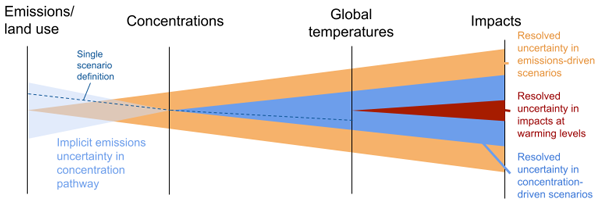
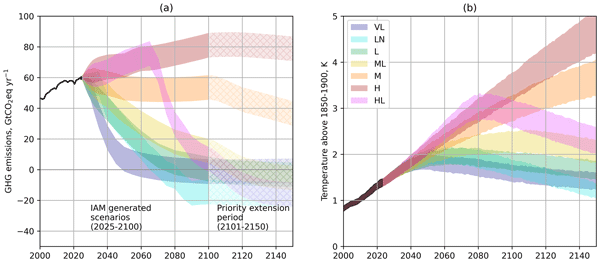
We propose a set of seven plausible 21st century emission scenarios, and their multi-century extensions, that will be used by the international community of climate modeling centers to produce the next generation of climate projections. These projections will support climate, impact and mitigation researchers, provide information to practitioners to address future risks from climate change, and contribute to policymakers’ considerations of the trade-offs among various levels of mitigation.
Pantelis Georgiades, Theo Economou, Yiannis Proestos, Jose Araya, Jos Lelieveld, and Marco Neira
Earth Syst. Sci. Data, 17, 1153–1171, https://doi.org/10.5194/essd-17-1153-2025, https://doi.org/10.5194/essd-17-1153-2025, 2025
Short summary
Short summary
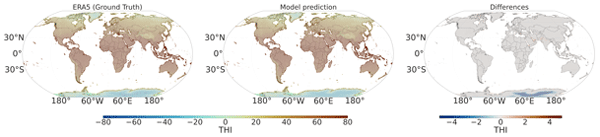
Climate change is posing increasing challenges in the dairy cattle farming sector, as heat stress adversely affects the animals' health and milk production. To accurately assess these impacts, we developed a machine learning model to downscale daily climate data to hourly Temperature Humidity Index (THI) values. We utilized historical weather data to train our model and applied them to future climate projections, under two climate scenarios.
Benjamin M. Sanderson, Ben B. B. Booth, John Dunne, Veronika Eyring, Rosie A. Fisher, Pierre Friedlingstein, Matthew J. Gidden, Tomohiro Hajima, Chris D. Jones, Colin G. Jones, Andrew King, Charles D. Koven, David M. Lawrence, Jason Lowe, Nadine Mengis, Glen P. Peters, Joeri Rogelj, Chris Smith, Abigail C. Snyder, Isla R. Simpson, Abigail L. S. Swann, Claudia Tebaldi, Tatiana Ilyina, Carl-Friedrich Schleussner, Roland Séférian, Bjørn H. Samset, Detlef van Vuuren, and Sönke Zaehle
Geosci. Model Dev., 17, 8141–8172, https://doi.org/10.5194/gmd-17-8141-2024, https://doi.org/10.5194/gmd-17-8141-2024, 2024
Short summary
Short summary
We discuss how, in order to provide more relevant guidance for climate policy, coordinated climate experiments should adopt a greater focus on simulations where Earth system models are provided with carbon emissions from fossil fuels together with land use change instructions, rather than past approaches that have largely focused on experiments with prescribed atmospheric carbon dioxide concentrations. We discuss how these goals might be achieved in coordinated climate modeling experiments.
Colin G. Jones, Fanny Adloff, Ben B. B. Booth, Peter M. Cox, Veronika Eyring, Pierre Friedlingstein, Katja Frieler, Helene T. Hewitt, Hazel A. Jeffery, Sylvie Joussaume, Torben Koenigk, Bryan N. Lawrence, Eleanor O'Rourke, Malcolm J. Roberts, Benjamin M. Sanderson, Roland Séférian, Samuel Somot, Pier Luigi Vidale, Detlef van Vuuren, Mario Acosta, Mats Bentsen, Raffaele Bernardello, Richard Betts, Ed Blockley, Julien Boé, Tom Bracegirdle, Pascale Braconnot, Victor Brovkin, Carlo Buontempo, Francisco Doblas-Reyes, Markus Donat, Italo Epicoco, Pete Falloon, Sandro Fiore, Thomas Frölicher, Neven S. Fučkar, Matthew J. Gidden, Helge F. Goessling, Rune Grand Graversen, Silvio Gualdi, José M. Gutiérrez, Tatiana Ilyina, Daniela Jacob, Chris D. Jones, Martin Juckes, Elizabeth Kendon, Erik Kjellström, Reto Knutti, Jason Lowe, Matthew Mizielinski, Paola Nassisi, Michael Obersteiner, Pierre Regnier, Romain Roehrig, David Salas y Mélia, Carl-Friedrich Schleussner, Michael Schulz, Enrico Scoccimarro, Laurent Terray, Hannes Thiemann, Richard A. Wood, Shuting Yang, and Sönke Zaehle
Earth Syst. Dynam., 15, 1319–1351, https://doi.org/10.5194/esd-15-1319-2024, https://doi.org/10.5194/esd-15-1319-2024, 2024
Short summary
Short summary
We propose a number of priority areas for the international climate research community to address over the coming decade. Advances in these areas will both increase our understanding of past and future Earth system change, including the societal and environmental impacts of this change, and deliver significantly improved scientific support to international climate policy, such as future IPCC assessments and the UNFCCC Global Stocktake.
John Hillier, Adrian Champion, Tom Perkins, Freya Garry, and Hannah Bloomfield
Geosci. Commun., 7, 195–200, https://doi.org/10.5194/gc-7-195-2024, https://doi.org/10.5194/gc-7-195-2024, 2024
Short summary
Short summary
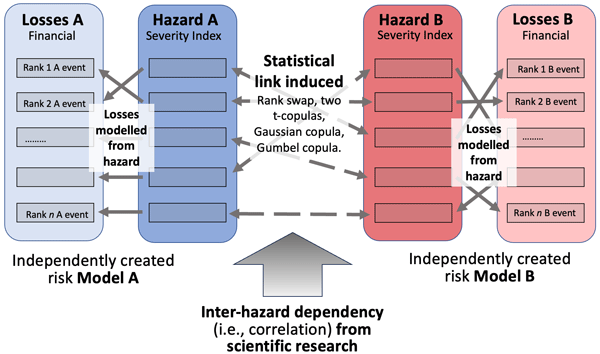
To allow for more effective use of climate science, this work proposes and evaluates an open-access R code that deploys a measure of how natural hazards (e.g. extreme wind and flooding) co-occur, is obtainable from scientific research and is usable in practice without restricted data (climate or risk) being exposed. The approach can be applied to hazards in various sectors (e.g. road, rail and telecommunications).
Georgia Lazoglou, Theo Economou, Christina Anagnostopoulou, George Zittis, Anna Tzyrkalli, Pantelis Georgiades, and Jos Lelieveld
Geosci. Model Dev., 17, 4689–4703, https://doi.org/10.5194/gmd-17-4689-2024, https://doi.org/10.5194/gmd-17-4689-2024, 2024
Short summary
Short summary
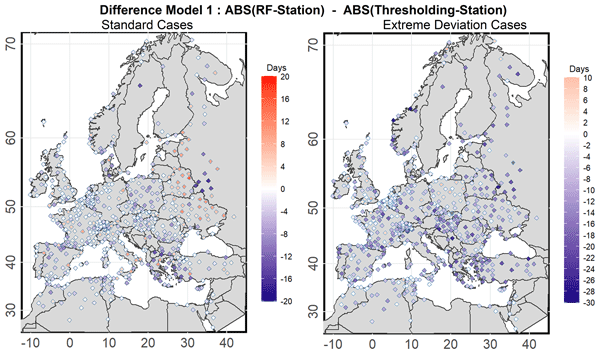
This study focuses on the important issue of the drizzle bias effect in regional climate models, described by an over-prediction of the number of rainy days while underestimating associated precipitation amounts. For this purpose, two distinct methodologies are applied and rigorously evaluated. These results are encouraging for using the multivariate machine learning method random forest to increase the accuracy of climate models concerning the projection of the number of wet days.
Cited articles
Aerts, J. C. J. H.: A Review of Cost Estimates for Flood Adaptation, Water, 10, 1646, https://doi.org/10.3390/w10111646, 2018. a
Alfieri, L., Feyen, L., and Di Baldassarre, G.: Increasing flood risk under climate change: a pan-European assessment of the benefits of four adaptation strategies, Climatic Change, 136, 507–521, https://doi.org/10.1007/s10584-016-1641-1, 2016. a
Babich Morrow, C., Dawkins, L., Pianosi, F., Prangle, D., and Bernie, D.: From climate risk to action: Analysing adaptation decision robustness under uncertainty, Climate Risk Management, 50, 100751, https://doi.org/10.1016/j.crm.2025.100751, 2025. a
Bates, P. D., Horritt, M. S., and Fewtrell, T. J.: A simple inertial formulation of the shallow water equations for efficient two-dimensional flood inundation modelling, J. Hydrol., 387, 33–45, https://doi.org/10.1016/j.jhydrol.2010.03.027, 2010. a
Bates, P. D., Savage, J., Wing, O., Quinn, N., Sampson, C., Neal, J., and Smith, A.: A climate-conditioned catastrophe risk model for UK flooding, Nat. Hazards Earth Syst. Sci., 23, 891–908, https://doi.org/10.5194/nhess-23-891-2023, 2023. a
Betterle, A. and Salamon, P.: Satellite-derived flood depth maps for Europe, https://doi.org/10.2905/JRC.NNQVVER, 2026. a
Bingler, J. A. and Colesanti Senni, C.: Taming the Green Swan: a criteria-based analysis to improve the understanding of climate-related financial risk assessment tools, Clim. Policy, 22, 356–370, https://doi.org/10.1080/14693062.2022.2032569, 2022. a
Bongiorno, L., Claringbold, A., Eichler, L., Jones, C., Kramer, B., Pryor, L., and Spencer, N.: Climate scenario analysis for pension schemes: a UK case study, British Actuarial Journal, 27, e6, https://doi.org/10.1017/S1357321721000106, 2022. a
Brown, S. J.: Future changes in heatwave severity, duration and frequency due to climate change for the most populous cities, Weather and Climate Extremes, 30, 100278, https://doi.org/10.1016/j.wace.2020.100278, 2020. a
Burek, P., Van der Knijff, J., and de Roo, A.: LISFLOOD: Distributed Water Balance and Flood Simulation Model Revised User Manual 2013, Publications Office of the European Union, Luxembourg, https://doi.org/10.2788/24719, 2013. a
Cardell, M. F., Amengual, A., Romero, R., and Ramis, C.: Future extremes of temperature and precipitation in Europe derived from a combination of dynamical and statistical approaches, Int. J. Climatol., 40, 4800–4827, https://doi.org/10.1002/joc.6490, 2020. a
Chan, S. C., Kendon, E. J., Fowler, H. J., Youngman, B. D., Dale, M., and Short, C.: New extreme rainfall projections for improved climate resilience of urban drainage systems, Climate Services, 30, 100375, https://doi.org/10.1016/j.cliser.2023.100375, 2023. a, b, c
Climate Financial Risk Forum: UK Financial Sector Survey on Practices and Information Use for Adapting to Physical Climate Risks, Tech. rep., Climate Financial Risk Forum, https://www.fca.org.uk/publication/corporate/cfrf-adaptation-working-group-user-survey-2024.pdf (last access: 9 February 2026), 2024. a
Climate Financial Risk Forum: A Risk Professional's Guide to Physical Risk Assessments, Tech. rep., Climate Financial Risk Forum, https://www.fca.org.uk/publication/corporate/risk-pro
fessionals-guide-physical-risk-assessments-garp-benchmarking-study-13-vendors.pdf (last access: 9 February 2026), 2025. a
Coles, S.: An Introduction to Statistical Modeling of Extreme Values, Springer London, London, https://doi.org/10.1007/978-1-4471-3675-0, ISBN 978-1-84996-874-4, 2001. a
Davison, A. C., Padoan, S. A., and Ribatet, M.: Statistical Modeling of Spatial Extremes, Stat. Sci., 27, 161–186, https://doi.org/10.1214/11-STS376, 2012. a
Dawkins, L. C., Bernie, D. J., Lowe, J. A., and Economou, T.: Assessing climate risk using ensembles: A novel framework for applying and extending open-source climate risk assessment platforms, Climate Risk Management, 40, 100510, https://doi.org/10.1016/j.crm.2023.100510, 2023a. a
Dawkins, L. C., Bernie, D. J., Pianosi, F., Lowe, J. A., and Economou, T.: Quantifying uncertainty and sensitivity in climate risk assessments: Varying hazard, exposure and vulnerability modelling choices, Climate Risk Management, 40, 100511, https://doi.org/10.1016/j.crm.2023.100511, 2023b. a
Dawkins, L. C., Brown, K., Bernie, D. J., Lowe, J. A., Economou, T., Grassie, D., Schwartz, Y., and Dyer, E.: Quantifying overheating risk in English schools: A spatially coherent climate risk assessment, Climate Risk Management, 44, 100602, https://doi.org/10.1016/j.crm.2024.100602, 2024. a
Deidda, C., Khanna, A. A., Schade, W., Smith, C., and Thiery, W.: Europe's transport infrastructure is not ready to face climate change, Nat. Hazards Earth Syst. Sci., 26, 3345–3394, https://doi.org/10.5194/nhess-26-3345-2026, 2026. a
de Model, H., Endendijk, T., Kelder, T., van Veldhoven, F., and Wouters, L.: Real Estate Asset Climate Testing (REACT) Tool: A quick, simple, and transparent assessment of real estate flood risk, Tech. rep., Zenodo, https://doi.org/10.5281/zenodo.8348391, 2023. a
Devadas, B., Paprotny, D., Kreibich, H., Steinhausen, M., Oostwegel, L. J. N., Endendijk, T., Schoppa, L., Domeneghetti, A., Castellarin, A., Dottori, F., D'Angelo, C., Mentaschi, L., Kuiry, S. N., and Sairam, N.: Projecting Future Flood Losses to Company Assets in Europe: The Role of Precautionary Measures, Earth's Future, 13, e2025EF006285, https://doi.org/10.1029/2025EF006285, 2025. a, b
Dottori, F., Alfieri, L., Bianchi, A., Skoien, J., and Salamon, P.: A new dataset of river flood hazard maps for Europe and the Mediterranean Basin, Earth Syst. Sci. Data, 14, 1549–1569, https://doi.org/10.5194/essd-14-1549-2022, 2022. a
European Commission Joint Research Centre: CEMS-EFAS Flood Hazard Data Collection, European Commission Joint Research Centre [data set], https://jeodpp.jrc.ec.europa.eu/ftp/jrc-opendata/CEMS-EFAS/flood_hazard/ (last access: 12 December 2025), 2025. a
Filipova, V. and Rana, A.: Urban Flooding in Gothenburg – A MIKE 21 Study, Tech. rep., Lund University, Division of Water Resources Engineering, https://lup.lub.lu.se/luur/download?func=downloadFile&recordOId=2723483&fileOId=2729509 (last access: 3 February 2026), 2012. a
Forzieri, G., Bianchi, A., e Silva, F. B., Herrera, M. A. M., Leblois, A., Lavalle, C., Aerts, J. C., and Feyen, L.: Escalating impacts of climate extremes on critical infrastructures in Europe, Global Environ. Chang., 48, 97–107, https://doi.org/10.1016/j.gloenvcha.2017.11.007, 2018. a
Garry, F. K., Bernie, D. J., Davie, J. C. S., and Pope, E. C. D.: Future climate risk to UK agriculture from compound events, Climate Risk Management, 32, 100282, https://doi.org/10.1016/j.crm.2021.100282, 2021. a
Hain, L. I., Kölbel, J. F., and Leippold, M.: Let's get physical: Comparing metrics of physical climate risk, Financ. Res. Lett., 46, 102406, https://doi.org/10.1016/j.frl.2021.102406, 2022. a
Herger, N., Sanderson, B. M., and Knutti, R.: Improved pattern scaling approaches for use in climate impact studies, Geophys. Res. Lett., 42, 3486–3494, https://doi.org/10.1002/2015GL063569, 2015. a
Hoehn, B., Salzberger, H., and Bienert, S.: Assessing climate risk quantification tools–mere fulfilment of duty or actually beneficial?, Journal of Property Investment & Finance, 43, 142–167, https://doi.org/10.1108/JPIF-01-2024-0008, 2025. a
Huizinga, J., De Moel, H., and Szewczyk, W.: Global flood depth-damage functions: Methodology and the database with guidelines, Publications Office of the European Union, https://doi.org/10.2760/16510, 2017. a, b, c, d
IPCC: Summary for Policymakers, in: Climate Change 2023: Synthesis Report. Contribution of Working Groups I, II and III to the Sixth Assessment Report of the Intergovernmental Panel on Climate Change, edited by: Core Writing Team, Lee, H., and Romero, J., Tech. rep., IPCC, Geneva, Switzerland, 34 pp., https://doi.org/10.59327/IPCC/AR6-9789291691647.001, 2023. a, b
Kendon, E. J., Roberts, N. M., Fowler, H. J., Roberts, M. J., Chan, S. C., and Senior, C. A.: Heavier summer downpours with climate change revealed by weather forecast resolution model, Nat. Clim. Change, 4, 570–576, https://doi.org/10.1038/nclimate2258, 2014. a
Kendon, E. J., Fischer, E. M., and Short, C. J.: Variability conceals emerging trend in 100yr projections of UK local hourly rainfall extremes, Nat. Commun., 14, 1133, https://doi.org/10.1038/s41467-023-36499-9, 2023. a
Kennedy-Asser, A. T., Andrews, O., Mitchell, D. M., and Warren, R. F.: Evaluating heat extremes in the UK Climate Projections (UKCP18), Environ. Res. Lett., 16, 014039, https://doi.org/10.1088/1748-9326/abc4ad, 2021. a
Kourtis, I. M., Tsihrintzis, V. A., and Baltas, E.: A robust approach for comparing conventional and sustainable flood mitigation measures in urban basins, Journal of Environmental Management, 269, 110822, https://doi.org/10.1016/j.jenvman.2020.110822, 2020. a
Lowe, J. A, Bernie, D., Bett, P., Bricheno, L., Brown, S., Calvert, D., Clark, R., Eagle, K., Edwards, T., Fosser, G., Fung, F., Gohar, L., Good, P., Gregory, J., Harris, G., Howard, T., Kaye, N., Kendon, E., Krijnen, J., Maisey, P., McDonald, R., McInnes, R., McSweeney, C., Mitchell, J. F. B., Murphy, J., Palmer, M., Roberts, C., Rostron, J., Sexton, D., Thornton, H., Tinker, J., Tucker, S., Yamazaki, K., and Belcher, S.: UKCP18 Science Overview report, Met Office Hadley Centre, Exeter, UK, Tech. rep., 1–73, https://www.metoffice.gov.uk/pub/data/weather/uk/ukcp18/science-reports/UKCP18-Overview-report.pdf (last access: 9 February 2026), 2018. a
Maraun, D.: Bias Correcting Climate Change Simulations - a Critical Review, Current Climate Change Reports, 2, 211–220, https://doi.org/10.1007/s40641-016-0050-x, 2016. a
Met Office Hadley Centre: UKCP18 Regional Projections at 12km Resolution for 1980–2080, Centre for Environmental Data Analysis [data set], https://catalogue.ceda.ac.uk/uuid/8c6c0ae2c25947168826a70d2241b797 (last access: 12 December 2025), 2018. a
Mittal, N., Fung, F., McSweeney, C. F., and Lowe, J. A.: Identifying user requirements to inform national climate projections in the UK, Climate Services, 40, 100613, https://doi.org/10.1016/j.cliser.2025.100613, 2025. a
Nawarat, K., Reyns, J., Vousdoukas, M. I., Mulholland, E., van Ginkel, K., Feyen, L., and Ranasinghe, R.: Coastal flood risk to European surface transport infrastructure at different global warming levels, Nat. Clim. Change, 16, 172–178, https://doi.org/10.1038/s41558-025-02510-y, 2026. a
ofou: country-capital-lat-long-population.csv, GitHub Gist [data set], https://gist.github.com/ofou/df09a6834a8421b4f376c875194915c9, 2018. a
Paprotny, D., Rhein, B., Vousdoukas, M. I., Terefenko, P., Dottori, F., Treu, S., Śledziowski, J., Feyen, L., and Kreibich, H.: Merging modelled and reported flood impacts in Europe in a combined flood event catalogue for 1950–2020, Hydrol. Earth Syst. Sci., 28, 3983–4010, https://doi.org/10.5194/hess-28-3983-2024, 2024. a
Pesaresi, M. and Politis, P.: GHS-BUILT-S R2023A - GHS built-up surface grid, derived from Sentinel2 composite and Landsat, multitemporal (1975–2030), European Commission, Joint Research Centre [data set], https://doi.org/10.2905/JRC.939FACR, 2023. a
Pesaresi, M., Schiavina, M., Politis, P., Freire, S., Krasnodębska, K., Uhl, J. H., Carioli, A., Corbane, C., Dijkstra, L., Florio, P., Friedrich, H. K., Gao, J., Leyk, S., Lu, L., Maffenini, L., Mari-Rivero, I., Melchiorri, M., Syrris, V., Hoek, J. V. D., and Kemper, T.: Advances on the Global Human Settlement Layer by joint assessment of Earth Observation and population survey data, Int. J. Digit. Earth, 17, 2390454, https://doi.org/10.1080/17538947.2024.2390454, 2024. a, b
Rajczak, J. and Schär, C.: Projections of future precipitation extremes over Europe: A multimodel assessment of climate simulations, J. Geophys. Res.-Atmos., 122, 10773–10800, https://doi.org/10.1002/2017JD027176, 2017. a
Ranger, N. A., Mahul, O., and Monasterolo, I.: Assessing financial risks from physical climate shocks, World Bank, Washington, DC, 2, https://documents1.worldbank.org/cura
ted/en/760481644944260441/pdf/Assessing-Financial-Risks-from-Physical-Climate-Shocks-A-Framework-for-Scenario-Generation.pdf (last access: 9 February 2026), 2022. a
Riahi, K., Rao, S., Krey, V., Cho, C., Chirkov, V., Fischer, G., Kindermann, G., Nakicenovic, N., and Rafaj, P.: RCP 8.5 – A scenario of comparatively high greenhouse gas emissions, Climatic Change, 109, 33–57, https://doi.org/10.1007/s10584-011-0149-y, 2011. a
Sakai, P. and Yao, Z.: Financial losses and flood damages experienced by SMEs: Who are the biggest losers across sectors and sizes?, Int. J. Disast. Risk Re., 91, 103677, https://doi.org/10.1016/j.ijdrr.2023.103677, 2023. a, b
Schleussner, C.-F., Lissner, T. K., Fischer, E. M., Wohland, J., Perrette, M., Golly, A., Rogelj, J., Childers, K., Schewe, J., Frieler, K., Mengel, M., Hare, W., and Schaeffer, M.: Differential climate impacts for policy-relevant limits to global warming: the case of 1.5 °C and 2 °C, Earth Syst. Dynam., 7, 327–351, https://doi.org/10.5194/esd-7-327-2016, 2016. a
Shaw, J., Kesserwani, G., Neal, J., Bates, P., and Sharifian, M. K.: LISFLOOD-FP 8.0: the new discontinuous Galerkin shallow-water solver for multi-core CPUs and GPUs, Geosci. Model Dev., 14, 3577–3602, https://doi.org/10.5194/gmd-14-3577-2021, 2021. a
Spuler, F. R., Wessel, J. B., Comyn-Platt, E., Varndell, J., and Cagnazzo, C.: ibicus: a new open-source Python package and comprehensive interface for statistical bias adjustment and evaluation in climate modelling (v1.0.1), Geosci. Model Dev., 17, 1249–1269, https://doi.org/10.5194/gmd-17-1249-2024, 2024. a
The Pensions Regulator: Review shows how pension trustees are addressing climate risks and opportunities, press Release PN24-18, https://www.thepensionsregulator.gov.uk/en/media-hub/press -releases/2024-press-releases/review-shows-how-pension-trustees-are-addressing-climate-risks-and-opportunities (last access: 9 February 2026), 2024a. a
The Pensions Regulator: Too many pension schemes focused on minimum compliance with ESG duties, says TPR, press release PN24-29, https://www.thepensionsregulator. gov.uk/en/media-hub/press-releases/2024-press-releases/too-many-pension-schemes-focused-on-minimum-compliance-with-esg-duties (last access: 9 February 2026), 2024b. a
The Pensions Regulator: Small DC schemes should improve or consolidate if they cannot protect savers from climate risk, press release PN25-15, https://www.thepensionsregulator.gov.uk/en/media-hub/press -releases/2025-press-releases/small-dc-schemes-should-improve-or-consolidate-if-they-cannot-protect-savers-from-climate-risk (last access: 9 February 2026), 2025. a
Tilloy, A., Paprotny, D., Grimaldi, S., Gomes, G., Bianchi, A., Lange, S., Beck, H., Mazzetti, C., and Feyen, L.: HERA: a high-resolution pan-European hydrological reanalysis (1951–2020), Earth Syst. Sci. Data, 17, 293–316, https://doi.org/10.5194/essd-17-293-2025, 2025. a
Tradowsky, J. S., Philip, S. Y., Kreienkamp, F., Kew, S. F., Lorenz, P., Arrighi, J., Bettmann, T., Caluwaerts, S., Chan, S. C., De Cruz, L., de Vries, H., Demuth, N., Ferrone, A., Fischer, E. M., Fowler, H. J., Goergen, K., Heinrich, D., Henrichs, Y., Kaspar, F., Lenderink, G., Nilson, E., Otto, F. E. L., Ragone, F., Seneviratne, S., I., Singh, R. K., Skålevåg, A., Termonia, P., Thalheimer, L., van Aalst, M., Van den Bergh, J., Van de Vyver, H., Vannitsem, S., van Oldenborgh, G. J., Van Schaeybroeck, B., Vautard, R., Vonk, D., and Wanders, N.: Attribution of the heavy rainfall events leading to severe flooding in Western Europe during July 2021, Climatic Change, 176, 90, https://doi.org/10.1007/s10584-023-03502-7, 2023. a
United Nations Environment Programme: Emissions Gap Report 2025: Off Target, Tech. rep., UNEP, https://www.unep.org/resources/emissions-gap-report-2025 (last access: 27 January 2026), 2025. a
Van der Knijff, J. M., Younis, J., and de Roo, A. P. J.: LISFLOOD: a GIS-based distributed model for river basin scale water balance and flood simulation, Int. J. Geogr. Inf. Sci., 24, 189–212, https://doi.org/10.1080/13658810802549154, 2010. a
van Veldhoven, F., Kelder, T., Endendijk, T., de Moel, H., Zhou, F., de Wolf, L., Botzen, W., Wouters, L., and Vrensen, H.: D2.9 Physical climate risk assessment approach for international real estate portfolios using European climate data and services, https://reachout-cities.eu/wp-content/uploads/2024/06/D2.9-Physical-Climate-Risk-assessment-approach.pdf (last access: 9 February 2026), 2024. a
Williams, K. D. Copsey, D., Blockley, E. W., Bodas-Salcedo, A., Calvert, D., Comer, R., Davis, P., Graham, T., Hewitt, H. T., Hill, R., Hyder, P., Ineson, S., Johns, T. C., Keen, A. B., Lee, R. W., Megann, A., Milton, S. F., Rae, J. G. L., Roberts, M. J., Scaife, A. A., Schiemann, R., Storkey, D., Thorpe, L., Watterson, I. G., Walters, D. N., West, A., Wood, R. A., Woollings, T., and Xavier, P. K.: The Met Office Global Coupled model 3.0 and 3.1 (GC3 & GC3.1) configurations, J. Adv. Model. Earth Sy., 10, 357–380, https://doi.org/10.1002/2017MS001115, 2017. a
Wood, S. N.: Generalized Additive Models: An Introduction with R, CRC Press, Boca Raton, 2nd edn., https://doi.org/10.1201/9781315370279, 2017. a
Wu, S.-H., Chiang, C.-L., Huang, Y.-H., Huang, J., Tsao, J.-H., and Tung, C.-P.: Climate Risk Assessment Framework in Real Estate: A Focus on Flooding, Sustainability, 16, 9577, https://doi.org/10.3390/su16219577, 2024. a
Youngman, B. D.: Generalized Additive Models for Exceedances of High Thresholds With an Application to Return Level Estimation for U.S. Wind Gusts, J. Am. Stat. Assoc., 114, 1865–1879, https://doi.org/10.1080/01621459.2018.1529596, 2019. a, b
Youngman, B. D.: evgam: An R Package for Generalized Additive Extreme Value Models, J. Stat. Softw., 103, 1–26, https://doi.org/10.18637/jss.v103.i03, 2022. a, b, c
Short summary
Extreme rainfall already creates significant financial risks for property investments in Europe, and these risks are expected to increase due to climate change. Using open data, we show how flooding resulting from extreme rainfall can damage assets and raise annual losses. The mix and location of assets in a property portfolio matter greatly, and practical measures to reduce flood damage can pay off quickly. Investors need to consider these risks to protect long‑term financial stability.
Extreme rainfall already creates significant financial risks for property investments in Europe,...
Altmetrics
Final-revised paper
Preprint