Articles | Volume 26, issue 8
https://doi.org/10.5194/nhess-26-4045-2026
© Author(s) 2026. This work is distributed under
the Creative Commons Attribution 4.0 License.
https://doi.org/10.5194/nhess-26-4045-2026
© Author(s) 2026. This work is distributed under
the Creative Commons Attribution 4.0 License.
Brief communication: Towards defining the worst-case breach scenarios and potential flood volumes for moraine-dammed lake outbursts

Adam Emmer
CORRESPONDING AUTHOR
Department of Geography and Regional Science, University of Graz, 8010 Graz, Austria
Department of Physical Geography and Geoecology, Faculty of Science, Charles University, Prague, Czechia
Ashim Sattar
School of Earth, Ocean and Climate Sciences, Indian Institute of Technology Bhubaneswar, Bhubaneswar, Odisha, India
Jan Hrebrina
Department of Civil and Environmental Engineering, Norwegian University of Science and Technology (NTNU), Trondheim, Norway
Related authors
Valentine Piroton, Adam Emmer, and Hans-Balder Havenith
EGUsphere, https://doi.org/10.5194/egusphere-2026-1442, https://doi.org/10.5194/egusphere-2026-1442, 2026
Short summary
Short summary
High-resolution satellite imagery was used to map the expansion in number and area of glacial lakes across Kyrgyzstan from 2016 to 2024. Small, high-elevation, glacier-connected lakes grew most, whereas larger, lower-elevation lakes remained stable. Including these often omitted small dynamic lakes in the 2024 inventory advances comprehensive monitoring of glacier–lake systems and high-mountain hydrology, highlighting how glacier retreat and topography shape lake distribution.
Ashim Sattar, Shashi Kant Rai, Abhinav Alangadan, Adam Emmer, Sunil Dhar, Umesh Haritashya, and Mohd. Farooq Azam
EGUsphere, https://doi.org/10.5194/egusphere-2025-6281, https://doi.org/10.5194/egusphere-2025-6281, 2026
Short summary
Short summary
The Warwan basin in the western Himalaya is a remote region that harbours many glacial lakes. Many past events including avalanches and sudden glacial lake floods went unnoticed in the region. This study shows that past avalanches triggered a sudden burst of a glacial lake. The GLOF exposure in the valley remains high owing to the existing infrastructure in the valley. Early warnings can give sufficient lead time in case of potential GLOF in the valley.
Adam Emmer, Oscar Vilca, Cesar Salazar Checa, Sihan Li, Simon Cook, Elena Pummer, Jan Hrebrina, and Wilfried Haeberli
Nat. Hazards Earth Syst. Sci., 25, 1207–1228, https://doi.org/10.5194/nhess-25-1207-2025, https://doi.org/10.5194/nhess-25-1207-2025, 2025
Short summary
Short summary
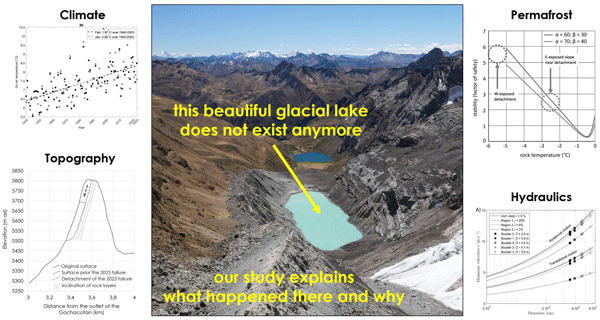
We describe in detail the most recent large landslide-triggered glacial lake outburst flood (GLOF) in the Peruvian Andes (the 2023 Rasac GLOF), analysing its preconditions and consequences, as well as the role of the changing climate. Our study contributes to understanding GLOF occurrence patterns in space and time and corroborates reports detailing the increasing frequency of such events in changing mountains.
Adam Emmer, Simon K. Allen, Mark Carey, Holger Frey, Christian Huggel, Oliver Korup, Martin Mergili, Ashim Sattar, Georg Veh, Thomas Y. Chen, Simon J. Cook, Mariana Correas-Gonzalez, Soumik Das, Alejandro Diaz Moreno, Fabian Drenkhan, Melanie Fischer, Walter W. Immerzeel, Eñaut Izagirre, Ramesh Chandra Joshi, Ioannis Kougkoulos, Riamsara Kuyakanon Knapp, Dongfeng Li, Ulfat Majeed, Stephanie Matti, Holly Moulton, Faezeh Nick, Valentine Piroton, Irfan Rashid, Masoom Reza, Anderson Ribeiro de Figueiredo, Christian Riveros, Finu Shrestha, Milan Shrestha, Jakob Steiner, Noah Walker-Crawford, Joanne L. Wood, and Jacob C. Yde
Nat. Hazards Earth Syst. Sci., 22, 3041–3061, https://doi.org/10.5194/nhess-22-3041-2022, https://doi.org/10.5194/nhess-22-3041-2022, 2022
Short summary
Short summary
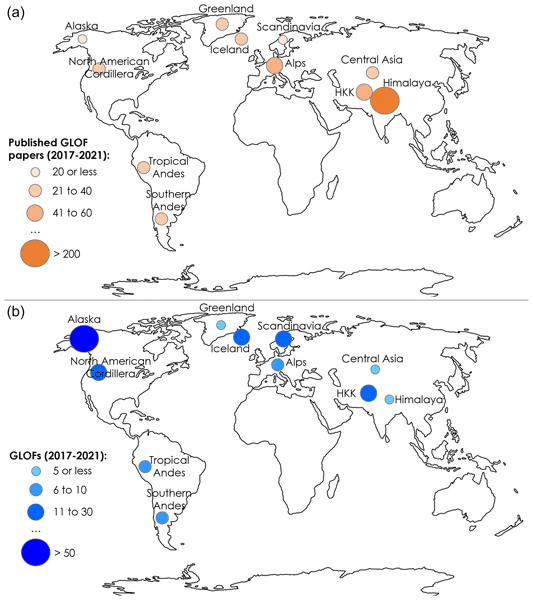
Glacial lake outburst floods (GLOFs) have attracted increased research attention recently. In this work, we review GLOF research papers published between 2017 and 2021 and complement the analysis with research community insights gained from the 2021 GLOF conference we organized. The transdisciplinary character of the conference together with broad geographical coverage allowed us to identify progress, trends and challenges in GLOF research and outline future research needs and directions.
Valentine Piroton, Adam Emmer, and Hans-Balder Havenith
EGUsphere, https://doi.org/10.5194/egusphere-2026-1442, https://doi.org/10.5194/egusphere-2026-1442, 2026
Short summary
Short summary
High-resolution satellite imagery was used to map the expansion in number and area of glacial lakes across Kyrgyzstan from 2016 to 2024. Small, high-elevation, glacier-connected lakes grew most, whereas larger, lower-elevation lakes remained stable. Including these often omitted small dynamic lakes in the 2024 inventory advances comprehensive monitoring of glacier–lake systems and high-mountain hydrology, highlighting how glacier retreat and topography shape lake distribution.
Sonam Rinzin, Stuart Dunning, Rachel Joanne Carr, Simon Allen, Sonam Wangchuk, and Ashim Sattar
Nat. Hazards Earth Syst. Sci., 26, 1015–1037, https://doi.org/10.5194/nhess-26-1015-2026, https://doi.org/10.5194/nhess-26-1015-2026, 2026
Short summary
Short summary
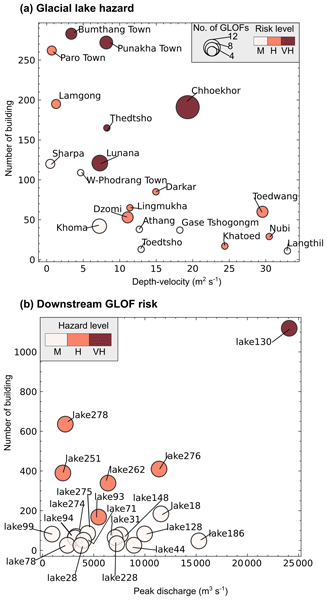
Glacial lake outburst floods pose a major threat to mountain communities worldwide. We assessed glacial lake outburst flood risk in Bhutan by integrating hydrodynamic flood modelling with downstream exposure data. Over 11,000 people and around 2,500 buildings are exposed. Thorthormi Tsho is identified as a very high hazard lake, with five additional high hazard lakes. Thirteen downstream settlements face high to very high GLOF risk, five identified for the first time in this study.
Ashim Sattar, Shashi Kant Rai, Abhinav Alangadan, Adam Emmer, Sunil Dhar, Umesh Haritashya, and Mohd. Farooq Azam
EGUsphere, https://doi.org/10.5194/egusphere-2025-6281, https://doi.org/10.5194/egusphere-2025-6281, 2026
Short summary
Short summary
The Warwan basin in the western Himalaya is a remote region that harbours many glacial lakes. Many past events including avalanches and sudden glacial lake floods went unnoticed in the region. This study shows that past avalanches triggered a sudden burst of a glacial lake. The GLOF exposure in the valley remains high owing to the existing infrastructure in the valley. Early warnings can give sufficient lead time in case of potential GLOF in the valley.
Sonam Rinzin, Stuart Dunning, Rachel Joanne Carr, Ashim Sattar, and Martin Mergili
Nat. Hazards Earth Syst. Sci., 25, 1841–1864, https://doi.org/10.5194/nhess-25-1841-2025, https://doi.org/10.5194/nhess-25-1841-2025, 2025
Short summary
Short summary
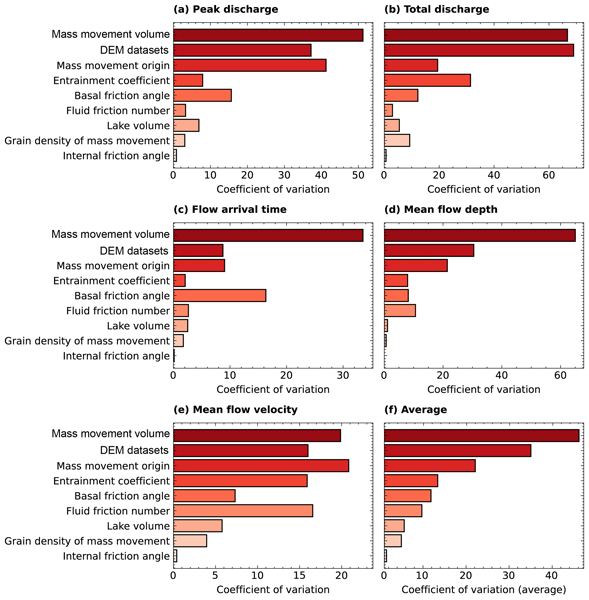
We modelled multiple glacial lake outburst flood (GLOF) scenarios (84 simulations) and tested the effect of nine key input parameters on the modelling results using r.avaflow. Our results highlight that GLOF modelling results are subject to uncertainty from the multiple input parameters. The variation in the volume of mass movement entering the lake causes the highest uncertainty in the modelled GLOF, followed by the DEM dataset and the origin of mass movement.
Adam Emmer, Oscar Vilca, Cesar Salazar Checa, Sihan Li, Simon Cook, Elena Pummer, Jan Hrebrina, and Wilfried Haeberli
Nat. Hazards Earth Syst. Sci., 25, 1207–1228, https://doi.org/10.5194/nhess-25-1207-2025, https://doi.org/10.5194/nhess-25-1207-2025, 2025
Short summary
Short summary
We describe in detail the most recent large landslide-triggered glacial lake outburst flood (GLOF) in the Peruvian Andes (the 2023 Rasac GLOF), analysing its preconditions and consequences, as well as the role of the changing climate. Our study contributes to understanding GLOF occurrence patterns in space and time and corroborates reports detailing the increasing frequency of such events in changing mountains.
Simon K. Allen, Ashim Sattar, Owen King, Guoqing Zhang, Atanu Bhattacharya, Tandong Yao, and Tobias Bolch
Nat. Hazards Earth Syst. Sci., 22, 3765–3785, https://doi.org/10.5194/nhess-22-3765-2022, https://doi.org/10.5194/nhess-22-3765-2022, 2022
Short summary
Short summary
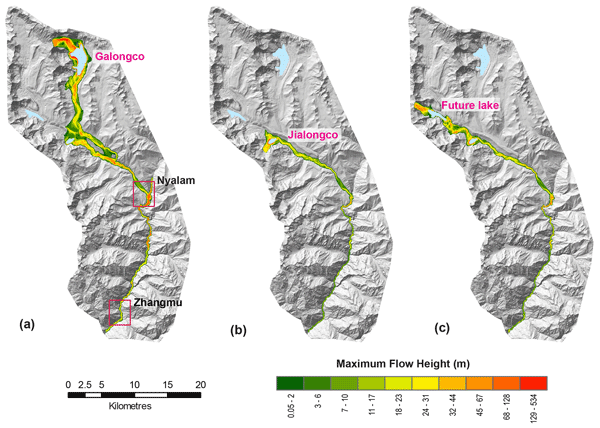
This study demonstrates how the threat of a very large outburst from a future lake can be feasibly assessed alongside that from current lakes to inform disaster risk management within a transboundary basin between Tibet and Nepal. Results show that engineering measures and early warning systems would need to be coupled with effective land use zoning and programmes to strengthen local response capacities in order to effectively reduce the risk associated with current and future outburst events.
Adam Emmer, Simon K. Allen, Mark Carey, Holger Frey, Christian Huggel, Oliver Korup, Martin Mergili, Ashim Sattar, Georg Veh, Thomas Y. Chen, Simon J. Cook, Mariana Correas-Gonzalez, Soumik Das, Alejandro Diaz Moreno, Fabian Drenkhan, Melanie Fischer, Walter W. Immerzeel, Eñaut Izagirre, Ramesh Chandra Joshi, Ioannis Kougkoulos, Riamsara Kuyakanon Knapp, Dongfeng Li, Ulfat Majeed, Stephanie Matti, Holly Moulton, Faezeh Nick, Valentine Piroton, Irfan Rashid, Masoom Reza, Anderson Ribeiro de Figueiredo, Christian Riveros, Finu Shrestha, Milan Shrestha, Jakob Steiner, Noah Walker-Crawford, Joanne L. Wood, and Jacob C. Yde
Nat. Hazards Earth Syst. Sci., 22, 3041–3061, https://doi.org/10.5194/nhess-22-3041-2022, https://doi.org/10.5194/nhess-22-3041-2022, 2022
Short summary
Short summary
Glacial lake outburst floods (GLOFs) have attracted increased research attention recently. In this work, we review GLOF research papers published between 2017 and 2021 and complement the analysis with research community insights gained from the 2021 GLOF conference we organized. The transdisciplinary character of the conference together with broad geographical coverage allowed us to identify progress, trends and challenges in GLOF research and outline future research needs and directions.
Cited articles
Allen, S. K., Sattar, A., King, O., Zhang, G., Bhattacharya, A., Yao, T., and Bolch, T.: Glacial lake outburst flood hazard under current and future conditions: worst-case scenarios in a transboundary Himalayan basin, Nat. Hazards Earth Syst. Sci., 22, 3765–3785, https://doi.org/10.5194/nhess-22-3765-2022, 2022.
Bazai, N. A., Carling, P. A., Cui, P., Hao, W., Guotao, Z., Dingzhu, L., and Hassan, J.: Refining lake volume estimation and critical depth identification for enhanced glacial lake outburst flood (GLOF) event anticipation, The Cryosphere, 18, 5921–5938, https://doi.org/10.5194/tc-18-5921-2024, 2024.
Emmer, A.: Understanding the risk of glacial lake outburst floods in the twenty-first century, Nat. Water, 2, 608–610, https://doi.org/10.1038/s44221-024-00254-1, 2024.
Emmer, A., Allen, S. K., Carey, M., Frey, H., Huggel, C., Korup, O., Mergili, M., Sattar, A., Veh, G., Chen, T. Y., Cook, S. J., Correas-Gonzalez, M., Das, S., Diaz Moreno, A., Drenkhan, F., Fischer, M., Immerzeel, W. W., Izagirre, E., Joshi, R. C., Kougkoulos, I., Kuyakanon Knapp, R., Li, D., Majeed, U., Matti, S., Moulton, H., Nick, F., Piroton, V., Rashid, I., Reza, M., Ribeiro de Figueiredo, A., Riveros, C., Shrestha, F., Shrestha, M., Steiner, J., Walker-Crawford, N., Wood, J. L., and Yde, J. C.: Progress and challenges in glacial lake outburst flood research (2017–2021): a research community perspective, Nat. Hazards Earth Syst. Sci., 22, 3041–3061, https://doi.org/10.5194/nhess-22-3041-2022, 2022.
Frank, P.-J.: Hydraulics of spatial dike breaches, Doctoral thesis, ETH Zurich, VAW Mitteilung 236, https://doi.org/10.3929/ethz-a-010803310, 2016.
Froehlich, D.: Predicting Peak Discharge of Outburst Floods from Moraine-Dammed Glacial Lakes, Nat. Hazards Rev., 26, 4, https://doi.org/10.1061/NHREFO.NHENG-2492, 2025.
Froehlich, D. C.: Embankment dam breach parameters revisited, Proc. Conference on Water Resources Engineering, San Antonio, Texas, 1995, https://cir.nii.ac.jp/crid/1573668925257806336 (last access: June 2026), 1995.
Fujita, K., Sakai, A., Takenaka, S., Nuimura, T., Surazakov, A. B., Sawagaki, T., and Yamanokuchi, T.: Potential flood volume of Himalayan glacial lakes, Nat. Hazards Earth Syst. Sci., 13, 1827–1839, https://doi.org/10.5194/nhess-13-1827-2013, 2013.
Furian, W. and Sauter, T.: Assessing economic impacts of future GLOFs in Nepal's Everest region under different SSP scenarios using three-dimensional simulations, Nat. Hazards Earth Syst. Sci., 25, 3779–3802, https://doi.org/10.5194/nhess-25-3779-2025, 2025.
Gantayat, P., Sattar, A., Haritashya, U. K., Watson, S. C. and Kargel, J.: Bayesian Approach to Estimate Proglacial Lake Volume (BE‐GLAV), Earth Space Sci,, 11, e2024EA003542, https://doi.org/10.1029/2024EA003542, 2024.
Halso, M. C.: Spatial Breaching of Homogeneous and Zoned Embankment Dams, ETH Zurich, VAW Mitteilung 236, https://doi.org/10.3929/ethz-b-000725593, 2024.
Lützow, N., Veh, G., and Korup, O.: A global database of historic glacier lake outburst floods, Earth Syst. Sci. Data, 15, 2983–3000, https://doi.org/10.5194/essd-15-2983-2023, 2023.
Osti, R., Egashira, S., and Adikari, Y.: Prediction and assessment of multiple glacial lake outburst floods scenario in Pho Chu River basin, Bhutan, Hydrol. Process., 27, 262–274, https://doi.org/10.1002/hyp.8342, 2013.
Qi, M., Liu, S., Zhao, Z., Gao, Y., Xie, F., Veh, G., Xiao, L., Jing, J., Zhu, Y., and Wu, K.: A mathematical model to improve water storage of glacial lake prediction towards addressing glacial lake outburst floods, Hydrol. Earth Syst. Sci., 29, 969–982, https://doi.org/10.5194/hess-29-969-2025, 2025.
Sattar, A., Haritashya, U. K., Kargel, J. S., Leonard, G. J., Shugar, D. H., and Chase, D. V.: Modeling lake outburst and downstream hazard assessment of the Lower Barun Glacial Lake, Nepal Himalaya, J. Hydrol., 598, 126208, https://doi.org/10.1016/j.jhydrol.2021.126208, 2021.
Sattar, A., Cook, K. L., Rai, S. K., Berthier, E., Allen, S., Rinzin, S., Van Wyk de Vries, M., Haeberli, W., Kushwaha, P., Shugar, D. H., Emmer, A., Haritashya, U. K., Frey, H., Rao, P., Gurudin, K. S. K., Rai, P., Rajak, R., Hossain, F., Huggel, C., Mergili, M., Azam, M. F., Gascoin, S., Carrivick, J. L., Bell, L. E., Ranjan, R. K., Rashid, I., Kulkarni, A. V., Petley, D., Schwanghart, W., Watson, C. S., Islam, N., Gupta, M. D., Lane, S. N., and Bhat, S. Y.: The Sikkim flood of October 2023: Drivers, causes and impacts of a multihazard cascade, Science, 387, eads2659, https://doi.org/10.1126/science.ads2659, 2025.
Worni, R., Huggel, C., and Stoffel, M.: Glacial lakes in the Indian Himalayas – From an area-wide glacial lake inventory to on-site and modeling based risk assessment of critical glacial lakes, Sci. Total Environ., 468–469, S71–S84, https://doi.org/10.1016/j.scitotenv.2012.11.043, 2013.
Yang, L., Lu, Z., Ouyang, C., Zhao, C., Hu, X., and Zhang, Q.: Glacial Lake Outburst Flood Monitoring and Modeling through Integrating Multiple Remote Sensing Methods and HEC-RAS, Remote Sens., 15, 5327, https://doi.org/10.3390/rs15225327, 2023.
Short summary
Glacial lake outburst floods (GLOFs) are major concern in high mountain regions across the globe and effective disaster risk management requires predictive modelling which needs various input data including potential flood volume. Building on the analysis of breached channels of largest documented GLOFs originating from moraine dam failures, we present new methodology that estimates maximum breach depth and so potential flood volumes of moraine-dammed lake outbursts.
Glacial lake outburst floods (GLOFs) are major concern in high mountain regions across the globe...
Altmetrics
Final-revised paper
Preprint