
the Creative Commons Attribution 4.0 License.
the Creative Commons Attribution 4.0 License.
 | 10 Aug 2026
A database of fatal coastal cliff failures
Malia N. Reiss
Adam P. Young
Jessica Carilli
Coastal cliffs shape the world's coastlines, providing areas of beauty, habitat, scientific discovery, and recreation. However, as erosional features, coastal cliffs can pose fatal hazards. This paper presents a database of global fatal coastal cliff and slope failures from public databases and media articles. In total, the fatal coastal cliff failure database includes 292 fatalities resulting from 114 events from 1927–2024. Cliff failure events occurred in 32 countries, with the most events in Spain (20), the United States (19), France (14), and the United Kingdom (10), including 10+ event hot spots on both Réunion Island, France, and in San Diego County, California, USA. Most fatalities occurred in temperate regions, with about half of events occurring with 30 d antecedent precipitation below average, differing from databases that include non-coastal fatal landslide events driven largely by rainfall. The database is likely incomplete, and we caution tested relationships on incomplete data; however, the present results suggest that the timing of coastal fatal cliff failures may be influenced by (a) elevated rainfall causing reduced cliff stability, leading to failures in wet seasons and (b) time periods of increased tourism and recreational beach activity, exposing more people to coastal cliff failure hazards in relatively dry seasons. The results can help inform beach hazard management.
- Article
(4242 KB) - Full-text XML
-
Supplement
(378 KB) - BibTeX
- EndNote


About half of the world's coastlines contain coastal cliffs (Young and Carilli, 2019). Coastal slopes and cliffs are erosional landforms and are often naturally unstable from a variety of marine and subaerial erosional processes (Kline et al., 2014; Sunamura, 1982; Trenhaile, 1987; Trenhaile and Kanyaya, 2007; Young et al., 2009). Cliffs are valuable aesthetic, cultural, and scientific resources, often contributing to increased tourism and recreation on beaches that closely border these features (Bird, 1994). However, this increased use also elevates the risk of potentially fatal hazards from coastal cliff failures. Cliff failures are often difficult to predict and rapid (Petrucci, 2022).
Physical processes weaken rocks over time (Hampton et al., 2004), eventually leading to collapse. These processes include wet-dry cycles, water infiltration, daily or seasonal temperature changes, groundwater flow, and wave energy reaching the cliffs (Duperret et al., 2005; Hampton et al., 2004; Sunamura, 1992; Trenhaile and Kanyaya, 2007). Wave-driven erosion at the cliff base can cause a basal “notch” to form, which increases tensile and shear stress on cantilevered cliffs and eventually leads to failure of the upper overhanging cliff (Kline et al., 2014; Moreiras, 2005; Young and Ashford, 2008). Breaking waves also compress air into crevices, generating cyclical stress that can lead to fracture (Sunamura, 1982). Cliff lithology and beach geometry also influence collapse susceptibility, as well as sea-level oscillations, climate, and tectonic activity (Emery and Kuhn, 1982; Kogure, 2022; Sunamura, 1992; Trenhaile, 2004; Trenhaile, 2010). Overall, landslides (coastal and inland) are more frequent in wet periods driven by cycles such as the El Niño Southern Oscillation (ENSO) (Moreiras, 2005). Sea level rise is generally expected to increase cliff erosion in many areas (Gornitz, 1991), but local response could vary widely (Matsumoto et al., 2024).
Coastal landslides can be triggered by tectonic movements (Bird, 1994), severe storms (Bird, 1994), freeze-thaw cycles (Bird, 1994; Letavernier, 1984), stress relief and fatigue (Duperret et al., 2005), heavy rainfall (Bird, 1994; Duperret et al., 2004; Letortu et al., 2015), sudden rain during dry periods (Duperret et al., 2004), cold and dry weather (Letortu et al., 2015), high wind (Letortu et al., 2015), and recreation such as fossil or mineral hunting (Bird, 1994), or combinations of these factors (Letortu et al., 2015).
When unstable cliffs back popular beaches, slope failures can have fatal consequences. For example, in August 2019, three women died on Grandview Beach, Encinitas, California, USA when a 9-by-8 m rock mass collapsed (Riggins, 2019). On Christmas Eve of 2021, a 30-m cliff collapsed on Australia's Bells Beach, killing one person and injuring 3 others (Blair, 2021). Other similar incidents have occurred globally. Coastal landslide fatalities often receive media coverage and public anger, leading to demands for increased beach safety (Bird, 1994); however, measures to increase beach safety, such as building seawalls, sometimes result in public protest over decreased scenic beauty, high construction costs, and unintended negative erosional impacts (Bird, 1994; Clemente et al., 2023; Griggs, 2005).
Total (combined coastal and inland) landslide fatalities have been previously compiled. For example, The Global Fatal Landslide Database (Froude and Petley, 2018) recorded 4862 fatal landslides from 2004 to 2017 using extensive English language media searches and found that fatal landslides coincide with regional rainfall driven by climate anomalies, occur most frequently in countries with lower gross national income, and are impacted by human disturbance and land-use change. However, a database of coastal landslide fatalities is lacking. This study compiled a database of fatalities related to coastal cliff failures, drawing from existing databases and media reports in multiple languages. Like Froude and Petley (2018), the dataset was used to evaluate potential causative factors with the goal to help inform coastal hazard management. Although we test relationships of potential drivers of fatal coastal cliff failures, the dataset is an initial compilation and not a complete global database. The dataset is limited and intended to provide the foundation for future studies and for expansion as new information and events occur.
2.1 Database Development
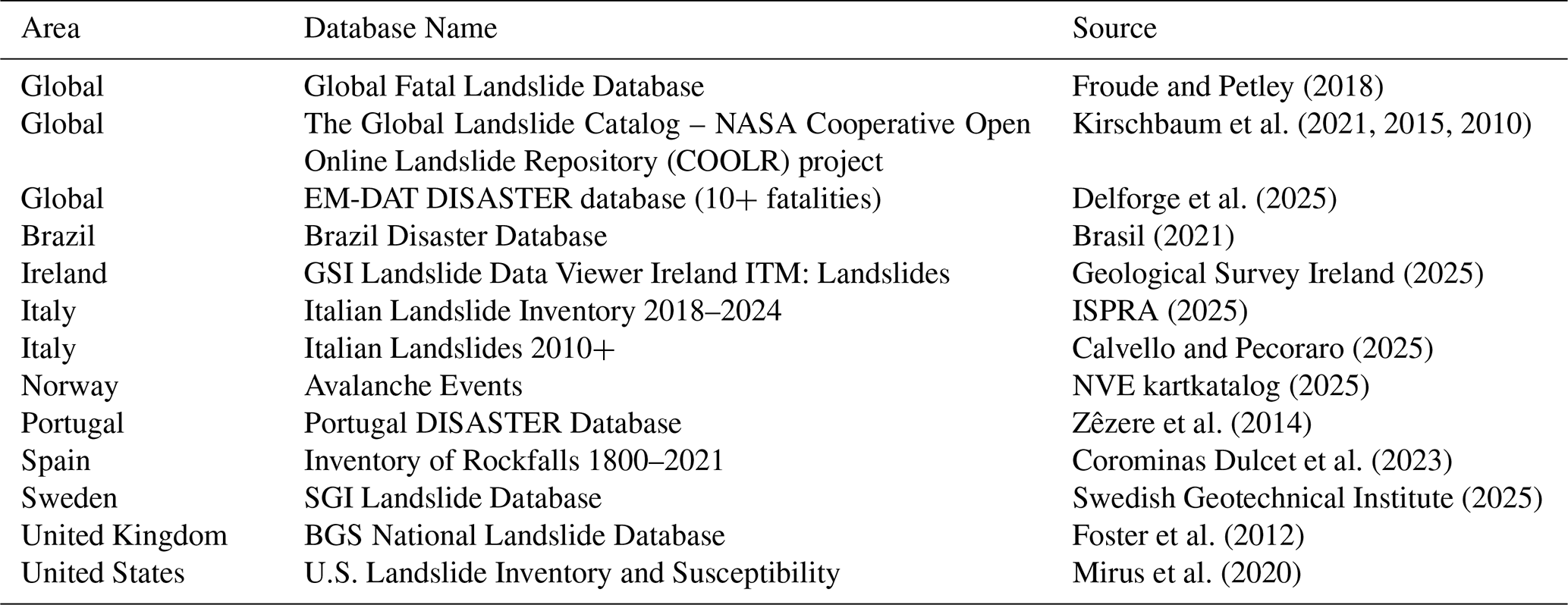
This study builds on previous research and compiles a global fatal coastal cliff failure database using 13 public databases (Table 1) and online media. The database includes the following information for each entry if available: date, location, location precision, known/unknown fatalities, number of fatalities, whether the victim traveled to the area or lived in the area, listed cliff failure trigger, media source, web link, and a small summary of the event. Definitions of these fields are found in the Appendix.
Table 1Regional and global databases used to compile the Fatal Coastal Landslide Database
Froude and Petley (2018) define landslides as slope failures that occur in any terrestrial environment; for the coastline, these slopes include cliffs, bluffs, or steep coastal mountains or slopes. Fatalities occur when people are exposed to these landslides, killed by vital organ injuries or traumatic asphyxia from burial (Petrucci, 2022). This study defines a fatal coastal cliff failure as one of the following:
-
Death from falling rocks or rock burial from a cliff or bluff on a beach, along a coastal highway, or other infrastructure built into or below a coastal cliff, including fjords but excluding rivers and lakes.
-
Death from a failure that originates in an immediate coastal area where the base of the slope was in contact with the ocean. Landslides that occurred on mountainous terrain near a coastline, but lacked recent wave-driven erosion, were not considered coastal.
-
Death from being carried down slope with a coastal cliff collapse.
-
Death from coastal cliff failure triggered by an earthquake or tsunami (but not from other hazards such as drowning caused by those events).
The goal of this database is to compile fatal landslides related to coastal processes. This database only considers events that occurred on coastal slopes and cliffs. Indirect fatalities, such as large landslides generating fatal tsunamis, are excluded, as well as landslides that originated inland.
Bodies “found” at the base of a cliff, or those that died without evidence of underfoot breakage or rockfall were not included. Slips, trips, falls, cliff jumping, and climbing accidents were also not included if there was no evidence of breakage of the cliff underfoot. Though a common beach hazard, burial by human-dug sand holes on beaches was not included. Fatalities associated with playing in caves or digging for fossils in cliffs were included, as the events were influenced by existing cliff-related hazards. We only include events resulting in fatalities; however, many more coastal rockfalls and landslides resulted in documented injuries.
All database entries were either visually inspected on a map interface or filtered by proximity to the coastline, and then manually reviewed to confirm the failure was coastal as defined with our criteria. Some national landslide datasets, such as the Inventory of Rockfalls in Spain (Corominas Dulcet et al., 2023), lacked web links to original sources, but entries were included if they clearly mentioned a fatality via landslide at a beach or coastal cliff. Mouvements de terrain (BDMvt) [France] (Migron, 2002), British Geological Survey National Landslide Database (Foster et al., 2012), and the New Zealand National Landslide Database Webmap (Rosser et al., 2017) were accessible but did not include fatality information, and we did not find a fatal coastal event using database-provided supplemental links, so data from those sources were not included. Many other national and regional datasets were identified but are not publicly accessible and therefore were not included.
We compiled a spreadsheet in the Supplement that includes events not confirmed as coastal, events with missing or unavailable media links, events that marginally did not meet defining criteria, events that could not be verified as a fatality, and events from after 2024. For example, entries from some databases (EM-DAT DISASTER database [Delforge et al., 2025] and the SGI Landslide database [Swedish Geotechnical Institute]) show fatal landslides mapped at the coast but could not be verified as “coastal” because of missing media links or lack of further information. The spreadsheet in the Supplement also includes some entries from the Global Fatal Landslide Database and the Global Landslide Catalog with missing or now-unavailable media links such that details could not be verified for this database. The sheet in the Supplement also contains events that marginally did not meet the defining criteria, such as sand dune burial, and events from the Portugal DISASTER Database (Zêzere et al., 2014), where the number of fatalities and injuries are not separated. Events that occurred in 2025 are also included in the database in the Supplement because we completed our thorough media searches before the end of 2025. The statistical analysis excludes events in the database in the Supplement.
Other fatal coastal cliff failure events had confirmed fatalities but did not include information on the number of fatalities that could be attributed to a coastal-specific landslide; for example, a 2022 South Africa multi-landslide flood event included 443 fatalities and 40 000 missing people (Petley, 2022b). While some of these fatal landslides occurred at the coast, it is unknown how many of these fatalities were from coastal versus inland landslides. For fatal coastal landslide events with confirmed fatalities, but an unknown number of victims, the event was included in the main database, and the “event” analyses, but not the “number of fatalities” analyses.
Our other data sources include web-based searches on media sites and the Google News Archive using a mix of search words such as “beach”, “coastal”, “landslide”, “rockfall”, “cliff”, “death”, “fatality”, “kill”, etc. Media searches were conducted using translations of the search word combinations in 50 world languages. Most translations were made using Google Translate, however we did use OpenAI for some languages to search for terms when Google Translate terms did not result in any articles. We included all languages with 50 million or more total speakers (Ethnologue, 2025). Several native speakers of non-English languages (Japanese, French, Hindi, Chinese, Polish) also aided our search by using appropriate search phrases that were not direct translations from English. This method follows Froude and Petley (2018), with the addition of using non-English languages in searches.
2.2 Coastal Setting Analysis
To evaluate possible drivers of either the number of fatal coastal cliff failure events or the number of fatalities, we used negative binomial regression analysis (R version 4.5.2) to compare the dependent variables of fatal cliff failure event counts per country (n=29) and cliff failure fatalities per country (n=27), against coastal setting explanatory variables including: total length of cliffs (km), percentage of coastline backed by cliffs, population, annual international tourism visits, and per-capita Gross Domestic Product (GDP). We used a multivariate negative binomial regression model because the number of fatal coastal cliff failure events and fatalities are count data that are non-negative, over-dispersed, and heavy-tailed. The Pearson chi-square dispersion statistic (Events = 1.35, Fatalities = 14.76) confirmed over-dispersion of the count data. To have interpretable incidence rate ratios (IRRs), we rescaled large explanatory variables. Our significance threshold is p=0.05.
Countries without a recorded fatal coastal cliff failure event were excluded to avoid zero-inflation. These country-scale models are conditioned on the presence of at least one documented event per country and not intended to account for the global pattern of occurrence or non-occurrence of fatal coastal cliff failures. We do not know if countries without a fatal cliff failure event actually had no events or if zeroes are a byproduct of biased information in the dataset. Because we purposefully excluded zeroes, we tested the sensitivity of our models using zero-truncated models, which resulted in similar statistical results (tourism and per-capita GDP significant for events and population significant for fatalities) to non-truncated models.
Per-country lengths of cliffs and coastlines were sourced from Young and Carilli (2019). The population of each country in 2024 was sourced from the US Census International Database (IDB). GDP per capita in 2024 was sourced from World Bank Group. Annual international tourism visits were sourced from the United Nations Tourism Organization, using values from 2018, to avoid bias from low tourism numbers during the COVID pandemic and data gaps in recent years (Herre and Samborska, 2023; United Nations, 2024). The United Nations Tourism Dashboard lacks data prior to 2015 and the tourism metrics used may not reflect historical tourism values during the time span of this database. Few countries provided data for the percentage of tourism that is coastal (European Commission, 2023), and this factor was therefore not included in the analysis.
We defined fatal coastal landslide “hot spots” as locations with 5 or more events within a 25 km radius. Hot spot regions remained consistent across varied parameter choices (15–105 km radii). We also consider fatal coastal landslide clusters as areas with 3 or more events within a 25 km radius. Monthly bins for hot spot analysis were only used for visualization and not statistical analysis. The database is likely incomplete, and we caution tested relationships on incomplete data.
Some analyses considered differences in time periods before and after 1995 when internet access became more available, to account for potential reporting bias.
2.3 Rainfall Analysis
To evaluate seasonal relationships between rainfall and fatal coastal slope failures, we used gridded 1.0° daily total precipitation (mm) from the NOAA Global Precipitation Climatology Project (GPCP) (Adler et al., 2017; Huffman et al., 2001). Using data from the nearest grid point within the global precipitation grid, we compiled total rainfall for the day-of the event, 1, 7, and 30 antecedent rainfall totals, and the associated anomalies compared to average rainfall for those time spans. 26 events out of 114 (23 %) lacked precipitation matches because they occurred outside the time span of the precipitation data (October 1996 to 2024). Events without matches were excluded from the rainfall analysis. We also note that 1.0° grid cells may not account for local variation in precipitation. Days without events were not included in statistical analysis. However, we do not compare event periods to non-event periods because of low event counts and uncertainty regarding non-event periods (database incompleteness or actual lack of events), and rainfall patterns should be interpreted with caution.
We completed a univariate negative binomial regression analysis on daily global precipitation values using day-of, 1, 7, and 30 d antecedent anomalies and total precipitation for those time spans. Response variables were event counts (n=88) and fatality counts per event (n=86 because two events had an unknown number of fatalities). Uncertainty is reported within profile likelihood 95 % confidence intervals. Rainfall anomalies were calculated for the designated time span before the event, compared to the average precipitation for that same time span over the full dataset at the same location. A two-sided binomial test was used to test if there was a significant difference between positive and negative rainfall anomaly counts associated with fatal coastal cliff failure events. Total precipitation values are raw and unscaled because we used univariate negative binomial regression.
To determine whether the fatal coastal cliff failure event fell within the given location's wet, dry, or transitional season, months were ranked according to average precipitation over the entire time series; the 4 months with highest precipitation were identified as “wet”, the 4 with lowest rainfall were “dry”, and all others were considered transitional. We used a chi-squared goodness-of-fit test to evaluate differences in fatal coastal cliff failures between the seasons, with the expected null distribution being an equal number of events per season.
Additional analysis was conducted on the seasonal timing of fatal coastal cliff failures compared to rainfall and tourism for coastal cliff fatality hot spots in both San Diego County, California and Réunion Island, France. Tourism data was sourced from San Diego International Airport's (SAN) records of total passengers by month for June 2024 to May 2025 and from the United Nations Tourism Organization for 2018 for Réunion Island. One Réunion Island event (1995) lacked a day and month, and therefore was not included in any daily or seasonal rainfall analysis.
3.1 Spatial Distribution
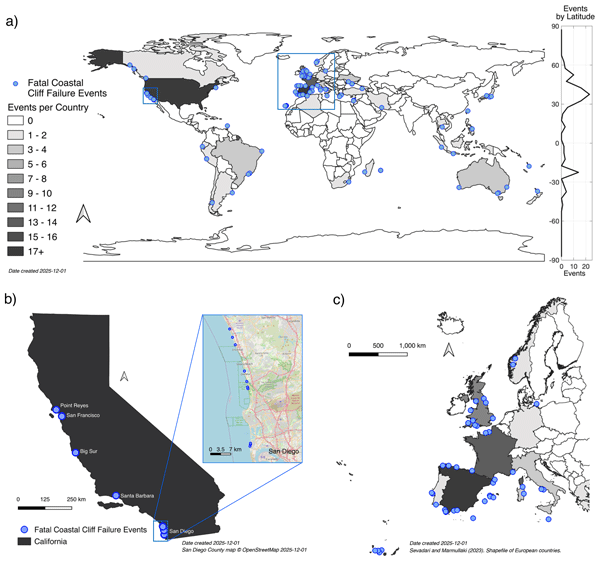
We recorded 114 individual fatal coastal cliff failure events (Fig. 1) from 1927 to 2024, and 292 fatalities. 25 of these events were sourced from the Global Fatal Landslide Database, 25 from English media, 38 from non-English Media, 4 from the Global Landslide Catalog, 1 from the Italian Landslide Inventory 2018–2024 (IFFI), 13 from the Inventory of Rockfalls in Spain 1800–2021 (Corominas Dulcet et al., 2023), 6 from newspaper archives, and 2 from scientific papers. The preceding list only provides the first source that we found describing the event. The Spain and Italy databases were the only national databases that contained events not also found in media searches.
Fatal coastal cliff failure events occurred in 32 countries (Fig. 1), with the most events in Spain (20), the United States (18), France (14), and the United Kingdom (10). On average, there were 2.6 fatalities per event; however, 64 % of fatal coastal events resulted in single fatalities. 70 % of coastal cliff fatalities were from direct rock falls, with many fatalities from individuals recreating on beaches, for example sunbathing, strolling with a pet, kayaking, or camping. Events binned by 5° of latitude peak at 20–30° S in the southern hemisphere, and at 30–40° N in the northern hemisphere (Fig. 1).
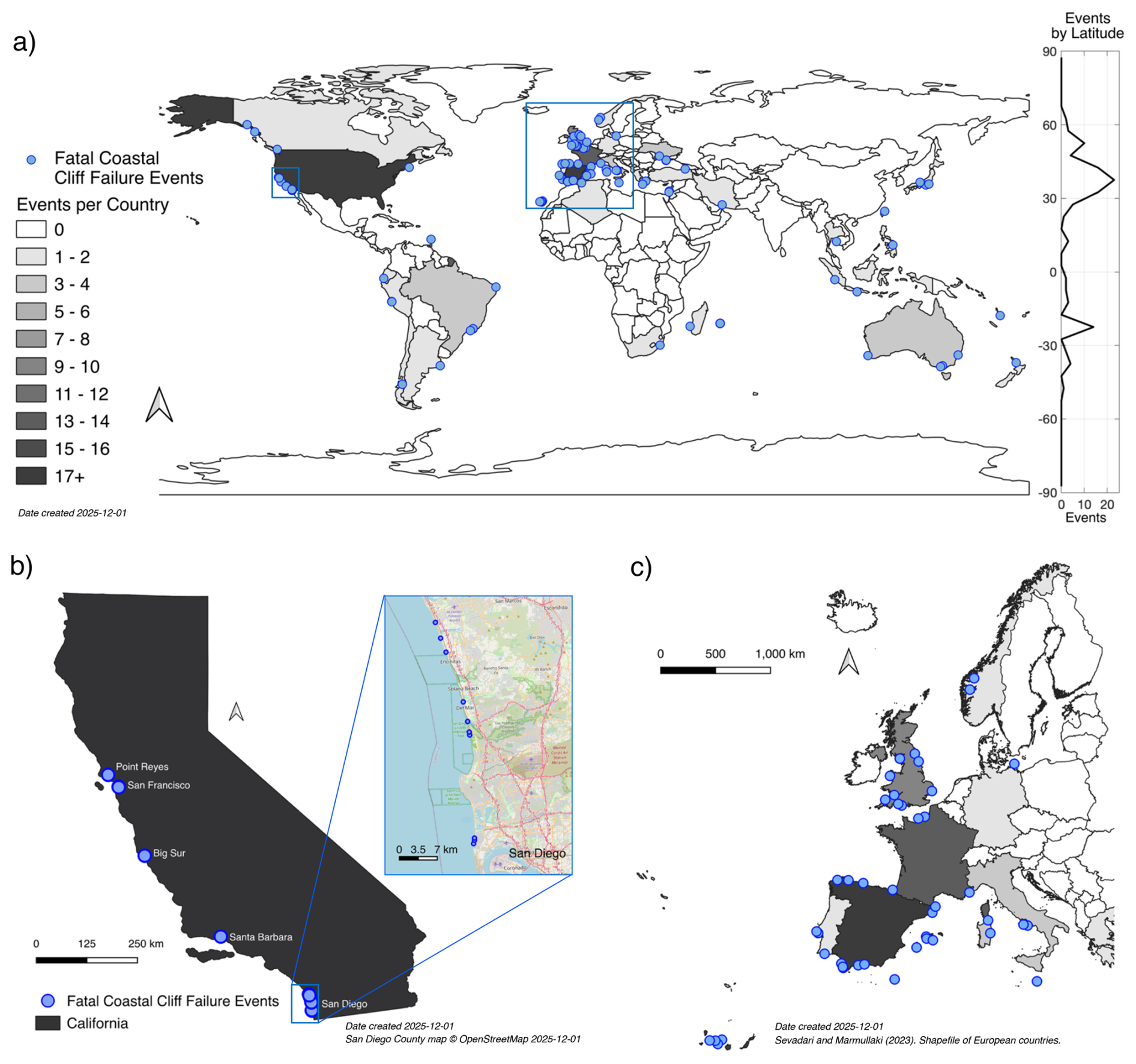
Figure 1The location of (a) global fatal coastal cliff failure events (blue dots) between 1927–2024, with insets showing (b) California (further inset to San Diego), and (c) Europe. Countries are color coded by the number of events within each country. Global political boundaries are from Natural Earth (2025). Europe political boundaries are from Sevdari and Marmullaku (2023). California boundaries are from California Open Data Portal (2023).
The Philippines, Brazil, and the United States had the highest number of coastal cliff fatalities (Fig. 2). The Philippines high fatality count resulted from a 2022 event with 53 fatalities that occurred at a seaside resort (Petley, 2022a). Brazil's high fatality count is primarily related to a 2010 event where 22 vacationers and staff were buried in a coastal landslide at Sankay Inn Resort, two hours west of Rio (Carvalho, 2010), and a 2009 event where 17 people were killed at Pousada Sankay Island resort in Ilha Grande (Azzoni and Dana, 2010).
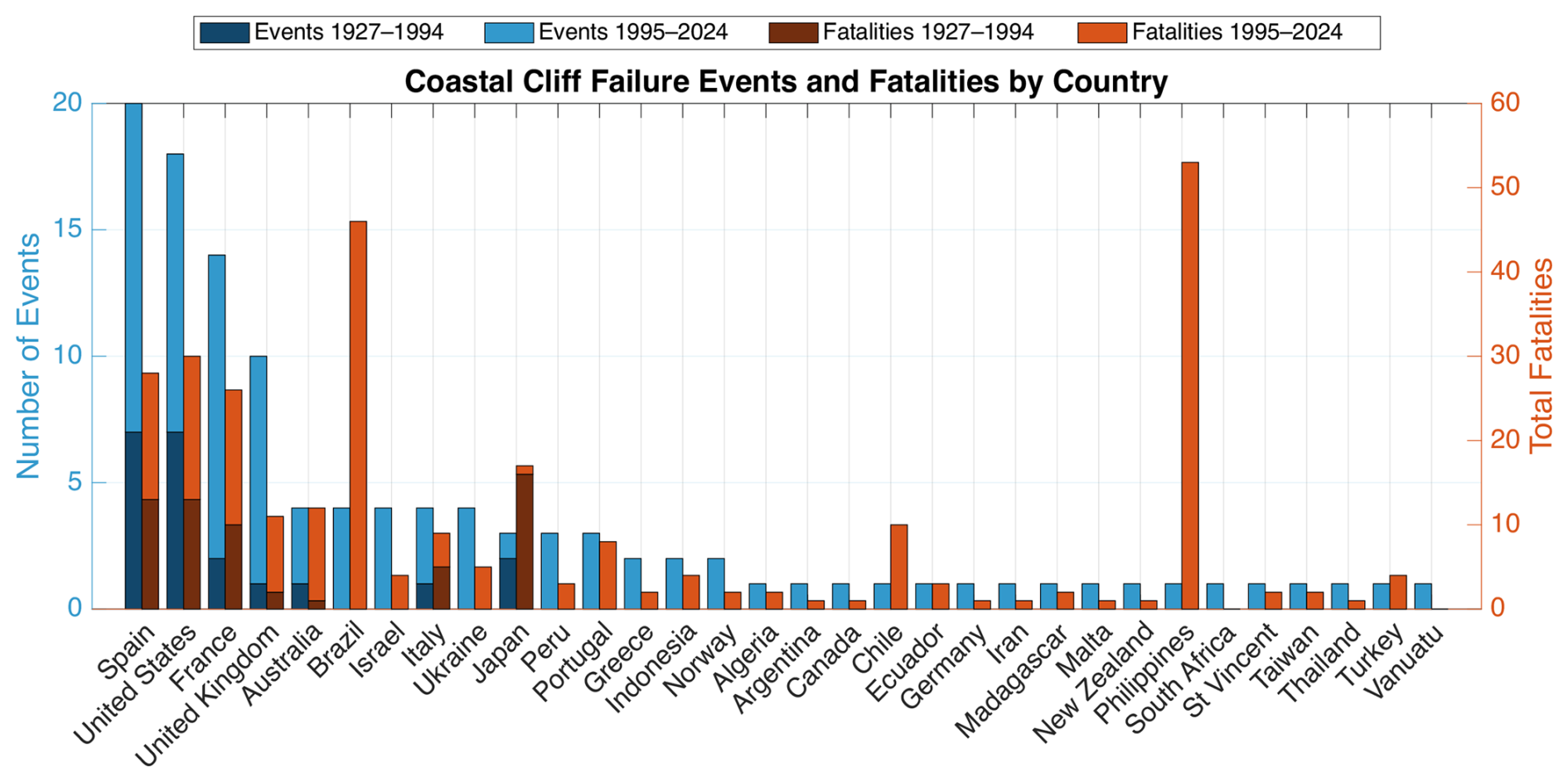
Figure 2Coastal cliff fatalities (red) and events (blue) binned by country, and stacked by time periods 1927 to 1994 (darker, pre-Internet access), and 1995–2024 (lighter, post-Internet).
Spain had the highest number of fatal coastal cliff failure events (20 events, Fig. 2) and these were generally spread spatially. The United States had both a high number of fatal coastal cliff failure events (18) and fatalities (30), mostly concentrated in a hot spot in San Diego County, California, which represented 63 % of the fatalities and 56 % of the events in the United States. France's fatal coastal cliff failure events (14) were geographically concentrated in a hot spot on Réunion Island, representing 79 % of the events in French territories. Other fatal coastal cliff failure clusters (3 or more events within a 25 km radius) occurred in: Cadiz, Spain; Netanya, Israel; San Francisco/Point Reyes, California, United States; Crimea, Ukraine; and Costa Verde, Peru.
3.2 Coastal Setting
Multivariate negative binomial regression indicated that per-country (n=29 countries) international tourism visits had the strongest relationship with the number of events (Fig. 3; , IRR=1.26, 95 % CI [1.16, 1.37]). Per-capita GDP also showed a significant relationship to fatal coastal cliff failure events (p=0.026, IRR=1.14, CI [1.01, 1.29]). The country population, length of coastal cliffs, and percentage of coastline composed of cliffs did not significantly explain the number of fatal coastal failures on a per-country basis for the full dataset. These results are consistent with a post-1995 subset of the data (n=29, Tourism [, IRR=1.22, CI [1.13, 1.33]], GDP [p=0.045, IRR=1.12, CI [1.00, 1.26]]).
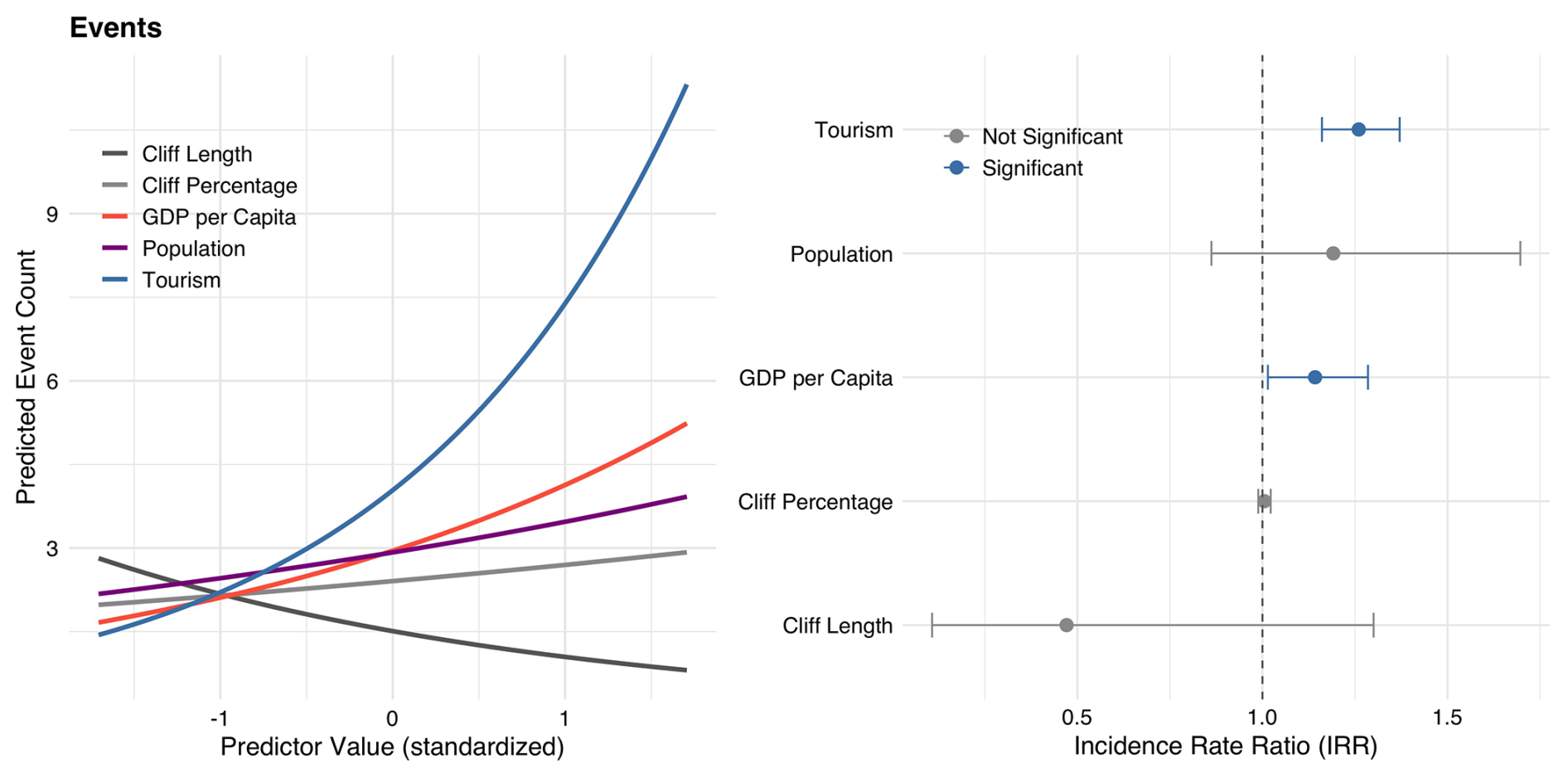
Figure 3Multivariate negative binomial marginal effect curves (left) and incidence rate ratios (right) for fatal coastal cliff failure events vs. kilometers of cliffs, percent coastline as cliffs, per-capita Gross Domestic Product (GDP), population, and international tourist arrivals.
For coastal cliff fatalities (n=27), per-country population had the strongest relationship of the tested variables (Fig. 4; p=0.024, IRR=1.96, CI [0.96, 4.58]). Tourism, per-capita GDP, length of coastal cliffs per country and cliff percentage did not exhibit strong relationships with per-country coastal cliff fatalities. Population was not significant with a post-1995 subset of the dataset, nor were other factors. People local to the area and people traveling to the area were impacted almost equally, with 66 locals and 69 tourists killed (and 157 fatalities of unknown victim affiliation).
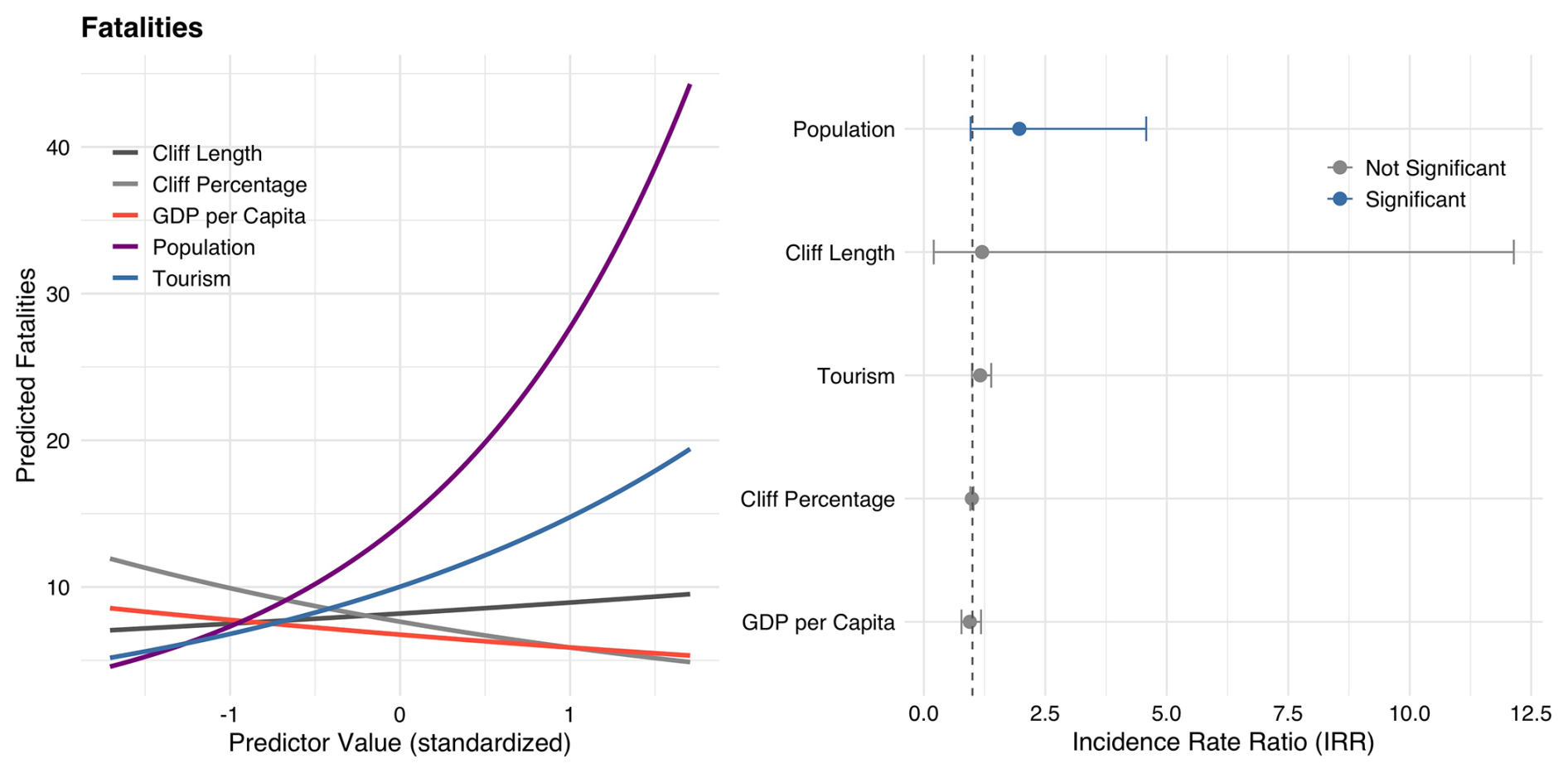
Figure 4Multivariate negative binomial marginal effect curves (left) and incidence rate ratios (right) for coastal cliff failure fatalities vs. kilometers of cliffs, percent coastline as cliffs, per-capita Gross Domestic Product (GDP), population, and international tourist arrivals.
3.3 Time History and Seasonality
The number of fatal coastal cliff failure events and fatalities in our database generally increased with time (Fig. 5a). By month, the number of fatal coastal events and fatalities exhibit a bimodal distribution, with more events in July–August (31 events) and January–February (22 events), and more fatalities in July–August (61 fatalities) and December–January (61 fatalities; Fig. 5b). When separated by hemisphere (Fig. 6), most fatal coastal cliff failure events and fatalities occurred in the summer months in each hemisphere: July–August in the Northern Hemisphere (30 events, 60 fatalities) and December–February in the Southern Hemisphere (13 events, 32 fatalities). April also had a Northern Hemisphere peak in fatalities from the 2022 Philippines event (53 fatalities).
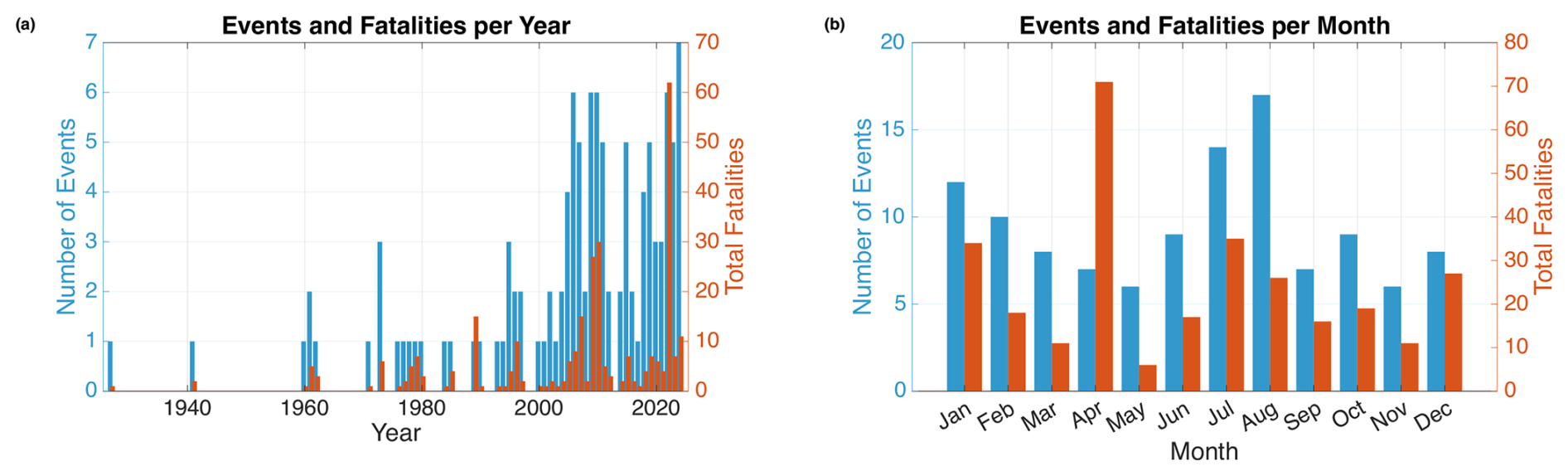
Figure 5Number of fatal coastal cliff failure events and fatalities globally binned per (a) year, and (b) month.
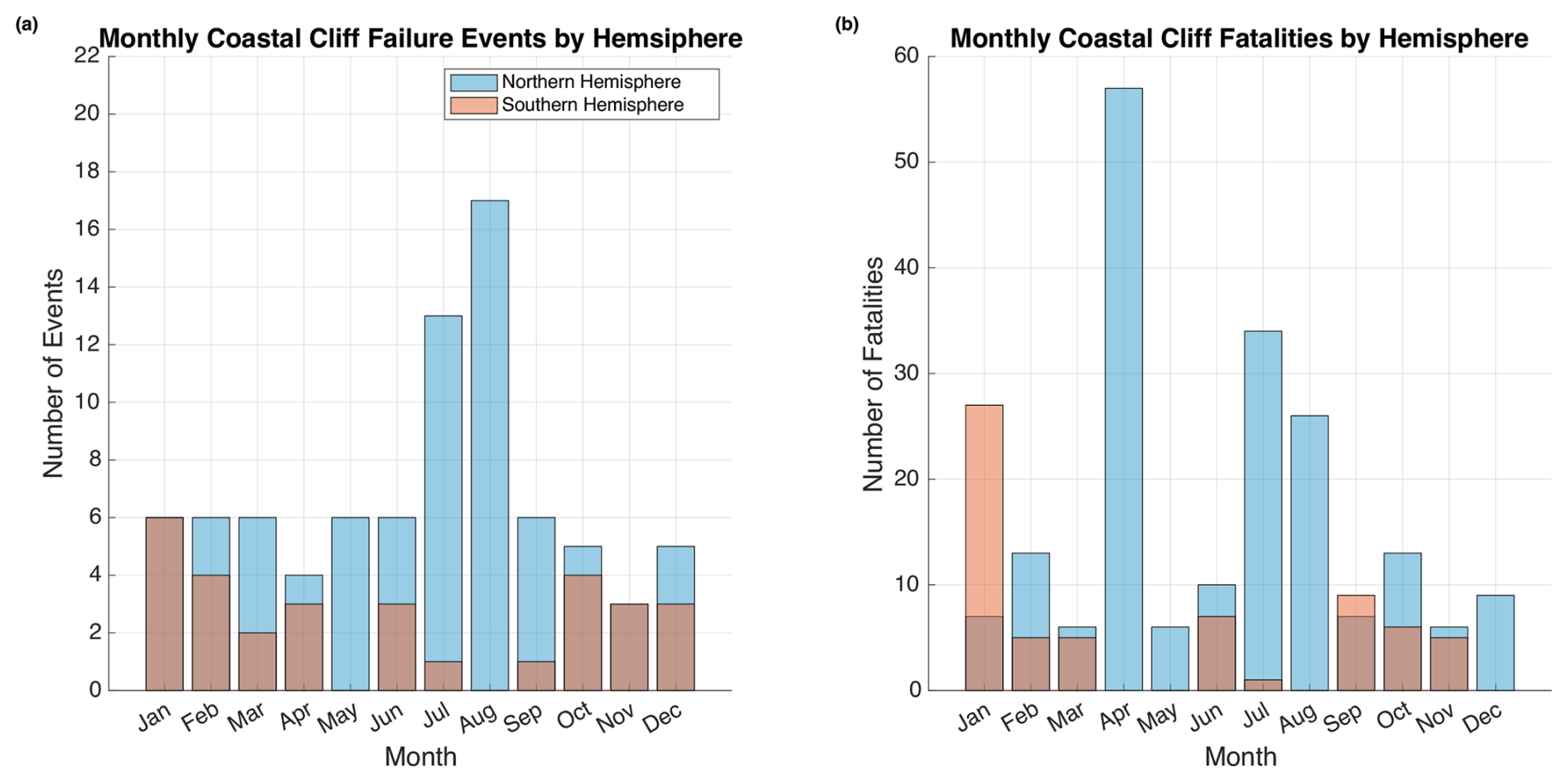
Figure 6Monthly number of fatal coastal cliff failure (a) events and (b) fatalities in the Northern and Southern Hemispheres.
3.4 Rainfall
While most media reports did not cite a particular cliff failure trigger (72.8 %), rainfall or rainfall combined with other factors (such as wind) was attributed to 21.1 % of events. Other triggers included earthquake (2.6 %), recreation (1.8 %), ice (0.9 %), and wave erosion (0.9 %).
Coastal cliff failure events (n=88) were associated with more day-of-event negative rainfall anomalies (less rainfall, 71 events) than positive (more rainfall, 17 events; two-sided binomial test ). There were also more day-before and 7 d antecedent negative rainfall anomalies than positive (66 negative, 22 positive, ; 53 negative, 35 positive, p=0.069, respectively). The 30 d antecedent rainfall anomalies were closely split between positive and negative anomalies (41 negative, 47 positive; p=0.59).
The number of fatalities per event was positively related to 7 and 30 d antecedent rainfall anomalies (n=86; negative binomial regression , ; , , respectively). The number of fatalities per event were also positively and significantly related to 30 d antecedent, 7 d antecedent, day-before, and day-of rainfall totals (, ; , ; , ; p=0.005, , respectively). The rainfall variable best related to the number of fatalities per event was 7 d total precipitation.
Considering rainfall seasonality, fatal coastal cliff failure events were relatively evenly distributed, with 37.5 % of fatal coastal slope failure events in the dry season, 33 % in the wet season, and 29.5 % occurring in transitional seasons. This seasonal distribution does not significantly differ from the null hypothesis (Chi-squared statistic = 0.84, p=0.66). 40 % of events (n=88) occurred during months with typical rainfall conditions for that month (rainfall within the 25th and 75th percentile). 35 % of events occurred during months that were much wetter than normal (rainfall above 75th percentile), and 25 % of events occurred during months that were much drier than usual (rainfall below 25th percentile). 33 % of events occurred with a 30 d antecedent rainfall of less than 25 mm. About an equal number of fatal coastal slope failure events occurred with 30 d antecedent periods with rainfall above vs. below the long term 30 d rainfall (1:1 line, Fig. 7).
Considering only dry season coastal cliff failure events, more events occurred during negative anomalies (less rainfall) than positive (p=0.014). For only wet and transitional season coastal cliff failure events, there was no difference between positive and negative anomalies.
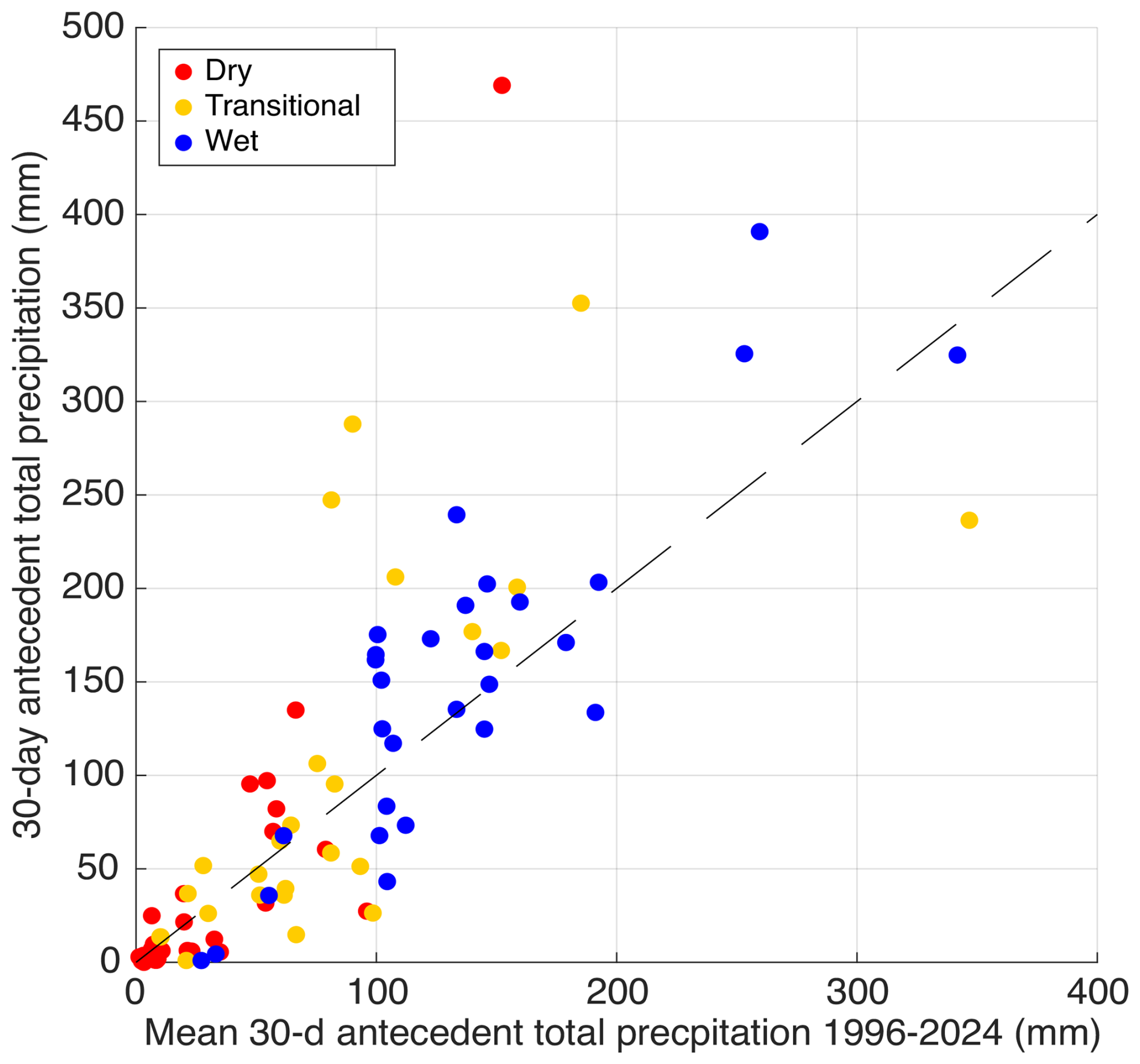
Figure 730 d antecedent total precipitation at the location of each cliff failure event compared to an average 30 d total at the same time over the dataset period (1996–2024). Points are color-coded corresponding to the location-based season, based on long-term rainfall data.
In San Diego County, 10 fatal coastal cliff failure events (19 fatalities) primarily occurred in two time periods: January–February and August. The number of passengers arriving at San Diego International Airport peaked in the summer (June–August), while rainfall in San Diego County peaked in the winter (December–March). The tourism and rainfall peaks align with the two peaks in San Diego fatal cliff failure events (Fig. 8). However, the overall low number of events precludes further robust statistical analysis.
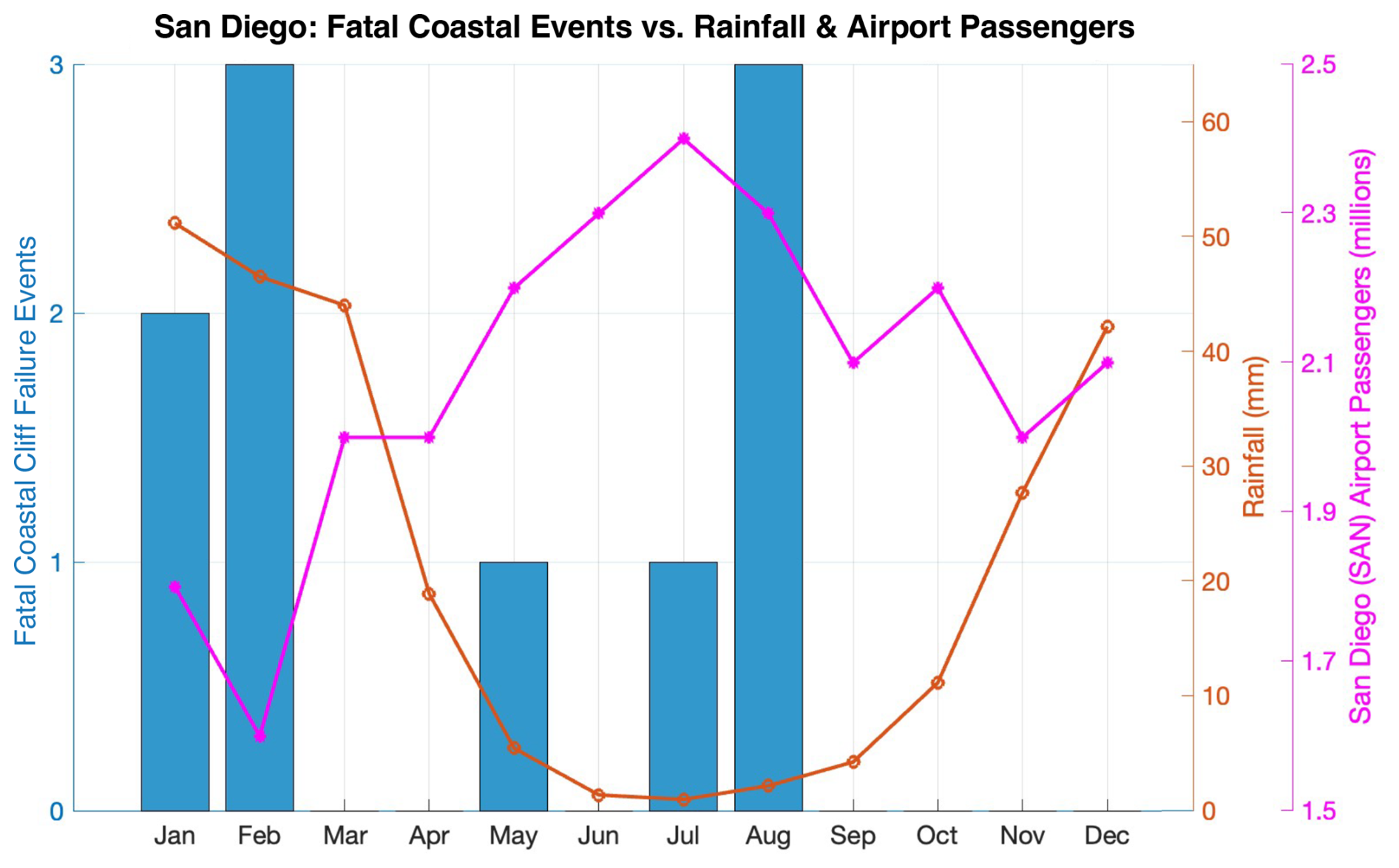
Figure 8San Diego County fatal coastal cliff failure events in relation to average monthly rainfall (1927–2024) and airport passenger traffic (2024–2025). Each fatal coastal cliff failure event in San Diego County resulted in 1–3 fatalities.
In the Southern Hemisphere, Réunion Island had 11 fatal coastal landslide events (16 fatalities) that also show a bimodal seasonal pattern, peaking in February–March and October (Fig. 9). The February–March peak occurred in the wet season and overlaps with both high and low levels of tourism. The October peak occurred during moderate rainfall and tourism conditions.
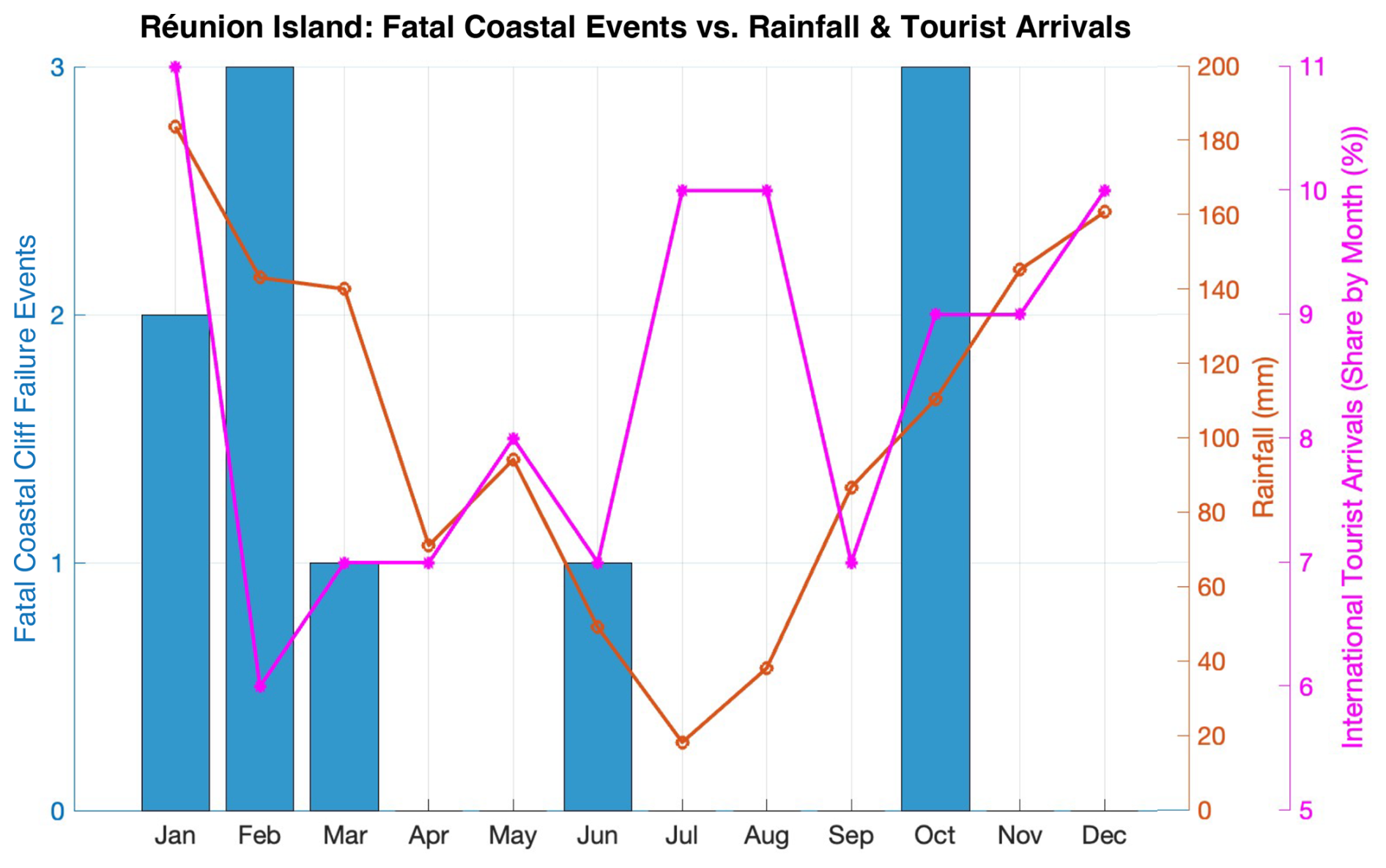
Figure 9Réunion Island fatal coastal cliff failure events in relation to average monthly rainfall (1996–2024) and 2018 international tourist arrivals. A 1995 event (1 fatality) is not shown due to lack of day/month specification.
4.1 Database completeness
The database presented here underestimates the actual number of fatal coastal slope failures worldwide and includes reporting biases similar to other global landslide databases (e.g. Froude and Petley, 2018). Landslides in remote areas and those that result in a small number of fatalities are less likely to be reported (Petley, 2009). Regional communication systems are also inconsistent in less developed or politically isolated nations (i.e. North Korea; Kirschbaum et al., 2010; Petley, 2010). For example, African countries, despite having many coastal cliffs (Young and Carilli, 2019), lack online national databases or online media records of coastal landslide fatalities. This database also only used records still available in 2025, while other databases like Froude and Petley (2018) used some data sources no longer accessible online (and thus could not always be verified for this database). Underestimations could also result if victims died weeks or months after the event (Petley, 2012) and from difficulties searching non-English media (Froude and Petley, 2018). Our use of translators and searches in alternative languages aimed to reduce this bias. The majority of entries in this database were sourced from online media searches using both English and non-English keywords. A comparison study (Sepúlveda and Petley, 2015) of the English-based Global Fatal Landslide Database with an independently compiled database of Spanish and Portuguese language reports found a reporting difference of only 5 % of records. However, the inclusion here of non-English media search keywords between 2004–2017 (GFLD time span) identified an additional 23 events not included in the Global Fatal Landslide Database, highlighting the importance of non-English data searches for global database compilations. Some non-English languages used for media searches yielded zero results, such as Bosnian, Serbian, Norwegian, Danish, Swedish, Croatian, Bangla, and German. While it is possible that no fatal coastal cliff failures were reported in these languages, this may also suggest a potential translation error.
The regional and national databases used here often contained information already identified in the media searches and therefore were most important for capturing events that occurred before online reporting. However, databases that included pre-Internet entries were limited and often inaccessible. This reporting bias results in an apparent increase in the number of fatal cliff failure events and fatalities towards the present (Fig. 5). Internet accessibility (and online searchable media records) only attained global coverage after 1995, suggesting that landslides occurring before 1995 will be underrepresented (Haque et al., 2016). Although our dataset contains events back to 1927, early records are limited and only included for countries with publicly accessible records that extend that far back (ref. Fig. 2), such as Spain's Inventory of Rockfalls (Corominas Dulcet et al., 2023), and the Google News Archive for United States newspapers. The number of reported events per year becomes more consistent after 2004, which aligns with the release of the Global Fatal Landslide Database (2004 to 2017).
Currently, a comprehensive global landslide database utilizing regional and national databases does not exist. Successful combination of these databases would provide a useful tool toward future analysis. Wood et al. (2020) found that current global catalogs lack consistency because of the “wealth and variety of data” in individual, smaller-scale databases. Van Den Eekhaut et al. (2012) analyzed national landslide databases in Europe and found that 68 % of the databases contained less than 50 % of all landslides in each country, and that different language and classification systems result in poor integration of multiple databases. They also found that public access to these databases is normally limited, which was also encountered for this study. Gómez et al. (2023) compiled four global databases (EM-DAT, the Global Landslide Catalog, the Global Fatal Landslide Database, DesInventar) to form the Unified Global Landslide Database (UGLD), which is not yet publicly available; however, we used the first three databases in our analysis.
4.2 Potential drivers of fatal coastal cliff failures
Considering database limitations, fatal coastal cliff failure events and fatalities did not have relationships to the proportion of coastlines backed by cliffs or total length of cliffed coastline per country despite these factors providing more opportunities for fatalities associated with cliff failures. Instead, tourism ( [events]), per-capita GDP (p=0.026 [events]), and the population of each country (p=0.023 [fatalities]) showed the strongest associations with fatal coastal landslide events and fatalities, respectively.
The results showed that 51 % of fatalities associated with coastal cliff failures were victims that traveled to the area rather than victims that lived there, of those fatalities where it was reported. Pereira et al. (2017) found that cliff-related fatalities in southern Portugal increased recently because of increased exposure from “careless intensive use of coastal areas for tourism and leisure”. This suggests hazards may increase with expanding coastal tourism and rapidly growing settlement in coastal areas (McGranahan et al., 2007). 60 % of the world's population lives within 60 km of the coast, with an expected population increase over time (Castedo et al., 2017). We note that simply labeling victims as “tourist” or “local” does not capture the familiarity of the victims with coastal hazard.
Globally, rainfall is the dominant factor driving landslide risk (Kirschbaum et al., 2012). Froude and Petley (2018) found that monthly rainfall explained 93 % of variance in the Global Fatal Landslide Database, and Haque et al. (2019) found that more than half of fatal landslides analyzed occurred in areas exposed to extreme rainfall. In our dataset, the number of per-event fatalities was positively related to 7 and 30 d antecedent rainfall anomalies, and day-of, day-before, 7 d, and 30 d antecedent total precipitation. In contrast, there were more events associated with negative rainfall anomalies (less rainfall than normal) for day-of, day-before, and 7 d antecedent precipitation anomalies. More fatal coastal cliff failure events occurred when rainfall was less than normal, when tourism and beach use may peak. However, events with high numbers of fatalities were strongly associated with higher rainfall and wetter precipitation anomalies.
Seasonally, only 33 % of fatal coastal events occurred during wet seasons, and only half of events occurred with above-average 30 d antecedent rainfall conditions. This pattern differs from datasets of all fatal landslides which reflect more events during wet periods (Froude and Petley, 2018) and is potentially driven by the increased hazard during dry seasons as more people recreate on beaches.
The latitudinal peak in fatal coastal slope fatalities and events between 30–40° shows that many coastal cliff failure fatalities occur in temperate, dry-summer climates, coinciding with some of the wealthiest nations and locations of high tourism with more beach use (Stringham, 2015). Thus, the distribution is potentially related to both elevated coastal cliff failure activity during high rainfall and elevated coastal recreation in dry periods (Georgopoulou et al., 2019). These findings are consistent with a bimodal pattern observed at the San Diego County hot spot, where fatal coastal events peaked in both dry and wet seasons. Fatality risks related to coastal cliff failures are therefore potentially related to a combination of environmental triggers (i.e. seasons with elevated rainfall), and human activity on the coast (i.e. intensive beach use during dry weather; Georgopoulou et al., 2019). On Réunion Island, rainfall and tourism patterns are not as clear as in San Diego. Réunion Island tourism does not show a clear relationship with fatal events, while high rainfall aligns with peaks in fatal events. These events also differ from San Diego County, as all Réunion Island events occurred on coastal highways bordering sea cliffs; in San Diego County, most fatal coastal landslide events occurred directly on beaches. The complicated relationship between rainfall and fatal coastal cliff failures could also be related to the limited number of events available for analyses in both hot spots.
The Global Fatal Landslide Database found that most fatalities occurred in developing, low GDP countries and areas characterized by significant poverty (Froude and Petley, 2018). Other datasets also reflect more landslide fatalities in developing countries with high poverty, more corrupt governments, and weaker healthcare systems (Dowling and Santi, 2014), leading to descriptions of landslides as “disasters of social vulnerability” (Petrucci, 2022; Santi et al., 2011). Developed countries tend to have a higher level of disaster preparedness and larger use of warning systems leading to a lower number of fatalities per landslide event (Petrucci, 2022). This negative relationship contrasts with the fatal coastal cliff failure events, which show a positive relationship with per-capita GDP. These differences may be related to media reporting bias (Haque et al., 2016) or reflect higher beach use in higher GDP locations (Risso, 2018).
Throughout this paper, the number of events are underestimated because of several stated biases. In addition, other data treatments such as separating events and fatalities into countries resulted in a small sample size (27) compared to the number of predictors tested (5). These types of statistical tests would be more robust with additional data points. Because of the small sample sizes, results should be interpreted with caution
4.3 Hazard perception
Differences between the number of fatalities and the number of fatal coastal cliff failure events can influence hazard perception. Spain, The United States, France, and the United Kingdom had the highest number of fatal coastal cliff failure events in the database (Fig. 2), while the Philippines and Brazil had the most fatalities, but lower numbers of fatal coastal cliff failure events (Fig. 2). High-fatality events may impact analyses, leading to results biased toward singular events. However, 64 % of coastal cliff failures in our database were single fatality events, compared to only 29 % of events in the Global Fatal Landslide Database (Froude and Petley, 2018). Many of the landslides in the Global Fatal Landslide Database with high fatalities were large-scale events often impacting entire towns, while fatal coastal landslides in this dataset were more likely to represent smaller rockfalls that affected one or a small number of people.
4.4 Hazard reduction
Various methods to reduce coastal hazards include eliminating rockfall, mitigating erosional processes, predicting landslides, and prioritizing human education. Methods to prevent rockfalls include cliff reshaping and terracing (Pradeepkumar et al., 2014), rock bolting (McInnes et al., 2007), adding seawalls and riprap (Griggs and Fulton-Bennett, 1988), and stabilizing via mesh or netting (Harp and Youd, 1995). Direct manual or mechanical removal of hazardous loose rocks, overhangs or protrusions is also used on some inland slopes and cliffs (Maerz et al., 2015).
Some hazard reduction methods attempt to eliminate or reduce erosional processes. Beach nourishments are widely used in the U.S. and Europe to provide a buffer to wave-cliff erosion (de Schipper et al., 2021; Griggs and Kinsman, 2016; Marinho et al., 2019). Controlling groundwater seepage into cliffs by improving drains has also been proposed (Brampton, 1998). Nature-based solutions for coastal protection, such as bio-fencing, are also increasingly popular (Clemente et al., 2023; Pradeepkumar et al., 2014). Artificial reefs and cobble berms are used to reduce wave energy and erosion and to help retain sand on beaches (Foss et al., 2023; Silva et al., 2016). These methods can also directly reduce interaction between coastal users and potential cliff failures; for example, on the Basque Coast of northern Spain, dunes placed at the cliff base provide a barrier between cliffs and people (Clemente et al., 2023).
Current research in hazard forecasting and monitoring is also increasing. Thermal remote sensing (Melis et al., 2020) and microseismic monitoring (Arosio et al., 2009) help identify growing fractures, water intrusion, and weathered areas. Lidar monitoring can determine specific failure mechanisms and sequences of erosional events (Olsen et al., 2012; Swirad and Young, 2025). 3D rockfall modeling (Morales et al., 2021) and topographic monitoring can also help establish maximum runout reach and can inform management and protection measures.
Other hazard reduction methods prioritize the human aspect of hazard mitigation, such as public and lifeguard education, regional weather warnings, warning signs, and restricting unstable areas. The BGS National Landslide Database highlighted many non-fatal landslides that triggered warnings, barriers, and closures of beaches, trails, and cliff sections in recently impacted areas or predicted hazardous areas. In 2024, Australia implemented a Cliff Safety Month to occur every February, prioritizing public education on the issue (Coast & Parks Authority, 2025; Rivalland, 2025). In 2024, Albufeira, Portugal implemented an awareness campaign to raise awareness for sun exposure and cliff danger by distributing leaflets in Portuguese and English (The Portugal News, 2024). However, there is large variation in public perception of coastal cliff hazards and responses to educational or warning signs (Bird 1994; Williams and Williams, 1988). Even after an obvious recent landslide, people continue to visit coastal areas and even walk on recent rock falls (Fox, 2023; Williams and Williams, 1988).
This study builds upon previous landslide research to develop a database of coastal fatal cliff failures. In total, the database includes 114 events and 292 fatalities with event hot spots in San Diego County, California, and Réunion Island, France. Aggregated by country, tourism, population, and per-capita GDP were related to the number of coastal cliff fatalities or events, suggesting the likelihood of fatal coastal cliff failures increases with beach use. Unlike general (including coastal and inland) fatal landslide databases, coastal fatal landslide events and fatalities had complicated relationships with rainfall, suggesting dry seasons should also be considered in hazard mitigation planning for coastal cliff failures. Overall, the results suggest event timing may be driven by a combination of high rainfall and elevated recreation on beaches during dry periods. The database is likely incomplete as evidenced by no entries from some large geographic areas such as Africa, and the analysis presented here should be interpreted with caution. In the future, better records and systematic reporting of coastal failures can help create a more comprehensive coastal fatal landslide database and identify potential drivers of coastal cliff failures and fatalities to improve risk management.
Media searches were conducted using translations of the search word combinations in Albanian, Amharic, Arabic, Bangla, Bhojpuri, Bosnian, Chinese, Croatian, Danish, Egyptian Arabic, Finnish, French, German, Greek, Gujarati, Hausa, Hebrew, Hindi, Indonesian, Iranian Persian, Italian, Javanese, Japanese, Kannada, Korean, Levantine Arabic, Marathi, Norwegian, Persian, Polish, Portuguese, Punjabi (Western), Russian, Serbian, Spanish, Sudanese Arabic, Swahili, Swedish, Tagalog, Tamil, Telugu, Thai, Turkish, Ukrainian, Urdu, Vietnamese, Wu Chinese, Yoruba, Yue Chinese, and Zulu.
-
Date: Date is in the format MM/DD/YYYY. Date was determined using publication dates of media reports and key phrases such as, “Last Friday”, “This weekend”, etc.
-
Location: Five fields are used for location. The first two location fields (Location 1, Location 2) list where the slope failure occurred, with Location 1 being a more specific area, such as a beach name, town name, or road, and Location 2 being a broader area. The third location field is the country. The fourth and fifth location fields list latitude and longitude of the event.
-
Precision (km): Our database includes the estimated spatial precision of the location in kilometers if available. Often, the original source location and/or spatial precision estimates were updated using additional information obtained in the media searches. An example “1 km” precision indicates the slope failure likely occurred within a 1 km radius of the point location. In some cases, the sources indicated multiple possible locations, or a broad location; precision reflects the region described and was determined based on the spatial extent of the possible location, varied from site-specific to regional. Whole numbers indicate the value is a true estimate.
-
Known Fatalities: This is a binary field, where “1” represents an event with a known coastal fatality count, and “0” represents an unknown count. Unknown counts are from large confirmed fatal slope failure events, but the exact number of coastal deaths vs. inland deaths is unknown.
-
Fatalities: This lists the number of fatalities for the event listed.
-
Victim: This field lists whether the victim was a local, tourist, or unknown affiliation. This was determined using media reports indicating if the victim lived in the area (local) or traveled to get to the destination (tourist). However, simply labeling victims as “tourist” or “local” does not capture the familiarity of the victims with coastal hazards.
-
Reason: This field lists the potential slope failure trigger if stated in the media report.
-
Source: The first source found that documented the event. Duplicate sources are not listed unless they provided additional information used to locate or date the event. Duplicate events were identified if both sources listed similar locations, dates, and event-victim descriptions. Precision was altered to reflect location conflicts across sources (wider precision). In the rare case of a date conflict, the most local source (local news site) date was used. Fatality counts did not conflict across sources.
-
Link: Web link to a source with details about the event.
-
Notes: A short description of the information on the web link.
The coastal fatal cliff failure database and spreadsheet in the Supplement are available at GFCCF_Database.xlsx for download. All landslide databases are publicly available and listed in Table 1. Information for access to each data source is located in the reference section. Maps were created using political boundaries in https://www.naturalearthdata.com/downloads/110m-cultural-vectors/110m-admin-0-countries/ (Natural Earth, 2025), https://doi.org/10.11583/DTU.23686383.v1 (Sevdari and Marmullaku, 2023), and https://data.ca.gov/dataset/ca-geographic-boundaries (California Open Data Portal, 2023), which are all located in the reference section.
The supplement related to this article is available online at https://doi.org/10.5194/nhess-26-3707-2026-supplement.
Malia N. Reiss: Writing – Original Draft, Methodology, Investigation, Visualization, Formal analysis, Data Curation Adam P. Young: Conceptualization, Methodology, Writing – Review & Editing, Supervision, Project administration, Funding acquisition Jessica Carilli: Methodology, Writing – Review & Editing, Investigation.
The contact author has declared that none of the authors has any competing interests.
Publisher's note: Copernicus Publications remains neutral with regard to jurisdictional claims made in the text, published maps, institutional affiliations, or any other geographical representation in this paper. The authors bear the ultimate responsibility for providing appropriate place names. Views expressed in the text are those of the authors and do not necessarily reflect the views of the publisher.
We thank two anonymous reviewers for constructive comments and foreign language searches conducted by native speakers (Raphael Krier-Mariani, Hironori Matsumoto, Zuzanna Świrad, Jyotismita Taye, and Danghan Xie).
This research has been supported by the State of California.
This paper was edited by Yves Bühler and reviewed by two anonymous referees.
Adler, R., Wang, J., Sapiano, M., Huffman, G., Bolvin, D., Nelkin, E., and NOAA CDR Program: Global Precipitation Climatology Project (GPCP) Climate Data Record (CDR), Version 1.3 (Daily) [October 1996–2024], NOAA National Centers for Environmental Information, https://doi.org/10.7289/V5RX998Z, 2017.
Arosio, D., Longoni, L., Papini, M., Scaioni, M., Zanzi, L., and Alba, M.: Towards rockfall forecasting through observing deformations and listening to microseismic emissions, Nat. Hazards Earth Syst. Sci., 9, 1119–1131, https://doi.org/10.5194/nhess-9-1119-2009, 2009.
Azzoni, T. and Dana, F.: Brazilian mudslides kill at least 17, CantonRep, https://www.cantonrep.com/story/news/2010/01/02/brazilian-mudslides-kill-at-least/42579463007/ (last access: 3 September 2025), 1 January 2010.
Bird, E. C.: Cliff Hazards and Coastal Management, Journal of Coastal Research, Coastal Education & Research Foundation, Inc., pp. 299–309, https://www.jstor.org/stable/25735606 (last access: 5 January 2026), 1994.
Blair, A.: 28-year-old man dies after cliff collapses at Bells Beach, https://www.news.com.au/national/victoria/news/three-injured-as-cliff-collapses-at-bells-beach/news-story/c65cd2d62546460ff1967e5236ffcaaf (last access: 5 December 2025), 31 December 2021.
Brampton, A. H.: Cliff conservation and protection: methods and practices to resolve conflicts, in: Coastal Defence and Earth Science Conservation, pp. 21–31, Geological Society of London, ISBN 978-1-897799-96-3, google-Books-ID: 4g2hynOBd4MC, 1998.
Brasil: Disaster database and records: integrated disaster information system, Ministry of National Integration National Secretary of Civil Defense [data set], http://s2id.integracao.gov.br/ (last access: 10 October 2025), 2021.
California Open Data Portal: CA Geographic Boundaries – California Open Data [data set], https://data.ca.gov/dataset/ca-geographic-boundaries (last access: 1 December 2025), 2023.
Calvello, M. and Pecoraro, G.: FraneItalia: a catalog of recent Italian landslides, Zenodo, https://zenodo.org/records/15144334 (last access: 4 April 2025), 2025.
Castedo, R., Paredes, C., de la Vega-Panizo, R., and Santos, A. P.: The Modelling of Coastal Cliffs and Future Trends, in: Hydro-Geomorphology – Models and Trends, IntechOpen, ISBN 978-953-51-3574-6, https://doi.org/10.5772/intechopen.68445, 2017.
Clemente, J. A., Uriarte, J. A., Spizzichino, D., Faccini, F., and Morales, T.: Rockfall hazard mitigation in coastal environments using dune protection: A nature-based solution case on Barinatxe beach (Basque Coast, northern Spain), Eng. Geol., 314, 107014, https://doi.org/10.1016/j.enggeo.2023.107014, 2023.
Coast & Parks Authority: Stay Safe on the Coast: Annual Cliff Safety Campaign Kicks Off, Great Ocean Road Coast & Parks Authority, https://www.greatoceanroadauthority.vic.gov.au/Latest-News/Stay-Safe-on-the-Coast-Annual-Cliff-Safety-Campaign (last access: 8 December 2025), 1 February 2025.
Corominas Dulcet, J., Lantada, N., and Núñez Andrés, M. A.: Inventario de desprendimientos de rocas en España desde 1800 a 2021, CORA.Repositori de Dades de Recerca, V3, https://doi.org/10.34810/data238, 2023.
de Carvalho, U. W.: Textos Mastigados: Mountain falls onto Brazil resort; 22 killed, Tesclasap, https://www.teclasap.com.br/textos-mastigados-mountain-falls-onto-brazil-resort-22-killed/ (last access: 5 December 2025), 2 January 2010.
de Schipper, M. A., Ludka, B. C., Raubenheimer, B., Luijendijk, A. P., and Schlacher, T. A.: Beach nourishment has complex implications for the future of sandy shores, Nat. Rev. Earth Environ., 2, 70–84, https://doi.org/10.1038/s43017-020-00109-9, 2021.
Delforge, D., Wathelet, V., Below, R., Sofia, C. L., Tonnelier, M., van Loenhout, J. A. F., and Speybroeck, N.: EM-DAT: the Emergency Events Database, Int. J. Disaster Risk Reduct., 124, 105509, https://doi.org/10.1016/j.ijdrr.2025.105509, 2025.
Dowling, C. A. and Santi, P. M.: Debris flows and their toll on human life: a global analysis of debris-flow fatalities from 1950 to 2011, Nat. Hazards, 71, 203–227, https://doi.org/10.1007/s11069-013-0907-4, 2014.
Duperret, A., Genter, A., Martinez, A., and Mortimore, R. N.: Coastal chalk cliff instability in NW France: Role of lithology, fracture pattern and rainfall, in: Coastal Chalk Cliff Instability, edited by: Mortimore, R. N. and Duperret, A., Vol. 20, p. 0, The Geological Society of London, ISBN 978-1-86239-150-5, https://doi.org/10.1144/GSL.ENG.2004.020.01.03, 2004.
Duperret, A., Taibi, S., Mortimore, R. N., and Daigneault, M.: Effect of groundwater and sea weathering cycles on the strength of chalk rock from unstable coastal cliffs of NW France, Eng. Geol., 78, 321–343, https://doi.org/10.1016/j.enggeo.2005.01.004, 2005.
Emery, K. O. and Kuhn, G. G.: Sea cliffs: Their processes, profiles, and classification, GSA Bull., 93, 644–654, https://doi.org/10.1130/0016-7606(1982)93<644:SCTPPA>2.0.CO;2, 1982.
Ethnologue: What are the top 200 most spoken languages?, https://www.ethnologue.com/insights/ethnologue200/ (last access: 14 February 2026), 2025.
European Commission: Coastal tourism – EU Blue Economy Observatory, https://blue-economy-observatory.ec.europa.eu/eu-blue-economy-sectors/coastal-tourism_en (last access: 12 November 2025), 2023.
Foss, O., Blenkinsopp, C. E., Bayle, P. M., Martins, K., Schimmels, S., and Almeida, L. P.: Comparison of dynamic cobble berm revetments with differing gravel characteristics, Coastal Eng., 183, 104312, https://doi.org/10.1016/j.coastaleng.2023.104312, 2023.
Foster, C., Pennington, C. V. L., Culshaw, M. G., and Lawrie, K.: The national landslide database of Great Britain: development, evolution and applications, Environ. Earth Sci., 66, 941–953, https://doi.org/10.1007/s12665-011-1304-5, 2012.
Fox, T.: Huge section of cliff collapses in East Sussex next to footpath, Sussex News, https://www.sussexlive.co.uk/news/sussex-news/huge-section-cliff-collapses-peacehaven-7988514 (last access: 1 August 2025), 3 January 2023.
Froude, M. J. and Petley, D. N.: Global fatal landslide occurrence from 2004 to 2016, Nat. Hazards Earth Syst. Sci., 18, 2161–2181, https://doi.org/10.5194/nhess-18-2161-2018, 2018.
Geological Survey Ireland: GSI Landslide Data Viewer Ireland ITM: Landslides. Contains Irish Public Sector Data (Geological Survey Ireland) licensed under a Creative Commons Attribution 4.0 International (CC BY 4.0) licence, https://www.gsi.ie/en-ie/data-and-maps/Pages/default.aspx (last access: 1 October 2025), 2025.
Georgopoulou, E., Mirasgedis, S., Sarafidis, Y., Hontou, V., Gakis, N., and Lalas, D. P.: Climatic preferences for beach tourism: an empirical study on Greek islands, Theor. Appl. Climatol., 137, 667–691, https://doi.org/10.1007/s00704-018-2612-4, 2019.
Gómez, D., García, E. F., and Aristizábal, E.: Spatial and temporal landslide distributions using global and open landslide databases, Nat. Hazards, 117, 25–55, https://doi.org/10.1007/s11069-023-05848-8, 2023.
Gornitz, V.: Global coastal hazards from future sea level rise, Palaeogeogr. Palaeoclimatol. Palaeoecol., 89, 379–398, https://doi.org/10.1016/0031-0182(91)90173-O, 1991.
Griggs, G. and Kinsman, N.: Beach widths, cliff slopes, and artificial nourishment along the California Coast, Shore & Beach, 84, 1–12, 2016.
Griggs, G. B.: The Impacts of Coastal Armoring, Shore & Beach, 73, 13–22, 2005.
Griggs, G. B. and Fulton-Bennett, K.: Rip rap revetments and seawalls and their effectiveness along the central California coast, Shore & Beach, 56, 3–11, 1988.
Hampton, M. A., Griggs, G. B., Shipman, H. M., Edil, T. B., Guy, D. E., Kelley, J. T., Komar, P. D., and Mickelson, D. M.: Processes that govern the formation and evolution of coastal cliffs, US Geological Survey professional paper, pp. 7–38, 2004.
Haque, U., Blum, P., da Silva, P. F., Andersen, P., Pilz, J., Chalov, S. R., Malet, J.-P., Aufliˇ c, M. J., Andres, N., Poyiadji, E., Lamas, P. C., Zhang, W., Peshevski, I., Pétursson, H. G., Kurt, T., Dobrev, N., García-Davalillo, J. C., Halkia, M., Ferri, S., Gaprindashvili, G., Engström, J., and Keellings, D.: Fatal landslides in Europe, Landslides, 13, 1545–1554, https://doi.org/10.1007/s10346-016-0689-3, 2016.
Haque, U., da Silva, P. F., Devoli, G., Pilz, J., Zhao, B., Khaloua, A., Wilopo, W., Andersen, P., Lu, P., Lee, J., Yamamoto, T., Keellings, D., Wu, J.-H., and Glass, G. E.: The human cost of global warming: Deadly landslides and their triggers (1995–2014), Sci. Total Environ., 682, 673–684, https://doi.org/10.1016/j.scitotenv.2019.03.415, 2019.
Harp, E. L. and Youd, T. L.: Landslides, Earthquake Spectra, SAGE Publications Ltd STM, 11, 41–48, https://doi.org/10.1193/1.1585838, 1995.
Herre, B. and Samborska, V.: Tourism, Our World in Data, https://ourworldindata.org/tourism (last access: 26 August 2025), 26 July 2023.
Huffman, G. J., Adler, R. F., Morrissey, M., Bolvin, D. T., Curtis, S., Joyce, R., McGavock, B., and Susskind, J.: Global Precipitation at One-Degree Daily Resolution from Multi-Satellite Observations, J. Hydrometeor., 2, 36–50, 2001.
ISPRA: Inventory of Landslide Phenomena in Italy – IFFI, ISPRA – Regione/Provincia Autonoma [data set], https://www.progettoiffi.isprambiente.it/, last access: 10 September 2025.
Kirschbaum, D., Adler, R., Adler, D., Peters-Lidard, C., and Huffman, G.: Global Distribution of Extreme Precipitation and High-Impact Landslides in 2010 Relative to Previous Years, J. Hydrometeorol., https://doi.org/10.1175/JHM-D-12-02.1, 2012.
Kirschbaum, D., Stanley, T., and Zhou, Y.: Spatial and temporal analysis of a global landslide catalog, Geomorphology, 249, 4–15, https://doi.org/10.1016/j.geomorph.2015.03.016, 2015.
Kirschbaum, D. B., Adler, R., Hong, Y., Hill, S., and Lerner-Lam, A.: A global landslide catalog for hazard applications: method, results, and limitations, Nat. Hazards, 52, 561–575, https://doi.org/10.1007/s11069-009-9401-4, 2010.
Kirschbaum, D. B., Stanley, T. A., Kostis, H.-N., and Fitzgibbons, R.: Global Landslide Catalog, NASA's Scientific Visualization Studio [data set], https://svs.gsfc.nasa.gov/4632#section_credits (last access: 9 October 2025), 2021.
Kline, S. W., Adams, P. N., and Limber, P. W.: The unsteady nature of sea cliff retreat due to mechanical abrasion, failure and comminution feedbacks, Geomorphology, 219, 53–67, https://doi.org/10.1016/j.geomorph.2014.03.037, 2014.
Kogure, T.: Rocky coastal cliffs reinforced by vegetation roots and potential collapse risk caused by sea-level rise, CATENA, 217, 106457, https://doi.org/10.1016/j.catena.2022.106457, 2022.
Letavernier, G.: La gélivité des roches calcaires. Relations avec la morphologie du milieu poreux. Par G. Letavernier. Thèse Doctorat 3e cycle Géographie, Univ. de Caen, Persée – Portail des revues scientifiques en SHS, https://www.persee.fr/doc/karst_0751-7688_1986_num_8_1_2144_t1_0058_0000_5, 1984.
Letortu, P., Costa, S., Cador, J.-M., Coinaud, C., and Cantat, O.: Statistical and empirical analyses of the triggers of coastal chalk cliff failure, Earth Surf. Process. Landf., 40, 1371–1386, https://doi.org/10.1002/esp.3741, 2015.
Maerz, N. H., Youssef, A. M., Pradhan, B., and Bulkhi, A.: Remediation and mitigation strategies for rock fall hazards along the highways of Fayfa Mountain, Jazan Region, Kingdom of Saudi Arabia, Arab. J. Geosci., 8, 2633–2651, https://doi.org/10.1007/s12517-014-1423-x, 2015.
Marinho, B., Coelho, C., Hanson, H., and Tussupova, K.: Coastal management in Portugal: Practices for reflection and learning, Ocean Coast. Manage., 181, 104874, https://doi.org/10.1016/j.ocecoaman.2019.104874, 2019.
Matsumoto, H., Dickson, M. E., Stephenson, W. J., Thompson, C. F., and Young, A. P.: Modeling future cliff-front waves during sea level rise and implications for coastal cliff retreat rates, Sci. Rep., 14, 7810, https://doi.org/10.1038/s41598-024-57923-0, 2024.
McGranahan, G., Balk, D., and Anderson, B.: The rising tide: assessing the risks of climate change and human settlements in low elevation coastal zones, Environ. Urbaniz., 19, 17–37, https://doi.org/10.1177/0956247807076960, 2007.
McInnes, R., Jakeways, J., Fairbank, H., and Mathie, E.: Landslides and Climate Change: Challenges and Solutions: Proceedings of the International Conference on Landslides and Climate Change, Ventnor, Isle of Wight, UK, 21–24 May 2007, CRC Press, ISBN 978-1-000-00670-4, 2007.
Melis, M. T., Da Pelo, S., Erbì, I., Loche, M., Deiana, G., Demurtas, V., Meloni, M. A., Dessì, F., Funedda, A., Scaioni, M., and Scaringi, G.: Thermal Remote Sensing from UAVs: A Review on Methods in Coastal Cliffs Prone to Landslides, Remote Sens., 12, 1971, https://doi.org/10.3390/rs12121971, 2020.
Migron, C.: Base de données mouvements de terrain (BDMVT), Geologists (Paris), 132, 85–87, https://www.georisques.gouv.fr/donnees/bases-de-donnees/base-de-donnees-mouvements-de-terrain (last access: 10 August 2025), 2002.
Mirus, B. B., Jones, E. S., Baum, R. L., Godt, J. W., Slaughter, S., Crawford, M. M., Lancaster, J., Stanley, T., Kirschbaum, D. B., Burns, W. J., Schmitt, R. G., Lindsey, K. O., and McCoy, K. M.: Landslides across the USA: occurrence, susceptibility, and data limitations, Landslides, 17, 2271–2285, https://doi.org/10.1007/s10346-020-01424-4, 2020.
Morales, T., Clemente, J. A., Damas Mollá, L., Izagirre, E., and Uriarte, J. A.: Analysis of instabilities in the Basque Coast Geopark coastal cliffs for its environmentally friendly management (Basque-Cantabrian basin, northern Spain), Eng. Geol., 283, 106023, https://doi.org/10.1016/j.enggeo.2021.106023, 2021.
Moreiras, S. M.: Climatic effect of ENSO associated with landslide occurrence in the Central Andes, Mendoza Province, Argentina, Landslides, 2, 53–59, https://doi.org/10.1007/s10346-005-0046-4, 2005.
Natural Earth: Natural Earth “Blog Archive” Admin 0 – Countries – Free vector and raster map data at 1:10 m, 1:50 m, and 1:110 m scales, https://www.naturalearthdata.com/downloads/110m-cultural-vectors/110m-admin-0-countries/, last access: 8 July 2025.
NVE kartkatalog: Avalanche events, https://kartkatalog.nve.no/, last access: 10 July 2025.
Olsen, M. J., Johnstone, E., Ashford, S. A., Driscoll, N., Young, A. P., Hsieh, T. J., and Kuester, F.: Rapid Response to Seacliff Erosion in San Diego County, California Using Terrestrial LIDAR, American Society of Civil Engineers, pp. 573–583, https://doi.org/10.1061/40968(312)52, 2012.
Pereira, S., Zêzere, J. L., and Quaresma, I.: Landslide Societal Risk in Portugal in the Period 1865–2015, in: Advancing Culture of Living with Landslides, edited by: Sassa, K., Mikoš, M., and Yin, Y., pp. 491–499, Springer International Publishing, Cham, ISBN 978-3-319-59469-9, https://doi.org/10.1007/978-3-319-59469-9_43, 2017.
Petley, D.: On the impact of climate change and population growth on the occurrence of fatal landslides in South, East and SE Asia, Q. J. Eng. Geol. Hydrogeol., 43, 487–496, https://doi.org/10.1144/1470-9236/09-001, 2010.
Petley, D.: Global patterns of loss of life from landslides, Geology, 40, 927–930, https://doi.org/10.1130/G33217.1, 2012.
Petley, D.: The Pilar landslide in the Philippines, The Landslide Blog, https://blogs.agu.org/landslideblog/2022/05/03/pilar-landslide-1/ (last access: 5 August 2025), 3 May 2022a.
Petley, D.: Understanding the deadly landslides in the Durban area of South Africa, The Landslide Blog, https://blogs.agu.org/landslideblog/2022/04/22/durban-1/ (last access: 5 August 2025), 22 April 2022b.
Petley, D. N.: On the impact of urban landslides, in: Engineering Geology for Tomorrow's Cities, edited by: Culshaw, M. G., Reeves, H. J., Jefferson, I., and Spink, T. W., vol. 22, pp. 83–89, Geological Society of London, ISBN 978-1-86239-290-8, https://doi.org/10.1144/EGSP22.6, 2009.
Petrucci, O.: Landslide Fatality Occurrence: A Systematic Review of Research Published between January 2010 and March 2022, Sustainability, 14, 9346, https://doi.org/10.3390/su14159346, 2022.
Pradeepkumar, A. P., Behr, F. J., and Shaji, E. (Eds.). Proceedings of the 2nd Disaster, Risk, and Vulnerability Conference: 24–26 April, 2014. Dept. of Geology, University of Kerala, Thiruvanan, https://www.researchgate.net/publication/397600964_DRVC2014_Disaster_Risk_and_Vulnerability_Conference_2014 (last access: 5 January 2026), 2014.
Riggins, A.: “Normal beach day gone awry”: 3 killed in Encinitas bluff collapse, San Diego Union-Tribune, https://www.sandiegouniontribune.com/2019/08/02/normal-beach-day-gone-awry-3-killed-in-encinitas-bluff-collapse/ (last access: 6 August 2025), 2 August 2019.
Risso, W. A.: Tourism and Economic Growth: A Worldwide Study, Tourism Anal., 23, 123–135, https://doi.org/10.3727/108354218X15143857349828, 2018.
Rivalland, N.: Authority urges safety near cliffs, Surf Coast Times, https://timesnewsgroup.com.au/surfcoasttimes/news/authority-urges-safety-near-cliffs/ (last access: 1 August 2025), 5 February 2025.
Rosser, B., Dellow, S., Haubrock, S., and Glassey, P.: New Zealand's National Landslide Database, Landslides, 14, 1949–1959, https://doi.org/10.1007/s10346-017-0843-6, 2017.
San Diego International Airport (SAN): Passenger Traffic Data, https://www.san.org/passenger-traffic-data/, last access: 26 August 2025.
Santi, P. M., Hewitt, K., VanDine, D. F., and Barillas Cruz, E.: Debris-flow impact, vulnerability, and response, Nat. Hazards, 56, 371–402, https://doi.org/10.1007/s11069-010-9576-8, 2011.
Sepúlveda, S. A. and Petley, D. N.: Regional trends and controlling factors of fatal landslides in Latin America and the Caribbean, Nat. Hazards Earth Syst. Sci., 15, 1821–1833, https://doi.org/10.5194/nhess-15-1821-2015, 2015.
Sevdari, K. and Marmullaku, D.: Shapefile of European countries, Technical University of Denmark [data set], https://doi.org/10.11583/DTU.23686383.v1, 2023.
Silva, R., Mendoza, E., Mariño-Tapia, I., Martínez, M. L., and Escalante, E.: An artificial reef improves coastal protection and provides a base for coral recovery, J. Coastal Res., 75, 467–471, https://doi.org/10.2112/SI75-094.1, 2016.
Stringham, T.: Climate, Latitude and Wealth, All Graduate Plan B and other Reports, Spring 1920 to Spring 2023, 546, Utah State University Digital Commons, https://doi.org/10.26076/a211-21b7, 2015.
Sunamura, T.: A wave tank experiment on the erosional mechanism at a cliff base, Earth Surf. Process. Landf., 7, 333–343, https://doi.org/10.1002/esp.3290070405, 1982.
Sunamura, T.: Geomorphology of rocky coasts. Chichester: Wiley. x + 302 pp. £55.00 cloth. ISBN: 0 471 91775 3, Prog. Phys. Geogr. – Earth Environ., 18, 616–617, https://doi.org/10.1177/030913339401800416, 1992.
Swedish Geotechnical Institute (SGI): SGI Landslide Database, Swedish Geotechnical Institute, https://gis.sgi.se/hajk/?m=skred, last access: 10 August 2025.
Swirad, Z. M. and Young, A. P.: Hazard of coastal cliff top failure through time, Geomorphology, 481, 109791, https://doi.org/10.1016/j.geomorph.2025.109791, 2025.
The Portugal News: Algarve cliff danger awareness, The Portugal News, http://www.theportugalnews.com/news/2024-07-20/algarve-cliff-danger-awareness/90748 (last access: 8 December 2025), 20 July 2024.
Trenhaile, A. S.: The geomorphology of rock coasts, Oxford Oxfordshire: Clarendon Press; New York: Oxford University Press, 1987.
Trenhaile, A. S.: Modeling the accumulation and dynamics of beaches on shore platforms, Mar. Geol., 206, 55–72, https://doi.org/10.1016/j.margeo.2004.03.013, 2004.
Trenhaile, A. S.: The effect of Holocene changes in relative sea level on the morphology of rocky coasts, Geomorphology, 114, 30–41, https://doi.org/10.1016/j.geomorph.2009.02.003, 2010.
Trenhaile, A. S. and Kanyaya, J. I.: The Role of Wave Erosion on Sloping and Horizontal Shore Platforms in Macro- and Mesotidal Environments, J. Coastal Res., 23, 298–309, https://doi.org/10.2112/04-0282.1, 2007.
United Nations: UN Tourism Data Dashboard | International Tourist Arrivals, http://www.unwto.org/tourism-data/un-tourism-tourism-dashboard, last access: 8 July 2024.
US Census Bureau: International Database (IDB), https://www.census.gov/data-tools/demo/idb/#/dashboarddashboard_page=country&COUNTRY_YR_ANIM=2018&COUNTRY_YEAR=2018, last access: 28 August 2025.
US Department of Commerce.: NOWData – NOAA Online Weather Data, NOAA's National Weather Service, https://www.weather.gov/wrh/climate?wfo=sgx, last access: 8 July 2025.
Van Den Eeckhaut, M. and Hervás, J.: State of the art of national landslide databases in Europe and their potential for assessing landslide susceptibility, hazard and risk, Geomorphology, 139–140, 545–558, https://doi.org/10.1016/j.geomorph.2011.12.006, 2012.
Williams, M. J. and Williams, A. T.: The perception of, and adjustment to, rockfall hazards along the Glamorgan Heritage Coast, Wales, United Kingdom, Ocean and Shoreline Management, Conservation and Recreation in the Coastal Zone, 11, 319–339, https://doi.org/10.1016/0951-8312(88)90012-4, 1988.
World Bank Group: GDP per capita (current US$), https://data.worldbank.org/indicator/NY.GDP.PCAP.CD, last access: 20 February 2026.
Wood, J. L., Harrison, S., Reinhardt, L., and Taylor, F. E.: Landslide databases for climate change detection and attribution, Geomorphology, 355, 107061, https://doi.org/10.1016/j.geomorph.2020.107061, 2020.
Young, A. P. and Ashford, S. A.: Instability investigation of cantilevered seacliffs, Earth Surf. Process. Landf., 33, 1661–1677, https://doi.org/10.1002/esp.1636, 2008.
Young, A. P. and Carilli, J. E.: Global distribution of coastal cliffs, Earth Surf. Process. Landf., 44, 1309–1316, https://doi.org/10.1002/esp.4574, 2019.
Young, A. P., Guza, R. T., Flick, R. E., O'Reilly, W. C., and Gutierrez, R.: Rain, waves, and short-term evolution of composite seacliffs in southern California, Mar. Geol., 267, 1–7, https://doi.org/10.1016/j.margeo.2009.08.008, 2009.
Zêzere, J. L., Pereira, S., Tavares, A. O., Bateira, C., Trigo, R. M., Quaresma, I., Santos, P. P., Santos, M., and Verde, J.: DISASTER: a GIS database on hydro-geomorphologic disasters in Portugal, Nat. Hazards, 72, 503–532, https://doi.org/10.1007/s11069-013-1018-y, 2014.