
Articles | Volume 26, issue 6
https://doi.org/10.5194/nhess-26-2921-2026
© Author(s) 2026. This work is distributed under
the Creative Commons Attribution 4.0 License.
the Creative Commons Attribution 4.0 License.
https://doi.org/10.5194/nhess-26-2921-2026
© Author(s) 2026. This work is distributed under
the Creative Commons Attribution 4.0 License.
the Creative Commons Attribution 4.0 License.
Research article
| 
25 Jun 2026
Research article |
| 25 Jun 2026
| 25 Jun 2026
Exploring seismic mass-movement data with anomaly detection and dynamic time warping

Swiss Data Science Center, École Polytechnique Fédérale de Lausanne, EPFL INN Building, Station 14, 1015 Lausanne, Switzerland
Fabian Walter
Swiss Federal Institute for Forest, Snow and Landscape Research WSL, Zürcherstrasse 111, 8903 Birmensdorf, Switzerland
Patrick Paitz
Swiss Federal Institute for Forest, Snow and Landscape Research WSL, Zürcherstrasse 111, 8903 Birmensdorf, Switzerland
Matthias Meyer
Swiss Data Science Center, Eidgenössische Technische Hochschule Zürich, Andreasstrasse 5, 8092 Zürich, Switzerland
Michele Volpi
Swiss Data Science Center, Eidgenössische Technische Hochschule Zürich, Andreasstrasse 5, 8092 Zürich, Switzerland
Mathieu Salzmann
Swiss Data Science Center, École Polytechnique Fédérale de Lausanne, EPFL INN Building, Station 14, 1015 Lausanne, Switzerland
Related authors
No articles found.
Samantha Biegel, David Brüggemann, Francesco Grossi, Michele Volpi, Konrad Schindler, and Benjamin D. Stocker
ISPRS Ann. Photogramm. Remote Sens. Spatial Inf. Sci., XI-3-2026, 713–721, https://doi.org/10.5194/isprs-annals-XI-3-2026-713-2026, https://doi.org/10.5194/isprs-annals-XI-3-2026-713-2026, 2026
Pascal Edme, Cristina Pérez-Guillén, Alec van Herwijnen, Johannes Aichele, Andri Simeon, Patrick Paitz, Fabian Walter, and Andreas Fichtner
EGUsphere, https://doi.org/10.5194/egusphere-2026-2373, https://doi.org/10.5194/egusphere-2026-2373, 2026
Short summary
Short summary
We present a near real-time snow avalanche detection method using Distributed Acoustic Sensing (DAS) on a ~10 km telecom cable following a road pass in the Swiss Alps. Avalanches are discriminated from vehicle traffic through distinct dual frequency spatio-temporal signatures. The proposed workflow achieved low false alert rates and detected 73 avalanches over one winter, demonstrating robust and cost-effective monitoring potential.
Gwendolyn Dasser, Alessandro Maissen, Michele Volpi, Jordan Aaron, Florian Denzinger, Hugo Raetzo, and Andrea Manconi
EGUsphere, https://doi.org/10.5194/egusphere-2026-375, https://doi.org/10.5194/egusphere-2026-375, 2026
Short summary
Short summary
We aim to improve early landslide detection and monitoring by automating signal segmentation of Sentinel-1 radar interferograms. We first compared how different experts map mass-movement related signals on interferograms using ten case studies, identifying dataset uncertainties and limitations. We then trained and evaluated deep learning approaches to perform segmentation. Finally showing that models can achieve results comparable to expert variability while improving efficiency.
Andri Simeon, Cristina Pérez-Guillén, Michele Volpi, Christine Seupel, and Alec van Herwijnen
Geosci. Model Dev., 18, 8751–8776, https://doi.org/10.5194/gmd-18-8751-2025, https://doi.org/10.5194/gmd-18-8751-2025, 2025
Short summary
Short summary
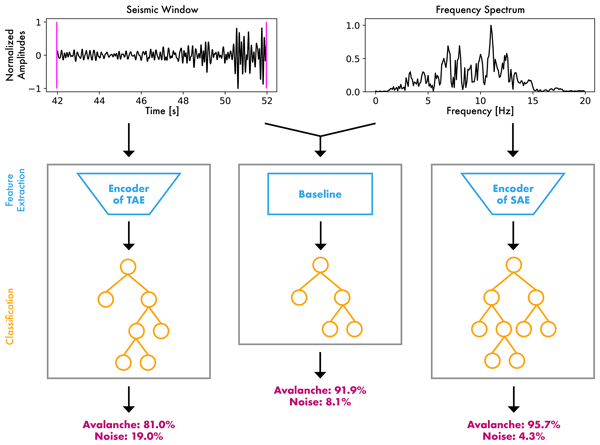
Avalanche detection systems are crucial for forecasting, but distinguishing avalanches from other seismic sources remains a challenge. We propose novel autoencoder models to automatically extract features and compare them with engineered seismic features. These features are then used to classify avalanches and noise events. The autoencoder feature classifiers exhibit the highest sensitivity in detecting avalanches, while the engineered seismic classifier performs better overall.
Jiahui Kang, Fabian Walter, Tobias Halter, Patrick Paitz, and Andreas Fichtner
Earth Surf. Dynam., 13, 1133–1155, https://doi.org/10.5194/esurf-13-1133-2025, https://doi.org/10.5194/esurf-13-1133-2025, 2025
Short summary
Short summary
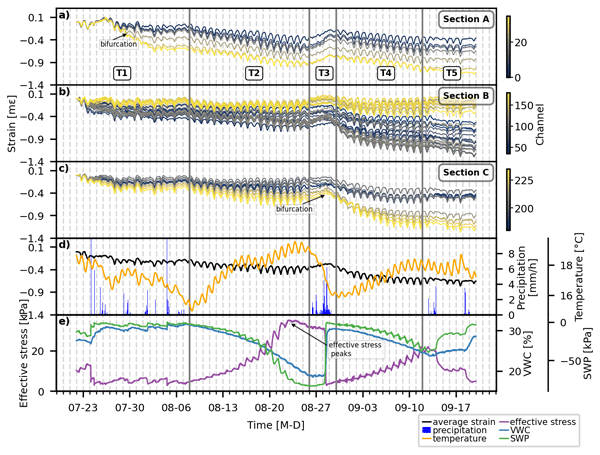
Soil strength is influenced by wetness conditions, affecting slope stability, agricultural productivity, etc. Monitoring soil moisture is essential for risk management. We used Distributed Acoustic Sensing to monitor the deformation of a grass-covered slope over two summer months. We observed both long-term drying and daily "breathing" cycles: nighttime swelling and daytime shrinkage. By integrating strain and soil moisture data, we provide new field-scale insights into soil strength evolution.
Jakob Boyd Pernov, William H. Aeberhard, Michele Volpi, Eliza Harris, Benjamin Hohermuth, Sakiko Ishino, Ragnhild B. Skeie, Stephan Henne, Ulas Im, Patricia K. Quinn, Lucia M. Upchurch, and Julia Schmale
Atmos. Chem. Phys., 25, 6497–6537, https://doi.org/10.5194/acp-25-6497-2025, https://doi.org/10.5194/acp-25-6497-2025, 2025
Short summary
Short summary
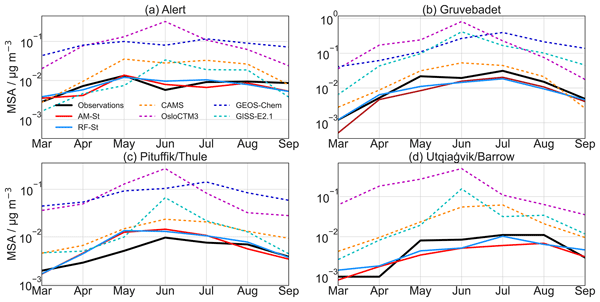
Particulate methanesulfonic acid (MSAp) is vital for the Arctic climate system. Numerical models struggle to reproduce the MSAp seasonal cycle. We evaluate three numerical models and one reanalysis product’s ability to simulate MSAp. We develop data-driven models for MSAp at four Arctic stations. The data-driven models outperform the numerical models and reanalysis product and identified precursor source-, chemical-processing-, and removal-related features as being important for modeling MSAp.
Cristina Pérez-Guillén, Frank Techel, Michele Volpi, and Alec van Herwijnen
Nat. Hazards Earth Syst. Sci., 25, 1331–1351, https://doi.org/10.5194/nhess-25-1331-2025, https://doi.org/10.5194/nhess-25-1331-2025, 2025
Short summary
Short summary
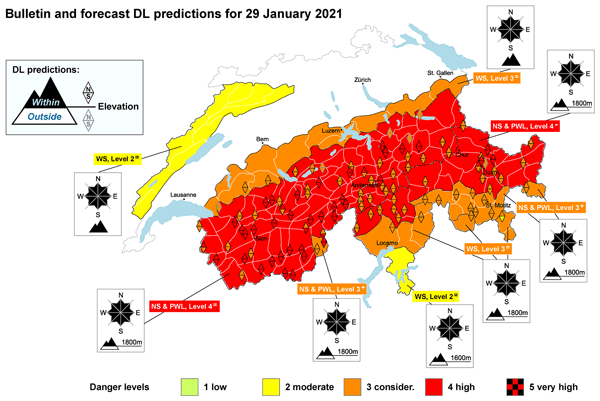
This study assesses the performance and explainability of a random-forest classifier for predicting dry-snow avalanche danger levels during initial live testing. The model achieved ∼ 70 % agreement with human forecasts, performing equally well in nowcast and forecast modes, while capturing the temporal dynamics of avalanche forecasting. The explainability approach enhances the transparency of the model's decision-making process, providing a valuable tool for operational avalanche forecasting.
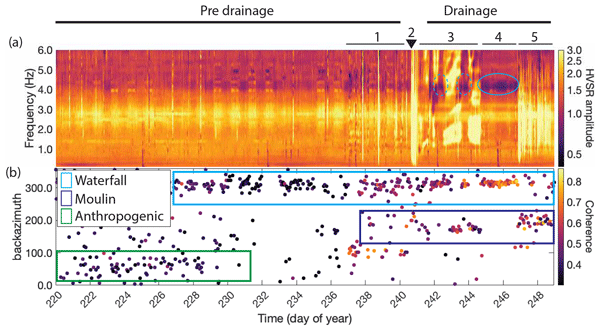
Janneke van Ginkel, Fabian Walter, Fabian Lindner, Miroslav Hallo, Matthias Huss, and Donat Fäh
The Cryosphere, 19, 1469–1490, https://doi.org/10.5194/tc-19-1469-2025, https://doi.org/10.5194/tc-19-1469-2025, 2025
Short summary
Short summary
This study on Glacier de la Plaine Morte in Switzerland employs various passive seismic analysis methods to identify complex hydraulic behaviours at the ice–bedrock interface. In 4 months of seismic records, we detect spatio-temporal variations in the glacier's basal interface, following the drainage of an ice-marginal lake. We identify a low-velocity layer, whose properties are determined using modelling techniques. This low-velocity layer results from temporary water storage subglacially.
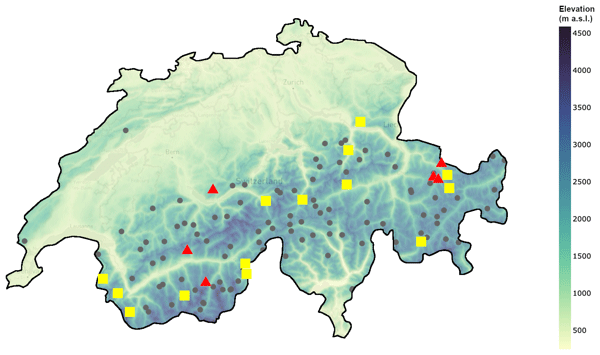
Jan Svoboda, Marc Ruesch, David Liechti, Corinne Jones, Michele Volpi, Michael Zehnder, and Jürg Schweizer
Geosci. Model Dev., 18, 1829–1849, https://doi.org/10.5194/gmd-18-1829-2025, https://doi.org/10.5194/gmd-18-1829-2025, 2025
Short summary
Short summary
Accurately measuring snow height is key for modeling approaches in climate science, snow hydrology, and avalanche forecasting. Erroneous snow height measurements often occur when snow height is low or changes, for instance during snowfall in summer. We prepare a new benchmark dataset with annotated snow height data and demonstrate how to improve the measurement quality using modern deep-learning approaches. Our approach can be easily implemented in a data pipeline for snow modeling.
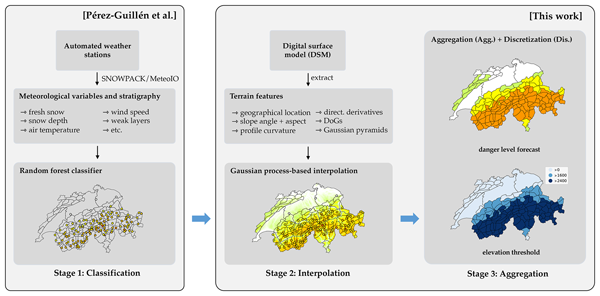
Alessandro Maissen, Frank Techel, and Michele Volpi
Geosci. Model Dev., 17, 7569–7593, https://doi.org/10.5194/gmd-17-7569-2024, https://doi.org/10.5194/gmd-17-7569-2024, 2024
Short summary
Short summary
By harnessing AI models, this work enables processing large amounts of data, including weather conditions, snowpack characteristics, and historical avalanche data, to predict human-like avalanche forecasts in Switzerland. Our proposed model can significantly assist avalanche forecasters in their decision-making process, thereby facilitating more efficient and accurate predictions crucial for ensuring safety in Switzerland's avalanche-prone regions.

Fabian Walter, Elias Hodel, Erik S. Mannerfelt, Kristen Cook, Michael Dietze, Livia Estermann, Michaela Wenner, Daniel Farinotti, Martin Fengler, Lukas Hammerschmidt, Flavia Hänsli, Jacob Hirschberg, Brian McArdell, and Peter Molnar
Nat. Hazards Earth Syst. Sci., 22, 4011–4018, https://doi.org/10.5194/nhess-22-4011-2022, https://doi.org/10.5194/nhess-22-4011-2022, 2022
Short summary
Short summary
Debris flows are dangerous sediment–water mixtures in steep terrain. Their formation takes place in poorly accessible terrain where instrumentation cannot be installed. Here we propose to monitor such source terrain with an autonomous drone for mapping sediments which were left behind by debris flows or may contribute to future events. Short flight intervals elucidate changes of such sediments, providing important information for landscape evolution and the likelihood of future debris flows.
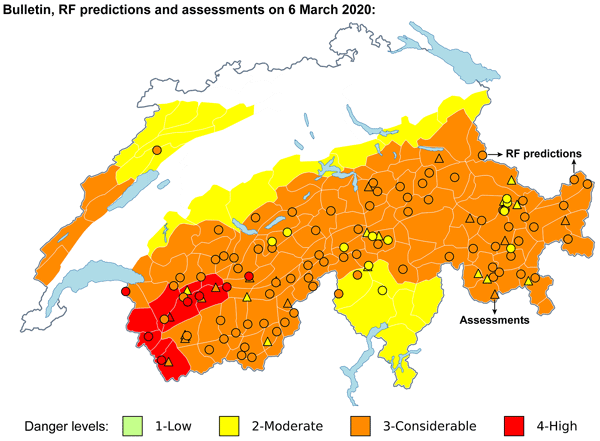
Cristina Pérez-Guillén, Frank Techel, Martin Hendrick, Michele Volpi, Alec van Herwijnen, Tasko Olevski, Guillaume Obozinski, Fernando Pérez-Cruz, and Jürg Schweizer
Nat. Hazards Earth Syst. Sci., 22, 2031–2056, https://doi.org/10.5194/nhess-22-2031-2022, https://doi.org/10.5194/nhess-22-2031-2022, 2022
Short summary
Short summary
A fully data-driven approach to predicting the danger level for dry-snow avalanche conditions in Switzerland was developed. Two classifiers were trained using a large database of meteorological data, snow cover simulations, and danger levels. The models performed well throughout the Swiss Alps, reaching a performance similar to the current experience-based avalanche forecasts. This approach shows the potential to be a valuable supplementary decision support tool for assessing avalanche hazard.
Sebastian Landwehr, Michele Volpi, F. Alexander Haumann, Charlotte M. Robinson, Iris Thurnherr, Valerio Ferracci, Andrea Baccarini, Jenny Thomas, Irina Gorodetskaya, Christian Tatzelt, Silvia Henning, Rob L. Modini, Heather J. Forrer, Yajuan Lin, Nicolas Cassar, Rafel Simó, Christel Hassler, Alireza Moallemi, Sarah E. Fawcett, Neil Harris, Ruth Airs, Marzieh H. Derkani, Alberto Alberello, Alessandro Toffoli, Gang Chen, Pablo Rodríguez-Ros, Marina Zamanillo, Pau Cortés-Greus, Lei Xue, Conor G. Bolas, Katherine C. Leonard, Fernando Perez-Cruz, David Walton, and Julia Schmale
Earth Syst. Dynam., 12, 1295–1369, https://doi.org/10.5194/esd-12-1295-2021, https://doi.org/10.5194/esd-12-1295-2021, 2021
Short summary
Short summary
The Antarctic Circumnavigation Expedition surveyed a large number of variables describing the dynamic state of ocean and atmosphere, freshwater cycle, atmospheric chemistry, ocean biogeochemistry, and microbiology in the Southern Ocean. To reduce the dimensionality of the dataset, we apply a sparse principal component analysis and identify temporal patterns from diurnal to seasonal cycles, as well as geographical gradients and
hotspotsof interaction. Code and data are open access.
Cited articles
Allen, R. V.: Automatic earthquake recognition and timing from single traces, Bull. Seismol. Soc. Am., 68, 1521–1532, https://doi.org/10.1785/BSSA0680051521, 1978. a
Allstadt, K. E., Matoza, R. S., Lockhart, A. B., Moran, S. C., Caplan-Auerbach, J., Haney, M. M., Thelen, W. A., and Malone, S. D.: Seismic and acoustic signatures of surficial mass movements at volcanoes, J. Volcanol. Geoth. Res., 364, 76–106, https://doi.org/10.1016/j.jvolgeores.2018.09.007, 2018. a
Amundson, J. M., Clinton, J. F., Fahnestock, M., Truffer, M., Lüthi, M. P., and Motyka, R. J.: Observing calving-generated ocean waves with coastal broadband seismometers, Jakobshavn Isbræ, Greenland, Ann. Glaciol., 53, 79–84, https://doi.org/10.3189/2012/AoG60A200, 2012. a, b
Badoux, A., Graf, C., Rhyner, J., Kuntner, R., and McArdell, B. W.: A debris-flow alarm system for the Alpine Illgraben catchment: design and performance, Nat. Hazards, 49, 517–539, https://doi.org/10.1007/s11069-008-9303-x, 2009. a, b
Bahavar, M., Allstadt, K. E., Van Fossen, M., Malone, S. D., and Trabant, C.: Exotic seismic events catalog (ESEC) data product, Seismol. Res. Lett., 90, 1355–1363, https://doi.org/10.1785/0220180402, 2019. a
Bartholomaus, T. C., Larsen, C. F., O'Neel, S., and West, M. E.: Calving seismicity from iceberg–sea surface interactions, J. Geophys. Res.-Earth, 117, https://doi.org/10.1029/2012JF002513, 2012. a
Begum, N., Ulanova, L., Wang, J., and Keogh, E.: Accelerating dynamic time warping clustering with a novel admissible pruning strategy, in: Proc. ACM SIGKDD Int. Conf. Knowl. Discov. Data Min., KDD '15, pp. 49–58, Association for Computing Machinery, Sydney, NSW, Australia, https://doi.org/10.1145/2783258.2783286, 2015. a
Beyreuther, M., Barsch, R., Krischer, L., Megies, T., Behr, Y., and Wassermann, J.: ObsPy: A Python toolbox for seismology, Seismol. Res. Lett., 81, 530–533, https://doi.org/10.1785/gssrl.81.3.530, 2010. a
Blázquez-García, A., Conde, A., Mori, U., and Lozano, J. A.: A review on outlier/anomaly detection in time series data, ACM Comput. Surv., 54, 1–33, https://doi.org/10.1145/3444690, 2021. a
Cao, Y., Xiang, H., Zhang, H., Zhu, Y., and Ting, K. M.: Anomaly detection based on isolation mechanisms: a survey, Mach. Intell. Res., 22, 849–865, https://doi.org/10.1007/s11633-025-1554-4, 2025. a
Chmiel, M., Walter, F., Wenner, M., Zhang, Z., McArdell, B. W., and Hibert, C.: Machine learning improves debris flow warning, Geophys. Res. Lett., 48, e2020GL090874, https://doi.org/10.1029/2020GL090874, 2021. a, b, c, d
Clinton, J. F., Nettles, M., Walter, F., Anderson, K., Dahl-Jensen, T., Giardini, D., Govoni, A., Hanka, W., Lasocki, S., Lee, W. S., McCormack, D., Mykkeltveit, S., Stutzmann, E., and Tsuboi, S.: Seismic network in Greenland monitors earth and ice system, Eos T. Am. Geoüphys. Un., 95, 13–14, https://doi.org/10.1002/2014EO020001, 2014. a
Coviello, V., Arattano, M., Comiti, F., Macconi, P., and Marchi, L.: Seismic characterization of debris flows: insights into energy radiation and implications for warning, J. Geophys. Res.-Earth, 124, 1440–1463, https://doi.org/10.1029/2018JF004683, 2019. a
Cuturi, M. and Blondel, M.: Soft-DTW: a differentiable loss function for time-series, in: Proc. Int. Conf. Mach. Learn. (ICML), edited by: Precup, D. and Teh, Y. W., vol. 70 of Proceedings of Machine Learning Research, PMLR, 894–903, https://proceedings.mlr.press/v70/cuturi17a.html (last access: 29 May 2026), 2017. a
Dempsey, D., Cronin, S. J., Mei, S., and Kempa-Liehr, A. W.: Automatic precursor recognition and real-time forecasting of sudden explosive volcanic eruptions at Whakaari, New Zealand, Nat. Commun., 11, 3562, https://doi.org/10.1038/s41467-020-17375-2, 2020. a
Ekström, G. and Stark, C. P.: Simple scaling of catastrophic landslide dynamics, Science, 339, 1416–1419, https://doi.org/10.1126/science.1232887, 2013. a
Fichtner, A., Bowden, D., and Ermert, L.: Optimal processing for seismic noise correlations, Geophys. J. Int., 223, 1548–1564, https://doi.org/10.1093/gji/ggaa390, 2020. a
Franceschi, J.-Y., Dieuleveut, A., and Jaggi, M.: Unsupervised scalable representation learning for multivariate time series, in: Adv. Neural Inf. Process. Syst., edited by: Wallach, H., Larochelle, H., Beygelzimer, A., d'Alché-Buc, F., Fox, E., and Garnett, R., vol. 32, https://proceedings.neurips.cc/paper_files/paper/2019/file/53c6de78244e9f528eb3e1cda69699bb-Paper.pdf (last access: 29 May 2026), 2019. a
Geological Survey of Denmark and Greenland: Registered earthquakes in Greenland, GEUS, https://www.geus.dk/natur-og-klima/jordskaelv-og-seismologi/registrerede-jordskaelv-i-groenland (last access: 13 July 2025), data list generated automatically: 13 July 2025 14:17 UTC, 2025. a
GEUS Geological Survey of Denmark and Greenland: Danish Seismological Network, International Federation of Digital Seismograph Networks [data set], https://doi.org/10.7914/nw3x-df02, 1976. a
Hariri, S., Kind, M. C., and Brunner, R. J.: Extended isolation forest, IEEE T. Knowl. Data En., 33, 1479–1489, https://doi.org/10.1109/TKDE.2019.2947676, 2021. a
Herzen, J., Lässig, F., Piazzetta, S. G., Neuer, T., Tafti, L., Raille, G., Van Pottelbergh, T., Pasieka, M., Skrodzki, A., Huguenin, N., Dumonal, M., Kościsz, J., Bader, D., Gusset, F., Benheddi, M., Williamson, C., Kosinski, M., Petrik, M., and Grosch, G.: Darts: user-friendly modern machine learning for time series, J. Mach. Learn. Res., 23, 1–6, http://jmlr.org/papers/v23/21-1177.html (last access: 29 May 2026), 2022. a
Hibert, C., Mangeney, A., Grandjean, G., and Shapiro, N. M.: Slope instabilities in Dolomieu crater, Réunion Island: from seismic signals to rockfall characteristics, J. Geophys. Res.-Earth, 116, https://doi.org/10.1029/2011JF002038, 2011. a
Hürlimann, M., Rickenmann, D., and Graf, C.: Field and monitoring data of debris-flow events in the Swiss Alps, Can. Geotech. J., 40, 161–175, https://doi.org/10.1139/t02-087, 2003. a
Ida, Y., Fujita, E., and Hirose, T.: Classification of volcano-seismic events using waveforms in the method of k-means clustering and dynamic time warping, J. Volcanol. Geoth. Res., 429, 107616, https://doi.org/10.1016/j.jvolgeores.2022.107616, 2022. a
Igel, J. K., Ermert, L. A., and Fichtner, A.: Rapid finite-frequency microseismic noise source inversion at regional to global scales, Geophys. J. Int., 227, 169–183, https://doi.org/10.1093/gji/ggab210, 2021. a
Jiang, J., Stankovic, V., Stankovic, L., Murray, D., and Pytharouli, S.: Generative self-supervised learning for seismic event classification, Eng. Appl. Artif. Intell., 165, 113355, https://doi.org/10.1016/j.engappai.2025.113355, 2026. a
Kamper, F. and Paitz, P.: seismic-isolation-forest, Zenodo [code], https://doi.org/10.5281/zenodo.20281582, 2026. a
Kamper, F., Walter, F., Paitz, P., Meyer, M., Volpi, M., and Salzmann, M.: Exploring seismic mass-movement data with anomaly detection and dynamic time warping, EGUsphere [preprint], https://doi.org/10.5194/egusphere-2025-3864, 2025. a
Kumar, U., Legendre, C. P., Zhao, L., and Chao, B. F.: Dynamic time warping as an alternative to windowed cross correlation in seismological applications, Seismol. Res. Lett., 93, 1909–1921, https://doi.org/10.1785/0220210288, 2022. a
Lai, V. H., Tsai, V. C., Lamb, M. P., Ulizio, T. P., and Beer, A. R.: The seismic signature of debris flows: flow mechanics and early warning at Montecito, California, Geophys. Res. Lett., 45, 5528–5535, https://doi.org/10.1029/2018GL077683, 2018. a
Langfelder, P., Zhang, B., and Horvath, S.: Defining clusters from a hierarchical cluster tree: the Dynamic Tree Cut package for R, Bioinformatics, 24, 719–720, https://doi.org/10.1093/bioinformatics/btm563, 2007. a
Larose, E., Carrière, S., Voisin, C., Bottelin, P., Baillet, L., Guéguen, P., Walter, F., Jongmans, D., Guillier, B., Garambois, S., Gimbert, F., and Massey, C.: Environmental seismology: what can we learn on earth surface processes with ambient noise?, J. Appl. Geophys., 116, 62–74, https://doi.org/10.1016/j.jappgeo.2015.02.001, 2015. a
Liu, F. T., Ting, K. M., and Zhou, Z.-H.: Isolation forest, in: IEEE Data Mining, IEEE, 413–422, https://doi.org/10.1109/ICDM.2008.17, 2008. a, b, c, d
Liu, F. T., Ting, K. M., and Zhou, Z.-H.: Isolation-based anomaly detection, ACM T. Knowl. Discov. D., 6, 1–39, https://doi.org/10.1145/2133360.2133363, 2012. a, b
Liu, Q. and Paparrizos, J.: The elephant in the room: towards a reliable time-series anomaly detection benchmark, in: Adv. Neural Inf. Process. Syst., vol. 37, edited by: Globerson, A., Mackey, L., Belgrave, D., Fan, A., Paquet, U., Tomczak, J., and Zhang, C., Curran Associates, Inc., 108231–108261, https://doi.org/10.52202/079017-3437, 2024. a
Longuet-Higgins, M. S.: A theory of the origin of microseisms, Philos. T. R. Soc. A, 243, 1–35, https://doi.org/10.1098/rsta.1950.0012, 1950. a
McNamara, D. E. and Buland, R. P.: Ambient noise levels in the continental United States, Bull. Seismol. Soc. Am., 94, 1517–1527, https://doi.org/10.1785/012003001, 2004. a
Medrzycka, D., Benn, D. I., Box, J. E., Copland, L., and Balog, J.: Calving behavior at Rink Isbræ, West Greenland, from time-lapse photos, Arct. Antarct. Alp. Res., 48, 263–277, https://doi.org/10.1657/AAAR0015-059, 2016. a, b
Meyer, M., Weber, S., Beutel, J., and Thiele, L.: Systematic identification of external influences in multi-year microseismic recordings using convolutional neural networks, Earth Surf. Dynam., 7, 171–190, https://doi.org/10.5194/esurf-7-171-2019, 2019. a
Meyer, M., Wenner, M., Hibert, C., Walter, F., and Thiele, L.: Using system context information to complement weakly labeled data, in: Workshop on weakly supervised learning, co-located with Int. Conf. Learn. Represent. (ICLR), https://doi.org/10.3929/ethz-b-000509303, 2021. a
Nakata, N., Gualtieri, L., and Fichtner, A.: Seismic ambient noise, Cambridge University Press, Cambridge, United Kingdom, https://doi.org/10.1017/9781108264808, 2019. a
Nettles, M. and Ekström, G.: Glacial earthquakes in Greenland and Antarctica, Annu. Rev. Earth Pl. Sc., 38, 467–491, https://doi.org/10.1146/annurev-earth-040809-152414, 2010. a
Pedregosa, F., Varoquaux, G., Gramfort, A., Michel, V., Thirion, B., Grisel, O., Blondel, M., Prettenhofer, P., Weiss, R., Dubourg, V., Vanderplas, J., Passos, A., Cournapeau, D., Brucher, M., Perrot, M., and Duchesnay, E.: Scikit-learn: machine learning in Python, J. Mach. Learn. Res., 12, 2825–2830, https://www.jmlr.org/papers/v12/pedregosa11a.html (last access: 29 May 2026), 2011. a
Poli, P.: Creep and slip: seismic precursors to the Nuugaatsiaq landslide (Greenland), Geophys. Res. Lett., 44, 8832–8836, https://doi.org/10.1002/2017GL075039, 2017. a
Provost, F., Hibert, C., and Malet, J.-P.: Automatic classification of endogenous landslide seismicity using the random forest supervised classifier, Geophys. Res. Lett., 44, 113–120, https://doi.org/10.1002/2016GL070709, 2017. a
Provost, F., Malet, J.-P., Hibert, C., Helmstetter, A., Radiguet, M., Amitrano, D., Langet, N., Larose, E., Abancó, C., Hürlimann, M., Lebourg, T., Levy, C., Le Roy, G., Ulrich, P., Vidal, M., and Vial, B.: Towards a standard typology of endogenous landslide seismic sources, Earth Surf. Dynam., 6, 1059–1088, https://doi.org/10.5194/esurf-6-1059-2018, 2018. a
Rakthanmanon, T., Campana, B., Mueen, A., Batista, G., Westover, B., Zhu, Q., Zakaria, J., and Keogh, E.: Searching and mining trillions of time series subsequences under dynamic time warping, in: Proc. ACM SIGKDD Int. Conf. Knowl. Discov. Data Min., KDD '12, Association for Computing Machinery, New York, NY, USA, p. 262–270, https://doi.org/10.1145/2339530.2339576, 2012. a
Rodríguez Tribaldos, V. and Ajo-Franklin, J. B.: Aquifer monitoring using ambient seismic noise recorded with distributed acoustic sensing (DAS) deployed on dark fiber, J. Geophys. Res.-Sol. Ea., 126, e2020JB021004, https://doi.org/10.1029/2020JB021004, 2021. a
Sager, K., Boehm, C., Ermert, L., Krischer, L., and Fichtner, A.: Global-scale full-waveform ambient noise inversion, J. Geophys. Res.-Sol. Ea., 125, e2019JB018644, https://doi.org/10.1029/2019JB018644, 2020. a
Sakoe, H. and Chiba, S.: Dynamic programming algorithm optimization for spoken word recognition, IEEE T. Acoust. Speech, 26, 43–49, https://doi.org/10.1109/TASSP.1978.1163055, 1978. a
Schmidl, S., Wenig, P., and Papenbrock, T.: Anomaly detection in time series: a comprehensive evaluation, Proc. VLDB Endow., 15, 1779–1797, https://doi.org/10.14778/3538598.3538602, 2022. a
Seydoux, L., Balestriero, R., Poli, P., Hoop, M. d., Campillo, M., and Baraniuk, R.: Clustering earthquake signals and background noises in continuous seismic data with unsupervised deep learning, Nat. Commun., 11, 3972, https://doi.org/10.1038/s41467-020-17841-x, 2020. a
Staerman, G., Mozharovskyi, P., Clémençon, S., and d’Alché Buc, F.: Functional isolation forest, in: Asian Conf. Mach. Learn., PMLR, 332–347, https://proceedings.mlr.press/v101/staerman19a.html (last access: 29 May 2026), 2019. a
Svennevig, K., Dahl-Jensen, T., Keiding, M., Merryman Boncori, J. P., Larsen, T. B., Salehi, S., Munck Solgaard, A., and Voss, P. H.: Evolution of events before and after the 17 June 2017 rock avalanche at Karrat Fjord, West Greenland – a multidisciplinary approach to detecting and locating unstable rock slopes in a remote Arctic area, Earth Surf. Dynam., 8, 1021–1038, https://doi.org/10.5194/esurf-8-1021-2020, 2020. a
Svennevig, K., Hicks, S. P., Forbriger, T., Lecocq, T., Widmer-Schnidrig, R., Mangeney, A., Hibert, C., Korsgaard, N. J., Lucas, A., Satriano, C., Anthony, R. E., Mordret, A., Schippkus, S., Rysgaard, S., Boone, W., Gibbons, S. J., Cook, K. L., Glimsdal, S., Løvholt, F., Noten, K. V., Assink, J. D., Marboeuf, A., Lomax, A., Vanneste, K., Taira, T., Spagnolo, M., Plaen, R. D., Koelemeijer, P., Ebeling, C., Cannata, A., Harcourt, W. D., Cornwell, D. G., Caudron, C., Poli, P., Bernard, P., Larose, E., Stutzmann, E., Voss, P. H., Lund, B., Cannavo, F., Castro-Díaz, M. J., Chaves, E., Dahl-Jensen, T., Dias, N. D. P., Déprez, A., Develter, R., Dreger, D., Evers, L. G., Fernández-Nieto, E. D., Ferreira, A. M. G., Funning, G., Gabriel, A.-A., Hendrickx, M., Kafka, A. L., Keiding, M., Kerby, J., Khan, S. A., Dideriksen, A. K., Lamb, O. D., Larsen, T. B., Lipovsky, B., Magdalena, I., Malet, J.-P., Myrup, M., Rivera, L., Ruiz-Castillo, E., Wetter, S., and Wirtz, B.: A rockslide-generated tsunami in a Greenland fjord rang earth for 9 days, Science, 385, 1196–1205, https://doi.org/10.1126/science.adm9247, 2024. a, b
Swiss Seismological Service (SED) At ETH Zurich: Temporary deployments in Switzerland associated with landslides, ETH Zurich [data set], https://doi.org/10.12686/SED/NETWORKS/XP, 2012. a
Ting, K. M., Liu, Z., Gong, L., Zhang, H., and Zhu, Y.: A new distributional treatment for time series anomaly detection, VLDB J., 33, https://doi.org/10.1007/s00778-023-00832-x, 2024. a
Titos, M., Benítez, C., D'Auria, L., Kowsari, M., and Ibáñez, J. M.: Could seismo-volcanic catalogs be improved or created using weakly supervised approaches with pre-trained systems?, Nat. Hazards Earth Syst. Sci., 25, 3827–3851, https://doi.org/10.5194/nhess-25-3827-2025, 2025. a
Tsai, V. C., Rice, J. R., and Fahnestock, M.: Possible mechanisms for glacial earthquakes, J. Geophys. Res.-Earth, 113, https://doi.org/10.1029/2007JF000944, 2008. a
U.S. Geological Survey: Earthquake catalog (1568 to 2018) for the USGS national seismic hazard model and nuclear regulatory commission, USGS, https://doi.org/10.5066/P95SNP2J (last access: 27 June 2025), 2023. a, b
van Herwijnen, A. and Schweizer, J.: Monitoring avalanche activity using a seismic sensor, Cold Reg. Sci. Technol., 69, 165–176, https://doi.org/10.1016/j.coldregions.2011.06.008, international Snow Science Workshop 2010 Lake Tahoe, 2011. a
Walter, F., Amundson, J. M., O'Neel, S., Truffer, M., Fahnestock, M., and Fricker, H. A.: Analysis of low-frequency seismic signals generated during a multiple-iceberg calving event at Jakobshavn Isbræ, Greenland, J. Geophys. Res.-Earth, 117, https://doi.org/10.1029/2011JF002132, 2012. a
Walter, F., Olivieri, M., and Clinton, J. F.: Calving event detection by observation of seiche effects on the Greenland fjords, J. Glaciol., 59, 162–178, https://doi.org/10.3189/2013JoG12J118, 2013. a, b
Walter, F., Burtin, A., McArdell, B. W., Hovius, N., Weder, B., and Turowski, J. M.: Testing seismic amplitude source location for fast debris-flow detection at Illgraben, Switzerland, Nat. Hazards Earth Syst. Sci., 17, 939–955, https://doi.org/10.5194/nhess-17-939-2017, 2017. a, b
Wenner, M., Hibert, C., van Herwijnen, A., Meier, L., and Walter, F.: Near-real-time automated classification of seismic signals of slope failures with continuous random forests, Nat. Hazards Earth Syst. Sci., 21, 339–361, https://doi.org/10.5194/nhess-21-339-2021, 2021. a, b
Woollam, J., Münchmeyer, J., Tilmann, F., Rietbrock, A., Lange, D., Bornstein, T., Diehl, T., Giunchi, C., Haslinger, F., Jozinović, D., Michelini, A., Saul, J., and Soto, H.: SeisBench – a toolbox for machine learning in seismology, Seismol. Res. Lett., 93, 1695–1709, https://doi.org/10.1785/0220210324, 2022. a
Wu, L., Yen, I. E.-H., Yi, J., Xu, F., Lei, Q., and Witbrock, M.: Random warping series: a random features method for time-series embedding, in: Int. Conf. Artif. Intell. Stat., PMLR, pp. 793–802, https://proceedings.mlr.press/v84/wu18b/wu18b.pdf (last access: 29 May 2026), 2018. a
Xu, H., Pang, G., Wang, Y., and Wang, Y.: Deep isolation forest for anomaly detection, IEEE T. Knowl. Data En., 35, 12591–12604, https://doi.org/10.1109/TKDE.2023.3270293, 2023. a
Yue, Z., Wang, Y., Duan, J., Yang, T., Huang, C., Tong, Y., and Xu, B.: Ts2vec: Towards universal representation of time series, in: AAAI Conf. Artif. Intell., vol. 25, pp. 8980–8987, https://doi.org/10.1609/aaai.v36i8.20881, 2022. a
Zhu, Q., Batista, G., Rakthanmanon, T., and Keogh, E.: A novel approximation to dynamic time warping allows anytime clustering of massive time series datasets, in: Proc. SIAM Int. Conf. Data Min., pp. 999–1010, https://doi.org/10.1137/1.9781611972825.86, 2012. a
Zhou, Q., Tang, H., Turowski, J. M., Braun, J., Dietze, M., Walter, F., Yang, C.-J., and Lagarde, S.: Benford's law as debris flow detector in seismic signals, J. Geophys. Res.-Earth, 129, e2024JF007691, https://doi.org/10.1029/2024JF007691, 2024. a
Zhou, Q., Tang, H., Hibert, C., Chmiel, M., Walter, F., Dietze, M., and Turowski, J. M.: Enhancing debris flow warning via machine learning feature reduction and model selection, J. Geophys. Res.-Earth, 130, e2024JF008094, https://doi.org/10.1029/2024JF008094, 2025. a, b, c, d
Zrelak, P., Breard, E. C. P., and Dufek, J.: Basal force fluctuations and granular rheology: linking macroscopic descriptions of granular flows to bed forces with implications for monitoring signals, J. Geophys. Res.-Earth, 129, e2024JF007760, https://doi.org/10.1029/2024JF007760, 2024. a
Short summary
We use anomaly detection to automatically find patterns in seismic data that may signal dangerous mass-movement events such as landslides, glacier collapses, or debris flows. Because such movements are rare, our approach reduces the amount of data that must be analyzed to find them, whether by experts, semi-supervised methods or clustering procedures. We demonstrate the usefulness of our approach by mining for mass movements in Switzerland and Greenland.
We use anomaly detection to automatically find patterns in seismic data that may signal...


Altmetrics
Final-revised paper
Preprint