Articles | Volume 26, issue 1
https://doi.org/10.5194/nhess-26-271-2026
© Author(s) 2026. This work is distributed under
the Creative Commons Attribution 4.0 License.
https://doi.org/10.5194/nhess-26-271-2026
© Author(s) 2026. This work is distributed under
the Creative Commons Attribution 4.0 License.
Brief Communication: Rejuvenating and strengthening the science–policy interface required to implement the Sendai Framework for Disaster Risk Reduction

School of Earth and Environmental Sciences, Cardiff University, Cardiff, CF10 3AT, United Kingdom
Geoscience for Global Development, Cardiff, CF10 3AT, United Kingdom
Related authors
Philip J. Ward, Sophie Buijs, Roxana Ciurean, Judith Claassen, James Daniell, Kelley De Polt, Melanie Duncan, Stefania Gottardo, Stefan Hochrainer-Stigler, Robert Šakić Trogrlić, Julius Schlumberger, Timothy Tiggeloven, Silvia Torresan, Nicole van Maanen, Andrew Warren, Carmen D. Álvarez-Albelo, Vanessa Banks, Benjamin Blanz, Veronica Casartelli, Jordan Correa González, Julia Crummy, Anne Sophie Daloz, Marleen C. de Ruiter, Juan José Díaz-Hernández, Jaime Díaz-Pacheco, Pedro Dorta Antequera, Davide Ferrario, Sara García-González, Joel Gill, Raúl Hernández-Martín, Wiebke Jäger, Abel López-Díez, Lin Ma, Jaroslav Mysiak, Diep Ngoc Nguyen, Noemi Padrón Fumero, Eva-Cristina Petrescu, Karina Reiter, Jana Sillmann, and Lara Smale
EGUsphere, https://doi.org/10.5194/egusphere-2025-5897, https://doi.org/10.5194/egusphere-2025-5897, 2025
This preprint is open for discussion and under review for Natural Hazards and Earth System Sciences (NHESS).
Short summary
Short summary
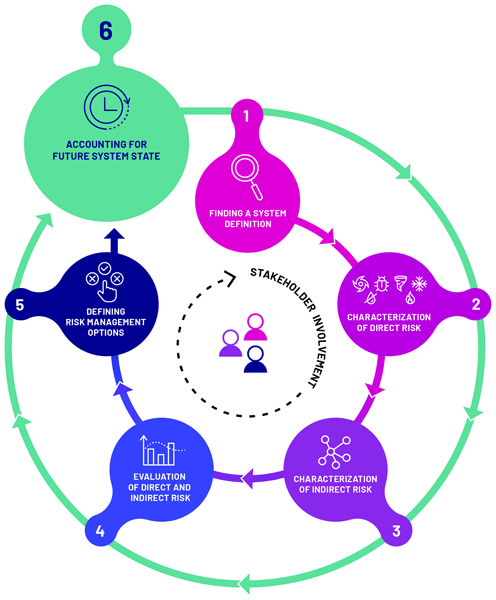
Disasters often result from interactions between different hazards, like floods triggering landslides, or earthquakes followed by tropical cyclones, so-called multi-hazards. People and societies are increasingly exposed and vulnerable to these multi-hazards. Assessing these aspects is referred to as multi-(hazard-)risk assessment and management. In this paper we synthesise key learnings from the MYRIAD-EU project, reflecting on progress and challenges faced in addressing multi-(hazard-)risk.
Molly Gilmour, Peter McGowran, Joel Gill, and Faith Taylor
EGUsphere, https://doi.org/10.5194/egusphere-2025-5704, https://doi.org/10.5194/egusphere-2025-5704, 2025
This preprint is open for discussion and under review for Natural Hazards and Earth System Sciences (NHESS).
Short summary
Short summary
The term “household preparedness” refers to households being prepared to absorb and recover from disasters. “Multi-hazard disasters” are caused by multiple, interacting hazards (e.g. droughts followed by floods). We analysed academic literature to understand what household preparedness means for multi-hazard disasters. We conclude that more qualitative data is needed to better support household preparedness, particularly in ‘Global South’ countries.
Christopher J. White, Mohammed Sarfaraz Gani Adnan, Marcello Arosio, Stephanie Buller, YoungHwa Cha, Roxana Ciurean, Julia M. Crummy, Melanie Duncan, Joel Gill, Claire Kennedy, Elisa Nobile, Lara Smale, and Philip J. Ward
Nat. Hazards Earth Syst. Sci., 25, 4263–4281, https://doi.org/10.5194/nhess-25-4263-2025, https://doi.org/10.5194/nhess-25-4263-2025, 2025
Short summary
Short summary
Indicators contain observable and measurable characteristics to understand the state of a concept or phenomenon and/or monitor it over time. There have been limited efforts to understand how indicators are being used in multi-hazard and multi-risk contexts. We find most of existing indicators do not include the interactions between hazards or risks. We propose a set of recommendations to enable the development and uptake of multi-hazard and multi-risk indicators.
Harriet E. Thompson, Joel C. Gill, Robert Šakić Trogrlić, Faith E. Taylor, and Bruce D. Malamud
Nat. Hazards Earth Syst. Sci., 25, 353–381, https://doi.org/10.5194/nhess-25-353-2025, https://doi.org/10.5194/nhess-25-353-2025, 2025
Short summary
Short summary
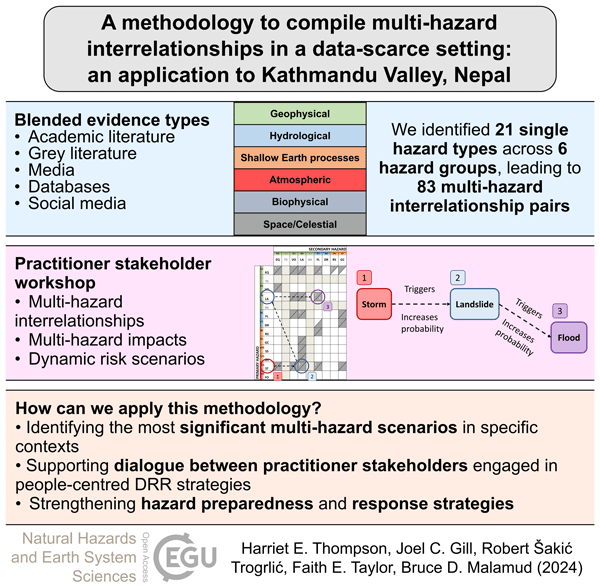
We present a methodology to compile single hazards and multi-hazard interrelationships in data-scarce urban settings, which we apply to the Kathmandu Valley, Nepal. Using blended sources, we collate evidence of 21 single natural hazard types and 83 multi-hazard interrelationships that could impact the Kathmandu Valley. We supplement these exemplars with multi-hazard scenarios developed by practitioner stakeholders, emphasising the need for inclusive disaster preparedness and response approaches.
Hedieh Soltanpour, Kamal Serrhini, Joel C. Gill, Sven Fuchs, and Solmaz Mohadjer
EGUsphere, https://doi.org/10.5194/egusphere-2024-1779, https://doi.org/10.5194/egusphere-2024-1779, 2024
Short summary
Short summary
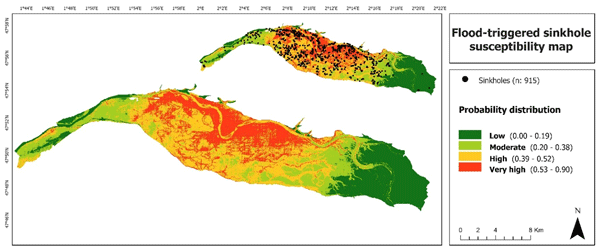
We applied the Maximum Entropy model to characterize multi-hazard scenarios in karst environments, focusing on flood-triggered sinkholes in Val d'Orléans, France. Karst terrains as multi-hazard forming areas, have received little attention in multi-hazard literature. Our study developed a multi-hazard susceptibility map to forecast the spatial distribution of these hazards. The findings improve understanding of hazard interactions and demonstrate the model's utility in multi-hazard analysis.
Philip J. Ward, James Daniell, Melanie Duncan, Anna Dunne, Cédric Hananel, Stefan Hochrainer-Stigler, Annegien Tijssen, Silvia Torresan, Roxana Ciurean, Joel C. Gill, Jana Sillmann, Anaïs Couasnon, Elco Koks, Noemi Padrón-Fumero, Sharon Tatman, Marianne Tronstad Lund, Adewole Adesiyun, Jeroen C. J. H. Aerts, Alexander Alabaster, Bernard Bulder, Carlos Campillo Torres, Andrea Critto, Raúl Hernández-Martín, Marta Machado, Jaroslav Mysiak, Rene Orth, Irene Palomino Antolín, Eva-Cristina Petrescu, Markus Reichstein, Timothy Tiggeloven, Anne F. Van Loon, Hung Vuong Pham, and Marleen C. de Ruiter
Nat. Hazards Earth Syst. Sci., 22, 1487–1497, https://doi.org/10.5194/nhess-22-1487-2022, https://doi.org/10.5194/nhess-22-1487-2022, 2022
Short summary
Short summary
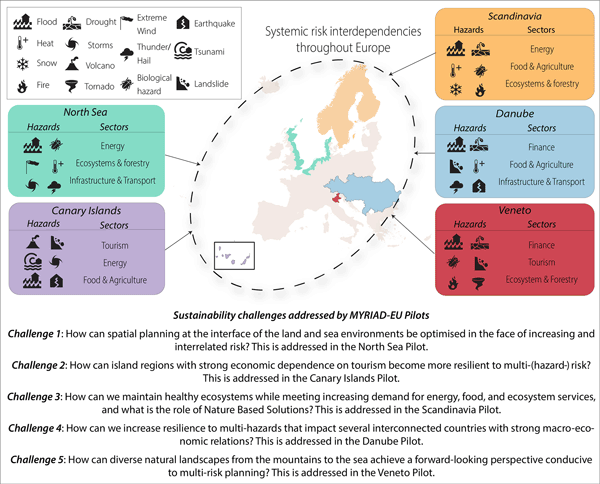
The majority of natural-hazard risk research focuses on single hazards (a flood, a drought, a volcanic eruption, an earthquake, etc.). In the international research and policy community it is recognised that risk management could benefit from a more systemic approach. In this perspective paper, we argue for an approach that addresses multi-hazard, multi-risk management through the lens of sustainability challenges that cut across sectors, regions, and hazards.
Joel C. Gill, Faith E. Taylor, Melanie J. Duncan, Solmaz Mohadjer, Mirianna Budimir, Hassan Mdala, and Vera Bukachi
Nat. Hazards Earth Syst. Sci., 21, 187–202, https://doi.org/10.5194/nhess-21-187-2021, https://doi.org/10.5194/nhess-21-187-2021, 2021
Short summary
Short summary
This paper draws on the experiences of seven early career scientists, in different sectors and contexts, to explore the improved integration of natural hazard science into broader efforts to reduce the likelihood and impacts of disasters. We include recommendations for natural hazard scientists, to improve education, training, and research design and to strengthen institutional, financial, and policy actions. We hope to provoke discussion and catalyse changes that will help reduce disaster risk.
Philip J. Ward, Sophie Buijs, Roxana Ciurean, Judith Claassen, James Daniell, Kelley De Polt, Melanie Duncan, Stefania Gottardo, Stefan Hochrainer-Stigler, Robert Šakić Trogrlić, Julius Schlumberger, Timothy Tiggeloven, Silvia Torresan, Nicole van Maanen, Andrew Warren, Carmen D. Álvarez-Albelo, Vanessa Banks, Benjamin Blanz, Veronica Casartelli, Jordan Correa González, Julia Crummy, Anne Sophie Daloz, Marleen C. de Ruiter, Juan José Díaz-Hernández, Jaime Díaz-Pacheco, Pedro Dorta Antequera, Davide Ferrario, Sara García-González, Joel Gill, Raúl Hernández-Martín, Wiebke Jäger, Abel López-Díez, Lin Ma, Jaroslav Mysiak, Diep Ngoc Nguyen, Noemi Padrón Fumero, Eva-Cristina Petrescu, Karina Reiter, Jana Sillmann, and Lara Smale
EGUsphere, https://doi.org/10.5194/egusphere-2025-5897, https://doi.org/10.5194/egusphere-2025-5897, 2025
This preprint is open for discussion and under review for Natural Hazards and Earth System Sciences (NHESS).
Short summary
Short summary
Disasters often result from interactions between different hazards, like floods triggering landslides, or earthquakes followed by tropical cyclones, so-called multi-hazards. People and societies are increasingly exposed and vulnerable to these multi-hazards. Assessing these aspects is referred to as multi-(hazard-)risk assessment and management. In this paper we synthesise key learnings from the MYRIAD-EU project, reflecting on progress and challenges faced in addressing multi-(hazard-)risk.
Molly Gilmour, Peter McGowran, Joel Gill, and Faith Taylor
EGUsphere, https://doi.org/10.5194/egusphere-2025-5704, https://doi.org/10.5194/egusphere-2025-5704, 2025
This preprint is open for discussion and under review for Natural Hazards and Earth System Sciences (NHESS).
Short summary
Short summary
The term “household preparedness” refers to households being prepared to absorb and recover from disasters. “Multi-hazard disasters” are caused by multiple, interacting hazards (e.g. droughts followed by floods). We analysed academic literature to understand what household preparedness means for multi-hazard disasters. We conclude that more qualitative data is needed to better support household preparedness, particularly in ‘Global South’ countries.
Christopher J. White, Mohammed Sarfaraz Gani Adnan, Marcello Arosio, Stephanie Buller, YoungHwa Cha, Roxana Ciurean, Julia M. Crummy, Melanie Duncan, Joel Gill, Claire Kennedy, Elisa Nobile, Lara Smale, and Philip J. Ward
Nat. Hazards Earth Syst. Sci., 25, 4263–4281, https://doi.org/10.5194/nhess-25-4263-2025, https://doi.org/10.5194/nhess-25-4263-2025, 2025
Short summary
Short summary
Indicators contain observable and measurable characteristics to understand the state of a concept or phenomenon and/or monitor it over time. There have been limited efforts to understand how indicators are being used in multi-hazard and multi-risk contexts. We find most of existing indicators do not include the interactions between hazards or risks. We propose a set of recommendations to enable the development and uptake of multi-hazard and multi-risk indicators.
Harriet E. Thompson, Joel C. Gill, Robert Šakić Trogrlić, Faith E. Taylor, and Bruce D. Malamud
Nat. Hazards Earth Syst. Sci., 25, 353–381, https://doi.org/10.5194/nhess-25-353-2025, https://doi.org/10.5194/nhess-25-353-2025, 2025
Short summary
Short summary
We present a methodology to compile single hazards and multi-hazard interrelationships in data-scarce urban settings, which we apply to the Kathmandu Valley, Nepal. Using blended sources, we collate evidence of 21 single natural hazard types and 83 multi-hazard interrelationships that could impact the Kathmandu Valley. We supplement these exemplars with multi-hazard scenarios developed by practitioner stakeholders, emphasising the need for inclusive disaster preparedness and response approaches.
Hedieh Soltanpour, Kamal Serrhini, Joel C. Gill, Sven Fuchs, and Solmaz Mohadjer
EGUsphere, https://doi.org/10.5194/egusphere-2024-1779, https://doi.org/10.5194/egusphere-2024-1779, 2024
Short summary
Short summary
We applied the Maximum Entropy model to characterize multi-hazard scenarios in karst environments, focusing on flood-triggered sinkholes in Val d'Orléans, France. Karst terrains as multi-hazard forming areas, have received little attention in multi-hazard literature. Our study developed a multi-hazard susceptibility map to forecast the spatial distribution of these hazards. The findings improve understanding of hazard interactions and demonstrate the model's utility in multi-hazard analysis.
Philip J. Ward, James Daniell, Melanie Duncan, Anna Dunne, Cédric Hananel, Stefan Hochrainer-Stigler, Annegien Tijssen, Silvia Torresan, Roxana Ciurean, Joel C. Gill, Jana Sillmann, Anaïs Couasnon, Elco Koks, Noemi Padrón-Fumero, Sharon Tatman, Marianne Tronstad Lund, Adewole Adesiyun, Jeroen C. J. H. Aerts, Alexander Alabaster, Bernard Bulder, Carlos Campillo Torres, Andrea Critto, Raúl Hernández-Martín, Marta Machado, Jaroslav Mysiak, Rene Orth, Irene Palomino Antolín, Eva-Cristina Petrescu, Markus Reichstein, Timothy Tiggeloven, Anne F. Van Loon, Hung Vuong Pham, and Marleen C. de Ruiter
Nat. Hazards Earth Syst. Sci., 22, 1487–1497, https://doi.org/10.5194/nhess-22-1487-2022, https://doi.org/10.5194/nhess-22-1487-2022, 2022
Short summary
Short summary
The majority of natural-hazard risk research focuses on single hazards (a flood, a drought, a volcanic eruption, an earthquake, etc.). In the international research and policy community it is recognised that risk management could benefit from a more systemic approach. In this perspective paper, we argue for an approach that addresses multi-hazard, multi-risk management through the lens of sustainability challenges that cut across sectors, regions, and hazards.
Joel C. Gill, Faith E. Taylor, Melanie J. Duncan, Solmaz Mohadjer, Mirianna Budimir, Hassan Mdala, and Vera Bukachi
Nat. Hazards Earth Syst. Sci., 21, 187–202, https://doi.org/10.5194/nhess-21-187-2021, https://doi.org/10.5194/nhess-21-187-2021, 2021
Short summary
Short summary
This paper draws on the experiences of seven early career scientists, in different sectors and contexts, to explore the improved integration of natural hazard science into broader efforts to reduce the likelihood and impacts of disasters. We include recommendations for natural hazard scientists, to improve education, training, and research design and to strengthen institutional, financial, and policy actions. We hope to provoke discussion and catalyse changes that will help reduce disaster risk.
Cited articles
Aitsi-Selmi, A., Murray, V., Wannous, C., Dickinson, C., Johnston, D., Kawasaki, A., Stevance, A. S., and Yeung, T.: Reflections on a science and technology agenda for 21st century disaster risk reduction: Based on the scientific content of the 2016 UNISDR science and technology conference on the implementation of the Sendai framework for disaster risk reduction 2015–2030, Int. J. Disaster Risk Sci., 7, 1–29, https://doi.org/10.1007/s13753-016-0081-x, 2016.
Carabine, E.: Revitalising evidence-based policy for the Sendai Framework for Disaster Risk Reduction 2015–2030: lessons from existing international science partnerships, PLoS Curr., 7, https://doi.org/10.1371/currents.dis.aaab45b2b4106307ae2168a485e03b8a, 2015.
Gill, J. C. and Bullough, F.: Geoscience engagement in global development frameworks, Ann. Geophys., 60, https://doi.org/10.4401/ag-7460, 2017.
Gill, J. C., Taylor, F. E., Duncan, M. J., Mohadjer, S., Budimir, M., Mdala, H., and Bukachi, V.: Invited Perspective: Building sustainable and resilient communities–Recommended actions for natural hazard scientists, Nat. Hazards Earth Syst. Sci., 21, 187–202, https://doi.org/10.5194/nhess-21-187-2021, 2021.
GNDR: GNDR's participation at the UN Global Platform for Disaster Risk Reduction, https://www.gndr.org/wp-content/uploads/2025/09/GNDR-GPDRR-2025-Report.pdf (last access: 16 December 2025), 2025.
Government of the Philippines: Statement delivered to the multi-stakeholder plenary “regional progress on implementation of the Sendai Framework” at the 2025 Global Platform, https://globalplatform.undrr.org/media/107436/download?startDownload=20250723 (last access: 16 December 2025), 2025.
Pearson, L. and Pelling, M.: The UN Sendai framework for disaster risk reduction 2015–2030: Negotiation process and prospects for science and practice, J. Extreme Events, 2, 1571001, https://doi.org/10.1142/S2345737615710013, 2015.
Smith, M. and Bricker, S.: Sustainable cities and communities, in: Geosciences and the Sustainable Development Goals, Springer International Publishing, Cham, 259–282, https://doi.org/10.1007/978-3-030-38815-7_11, 2021.
UNDRR: Sendai Framework for Disaster Risk Reduction 2015–2030, https://www.undrr.org/publication/sendai-framework-disaster-risk-reduction-2015-2030 (last access: 16 December 2025), 2015.
UNDRR: Terms of Reference – Science and Technology Advisory Group (STAG), https://www.undrr.org/implementing-sendai-framework-partners-and-stakeholders/science-and-technology-action-group (last access: 16 December 2025), 2018.
UNDRR: Partnership and Stakeholder Engagement Strategy, https://www.undrr.org/media/91259/download?startDownload=20250703 (last access: 16 December 2025), 2021.
UNDRR: Science and Technology Community, https://www.undrr.org/implementing-sendai-framework/partners-and-stakeholders/science-and-technology-community (last access: 16 December 2025), 2025a.
UNDRR: Global Platform for Disaster Risk Reduction, https://globalplatform.undrr.org/2025/about-gp (last access: 16 December 2025), 2025b.
UNDRR: The Geneva Call for Disaster Risk Reduction: The Co-Chairs' Summary of the Global Platform, https://www.undrr.org/news/geneva-call-disaster-risk-reduction-co-chairs-summary-global-platform (last access: 16 December 2025), 2025c.
UNDRR and ISC: Update of the UNDRR-ISC Hazard Information Profiles, https://www.undrr.org/publication/2025-update-undrr-isc-hazard-information-profiles-hips (last access: 16 December 2025), 2025.
UNISDR: International Strategy for Disaster Risk Reduction Scientific and Technical Committee, Reducing Disaster Risks through Science: Issues and Actions, UNISDR, Geneva, 32 pp., https://www.unisdr.org/files/11543_STCReportlibrary.pdf (last access: 16 December 2025), 2009.
United Nations: Political declaration of the high-level meeting on the midterm review of the Sendai Framework for Disaster Risk Reduction 2015–2030, A/RES/77/289, https://www.undrr.org/publication/political-declaration-high-level-meeting-midterm-review-sendai-framework-disaster-risk (last access: 16 December 2025), 2023.
United Nations: Scientific and Technological Community, https://hlpf.un.org/mgos/scientific-and-technological-community (last access: 16 December 2025), 2025.
Van den Hove, S.: A rationale for science–policy interfaces, Futures, 39, 807–826, https://doi.org/10.1016/j.futures.2006.12.004, 2007.
Van Enst, W. I., Driessen, P. P., and Runhaar, H. A.: Towards productive science–policy interfaces: a research agenda, J. Environ. Assess. Policy Manag., 16, 1450007, https://doi.org/10.1142/S1464333214500070, 2014.
Executive editor
The paper delivers a timely and critical assessment of the Sendai Framework’s science–policy interface at a pivotal moment. This draws directly on insights from the 2025 Global Platform for Disaster Risk Reduction. The paper makes a high-impact contribution with direct relevance for global disaster risk reduction policy and practice, extending beyond 2030.
The paper delivers a timely and critical assessment of the Sendai Framework’s science–policy...
Short summary
This article looks at how science connects with policy to reduce disaster risks. Although the Sendai Framework says science is key, current efforts to bring together scientists and share their perspectives with other stakeholders are not as effective as they could be. We suggest three ways to improve this: include more voices, better share research, and create spaces to discuss key topics.
This article looks at how science connects with policy to reduce disaster risks. Although the...
Altmetrics
Final-revised paper
Preprint