
Articles | Volume 26, issue 5
https://doi.org/10.5194/nhess-26-2319-2026
© Author(s) 2026. This work is distributed under
the Creative Commons Attribution 4.0 License.
the Creative Commons Attribution 4.0 License.
https://doi.org/10.5194/nhess-26-2319-2026
© Author(s) 2026. This work is distributed under
the Creative Commons Attribution 4.0 License.
the Creative Commons Attribution 4.0 License.
Research article
| 
20 May 2026
Research article |
| 20 May 2026
| 20 May 2026
Culvert blockages in 2D-hydrodynamic flash flood modeling: quantifying the impact on flood dynamics and mitigation strategies
Leon Frederik De Vos
CORRESPONDING AUTHOR
Chair of Hydraulic Engineering, Technical University of Munich, 80333 Munich, Germany
Karan Mahajan
Chair of Hydraulic Engineering, Technical University of Munich, 80333 Munich, Germany
Daniel Caviedes-Voullième
Chair for Environmental Fluid Dynamics and Modelling, Dresden University of Technology, 01069 Dresden, Germany
Jülich Supercomputing Centre & Institute for Bio- and Geosciences, Forschungszentrum Jülich, 52428 Jülich, Germany
Nils Rüther
Chair of Hydraulic Engineering, Technical University of Munich, 80333 Munich, Germany
Related authors
Sophia Dobkowitz, Leon Frederik De Vos, Deva Charan Jarajapu, Sarah Lindenlaub, Guilherme Samprogna Mohor, Omar Seleem, and Axel Bronstert
Hydrol. Earth Syst. Sci., 30, 3041–3060, https://doi.org/10.5194/hess-30-3041-2026, https://doi.org/10.5194/hess-30-3041-2026, 2026
Short summary
Short summary
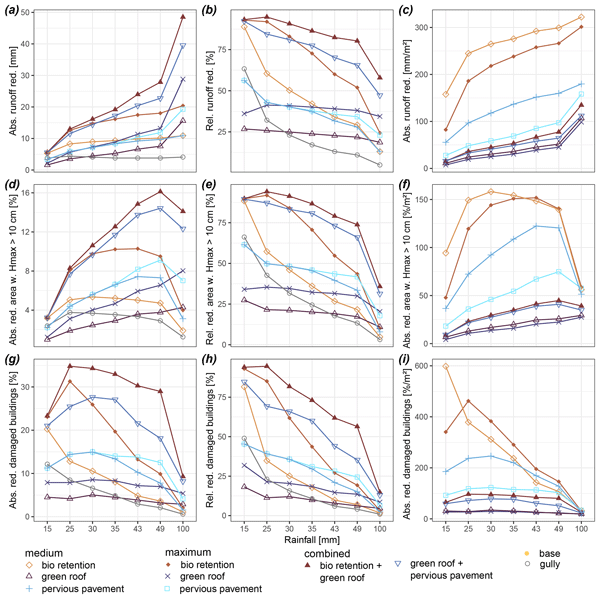
Surface sealing makes cities vulnerable to flooding caused by heavy rain. Green infrastructure, such as green roofs, can reduce flooding. This modelling study investigates the potential of green infrastructure to reduce runoff, flood water depth and building damage. Bioretention systems turned out to be the most space efficient compared to green roofs and pervious pavement. For larger rain events, more green infrastructure implementation is needed to achieve relevant flood mitigation.
Shahin Khosh Bin Ghomash and Daniel Caviedes-Voullième
EGUsphere, https://doi.org/10.5194/egusphere-2026-3652, https://doi.org/10.5194/egusphere-2026-3652, 2026
This preprint is open for discussion and under review for Natural Hazards and Earth System Sciences (NHESS).
Short summary
Short summary
Forecasting river floods has long required chaining two separate computer models: one converting rainfall into river flow, another simulating the flooding. We tested whether a single high-resolution physics-based model, driven directly by rainfall, can replace this chain. Applied to the catastrophic 2021 Ahr valley flood, it reproduced the observed flood extent and water depths accurately across an entire catchment, fast enough on supercomputers for early warning.
Sophia Dobkowitz, Leon Frederik De Vos, Deva Charan Jarajapu, Sarah Lindenlaub, Guilherme Samprogna Mohor, Omar Seleem, and Axel Bronstert
Hydrol. Earth Syst. Sci., 30, 3041–3060, https://doi.org/10.5194/hess-30-3041-2026, https://doi.org/10.5194/hess-30-3041-2026, 2026
Short summary
Short summary
Surface sealing makes cities vulnerable to flooding caused by heavy rain. Green infrastructure, such as green roofs, can reduce flooding. This modelling study investigates the potential of green infrastructure to reduce runoff, flood water depth and building damage. Bioretention systems turned out to be the most space efficient compared to green roofs and pervious pavement. For larger rain events, more green infrastructure implementation is needed to achieve relevant flood mitigation.
Na Zheng, Zhi Li, Gregor Rickert, Mario Morales-Hernández, Ilhan Özgen-Xian, and Daniel Caviedes-Voullième
Geosci. Model Dev., 19, 2799–2819, https://doi.org/10.5194/gmd-19-2799-2026, https://doi.org/10.5194/gmd-19-2799-2026, 2026
Short summary
Short summary
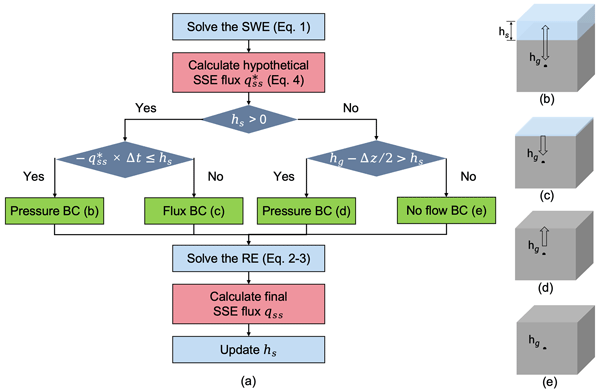
This study introduces a computer model that simulates water flow both on the land surface and underground, and their interaction. The model can run efficiently on many kinds of computers, and its design lets each part update at its own pace to save time. In the tests performed, the model's results matched those from well-known tools in the field. Overall, the model offers a fast, flexible, and scalable way to study combined surface and groundwater behavior.
Stefan Poll, Paul Rigor, Slavko Brdar, Ha Thi Minh Ho-Hagemann, Carl Hartick, Marco van Hulten, Ana Gonzalez-Nicolas, Johannes Keller, Daniel Caviedes-Voullieme, Harrie-Jan Hendricks-Franssen, Klaus Goergen, and Stefan Kollet
EGUsphere, https://doi.org/10.5194/egusphere-2025-5468, https://doi.org/10.5194/egusphere-2025-5468, 2025
This preprint is open for discussion and under review for Natural Hazards and Earth System Sciences (NHESS).
Short summary
Short summary
This paper presents TSMP2, a new version of an regional Earth system model that allows to simulate and analyze the complex interactions within terrestrial ecosystems from groundwater to atmosphere. TSMP2 links an atmospheric, a land surface model and an hydrological model through an external coupler and is fully open-source. We describe the TSMP2 model system, present the impact of coupling approaches, and outline our development strategy along with technical and performance aspects.
Pablo Vallés, Mario Morales-Hernández, Volker Roeber, Pilar García-Navarro, and Daniel Caviedes-Voullième
Geosci. Model Dev., 18, 7399–7416, https://doi.org/10.5194/gmd-18-7399-2025, https://doi.org/10.5194/gmd-18-7399-2025, 2025
Short summary
Short summary
This study presents a computational model for passive particle transport in water. The particles' trajectories depend on advection and turbulence, represented by a random-walk model. Three numerical methods are compared to estimate their trajectory, evaluating accuracy and computational cost. Tests show that the Euler method offers the best balance. Finally, a rainfall event in a catchment is simulated to validate the model's performance over irregular terrain.
Zhi Li, Gregor Rickert, Na Zheng, Zhibo Zhang, Ilhan Özgen-Xian, and Daniel Caviedes-Voullième
Geosci. Model Dev., 18, 547–562, https://doi.org/10.5194/gmd-18-547-2025, https://doi.org/10.5194/gmd-18-547-2025, 2025
Short summary
Short summary
We introduce SERGHEI-RE, a 3D subsurface flow simulator with performance-portable parallel computing capabilities. SERGHEI-RE performs effectively on various computational devices: from personal computers to advanced clusters. It allows users to solve flow equations with multiple numerical schemes, making it adaptable to various hydrological scenarios. Testing results show its accuracy and performance, confirming that SERGHEI-RE is a powerful tool for hydrological research.
Shahin Khosh Bin Ghomash, Heiko Apel, and Daniel Caviedes-Voullième
Nat. Hazards Earth Syst. Sci., 24, 2857–2874, https://doi.org/10.5194/nhess-24-2857-2024, https://doi.org/10.5194/nhess-24-2857-2024, 2024
Short summary
Short summary
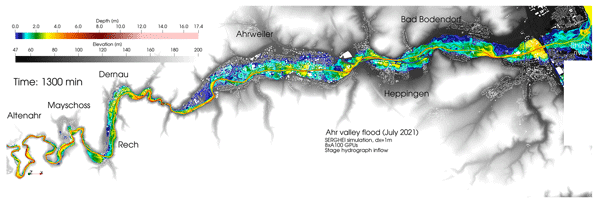
Early warning is essential to minimise the impact of flash floods. We explore the use of highly detailed flood models to simulate the 2021 flood event in the lower Ahr valley (Germany). Using very high-resolution models resolving individual streets and buildings, we produce detailed, quantitative, and actionable information for early flood warning systems. Using state-of-the-art computational technology, these models can guarantee very fast forecasts which allow for sufficient time to respond.
Denise Degen, Daniel Caviedes Voullième, Susanne Buiter, Harrie-Jan Hendricks Franssen, Harry Vereecken, Ana González-Nicolás, and Florian Wellmann
Geosci. Model Dev., 16, 7375–7409, https://doi.org/10.5194/gmd-16-7375-2023, https://doi.org/10.5194/gmd-16-7375-2023, 2023
Short summary
Short summary
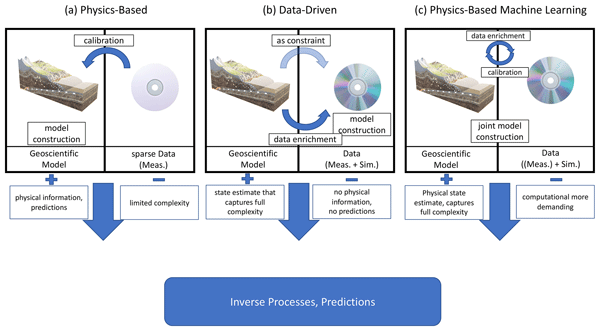
In geosciences, we often use simulations based on physical laws. These simulations can be computationally expensive, which is a problem if simulations must be performed many times (e.g., to add error bounds). We show how a novel machine learning method helps to reduce simulation time. In comparison to other approaches, which typically only look at the output of a simulation, the method considers physical laws in the simulation itself. The method provides reliable results faster than standard.
Zbigniew P. Piotrowski, Jaro Hokkanen, Daniel Caviedes-Voullieme, Olaf Stein, and Stefan Kollet
EGUsphere, https://doi.org/10.5194/egusphere-2023-1079, https://doi.org/10.5194/egusphere-2023-1079, 2023
Preprint withdrawn
Short summary
Short summary
The computer programs capable of simulation of Earth system components evolve, adapting new fundamental science concepts and more observational data on more and more powerful computer hardware. Adaptation of a large scientific program to a new type of hardware is costly. In this work we propose cheap and simple but effective strategy that enable computation using graphic processing units, based on automated program code modification. This results in better resolution and/or longer predictions.
Daniel Caviedes-Voullième, Mario Morales-Hernández, Matthew R. Norman, and Ilhan Özgen-Xian
Geosci. Model Dev., 16, 977–1008, https://doi.org/10.5194/gmd-16-977-2023, https://doi.org/10.5194/gmd-16-977-2023, 2023
Short summary
Short summary
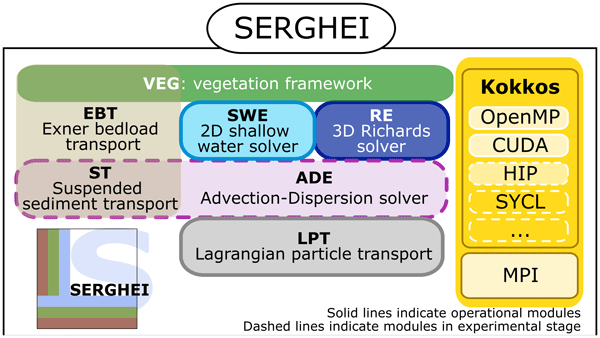
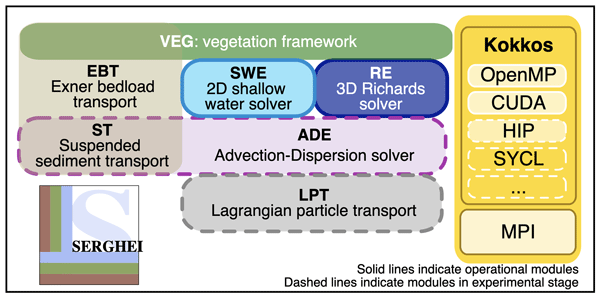
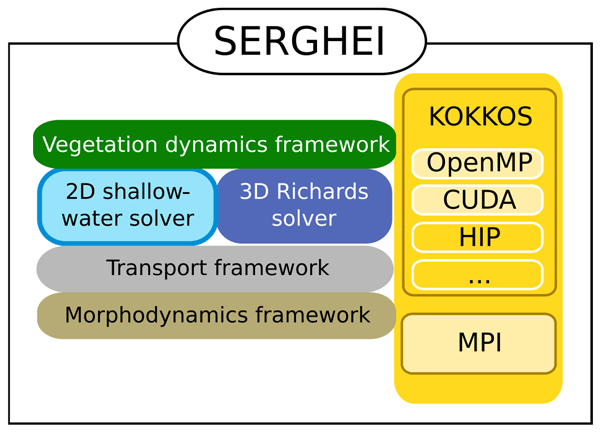
This paper introduces the SERGHEI framework and a solver for shallow-water problems. Such models, often used for surface flow and flood modelling, are computationally intense. In recent years the trends to increase computational power have changed, requiring models to adapt to new hardware and new software paradigms. SERGHEI addresses these challenges, allowing surface flow simulation to be enabled on the newest and upcoming consumer hardware and supercomputers very efficiently.
Cited articles
Ah-Woane, E., Amama, Z., Cordier, F., Davarend, T., Lotfi, J., Assaba, M., Sochinskii, A., Majdalani, S., Moussa, R., Abily, M., and Delestre, O.: Toward Brague river flood modelling 3: the impact of culvert representation, Digital Water, 3, 1–22, https://doi.org/10.1080/28375807.2025.2465376, 2025. a, b, c, d
Apel, H., Aronica, G., Kreibich, H., and Thieken, A.: Flood risk analyses-how detailed do we need to be?, Nat. Hazards, 49, 79–98, https://doi.org/10.1007/s11069-008-9277-8, 2008. a, b
Archer, D., O'Donnell, G., Lamb, R., Warren, S., and Fowler, H. J.: Historical flash floods in England: New regional chronologies and database, J. Flood Risk Manag., 12, e12526, https://doi.org/10.1111/jfr3.12526, 2019. a
Bartels, H., Weigl, E., Reich, T., Lang, P., Wagner, A., Kohler, O., and Gerlach, N.: Projekt RADOLAN-Routineverfahren zur Online-Aneichung der Radarniederschlagsdaten mit Hilfe von automatischen Bodenniederschlagsstationen (Ombrometer): zusammenfassender Abschlussbericht für die Projektlaufzeit von 1997 bis 2004, Tech. rep., Deutscher Wetterdienst (DWD), https://www.dwd.de/DE/leistungen/radolan/radolan_info/abschlussbericht_pdf.pdf?__blob=publicationFile&v=2 (last access: 13 May 2026), 2004. a
Bayerisches Landesamt für Umwelt (Ed.): Klima-Faktenblätter Bayern und Mainregion – Klima der Vergangenheit und Zukunft, Bayerisches Landesamt für Umwelt, Augsburg, Germany, https://www.bestellen.bayern.de/med/7ee3d7b0-b4a5-11f0-81ee-c3fc7d0a3316/4b0e6a70-1059-11d9-4c85-9d915831e9eb/0/lfu_klima_00188.pdf (last access: 13 May 2026), 2021. a
Bayón, A., Valero, D., and Franca, M. J.: Urban flood drifters (UFD): Identification, classification and characterisation, J. Flood Risk Manag., 17, https://doi.org/10.1111/jfr3.13002, 2024. a
Borga, M., Gaume, E., Creutin, J., and Marchi, L.: Surveying flash floods: Gauging the ungauged extremes, Hydrol. Process., 22, 3883–3885, https://doi.org/10.1002/hyp.7111, 2008. a, b
Borga, M., Stoffel, M., Marchi, L., Marra, F., and Jakob, M.: Hydrogeomorphic response to extreme rainfall in headwater systems: Flash floods and debris flows, J. Hydrol., 518, 194–205, https://doi.org/10.1016/j.jhydrol.2014.05.022, 2014. a
Bowling, L. C. and Lettenmaier, D. P.: The Effects of Forest Roads and Harvest on Catchment Hydrology in a Mountainous Maritime Environment, Land Use and Watersheds: Human Influence on Hydrology and Geomorphology in Urban and Forest Areas, 145–164 pp., https://doi.org/10.1029/WS002p0145, 2001. a
Burghardt, L., Klopries, E.-M., and Schüttrumpf, H.: Structural damage, clogging, collapsing: Analysis of the bridge damage at the rivers Ahr, Inde and Vicht caused by the flood of 2021, J. Flood Risk Manag., 18, https://doi.org/10.1111/jfr3.13001, 2025. a
Caretta, M., Mukherji, A., Arfanuzzaman, Betts, R., Gelfan, A., Hirabayashi, Y., Lissner, T., Liu, J., Lopez Gunn, E., Morgan, R., Mwanga, S., and Supratid, S.: Water, in: Climate Change 2022: Impacts, Adaptation and Vulnerability. Contribution of Working Group II to the Sixth Assessment Report of the Intergovernmental Panel on Climate Change, edited by: Pörtner, H.-O., Roberts, D., Tignor, M., Poloczanska, E., Mintenbeck, K., Alegría, A., Craig, M., Langsdorf, S., Löschke, S., Möller, V., Okem, A., and Rama, B., Cambridge University Press, Cambridge, UK and New York, NY, USA, 551–712, https://doi.org/10.1017/9781009325844.006, 2022. a
Caviedes-Voullième, D., García-Navarro, P., and Murillo, J.: Influence of mesh structure on 2D full shallow water equations and SCS Curve Number simulation of rainfall/runoff events, J. Hydrol., 448–449, 39–59, https://doi.org/10.1016/j.jhydrol.2012.04.006, 2012. a
Collier, C. G.: Flash flood forecasting: What are the limits of predictability?, Q. J. Roy. Meteor. Soc., 133, 3–23, https://doi.org/10.1002/qj.29, 2007. a
Deutsche Vereinigung für Wasserwirtschaft, Abwasser und Abfall: Arbeitsblatt DWA-A 118: Hydraulische Bemessung und Nachweis von Entwässerungssystemen, Deutsche Vereinigung für Wasserwirtschaft, Abwasser und Abfall, Hennef, ISBN 978-3-887-21924-6, 2006. a
De Vos, L. F.: Culvert Blockage in Catchment Floods, OSF [data set], https://osf.io/6m5nb/?view_only=c3f6c563d4bc44ff844bfa48d2038116 (last access: 13 May 2026), 2025. a
De Vos, L. F., Wirthensohn, M., Broich, K., and Rüther, N.: Revised Implementation of the Green-Ampt Infiltration Method in TELEMAC-2D, in: Proceedings of 30th TELEMAC User Conference, https://henry.baw.de/server/api/core/bitstreams/e89ec4c8-b56e-4c5c-8836-51e74ba0ce37/content (last access: 13 May 2026), 2024. a
DWD Climate Data Center (CDC): Recent hourly RADOLAN grids of precipitation depth (GIS-readable), version 2.5, https://opendata.dwd.de/climate_environment/CDC/grids_germany/hourly/radolan/recent/asc/ (last access: 13 May 2026), 2025. a
Erpicum, S., Poppema, D., Burghardt, L., Benet, L., Wüthrich, D., Klopries, E.-M., and Dewals, B.: A dataset of floating debris accumulation at bridges after July 2021 flood in Germany and Belgium, Sci. Data, 11, 1092, https://doi.org/10.1038/s41597-024-03907-8, 2024. a
Fallowfield, L. and Motta, D.: The permanent flood risk of culverts and the impact of increasing debris blockage, J. Flood Risk Manag., 17, e13021, https://doi.org/10.1111/jfr3.13021, 2024. a, b
Fernández-Pato, J., Martínez-Aranda, S., Morales-Hernández, M., and García-Navarro, P.: Analysis of the performance of different culvert boundary conditions in 2D shallow flow models, J. Hydroinform., 22, 1093–1121, https://doi.org/10.2166/hydro.2020.025, 2020. a, b
Feuerwehr Reichenberg: Flood Protection Operation July 15th, 2021, https://ff-reichenberg.de/einsatzberichte/1775-hochwasser-keller-unter-wasser/ (last access: 24 April 2025), 2021a. a
Feuerwehr Reichenberg: Fire Department Operations in 2021, https://ff-reichenberg.de/einsatzberichte/2021/ (last access: 24 April 2025), 2021c. a
Feuerwehr Reichenberg: Flood Protection Operation August 3rd, 2024, https://ff-reichenberg.de/einsatzberichte/4944-hochwasser-strasse-uebeflutet/ (last access: 24 April 2025), 2024. a
Gaume, E., Bain, V., Bernardara, P., Newinger, O., Barbuc, M., Bateman, A., Blaškovičová, L., Blöschl, G., Borga, M., Dumitrescu, A., Daliakopoulos, I., Garcia, J., Irimescu, A., Kohnova, S., Koutroulis, A., Marchi, L., Matreata, S., Medina, V., Preciso, E., Sempere-Torres, D., Stancalie, G., Szolgay, J., Tsanis, I., Velasco, D., and Viglione, A.: A compilation of data on European flash floods, J. Hydrol., 367, 70–78, https://doi.org/10.1016/j.jhydrol.2008.12.028, 2009. a
Georgakakos, K.: Real-Time Flash Flood Prediction, J. Geophys. Res., 92, 9615–9629, https://doi.org/10.1029/JD092iD08p09615, 1987. a
Green, W. H. and Ampt, G. A.: Studies on Soil Physics, J. Agr. Sci., 4, 1–24, https://doi.org/10.1017/S0021859600001441, 1911. a
Hawkins, R. H.: Runoff curve numbers with varying site moisture, J. Irr. Drain. Div.-ASCE, 104, 389–398, 1978. a
Iqbal, U. and Riaz, M. Z. B.: Blockage at cross-drainage hydraulic structures – Advances, challenges and opportunities, Heliyon, 10, e35786, https://doi.org/10.1016/j.heliyon.2024.e35786, 2024. a
Junghänel, T., Bär, F., Deutschländer, T., Haberlandt, U., Otte, I., Shehu, B., Stockel, H., Stricker, K., Thiele, L., and Willems, W.: Methodische Untersuchungen zur Novellierung der Starkregenstatistik für Deutschland (MUNSTAR), Tech. rep., Synthesebericht, https://www.dwd.de/DE/leistungen/kostra_dwd_rasterwerte/download/Synthesebericht_MUNSTAR_pdf.pdf?__blob=publicationFile&v=3 (last access: 13 May 2026), 2022. a, b
Khosh Bin Ghomash, S., Apel, H., and Caviedes-Voullième, D.: Are 2D shallow-water solvers fast enough for early flood warning? A comparative assessment on the 2021 Ahr valley flood event, Nat. Hazards Earth Syst. Sci., 24, 2857–2874, https://doi.org/10.5194/nhess-24-2857-2024, 2024. a
Khosh Bin Ghomash, S., Deng, S., and Apel, H.: Enabling real-time high-resolution flood forecasting for the entire state of Berlin through multi-GPU accelerated physics-based modeling, Nat. Hazards Earth Syst. Sci., 26, 85–101, https://doi.org/10.5194/nhess-26-85-2026, 2026. a, b
Lapillone, S., Bourban, S., Camazzola, A., Mignot, E., Rivière, N., Proust, S., and Lipeme Kouyi, G.: Modelling drainage-surface exchanges with TELEMAC-SWMM at the scale of a neighbourhood, in: Proceedings of 31st TELEMAC User Conference, https://hal.science/hal-05325000v1/document (last access: 13 May 2026), 2025. a
Lessard, F., Jutras, S., Perreault, N., and Éric Guilbert: Performance of automated geoprocessing methods for culvert detection in remote Forest environments, Can. Water Resour. J., 48, 248–257, https://doi.org/10.1080/07011784.2022.2160660, 2023. a
Li, C., Jiang, C., Chen, J., Lam, M. Y., Xia, J., and Ahmadian, R.: An overview of flood evacuation planning: Models, methods, and future directions, J. Hydrol., 656, 133026, https://doi.org/10.1016/j.jhydrol.2025.133026, 2025. a
Ligier, P. L.: Implementation of a rainfall-runoff model in TELEMAC-2D, in: Proceedings of XXIIIrd TELEMAC-MASCARET User Conference, https://henry.baw.de/server/api/core/bitstreams/fd1d3237-cc94-4561-a8a8-2a85bf9bb985/content (last access: 13 May 2026), 2016. a
Lóczy, D., Czigány, S., and Pirkhoffer, E.: Flash Flood Hazards, in: Studies on Water Management Issues, edited by: Kumarasamy, M., Chap. 2, IntechOpen, Rijeka, https://doi.org/10.5772/28775, 2012. a
LUBW: Kommunales Starkregenrisikomanagement in Baden-Württemberg, LUBW, https://www.dwd.de/DE/leistungen/kostra_dwd_rasterwerte/download/Synthesebericht_MUNSTAR_pdf.pdf?__blob=publicationFile&v=3 (last access: 13 May 2026), 2020. a
Miranzadeh, A., Keshavarzi, A., and Hamidifar, H.: Blockage of box-shaped and circular culverts under flood event conditions: a laboratory investigation, International Journal of River Basin Management, 21, 607–616, https://doi.org/10.1080/15715124.2022.2064483, 2023. a
Molinari, D., Scorzini, A. R., Arrighi, C., Carisi, F., Castelli, F., Domeneghetti, A., Gallazzi, A., Galliani, M., Grelot, F., Kellermann, P., Kreibich, H., Mohor, G. S., Mosimann, M., Natho, S., Richert, C., Schroeter, K., Thieken, A. H., Zischg, A. P., and Ballio, F.: Are flood damage models converging to “reality”? Lessons learnt from a blind test, Nat. Hazards Earth Syst. Sci., 20, 2997–3017, https://doi.org/10.5194/nhess-20-2997-2020, 2020. a
Oberauer, M., Lehmann, B., Buttinger-Kreuzhuber, A., and Waser, J.: Methodological approaches for numerical integration of culverts in 2D surface models in urban flood analysis, J. Hydrol., 665, 134728, https://doi.org/10.1016/j.jhydrol.2025.134728, 2026. a, b
Okamoto, T., Takebayashi, H., Sanjou, M., Suzuki, R., and Toda, K.: Log jam formation at bridges and the effect on floodplain flow: A flume experiment, J. Flood Risk Manag., 13, https://doi.org/10.1111/jfr3.12562, 2019. a, b
Pizzileo, S., Moretti, G., and Orlandini, S.: Flood plain inundation modeling with explicit description of land surface macrostructures, Adv. Water Resour., 188, 104713, https://doi.org/10.1016/j.advwatres.2024.104713, 2024. a
Reinert, J., Dittmer, C., Lorenz, D., and Klopries, E.-M.: Design Flaws at the Interface of Flood Forecasting, Early Warning and Disaster Response in the Disaster in Western Germany in July 2021 – An Interdisciplinary Analysis, J. Flood Risk Manag., 18, 70099, https://doi.org/10.1111/jfr3.70099, 2025. a
Rigby, E., Boyd, M., Roso, S., Silveri, P., and Davis, A.: Causes and Effects of Culvert Blockage During Large Storms, Ninth International Conference on Urban Drainage, https://doi.org/10.1061/40644(2002)298, 2002. a, b
Robinson, A., Lehmann, J., Barriopedro, D., Rahmstorf, S., and Coumou, D.: Increasing heat and rainfall extremes now far outside the historical climate, npj Clim. Atmos. Sci., 4, 45, https://doi.org/10.1038/s41612-021-00202-w, 2021. a
Rohmat, F. I. W., Sa'adi, Z., Stamataki, I., Kuntoro, A. A., Farid, M., and Suwarman, R.: Flood modeling and baseline study in urban and high population environment: A case study of Majalaya, Indonesia, Urban Climate, 46, 101332, https://doi.org/10.1016/j.uclim.2022.101332, 2022. a
Schall, J. D., Thompson, P. L., Zerges, S. M., Kilgore, R. T., and Morris, J. L.: Hydraulic Design of Highway Culverts, Third Edition, Tech. Rep. FHWA-HIF-12-026, U.S. Department of Transportation, Federal Highway Administration, Washington, DC, USA, https://www.fhwa.dot.gov/engineering/hydraulics/pubs/12026/hif12026.pdf (last access: 13 May 2026), 2012. a, b
Schubert, J. E. and Sanders, B. F.: Building treatments for urban flood inundation models and implications for predictive skill and modeling efficiency, Adv. Water Resour., 41, 49–64, https://doi.org/10.1016/j.advwatres.2012.02.012, 2012. a
Sellevold, J., Norem, H., Bruland, O., Rüther, N., and Pummer, E.: Effects of Bottom-Up Blockage on Entrance Loss Coefficients and Head-Discharge Relationships for Pipe Culvert Inlets: Comparisons of Theoretical Methods and Experimental Results, J. Irrig. Drain. E., 150, https://doi.org/10.1061/JIDEDH.IRENG-10219, 2024. a
Shewchuk, J. R.: Triangle: Engineering a 2D Quality Mesh Generator and Delaunay Triangulator, in: Applied Computational Geometry: Towards Geometric Engineering, edited by: Lin, M. C. and Manocha, D., Lecture Notes in Computer Science, from the First ACM Workshop on Applied Computational Geometry, Springer-Verlag, vol. 1148, 203–222, https://doi.org/10.1007/BFb0014497, 1996. a
Smolders, S. and Bourbain, S.: Applications of the new simplified approach to model obstacles: weirs, culverts and virtual ponds, Proceedings of the 30th TELEMAC User Conference, https://henry.baw.de/server/api/core/bitstreams/12f5c2d8-0dab-4e9c-9664-f813db8d2a5c/content (last access: 13 May 2026), 2024. a
Smolders, S., Leroy, A., Teles, M. J., Maximova, T., and Vanlede, J.: Culverts modelling in TELEMAC-2D and TELEMAC-3D, Proceedings of the 23rd TELEMAC User Conference, 21–33, https://henry.baw.de/server/api/core/bitstreams/01796a18-ef3a-4e07-957b-5728be4ef276/content (last access: 13 May 2026), 2016. a, b, c, d
Truhlar, A. M., Marjerison, R. D., Gold, D. F., Watkins, L., Archibald, J. A., Lung, M. E., Meyer, A., and Walter, M. T.: Rapid Remote Assessment of Culvert Flooding Risk, Journal of Sustainable Water in the Built Environment, 6, 06020001, https://doi.org/10.1061/JSWBAY.0000900, 2020. a
U.S. Department of Agriculture, Soil Conservation Service: National Engineering Handbook, Section 4: Hydrology, Chapter 10: Estimation of Direct Runoff from Storm Rainfall, U.S. Department of Agriculture, Washington, D.C., nEH Notice 4-102, August 1972, https://ia601205.us.archive.org/27/items/CAT71334647003/CAT71334647003.pdf (last access: 13 May 2026), 1972. a, b, c
Valero, D., Bayón, A., and Franca, M. J.: Urban Flood Drifters (UFDs): Onset of movement, Sci. Total Environ., 927, 171568, https://doi.org/10.1016/j.scitotenv.2024.171568, 2024. a
Voit, P. and Heistermann, M.: A downward-counterfactual analysis of flash floods in Germany, Nat. Hazards Earth Syst. Sci., 24, 2147–2164, https://doi.org/10.5194/nhess-24-2147-2024, 2024. a
Weeks, B., Barthelmess, A., Rigby, E., Witheridge, G., and O'Loughlin, G.: Project 11: Blockage of Hydraulic Structures, Stage 1 Report, Engineers Australia, https://arr.ga.gov.au/arr-guideline/revision-projects/project-list/projects/project-11/downloads/ARR_Project_11_Stage1_report_Final.pdf (last access: 13 May 2026), 2013. a, b, c
Wimmer, L. and Hovenbitzer, M.: Introducing a Nationwide High-Resolution Pluvial Flood Map: A New Tool for Risk Assessment and Emergency Management in Germany, Abstr. Int. Cartogr. Assoc., 9, 43, https://doi.org/10.5194/ica-abs-9-43-2025, 2025. a
Wimmer, L., Hovenbitzer, M., Lenk, M., Katz, E.-C., and Engel, M.: Hinweiskarte Starkregengefahren: Ein Projekt des Bundes und der Länder, Korrespondenz Wasserwirtschaft, 2023, 732–737, 2023. a
Wing, O. E. J., Pinter, N., Bates, P. D., and Kousky, C.: New insights into US flood vulnerability revealed from flood insurance big data, Nat. Commun., 11, 1444, https://doi.org/10.1038/s41467-020-15264-2, 2020. a
Winterrath, T., Brendel, C., Hafer, M., Junghänel, T., Klameth, A., Lengfeld, K., Walawender, E., Weigl, E., and Becker, A.: Radar climatology (RADKLIM) version 2017.002; gridded precipitation data for Germany, Deutscher Wetterdienst (DWD), https://doi.org/10.5676/DWD/RADKLIM_RW_V2017.002, 2018. a, b
Short summary
In this study, we assess the impact of culvert blockages on flash flood dynamics. Applying the 2D Shallow Water Equations, we model multiple flash flood and blockage scenarios within a steep catchment in central Germany. The results emphasize the need for accurate culvert representation in hydrodynamic models and demonstrate how scenario-based blockage modeling can support the identification of critical infrastructure and the development of targeted mitigation measures.
In this study, we assess the impact of culvert blockages on flash flood dynamics. Applying the...


Altmetrics
Final-revised paper
Preprint