
Articles | Volume 26, issue 5
https://doi.org/10.5194/nhess-26-2305-2026
© Author(s) 2026. This work is distributed under
the Creative Commons Attribution 4.0 License.
the Creative Commons Attribution 4.0 License.
https://doi.org/10.5194/nhess-26-2305-2026
© Author(s) 2026. This work is distributed under
the Creative Commons Attribution 4.0 License.
the Creative Commons Attribution 4.0 License.
Research article
| 
19 May 2026
Research article |
| 19 May 2026
| 19 May 2026
A workflow to identify and monitor slow-moving landslides through spaceborne optical feature tracking

Department of Geography, King's College London, London, UK
King's Institute of Artificial Intelligence, King's College London, London, UK
Department of Earth Sciences, University of Cambridge, Cambridge, UK
Department of Geography, University of Cambridge, Cambridge, UK
Maximillian Van Wyk de Vries
Department of Geography, University of Cambridge, Cambridge, UK
Department of Earth Sciences, University of Cambridge, Cambridge, UK
Scott Polar Research Institute, University of Cambridge, Cambridge, UK
Louie Elliot Bell
Department of Geography, University of Cambridge, Cambridge, UK
Scott Polar Research Institute, University of Cambridge, Cambridge, UK
Related authors
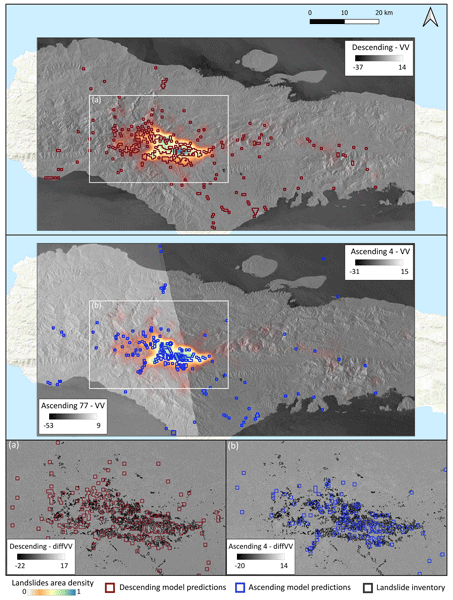
Lorenzo Nava, Alessandro Mondini, Kushanav Bhuyan, Chengyong Fang, Oriol Monserrat, Alessandro Novellino, and Filippo Catani
Geosci. Model Dev., 19, 167–185, https://doi.org/10.5194/gmd-19-167-2026, https://doi.org/10.5194/gmd-19-167-2026, 2026
Short summary
Short summary
This paper presents a framework for landslide rapid detection using radar and deep learning, trained and tested on data from ≈73000 landslides across diverse regions in the world. The method showed high accuracy and rapid response potential regardless of weather and illumination conditions. By overcoming the limits of optical satellite imagery, it offers a powerful tool for timely landslide disaster response, benefiting disaster management and advancing methods for monitoring hazardous terrains.
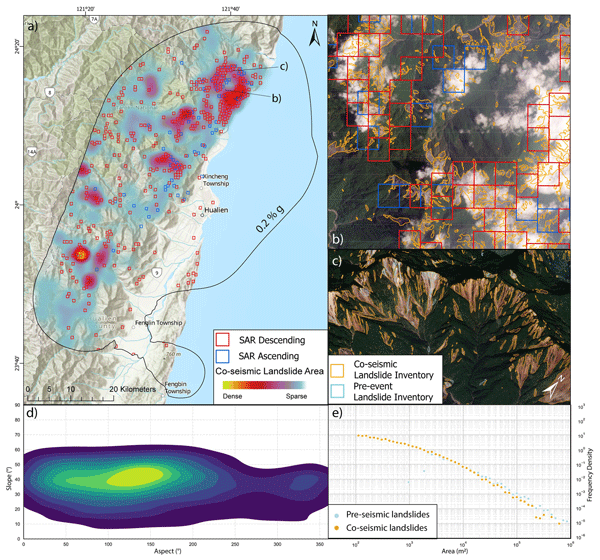
Lorenzo Nava, Alessandro Novellino, Chengyong Fang, Kushanav Bhuyan, Kathryn Leeming, Itahisa Gonzalez Alvarez, Claire Dashwood, Sophie Doward, Rahul Chahel, Emma McAllister, Sansar Raj Meena, and Filippo Catani
Nat. Hazards Earth Syst. Sci., 25, 2371–2377, https://doi.org/10.5194/nhess-25-2371-2025, https://doi.org/10.5194/nhess-25-2371-2025, 2025
Short summary
Short summary
On 2 April 2024, a Mw 7.4 earthquake hit Taiwan's eastern coast, causing extensive landslides and damage. We used automated methods combining Earth observation (EO) data with AI to quickly inventory the landslides. This approach identified 7090 landslides over 75 km2 within 3 h of acquiring the EO imagery. The study highlights AI's role in improving landslide detection efforts in disaster response.
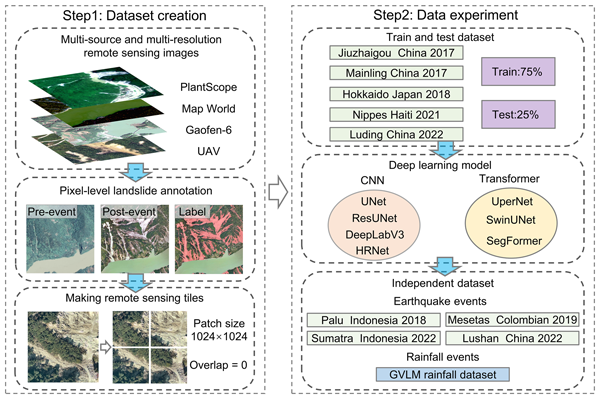
Chengyong Fang, Xuanmei Fan, Xin Wang, Lorenzo Nava, Hao Zhong, Xiujun Dong, Jixiao Qi, and Filippo Catani
Earth Syst. Sci. Data, 16, 4817–4842, https://doi.org/10.5194/essd-16-4817-2024, https://doi.org/10.5194/essd-16-4817-2024, 2024
Short summary
Short summary
In this study, we present the largest publicly available landslide dataset, Globally Distributed Coseismic Landslide Dataset (GDCLD), which includes multi-sensor high-resolution images from various locations around the world. We test GDCLD with seven advanced algorithms and show that it is effective in achieving reliable landslide mapping across different triggers and environments, with great potential in enhancing emergency response and disaster management.
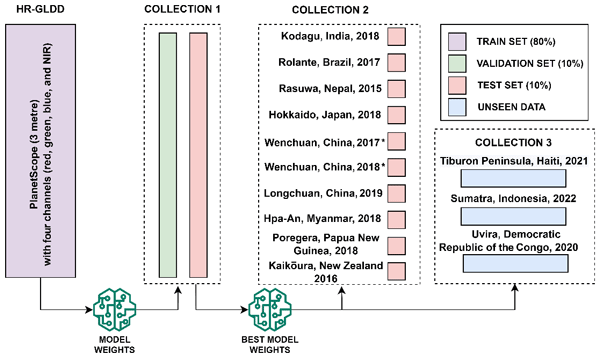
Sansar Raj Meena, Lorenzo Nava, Kushanav Bhuyan, Silvia Puliero, Lucas Pedrosa Soares, Helen Cristina Dias, Mario Floris, and Filippo Catani
Earth Syst. Sci. Data, 15, 3283–3298, https://doi.org/10.5194/essd-15-3283-2023, https://doi.org/10.5194/essd-15-3283-2023, 2023
Short summary
Short summary
Landslides occur often across the world, with the potential to cause significant damage. Although a substantial amount of research has been conducted on the mapping of landslides using remote-sensing data, gaps and uncertainties remain when developing models to be operational at the global scale. To address this issue, we present the High-Resolution Global landslide Detector Database (HR-GLDD) for landslide mapping with landslide instances from 10 different physiographical regions globally.
Ye Chen, Fawu Wang, Maximillian Van Wyk de Vries, Weichao Liu, Bo Zhang, and Changbao Guo
Nat. Hazards Earth Syst. Sci., 26, 5185–5200, https://doi.org/10.5194/nhess-26-5185-2026, https://doi.org/10.5194/nhess-26-5185-2026, 2026
Short summary
Short summary
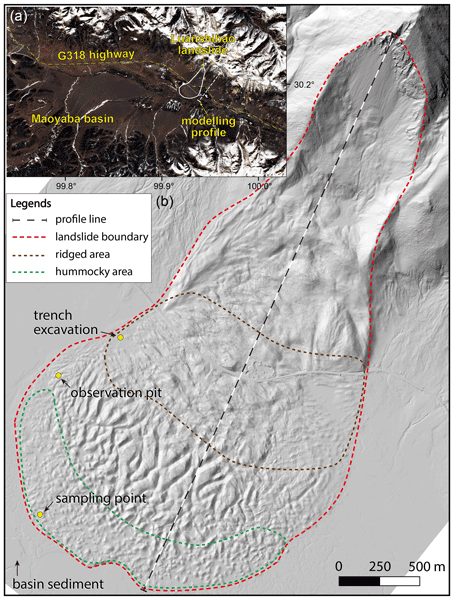
Landslides in alluvial basins can travel farther than expected. To investigate this abnormal mobility, we examined a representative event and performed mechanical tests on erodible alluvial sand. Results show that landslide impact on saturated sediment can create a fluid-like layer, enabling long travel distances. Simulations showed that the severity of this effect depends on how fragile and deformable the materials are.
Andrew D. Wickert, Jabari C. Jones, Devon Libby, Phillip H. Larson, Katherine R. Barnhart, Maximillian S. Van Wyk de Vries, and Taylor F. Schildgen
EGUsphere, https://doi.org/10.5194/egusphere-2026-1018, https://doi.org/10.5194/egusphere-2026-1018, 2026
Short summary
Short summary
Some rivers are wide. Others are narrow. Why is this, and do they change over time? To answer these questions, we developed a model and tested it against real rivers. Rivers erode bank materials to widen, but transported sediments can settle on and rebuild the banks. Rivers generally widen during large floods and narrow during moderate ones. We demonstrate how changing streamflow alters river-channel width over time, with implications for erosion and flood hazards.
Lorenzo Nava, Alessandro Mondini, Kushanav Bhuyan, Chengyong Fang, Oriol Monserrat, Alessandro Novellino, and Filippo Catani
Geosci. Model Dev., 19, 167–185, https://doi.org/10.5194/gmd-19-167-2026, https://doi.org/10.5194/gmd-19-167-2026, 2026
Short summary
Short summary
This paper presents a framework for landslide rapid detection using radar and deep learning, trained and tested on data from ≈73000 landslides across diverse regions in the world. The method showed high accuracy and rapid response potential regardless of weather and illumination conditions. By overcoming the limits of optical satellite imagery, it offers a powerful tool for timely landslide disaster response, benefiting disaster management and advancing methods for monitoring hazardous terrains.
Lorenzo Nava, Alessandro Novellino, Chengyong Fang, Kushanav Bhuyan, Kathryn Leeming, Itahisa Gonzalez Alvarez, Claire Dashwood, Sophie Doward, Rahul Chahel, Emma McAllister, Sansar Raj Meena, and Filippo Catani
Nat. Hazards Earth Syst. Sci., 25, 2371–2377, https://doi.org/10.5194/nhess-25-2371-2025, https://doi.org/10.5194/nhess-25-2371-2025, 2025
Short summary
Short summary
On 2 April 2024, a Mw 7.4 earthquake hit Taiwan's eastern coast, causing extensive landslides and damage. We used automated methods combining Earth observation (EO) data with AI to quickly inventory the landslides. This approach identified 7090 landslides over 75 km2 within 3 h of acquiring the EO imagery. The study highlights AI's role in improving landslide detection efforts in disaster response.
Maximillian Van Wyk de Vries, Alexandre Dunant, Amy L. Johnson, Erin L. Harvey, Sihan Li, Katherine Arrell, Jeevan Baniya, Dipak Basnet, Gopi K. Basyal, Nyima Dorjee Bhotia, Simon J. Dadson, Alexander L. Densmore, Tek Bahadur Dong, Mark E. Kincey, Katie Oven, Anuradha Puri, and Nick J. Rosser
Nat. Hazards Earth Syst. Sci., 25, 1937–1942, https://doi.org/10.5194/nhess-25-1937-2025, https://doi.org/10.5194/nhess-25-1937-2025, 2025
Short summary
Short summary
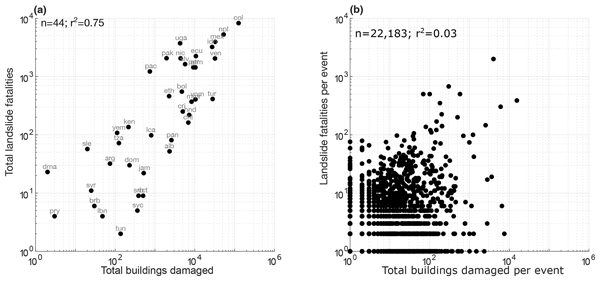
Mapping exposure to landslides is necessary to mitigate risk and reduce vulnerability. In this study, we show that there is a poor correlation between building damage and deaths from landslides, such that the deadliest landslides do not always destroy the most buildings and vice versa. This has important implications for our management of landslide risk.
Alexandre Dunant, Tom R. Robinson, Alexander L. Densmore, Nick J. Rosser, Ragindra Man Rajbhandari, Mark Kincey, Sihan Li, Prem Raj Awasthi, Max Van Wyk de Vries, Ramesh Guragain, Erin Harvey, and Simon Dadson
Nat. Hazards Earth Syst. Sci., 25, 267–285, https://doi.org/10.5194/nhess-25-267-2025, https://doi.org/10.5194/nhess-25-267-2025, 2025
Short summary
Short summary
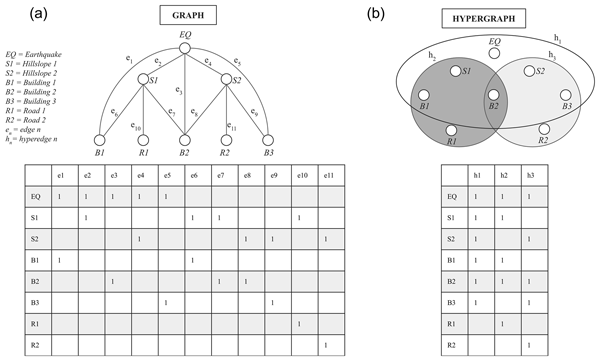
Natural hazards like earthquakes often trigger other disasters, such as landslides, creating complex chains of impacts. We developed a risk model using a mathematical approach called hypergraphs to efficiently measure the impact of interconnected hazards. We showed that it can predict broad patterns of damage to buildings and roads from the 2015 Nepal earthquake. The model's efficiency allows it to generate multiple disaster scenarios, even at a national scale, to support preparedness plans.
Maximillian Van Wyk de Vries, Tom Matthews, L. Baker Perry, Nirakar Thapa, and Rob Wilby
Geosci. Model Dev., 17, 7629–7643, https://doi.org/10.5194/gmd-17-7629-2024, https://doi.org/10.5194/gmd-17-7629-2024, 2024
Short summary
Short summary
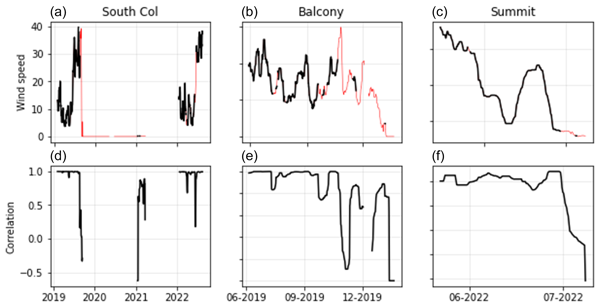
This paper introduces the AtsMOS workflow, a new tool for improving weather forecasts in mountainous areas. By combining advanced statistical techniques with local weather data, AtsMOS can provide more accurate predictions of weather conditions. Using data from Mount Everest as an example, AtsMOS has shown promise in better forecasting hazardous weather conditions, making it a valuable tool for communities in mountainous regions and beyond.
Chengyong Fang, Xuanmei Fan, Xin Wang, Lorenzo Nava, Hao Zhong, Xiujun Dong, Jixiao Qi, and Filippo Catani
Earth Syst. Sci. Data, 16, 4817–4842, https://doi.org/10.5194/essd-16-4817-2024, https://doi.org/10.5194/essd-16-4817-2024, 2024
Short summary
Short summary
In this study, we present the largest publicly available landslide dataset, Globally Distributed Coseismic Landslide Dataset (GDCLD), which includes multi-sensor high-resolution images from various locations around the world. We test GDCLD with seven advanced algorithms and show that it is effective in achieving reliable landslide mapping across different triggers and environments, with great potential in enhancing emergency response and disaster management.
Matias Romero, Shanti B. Penprase, Maximillian S. Van Wyk de Vries, Andrew D. Wickert, Andrew G. Jones, Shaun A. Marcott, Jorge A. Strelin, Mateo A. Martini, Tammy M. Rittenour, Guido Brignone, Mark D. Shapley, Emi Ito, Kelly R. MacGregor, and Marc W. Caffee
Clim. Past, 20, 1861–1883, https://doi.org/10.5194/cp-20-1861-2024, https://doi.org/10.5194/cp-20-1861-2024, 2024
Short summary
Short summary
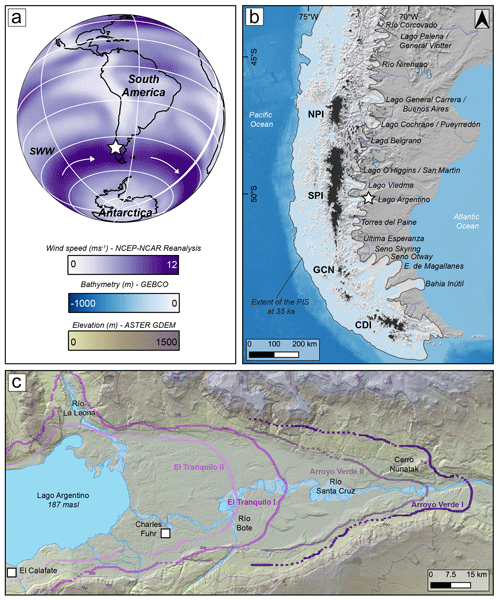
Investigating past glaciated regions is crucial for understanding how ice sheets responded to climate forcings and how they might respond in the future. We use two independent dating techniques to document the timing and extent of the Lago Argentino glacier lobe, a former lobe of the Patagonian Ice Sheet, during the late Quaternary. Our findings highlight feedbacks in the Earth’s system responsible for modulating glacier growth in the Southern Hemisphere prior to the global Last Glacial Maximum.
Maximillian Van Wyk de Vries, Sihan Li, Katherine Arrell, Jeevan Baniya, Dipak Basnet, Gopi K. Basyal, Nyima Dorjee Bhotia, Alexander L. Densmore, Tek Bahadur Dong, Alexandre Dunant, Erin L. Harvey, Ganesh K. Jimee, Mark E. Kincey, Katie Oven, Sarmila Paudyal, Dammar Singh Pujara, Anuradha Puri, Ram Shrestha, Nick J. Rosser, and Simon J. Dadson
EGUsphere, https://doi.org/10.5194/egusphere-2024-397, https://doi.org/10.5194/egusphere-2024-397, 2024
Preprint archived
Short summary
Short summary
This study focuses on understanding soil moisture, a key factor for evaluating hillslope stability and landsliding. In Nepal, where landslides are common, we used a computer model to better understand how rapidly soil dries out after the monsoon season. We calibrated the model using field data and found that, by adjusting soil properties, we could predict moisture levels more accurately. This helps understand where landslides might occur, even where direct measurements are not possible.
Whyjay Zheng, Shashank Bhushan, Maximillian Van Wyk De Vries, William Kochtitzky, David Shean, Luke Copland, Christine Dow, Renette Jones-Ivey, and Fernando Pérez
The Cryosphere, 17, 4063–4078, https://doi.org/10.5194/tc-17-4063-2023, https://doi.org/10.5194/tc-17-4063-2023, 2023
Short summary
Short summary
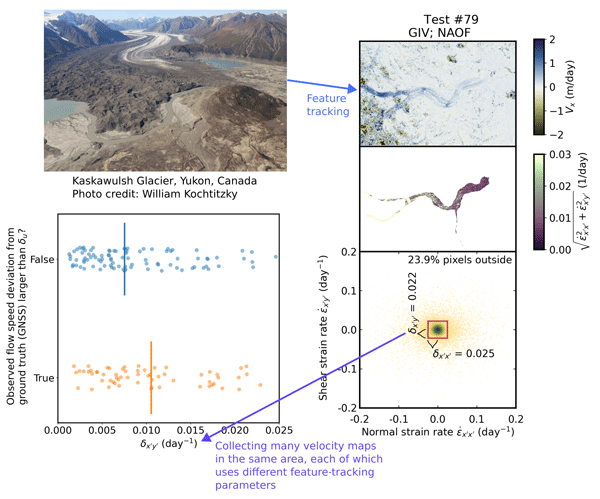
We design and propose a method that can evaluate the quality of glacier velocity maps. The method includes two numbers that we can calculate for each velocity map. Based on statistics and ice flow physics, velocity maps with numbers close to the recommended values are considered to have good quality. We test the method using the data from Kaskawulsh Glacier, Canada, and release an open-sourced software tool called GLAcier Feature Tracking testkit (GLAFT) to help users assess their velocity maps.
Sansar Raj Meena, Lorenzo Nava, Kushanav Bhuyan, Silvia Puliero, Lucas Pedrosa Soares, Helen Cristina Dias, Mario Floris, and Filippo Catani
Earth Syst. Sci. Data, 15, 3283–3298, https://doi.org/10.5194/essd-15-3283-2023, https://doi.org/10.5194/essd-15-3283-2023, 2023
Short summary
Short summary
Landslides occur often across the world, with the potential to cause significant damage. Although a substantial amount of research has been conducted on the mapping of landslides using remote-sensing data, gaps and uncertainties remain when developing models to be operational at the global scale. To address this issue, we present the High-Resolution Global landslide Detector Database (HR-GLDD) for landslide mapping with landslide instances from 10 different physiographical regions globally.
Maximillian Van Wyk de Vries, Shashank Bhushan, Mylène Jacquemart, César Deschamps-Berger, Etienne Berthier, Simon Gascoin, David E. Shean, Dan H. Shugar, and Andreas Kääb
Nat. Hazards Earth Syst. Sci., 22, 3309–3327, https://doi.org/10.5194/nhess-22-3309-2022, https://doi.org/10.5194/nhess-22-3309-2022, 2022
Short summary
Short summary
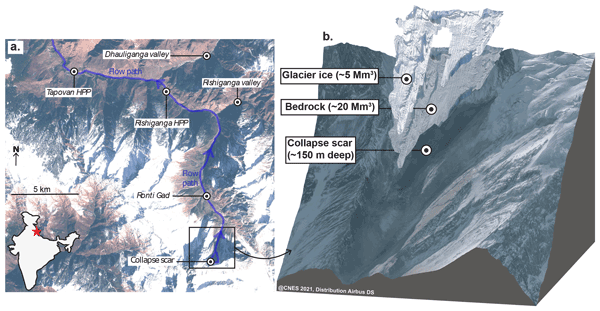
On 7 February 2021, a large rock–ice avalanche occurred in Chamoli, Indian Himalaya. The resulting debris flow swept down the nearby valley, leaving over 200 people dead or missing. We use a range of satellite datasets to investigate how the collapse area changed prior to collapse. We show that signs of instability were visible as early 5 years prior to collapse. However, it would likely not have been possible to predict the timing of the event from current satellite datasets.
Maximillian Van Wyk de Vries, Emi Ito, Mark Shapley, Matias Romero, and Guido Brignone
Clim. Past Discuss., https://doi.org/10.5194/cp-2022-29, https://doi.org/10.5194/cp-2022-29, 2022
Manuscript not accepted for further review
Short summary
Short summary
In some situations, the color of sediment records information about the climatic conditions under which it was deposited. We show that sediment color and climate are linked at Lago Argentino, the world's largest ice-contact lake, but that this relationship is too complex to be used for reconstructing past climate. We instead use this sediment color-climate relationship to show that temperature and wind speed affect sediment deposition in the summer, but not in the winter.
Cited articles
Aati, S., Milliner, C., and Avouac, J.-P.: A new approach for 2-D and 3-D precise measurements of ground deformation from optimized registration and correlation of optical images and ICA-based filtering of image geometry artifacts, Remote Sens. Environ., 277, 113038, https://doi.org//10.1016/j.rse.2022.113038, 2022. a, b
Amatya, P., Kirschbaum, D., Stanley, T., and Tanyas, H.: Landslide mapping using object-based image analysis and open source tools, Eng. Geol., 282, 106000, https://doi.org/10.1016/j.enggeo.2021.106000, 2021. a
Barron, J. L., Fleet, D. J., and Beauchemin, S. S.: Performance of optical flow techniques, Int. J. Comput. Vision, 12, 43–77, 1994. a
Beauchemin, S. S. and Barron, J. L.: The computation of optical flow, ACM Comput. Surv., 27, 433–466, 1995. a
Berardino, P., Fornaro, G., Lanari, R., and Sansosti, E.: A new algorithm for surface deformation monitoring based on small baseline differential SAR interferograms, IEEE T. Geosci. Remote, 40, 2375–2383, https://doi.org/10.1109/TGRS.2002.803792, 2002. a, b
Charrier, L., Godet, P., Rambour, C., Weissgerber, F., Erdmann, S., and Koeniguer, E. C.: Analysis of dense coregistration methods applied to optical and SAR time-series for ice flow estimations, in: 2020 IEEE Radar Conference (RadarConf20), 1–6, IEEE, https://doi.org/10.1109/RadarConf2043947.2020.9266643, 2020. a
Charrier, L., Dehecq, A., Guo, L., Brun, F., Millan, R., Lioret, N., Copland, L., Maier, N., Dow, C., and Halas, P.: TICOI: an operational Python package to generate regular glacier velocity time series, The Cryosphere, 19, 4555–4583, https://doi.org/10.5194/tc-19-4555-2025, 2025. a
Coe, J. A., Ellis, W. L., Godt, J. W., Savage, W. Z., Savage, J. E., Michael, J., Kibler, J. D., Powers, P. S., Lidke, D. J., and Debray, S.: Seasonal movement of the Slumgullion landslide determined from Global Positioning System surveys and field instrumentation, July 1998–March 2002, Eng. Geol., 68, 67–101, 2003. a
Crosetto, M., Monserrat, O., Cuevas-González, M., Devanthéry, N., and Crippa, B.: Persistent Scatterer Interferometry: A review, ISPRS J. Photogramm., 115, 78–89, https://doi.org/10.1016/j.isprsjprs.2015.10.011, 2016. a, b
Fan, X., Domènech, G., Scaringi, G., Huang, R., Xu, Q., Hales, T. C., Dai, L., Yang, Q., and Francis, O.: Spatio-temporal evolution of mass wasting after the 2008 Mw 7.9 Wenchuan earthquake revealed by a detailed multi-temporal inventory, Landslides, 15, 2325–2341, https://doi.org/10.1007/s10346-018-1054-5, 2018. a
Fang, C., Fan, X., Wang, X., Nava, L., Zhong, H., Dong, X., Qi, J., and Catani, F.: A globally distributed dataset of coseismic landslide mapping via multi-source high-resolution remote sensing images, Earth Syst. Sci. Data, 16, 4817–4842, https://doi.org/10.5194/essd-16-4817-2024, 2024. a
Farnebäck, G.: Two-Frame Motion Estimation Based on Polynomial Expansion, in: Scandinavian Conference on Image Analysis, Springer, 363–370, https://doi.org/10.1007/3-540-45103-X_50, 2003. a, b
Ferretti, A., Prati, C., and Rocca, F.: Permanent scatterers in SAR interferometry, in: IEEE 1999 International Geoscience and Remote Sensing Symposium. IGARSS'99 (Cat. No. 99CH36293), vol. 3, 1528–1530, IEEE, https://doi.org/10.1109/IGARSS.1999.772008, 1999. a
Froude, M. J. and Petley, D. N.: Global fatal landslide occurrence from 2004 to 2016, Nat. Hazards Earth Syst. Sci., 18, 2161–2181, https://doi.org/10.5194/nhess-18-2161-2018, 2018. a
Gance, J., Malet, J.-P., Dewez, T., and Travelletti, J.: Target Detection and Tracking of moving objects for characterizing landslide displacements from time-lapse terrestrial optical images, Eng. Geol., 172, 26–40, https://doi.org/10.1016/j.enggeo.2014.01.003, 2014. a
Giordan, D., Allasia, P., Manconi, A., Baldo, M., Santangelo, M., Cardinali, M., Corazza, A., Albanese, V., Lollino, G., and Guzzetti, F.: Morphological and kinematic evolution of a large earthflow: The Montaguto landslide, southern Italy, Geomorphology, 187, 61–79, https://doi.org/10.1016/j.geomorph.2012.12.035, 2013. a
Guizar-Sicairos, M., Thurman, S. T., and Fienup, J. R.: Efficient subpixel image registration algorithms, Opt. Lett., 33, 156–158, 2008. a
Guzzetti, F., Mondini, A. C., Cardinali, M., Fiorucci, F., Santangelo, M., and Chang, K.-T.: Landslide inventory maps: New tools for an old problem, Earth-Sci. Rev., 112, 42–66, https://doi.org/10.1016/j.earscirev.2012.02.001, 2012. a
Haghshenas Haghighi, M.: InSAR Explorer, Zenodo, https://doi.org/10.5281/zenodo.14633158, 2025. a, b
Hu, X., Bürgmann, R., Schulz, W. H., and Fielding, E. J.: Four-dimensional surface motions of the Slumgullion landslide and quantification of hydrometeorological forcing, Nat. Commun., 11, 2792, https://doi.org/10.1038/s41467-020-16617-7, 2020. a, b
Hungr, O., Leroueil, S., and Picarelli, L.: The Varnes classification of landslide types, an update, Landslides, 11, 167–194, https://doi.org/10.1007/s10346-013-0436-y, 2014. a
Intrieri, E., Gigli, G., Mugnai, F., Fanti, R., and Casagli, N.: Design and implementation of a landslide early warning system, Eng. Geol., 147–148, 124–136, https://doi.org/10.1016/j.enggeo.2012.07.017, 2012. a, b
Kanade, T. and Okutomi, M.: A stereo matching algorithm with an adaptive window: Theory and experiment, IEEE T. Pattern Anal., 16, 920–932, 2002. a
Lacroix, P., Bièvre, G., Pathier, E., Kniess, U., and Jongmans, D.: Use of Sentinel-2 images for the detection of precursory motions before landslide failures, Remote Sens. Environ., 215, 507–516, https://doi.org/10.1016/j.rse.2018.03.042, 2018. a
Lacroix, P., Handwerger, A. L., and Bièvre, G.: Life and death of slow-moving landslides, Nature Reviews Earth & Environment, 1, 404–419, https://doi.org/10.1038/s43017-020-0072-8, 2020. a, b
Lei, Y., Gardner, A., and Agram, P.: Autonomous repeat image feature tracking (autoRIFT) and its application for tracking ice displacement, Remote Sens., 13, 749, https://doi.org/10.3390/rs13040749, 2021. a, b
Meena, S. R., Nava, L., Bhuyan, K., Puliero, S., Soares, L. P., Dias, H. C., Floris, M., and Catani, F.: HR-GLDD: a globally distributed dataset using generalized deep learning (DL) for rapid landslide mapping on high-resolution (HR) satellite imagery, Earth Syst. Sci. Data, 15, 3283–3298, https://doi.org/10.5194/essd-15-3283-2023, 2023. a
Messerli, A. and Grinsted, A.: Image georectification and feature tracking toolbox: ImGRAFT, Geosci. Instrum. Method. Data Syst., 4, 23–34, https://doi.org/10.5194/gi-4-23-2015, 2015a. a
Messerli, A. and Grinsted, A.: Image georectification and feature tracking toolbox: ImGRAFT, Geosci. Instrum. Method. Data Syst., 4, 23–34, https://doi.org/10.5194/gi-4-23-2015, 2015b. a
Mondini, A. C., Santangelo, M., Rocchetti, M., Rossetto, E., Manconi, A., and Monserrat, O.: Sentinel-1 SAR amplitude imagery for rapid landslide detection, Remote Sens., 11, https://doi.org/10.3390/rs11070760, 2019. a
Monserrat, O., Crosetto, M., and Luzi, G.: A review of ground-based SAR interferometry for deformation measurement, ISPRS J. Photogramm., 93, 40–48, https://doi.org/10.1016/j.isprsjprs.2014.04.001, 2014. a
Morriss, M. C., Lehmann, B., Campforts, B., Brencher, G., Rick, B., Anderson, L. S., Handwerger, A. L., Overeem, I., and Moore, J.: Alpine hillslope failure in the western US: insights from the Chaos Canyon landslide, Rocky Mountain National Park, USA, Earth Surf. Dynam., 11, 1251–1274, 2023. a
Nava, L., Carraro, E., Reyes-Carmona, C., Puliero, S., Bhuyan, K., Rosi, A., Monserrat, O., Floris, M., Meena, S. R., Galve, J. P., and Catani, F.: Landslide displacement forecasting using deep learning and monitoring data across selected sites, Landslides, 20, 2111–2129, https://doi.org/10.1007/s10346-023-02104-9, 2023. a
Nava, L., Mondini, A., Bhuyan, K., Fang, C., Monserrat, O., Novellino, A., and Catani, F.: Sentinel-1 SAR-based globally distributed co-seismic landslide detection by deep neural networks, Geosci. Model Dev., 19, 167–185, https://doi.org/10.5194/gmd-19-167-2026, 2026. a
Nava, L.: TerraTrack: A Workflow to Identify and Monitor Slow-Moving Landslides through Spaceborne Optical Feature Tracking, Zenodo [code, data set], https://doi.org/10.5281/zenodo.15609754, 2026. a
Novellino, A., Pennington, C., Leeming, K., Taylor, S., Alvarez, I. G., McAllister, E., Arnhardt, C., and Winson, A.: Mapping landslides from space: A review, Landslides, 21, 1041–1052, https://doi.org/10.1007/s10346-024-02215-x, 2024. a
Paige, C. C. and Saunders, M. A.: LSQR: An algorithm for sparse linear equations and sparse least squares, ACM T. Math. Software, 8, 43–71, 1982. a
Philip, J. T., Samuvel, B., Pradeesh, K., and Nimmi, N.: A comparative study of block matching and optical flow motion estimation algorithms, in: 2014 Annual International Conference on Emerging Research Areas: Magnetics, Machines and Drives (AICERA/iCMMD), 1–6, IEEE, https://doi.org/10.1109/AICERA.2014.6908204, 2014. a
Prakash, N., Manconi, A., and Loew, S.: A new strategy to map landslides with a generalized convolutional neural network, Sci. Rep., 11, 9722, https://doi.org/10.1038/s41598-021-89015-8, 2021. a
Prokešová, R., Kardoš, M., Tábořík, P., Medveďová, A., Stacke, V., and Chudỳ, F.: Kinematic behaviour of a large earthflow defined by surface displacement monitoring, DEM differencing, and ERT imaging, Geomorphology, 224, 86–101, 2014. a
Provost, F., Michéa, D., Malet, J.-P., Boissier, E., Pointal, E., Stumpf, A., Pacini, F., Doin, M.-P., Lacroix, P., Proy, C., and Bally, P.: Terrain deformation measurements from optical satellite imagery: The MPIC-OPT processing services for geohazards monitoring, Remote Sens. Environ., 274, 112949, https://doi.org/10.1016/j.rse.2022.112949, 2022. a, b
Santangelo, M., Marchesini, I., Bucci, F., Cardinali, M., Fiorucci, F., and Guzzetti, F.: An approach to reduce mapping errors in the production of landslide inventory maps, Nat. Hazards Earth Syst. Sci., 15, 2111–2126, https://doi.org/10.5194/nhess-15-2111-2015, 2015. a
Sattar, A., Cook, K. L., Rai, S. K., Berthier, E., Allen, S., Rinzin, S., de Vries, M. V. W., Haeberli, W., Kushwaha, P., Shugar, D. H., Emmer, A., Haritashya, U. K., Frey, H., Rao, P., Gurudin, K. S. K., Rai, P., Rajak, R., Hossain, F., Huggel, C., Mergili, M., Azam, M. F., Gascoin, S., Carrivick, J. L., Bell, L. E., Ranjan, R. K., Rashid, I., Kulkarni, A. V., Petley, D., Schwanghart, W., Watson, C. S., Islam, N., Gupta, M. D., Lane, S. N., and Bhat, S. Y.: The Sikkim flood of October 2023: Drivers, causes, and impacts of a multihazard cascade, Science, 387, eads2659, https://doi.org/10.1126/science.ads2659, 2025. a
Shean, D.: dshean/vmap: Zenodo DOI release, Zenodo, https://doi.org/10.5281/zenodo.3243479, 2019. a
Sinha, M. and Garrison, L. H.: CORRFUNC – a suite of blazing fast correlation functions on the CPU, Mon. Not. R. Astron. Soc., 491, 3022–3041, https://doi.org/10.1093/mnras/stz3157, 2020. a
Stumpf, A., Malet, J.-P., and Delacourt, C.: Correlation of satellite image time-series for the detection and monitoring of slow-moving landslides, Remote Sens. Environ., 189, 40–55, https://doi.org/10.1016/j.rse.2016.11.007, 2017. a, b, c
Tanyaş, H., Görüm, T., Fadel, I., Yıldırım, C., and Lombardo, L.: An open dataset for landslides triggered by the 2016 Mw 7.8 Kaikōura earthquake, New Zealand, Landslides, 19, 1405–1420, https://doi.org/10.1007/s10346-022-01869-9, 2022. a
Teza, G., Atzeni, C., Balzani, M., Galgaro, A., Galvani, G., Genevois, R., Luzi, G., Mecatti, D., Noferini, L., Pieraccini, M., Silvano, S., Uccelli, F., and Zaltron, N.: Ground-based monitoring of high-risk landslides through joint use of laser scanner and interferometric radar, Int. J. Remote Sens., 29, 4735–4756, 2008. a
Tofani, V., Raspini, F., Catani, F., and Casagli, N.: Persistent Scatterer Interferometry (PSI) technique for landslide characterization and monitoring, Remote Sens., 5, 1045–1065, 2013. a
Tordesillas, A., Zheng, H., Qian, G., Bellett, P., and Saunders, P.: Augmented Intelligence Forecasting and What-If-Scenario Analytics With Quantified Uncertainty for Big Real-Time Slope Monitoring Data, IEEE T. Geosci. Remote, 62, 1–29, https://doi.org/10.1109/TGRS.2024.3382302, 2024. a
van Westen, C. and Lulie Getahun, F.: Analyzing the evolution of the Tessina landslide using aerial photographs and digital elevation models, Geomorphology, 54, 77–89, https://doi.org/10.1016/S0169-555X(03)00057-6, 2003. a
Van Wyk de Vries, M., Arrell, K., Basyal, G. K., Densmore, A. L., Dunant, A., Harvey, E. L., Jimee, G. K., Kincey, M. E., Li, S., Pujara, D. S., Shrestha, R., Rosser, N. J., and Dadson, S. J.: Detection of slow-moving landslides through automated monitoring of surface deformation using Sentinel-2 satellite imagery, Earth Surf. Proc. Land., 49, 1397–1410, https://doi.org/10.1002/esp.5775, 2024. a, b, c, d, e, f, g, h
Short summary
We introduce TerraTrack, an open-source tool for detecting and monitoring slow-moving landslides using Sentinel-2 data. It automates image acquisition, landslide identification, and time-series generation in an accessible and cloud-based workflow. TerraTrack supports early warning, complements interferometric synthetic aperture radar (InSAR), and offers a scalable solution for landslide hazard identification and monitoring.
We introduce TerraTrack, an open-source tool for detecting and monitoring slow-moving landslides...


Altmetrics
Final-revised paper
Preprint