
Articles | Volume 26, issue 4
https://doi.org/10.5194/nhess-26-1813-2026
© Author(s) 2026. This work is distributed under
the Creative Commons Attribution 4.0 License.
the Creative Commons Attribution 4.0 License.
https://doi.org/10.5194/nhess-26-1813-2026
© Author(s) 2026. This work is distributed under
the Creative Commons Attribution 4.0 License.
the Creative Commons Attribution 4.0 License.
Research article
| 
23 Apr 2026
Research article |
| 23 Apr 2026
| 23 Apr 2026
Future rime ice conditions for energy infrastructure over Fennoscandia resolved with a high-resolution regional climate model
Oskari Rockas
CORRESPONDING AUTHOR

Finnish Meteorological Institute, Erik Palménin aukio 1, 00560, Helsinki, Finland
Pia Isolähteenmäki
Finnish Meteorological Institute, Erik Palménin aukio 1, 00560, Helsinki, Finland
Marko Laine
Finnish Meteorological Institute, Erik Palménin aukio 1, 00560, Helsinki, Finland
Anders V. Lindfors
Finnish Meteorological Institute, Erik Palménin aukio 1, 00560, Helsinki, Finland
Karoliina Hämäläinen
Finnish Meteorological Institute, Erik Palménin aukio 1, 00560, Helsinki, Finland
Anton Laakso
Finnish Meteorological Institute, Erik Palménin aukio 1, 00560, Helsinki, Finland
Related authors
No articles found.
Katharina Perny, Timofei Sukhodolov, Ales Kuchar, Pavle Arsenovic, Bernadette Rosati, Christoph Brühl, Sandip S. Dhomse, Andrin Jörimann, Anton Laakso, Graham Mann, Ulrike Niemeier, Giovanni Pitari, Ilaria Quaglia, Takashi Sekiya, Kengo Sudo, Claudia Timmreck, Simone Tilmes, Daniele Visioni, and Harald E. Rieder
Atmos. Chem. Phys., 26, 10997–11025, https://doi.org/10.5194/acp-26-10997-2026, https://doi.org/10.5194/acp-26-10997-2026, 2026
Short summary
Short summary
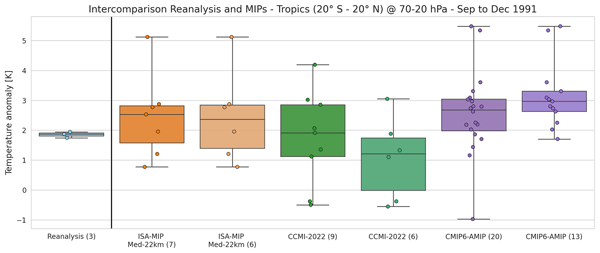
Major volcanic eruptions, such as the one of Mt. Pinatubo in 1991, can inject large amounts of sulfur dioxide into the stratosphere. The resulting aerosol cloud affects stratospheric temperature and thereby middle atmospheric dynamics and chemistry. Here we investigate similarities and differences across an ensemble of climate models in reproducing the stratospheric temperature signal following the Mt. Pinatubo eruption.
William Wandji Nyamsi, Ville Leinonen, Antti Lipponen, Else van den Besselaar, Santtu Mikkonen, Arturo Sanchez-Lorenzo, Martin Wild, Doris Folini, Tero Mielonen, Harri Kokkola, Antti Kukkurainen, Neus Sabater, Rei Kudo, Ben Liley, Raghav Srinivasan, Bruce W. Forgan, Alexandru Dumitrescu, Grzegorz Urban, Michał K. Kowalewski, Márcia Akemi Yamasoe, Nilton Évora do Rosário, Dimitra Founda, Stelios Kazadzis, Veronica Manara, Derbetini A. Vondou, Christian Gueymard, Anders V. Lindfors, Atsumu Ohmura, and Antti Arola
Atmos. Chem. Phys., 26, 10767–10788, https://doi.org/10.5194/acp-26-10767-2026, https://doi.org/10.5194/acp-26-10767-2026, 2026
Short summary
Short summary
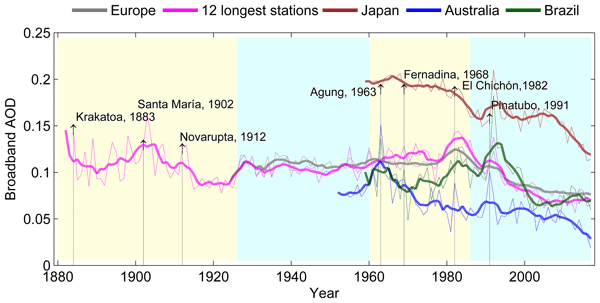
Worldwide reconstructed historical aerosol load reveals that during the period of:
- 1900–1959: the atmosphere became cleaner in most European cities;
- 1960–1985: anthropogenic aerosols were responsible for the dimming phenomenon in Europe. AOD increased over Southeast Brazil and decreased noticeably over Japan while a small negative trend was found over Oceania;
- 1986–2015: generally, the atmosphere has become much cleaner everywhere after the reversal trend around 1980s mainly observed in Europe.
Karoliina Hämäläinen, Laura Rautiainen, Jani Tyynelä, and Lauri Laakso
EGUsphere, https://doi.org/10.5194/egusphere-2026-1629, https://doi.org/10.5194/egusphere-2026-1629, 2026
This preprint is open for discussion and under review for Geoscientific Model Development (GMD).
Short summary
Short summary
This study investigated how well a weather model can predict anomalous signal propagation conditions over the sea. We tested different model settings and compared the results with mast observations from the summer of 2022. The model results are promising in identifying these conditions, especially at higher altitudes. Yet, model’s had difficulties near the surface due to simplified land and sea description.
Mian Chin, Jonathon S. Wright, Huisheng Bian, Qian Tan, Xiaohua Pan, Toshihiko Takemura, Hitoshi Matsui, Kostas Tsigaridis, Susanne Bauer, Paul Ginoux, Yiran Peng, Zengyuan Guo, Suvarna Fadnavis, Anton Laakso, John P. Burrows, Ghassan Taha, Jayanta Kar, Alexei Rozanov, Carlo Arosio, Landon Rieger, and Adam Bourassa
Atmos. Chem. Phys., 26, 6035–6059, https://doi.org/10.5194/acp-26-6035-2026, https://doi.org/10.5194/acp-26-6035-2026, 2026
Short summary
Short summary
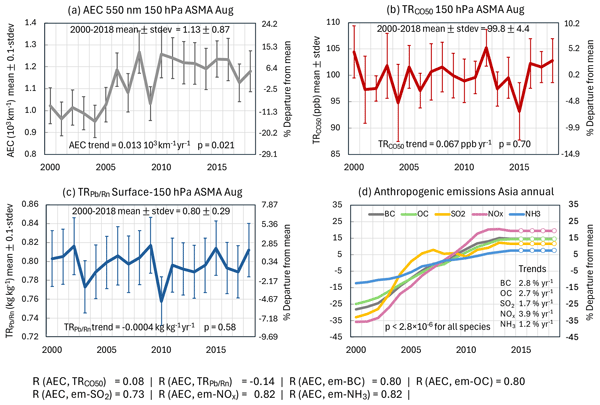
Aerosols in the upper troposphere influence weather and climate. The Asian summer monsoon efficiently transports surface pollutants upward, shaping aerosol amounts and variability in the upper troposphere. Using multiple global models, this study finds a summertime increase in upper-tropospheric aerosols at 1.2 % per year from 2000 to 2018 over Asia, consistent with rising pollutant emissions in Asia, while year-to-year changes are mainly driven by climate variability affecting monsoon dynamics.
William Wandji Nyamsi, Anders V. Lindfors, Angela Meyer, Antti Lipponen, and Antti Arola
Atmos. Meas. Tech., 19, 899–922, https://doi.org/10.5194/amt-19-899-2026, https://doi.org/10.5194/amt-19-899-2026, 2026
Short summary
Short summary
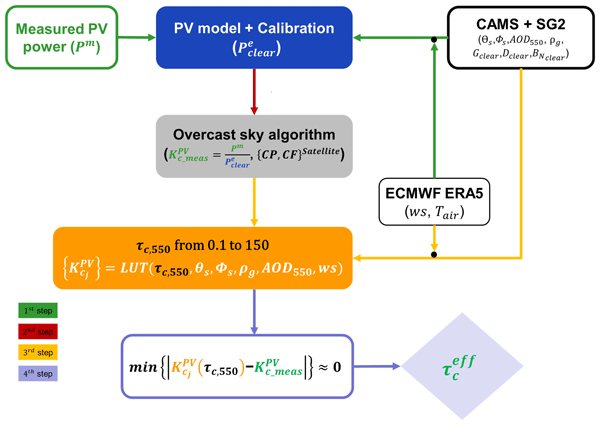
This paper proposes a new, fast and accurate method for estimating the cloud optical depth (τc) from photovoltaic (PV) power measurements under overcast sky conditions. The method performs very well with the European Centre for Medium-Range Weather Forecasts (ECMWF) products as inputs describing the state of the atmosphere. The method exhibits a better performance than published state-of-the-art methods when compared to ground and satellite-based τc retrievals serving as reference.
George Jordan, Florent Malavelle, Jim Haywood, Ying Chen, Ben Johnson, Daniel Partridge, Amy Peace, Eliza Duncan, Duncan Watson-Parris, David Neubauer, Anton Laakso, Martine Michou, and Pierre Nabat
Atmos. Chem. Phys., 25, 13393–13428, https://doi.org/10.5194/acp-25-13393-2025, https://doi.org/10.5194/acp-25-13393-2025, 2025
Short summary
Short summary
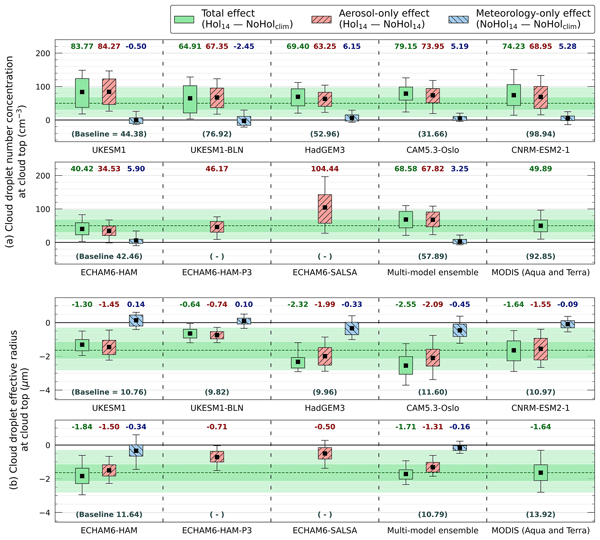
The 2014–15 Holuhraun eruption created a vast aerosol plume that acted as a natural experiment to assess how well climate models capture changes in cloud properties due to increased aerosol. We find that climate models represent the observed shift to smaller, more numerous cloud droplets well. However, climate models diverge in their aerosol-induced changes to large-scale cloud properties, particularly cloud liquid water content. Our study shows that Holuhraun had a cooling effect on the Earth.
Prashant Chavan, Suvarna Fadnavis, Anton Laakso, Jean-Paul Vernier, Simone Tilmes, and Rolf Müller
EGUsphere, https://doi.org/10.5194/egusphere-2024-3825, https://doi.org/10.5194/egusphere-2024-3825, 2025
Preprint archived
Short summary
Short summary
Our simulations with volcanoes, when compared without volcanoes, show that volcanic aerosol precursors enter the tropical stratosphere, propagating upward and enhancing sulphate aerosol and heating. This stratospheric heating caused by the volcanoes reduces the amplitude of the QBO and disrupts its phases. Since QBO also modulates tropical convection and weather, we suggest including volcanic emissions and the QBO in the weather prediction model for a better forecast.

Stephanie Bohlmann and Marko Laine
Nat. Hazards Earth Syst. Sci., 24, 4225–4235, https://doi.org/10.5194/nhess-24-4225-2024, https://doi.org/10.5194/nhess-24-4225-2024, 2024
Short summary
Short summary
Probabilistic ensemble forecasts of the Canadian Forest Fire Weather Index (FWI) can be used to estimate the possible wildfire risk but require post-processing to provide accurate and reliable predictions. This article presents a calibration method using non-homogeneous Gaussian regression to statistically post-process FWI forecasts up to 15 d. Calibration improves the forecast especially at short lead times and in regions with high fire risk.
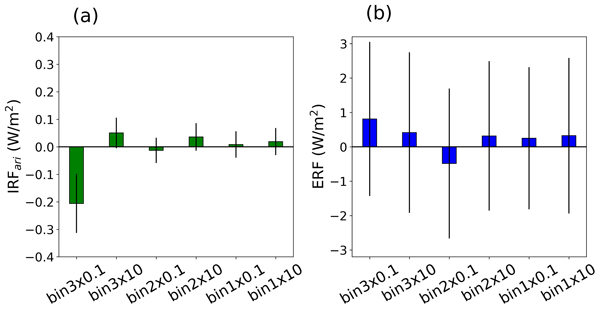
Muhammed Irfan, Thomas Kühn, Taina Yli-Juuti, Anton Laakso, Eemeli Holopainen, Douglas R. Worsnop, Annele Virtanen, and Harri Kokkola
Atmos. Chem. Phys., 24, 8489–8506, https://doi.org/10.5194/acp-24-8489-2024, https://doi.org/10.5194/acp-24-8489-2024, 2024
Short summary
Short summary
The study examines how the volatility of semi-volatile organic compounds affects secondary organic aerosol (SOA) formation and climate. Our simulations show that uncertainties in these volatilities influence aerosol mass and climate impacts. Accurate representation of these compounds in climate models is crucial for predicting global climate patterns.

Christina V. Brodowsky, Timofei Sukhodolov, Gabriel Chiodo, Valentina Aquila, Slimane Bekki, Sandip S. Dhomse, Michael Höpfner, Anton Laakso, Graham W. Mann, Ulrike Niemeier, Giovanni Pitari, Ilaria Quaglia, Eugene Rozanov, Anja Schmidt, Takashi Sekiya, Simone Tilmes, Claudia Timmreck, Sandro Vattioni, Daniele Visioni, Pengfei Yu, Yunqian Zhu, and Thomas Peter
Atmos. Chem. Phys., 24, 5513–5548, https://doi.org/10.5194/acp-24-5513-2024, https://doi.org/10.5194/acp-24-5513-2024, 2024
Short summary
Short summary
The aerosol layer is an essential part of the climate system. We characterize the sulfur budget in a volcanically quiescent (background) setting, with a special focus on the sulfate aerosol layer using, for the first time, a multi-model approach. The aim is to identify weak points in the representation of the atmospheric sulfur budget in an intercomparison of nine state-of-the-art coupled global circulation models.
Anton Laakso, Daniele Visioni, Ulrike Niemeier, Simone Tilmes, and Harri Kokkola
Earth Syst. Dynam., 15, 405–427, https://doi.org/10.5194/esd-15-405-2024, https://doi.org/10.5194/esd-15-405-2024, 2024
Short summary
Short summary
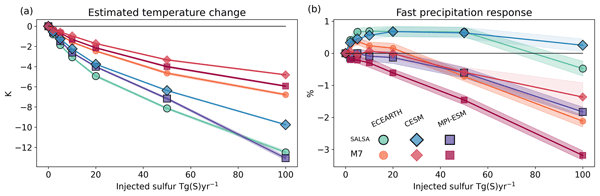
This study is the second in a two-part series in which we explore the dependency of the impacts of stratospheric sulfur injections on both the model employed and the strategy of injection utilized. The study uncovers uncertainties associated with these techniques to cool climate, highlighting how the simulated climate impacts are dependent on both the selected model and the magnitude of the injections. We also show that estimating precipitation impacts of aerosol injection is a complex task.
George Jordan, Florent Malavelle, Ying Chen, Amy Peace, Eliza Duncan, Daniel G. Partridge, Paul Kim, Duncan Watson-Parris, Toshihiko Takemura, David Neubauer, Gunnar Myhre, Ragnhild Skeie, Anton Laakso, and James Haywood
Atmos. Chem. Phys., 24, 1939–1960, https://doi.org/10.5194/acp-24-1939-2024, https://doi.org/10.5194/acp-24-1939-2024, 2024
Short summary
Short summary
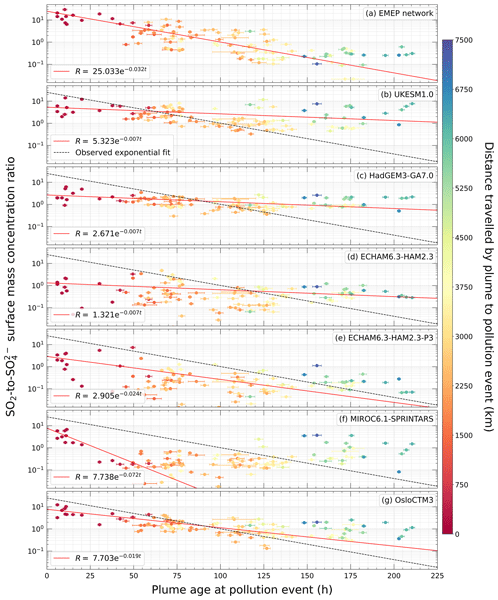
The 2014–15 Holuhraun eruption caused a huge aerosol plume in an otherwise unpolluted region, providing a chance to study how aerosol alters cloud properties. This two-part study uses observations and models to quantify this relationship’s impact on the Earth’s energy budget. Part 1 suggests the models capture the observed spatial and chemical evolution of the plume, yet no model plume is exact. Understanding these differences is key for Part 2, where changes to cloud properties are explored.
Olle Räty, Marko Laine, Ulpu Leijala, Jani Särkkä, and Milla M. Johansson
Nat. Hazards Earth Syst. Sci., 23, 2403–2418, https://doi.org/10.5194/nhess-23-2403-2023, https://doi.org/10.5194/nhess-23-2403-2023, 2023
Short summary
Short summary
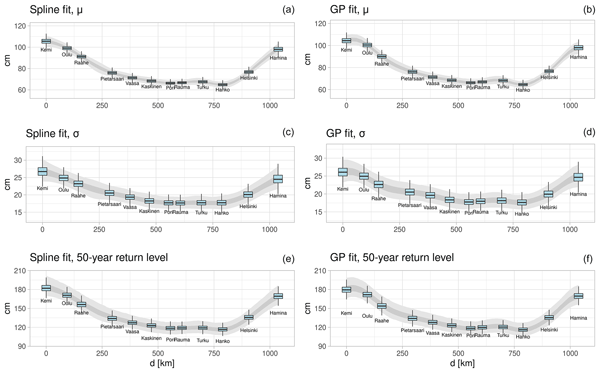
We studied annual maximum sea levels in the Finnish coastal region. Our aim was to better quantify the uncertainty in them compared to previous studies. Using four statistical models, we found out that hierarchical models, which shared information on sea-level extremes across Finnish tide gauges, had lower uncertainty in their results in comparison with tide-gauge-specific fits. These models also suggested that the shape of the distribution for extreme sea levels is similar on the Finnish coast.
Ilaria Quaglia, Claudia Timmreck, Ulrike Niemeier, Daniele Visioni, Giovanni Pitari, Christina Brodowsky, Christoph Brühl, Sandip S. Dhomse, Henning Franke, Anton Laakso, Graham W. Mann, Eugene Rozanov, and Timofei Sukhodolov
Atmos. Chem. Phys., 23, 921–948, https://doi.org/10.5194/acp-23-921-2023, https://doi.org/10.5194/acp-23-921-2023, 2023
Short summary
Short summary
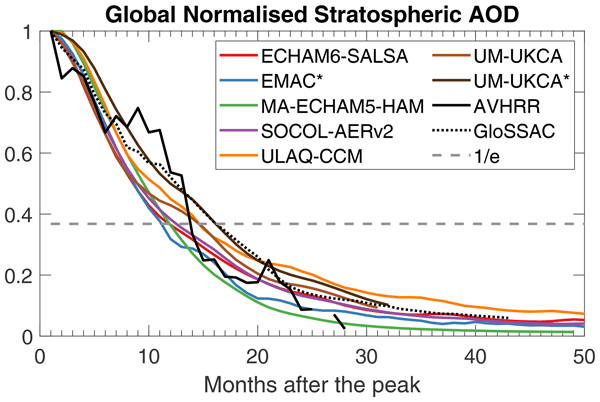
The last very large explosive volcanic eruption we have measurements for is the eruption of Mt. Pinatubo in 1991. It is therefore often used as a benchmark for climate models' ability to reproduce these kinds of events. Here, we compare available measurements with the results from multiple experiments conducted with climate models interactively simulating the aerosol cloud formation.

Anton Laakso, Ulrike Niemeier, Daniele Visioni, Simone Tilmes, and Harri Kokkola
Atmos. Chem. Phys., 22, 93–118, https://doi.org/10.5194/acp-22-93-2022, https://doi.org/10.5194/acp-22-93-2022, 2022
Short summary
Short summary
The use of different spatio-temporal sulfur injection strategies with different magnitudes to create an artificial reflective aerosol layer to cool the climate is studied using sectional and modal aerosol schemes in a climate model. There are significant differences in the results depending on the aerosol microphysical module used. Different spatio-temporal injection strategies have a significant impact on the magnitude and zonal distribution of radiative forcing and atmospheric dynamics.
Anu Kauppi, Antti Kukkurainen, Antti Lipponen, Marko Laine, Antti Arola, Hannakaisa Lindqvist, and Johanna Tamminen
Atmos. Meas. Tech. Discuss., https://doi.org/10.5194/amt-2021-328, https://doi.org/10.5194/amt-2021-328, 2021
Revised manuscript not accepted
Short summary
Short summary
We present a methodology in Bayesian framework for retrieving atmospheric aerosol optical depth and aerosol type from the pre-computed look-up tables (LUTs). Especially, we consider Bayesian model averaging and uncertainty originating from aerosol model selection and imperfect forward modelling. Our aim is to get more realistic uncertainty estimates. We have applied the methodology to TROPOMI/S5P satellite observations and evaluated the results against ground-based data from the AERONET.
Cited articles
Arenberg, D. L.: Determination of icing-conditions for airplanes, Eos Trans. AGU, 24, 99–122, 1943. a
Belušić, D., de Vries, H., Dobler, A., Landgren, O., Lind, P., Lindstedt, D., Pedersen, R. A., Sánchez-Perrino, J. C., Toivonen, E., van Ulft, B., Wang, F., Andrae, U., Batrak, Y., Kjellström, E., Lenderink, G., Nikulin, G., Pietikäinen, J.-P., Rodríguez-Camino, E., Samuelsson, P., van Meijgaard, E., and Wu, M.: HCLIM38: a flexible regional climate model applicable for different climate zones from coarse to convection-permitting scales, Geosci. Model Dev., 13, 1311–1333, https://doi.org/10.5194/gmd-13-1311-2020, 2020. a
Bengtsson, L., Andrae, U., Aspelien, T., Batrak, Y., Calvo, J., de Rooy, W., Gleeson, E., Hansen-Sass, B., Homleid, M., Hortal, M., Ivarsson, K.-I., Lenderink, G., Niemelä, S., Nielsen, K. P., Onvlee, J., Rontu, L., Samuelsson, P., Muñoz, D. S., Subias, A., Tijm, S., Toll, V., Yang, X., and Køltzow, M. Ø.: The HARMONIE–AROME model configuration in the ALADIN–HIRLAM NWP system, Mon. Weather Rev., 145, 1919–1935, 2017. a, b
Chang, S. E., McDaniels, T. L., Mikawoz, J., and Peterson, K.: Infrastructure failure interdependencies in extreme events: Power outage consequences in the 1998 Ice Storm, Nat. Hazards, 41, 337–358, https://doi.org/10.1007/s11069-006-9039-4, 2007. a
Chen, J., Sun, G., Guo, X., and Peng, Y.: Galloping behaviors of ice-coated conductors under steady, unsteady and stochastic wind fields, Cold Reg. Sci. Technol., 200, 103583, https://doi.org/10.1016/j.coldregions.2022.103583, 2022. a
Dyrrdal, A. V., Médus, E., Dobler, A., Øivind Hodnebrog, Arnbjerg-Nielsen, K., Olsson, J., Thomassen, E. D., Lind, P., Gaile, D., and Post, P.: Changes in design precipitation over the Nordic-Baltic region as given by convection-permitting climate simulations, Weather and Climate Extremes, 42, 100604, https://doi.org/10.1016/j.wace.2023.100604, 2023. a
Ellis, S. M. and Vivekanandan, J.: Liquid water content estimates using simultaneous S and Ka band radar measurements, Radio Sci., 46, 1–15, 2011. a
Finnish Meteorological Institute: Data for manuscript: “Future Rime Ice Conditions for Energy Infrastructure over Fennoscandia Resolved with a High-Resolution Regional Climate Model” by Rockas et al., Finnish Meteorological Institute [data set], https://doi.org/10.57707/fmi-b2share.z35ej-9c516, 2026. a
Freistetter, N. C., Médus, E., Hippi, M., Kangas, M., Dobler, A., Belušić, D., Käyhkö, J., and Partanen, A. I.: Climate change impacts on future driving and walking conditions in Finland, Norway and Sweden, Reg. Environ. Change, 22, https://doi.org/10.1007/s10113-022-01920-4, 2022. a, b
Frick, C. and Wernli, H.: A Case Study of High-Impact Wet Snowfall in Northwest Germany (25–27 November 2005): Observations, Dynamics, and Forecast Performance, Weather Forecast., 27, 1217–1234, https://doi.org/10.1175/WAF-D-11-00084.1, 2012. a
Hämäläinen, K., Hirsikko, A., Leskinen, A., Komppula, M., O'Connor, E. J., and Niemelä, S.: Evaluating atmospheric icing forecasts with ground-based ceilometer profiles, Meteorol. Appl., 27, https://doi.org/10.1002/met.1964, 2020. a
Havard, D. G. and Van Dyke, P.: Effects of ice on the dynamics of overhead lines. Part II: field data on conductor galloping, ice shedding and bundle rolling, in: Proceeding of the 11th International Workshop Atmospheric Icing Structures, Montreal (Canada), 12–16 June 2005, Univ. du Québec, 291–296, ISBN 2-9805200-1-2, 2005. a
Kämäräinen, M., Hyvärinen, O., Vajda, A., Nikulin, G., Meijgaard, E. v., Teichmann, C., Jacob, D., Gregow, H., and Jylhä, K.: Estimates of Present-Day and Future Climatologies of Freezing Rain in Europe Based on CORDEX Regional Climate Models, J. Geophys. Res.-Atmos., 123, 13291–13304, https://doi.org/10.1029/2018JD029131, 2018. a
Kendon, E. J., Rowell, D. P., Jones, R. G., and Buonomo, E.: Robustness of Future Changes in Local Precipitation Extremes, J. Climate, 21, 4280–4297, 2008. a
Lewis, W., Kline, D. B., and Steinmetz, C. P.: A further investigation of the meteorological conditions conducive to aircraft icing, Tech. rep., No. NACA-TN-1424, National Advisory Committee for Aeronautics, https://ntrs.nasa.gov/api/citations/19930082171/downloads/19930082171.pdf (last access: 20 April 2026) 1947. a
Lind, P., Belušić, D., Christensen, O. B., Dobler, A., Kjellström, E., Landgren, O., Lindstedt, D., Matte, D., Pedersen, R. A., Toivonen, E., and Wang, F.: Benefits and added value of convection-permitting climate modeling over Fenno-Scandinavia, Clim. Dynam., 55, 1893–1912, https://doi.org/10.1007/s00382-020-05359-3, 2020. a, b
Lind, P., Belušić, D., Médus, E., Dobler, A., Pedersen, R. A., Wang, F., Matte, D., Kjellström, E., Landgren, O., Lindstedt, D., Christensen, O. B., and Christensen, J. H.: Climate change information over Fenno-Scandinavia produced with a convection-permitting climate model, Clim. Dynam., 61, 519–541, https://doi.org/10.1007/s00382-022-06589-3, 2022. a, b, c, d, e
Lindstedt, D., Lind, P., Kjellström, E., and Jones, C.: A new regional climate model operating at the meso-gamma scale: performance over Europe, Tellus A, 67, 24138, https://doi.org/10.3402/tellusa.v67.24138, 2015. a
Liu, W., Xie, S.-P., Liu, Z., and Zhu, J.: Overlooked possibility of a collapsed Atlantic Meridional Overturning Circulation in warming climate, Science Advances, 3, e1601666, https://doi.org/10.1126/sciadv.1601666, 2017. a
Makkonen, L.: Modeling of Ice Accretion on Wires, J. Appl. Meteorol. Clim., 23, 929–939, https://doi.org/10.1175/1520-0450(1984)023<0929:MOIAOW>2.0.CO;2, 1984. a
Makkonen, L.: Models for the growth of rime, glaze, icicles and wet snow on structures, Philos. T. Roy. Soc. A, 358, 2913–2939, https://doi.org/10.1098/rsta.2000.0690, 2000. a, b
Makkonen, L. J. and Stallabrass, J.: Ice accretion on cylinders and wires, National Research Council Canada, Division of Mechanical Engineering, https://doi.org/10.4224/40002646, 1984. a
Marinier, S., Thériault, J. M., and Ikeda, K.: Changes in freezing rain occurrence over eastern Canada using convection-permitting climate simulations, Clim. Dynam., 60, 1369–1384, https://doi.org/10.1007/s00382-022-06370-6, 2023. a
Nygaard, B. E., Ingvaldsen, K., and Welgaard, Ø.: Development of ice load maps for structural design, IWAIS 2022, Montreal Canada, 20–23 June 2022, Paper ID 064, 7 pp., 2022. a
Nygaard, B. E. K., Seierstad, I. A., and Veal, A. T.: A new snow and ice load map for mechanical design of power lines in Great Britain, Cold Reg. Sci. Technol., 108, 28–35, 2014. a
Rácz, L., Szabó, D., Göcsei, G., and Németh, B.: Investigation of climate change on power line icing over Hungary, Tech. rep., https://www.mcgill.ca/iwais2022/files/iwais2022/paperid031.pdf (last access: 15 April 2026), 2022. a
Ridal, M., Bazile, E., Le Moigne, P., Randriamampianina, R., Schimanke, S., Andrae, U., Berggren, L., Brousseau, P., Dahlgren, P., Edvinsson, L., El-Said, A., Glinton, M., Hagelin, S., Hopsch, S., Isaksson, L., Medeiros, P., Olsson, E., Unden, P., and Wang, Z. Q.: CERRA, the Copernicus European Regional Reanalysis system, Q. J. Roy. Meteor. Soc., 150, 3385–3411, https://doi.org/10.1002/QJ.4764, 2024. a
Ruosteenoja, K. and Räisänen, P.: Seasonal changes in solar radiation and relative humidity in Europe in response to global warming, J. Climate, 26, 2467–2481, 2013. a
Schwalm, C. R., Glendon, S., and Duffy, P. B.: RCP8.5 tracks cumulative CO2 emissions, P. Natl. Acad. Sci. USA, 117, 19656–19657, 2020. a
Sollerkvist, F. J., Maxwell, A., Roudén, K., and Ohnstad, T. M.: Evaluation, verification and operational supervision of corona losses in Sweden, IEEE T. Power Deliver., 22, 1210–1217, https://doi.org/10.1109/TPWRD.2006.881598, 2007. a
Taylor, K. E., Stouffer, R. J., and Meehl, G. A.: An overview of CMIP5 and the experiment design, B. Am. Meteorol. Soc., 93, 485–498, 2012. a
Termonia, P., Fischer, C., Bazile, E., Bouyssel, F., Brožková, R., Bénard, P., Bochenek, B., Degrauwe, D., Derková, M., El Khatib, R., Hamdi, R., Mašek, J., Pottier, P., Pristov, N., Seity, Y., Smolíková, P., Španiel, O., Tudor, M., Wang, Y., Wittmann, C., and Joly, A.: The ALADIN System and its canonical model configurations AROME CY41T1 and ALARO CY40T1, Geosci. Model Dev., 11, 257–281, https://doi.org/10.5194/gmd-11-257-2018, 2018. a
Tian, J., Dong, X., Xi, B., Williams, C. R., and Wu, P.: Estimation of liquid water path below the melting layer in stratiform precipitation systems using radar measurements during MC3E, Atmos. Meas. Tech., 12, 3743–3759, https://doi.org/10.5194/amt-12-3743-2019, 2019. a
Tobin, I., Jerez, S., Vautard, R., Thais, F., van Meijgaard, E., Prein, A., Déqué, M., Kotlarski, S., Maule, C. F., Nikulin, G., Noël, T., and Teichmann, C: Climate change impacts on the power generation potential of a European mid-century wind farms scenario, Environ. Res. Lett., 11, 034013, https://doi.org/10.1088/1748-9326/11/3/034013, 2016. a
Turkia, V., Huttunen, S., and Wallenius, T.: Method for estimating wind turbine production losses due to icing, Technical Report 114, ISSN 2242-122X/ISBN 978-951-38-8041-5, 2013. a
van Westen, R. M., Kliphuis, M., and Dijkstra, H. A.: Physics-based early warning signal shows that AMOC is on tipping course, Science Advances, 10, eadk1189, https://doi.org/10.1126/sciadv.adk1189, 2024. a
Wang, F., Landgren, O., Laakso, A., Christensen, O. B., Dobler, A., and Lind, P.: User policy for NorCP data, Zenodo [data set], https://doi.org/10.5281/zenodo.13827561, 2024. a
Westbrook, C. D. and Illingworth, A. J.: Evidence that ice forms primarily in supercooled liquid clouds at temperatures > −27 °C, Geophys. Res. Lett., 38, L14808, https://doi.org/10.1029/2011GL048021, 2011. a
Wilks, D.: “The stippling shows statistically significant grid points”: How research results are routinely overstated and overinterpreted, and what to do about it, B. Am. Meteorol. Soc., 97, 2263–2273, 2016. a
Yin, F., Farzaneh, M., and Jiang, X.: Corona investigation of an energized conductor under various weather conditions, IEEE T. Dielect. El. In., 24, 462–470, https://doi.org/10.1109/TDEI.2016.006302, 2017. a
Zhou, B., Gu, L., Ding, Y., Shao, L., Wu, Z., Yang, X., Li, C., Li, Z., Wang, X., Cao, Y., Zeng, B., Yu, M., Wang, M., Wang, S., Sun, H., Duan, A., An, Y., Wang, X., and Kong, W.: The great 2008 Chinese ice storm: its socioeconomic-ecological impact and sustainability lessons learned, B. Am. Meteorol. Soc., 92, 47–60, https://doi.org/10.1175/2010BAMS2857.1, 2011. a
Short summary
When ice buildup occurs on an energy infrastructure such as a power transmission line or a wind turbine, this can cause disturbances in energy production and transmission efficiency. In our study, we assessed how atmospheric icing conditions will change in the future climate in northern Europe. Towards the end of the century, the climate projections suggest a mostly decreasing trend in ice accumulation. However, the northern parts of Fennoscandia can locally experience increasing amounts of ice.
When ice buildup occurs on an energy infrastructure such as a power transmission line or a wind...


Altmetrics
Final-revised paper
Preprint