the Creative Commons Attribution 4.0 License.
the Creative Commons Attribution 4.0 License.
 | 11 Mar 2026
Reducing risk together: moving towards a more holistic approach to multi-hazard and multi-risk assessment and management
Philip J. Ward
Sophie L. Buijs
Roxana Ciurean
Judith N. Claassen
James Daniell
Kelley De Polt
Melanie Duncan
Stefania Gottardo
Stefan Hochrainer-Stigler
Robert Šakić Trogrlić
Julius Schlumberger
Timothy Tiggeloven
Silvia Torresan
Nicole van Maanen
Andrew Warren
Carmen D. Álvarez-Albelo
Vanessa Banks
Benjamin Blanz
Veronica Casartelli
Jordan Correa
Julia Crummy
Anne Sophie Daloz
Marleen C. de Ruiter
Juan José Díaz-Hernández
Jaime Díaz-Pacheco
Pedro Dorta Antequera
Davide Ferrario
David Geurts
Sara García-González
Joel C. Gill
Raúl Hernández-Martín
Wiebke S. Jäger
Abel López-Díez
Jaroslav Mysiak
Diep Ngoc Nguyen
Noemi Padrón Fumero
Eva-Cristina Petrescu
Karina Reiter
Jana Sillmann
Lara Smale
Tristian Stolte
Moving towards a more holistic approach to disaster risk management, in which a multi-hazard and multi-risk approach is central, offers many opportunities to increase society's resilience. In 2022, we presented a research agenda of six points that could contribute towards this paradigm shift. In this perspective paper we synthesise key learnings from the MYRIAD-EU project – which ran from September 2021 to December 2025 – reflecting on progress and challenges faced in pursuing this research agenda, and share perspectives that may help to further improve multi-hazard and multi-risk assessment and management. Going forward, we point to several avenues for continued scientific research that we feel would benefit the field: continue the mainstreaming and mutual understanding of concepts and definitions; continue developing a strong evidence base of how dynamics in hazard, exposure, and vulnerability in space and time shape multi-risk; further developing methods for providing both current and future multi-hazard and multi-risk scenarios; increasing the availability of appropriate, solutions-oriented, usable tools; more explicitly including equity issues and equitable disaster risk reduction and adaptation; continue extensively testing and coproducing multi-hazard and multi-risk knowledge in in-depth case studies; supporting the development of Multi-Hazard Early Warning Systems; and strengthening opportunities for Early Career Researcher leadership and empowerment within project structures. We suggest concrete ways in which we believe these topics can be addressed in future years and decades.
- Article
(1040 KB) - Full-text XML
- BibTeX
- EndNote


Effective Disaster Risk Management (DRM) is essential for achieving a sustainable future. In 2015, the Sendai Framework for Disaster Risk Reduction 2015–2030 was launched, calling for “The substantial reduction of disaster risk and losses in lives, livelihoods and health and in the economic, physical, social, cultural and environmental assets of persons, businesses, communities and countries” (UNDRR, 2015, p. 12). The 2023 Mid-Term Review (MTR) of the Sendai Framework states that progress towards its overall goal has stalled and, in some cases, reversed. Specifically, it states that there is an “...urgent need to adopt multi-hazard risk reduction approaches that address all risks at source before they manifest as shocks or disasters …” (UNDRR, 2023, p. 23). However, it also clearly states that there is currently a significant gap in our ability to comprehend and manage these risks (UNDRR, 2023), as also discussed by Tiggeloven et al. (2025a).
Within the EU, the importance of this multi-hazard approach to DRM has taken centre stage in the policy arena. The EU Preparedness Union Strategy was recently set up to boost the EU's ability to anticipate, prevent, and respond to these complex risks (European Commission, 2025a). The strategy calls for an “integrated all-hazards approach”, focusing on preparing for and responding to all types of hazards, rather than addressing them separately. Moreover, the 2025 update of the UNDRR/International Science Council Hazard Information Profiles (HIPs) (UNDRR and ISC, 2025) includes a multi-hazard context.
To develop the scientific knowledge required to support this, over the last five years the EU has funded several large research projects on the challenge of multi-hazard and multi-risk assessment and management, including: MYRIAD-EU, PARATUS, The HuT, MEDiate, MIRACA, ANTICIPATE, C2Impress, COMPASS, and TOGETHER. Each of these projects focuses on a different aspect of the challenge, with all projects interacting to collectively try to increase our understanding of multi-hazard and multi-risk assessment and management.
Ward et al. (2022) set out a research agenda outlining six key challenges that need to be addressed in order to help us better understand and manage multi-hazards and multi-risk. The research agenda called for the following:
-
Establishing a set of common multi-hazard and multi-risk definitions and concepts and an overview of existing methods and tools;
-
Co-developing a framework for multi-risk assessment and management;
-
Increasing understanding of dynamic feedbacks between hazard, exposure, and vulnerability;
-
Developing future scenarios of plausible multi-hazards and multi-risk;
-
Assessing the effectiveness of DRM measures across hazards, sectors, and time horizons;
-
Testing of approaches in in-depth case studies on multi-hazard and multi-risk assessment and management.
Each of these was tackled by the MYRIAD-EU project (September 2021–December 2025). In this paper we synthesise the key learnings, reflecting on progress and challenges faced in pursuing this research agenda (Sect. 2), and set out our forward-looking perspective on how to further catalyse the paradigm shift towards a more holistic approach to multi-hazard and multi-risk assessment (Sect. 3). This contribution is not intended to serve as a summary of the rich contributions from other multi-risk projects, including those mentioned above, but rather provides our perspective on how results from MYRIAD-EU contributed to advancing our research agenda and what next steps are still required.
In this paper, we use the term “multi-hazard” to specifically describe both “multiple hazards” faced by a region and the context in which various hazards interact with each other in various ways (e.g. simultaneously, cascadingly, or cumulatively) strictly at the hazard level. This follows the definition of multi-hazard of UNDRR (2017). We use the term “multi-risk” when we specifically referring to risk that is generated from these multi-hazards, including how they interact with the other risk drivers (vulnerability and exposure), which reflects the definition of Zschau (2017). When the text refers to (or could refer to) both of these terms collectively, we state “multi-hazard and multi-risk”. In this sense, we deviate from using the term “multi-(hazard-)risk” that we put forward in the Ward et al. (2022) paper, since experience through stakeholder dialogue throughout the project showed that the proliferation of new terms including the “multi” prefix itself can be a challenge for fostering common understanding (Gill et al., 2022).
The MYRIAD-EU project had the overall aim to enable policymakers, decision makers, and practitioners to develop forward-looking DRM pathways that assess trade-offs and synergies of various strategies across sectors, hazards, and spatial scales. At its core were five Pilots: North Sea, Canary Islands, Scandinavia, Danube Region, and Veneto. Within each of these Pilots, we worked together with multiple stakeholders to co-produce and iteratively test methods, tools, and approaches for assessing and managing multi-risk. Each Pilot covered a selection of three interlinked sectors, from ecosystems & forestry, energy, finance, food & agriculture, infrastructure & transport, and tourism. In this section, we present key learnings related to each of the research agenda points (Sect. 2.1–2.6), highlighting key challenges encountered along the way. We also briefly reflect on several other key learnings that were gained throughout the course of the project (Sect. 2.7).
2.1 Establishing a set of common multi-hazard and multi-risk definitions and concepts and an overview of existing methods and tools
We undertook research with the objective of building a common baseline of terminology and concepts, and academic, policy and industry perspectives, on multi-hazard and multi-risk management. We approached this challenge through three complementary activities: (1) the collaborative establishment of a set of common multi-hazard and multi-risk concepts and definitions, and indicators for use throughout MYRIAD-EU; (2) a comprehensive review of existing qualitative and quantitative methods, models, and tools relating to multi-hazard and multi-risk management; and (3) a review of policies, policy-making processes, and governance at multiple scales relevant to multi-hazard and multi-risk management.
Acknowledging the number of international and intergovernmental efforts to harmonise and build common understanding of disaster risk related terminology, the MYRIAD-EU Handbook (Gill et al., 2022) adopted and built upon this existing work, using literature review, survey, and workshops to integrate different insights from across and beyond the MYRIAD-EU project. Our review of the literature identified that despite there being well-established definitions for a number of risk-related terms, many publications created their own, emphasising the need for a community-wide common understanding of terminology (Gill et al., 2022). Following recommendation 3 of the UNDRR Technical Working Group on Hazard Definition Classification Review (UNDRR, 2020) (i.e. engaging with users and sectors for greater alignment and consistency of hazard definitions), a participatory, co-developed approach was applied to the identification of terms and concepts of relevance to the project. Consortium members (researchers and sectoral representatives) were invited to submit terms and concepts for inclusion in the handbook, which were collectively discussed during a participatory session at the first General Assembly and through subsequent online meetings. There are 140 terms in the glossary, 102 directly related to multi-hazard and multi-risk management and an additional 38 due to their specific relevance to the project (see Gill et al., 2022). An early learning in the process was the acknowledgement that divergences in definitions are necessary (e.g. sector specific defined terms) and that the ambition should be for a common understanding rather than standardisation of definitions. This and other insights were shared at a 2 d international workshop in April 2022 (62 participants) held to gather perspectives from experts from outside the MYRIAD-EU project.
The Handbook took a deeper dive into indicators for multi-hazard risk, leading to a collaboration with the MEDiate project to extend this into a wider review of multi-hazard indicators (White et al., 2025). The terminology was used by the Pilots to understand the different concepts within the project. It also brought a notable contribution to sectoral understanding of disaster risk terminology (e.g., the finance sector) and has been adopted by other European research projects as the basis for their own terminology and concepts (e.g., Kennedy et al., 2023).
The MYRIAD-EU partnership spanned different academic disciplines, different sectors and different languages, meaning that building a common understanding was not without its challenges. The Handbook was delivered in English, and would have benefited from being translated into local languages to facilitate the engagement of decision-makers; for example, parts of the handbook have been translated in Norwegian in a project for the municipality of Bergen. Ideally the process would have benefited from greater insight into the different disciplinary backgrounds and epistemological perspectives of the expertise across the partnership. Moreover, despite reaching consensus at the point of publishing the handbook (month 9 of the project), implementation of the terms and definitions only began in earnest through the subsequent technical work packages and application in the Pilots. Consequently, as the project progressed, additional terms emerged and some existing definitions in the handbook were contested when applied in practice. A key learning was therefore that building a common understanding is an evolving process and the handbook needed to be “living”. This is partly enabled by adding the glossary to the Disaster Risk Gateway wiki (https://disasterriskgateway.net/, last access: 18 February 2026). The wiki is a project output created for the discovery and sharing of multi-hazard and multi-risk quantitative and qualitative frameworks, models, tools and methods, and resources across the disaster risk community. The content in Disaster Risk Gateway can be regularly updated, fostering collaboration and encouraging contributions from the wider disaster risk management and climate change adaptation communities in building a common understanding.
A key step in establishing a common baseline was reviewing existing multi-hazard and multi-risk assessment and management approaches, building upon existing reviews and the knowledge and experience across the consortium. This process evidenced a predominance towards risk assessment rather than risk management approaches to multi-hazard and multi-risk, which is demonstrated in the examples catalogued within the Disaster Risk Gateway. The target audience of Disaster Risk Gateway includes researchers/academics; practitioners, policymakers and educators and students, and has facilitated collaboration/conversations across Horizon Europe funded multi-hazard and multi-risk projects on opportunities for co-development of information platforms. While scientific research continues to advance conceptual frameworks and promising methodologies, their practical application remains limited (Schlumberger et al., 2023). Many tools for identifying and managing hazard interactions are still in early development, and their usability for practitioners is often constrained by technical complexity or lack of contextual relevance. Addressing this gap requires not only refining these tools but also embedding risk assessment and management processes within integrated, real-world decision-making contexts.
The development of strategic solutions to multi-hazard and multi-risk challenges requires a good understanding of the decision context and processes that govern multi-hazard and multi-risk. Our research therefore also investigated and reviewed policies, policy-making processes and governance for multi-hazard risk management in Europe (Schlumberger et al., 2023) using both literature reviews and interviews with sectoral representatives. This work identified a need to increase awareness of inter-sectoral dependencies, and also provided several lessons and insights for research, policy, practice and co-production.
Multi-hazard and multi-risk governance is a deeply interdisciplinary endeavour, shaped by complex interactions across hazards, sectors, and systems. Despite the central role of National Risk Assessments (NRAs) in disaster governance, they rarely reflect the systemic ambition of multi-hazard and multi-risk policies. Emerging platforms and partnerships offer opportunities for cross-sectoral collaboration, yet these remain fragmented and underutilised. Practitioners often struggle with siloed systems and limited guidance, making effective communication, through intuitive tools and tailored narratives, essential for fostering shared understanding and actionable strategies. As climate change intensifies risk interdependencies, some sectors are beginning to reconsider long-term governance structures.
2.2 Co-developing a framework for multi-risk assessment and management
Responding to the identified lack of a harmonised framework and guidelines for multi-risk assessment and management, we co-developed a framework for systemic, multi-risk assessment and management (Hochrainer-Stigler et al., 2023). A guiding principle was that it should overcome the classic approach where individual hazards/sectors are the point of departure. The framework was co-produced through an iterative process involving stakeholders from the Pilot regions and beyond, including stages of development, testing, feedback, and refinement. Prototype framework development started with a thorough literature review of existing frameworks tackling hazards and related risks and a discussion among MYRIAD-EU experts. This prototype was then presented and discussed through a two-day international workshop in April 2022 (62 participants) with experts, practitioners and scientists (Hochrainer-Stigler et al., 2022). It quickly became clear that the framework needed to be flexible enough to operate on the spectrum from single to multi- and systemic risk analysis. In this way, it can accommodate different existing tools and methods that are already in use and can be tailored to the specific context.
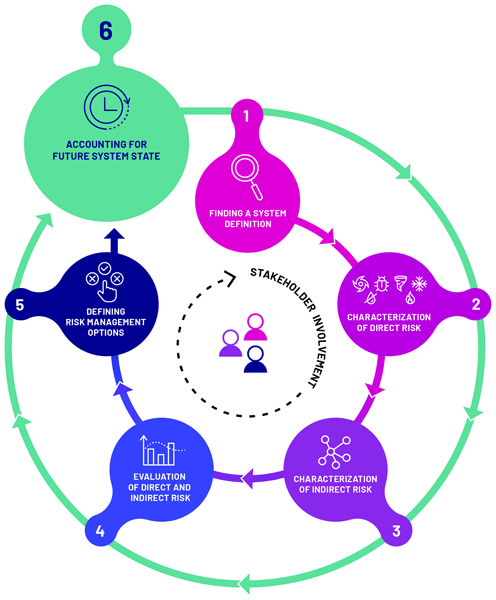
The framework was built on the concept of dependencies, which enabled the conceptualisation of single to multi-risks within a risk continuum. From a research perspective, it had the additional benefit that direct risks (e.g. due to the hazards themselves) and indirect risks (e.g, follow-on consequences and cascading effects) could be further integrated to provide a comprehensive picture of impacts for different stakeholders.
Following the workshop, the prototype framework was revised into our initial six-step framework (Hochrainer-Stigler et al., 2023), which is summarised in Fig. 1. Each step is accompanied by a “guidance protocol”, which is essentially a set of questions to be asked when working through a specific step of the framework.
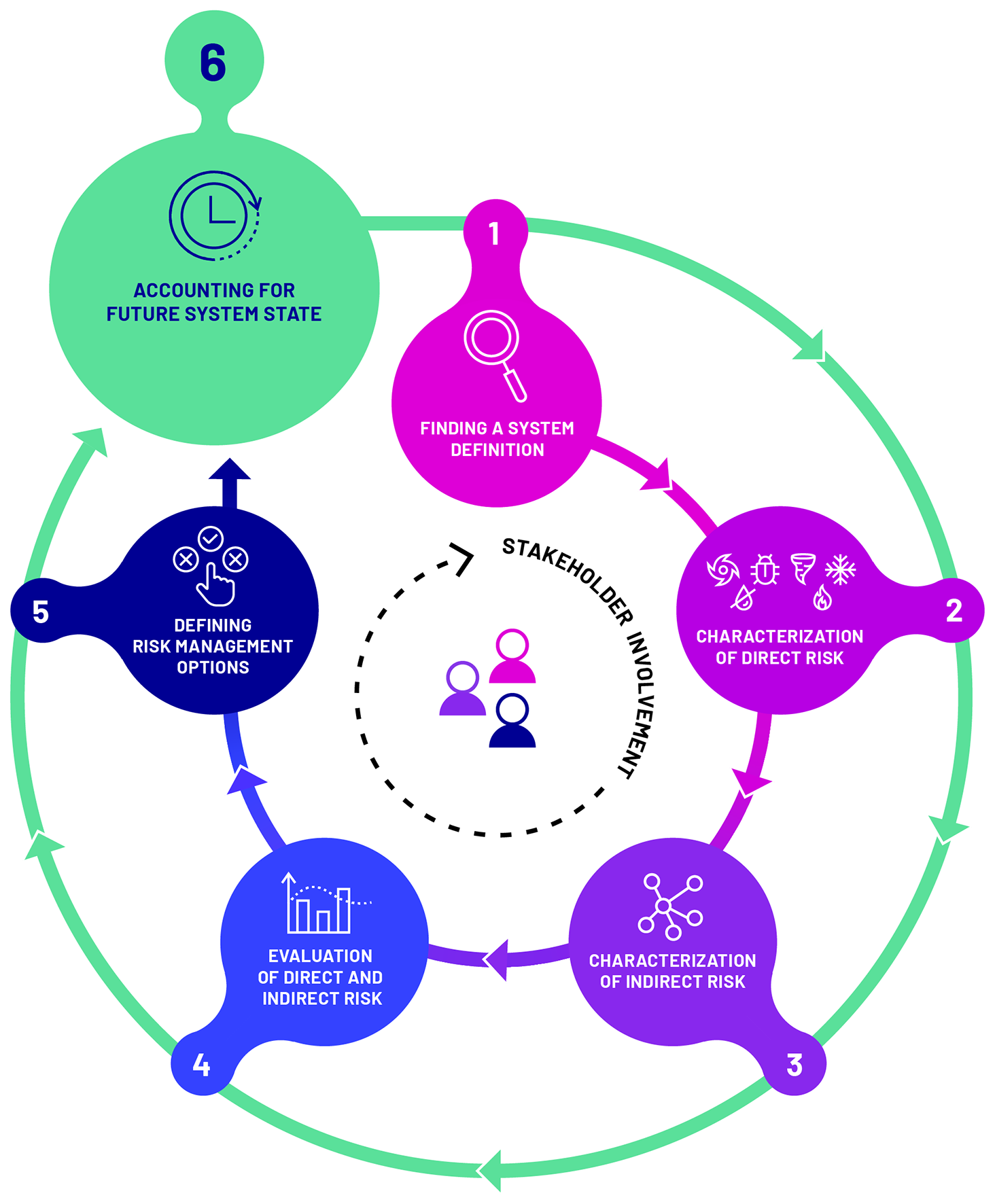
Figure 1The MYRIAD-EU six-step framework for individual, multi-, and systemic risk analysis and management (simplified figure adapted from Hochrainer-Stigler et al., 2023, CC BY 4.0).
This initial framework was then iteratively tested within the five Pilot studies. In practice, the framework was used to provide a “frame one can work with”, using a system-of-systems approach based on boundary concepts. In this way, the different stakeholders involved could identify elements that belong to their “system” (e.g. political boundaries, business models or sectoral aspects), including resources and instruments in their repertoire to deal with current and emerging risks. By doing this, it was also possible to concretely identify gaps as well as opportunities between different systems, such as governments, insurers or households, and the respective roles they could play in managing risk. The system boundaries concept was also useful with regards to policy-making processes. Policies are often related to specific goals that are designed for specific single hazards or risk situations and can be brought together through a step-by-step approach that is in its essence, a co-production process (Hochrainer-Stigler et al., 2023). Indeed, the framework itself provides a clear structure on how single as well as multi-risks can be thought of simultaneously with increasing complexity, therefore making it possible to develop multi-risk management strategies for current and future risks that were further developed within the Dynamic Adaptive Policy Pathways – Multi Risk (DAPP-MR) approach discussed in Sect. 2.5.
The main learnings from the implementation in the Pilots show that its structured, six-step design effectively supported users in navigating the complexity of multi-risk assessment. In MYRIAD-EU, the framework was applied at diverse geographical scales, from local to multinational, demonstrating its flexibility. Pilots found that the framework promoted systems thinking and enabled a more holistic understanding of interdependencies across hazards, sectors, and governance levels. Its flexible and non-prescriptive nature allowed for adaptation to diverse regional contexts, facilitating tailored approaches to risk analysis and stakeholder engagement. Importantly, the framework helped clarify DRM processes in the regions, supported the integration of direct and indirect risks, and fostered more meaningful dialogue with stakeholders by serving as a shared reference point throughout the process.
In order to make the framework more accessible, we have developed an online dashboard (https://dashboard.myriadproject.eu/, last access: 18 February 2026), to help users to understand and navigate it. The dashboard contains the guidance protocols to carry out each of the six steps, provides examples of how the framework has been implemented in five Pilot regions, and examples of tools and methods that can be used to carry out the analysis within each step. The framework is now being used beyond the initial project. For example, the framework and/or parts of its steps are being used in EU-projects such as DIRECTED, CLIMAAX, and P2R.
2.3 Increasing understanding of dynamic feedbacks between hazard, exposure, and vulnerability
We developed a range of methods to increase our understanding of dynamic feedbacks between hazard, exposure, and vulnerability. These are brought together in the MYRIAD-EU Metadatabase for Dynamics of Risk Drivers (Stolte et al., 2025). This online metadatabase provides a structured catalogue of empirically grounded methods and datasets, developed both within and beyond the MYRIAD-EU project, to assess evolving risk patterns and feedbacks across spatial and temporal scales. We identify four key themes of methods developed within the MYRIAD-EU project: (1) multi-hazard dynamic footprints and susceptibility maps; (2) time-dependent intensity-damage functions; (3) vulnerability indicators; and (4) exposure as a function of time since a previous hazard. A synthesis of the key methods developed along each of these themes is provided below.
In terms of multi-hazard dynamic footprints and susceptibility maps, we show that unsupervised machine learning, specifically DBSCAN, can create spatiotemporal footprints of multi-hazard events/clusters and extract information on the single and multi-hazard event duration, intensity, extension, and seasonality under current and future conditions (Ferrario et al., 2025a). Furthermore, we developed a global framework for multi-hazard susceptibility mapping using deep learning, applying it to Japan (Tiggeloven et al., 2025b) and the Veneto region (Ferrario et al., 2025b). These susceptibility maps show spatial representations of the likelihood of specific hazards (such as landslides or floods) occurring in different geographic areas, trained on historical hazard-influencing factors such as topography, geology, hydrology, land use, and vegetation. They can provide practitioners with spatial tools to identify hotspots over time where multiple hazards occur (Tiggeloven et al., 2025b). Building on this foundation, our review of AI applications across all four pillars of the Early Warning for All (EW4ALL) framework reveals significant opportunities to enhance the effectiveness of early warning systems, while also identifying critical gaps in knowledge, application, and policy that must be addressed for responsible implementation (Tiggeloven et al., 2025c).
In terms of time-dependent intensity-damage functions, we identified and analysed impacts from single-hazard and multi-hazard events in the global emergency events database EM-DAT to understand potential differences in impacts due to multi-hazard dynamics. The results indicate that whether or not multi-hazard impacts are different to the sum of single-hazard impacts depends on the type of hazard as well as on the type of impact (Jäger et al., 2025).
A follow-up study, using machine learning and explainable AI techniques on compound flood events in Europe, showed that a higher number of co-occurring hazards significantly amplifies damages, particularly in vulnerable regions (Ronco et al., 2025). Machine learning and explainable AI approaches can help to enable the operationalisation of these complex, non-linear relationships by capturing dynamic interactions between hazards and evolving impacts (Dal Barco et al., 2024, 2025; Nguyen et al., 2026); however, we propose guiding questions for responsible AI before making such models operational (Tiggeloven et al., 2025c). Further, we demonstrate that risk components vary spatially and temporally, and that identical hazard intensities can produce different impacts depending on multi-hazard conditions (De Polt et al., 2025a), the timeframe that is being assessed (De Polt et al., 2023), or dynamic vulnerability changes (Schlumberger et al., 2026). Developing such hazard(s)-impact relationships ensures more informed relationships to set warning criteria and input for risk assessments. More broadly, a better understanding of dynamic feedback of risk drivers allows practitioners to make more informed decisions and design more effective DRM measures (de Ruiter et al., 2020).
While ML, AI, and data-driven approaches may offer significant potential for multi-hazard risk assessment, their effectiveness is fundamentally constrained by data availability and quality. For example, there are limitations for ML and AI usage in data scarce regions as these regions may encounter insufficient historical records and inadequate monitoring networks on which to train models (Tiggeloven et al., 2025c), which may produce biased models that perform poorly for rare but catastrophic events. This may create concerning disparities where technological advances may worsen rather than reduce existing warning system inequalities (e.g., language and data availability), with regions most affected by the digital divide receiving the least research attention. To address these gaps, we should both advance novel methodological approaches, such as physics-informed models, data augmentation, and transfer learning, and also propose explicit guardrails around explainability, accountability, and the integration of local knowledge to ensure that ML applications remain people-centred and equitable (Tiggeloven et al., 2025c).
The need for more qualitative approaches was underscored by our stakeholder interviews across the five Pilots (van Maanen et al., 2025), which showed rich contextual evidence of dynamic changes in vulnerability and exposure, shaped by climate change, governance structures, and socio-economic shifts, which would be difficult to capture using conventional assessments. In this sense, disaster forensic studies (UNDRR, 2024), which examine systemic root causes rather than immediate impacts, can also be useful. We applied the paired-events disaster forensics method of Kreibich et al. (2017, 2022) to examine multi-hazard and multi-risk dynamics across 57 multi-hazard events, bringing together over 150 experts globally, the results of which and accompanying database will be published in a forthcoming paper (Sakic Trogrlic et al., 2025).
In terms of vulnerability indicators, we show that vulnerability to multi-hazards is unequally distributed around the world, with socioeconomic conditions, such as human development index, political stability, and distance to healthcare, playing a critical role (Tiggeloven et al., 2025d). Stolte et al. (2024) designed VulneraCity, a database of 1460 vulnerability drivers from over 400 papers. By analysing these drivers, we highlight the complexity of interactions among risk components in multi-risk settings, and identify six types of directional dynamics that challenge the assumption that vulnerability can be adequately captured through static, generalisable indicators. In the context of flood risk research, we further investigated how different assessment methods are used to capture different types of dynamics, considering different temporal focus, dimensions of vulnerability, and sources of data used (Schlumberger et al., 2026). Our stakeholder interviews across the Pilot regions reinforce the need for vulnerability assessment and management approaches that are sensitive to local conditions and hazard-specific dynamics (van Maanen et al., 2025).
We highlight that a lack of recovery between events can erode a society's ability to prepare for, cope with, and recover from new disasters, potentially significantly prolonging recovery trajectories (Buijs et al., 2025). In terms of exposure as a function of time since a previous hazard, Buijs et al. (2023) use nighttime light satellite data to compare general trends in impacts and recovery for single and multi-hazard events on a global scale. This showcases the potential of Earth Observation data as a valuable tool for tracking dynamic processes like recovery over time in multi-risk contexts, helping to identify where resilience is being impaired between events, which is something that should be further explored to support timely and data-driven interventions (Van Maanen et al., 2024).
2.4 Developing future scenarios of plausible multi-hazard and multi-risk
As identified in Ward et al. (2022), many datasets, papers and tools exist for analysing current and future single hazards. In MYRIAD-EU, we observed a lack of multi-hazard scenarios, methods to evaluate their direct and indirect risk, and user-friendly software to evaluate such scenarios and risks. Within the project's efforts to establish a common set of multi-risk definitions (Sect. 2.1), we distinguish between current scenarios (based on historical or present-day data) and future scenarios (which also incorporate projected climate metrics) (Gill et al., 2022). These scenarios support understanding and communication of risk and can take various forms such as historical data, probabilistic indicators, or storylines.
While Ward et al. (2022) called for future scenarios of plausible multi-hazards, our early discussions with stakeholders in the Pilots revealed that the understanding of current multi-hazard events remains very limited, with no widely applicable event sets beyond case studies. To address this gap, we developed the MYRIAD-Hazard Event Set Algorithm (MYRIAD-HESA) (Claassen et al., 2023), which compiles single-hazard footprints into multi-hazard event sets based on their spatial and temporal overlap. Using eleven hazard types, we created the first global multi-hazard event set database, enabling the identification of hotspots, frequent hazard pairs such as heatwave-drought and cyclone-flood, and more complex groups like multiple earthquakes followed by tsunamis and landslides. While the dataset we compiled with MYRIAD-HESA has global coverage, it is limited by data availability, as global datasets may miss small local events or regions with incomplete hazard records. This can be addressed through the open-source nature of MYRIAD-HESA, which allows users to integrate higher-resolution local data and update results as data quality improves with future innovations.
MYRIAD-HESA shows us what has happened in the past, however, methods are also required to evaluate what could happen in the future. Within MYRIAD-EU this is achieved through the use of stochastic data and storylines. Stochastic data are plausible events based on the statistical properties of historic observations. Within MYRIAD-EU, we developed a stochastic earthquake set for Europe (Schaefer et al., 2022). We also developed MYRIAD-SIM, a weather generator that simulates extreme variables while preserving their dependencies using copulas (Claassen et al., 2025a), and VineCopulas (Claassen et al., 2025b), an open-source Python package for vine copula modelling. MYRIAD-SIM was used to evaluate the likelihood of high impact multi-hazard extreme weather events, such as the occurrence of multiple storms in close succession. The results show that while some multi-hazard events are rare, they may reach higher intensities than those observed historically, meaning they may pose greater risks than suggested by past records alone. To complement such probabilistic approaches, multi-hazard and multi-risk storylines offer an alternative by focusing on plausibility rather than probability, building on the concept of climate storylines (e.g. Shepherd et al., 2018; Sillmann et al., 2021). MYRIAD-EU has developed an approach to storylines that explores cause-and-effect relationships in multi-hazard and multi-risk systems (Crummy et al., 2025). Drawing on past events for context, MYRIAD-EU explored the application of storylines to support multi-hazard decision-making through co-creation and iterative exploration (Crummy et al., 2025; Casartelli et al., 2025b). This approach supports understanding of complex events and the development of forward-looking decision pathways in the Pilot regions (Sect. 2.4 and 2.5). The development of storylines supports a holistic examination of cascading effects, critical thresholds and emerging risks (Cocuccioni et al., 2025).
Within MYRIAD-EU, we also studied indirect impacts, such as disrupted supply chains that cause economic losses for businesses outside the hazard zone, and showed that indirect impacts strongly affect the overall impacts of hazard events by evaluating common sets of hazard events across macro-economic models (IIASA-ABM (Poledna et al., 2023), GRACE (Aaheim et al., 2018), and MRIA (Koks and Thissen, 2016). Through the examination of specific scenarios like the Danube Region's earthquake and flood events, and the Scandinavia region's heat, drought, and wildfire events, we demonstrate that indirect impacts can influence regional and sectoral economies in ways not immediately apparent from direct damage assessments alone. Our results reveal that regions not directly affected by a hazard event can both benefit from shifting demand and increased economic activity due to reconstruction efforts as well as suffer from missing inputs produced in affected regions (Ducros et al., 2025). However, the magnitude of the both indirect and total impacts varies strongly across modelling approaches.
To complement the varying modelling approaches and make multi-hazard and multi-risk scenarios more accessible to a broader audience, a user-friendly online software has been developed (https://www.myriad-multirisk.eu/, last access: 9 March 2026). The MYRIAD-EU Software combines a range of different data into one place, such as vulnerability curves for different hazards, and both current and future hazard exposure data in the exposure at risk explorer. A key learning from the development of multi-hazard and multi-risk scenarios was that different sectors require different risk metrics. Therefore, the software provides multiple exposure indicators such as GDP, population, and tourism expenditure, allowing sector-specific assessment of multi-hazards and multi-risk. The software is open-source, available online for anyone to use, and will continue to be maintained, tested, and further developed beyond the end of the project.
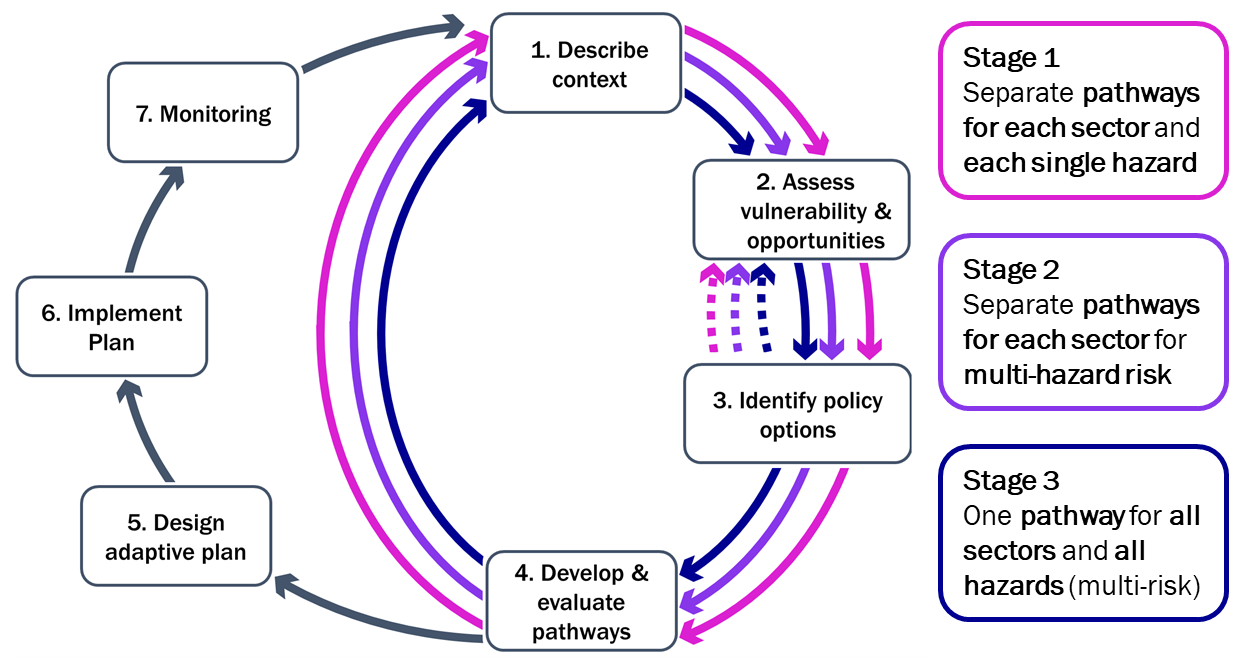
Figure 2The DAPP-MR framework to guide the development and evaluation of pathways with increasing complexity from multi-hazard and multi-sector interactions through time. Source: copied from Schlumberger et al. (2022), CC BY 4.0.
2.5 Assessing the effectiveness of DRM measures across hazards, sectors, and time horizons
Our research agenda stressed the need to account for uncertainty in future changes and cross-sector, multi-hazard interactions in DRM to leverage synergies and avoid trade-offs. It observed a lack of guidance for contexts involving multiple hazards, sectors, and timescales, and identified pathways thinking as a promising foundation for advancing multi-risk policy analysis. As one approach, in MYRIAD-EU we extended the Dynamic Adaptive Policy Pathways (DAPP) into a multi-risk framework (DAPP-MR; Schlumberger et al., 2022).
DAPP-MR guides the evaluation of adaptation pathways under multi-hazard and multi-risk conditions. It systematically considers three themes critical for DRM across multiple hazards, sectors and time: (1) interactions between multiple hazards; (2) sectoral dynamics and interdependencies; and (3) synergies and trade-offs of DRM options across sectors and scales. Building on the MYRIAD-EU framework (Sect. 2.2), DAPP-MR applies systems thinking and introduces complexity stepwise: pathways are first developed per hazard and sector, then multi-hazard effects within sectors are added, before integrating all hazards, sectors, and time dimensions (Fig. 2). A key learning is that while complexity is essential, the process must remain tractable. Iterative integration provides interim results that both inform policy and simplify analysis under more complex dynamics.
2.5.1 Quantitative evaluation of DRM effectiveness
We applied DAPP-MR in a synthetic multi-risk case study (Schlumberger et al., 2024) to evaluate DRM effectiveness quantitatively. The results reveal the difficulty of assessing effectiveness of DRM in multi-risk contexts. Some DRM measures gained new relevance or were conceptualised differently: for example, nature-based flood measures such as extended floodplains also improved groundwater recharge under drought conditions, or restoration of mangroves that contribute to flood protection (Tiggeloven et al., 2026). Interactions between pathways, their timing, and the presence of other DRM measures strongly shaped the exposure and vulnerability and thus ultimately the risk outcomes. Managing risks in isolation risks overestimating measure and pathway performance, but the staged approach highlights pathways that are robust under increasing complexity.
Effective visualisation was found to be critical. Decision support in complex systems requires both data and judgment about which analyses and data matter most (Hadjimichael et al., 2024). To this end, we developed an exploratory pathways dashboard, which enables stakeholders to interactively explore the quantitative data relevant to assess the effectiveness of DRM across sectors, hazards, and time (Schlumberger et al., 2025a).
Beyond the pathways approach, additional approaches have been used to evaluate the effectiveness of DRM measures across hazards, sectors and time quantitatively. For example, in the work mentioned in Sect. 2.3 by De Polt et al. (2023), we developed qualitative impact functions between heat-related hazard intensities and impacts (e.g., fatalities), which show how actions taken by individuals can lower their vulnerability.
2.5.2 Qualitative evaluation of DRM effectiveness
DAPP-MR was also applied qualitatively in four Pilot studies (Gottardo et al., 2025; Schlumberger et al., 2025b). In the North Sea Pilot, a structured interaction matrix assessed sectoral impacts of measures, identifying synergies and trade-offs in their effectiveness across hazards and sectors. This supported evaluation of cross-sectoral versus sectoral optimisation. A similar approach in the Danube Region Pilot focused on timing and coordination between agriculture and shipping, with stakeholders co-developing sectoral pathways simultaneously to discuss synergies and trade-offs and highlighting governance and land-use challenges.
The Scandinavian Pilot adopted a systems-level perspective, facilitating broad, accessible discussions of cross-sector DRM without explicit measure-level analysis. The Canary Islands Pilot used quantitative modelling to link tourism development and water availability, showing how sectoral strategies compounded climate pressures. Visualisation tools enabled exploration of trade-offs and the feasibility of water-saving measures under interaction scenarios, including “what-if” cases where tourism and agriculture were simultaneously strained by limited water supplies during heatwaves.
Across Pilots, DAPP-MR fostered integrated, cross-sectoral thinking and stakeholder dialogue. In the Canary Islands, it helped to structure discussions between stakeholders from the tourism and agriculture sectors, highlighting governance gaps between water planning and risk reduction. In the Danube Region, it helped to improve awareness of interdependencies in a transboundary context. In the North Sea, it helped to initiate new stakeholder networks in a region with limited DRM awareness. Overall, the framework facilitated shared understanding of multi-risk systems and supported solution-oriented dialogues on synergies, trade-offs, and long-term planning. All Pilots demonstrated the value of scenario-based thinking in the evaluation of DRM effectiveness: beyond climate scenarios, they incorporated dimensions such as social perceptions (Scandinavia), spatial planning (North Sea, Scandinavia), external decision-making (Canary Islands), and socio-economic uncertainty (Danube Region) to identify DRM options that were either feasible or necessary.
A consistent finding was that building a shared system understanding, including sectors, vulnerabilities, and short- and long-term needs, required significant effort but eased integration of additional complexities (Schlumberger et al., 2025b). In some cases, multi-hazard and multi-risk storylines of past events facilitated this process, improving engagement and integration of uncertainty (Crummy et al., 2025; Casartelli et al., 2025b).
Qualitative evaluation in our Pilots also highlighted challenges. Tracking all interaction effects and trade-offs was difficult without quantification. Still, qualitative analysis often revealed additional measures with strong cross-sector or multi-risk synergies and allowed for a richer characterisation of these interactions. Pilots therefore adopted semi-quantitative criteria to structure DRM evaluation.
Beyond DAPP-MR, we used additional approaches to evaluate the effectiveness of DRM measures across hazards, sectors and time. Multi-hazard and multi-risk storylines (Crummy et al., 2025) were applied in different Pilots primarily with a focus on understanding past events and the effectiveness of DRM measures. Storylines facilitated Pilots to engage with stakeholders on multi-hazard and multi-risk interactions, facilitating discussions on plausible future events and multi-risk decision-making. There is large potential for storylines to be used in practice for supporting development of DRM pathways or the evaluation of DRM effectiveness, which should be explored in future multi-hazard and multi-risk projects. In the Veneto Pilot, the use of storylines to inform multi-risk and cross-sectoral pathways was tested by combining climate storylines with the Peer Review Assessment Framework (PRAF), developed under the Union Civil Protection Mechanism (Casartelli et al., 2025a). The PRAF, which provides a flexible and comprehensive structure spanning the entire DRM cycle, as well as risk governance, risk assessment, and DRM planning, facilitated the identification of multi-hazard and multi-risk pathways, in alignment with existing regional policies and practices. The integration of co-created storylines, projecting a past storm event (the Vaia storm of 2018) 56 years into the future (Vaia 2074) (Casartelli et al., 2025b), enabled the identification of detailed cross-sectoral pathways by adopting an holistic, integrated, and participatory approach.
Beyond the pathways approach, we used additional approaches to evaluate the effectiveness of DRM measures across hazards, sectors and time quantitatively. For example, the disaster forensics study by Sakic Trogrlic et al. (2025) shows how DRM measures taken between paired-events provide evidence of social learning and missed opportunities to learn from past events. Moreover, the work carried out within MYRIAD-EU to develop the VulneraCity database (Stolte et al., 2024) and explore dynamic vulnerability assessment methods (Schlumberger et al., 2026) provides qualitative information on how DRM actions can influence the vulnerability in urban or flood contexts.
2.6 Testing of approaches in in-depth case studies on multi-hazard and multi-risk assessment and management
Our five Pilots tested and refined a diverse set of innovative tools, methods, and approaches that address multi-hazard and multi-risk and multi-sector challenges in DRM in varied geographic and socio-economic contexts, including the aforementioned MYRIAD-EU framework, the DAPP-MR approach, and the other tools and methods described in the preceding sections (Gottardo et al., 2025). Through this process, all five Pilots came across the following challenges: (1) limited cooperation between institutions (government authorities, public agencies, private entities) within and across countries and sectors; (2) limited stakeholder awareness and engagement, mainly due to capacity constraints; (3) limited data availability and quality, along with limited understanding of climate and non-climate risk components and their interactions; and (4) complexity of the system (multi-risk, dynamic risk, multi-sector, multi-scale).
Despite these challenges, the Pilots built a solid stakeholder network and co-developed multi-hazard and multi-risk pathways relevant for local and regional as well as national and international actors. Based on this experience, it is possible to draw a set of key learnings for researchers and experts:
-
Stakeholders need to be involved in the co-development process from the early stages of any research project. A relevant group of stakeholders includes government and public agencies, research and academia, as well as representatives of the private sector and the civil society (specific business operators, municipalities and citizens). Stakeholders should also be selected with knowledge and/or responsibilities across hazards, sectors, scales and countries. Their involvement from the early stages ensures that research results meet their needs and are actionable. Diversifying the engagement fosters participation and exchange (through, for example, workshops, webinars, interviews).
-
An effective communication is key to ensure alignment between project objectives and stakeholder expectations. It is important that researchers and experts raise awareness about the current and future risks in the region and honestly communicate what can be done and what cannot be done with the available methods and tools as well as the associated uncertainties. Results need to be understandable, usable, and tailored to the specific needs of the involved stakeholders.
-
A “one-size-fits-all” approach is not suitable and should not be applied at any level (transnational, national, local, sectoral). Every region in Europe faces different challenges, which depend on factors such as scale, relevant hazards, relevant sectors, governance landscape, financial capacity, therefore a tailored range of solutions in terms of methods and tools should be offered. In MYRIAD-EU, using combined quantitative and qualitative methods has proven to be crucial in disentangling complexities, filling in any existing gaps in knowledge, and communicating the results to the involved stakeholders.
-
Multiple data sources (e.g., from in situ to Earth Observation-based) should be considered and integrated in applications to increase data availability and quality.
We have also drawn key learnings for government and public agencies, which, if implemented, could facilitate the replicability and upscaling of MYRIAD-EU research outcomes:
-
Apply multi-criteria decision-making in policy design and DRM or adaptation planning. Governments and public agencies should move beyond relying on single indicators, such as effectiveness or cost-efficiency and incorporate additional decision-making criteria, such as long-term resilience, sustainability, spatial equity, and risk tolerance, when evaluating policy options and DRM or adaptation pathways. This ensures more robust, transparent, and context-sensitive choices that reflect diverse stakeholder priorities and system trade-offs.
-
Support the mapping of institutional roles and governance responsibilities at the onset of any collaborative initiative. Governments and public agencies should support partnerships in mapping existing institutional frameworks, decision-making levels, and governance arrangements at the relevant supra-national, national, regional, or local level. This helps to clarify mandates, prevent overlaps or gaps, and align new actions with existing structures, particularly in complex or multi-jurisdictional contexts.
-
Create or strengthen existing cross-sector, multi-level coordination mechanisms. Permanent coordination bodies initiated by public authorities to facilitate alignment across sectors (e.g. water, agriculture, tourism, energy, forestry) and governance levels (municipal, regional, national) can support a more integrated approach on future DRM and climate change adaptation. These may include interdepartmental working groups, joint planning platforms, or shared data systems to enhance coherence in climate adaptation and risk governance strategies.
-
Recognise and engage informal and non-state stakeholders in governance processes. Formally, recognise roles of non-state actors, such as private water associations, as key contributors to an increasingly complex risk governance landscape. Develop inclusive engagement strategies that bring these stakeholders into planning and decision-making processes from the outset, thereby increasing policy legitimacy, ownership, and effectiveness.
-
Align policy objectives across sectors to enhance coherence and avoid contradictions. Develop, review, and revise sectoral policies considering interdependencies between sectors (or policy areas) and to ensure consistency between climate adaptation, disaster risk reduction, and sustainable development goals. Use scenario-based planning approaches to identify potential policy trade-offs and facilitate inter-ministerial coordination to promote coherent, system-wide resilience strategies (e.g., via a designated network of senior level servants attached to each sector or policy area).
We also reflected on the potential transferability and upscaling of the MYRIAD-EU approach beyond our Pilot regions. Although the Pilot studies were embedded in European governance, socio-economic, and environmental settings, the project's methodological foundations, such as the framework, DAPP-MR, Collaborative Systems Analysis, storylines, and mixed qualitative-quantitative tools, were intentionally designed to be generic, modular, and scalable. Across the five Pilots, these approaches proved effective in very different “riskscapes”, ranging from offshore energy-ecology conflicting priorities (North Sea), insular drought–tourism trade-offs (Canary Islands), high-latitude forest-energy interactions (Scandinavia), transboundary river-basin risks (Danube), and mountainous-coastal compound climate hazards (Veneto). This diversity demonstrates that the MYRIAD-EU approach is not culturally or geographically bound to Europe, but instead focuses on systemic interdependencies, cross-sectoral dynamics, and long-term adaptive decision-making, factors relevant to multi-hazard environments globally.
However, governance complexity emerged as a shared barrier across all Pilots, even though European institutions tend to have stronger coordination architectures than many regions globally (European Commission, 2025b). This implies that approaches relying heavily on inter-agency collaboration, participatory co-production, or transboundary governance (e.g.,North Sea or Danube Pilots) may require significant tailoring where institutional capacity is low or where informal systems dominate risk management. Similarly, the Canary Islands Pilot highlighted how deeply rooted socio-economic lock-ins, such as tourism dependency or water governance fragmentation, shape feasible pathways; these dynamics may be even more pronounced in Small Island Developing States (SIDS) or rapidly urbanising coastal regions, requiring customised scenario design and stakeholder engagement processes.
Nevertheless, regions facing complex and competing uses of maritime space are reasonable candidates for the transferability of the North Sea Pilot approach: relevant examples are the Baltic Sea, characterised by high density of activities, including fisheries, shipping and offshore wind, and the Mediterranean Sea, which faces similar intense shipping and fisheries, whilst also serving as a key area for regional tourism. Likewise, high-latitude forested regions in Europe, Canada or Northern Russia, experience interacting hazards including heatwaves, droughts, wildfires, and forest diseases making them well aligned with the insights generated in the Scandinavia Pilot on cross-sectoral energy-ecosystem interactions and climate-sensitive resource management. The Canary Islands Pilot, analysing multi-risk dynamics by shaping the systemic vulnerability of tourism destinations in a context of climate-driven, volcanic, and seismic risk, offers valuable insights for many Mediterranean as well as Pacific or Caribbean Islands regions, but also tourism-dependent regions exposed to multi-risks. The Danube Pilot results also have potential for transferability to other river basins exposed to multi-risks, sharing complex interdependencies between sectors, and displaying cross-border governance structures – conditions shared by basins such as the Rhine, Po, or Tisa. Finally, the mixed-method approach used in the Veneto Pilot, combining results from AI-based models with storylines to generate plausible future scenarios and multi-risk pathways, can serve as a model for various densely populated, heavily exploited territories exposed to multiple climate-driven hazards. However, in each of these settings, applying MYRIAD-EU methods demands contextual calibration of hazard data, governance arrangements, socio-economic drivers, and sectoral interdependencies. Thus, while the project offers a coherent transferable framework, the pathways themselves are not exportable “templates”: they require localised tailoring to reflect different institutional capacities, cultural norms, risk perceptions, and resource regimes.
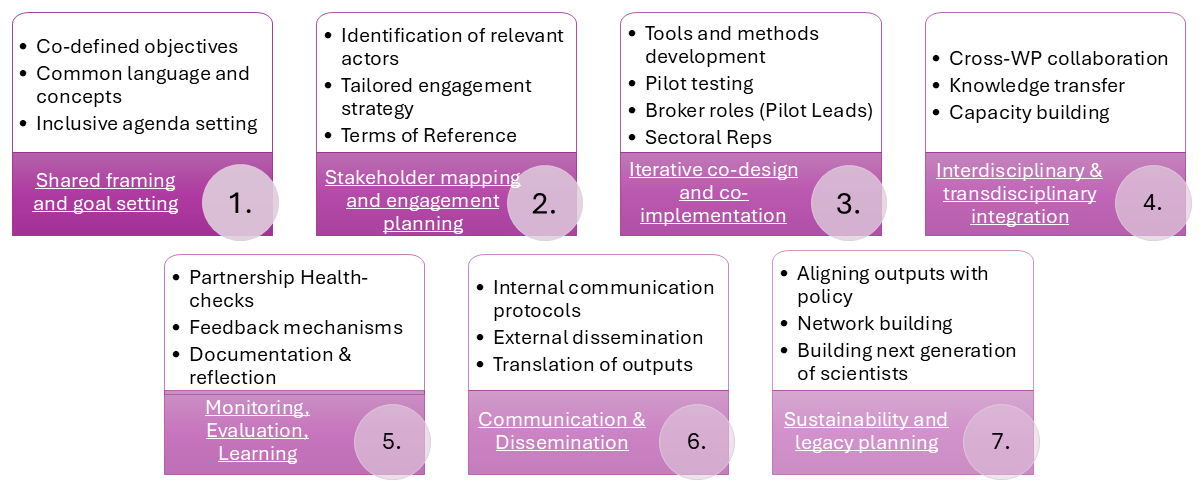
Figure 3Seven key elements of the co-development process in MYRIAD-EU. British Geological Survey © UKRI 2025.
2.7 Additional key findings
2.7.1 Knowledge co-production
The co-production process in MYRIAD-EU was both a methodological foundation and a practical challenge, shaping the development and implementation of multi-hazard and multi-risk approaches across the project. A more detailed analysis of the co-production methodology and outcomes will be presented in a separate manuscript (building on Ciurean, 2025), this section synthesises key learnings relevant to the broader MYRIAD-EU research agenda. Figure 3 illustrates the seven key elements of the knowledge co-production process in MYRIAD-EU.
Co-production was central to MYRIAD-EU's work packages and Pilots, enabling the integration of scientific and stakeholder knowledge in the development of frameworks, tools, and decision-support approaches. Before the co-development of any of these, MYRIAD-EU initiated the co-production process within the consortium with the development of the Handbook (Gill et al., 2022). This early effort underscored the challenge of establishing a shared understanding of key concepts and terminology across disciplines early on, while also recognising and integrating the diverse knowledge and perspectives within the partnership.
Co-production was then key to developing the frameworks, tools, and decision-support approaches. For instance, in the creation and iterative updating of the MYRIAD-EU framework, co-production enabled a deeper understanding of the complex hazard interrelationships among stakeholders. This was important for defining system boundaries and recognising how dependencies between hazards and elements at risk could influence components both within and beyond the system. Similarly, the co-production process underpinned the development of the multi-hazard and multi-risk software, underscoring the importance of early engagement with end-users during scenario design. By integrating stakeholder input, particularly from the finance and tourism sectors, the scenarios were more effectively contextualised and tailored to local decision-making needs.
The co-production approach also played a key role in fostering knowledge exchange and in shaping both bottom-up and top-down strategies for multi-hazard and multi-risk assessment and management. Specifically, it ensured that the diverse insights, resources, and instruments available across different sub-systems were acknowledged and incorporated into an integrated strategy, i.e., one that enhances synergies and reduces asynergies.
Pilots showed that early and continuous stakeholder involvement was essential for tailoring outputs to local needs. Co-production helped translate complex scientific concepts into actionable insights, such as through the use of storylines, dashboards, and sector-specific scenarios. The process fostered mutual learning and built trust, but also required significant facilitation effort and time investment, particularly from Pilot Leads who often acted as knowledge brokers, translating between technical teams and stakeholders. While this approach was largely successful, it underscored the importance of capacity-building and the need for more direct interaction between tool developers and end-users, which is often difficult to achieve in large-scale complex projects.
The co-production process supported cross-sectoral dialogue and helped identify governance gaps, particularly in transboundary and multi-level contexts; it also contributed to mapping the knowledge on multi-risk governance and decision-making processes early in the project. Stakeholders valued the opportunity to shape research outputs and saw potential for uptake in policy processes, especially where tools were co-developed with local actors. However, feedback also pointed to the need for clearer pathways to impact, including targeted dissemination to decision-makers and practical examples of tool application. Future projects should consider integrating co-production strategies from the proposal stage, incorporating clear mechanisms to ensure sustainable exploitation and lasting impact beyond the project's lifetime.
MYRIAD-EU's experience reinforces that co-production is not a one-size-fits-all process. It evolved differently across Pilots, shaped by local contexts, stakeholder networks, and thematic priorities. Key enabling factors included a culture of openness, iterative feedback loops, and the use of participatory formats such as focus groups and workshops that were followed by an evaluation of the engagement. Challenges included managing expectations, navigating disciplinary boundaries, and sustaining stakeholder engagement over time. The project's evaluation (externally, via stakeholder surveys, and internally, via partnership health-check forms) showed generally high satisfaction with the interaction and collaboration processes, but also identified areas for improvement, as indicated above. Overall, MYRIAD-EU demonstrates that knowledge co-production strengthens the relevance, usability, and legitimacy of multi-hazard and multi-risk research. However, it requires dedicated resources, skilled facilitation, and strong commitment to shared learning.
2.7.2 Early Career Researcher Empowerment
Early Career Researchers (ECRs) were key contributors to the advances and research outcomes of the MYRIAD-EU project. From the proposal phase, there was a strong commitment to providing means of empowerment of ECRs directly within the project's structure. This was especially important since approximately 30 % of the entire consortium consisted of ECRs. One of the main structural components was the implementation of the Early Career Researcher Board (ECRB), which operated in terms of 2 consecutive years, enabling a number of ECRs to participate throughout the project's lifetime. The board had several tasks, including the organisation of ECR-centred formal and informal gatherings and ensuring the ECRs in the project were informed about any information relevant to them. A core component of the ECRB was the elected Early Career Representative, who was a full member of the project's Management Team (MT), providing an opportunity to directly relate ideas, updates, and concerns from the ECRs within the project.
We observed that the broad network formed within the large MYRIAD-EU consortium supports and advances inter- and intra-disciplinary collaborations, as well as connections between different sectors. ECRs were able to benefit from this network through repeated interactions with, and mentorship from, senior colleagues who spanned these breadths. Access to these broad professional networks served as a valuable resource for ECRs within the project, contributing to their own professional development and the project's research goals.
The experiences of MYRIAD-EU ECRs, as well as senior members of the consortium, provided input for a broader analysis that identified three key enabling factors and examples of empowerment of ECRs (Schlumberger et al., 2025c). These activities fell into three main categories: (1) structural involvement in project management; (2) organisation of events for ECRs – together with ECRs; and (3) forming networks beyond their own work. The investigation also highlighted three essential enabling factors that support an empowering and encouraging environment: (1) direct influences and advisory support; (2) agency of ECRs to enable action; and (3) external factors in the project context.
Both internal and external (e.g., external advisory board and project review board) feedback confirmed that ECR engagement and empowerment to be a key strength of the project. MYRIAD-EUs experience demonstrates that through integrating ECR empowerment into the structure, activities, and networks results in lasting benefits for the ECRs and the projects themselves.
2.7.3 Policy and practice implications
The key learnings described in this paper help to address the urgent call of the Sendai Framework MTR to “… adopt multi-hazard risk reduction approaches that address all risks at source before they manifest as shocks or disasters …” (UNDRR, 2023, p. 23). A specific contribution to global scale policy has been through the contribution to the updated HIPS (UNDRR and ISC, 2025; Gill et al., 2025). At EU level, tools developed in MYRIAD-EU to disentangle the contribution of different hazards to overall impact (Jäger et al., 2025) and MYRIAD-HESA (Claassen et al., 2023) are being used in several collaborative studies between the consortium and the EU Joint Research Centre, for example to explore vulnerability dynamics associated with compound flood impacts across European regions (Ronco et al., 2025). The MYRIAD-EU framework was identified as a useful approach for assessing risk throughout Europe in the EU Climate Risk Assessment (EUCRA) report (EEA, 2024). Through the Pilots work, policy impacts have been made at regional to local levels. For example, parts of the MYRIAD-EU framework are now being applied in spin off studies together with municipalities; the Veneto Pilot contributed to the Regional Strategy for Climate Change Adaptation (Veneto region 2024); the Scandinavian Pilot contributed to the risk assessment of the municipality of Bergen; and the Danube Region Pilot is contributing to the Preliminary Flood Risk Assessment in the Danube River Basin report prepared by the International Commission for the Protection of the Danube River (ICPDR), especially its chapter on Supporting Transboundary Activities. This report will form a crucial component of the updated Danube Flood Risk Management Plan (DFMP) scheduled for release in 2027. Finally, through close collaboration with our sectoral representatives, we have developed sectoral briefs that provide stakeholders within these sectors information on how the knowledge developed can be used within their sector (ecosystems & forestry, Cordier and Appulo, 2025; energy, Bulder et al., 2025; finance, Champion and Madappatt, 2025; food & agriculture, Campillo and Gonzalo, 2025; infrastructure & transport, Adesiyun, 2025; tourism, Khazai et al., 2025).
Progress on understanding, assessing, and managing multi-hazard and multi-risk has developed rapidly over the last five years. Within Europe, this is for a large part due to the combined efforts of the projects mentioned in the introduction, as well as numerous projects not mentioned here. Through these projects, a flourishing community of researchers and practitioners has evolved. This is evidenced for example by the rapid growth of the multi-hazards sub-division of the European Geosciences Union (EGU). Launched in 2019, this sub-division hosted five sessions at the EGU General Assembly 2025, making it one of the larger Natural Hazards sub-divisions in terms of sessions. Moreover, the topic is central to many of the Working Groups of the Knowledge Action Network on Emergent Risks and Extreme Events (Risk-KAN). In a collaborative effort between Risk-KAN, NatRiskChange, and MYRIAD-EU, the 3rd International Conference on Natural Hazards and Risks in a Changing World – Addressing Compound and Multi-Hazard Risk (Tiggeloven et al., 2025a) attracted ∼500 abstract submissions from science and practice, highlighting the rapid growth of this field.
This is an encouraging sign for the future, as the topic continues to become even more important in policy and practice. Nevertheless, it remains a relatively young and rapidly developing research field. As such, there are still many avenues for continued scientific development. In this section, we provide a brief perspective on some of these potential avenues, explicitly building on our experiences over the course of the MYRIAD-EU project.
We believe that it is essential to continue the mainstreaming and mutual understanding of concepts and definitions. Over the last years, the concept of “multi-hazards” has begun to filter through to mainstream media reports of several hazards (e.g., BBC, 2024). This is an important development, and ensuring continued attention will require clear concepts and definitions. Building a common understanding across different sectors also requires that terminology can and is effectively translated into other languages, as was demonstrated in Norway. Moving forward, we believe that similar translations would also be useful for other languages, also broadening the reach of mutual understanding of concepts and definitions beyond countries where English is widely spoken. It also requires collective effort from the research community to adopt established terminology or clearly explain why alternative definitions are required, rather than simply defining terms afresh in publications (see Gill et al., 2022). Advancing the contributions and reach of Disaster Risk Gateway would help to amplify terminology and maintain a baseline of understanding across the disaster risk community. With advances in AI/LLM since the wiki was developed, there are opportunities to explore new approaches to enhancing the discovery of information contained within Disaster Risk Gateway. To ensure synergy and mutual understanding between different projects and activities, we feel that project clusters can be beneficial. For example, by creating an informal cluster of projects around multi-hazard and multi-risk, which involved annual meetings at the EGU General Assemblies, several cross-project activities arose during the last couple of years. These include sharing news on each other's newsletters, writing of joint papers, the organisation of a joint ECR-led summer school (the DRM Academy; Gargiulo, 2025), and co-organisation of training sessions at the EGU General Assembly (De Polt et al., 2025b). While this clustering occurred organically, due to the shared ambitions of the various project management teams, more formal clusters can help to reduce this dependency and ensure longer term clustering even when old or new projects come and go. An example is the Societal Resilience Cluster of Projects, part of the Community for European Research and Innovation for Security (CERIS), which takes this role. Through the SRC, a series of cross-project webinars has been developed, policy briefs have been (and are being) developed that synthesise policy recommendations across projects, and a stakeholder hub has been established. To reach audiences outside Europe, the aforementioned Risk-KAN network also has several working groups on topics related to multi-hazard and multi-risk management. These working groups, including their webinars and other events, allow for the transfer of knowledge and networking across the globe, and can play an important role in consolidating the international community working on the topic.
We strongly believe that it is essential to continue developing a strong evidence base of how dynamics in hazard, exposure, and vulnerability in space and time shape multi-risk. Our Metadatabase for Dynamics of Risk Drivers (Stolte et al., 2025) is a first step into the direction of a structured catalogue of empirically grounded methods and data to assess evolving risk patterns and feedback across spatial and temporal scales. We invite the scientific community to actively contribute to the database, in order to share data, methods, and knowledge on this topic. A key direction involves advancing mixed-method approaches to assess dynamics of exposure and vulnerability that integrate quantitative modelling, qualitative stakeholder engagement, and Earth Observation data. Other opportunities include the expansion of disaster forensics studies, and the development of AI- and EO-driven tools to analyse complex multi-hazard-risk relationships and nonlinear dynamics (e.g. Tiggeloven et al., 2025c). These innovations can help overcome the limitations of current static or linear risk models by embracing risk as an emergent, evolving, process shaped by interactions between environmental hazards, social systems, and feedback loops. A richer, context-specific evidence base is also required to demonstrate the value of multi-hazard and multi-risk DRM thinking and planning. For example, historical re-analysis of past events using DAPP-MR or similar frameworks could highlight how different decisions might have improved outcomes – especially when interactions between multiple hazards are involved. Similarly, the storyline approach proved effective in engaging stakeholders with systemic risk thinking, serving as a successful conversation starter and entry activity, and offers potential for further development in the multi-risk setting. Recent years have also seen an expansion of the concept of multi-hazard and multi-risk by including disease outbreaks and health impacts as these have a strong link to risk dynamics of space and time (Sairam and de Ruiter, 2026; UNDRR, 2022).
Despite progress over the last five years, from both within and outside MYRIAD-EU, we still note that there is a large need for further developing methods for providing both current and future multi-hazard and multi-risk scenarios. Within MYRIAD-EU, different tools and datasets were introduced, such as MYRIAD-HESA, MYRIAD-SIM, susceptibility maps, and the multi-hazard and multi-risk software. Future research can build on these tools by expanding the breadth of the multi-hazard scenarios, for example, extending the simulated data in MYRIAD-SIM and the software with more stochastic hazards, such as landslides, volcanic eruptions, and tsunamis. This would allow for a broader exploration of hazard interrelations. Additionally, these tools could be further expanded through the inclusion of climate projections, as we showed in the Veneto Pilot for future scenarios of multi-hazard susceptibility. It is important to note that some of the methods developed within the project, such as MYRIAD-HESA (Claassen et al., 2023), have already been applied at the global scale, while others have been applied in regions outside Europe, such as the multi-hazard susceptibility mapping of Tiggeloven et al. (2025b). However, testing and application of more of the methods in non-European settings are important future research avenues. Another key finding within MYRIAD-EU was the need for a larger scale macro-economic intercomparison project to help unpack the uncertainties associated with current modelling practices related to indirect risks, offering insights into the variability of outcomes and their implications for policy decisions. By integrating an array of models, more reliable ensemble estimates of indirect impacts could be obtained, enhancing confidence in projections used for climate risk assessments and policy planning. This collaboration would refine the quantification of indirect impacts and deepen understanding of their systemic nature across socio-economic contexts and geographic scales. Within MYRIAD-EU an initial workshop was organised to kick off this large scale macro-economic model intercomparison project. During the workshop the initial set of experiments for the macro-economic model intercomparison (macroMIP) was agreed upon, refined into a formal experiment protocol in online follow up meetings. Future experiments are intended to incorporate expected forcings under climate change based on output from global-scale impact models organised within the Inter-Sectoral Impact Model Intercomparison Project (ISIMIP).
Our experience through MYRIAD-EU shows that effective DRM evaluation in multi-risk settings depends on the availability of appropriate, solutions-oriented, usable tools. To inform the assessment of DRM effectiveness qualitatively or quantitatively, relevant tools need to strike a balance between completeness and accuracy on the one hand, and accessibility and complementarity on the other hand. MYRIAD-EU brought forward a suite of powerful methods and tools for the assessment of aspects of multi-risk that are relevant to be understood for DRM decision-making. They were developed and tested in parallel to the work in the Pilots to develop and evaluate forward-looking DRM pathways and as such there was limited space and time for full alignment. Future efforts could focus on their integration and adding interoperable tools that can address different dimensions of multi-risk complexity relevant for DRM effectiveness. This includes improving usability and accessibility, and also ensuring that outputs of different products are directly usable within an operationalised framework for evaluating DRM options in multi-risk settings. Moreover, the tools developed should be further developed and tested in non-European setttings and contexts. At the same time, there are several factors that could limit direct global transferability and upscaling (Guentchev et al., 2023; Met Office, 2024) and require careful adaptation, such as the need for high-quality, harmonised multi-hazard, exposure, and vulnerability datasets, which are often scarce or uneven outside Europe (Jäger et al., 2025).
As the field of multi-risk begins to mature, it is the strong belief of the MYRIAD-EU consortium that we should more explicitly include equity issues and equitable disaster risk reduction and adaptation, given that vulnerable and marginalised groups are disproportionately affected by the compounding impacts of disasters all around the world, as shown by the global analysis of Tiggeloven et al. (2025d). Within MYRIAD-EU, we carried out a high-level global-scale assessment of the exposure of sexual and gender minorities to flood risk (Mortensen et al., 2025), and stressed the need to explicitly include all minorities in risk assessment and management. Haer and de Ruiter (2024) discuss that equitable adaptation aims to transform how risk is managed. This can be achieved through three aspects: (1) ensuring burdens and benefits of implementing adaptation measures are distributed fairly to those most in need (distributive equitability); (2) make sure that vulnerable groups and minorities are included in and have control over the adaptation decision-making processes (procedural equitability); and (3) addressing the underlying socio-economic inequalities that are the root causes of vulnerability (systemic equitability). By focusing on these aspects, adaptation efforts can prevent multi-hazard events from pushing already vulnerable populations into a vulnerability trap and can create more resilient, socially just outcomes. To support this work, future research requires an even greater emphasis on the social dimensions of risk and vulnerability, and should develop new metrics that measure success in terms of community agency and social cohesion rather than just economic losses, and which account for cultural and geographic differences between regions.
Building on our rich experiences in our Pilot regions, we strongly advocate for projects to continue extensively testing and coproducing multi-hazard and multi-risk knowledge in in-depth case studies to ensure the transferability and scalability beyond isolated case studies or Pilot regions (van Maanen et al., 2025). Firstly, this means continuing the work started through MYRIAD-EU (and related projects) in the existing Pilot regions. Much time and effort has been invested in developing strong relationships and trust with, and among, stakeholders in these regions. As with many projects, being able to push this forward would allow for taking implementation of this knowledge to a next level. Efforts have been made in continuing collaboration with the established stakeholder networks to further promote MYRIAD-EU results within their organisation and inform ongoing and future policy initiatives (e.g. regional climate adaptation plans, national risk assessment guidelines). However, funding mechanisms that allow for (and provide financial resources for) continuation of successful co-production environments would be instrumental in catalysing this but are currently very lacking. Secondly, the approaches tested in the Pilots are considered to be transferable and scalable to other regions in the EU and beyond, provided that they are adapted/tailored to the local contexts. Therefore, the Pilots now can serve as lighthouses for other European regions facing similar challenges and aiming to transition towards integrated, systemic multi-risk assessment and management, such as the EUCRA hotspots. Expanding this work to other regions both within and outside Europe is a key consideration, as transferring knowledge and methodologies to areas with limited or lower-quality data poses significant challenges, as discussed in Sect. 2.6. Variations in data availability and consistency across regions can affect the applicability and reliability of the tools. Some of our methods have, however, already been applied to regions beyond the EU border (e.g., susceptibility maps for Japan) Pilot leads have already initiated projects aimed to upgrade their results or to apply their approaches to other regions or scales (e.g. ECOAMARE, AQUAMAN, EO4MULTIHAZARDS, and collaborations with municipalities to account for context-specific aspects linked to climate adaptation) and will put effort in finding new opportunities for transferability and upscaling in future Horizon Europe calls. In particular, we see an important avenue to be testing the approaches within Global Majority settings.
While it was only a relatively small part of MYRIAD-EU, we would also like to explicitly point to the essential need to more explicitly examine how the multi-hazard and multi-risk tools, methods, and knowledge developed can support the development of Multi-Hazard Early Warning Systems (MHEWS). MHEWS are increasingly recognised as a global priority, as reflected in the Early Warning for All (EW4ALL) initiative launched by the UN Secretary-General in 2022, which aims to achieve universal coverage by 2027. Yet, analysis by Budimir et al. (2025) highlights that much of the current discourse and practice still emphasises “multiple single-hazards” rather than addressing the interrelations between hazards and the dynamics of other risk components. This is not surprising, as the integration of multi-hazard and multi-risk thinking across the four pillars of EW4ALL, namely risk knowledge, forecasting and monitoring, dissemination and communication, and preparedness and response, is inherently challenging because of methodological and practical complexities. For example, building strong risk knowledge requires locally relevant assessments that consider interactions between hazards as well as changing vulnerability patterns within a given multi-hazard scenario. In practice, however, the necessary data, especially detailed and disaggregated information on vulnerability such as age or gender, are often not available, while specifics of vulnerability per hazard type are not considered adequately (Haer and de Ruiter, 2024). In their literature review on the role of AI for EWS, Tiggeloven et al. (2025c), note a similar pattern: even though technologies are rapidly changing and increasingly used, a significant gap exists on the implementation of MHEWS in research papers. Similarly, preparedness and response planning faces similar difficulties, as it must account for the needs of both people and infrastructure under multiple, potentially compounding hazards. A combined tsunami and heatwave event, for instance, may require air-conditioned tsunami shelters and towers, showing how response strategies must address multi-hazards and multi-risk. Furthermore, response options also need to avoid conflicts (i.e., asynergies as defined by de Ruiter et al., 2021) between measures designed for different hazards. In reality, planning is still largely carried out for single hazards in isolation. From a broader governance perspective, effective MHEWS Systems depend on strong collaboration across institutions, sectors, and policy areas. Yet practical experience, including findings from the MYRIAD-EU project (Šakić Trogrlić et al., 2024), shows that achieving such coordination remains a major challenge due to siloed institutional working resulting in a lack of ownership of multi-hazard and multi-risk knowledge. Advances within MYRIAD-EU and related projects demonstrate clear potential to move towards truly multi-risk oriented systems, and especially from a methodological perspective. For example, tools such as MYRIAD-HESA, MYRIAD-SIM, susceptibility maps, and the MYRIAD-EU software support multi-hazard and multi-risk identification as well as the monitoring and forecasting of multi-hazard events across scales. Emerging innovations in artificial intelligence (AI) offer further opportunities. As shown by Reichstein et al. (2025), AI applications can enhance MHEWS, and our review of AI applications across four different pillars of EW4ALL (Tiggeloven et al., 2025c) provides critical insights into how they may contribute to the implementation of MHEWS.
In facilitating progress and innovations in knowledge development and for multi-hazard and multi-risk assessment and management, ECRs and practitioners are a key component for its success. As a consortium, we took concerted efforts to ensure ECR empowerment from the proposal phase, which led to a very strong ECR engagement throughout the project. Therefore, we feel that strengthening opportunities for ECR leadership and empowerment within project structures is essential for research innovation, collaboration, and impact. Reflections on key enabling factors and examples of empowerment (Schlumberger et al., 2025c) highlight the importance of fostering connection amongst ECRs to enhance integration across the consortium and create pathways for future collaboration, which generates impact both within the project and beyond through strengthening networks, advancing methodological innovations, and facilitating project recognition. Structural inclusion of ECRs, for example through involvement of ECRs in the project management team and establishment of an Early Career Researchers Board, provides a space for sharing of needs and opinions in regard to project decision making. The experiences within MYRIAD-EU demonstrate that integrating ECR empowerment and encouragement into the structure, activities, and networks fosters lasting benefits for both the ECRs, the projects themselves, and the broader research community.
No data sets were used in this article.
PJW coordinated and led the writing of the paper. PJW, SLB, RC, JNC, JD, KDP, MD, SG, SH-S, RST, JS, TT, ST, NvM, and AW led or co-led the writing of various (sub-)sections. All authors contributed to the conceptualisation of the paper, to discussions on the content, and the writing and editing of the paper.
At least one of the (co-)authors is a member of the editorial board of Natural Hazards and Earth System Sciences. The peer-review process was guided by an independent editor, and the authors also have no other competing interests to declare.
Publisher's note: Copernicus Publications remains neutral with regard to jurisdictional claims made in the text, published maps, institutional affiliations, or any other geographical representation in this paper. The authors bear the ultimate responsibility for providing appropriate place names. Views expressed in the text are those of the authors and do not necessarily reflect the views of the publisher.
We extend gratitude to all members of the community who have contributed to both formal and informal discussion on the topic of multi-hazard and multi-risk assessment and management. We thank Eric Mortensen and Lars Tierolf for their contributions to this paper.
MYRIAD-EU received funding from the European Union's Horizon 2020 research and innovation programme (grant no. 101003276). The work reflects only the author's view and that the agency is not responsible for any use that may be made of the information it contains.
This paper was edited by Margreth Keiler and reviewed by Alan Tan and Maximillian Van Wyk de Vries.
Aaheim, H. A., Orlov, A., Wei, T., and Glomsrød, S.: GRACE model and applications, CICERO Report, http://hdl.handle.net/11250/2480843, 2018.
Adesiyun, A.: Addressing multi-hazard risk in the transport and infrastructure sector – learnings from the MYRIAD-EU project, MYRIAD-EU Sectoral Brief, Zenodo, https://doi.org/10.5281/zenodo.17787359, 2025.
BBC: Man dies after tree falls on car as Storm Bert sweeps UK, https://www.bbc.com/news/articles/clyg7q6wnwxo (last access: 9 October 2025), 2024.
Budimir, M., Šakić Trogrlić, R., Almeida, C., Arestegui, M., Chuquisengo Vásquez, O., Cisneros, A., Cuba Iriarte, M., Dia, A., Lizon, L., Madueño, G., Ndiaye, A., Ordoñez Caldas, M., Rahman, T., RanaTharu, B., Sall, A., Uprety, D., Anderson, C., and McQuistan, C.: Opportunities and challenges for people-centered multi-hazard early warning systems: Perspectives from the Global South, iScience, 28, 112353, https://doi.org/10.1016/j.isci.2025.112353, 2025.
Buijs, S. L., de Ruiter, M. C., and Ward, P. J.: A continental-scale multi-hazard analysis of economic recovery using nighttime light satellite data, EGU General Assembly 2023, Vienna, Austria, 24–28 Apr 2023, EGU23-717, https://doi.org/10.5194/egusphere-egu23-717, 2023.
Buijs, S. L., Sauer, I. J., Kropf, C. M., Juhel, S., Stalhandske, Z., and De Ruiter, M. C.: Recovery under consecutive disasters: how recovery dynamics shape societal resilience, EGUsphere [preprint], https://doi.org/10.5194/egusphere-2025-3200, 2025.
Bulder, B., Wiggelinkhuizen, E., and Mohanan Nair, J.: Sectoral Brief: Addressing multi-hazard risk in the energy sector, learnings from the MYRIAD-EU project, MYRIAD-EU Sectoral Brief, Zenodo, https://doi.org/10.5281/zenodo.17947317, 2025.
Campillo, C. and Gonzalo, J.: Sectoral Brief: Addressing multi-hazard risk in the food and agriculture sector – learnings from the MYRIAD-EU project, MYRIAD-EU Sectoral Brief, Zenodo, https://doi.org/10.5281/zenodo.17787170, 2025.
Casartelli, V., Salpina, D., Marengo, A., Vivo, G., Sørensen, J., and Mysiak, J.: An innovative framework to conduct peer reviews of disaster risk management capabilities under the Union Civil Protection Mechanism (UCPM), Int. J. Disast. Risk Re., 120, 105350, https://doi.org/10.1016/j.ijdrr.2025.105350, 2025a.
Casartelli, V., Salpina, D., Marengo, A., Ferrario, D. M., Mysiak, J., and Torresan, S.: Back to the future: advancing climate risk assessments with event-based participatory storylines, Climate Risk Management Journal, under review, 2025b.
Champion, A. and Madappatt, N.: Sectoral Brief: Addressing multi-hazard risk in the finance sector – learnings from the MYRIAD-EU project, MYRIAD-EU Sectoral Brief, Zenodo, https://doi.org/10.5281/zenodo.17787018, 2025.
Ciurean, R. L.: Reflections on Stakeholder Engagement, Co-Production Methods, and Knowledge Co-Development in the MYRIAD-EU Project, EGU General Assembly 2025, Vienna, Austria, 27 Apr–2 May 2025, EGU25-21264, https://doi.org/10.5194/egusphere-egu25-21264, 2025.
Claassen, J. N., Ward, P. J., Daniell, J., Koks, E. E., Tiggeloven, T., and de Ruiter, M. C.: A new method to compile global multi-hazard event sets, Sci. Rep., 13, 13808, https://doi.org/10.1038/s41598-023-40400-5, 2023.
Claassen, J. N., Koks, E. E., de Ruiter, M. C., Ward, P. J., and Jäger, W. S.: A Synthetic European Weather Dataset Based on Spatiotemporal Vine Copulas, Scientific Data, 12, 1734, https://doi.org/10.1038/s41597-025-06015-3, 2025a.
Claassen, J. N., Koks, E. E., de Ruiter, M. C., Ward, P. J., and Jäger, W. S.: VineCopulas: an open-source Python package for vine copula modelling. Journal of Open Source Software, 9, 6728, https://doi.org/10.21105/joss.06728, 2025b.
Cocuccioni, S., Pittore, M., Zebisch, M., Schneiderbauer, S., Shepherd, T. G., Casartelli, V., Crummy, J., and Pedde, S.: Risk Storylines: A Community-Led Discussion between Disaster and Climate Science, B. Am. Meteor. Soc., 106, E1717–E1723, https://doi.org/10.1175/BAMS-D-25-0155.1, 2025.
Cordier, E. and Appulo, L.: Sectoral Brief: Addressing linkages between multi-hazard risk and wetlands ecosystems – learnings from the MYRIAD-EU project, MYRIAD-EU Sectoral Brief, Zenodo, https://doi.org/10.5281/zenodo.17947278,2025.
Crummy, J., Banks, V., Ciurean, R., Duncan, M., Smale, L., Daloz, A. S., Ma, L., Casartelli, V., Torresan, S., Stuparu, D., Tatman, S., Geurts, D., Rautenbach, S., Warren, A., Toebrock, L., Šakić Trogrlić, R., Hochrainer-Stigler, S., Padrón Fumero, N., García González, S., and Díaz Pacheco, J.: Online repository of storylines on multi-risk decision-making, Zenodo, https://doi.org/10.5281/zenodo.16366883, 2025.
Dal Barco, M. K., Maraschini, M., Ferrario, D. M., Nguyen, N. D., Vascon, S., Torresan, S., and Critto, A.: A machine learning approach to evaluate coastal risks related to extreme weather events in the Veneto region (Italy), International Journal of Disaster Risk Reduction, 108, 104526, https://doi.org/10.1016/j.ijdrr.2024.104526, 2024.
Dal Barco, M. K., Maraschini, M., Nguyen, N. D., Ferrario, D. M., Rufo, O., Fonseca, H. L., Vascon, S., Torresan, S., and Critto, A: Integrating AI and climate change scenarios for multi-risk assessment in the coastal municipalities of the Veneto region, Sci. Total Environ., 965, 178586, https://doi.org/10.1016/j.scitotenv.2025.178586, 2025.
De Polt, K., Ward, P. J., de Ruiter, M., Bogdanovich, E., Reichstein, M., Frank, D., and Orth, R.: Quantifying impact-relevant heatwave durations, Environ. Res. Lett., 18, 104005, https://doi.org/10.1088/1748-9326/acf05e, 2023.
De Polt, K., Dormann C. F., Ward, P. J., de Ruiter, M. C., Runkle, J. D., Wutzler, T., Reichstein, M., and Orth, R.: Regional Differences in the Impact of Heat and Moisture on Public Health within Europe, ESS Open Archive, https://doi.org/10.22541/essoar.174282873.38972040/v1, 2025a.
De Polt, K., Claassen, J. N., Buijs, S. L., Reluy, N. P., Schlumberger, J., and Ramalingam, N. R.: How can we encourage and empower Early Career Researchers? Reflections on a short course held at EGU 2025, EGU blog, https://blogs.egu.eu/divisions/nh/2025/11/17/how-can-we-encourage-and-empower-early-career-researchers-reflections-on-a-short-course-held-at-egu-2025/ (last access: 27 November 2025), 2025b.
de Ruiter, M., Couasnon, A., Van den Homberg, M. J. C., Daniell, J. E., Gill, J. C., and Ward, P. J.: Why we can no longer ignore consecutive events, Earth's Future, 8, e2019EF001425, https://doi.org/10.1029/2019EF001425, 2020.
de Ruiter, M. C., de Bruijn, J. A., Englhardt, J., Daniell, J. E., de Moel, H., and Ward, P. J.: The asynergies of structural disaster risk reduction measures: Comparing floods and earthquakes, Earth's Future, 9, e2020EF001531, https://doi.org/10.1029/2020EF001531, 2021.
Ducros, G., Tiggeloven, T., Ma, L., Daloz, A. S., Schuhen, N., Claassen, J., and de Ruiter, M. C.: Multi-hazards in Scandinavia: impacts and risks from compound heatwaves, droughts and wildfires, Nat. Hazards Earth Syst. Sci., 25, 4693–4712, https://doi.org/10.5194/nhess-25-4693-2025, 2025.
EEA: European Climate Risk Assessment (EUCRA), European Environment Agency, https://www.eea.europa.eu/en/analysis/publications/european-climate-risk-assessment (last access: 18 February 2026), 2024.
European Commission: Joint communication to the european parliament, the european council, the council, the european economic and social committee and the committee of the regions on the European Preparedness Union Strategy, JOIN(2025) 130 final, European Commission, https://eur-lex.europa.eu/legal-content/EN/TXT/PDF/?uri=CELEX:52023JC0020 (last access: 8 March 2025) , 2025a.
European Commission: Second update on preventing and managing disaster risk in Europe (SWD(2025) 279 final), European Commission, Brussels, https://civil-protection-humanitarian-aid.ec.europa.eu/resources-campaigns/policy-guidelines_en (last access: 11 February 2026), 2025b.
Ferrario, D. M., Tiggeloven T., Maraschini, M., Sano, M., Claassen, J., de Ruiter, M. C., Torresan, S., and Critto, A.: A machine learning methodology to identify current and future multi-hazard extreme events, ESS Open Archive [preprint], https://doi.org/10.22541/essoar.175396232.24844978/v1, 2025a.
Ferrario, D. M., Tiggeloven, T., Casagrande, S., Sanò, M., de Ruiter, M., Critto, A., and Torresan, S.: An AI approach for multi-risk assessment in the Veneto Region , EGU General Assembly 2025, Vienna, Austria, 27 Apr–2 May 2025, EGU25-16640, https://doi.org/10.5194/egusphere-egu25-16640, 2025b.
Gargiulo, M. V.: Building the Future of Multi-hazard Disaster Risk Reduction in Barcelona, EGU Blogs, https://blogs.egu.eu/divisions/nh/2025/01/13/building-the-future-of-multi-hazard-disaster-risk-reduction-in-barcelona/ (last access: 9 October 2025), 2025.
Gill, J., Duncan, M., Ciurean, R., Smale, L., Stuparu, D., Schlumberger, J., de Ruiter, M., Tiggeloven, T., Torresan, S., Gottardo, S., Mysiak, J., Harris, R., Petrescu, E.-C., Girard, T., Khazai, B., Claassen, J., Dai, R., Champion, A., Daloz, A. S., Blanco Cipollone, F., Campillo Torres, C., Palomino Antolin, I., Ferrario, D., Tatman, S., Tijssen, A., Vaidya, S., Adesiyun, A., Goger, T., Angiuli, A., Audren, M., Machado, M., Hochrainer-Stigler, S., Šakić Trogrlić, R., Daniell, J., Bulder, B., Krishna Swamy, S., Wiggelinkhuizen, E.-J., Díaz Pacheco, J., López Díez, A., Mendoza Jiménez, J., Padrón-Fumero, N., Appulo, L., Orth, R., Jana Sillmann, J., and Ward, P. J.: Handbook of Multi-hazard, Multi-Risk Definitions and Concepts, MYRIAD-EU Deliverable 1.2, Zenodo, https://doi.org/10.5281/zenodo.7870260, 2022.
Gill, J., Duncan, M., de Ruiter, M., Tiggeloven, T., Ward, P. J., Smale, L., and Ciurean, R.: Concept note: The multi-hazard context and its relevance to the UN Office for Disaster Risk Reduction/International Science Council's Hazard Information Profiles (HIPs), MYRIAD-EU report, Zenodo, https://doi.org/10.5281/zenodo.15574444, 2025.
Gottardo, S., Ciurean, R., Daloz, A. S., Padron-Fumero, N., Šakić Trogrlić, R., Tatman, S., Torresan, S., Casartelli, V., Critto, A., Dal Barco, M. K., Díaz- Pacheco, J., Ferrario, D. M., García González, S., Gatti, I., Geurts, D., Hochrainer-Stigler, S., Ma, L., Marengo, A., Romero Manrique Lara, D., Mysiak, J., Ngoc Nguyen, D., Petrescu, E.-C., Reiter, K., Salpina, D., Schlumberger, J., Strelkovskii, N., and Ward, P. J.: D3.4 Final report on forward-looking DRM pathways and recommendations for upscaling and transferability, MYRIAD-EU project deliverable, Zenodo, https://doi.org/10.5281/zenodo.17245464, 2025.
Guentchev, G., Palin, E. J., Lowe, J. A., and Harrison, M.: Upscaling of climate services-What is it? A literature review, Climate Services, 30, 100352, https://doi.org/10.1016/j.cliser.2023.100352, 2023
Hadjimichael, A., Schlumberger, J., and Haasnoot, M.: Data visualisation for decision making under deep uncertainty: current challenges and opportunities, Environ. Res. Lett., 19, 111011, https://doi.org/10.1088/1748-9326/ad858b, 2024.
Haer, T. and de Ruiter, M.: A multi-hazard perspective on equitable adaptation and how to assess it, PLOS Climate, 3, e0000521, https://doi.org/10.1371/journal.pclm.0000521, 2024.
Hochrainer-Stigler, S., Šakić Trogrlić, R., and Reiter, K.: Initial Framework and Guidance Protocol Document, MYRIAD-EU Deliverable 2.1, Zenodo, https://doi.org/10.5281/zenodo.7215816, 2022.
Hochrainer-Stigler, S., Šakić Trogrlić, R., Reiter, K., Ward, P. J., de Ruiter, M. C., Duncan, M. J., Torresan, S., Ciurean, R., Mysiak, J., Stuparu, D., and Gottardo, S.: Toward a framework for systemic multi-hazard and multi-risk assessment and management, iScience, 26, 106736, https://doi.org/10.1016/j.isci.2023.106736, 2023.
Jäger, W. S., de Ruiter, M. C., Tiggeloven, T., and Ward, P. J.: What can we learn about multi-hazard impacts from global disaster records?, Nat. Hazards Earth Syst. Sci., 25, 2751–2769, https://doi.org/10.5194/nhess-25-2751-2025, 2025.
Kennedy, C., Douglas, J., Sarfaraz Gani Adnan, M., White, C., Roberts, M., Jensen, E., and De Maio, F.: A generalised framework for the assessment of current and future multi-hazard interactions, MEDiate Deliverable 2.1, 2023.
Khazai, B., Padrón Fumero, N., and Machado, M.: Sectoral Brief: Enhancing Tourism Destination Resilience: Insights of the MYRIAD-EU Multi-risk Approach, MYRIAD-EU Sectoral Brief, Zenodo, https://doi.org/10.5281/zenodo.17787282, 2025.
Koks, E. E. and Thissen, M.: A Multiregional Impact Assessment Model for disaster analysis, Econ. Syst. Res., 28, 429–449, https://doi.org/10.1080/09535314.2016.1232701, 2016.
Kreibich, H., Di Baldassarre, G., Vorogushyn, S., Aerts, J. C. J. H., Apel, H., Aronica, G. T., Arnbjerg-Nielsen, K., Bouwer, L. M., Bubeck, P., Caloiero, T., Chinh, D. T., Cortès, M., Gain, A. K., Giampá, V., Kuhlicke, C., Kundzewicz, Z. W., Carmen Llasat, M., Mård, J., Matczak, P., Mazzoleni, M., Molinari, D., Dung, N. V., Petrucci, O., Schröter, K., Slager, K., Thieken, A. H., Ward, P. J., and Merz, B.: Adaptation to flood risk: Results of international paired flood event studies, Earth's Future, 5, 953–965, https://doi.org/10.1002/2017EF000606, 2017.
Kreibich, H., Van Loon, A. F., Schröter, K., Ward, P .J., Mazzoleni, M., Sairam, N., Abeshu, G. W., Agafonova, S., AghaKouchak, A., Aksoy, H., Alvarez-Garreton, C., Aznar, B., Balkhi, L., Barendrecht, M. H., Biancamaria, S., Bos-Burgering, L., Bradley, C., Budiyono, Y., Buytaert, W., Capewell, L., Carlson, H., Cavus, Y., Couasnon, A., Coxon, G., Daliakopoulos, I., de Ruiter, M. C., Delus, C., Erfurt, M., Esposito, G., François, D., Frappart, F., Freer, J., Frolova, N., Gain, A. K., Grillakis, M., Grima, J. O., Guzmán, D.A., Huning, L. S., Ionita, M., Kharlamov, M., Khoi, D. N., Kieboom, N., Kireeva, M., Koutroulis, A., Lavado-Casimiro, W., Li, H. -Y., Carmen Llasat, M., Macdonald, D., Mård, J., Mathew-Richards, H., McKenzie, A., Mejia, A., Mendiondo, E. M., Mens, M., Mobini, S., Mohor, G. S., Nagavciuc, V., Ngo-Duc, T., Huynh, T. T. N., Nhi., P. T. T., Petrucci, O., Nguyen, H. Q., Quintana-Seguí, P., Razavi, S., Ridolfi, E., Riegel, J., Sadik, M. S., Savelli, E., Sazonov, A., Sharma, S., Sörensen, J., Arguello Souza, F. A., Stahl, K., Steinhausen, M., Stoelzle, M., Szalińska, W., Tang, Q., Tian, F. Tokarczyk, T., Tovar, C., Tran, T. V. T., Van Huijgevoort, M. H. J., van Vliet, M. T. H., Vorogushyn, S., Wagener, T., Wang, Y., Wendt, D. E., Wickham, E., Yang, L., Zambrano-Bigiarini, M., Blöschl, G., and Di Baldassarre, G.: The challenge of unprecedented floods and droughts in risk management, Nature, 608, 80–86, https://doi.org/10.1038/s41586-022-04917-5, 2022.
Met Office: An upscaling approach for climate services: Toolkit, Met Office, https://www.metoffice.gov.uk/binaries/content/assets/metofficegovuk/pdf/research/spf/upscaling-climate-services/upscaling-toolkit-introduction_and_stage1.pdf (last access: 11 February 2026), 2024.
Mortensen, E., Cassanti, A. C., Tiggeloven, T., Twaalfhoven, A., Ward, P. J., and Haer, T.: On moving towards a more inclusive understanding of disaster risk reduction: A sexual and gender minorities perspective through the lens of global flood risk, Progress in Disaster Science, 26, 100442, https://doi.org/10.1016/j.pdisas.2025.100442, 2025.
Nguyen, D. N., Furlanetto, J., Critto, A., and Torresan, S.: Understanding multi-hazard risk dynamics between land use, climate extremes and water quality leveraging artificial intelligence, Ecological Indicators, 182, 114494, https://doi.org/10.1016/j.ecolind.2025.114494, 2026.
Poledna, S., Miess, M. G., Hommes, C., and Rabitsch, K.: Economic forecasting with an agent-based model, Eur. Econ. Rev., 151, 104306, https://doi.org/10.1016/j.euroecorev.2022.104306, 2023.
Reichstein, M., Benson, V., Blunk, J., Camps-Valls, G., Creutzig, F., Fearnley, C. J., Han, B., Kornhuber, K., Rahaman, N., Schölkopf, B., María Tárraga, J., Vinuesa, R., Dall, K., Denzler, J., Frank, D., Martini, G., Nganga, N., Maddix, D. C., and Weldemariam, K.: Early warning of complex climate risk with integrated artificial intelligence, Nat. Commun., 16, 2564, https://doi.org/10.1038/s41467-025-57640-w, 2025.
Ronco, M., Tilloy, A., Corbane, C., Feyen, L., Paprotny, D., Jager, W., Claassen, J., Tiggeloven, T., Riemann, L., Matano, A., Delforge, D., Kummu, M., Sibilia, A., and Ward, P.: Exploring Vulnerability Dynamics Associated with Compound Flood Impacts Across European Regions, EGU General Assembly 2025, Vienna, Austria, 27 Apr–2 May 2025, EGU25-19024, https://doi.org/10.5194/egusphere-egu25-19024, 2025.
Sairam, N. and de Ruiter, M. C.: Invited perspectives: Redefining disaster risk – the convergence of natural hazards and health crises, Nat. Hazards Earth Syst. Sci., 26, 119–130, https://doi.org/10.5194/nhess-26-119-2026, 2026.
Šakić Trogrlić, R., Reiter, K., Ciurean, R. L., Gottardo, S., Torresan, S., Daloz, A. S., Ma, L., Padrón Fumero, N., Tatman, S., Hochrainer-Stigler, S., de Ruiter, M. C., Schlumberger, J., Harris, R., Garcia-Gonzalez, S., García-Vaquero, M., Lucía Febles Arévalo, T., Hernandez-Martin, R., Mendoza-Jimenez, J., Mauro Ferrario, D., Geurts, D., Stuparu, D., Tiggeloven, T., Duncan, M. J., and Ward, P. J.: Challenges in assessing and managing multi-hazard risks: A European stakeholders perspective, Environ. Sci. Policy, 157, 103774, https://doi.org/10.1016/j.envsci.2024.103774, 2024.
Sakic Trogrlic, R., de Ruiter, M., de Angeli, S., Duncan, M., Gill, J., Kreibich, H., White, C., and Ward, P.: Unlocking Global Insights: Opportunities for Multi-Hazard Risk Management from a Unique Empirical Database, EGU General Assembly 2025, Vienna, Austria, 27 Apr–2 May 2025, EGU25-17791, https://doi.org/10.5194/egusphere-egu25-17791, 2025.
Schaefer, A. M., Daniell, J. E., Khazai, B., and Girard, T.: Stochastic and Empirical Multi-Hazard Event Sets for Europe: Earthquake Stochastic Event Set for Europe (ISO3166 code) (Version V1), Zenodo [data set], https://doi.org/10.5281/zenodo.7141934, 2022.
Schlumberger, J., Haasnoot, M., Aerts, J., and De Ruiter, M.: Proposing DAPP-MR as a disaster risk management pathways framework for complex, dynamic multi-risk, iScience, 25, 105219, https://doi.org/10.1016/j.isci.2022.105219, 2022.
Schlumberger, J., Stuparu, D., Ciurean, R. L., Duncan, M., Mysiak, J., Khazai, B., Rimmer, J., Dochiu, C., Claassen, J., and Warren, A.: D1.3 Report on policies, policy-making processes, and governance for multi- hazard, multi-risk management (Version 2), MYRIAD-EU project deliverable, Zenodo, https://doi.org/10.5281/zenodo.10001937, 2023.
Schlumberger, J., Haasnoot, M., Aerts, J. C., Bril, V., van der Weide, L., and De Ruiter, M. C.: Evaluating adaptation pathways in a complex multi-risk system, Earth's Future, 12, e2023EF004288, https://doi.org/10.1029/2023EF004288, 2024.
Schlumberger, J., Šakić Trogrlić, R., Aerts, J. C. J. H., Hyun, J.-H., Hochrainer-Stigler, S., de Ruiter, M., and Haasnoot, M.: A pathways analysis dashboard prototype for multi-risk systems, Nat. Hazards Earth Syst. Sci., 25, 4089–4113, https://doi.org/10.5194/nhess-25-4089-2025, 2025a.
Schlumberger, J., Warren, A., Daloz, A. S., Geurts, D., Hochrainer-Stigler, S., Ma, L., Padrón-Fumero, N., Reiter, K., Šakić Trogrlić, R., Tatman, S., Banks, V. J., Crummy, J., Díaz-Pacheco, J., Antequera, P. D., García-González, S., López-Díez, A., Febles Arévalo, T.L., Romero-Manrique, D., Strelkovskii, N., Torresan, S., Torvanger, A., Casartelli, V., Ciurean, R., Claassen, J. N., Gottardo, S., Aerts, J. C. J. H., Haasnoot, M., and De Ruiter, M. C.: Developing multi-risk DRM pathways – Lessons from four European case studies, Climate Risk Management, 50, https://doi.org/10.1016/j.crm.2025.100753, 2025b.
Schlumberger, J., De Polt, K., Claassen, J. N., Tiggeloven, T., Buijs, S. L., De Ruiter, M. C., Gargiulo, M. V., Gill, J. C., and Ward, P. J.: Empowering ECRs to make research projects flourish: lessons from a European research project, Open Research Europe [preprint], https://doi.org/10.12688/openreseurope.21517.1, 2025c.
Schlumberger, J., Stolte, T. R., Garcia, H. M., Sebastian, A., Jäger, W., Ward, P. J., de Ruiter, M. C., Trogrlić, R. Š., Tijssen, A., and de Brito, M. M.: Review article: Exploring methods capturing vulnerability dynamics in the context of flood hazard research, EGUsphere [preprint], https://doi.org/10.5194/egusphere-2025-6132, 2026.
Shepherd, T. G., Boyd, E., Calel, R. A., Chapman, S. C., Dessai, S., Dima-West, I. M., Fowler, H. J., James, R., Maraun, D., Martius, O., Senior, C. A., Sobel, A. H., Stainforth, D. A., Tett, S. F. B., Trenberth, K. E., Van den Hurk, B. J. J. M., Watkins, N. W., Wilby, R. L., and Zenghelis, D. A.: Storylines: an alternative approach to representing uncertainty in physical aspects of climate change, Climatic Change, 151, 555–571, https://doi.org/10.1007/s10584-018-2317-9, 2018.
Sillmann, J., Shepherd, T. G., Van den Hurk, B., Hazeleger, W., Martius, O., Slingo, J., and Zscheischler, J.: Event-Based Storylines to Address Climate Risk, Earth's Future, 9, e2020EF001783, https://doi.org/10.1029/2020EF001783, 2021.
Stolte, T. R, Koks, E. E., De Moel, H., Reimann, L., Van Vliet, J., De Ruiter, M. C., and Ward, P. J.: VulneraCity–drivers and dynamics of urban vulnerability based on a global systematic literature review, International Journal of Disaster Risk Reduction, 108, 104535, https://doi.org/10.1016/j.ijdrr.2024.104535, 2024.
Stolte, T. R., Jäger, W., Daniell, J., Ward, P. J., de Ruiter, M., Tiggeloven, T., De Polt, K., Buijs, S. L., Claassen, J., Van Maanen, N., Sestito, B., Benito Lazaro, I., Ferrario, D. M., Nguyen, N. D., Dal Barco, M. K., Schlumberger, J., Torresan, S., Orth, R., Duncan, M., and Smale, L.: Metadatabase for Dynamics of Risk Drivers, MYRIAD-EU Deliverable 4.5, Zenodo, https://doi.org/10.5281/zenodo.16794440, 2025.
Tiggeloven, T., Raymond, C., de Ruiter, M. C., Sillmann, J., Thieken, A. H., Buijs, S. L., Ciurean, R., Cordier, E., Crummy, J. M., Cumiskey, L., De Polt, K., Duncan, M., Ferrario, D. M., Jäger, W. S., Koks, E. E., van Maanen, N., Murdock, H. J., Mysiak, J., Nirandjan, S., Poschlod, B., Priesmeier, P., Sairam, N., Schweizer, P.-J., Stolte, T. R., Zenker, M.-L., Daniell, J. E., Fekete, A., Geiß, C. M., van den Homberg, M. J. C., Juhola, S. K., Kuhlicke, C., Lebek, K., Šakić Trogrlić, R., Schneiderbauer, S., Torresan, S., van Westen, C. J., Claassen, J. N., Khazai, B., Murray, V., Schlumberger, J., and Ward, P. J.: Reflections and Future Directions for Multi-Hazard Risk in the Context of the Sendai Framework and Discussions Beyond, EGUsphere [preprint], https://doi.org/10.5194/egusphere-2025-2771, 2025a.
Tiggeloven, T., Ferrario, D. M., Claassen, J. N., Jäger, W. S., Shapovalova, Y., Koyama, M., de Ruiter, M. C., Daniell, J. E., Torresan, S., and Ward, P. J.: A global approach for mapping multi-hazard susceptibility using deep learning: A case study in Japan, Artificial Intelligence for the Earth Systems, 4, https://doi.org/10.1175/AIES-D-25-0039.1, 2025b.
Tiggeloven, T., Pfeiffer, S., Matanó, A., van den Homberg, M., Thalheimer, L., Reichstein, M., and Torresan, S.: The Role of Artificial Intelligence for Early Warning Systems: Status, Applicability, Guardrails and Ways Forward, iScience, 28, https://doi.org/10.1016/j.isci.2025.113689, 2025c.
Tiggeloven, T., Stolte, T., Claassen, J., Chang, C.-W., Paszkowski, A., Schneiderbauer, S., Yotsui, S., and van Maanen, N.: Multi-hazards in an unequal world, EGU General Assembly 2025, Vienna, Austria, 27 Apr–2 May 2025, EGU25-1005, https://doi.org/10.5194/egusphere-egu25-1005, 2025d.
Tiggeloven, T., van Zelst, V., van Wesenbeeck, B. K., Worthington, T. A., Spalding, M., de Moel, H., and Ward, P. J.: Mangrove restoration and coastal flood adaptation: A global perspective on the potential for hybrid coastal defenses, P. Natl. Acad. Sci. USA, 123, e2510980123, https://doi.org/10.1073/pnas.2510980123, 2026.
UNDRR: Sendai Framework for Disaster Risk Reduction 2015–2030, UNDRR, https://www.undrr.org/publication/sendai-framework-disaster-risk-reduction-2015-2030 (last access: 18 February 2026), 2015.
UNDRR: Terminology for Disaster Risk Reduction, UNDRR, Geneva, Switzerland, https://www.undrr.org/terminology (last access: 4 February 2026), 2017.
UNDRR: Hazard Definition & Classification Review, Technical Report, https://www.undrr.org/publication/documents-and-publications/hazard-definition-and-classification-review-technical-0 (last access: 18 February 2026), 2020.
UNDRR: Global Assessment Report 2022. Our World at Risk: Transforming Governance for a Resilient Future, UNDRR, https://www.undrr.org/gar/gar2022-our-world-risk-gar (last access: 18 February 2026), 2022.
UNDRR: The Report of the Midterm Review of the Implementation of the Sendai Framework for Disaster Risk Reduction 2015–2030, UNDRR, https://sendaiframework-mtr.undrr.org/publication/report-midterm-review-implementation-sendai-framework-disaster-risk-reduction-2015-2030 (last access: 18 February 2026), 2023.
UNDRR: Forensic Insights for Future Resilience, Learning from Past Disasters, GAR Special Report 2024, UNDRR, Geneva, ISBN 9789211067545, 2024.
UNDRR and ISC: UNDRR-ISC Hazard Information Profiles – 2025 Update, United Nations Office for Disaster Risk Reduction, International Science Council, https://doi.org/10.24948/2025.05, 2025.
Van Maanen, N., De Ruiter, M., and Ward, P. J.: Workshop report: The role of Earth Observation for multi-(hazard-)risk assessment and management, iScience, 27, 110833, https://doi.org/10.1016/j.isci.2024.110833, 2024.
van Maanen, N., de Ruiter, M., Jäger, W., Casartelli, V., Ciurean, R., Padrón-Fumero, N., Daloz, A. S., Geurts, D., Gottardo, S., Hochrainer-Stigler, S., López Diez, A., Díaz Pacheco, J., Dorta Antequera, P., Febles Arévalo, T., García González, S., Hernández-Martín, R., Alvarez-Albelo, C., Diaz-Hernandez, J. J., Ma, L., Monteleone, L., Reiter, K., Stolte, T., Šakić Trogrlić, R., Torresan, S., Tatman, S., Romero Manrique de Lara, D., Hernández González, Y., and Ward, P. J.: Bridging science and practice on multi-hazard risk drivers: stakeholder insights from five pilot studies in Europe, Earth Syst. Dynam., 16, 2295–2311, https://doi.org/10.5194/esd-16-2295-2025, 2025.
Ward, P. J., Daniell, J., Duncan, M., Dunne, A., Hananel, C., Hochrainer-Stigler, S., Tijssen, A., Torresan, S., Ciurean, R., Gill, J. C., Sillmann, J., Couasnon, A., Koks, E., Padrón-Fumero, N., Tatman, S., Tronstad Lund, M., Adesiyun, A., Aerts, J. C. J. H., Alabaster, A., Bulder, B., Campillo Torres, C., Critto, A., Hernández-Martín, R., Machado, M., Mysiak, J., Orth, R., Palomino Antolín, I., Petrescu, E.-C., Reichstein, M., Tiggeloven, T., Van Loon, A. F., Vuong Pham, H., and de Ruiter, M. C.: Invited perspectives: A research agenda towards disaster risk management pathways in multi-(hazard-)risk assessment, Nat. Hazards Earth Syst. Sci., 22, 1487–1497, https://doi.org/10.5194/nhess-22-1487-2022, 2022.
White, C. J., Adnan, M. S. G., Arosio, M., Buller, S., Cha, Y., Ciurean, R., Crummy, J. M., Duncan, M., Gill, J., Kennedy, C., Nobile, E., Smale, L., and Ward, P. J.: Review article: Towards multi-hazard and multi-risk indicators – a review and recommendations for development and implementation, Nat. Hazards Earth Syst. Sci., 25, 4263–4281, https://doi.org/10.5194/nhess-25-4263-2025, 2025.
Zschau, J.: Where are we with multihazards, multirisks assessment capacities?, in: Science for disaster risk management 2017: knowing better and losing less, edited by: Poljansek, K., Marin Ferrer, M., De Groeve, T., and Clark, I., European Union, Brussels, Belgium, https://drmkc.jrc.ec.europa.eu/knowledge/science-for-drm/science-for-disaster-risk-management-2017 (last access: 4 February 2026), 2017.