
the Creative Commons Attribution 4.0 License.
the Creative Commons Attribution 4.0 License.
 | 11 Mar 2026
Droughts in South East Europe (SEE): current picture, tendencies and impact
Maria Kireeva
Mirjana Radulović
Gordan Mimić
Marthe Wens
Tijana Nikolić-Lugonja
Droughts are among the major challenges facing Europe and pose a significant threat to food security on a continental scale. The shifting of climatic zones is forcing societies to adopt measures to cope with climate extremes. However, the pace of adaptation is much slower than the rate of change observed over the past decade. The most developed economies in Europe are already progressing toward implementing strategies aligned with the Sustainable Development Goals. One of the key scientific objectives is to support this adaptation by providing data-driven decision-making tools at both regional and national levels. At the same time, in some European countries, the understanding of drought remains uncertain. Even basic hazard assessments lack coherence, and methodologically sound and systematic vulnerability assessments are often entirely absent. This paper aims to uncover the drought research landscape over the past ten years for nine countries in Southeast Europe. Using a structured query in the SCOPUS database, we attempted to systematize scientific knowledge on drought exposure in the region and identify “white spots” and gaps in knowledge at both country and regional levels. Our findings show a significant increase in the number of research papers focused on various aspects of drought in these nine countries over the last decade. However, for Montenegro, Albania, Slovenia, and North Macedonia, only one or two papers were found. On the other hand, due to the complexity of drought phenomena – including the wide range of indicators, seasonality, methodologies, and aspects studied – it is extremely difficult to form a comprehensive picture for well-represented countries like Romania and Serbia. To enhance understanding of drought trends in the region over the past ten years, our review incorporates the Combined Drought Indicator (CDI) assessment. The CDI v4 dataset, provided by the Copernicus Drought Observatory, serves as the main unified tool for drought monitoring across Europe. The analysis revealed similar temporal patterns across the region, with some differences in outliers, such as historical droughts. As additional context, we included drought impact data gathered from the newly published European Drought Impact Database (EDID) database. This supplementary information helps us understand the “inheritance” of drought impacts along major rivers and their variability.
- Article
(3557 KB) - Full-text XML
- BibTeX
- EndNote


Droughts are one of the most dangerous natural disasters in terms of losses, due to their magnitude, duration and spatial extent, together with a lack of short-term and rapidly deployable prevention measures. Compared to floods, which are predominantly localized or subregional, the most large-scale and devastating droughts cover entire continents and are associated with major anomalies in atmospheric dynamics. Every year up to 55 million people experience the impacts of droughts worldwide (Toreti et al., 2024). Drought has delivered a crushing blow to the global economy, costing USD 128 billion in reported losses between 2000 and 2019. Critically, the UNCCD warns this is a major underestimation, suggesting the real financial toll is dramatically higher (Naumann et al., 2021; Thomas et al., 2024). While drought inflicts an annual economic blow of USD 307 billion (UNCCD), the investment required to implement drought and resilience measures globally is significantly less: a total of just USD 210 billion through 2030. This investment unlocks a colossal opportunity: a shift to a nature-positive economy could generate an annual business value of up to USD 10.1 trillion and create 395 million jobs within this decade (Thomas et al., 2024). A nature-positive economy is a regenerative economic system that shifts from exploiting natural resources to protecting and restoring ecosystems, hence integrates nature into business through sustainable managing.
The complexity of drought lay in its nature as holistic, both socio-economic and nature-driven hazard, cutting across sectors and systems. Drought impacts go far beyond losses in particular sectors of economy like agriculture, water management, navigation and trade or hydropower production for one year. Therefore, long-term and all-embracing effects of droughts could led to significant changes in human migration patterns, enhance instability in rural and urban communities, ruin ecosystems health and services and even pose a threat to food security in small low-income economies (Toreti et al., 2024; Walker and Van Loon, 2023; Biella et al., 2026).
Driven by high demand and a great number of challenges associated with drought research, the number of publications focused on droughts is increasing dramatically while the hot topics are shifting greatly (Fig. 1). However, there are still debates in the scientific community even about the definition of drought, the classification of droughts and their new forms (Crausbay et al., 2020; Walker and Van Loon, 2023). During the first decade of the 21st century drought was generally considered a long and slowly developing hazard, starting from lack of precipitation, followed by drying in the soil and stress in vegetation and finally ended up with depletion in water levels in surface and groundwater bodies (Walker and Van Loon, 2023). Novel emerging forms of droughts, such as flash, ecological or anthropogenic droughts (AghaKouchak et al., 2021), appear due to influence of climate change, land use and land cover transformations, increasing water use and stress to ecosystems (Crausbay et al., 2020).

Figure 1Current domains in the hottest topics of the drought research landscape (based on keyword analyses of 2023–2025 publications, position of that paper marked with a star).
The major group of papers focused on new theoretical approaches that arose. Interference of human adaptation and ecosystem feedback loops pose challenges to practitioners, policymakers and scientists, cast doubt on drought monitoring and early warning systems and threaten recovery capacities (Van Loon et al., 2024). The research introduces a powerful conceptual shift: moving beyond the outdated event-based view of drought to embrace a hydro-eco-social continuum. This systems approach is critical, concentrating on the role of “memory” – the lingering effects and stored impacts – which dictates complex feedback loops and interdependencies among water, ecological, and societal components over time. At the same time, physically based conception of the “system of systems” widely developed by the Perdigão (2021) considered the basis of universal laws of information and system theory (Hall and Perdigão, 2021). The groundbreaking Earth System Dynamic Intelligence (ESDI) framework, pioneered by Perdigão and Hall (2022), revolutionizes multi-hazard management. This framework delivers high-resolution spatiotemporal early detection, high-performance forecasting, and robust decision support, enabling users to navigate the complex, dynamical interplay that defines multi-hazard events. Somehow it is more evident now that irreversible shifts in ecosystems could accelerate drought impacts and increase uncertainty in pathways to more resilient societies (Stefanski et al., 2025; Yuan et al, 2023).
Compound droughts and heat waves events are investigated in several papers with different focus (Tripathy et al., 2023; Hagenlocher et al., 2023; Matanó et al., 2024; Barendrecht et al., 2024; Götte and Brunner, 2024). In general, it is shown that roughly by the late 21st century up to 20 % of global land areas will likely observe two of 25 d duration events per year in the case of the high-end scenario (Tripathy et al., 2023). Based on global datasets for 8255 catchments worldwide in Matanó et al. (2024) it is shown that 24 % of floods globally are preceded by, or happen during, drought conditions.
The next, widely covered with highly cited studies, focuses on “one year” showcases usually associated not only with spatial analyses but with societal aspects, climate justice and spatial variability across particular regions or continents as well (Van Lanen et al., 2016; Spinoni et al., 2015, 2018; Toreti et al., 2019; Biella et al, 2026).
The third group of publications emphasise applied multidisciplinary studies based on impact assessments with remote sensing techniques and impact-based modelling (Crocetti et al., 2020; West et al., 2019; Bucur et al., 2018; Veettil and Mishra, 2023; Shyrokaya et al., 2024). The shift of the paradigm from physical forecasts of droughts toward impact-based forecasting and modelling characterises the latest advances in drought research and early warning (Shyrokaya et al., 2024; Biella et al., 2025; Sutanto et al., 2024).
And finally, the last group of studies focused on the particular region or country scaled are the most classical topic for drought research (Županić et al., 2021; Crocetti et al., 2020; Bucur et al., 2018). This paper is attributed to the four groups.
Europe wide context and SEE region position. Currently, the EU faces estimated direct annual drought losses of EUR 9 billion (Naumann et al., 2021). However, failure to mitigate climate change – leading to a 4 °C warming scenario by 2100 – will escalate these losses to a crippling EUR 65 billion per year (Naumann et al., 2021; Rossi et al., 2023). This projection demands immediate, decisive climate action. Research indicates that climate change has intensified and extended meteorological droughts across parts of Europe, with southern European regions experiencing particularly severe impacts (IPCC, 2021). Central and Northern Europe as well as the European part of the Mediterranean region, which experienced meteorological drought hazards in the past (Spinoni et al., 2015), are on the front lines of twenty-first-century risk (Spinoni et al., 2018).
The IPCC's Sixth Assessment Report (IPCC, 2021) confirms a definitive increase in the frequency and intensity of agricultural droughts across the Mediterranean, Western, and Central Europe, evidenced by observed drops in total soil moisture. Furthermore, the future is dire: agricultural droughts are projected to be at least twice as likely with just 1.5 °C of global warming. It is alarming that this level of warming was already reached in the year 2024 (Copernicus Climate Change Service, 2025). Climate change threatens to deplete our soils. With 4 °C of global warming, we face an estimated loss of up to one-quarter (25 %) of the annual mean total column soil moisture. Significant parts of the Danube River Basin (DRB), including 19 European countries, have been affected by drought recently – notably in 2003, 2007, 2012, 2015, and 2017. The frequency of droughts is projected to rise in the period 2041–2070, with low water levels becoming increasingly common, especially in the southeastern regions of the DRB. The spatial extent of drought-affected areas is expected to expand from the southeast toward the northwest. However, at the political level, drought remains a low-priority issue in the DRB region. Institutional responses are typically reactive, initiated only when drought intensity reaches alarming levels. The legal and institutional landscape is fractured: existing legislation and stakeholder responsibilities are often unclear and confusing, creating major systemic bottlenecks (GAR, 2021).
If for the Central Europe and Mediterranean region the tendencies in drought frequency and severity are quite clear meanwhile for SEE it is still under the question if the common trends exists or not. Spatial extent of drought exposure varies greatly across Europe. Until 2012, the greatest drought events in the SEE region were noticed in 2002, 2003, 2011, 2012 (European Environmental Agency, 2012). More accurate calculations by regions are provided in Spinoni et al. (2015) where 2007–2009 and 2011–2012 events are identified as the longest and the most severe droughts for Balkans. The vast drought that hit Central Europe in 2015 was only partially observed in the SEE region (Van Lanen, 2016) and not caused vast damage in the region. In Bezak and Mikoš (2020) it is shown that multiple hotspots of compound drought and extreme heat conditions could be identified in Europe during 1961–2018. Among others, Balkan Peninsula is typically a hot spot on the maps especially for 2000, 2007, 2012. Surprisingly after 2018 there are not that many publications focused on drought prone on the continental scale. In Toreti et al. (2019) the showcase of exceptional water seesaw of 2018 is under discussion. In the paper both positive and negative anomalies are considered. While Central and Northern Europe suffered devastating spring/summer drought losses, with main crop yields plummeting by up to 50 %, Southern Europe simultaneously experienced yield gains of up to 34 % due to extremely wet conditions (Toreti et al., 2019). This stark contrast highlights a system under severe, geographically polarized stress. Županić et al. (2021) deliver a critical, comprehensive analysis of the agriculture-climate nexus in the Western Balkans. Their work establishes the status, mitigation strategies, and future perspectives on agricultural causality, directly assessing the region's exposure and vulnerability to natural hazards within the strategic framework of the European Green Deal. The devastating 2022 drought served as a continental stress test (Biella et al., 2025), revealing a crucial failure in governance. The widespread impact underscored that preparedness is highly inconsistent, with profound regional disparities in drought risk management capacity existing among various European nations. Currently the main tool for spatio-temporal variability analyses is the European Drought Observatory (EDO), operated by the European Commission's Joint Research Centre, provides comprehensive European drought monitoring (Cammalleri et al., 2021).
In this review paper, we pose three key research questions to enhance the understanding of drought-related issues in the South East Region of Europe:
-
How well is the topic of drought in SEE countries covered within the existing scientific literature published in the last 10 years?
-
What are the tendencies in drought dynamics and are they common across SEE?
-
What is the socio-economic impact of drought in the region?
The paper consists of three main parts, each corresponding to a specific research question. The first part focuses on a regional overview of published studies that examine various aspects of drought-related issues, but mostly on drought hazard, to investigate how well it is presented in scientific literature. These publications were collected from nine countries commonly grouped into the SEE region – Albania, Bosnia and Herzegovina, Bulgaria, Croatia, Montenegro, North Macedonia, Romania, Serbia and Slovenia. Generally, the focus is on studies published in the last decade (2015–2025). Our search was performed in the official SCOPUS database for the indicated period. As a main search request, we used keywords “drought” and “country name” for article keywords and title, so all publications mentioning the particular country were identified. An example of the exact query was the following: (KEY(“drought” AND “Serbia”) OR TITLE(“drought” AND “Serbia”)) AND PUBYEAR >2014. For the resulting list of papers, the abstract was read. The papers dealing with too specific topics like forestry, potamology, genetics etc or being out of scope defined by the research questions, e.g. dealing with the climate projections, were excluded. Selected scientific literature consisted of journal papers, book chapters and full text conference papers.
Due to the heterogeneous time periods of analysis, differing methodologies, and the wide variety of drought parameters used by authors in describing drought tendencies, it was not possible to consolidate the findings of these publications into a unified overview map. The seasonal nature of drought and the commonly used methods for calculating drought indices make it very difficult to compare spatial and temporal patterns in drought hazard dynamics, even among neighboring countries. Thus, the regional overview is structured at the country level.
The inability to summarize published results into a joint output necessitates the use of additional sources of information. Another reason for that lies in fact that searched literature does not describe the most recent drought cases in the studied region, and their socio-economic impact. Since the primary tool for drought dynamics analysis is the EDO portal, we decided to use the CDI v4.0 dataset to understand drought dynamics in the studied region over the last 12 years, which are not as well covered as the previous period from 1950 to 2012 (Spinoni et al., 2015). The CDI dataset was downloaded from the EDO portal (https://drought.emergency.copernicus.eu/tumbo/edo/download/, last access: 22 April 2025). The Combined Drought Indicator (CDI) is used to monitor drought and its impact on vegetation and crops across Europe. Full details regarding the CDI calculation procedure can be found in the EDO indicator factsheet (2024). The dataset used provides information about CDI version 4.0.0, which is implemented in the Copernicus Emergency Management System (CEMS) European Drought Observatory (EDO) (EDO indicator factsheet, 2024). The CDI data have a temporal resolution of 10 d and a spatial resolution of 1/24 decimal degrees (approximately 5 km at the Equator). CDI maps are available from 2012 to the present and are updated every 10 d. This resolution appears reasonable for monitoring crop stress assessment. Based on the dataset for each 10 d period, the total number of pixels in each of the six classes was calculated for each country. Several metrics were then derived: (a) The total number of pixels classified under the third class “Alert” per country annually. (b) The timing and maximum area covered by the “Alert” class (percentage of the total) for each country during the period from 2012 to 2024. (c) The longest temporal coverage of drought events, determined by counting consecutive 10 d periods in which most of the country was under the “Alert” classification (with a threshold of 50 % of the country's territory classified as CDI class 3). (d) The highest percentage of the country's area classified under class 2 (“Warning”) and its timing, representing hydrological droughts with a longer duration, including non-vegetation periods. These statistics were selected to identify general trends and provide an overall picture, helping to focus attention on the most severe droughts in the region from an impact perspective.
The impacts of the most severe droughts were collected from the newly launched European Drought Impact Database (EDID), available on the Copernicus portal (https://drought.emergency.copernicus.eu/tumbo/edid, last access: 4 May 2025), and supported by the Drought Team of the European Commission Joint Research Center. Impacts were gathered at the country level and categorized by sectors according to the EDID structure. Due to the fragmented nature of the database for the full period from 2012 to 2024, it was decided to focus on the most severe drought events identified by CDI analyses – specifically, the years 2012, 2020, 2022. Unfortunately, the 2024 impacts aren't downloaded into EDID until the time of writing this review.
3.1 Regional overview of the drought
3.1.1 Romania
Romania is the most covered by scientific publications country in the SEE region. The total number of publications gained via structured query and further selection described in methodology is 21. According to a huge number of publications all selected papers were grouped into three categories: (a) focused on a drought hazard, (b) drought risk, management and vulnerability, (c) applications of remote sensing techniques in the drought research.
Hazard. A landmark five-decade country-scale analysis by Ionita et al. (2016) quantified the temporal and spatial volatility of droughts. Using the Standardized Precipitation Index (SPI) across 3-, 6-, and 12-month scales, the research definitively identified the 2000–2001 episode as the most catastrophic drought event on record. This unprecedented event saw a staggering 60 % of the country gripped by extreme drought for over 10 consecutive months. In Mares et al. (2016) was shown that huge weather anomalies in Romania are connected to Greenland-Balkan Oscillation Index (GBOI), which have a greater influence on southeastern Europe, including Romania, than the North Atlantic Oscillation Index (NAOI). In Ontel and Vladut (2015) based on the agro-databases of winter wheat, maize and sunflower and meteorological data the SPI and De Martonne Index were evaluated for the period 1971–2013. While drought years were recurrent (1983–1985, 1993, 2000, 2002, 2007, 2012), the lowest production years clustered disastrously in the latter half of the period (1993, 1996, 2000, 2002, 2007, 2012). Crucially, the statistical link between drought and yield was not significant initially but became statistically significant in the later period. This catastrophic shift is directly attributable to the post-'89 collapse of the political system and the gradual degradation of the irrigation infrastructure, which amplified dependence on erratic climatic conditions. The drought hazard investigation was continued in Minea et al. (2022). A comprehensive, multi-scalar analysis uncovers the chain of drought causality in Eastern Romania. Utilizing standardized indices (SPI, SPEI, SDI, SGI) across meteorological, hydrological, and critical hydrogeological domains, the study confirms a close and inescapable connection: meteorological drought rapidly cascades into hydrological drought, which in turn tightly links to groundwater drought across all seven analyzed groundwater bodies. In the study Abu Arra et al. (2024), the Innovative Periodic Innovative Polygon Trend Analysis (P-IPTA) is suggested and applied to analyze the stream flow (Danube River, Romania) series. Drought frequency is escalating, while wet events are simultaneously declining across the study areas. Serban and Maftei (2025a) confirm this alarming trend by developing a cutting-edge, high-resolution (1 km) Composite Drought Index (CDI) dataset for the Dobrogea region (2001–2021). Their analysis reveals a stark increase in drought frequency, directly attributable to high temperatures and below-normal rainfall. The worst events – 2011, 2012, and 2020 – saw the region buckle under severe land surface temperature stress. The full update on the drought hazard was carried out in Ionita et al. (2025). Authors have created a 172-year drought catalogue for Romania (1852–2023) by combining long-term meteorological records, documentary sources and two drought indices: SPI and SPEI. The results of the paper correlate with the previous investigations. The SPEI analysis highlights increasing dryness, especially in southern and eastern areas, driven by higher potential evapotranspiration and rising air temperatures since the 1990s, whereas SPI shows little change in precipitation-based droughts. Five major drought-rich periods emerged – 1866–1867, 1918–1920, 1947–1948, 2000–2001 and 2019–2022 – with the first and last being the most severe. These events exhibit notable regional differences, largely shaped by the Carpathian Mountains, as stations in the south and east endure longer and more intense droughts. Documentary evidence further contextualizes these episodes, revealing their social and economic impacts.
Drought risk, management and vulnerability. Roşu and Zăgan (2017) provide a definitive review of Romania's water crisis governance. Their work meticulously details the nation's applied policies, implemented steps, and core concepts for both drought and flood management, serving as a critical policy blueprint. In several papers published in 2018–2024 regional aspects of risk and different types of vulnerability are discussed. One of the most vulnerable regions is Oltenia (Dumitrascu et al., 2018). At the same time, it is one of the most sensitive and important agricultural regions in Romania. Authors performed a multi-criteria vulnerability assessment on the regional scale and showed that areas of high and very high socio-economic vulnerability largely overlap the areas of high and very high exposure to drought. Dryness and drought in the Constanta region are intensified by the convergence of human and natural drivers. Both human-made interventions and natural forces actively contribute to triggering and exacerbating regional water risks. In Maftei et al. (2024) full risk assessment based on de Martonne aridity index is obtained. Drought is intensifying in Constanţa, manifested by a wide volatility in event duration – from minor, 3-month episodes to a devastating, nearly six-year duration of 71 months. Crucially, despite statistical complexity (M-K test), the underlying climate crisis is clear: the region shows a confirmed, accelerating trend toward aridity, with a positive Sen's slope of 0.09048.
The hydrological vulnerability for NE Romania is considered in Albulescu et al. (2022). The convergence of socioeconomic factors and inadequate hydrotechnical infrastructure intensifies the region's vulnerability to drought. This threat is geographically unequal, easing only along the East-West progression toward the Carpathian heights. Utilizing key pluviometric indicators (SPI, Hellmann's, and Topor aridity index), Corduneanu et al. (2016) warn that severe autumn droughts have a high probability of extending across winter and decimating the subsequent growing season. This has already resulted in a severe hydrological collapse: Moldavian Plain droughts have caused runoff to plummet, directly leading to the drying-up of the middle Prut River basin. In Minea et al. (2021) various aspects of natural and social vulnerability are considered in the specific to Romania context. Chis et al. (2023) provides clear evidence of stratified climate perception in Timiş County. Their 14-question online survey pinpoints key demographic segments – specifically age, residency (urban/rural), and educational level – as the primary factors dictating how the public understands and internalizes climate change. To conclude, the most part of the publication highlights the increasing trend in different aspects of vulnerability to droughts in Romania.
Remote sensing and impacts. The impressive number of the drought related publications for Romania are based on the satellite data. Due to regional interpretation of satellite-based indexes most of them are focused on some region. A foundational study by Mihai et al. (2016) pioneered the validation of drought indicators in the Caracal plain, Romania. The authors successfully integrated in-situ reflectance, satellite imagery, and agro-meteorological data to analyze high-precision indices during the critical germination period. Their results definitively proved that these correlated in-situ and satellite metrics are robust and reliable indicators of drought-induced vegetation stress.
In Angearu et al. (2020) remote sensing techniques were used to investigate drought prone areas and impacts across Romania. The Dobri et al. (2021) analysis provides definitive evidence of Romania's uneven drought risk. By analyzing the DSI and NDDI using nearly two decades of MODIS products, the research confirms that agricultural areas in the Baragan and Oltenia Plains were disproportionately devastated compared to the Banat Plain. This geographical disparity translated into catastrophic national losses: the negative effects are proven by monumental yield reductions, including a 62.4 % drop in maize production in 2007 and a 55.6 % collapse in wheat production in 2003 (NIS data). While the NDDI analysis for the growing season (March–September) highlights 2003 as a catastrophic peak, affecting over a quarter (25.6 %) of arable land, the crisis does not blanket the entire region every year. Nevertheless, a persistent, core vulnerability exists: 11.7 % of arable land is constantly afflicted by severe or extreme drought.
Ontel et al. (2021) rigorously validated the utility of satellite-derived soil moisture. The study precisely assessed the sensitivity of the Soil Moisture Anomaly (SMA) from the Metop ASCAT Soil Water Index (SWI) product, confirming its accuracy against high-quality ISMN in-situ measurements (2015–2020). Crucially, the research established significant correlations between SMA and key climate indices (SPI, LST anomaly, and NDVI anomaly) during the latter half of the warm season (July–September).
Serban and Maftei (2025b) leveraged a sophisticated multi-index framework (VHI and SPEI) to track the spatiotemporal dynamics of drought in Dobrogea region between 2001 and 2021, documenting severe-to-extreme events in seven different years. While regional trends are non-uniform, the sheer scale of the crisis – with 71 % area coverage in 2020 – highlights the catastrophic risk. The study pinpoints the central, southern, and northwestern zones as highly vulnerable areas demanding targeted, rather than generalized, mitigation strategies.
Tautan et al. (2024) utilize satellite time series for a precise assessment of drought impacts on vegetation in the dryland Constanţa County. Meanwhile, Crişu et al. (2025) confirm that the Central Oltenia plain has experienced episodes of extreme drought since the 1990s (based on SPI-CDF-ISND values), although these crises do not yet show a continuous or converging trend toward the present.
3.1.2 Bulgaria
Drought hazard and vulnerability, drought management. Drought assessment in Bulgaria is the topic of several studies performed in many regions. Due to various geographical conditions across the country, the tendencies are quite different. In Radeva et al. (2018) meteorological drought is analyzed with the Standardized Precipitation Index (SPI), and hydrologic drought is defined by the Streamflow Drought Index (SDI) over the 1993–2009 period. This research was continued in Radeva and Nikolova (2020). While the analysis of long-term indices (SPI, SPEI, SDI, 1961–2012) confirmed a homogeneous distribution and low overall Drought Hazard Index (DHI), the region's Drought Vulnerability Index (DVI) is dangerously high. This extreme vulnerability is driven entirely by human demand, fueled by intensive water consumption from industry, municipal services, and extensive agricultural lands. Similar research was conducted for the southwest Bulgaria in Stoyanova and Nikolova (2022). A six-decade analysis (1961–2020) using SPI-1 and SPI-3 reveals a critical seasonal paradox: while drought events occur most frequently during the spring and summer, the most extreme and devastating drought episodes are overwhelmingly concentrated in the winter and autumn months. Nikolova et al. (2024), employing the highly sensitive SPEI index, documented a clear, severe spike in drought frequency in the last three decades (1991–2020) compared to the previous period (1961–1990). Evgeniev et al. (2023) confirms the 2019–2020 drought as Bulgaria's most significant recent crisis. The study analyzing the 2014–2022 period reveals this single event catastrophically impacted 60 %–80 % of the country's territory during its peak, effectively overwhelming and affecting almost all watersheds in Bulgaria. In Ilcheva et al. (2022) the system of drought indicators developed in NIMH and its improvement at River Basin level are proposed. During drought prone periods immediate actions are required to identify and isolate critical “hot spots”. This process targets reservoirs, watersheds, and river basins where drought indicators are already flashing red, or where declining regulatory capabilities pose an imminent, severe risk in the event of prolonged drought. Stoyanova et al. (2023) provided critical scientific validation for satellite-based drought monitoring. Their work rigorously assessed the capacity of evapotranspiration data from geostationary meteorological satellites by comparing constructed indices (ETDI, ESR) against soil moisture availability (SMA) from a SVAT model over a decade (2011–2021). The resulting analysis definitively confirmed the consistency in the behaviour of vegetation water-stress indexes and soil moisture availability. In Sori et al. (2024) the oceanic and terrestrial sources of moisture for Bulgaria were identified through the Lagrangian model. The results show that 57 % of the total moisture loss over Bulgaria occurs on air masses from oceanic origin, standing out the Mediterranean Sea and the land region encompassing Central and Eastern Europe as the most significant suppliers. The conditional probability of drought in Bulgaria given similar deficits in contributions from the sources, also revealed the major influence of oceanic origin precipitation.
Drought impacts and remote sensing. Unfortunately, there are just a few publications focused on drought impacts in Bulgaria. Influence of droughts on the maize yield is investigated in Popova et al. (2015). Long-term experimental data precisely quantifies the economic tipping point for Bulgarian maize production. Our water balance and yield computations reveal that catastrophic economic losses are triggered when the peak growing season (July–August) SPI-2 drops below specific thresholds that vary wildly across the country. These critical risk thresholds range from a mere +0.2 in Sandanski to a severe −0.90 in Sofia, and even plummet to −1.5 at Pleven in Northern Bulgaria, underscoring profound regional vulnerability. The study of meteorological drought (precipitation anomalies, drought indices SPI and De Martonne) found that massive yield decreases – including those for maize and sunflower in 2001, and wheat and barley in 2005 and 2009 – were temporally aligned with periods of severe drought identified across the region. Crucially, the worst general decline coincided directly with the severe spring drought of 2007 and intense summer droughts (2003, 2007, 2008). Avetisyan et al. (2021) introduced a pioneering, experimental methodology for evaluating vegetation drought stress in complex systems and tested it for Bulgaria. This innovative approach integrates remote sensing with a systems perspective, significantly enhanced by normalization coefficients (for elevation and land cover). The resulting Drought Coefficient (DC) provides unprecedented clarity, mapping the precise temporal, spatial, and interspecific differences in how vegetation responds to drought stress across heterogeneous territories.
3.1.3 North Macedonia
There are no local studies published in scientific literature that are found by our query. In the one existing paper it is explained that drought in the country is investigated and monitored through agrometeorological services provided by the hydrometeorological service of the Republic of North Macedonia, and that relevant information can be found at the official channels of the service (Stevkova and Alcinova Monevska, 2019).
3.1.4 Albania
Gjoni et al. (2024) investigated how drought dynamics vary across Albania's diverse climate. Analysing drought using hydrothermal and xerothermic indices, and also analysing synoptic conditions suitable for drought events, they revealed regional variability across Albania. Countrywide's precipitation analysis reveals a dangerous imbalance: Rainfall exhibits a pronounced seasonality, with the bulk occurring outside the growing season (October–April). This structural deficit significantly amplifies dry conditions, locking the region into severe summer vulnerability.
3.1.5 Croatia
Drought hazard and spatiotemporal distribution. Based on observations from the dense national rain gauge network, Marinović et al. (2021) found an increasing trend of the maximum seasonal dry spells (DS) in the warm part of the year (both the spring and summer), where DS are defined as consecutive sequences of days with daily precipitation less than 5 mm. On the other hand, the 50-year analysis by Cindrić Kalin and Pasarić (2022) clearly indicated that while easternmost Croatia suffers its most prolonged drought spells during the winter, the southern Adriatic faces its maximum vulnerability during the summer. A group of authors used the CarpatClim database for the period 1960–2010 and investigated drought tendencies in the Carpathians. Considering air temperature and evapotranspiration they identified eastern Croatia as one of the most sensitive areas to drought in the region (Szabó et al., 2019). Pandžić et al. (2020) showed a stronger long-term negative trend of the monthly Palmer Drought Severity Index (PDSI) than the SPI using the data for the Zagreb-Grič Observatory, during the long-term period 1862–2012. The SPEI is commonly used for drought monitoring in Croatia. With temperature and precipitation data from 13 meteorological stations in continental Croatia for the period 1981–2018, Tadić et al. (2019) calculated SPEI, indicating inhomogeneity across the study area and concluding that drought occurrence was influenced more strongly by increasing trends in air temperature as compared with increasing or decreasing precipitation trends. Leveraging 72 years of E-OBS data, Santos et al. (2023) precisely segmented continental Croatia's drought risk. Through the application of robust SPEI calculations combined with powerful statistical tools (PCA and K-means clustering), the study demonstrated that the region is composed of three clear, separate zones – central northern, eastern, and southern – each requiring a distinct approach due to their specific drought signatures. In hydrological drought assessment, based on groundwater levels from 1987 to 2018 for a small catchment area in Croatia, Brleković and Tadić (2022) showed that correlation between the SPI and standardized groundwater index (SGI) of different time scales (1, 3, 6, 12, 24 and 48 months) varied a lot, but the highest value was in the longest time scale of 48 months, for all observation wells. On the other hand, the SPI and groundwater levels (GW) correlation showed results more related to physical catchment characteristics.
Impact. Marinović and Kalin (2021), leveraging decades of media data (1981–2019) within the DriDanube project, definitively quantified the economic impact of drought across Continental and Adriatic Croatia. The analysis confirmed that the crisis overwhelmingly centers on agriculture (manifesting as severe monetary losses and market price hikes) and water management (leading to local supply failures). Crucially, the study exposed a major blind spot: impacts on forests, soil, and wildfires were significantly underrepresented in public reporting. The main consequences drought is having in the agricultural sector. Based on the period 1981–2018 and using the self-calibrating 10 d PDSI and the SPI, Pandžić et al. (2022) proved 2018 to be a “normal year,” while 2017 experienced a “mild to moderate drought,” which resulted in a 13 % reduction in maize grain yield at eight experimental locations in the Pannonian part of Croatia, compared to 2018. Severe atmospheric blocking has consistently driven catastrophic droughts in Croatia, primarily causing yield collapse through insufficient grain filling. The extreme 2011/2012 drought, characterized by its prolonged continental duration (SPI-based), was directly caused by intense European blocking that starved the region of rainfall in crucial months (Cindrić et al., 2016). Crucially, the subsequent 2022 crisis confirmed a critical monitoring need: Lončar-Petrinjak et al. (2024) found that the SPEI index definitively detects drought earlier than the SPI, revealing that the massive spatial extent of the 2022 event was fueled by persistent air temperature excesses.
3.1.6 Bosnia and Herzegovina
Čadro et al. (2024b) stated that Bosnia and Herzegovina lacks adequate information and analysis of extreme climate events, especially regarding their timing, intensity, duration and spatial extent. Hence, the authors used SPEI for the six stations across the country and identified that dry years were 1961, 1971, 1983, 1990, 2000, 2003, 2007, 2011, 2012, and 2020. The longest drought with the largest spatial extent was observed from August 2011 to July 2013. Similarly, Čadro et al. (2024a) calculated average and peak values of SPEI separately for the periods 1961–1990 and 1991–2020, focusing on October and August, where SPEI-2 August indicated extremely dry seasons in 2012 (−2.35) and 2017 (−2.25).
Sabljić et al. (2024) explored remote sensing techniques to identify drought within the Sana River basin area. They calculated SPI using the Climate Hazards Group InfraRed Precipitation with Station Data (CHIRPS) and compared the years 2016 and 2017 with the 42-year reference period 1981–2023. The period with reduced precipitation, i.e. meteorological drought, during 2016 and 2017 coincided with decreasing water levels in the mainstream of the Sana River, i.e. hydrological drought. Additionally, they calculated temperature condition index (TCI), vegetation condition index (VCI), and vegetation health index (VHI) using MODIS satellite data and observed agricultural drought in 2017 that resulted with extreme decrease in yields of wheat, barley, maize, potatoes, pears and plums. Đidelija et al. (2023) calculated normalized difference vegetation index (NDVI) and normalized moisture index (NMI) using Landsat images for Sarajevo Canton and showed that these two are suitable for drought monitoring in August.
3.1.7 Montenegro
Calculating SPI and SPEI, Burić et al. (2024) analysed drought dynamics in Montenegro from 1961–2020, seeking to identify trends, tipping points, and the influence of teleconnection patterns on drought occurrences. The analysis revealed a negative trend in both SPI and SPEI, with a significant increase in drought frequency after 1991. The most severe drought impacts were observed in summer, including water shortages, vegetation loss and frequent fires.
Using data from 18 meteorological stations, Luković et al. (2024) analysed drought in Montenegro by calculating three aridity indices: De Martonne Aridity Index (IDM), Lang's Rain Factor (RF), and Pinna Combinative Index (IP), and the Aridity Index (AI) from ERA5-Land datasets. The study assessed spatial and temporal trends in aridity from 1961 to 2020, comparing the first and second half of this period. Analysis showed that Montenegro's climate ranges from humid to extremely humid, with winter, autumn, and spring being very to extremely humid, while summer exhibits semi-arid conditions, especially in coastal areas.
3.1.8 Serbia
Drought hazard and spatiotemporal distribution. A study by Amiri and Gocić (2023) analyzed multiple precipitation indices: SPI, Standardized Anomaly Index (SAI), Rainfall Anomaly Index (RAI), Percent of Normal Precipitation (PNP), China Z Index (CZI), and Modified China Z Index (MCZI), using Serbian weather stations data from 1946–2019. Their research shows RAI performs similarly to SPI, making it an effective tool for drought monitoring in Serbia. Using SPEI, Đurđević et al. (2024) analyzed the spatiotemporal variations in drought in Serbia over recent decades. For the first time, this research identified extreme droughts in Serbia, occurring at the beginning of the 1950s and after 2000, using high-resolution daily gridded data. Also, they indicated that drought changes over recent years in Serbia may be driven by the combined effects of persistent warming and broader atmospheric circulation patterns. In the research Filipović et al. (2025) spatial and temporal characteristics of drought in Serbia were analysed using SPI and SPEI index for 10 meteorological stations. Within the period 1961–2020 they detected several long-term droughts: 1961–1963, 1971–1972, 1987–1993, 2000–2003 and 2011. The 1972 drought affected nearly all parts of Serbia, with greater intensity in the northern regions. The most prolonged drought in Loznica, recorded with the SPEI-12 index, lasted 21 months from June 2011 to February 2013, with a severity of −37.5. They found that with rising temperatures in Serbia, the SPEI is more suitable than the SPI for analyzing drought characteristics in warming conditions. In the study Zeleňáková et al. (2023) long-term meteorological drought at five synoptic stations in northern Serbia were analysed using the 12-month SPI for the period 1946–2021. They found that the most severe droughts occurred in 1948 and 2001, with an average return period of 11.8 years, varying by station. With monthly precipitation data from 28 synoptic stations in Serbia for the period 1946–2017 and rainfall variability index, Gocić et al. (2020) analysed precipitation and drought in Serbia at the country level and for three sub-regions. Analysis revealed that during the period 2000–2017, 16 % of years experienced drought conditions, with 4 % classified as extreme drought. The years 2000 and 2011 were identified as Serbia's driest, with extreme drought impacting most of the country. Dimkić et al. (2022) analysed Serbia's 1949–2016 drought trends using the De Martonne Aridity and Ped Drought indices, revealing increasing drought areas, less severe than in the Mediterranean, with a pattern shift from west-southeast to north-south due to altitude and human water use impacts. Drought in the Vojvodina region, the main agricultural region in Serbia, was analysed in the study Leščešen et al. (2019) by using SPI from a 1956–2016 database of monthly precipitation at nine meteorological stations. Applying K-means clustering on 12-month SPI values they identified four distinct drought regions in Vojvodina. When it comes to hydrological drought, research Leščešen et al. (2020) analyzed hydrological drought along the Tisza River (1964–2018) using the Streamflow Drought Index (SDI) at four gauging stations. Two drought periods were identified: a moderate event (1983–1993), and a more intense drought (2011–2015), strongly impacting Vásárosnamény and Szolnok. The Mann-Kendall test showed no significant long-term drying trend. Study Urošev et al. (2016) analyzed hydrological droughts in the Južna Morava Basin using Q90 threshold. The longest droughts occurred on the Visočica and Vlasina Rivers, while the shortest were at upstream Južna Morava stations. Drought deficits correlated with catchment size and discharge, and standardized deficits matched drought duration patterns.
Impact. What consequences drought can have on crop yield were investigated in research by Mimić et al. (2022). For that purpose, they used maize and sunflower yield data for the specific parcels in the Bačka region of Vojvodina Province (Serbia) for the period 2017–2020 to quantify the level of moisture stress in crops during the summer period. This research introduces the newly developed Crop Moisture Stress (CMS) index, derived from July NDMI values, which can effectively predict maize and sunflower yields during the growing season and evaluate drought impacts at the field level.
3.1.9 Slovenia
As water scarcity becomes an increasing issue in Slovenia, Zalokar et al. (2021) examined the spatial and temporal variability of hydrological drought in the country using monthly data from 46 gauging stations for the 1961–2016 period and calculating the Standardized Streamflow Index (SSI). They found that the frequency and intensity of droughts have risen in recent decades, with spring and summer identified as critical periods for water deficits.
Using the SPI index and HISTALP data, Brenčič (2016) identified several long-term extreme drought events in Slovenia, spanning from the 19th century to the present. The study revealed that after the second half of the 20th century, the frequency of shorter, extreme drought events increased.
3.2 Drought tendencies in SEE region during 2012–2024 according to EDO
Table 1 represents the largest spatial extent of the drought for each country with the percentage of the country area having CDI of class 3, i.e., being under the “Alert”. The period of occurrence is given as a starting date of a corresponding 10 d period. For most of the countries it is the same drought event that happened in the summer of 2022, excluding Albania and North Macedonia (spring 2012), and Bulgaria (summer 2024). Since the “Alert” is referring to the negative anomaly of vegetation growth, it can be observed in the warm half of the year, overlapping with the vegetative period. Thus, it is mainly related to the agricultural drought and forest fire danger.
Table 1The largest spatial extent of the drought for each country with the percentage of the country area having CDI of class 3, i.e., being under the “Alert” and the period of occurrence.

Additionally, we examined the longest temporal coverage of the drought events by counting the consecutive 10 d periods being under the “Alert” in most of the country, defining the criterium that CDI class 3 is covering more than 50 % of the country's territory. The results coincide with the period of occurrence given in Table 1 for all the countries but Serbia, where the longest temporal coverage is observed in the late summer of 2024 while the largest spatial extent is observed in August 2012.
Table 2The consecutive 10 d periods being under the “Alert” in most of the country, (with CDI class 3 is covering more than 50 % of the country's territory threshold).

However, in the cold half of the year, with no vegetation, soil moisture deficit across a wider region potentially can have a negative hydrological impact. Table 3 represents the highest value of a percentage of the country area belonging to class 2, i.e., being under the “Warning”. The period of occurrence is given as a starting date of a corresponding 10 d period. For BIH, Croatia and Serbia very high values are referring to the same date (11 January 2012), while for Romania, Montenegro and Slovenia the results are referring to the consecutive periods in the spring of 2020, and for the rest of the countries they are referring to the autumn of different years; Albania – 2017, Bulgaria – 2023 and North Macedonia – 2019.
Table 3The highest value of a percentage of the country area belonging to class 2 (“Warning”).

3.3 Socio-economic impact of severe drought in the region during the least fifteen years (2010–2025)
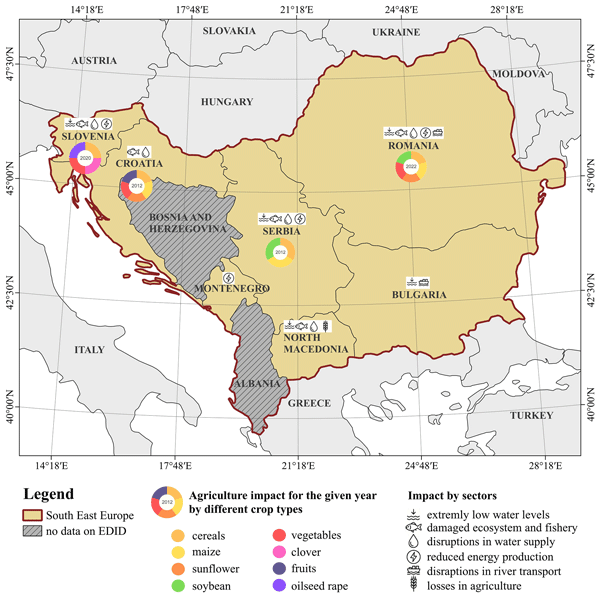
To assess the socio-economic impacts of severe droughts in the region, we utilized the European Drought Impact Database (EDID), a platform developed under the Copernicus Programme. EDID serves as a centralized repository for documented drought impacts across Europe, aiming to enhance our understanding of how droughts affect society, the environment, and the economy. In this study, we highlight the value of such a tool for systematic data collection and also emphasize the need for improved reporting at the national level. For the SEE region, a total of 97 reports for severe droughts were available across all countries during the research period. Notably, countries like Romania, Croatia, Slovenia, and Serbia are well-represented in the database, whereas Albania, North Macedonia, and Montenegro have only limited reporting. Furthermore, Bosnia and Herzegovina and Bulgaria lack any recorded reports of severe drought impacts during the study period. Given these disparities, the assessment of socio-economic impacts in SEE will be based on all available sources to provide the most comprehensive overview possible.
3.3.1 The period 2011–2012
The SEE region faced a severe drought in winter 2011 and spring 2012. EDID reports were obtained for this multiyear drought. Then in summer, low precipitation and additionally high temperatures characterized the weather conditions from mid-June until mid-August. Inadequate water supplies have inflicted irreversible agricultural damages, forcing a premature and accelerated harvest of winter cereals. Concurrently, the crisis has paralyzed critical infrastructure: hydropower supplies have plummeted across almost the entire region, with air temperatures routinely surging above 40 °C during late-summer dry spells.
Serbia endured its hottest summer since 1887, with temperatures surging past 35 °C for over 50 d, triggering an immediate national crisis. This extreme heat is projected to slash the national maize yield in half. The epicenter of the disaster is the northern province of Vojvodina, where cereal production is expected to plummet to just 50 % of normal. With over one million hectares – predominantly maize and soy – affected, preliminary damage estimates already exceed EUR 130 million.
Croatia suffered its worst drought in 50 years, forcing the declaration of a natural disaster in five counties. The agricultural sector faced a catastrophic blow, decimating key crops – maize, wheat, sunflower, vegetables, and viticulture (leading to one of the earliest grape harvests on record). Reports from Slavonia confirmed near-total destruction, with spring-planted crop losses estimated between 60 % and a full 100 %. The total damage inflicted by this disaster will exceed EUR 130 million.
Eastern and southern regions of Romania were highly affected by drought which significantly reduced crop yields, with maize, sunflower, soy, wheat, and potatoes being the most affected. In 2012, an exceptionally harsh winter followed by a summer drought led to a reduced harvest, causing an increase in the prices of essential food items such as potatoes and flour. Reports indicate that losses for maize alone could reach 50 %, leading to a substantial drop in overall agricultural output. In Transylvania, fruit exporters have suffered severe setbacks, with small-scale farmers losing up to 90 % of their expected production, making it nearly impossible to meet export quotas for Western European markets.
When it comes to North Macedonia, this country reports 20 % reduced harvest than normal. In addition to agricultural production, the drought also had a major impact on water resources, water supply, and the ecosystem. Some of the lakes in Northern Serbia were artificially filled with water from rivers to save fish and ecological systems. During this period water restrictions were reported from Serbia, Croatia and North Macedonia.
The public water supply in Croatia was strongly affected and due to that the state of the natural disaster was declared in all counties in Continental Croatia. Wells, bars, ponds, springs have been drained causing residents to supply with water from different sources such as hydrants and car cisterns. There were 227 transports of drinking water to the population to which regular water supply sources (wells) were drowned because of droughts. As one of the measures to mitigate the situation, it was forbidden to wash streets and watering football fields and similar surfaces. When it comes to aquatic ecosystems, some mountain streams have dried up, staying without water and oxygen and causing fish to die.
In eastern Romania, some rivers dried up entirely and others reached historic low streamflow. Additionally, reduced water levels, which have decreased to 30 %–50 % of the annual average, have disrupted transport, severely impacting the shipment of grain and maize. In response to the crisis, the Romanian government has allocated 25 million euros to support affected farmers and has reduced irrigation water costs by 20 % to mitigate losses. Due to this drought event, officials in North Macedonia have warned that the drinking water supply may be at risk.
3.3.2 The year 2020
During 2020, drought severely affected the entire area of Slovenia, with the most significant damage occurring in the Littoral region of western and southwestern Slovenia, where the lack of rainfall was worsened by strong winds – particularly the bora – which further dried out the soil. Drought damage was evident in spring cereals, clover, oilseed rape, and winter cereals. Vegetables without irrigation and early potatoes failed to sprout, while asparagus yields dropped. Orchards, especially apple trees, and hop plantations also suffered. The Vipava Valley in western Slovenia experienced extreme soil dryness. Permanent meadows and grasslands were also affected, threatening livestock feed.
Prolonged drought during winter and spring led to a hydrological drought. In the first half of the year low water content was noted on 80 % of water measuring stations, while 10 % recorded completely dry conditions, especially in southern Slovenia. Water scarcity reached critical levels: surface water supplies were failing, with streams and small rivers drying out, while northwestern aquifers showed critically low, continually declining groundwater levels. The need for water deliveries increased significantly during this period, with nearly twice as many deliveries recorded by mid-April compared to the entire month during the previous year.
The 2020 drought triggered a catastrophic agricultural failure in Romania. The crisis overwhelmingly hit eastern and southern regions, where more than half of the country's USD 2.9 million sown hectares were devastated by unrelenting winter and spring drought. Wheat, maize, and sunflower were in danger the most. In the Harghita region in central Romania, rain deficit raised concerns over massive losses in potato yield. The negative impacts were most evident in market prices for cereals, which had already become more expensive due to the prolonged drought conditions that affected much of the country. In relation to that, potatoes were being sold for almost double the price compared to the same period a year before. For some cereals such as wheat, authorities decided to ban the export of wheat to destinations other than the EU for a week. As water demand for irrigation peaked, the severely diminished flows of the Danube and Siret rivers incapacitated functional pumping stations, paralyzing the capacity to deliver water.
The prolonged drought created problems for livestock farmers, as dried-up grasslands left them with no suitable areas for grazing their animals.
The drought triggered a hydrological drought, drying up 95 % of Lake Nuntaşu and 60 % of Lake Soleşti. Additionally, salt levels in Lake Techirghiol rose, threatening the destruction of its flora and fauna.
The drought also impacted on the water supply in several communes across the country. In some parts of southwestern Romania, tap water was available only at specific times. While some used it for agricultural activities, there was not enough water for basic needs like food and personal hygiene. Due to that, authorities had to make a schedule of water supply for some municipalities.
3.3.3 The year 2022
Experts say that the 2022 drought was not only meteorological, but also an agricultural or soil drought and hydrological (low water levels, dried up rivers). Extreme weather conditions and intense heat caused a decline in agricultural production in Croatia. The prolonged drought has led to significant agricultural losses, with potato yields declining by 50 %–60 %. This substantial reduction threatens both local supply and market stability. Wheat, maize, fruits, and vegetables have also been heavily impacted. Poor conditions have reduced olive quality, leading to higher olive oil prices. Sunflower crops suffered as well, with worsened yield quality due to drought, raising concerns about future production and market stability. To mitigate this, the Ministry of Agriculture announced an extraordinary measure for farmers worth around EUR 26 million.
The drought triggered a catastrophic setback to Serbia's key cash crops. Yields for maize, soybeans, and sunflower were so poor that production could only guarantee domestic consumption, resulting in an export volume far below the country's normal, massive grain output.


Figure 3Total number of pixels per country under the 3rd class “Alert” of CDI for 2012–2024 according to EDO.
That year's drought has severely impacted Romania's agricultural sector, causing losses exceeding EUR 1 billion. Of the country's 5.4 million hectares of crops, 800 000 ha have suffered significant damage. The drought was particularly severe in the south, where rainfall has been scarce since the fall of 2021, leading to the complete destruction of maize harvests in several municipalities. The crisis extended across the country, with 75 % of Romania's land experiencing extreme temperatures and drought conditions.
As the second-largest European producer of maize and oilseeds, Romania faced its lowest maize harvest since 2007, with losses estimated at 40 %–50 % compared to previous years. Romania's wheat harvest in 2022 reached 9 million tons, a significant decline from the record 11.3 million tons harvested in 2021. Potato production has also been affected, especially in central Romania, a key growing region. In Romania, water usage was highly restricted on essential needs.
Severe drought affected water courses in Eastern Europe. Drought affects water levels in large rivers such as the Danube and Sava. At the border between Romania and Bulgaria, the water level of the Danube dropped so dramatically that dozens of sand islands formed.
Together with the Sava River, the Danube River is vital for grain exports and coal imports. Ships from Bulgaria and Romania reduced capacity, affecting navigation and fishing. This low level of water in those main rivers disrupted the supply of crude oil, diesel, and other derivatives in Bulgaria. A blocked Danube disrupted the logistics chain in Romania and beyond, leading to delays that ultimately increased prices for end consumers.
Serbia faced a systemic hydrological collapse, with water levels in most river courses plummeting near the biological minimum. The crisis was acute on the Sava River, and hydrological warnings were rapidly extended to the Danube, driven by critically low upstream levels. The severity was starkly visible: the Drina River was so shallow in places it could be crossed on foot. This national failure fueled an ecological disaster in Vojvodina, where insufficient rainfall led to the dwindling of Conopljan Lake and resulted in the grim discovery of mass dead fish. The collapsing ecosystem forced fish relocation to the Danube-Tisa-Danube canal. With extreme water shortages, irrigation was banned in parts of Vojvodina as reservoir levels, including Moravica and Sava, hit record lows.
The low water levels in rivers also led to a reduction in electricity production. According to Electricity company Serbia (EPS), the hydrological situation in 2022 was the worst in the past 100 years, causing hydropower plants on the Danube, Drina, and Lim to produce minimal electricity. As a result, the 16 main hydroelectric power plants in Serbia, which generate 38 % of the nation's electricity, reduced their output by a third. During this year, the largest hydroelectric power plant – Đerdap, faced a decrease in output of at least 30 %. The situation was not so good in Montenegro either. The Electric Power Company of Montenegro operates two hydropower plants with over 50 % of energy coming from hydro sources. The simultaneous pressures of drought-induced low water levels and surging tourist-season consumption forced the emergency importation of 294 GWh, creating a swift financial liability of approximately EUR 100 million.
The drought has inflicted a crippling blow to Slovenia's hydropower capacity. Production on the Soča River has plummeted by 45 %, the Drava by 31 %, and the lower Sava by 39 %, severely undercutting the five-year average. This crisis culminated in the first operational shutdown since 2003 for the Solkan Hydroelectric Power Plant due to the Soča River's extremely low flow. Late June of 2022 was also critical when it comes to supply of drinking water. Hydrological drought was putting even groundwater levels at risk of drying up causing the first water consumption bans for non-essential purposes in some parts of the country. The prolonged drought, causing very low water levels in rivers, impacted fishing tourism and other activities. Fishing was suspended in several rivers in the Alpine northwest, including Soča, Sava Bohinjka, and Mostnica, to protect fish stocks. This drought also affected river tourism in the Julian Alps, with limitations or bans due to low water levels.
Due to low water levels in rivers like the Neretva, seawater entered the river, making it unsuitable for irrigating agricultural crops. Additionally, water scarcity extended to deeper soil layers along the Adriatic, where drought conditions led to smaller olive fruits.
General statistics and regional overview results. Overall, during the collection stage in the SEE region, we gathered 62 publications from national and joint international teams. However, the distribution of these publications is uneven. Romania, Croatia, Serbia, and Bulgaria lead the list, with 21, 11 and 10 publications over the past 15 years. In contrast, Montenegro, Albania, Bosnia and Herzegovina (BIH), and Slovenia are underrepresented in the scientific literature focusing on drought. While Slovenia is well represented in research concerning the Danube and Pannonian Basin, Montenegro, Albania, and North Macedonia are largely excluded from regional studies. As a result, these three countries rank at the bottom of the distribution and are significantly less covered by national drought research (Fig. 2). In Croatia, Serbia, and Romania, a significant increase in the number of publications over the past five years has been observed. Undoubtedly, drought-related topics are a major focus in these countries, driven by high level of vulnerability, sensitivity to drought economies and quite strong national scientific teams specializing in natural hazards, particularly droughts.
Among the last twelve years generally the 2011/2012 drought is the worst in the region according to the total number of pixels under the 3D class of CDI (Fig. 3) and the collection of impacts from the EDID database (Fig. 4). After the 2012 historical event for all countries a slight tendency of increasing in total number of pixels under the 3d class of CDI is observed until the next 2022 vast drought. Curiously, the 2020 event struck Slovenia and Romania, according to EDID. In Fig. 3 it is seen that this event is not associated with a big area under “Alert” class but in Table 2 it appeared for Slovenia, Romania and Montenegro with 95 %, 88 % and 95 % of the country area coverage respectively. Thus, less severe but longer and more spatially extended events caused higher impacts in these countries.

Figure 4Socio-economic impact of drought from EDID database (if there is extensive information on agriculture losses for the worst event it is shown as donut diagram).
During the summer 2022 west part of the SEE region was more exposed to drought than the east. For Montenegro, BIH, Croatia and Slovenia the area under “Alert” class achieved the maximum for the last 12 years, but the impact for the 2012 event is higher and struck more sectors of the economy.
The 2024 drought has a high percentage under 3d class only for the east part of SEE region and it is not present on the west – in Albania, Montenegro, BIH, Croatia and Slovenia. However, the impacts for this event are probably not still available in the EDID database.
The other impact databases (EDII database from European Drought Center and Climate Change Knowledge Portal from World Bank) do not have data about the drought impacts after 2014 and could be considered as outdated.
Overall, we found a great disbalance in the scientific literature for drought topics between the countries in SEE. Underestimated countries with one or two scientific publications are – Albania, N. Macedonia, Montenegro, Slovenia. On the opposite side – EU countries (Romania and Bulgaria) and Serbia with more than 10 publications for the last 10 years. Generally, the literature review suggests that the SEE countries can be categorized into three main groups based on trends in drought hazard dynamics. The first group, which includes Slovenia, Croatia, Bosnia and Herzegovina (BIH), and Montenegro, is characterized by statistically significant negative trends in drought indexes and positive trends in the duration of drought spells. However, there are exceptions and additional factors influencing drought dynamics, particularly the humid climate and higher average precipitation levels. The second group, consisting of Serbia, Albania, and North Macedonia, experiences greater exposure to droughts, but the literature does not present a coherent picture of drought trends. Most authors identify increased drought impacts over the last two decades. However, recent drought variations in this group may be driven by a combination of persistent warming and broader shifts in atmospheric circulation patterns. Since Albania and North Macedonia are not well covered in scientific publications, identifying the causes and patterns of change in this group remains challenging. The third group, including Romania and Bulgaria, exhibits significant variability in drought dynamics due to the large geographic size of these countries and seasonal differences in drought patterns. For example, in Romania, statistically significant trends can only be observed during winter and spring and highly depend on the analyses period.
Transformative change is urgently needed to mitigate drought impacts in South-East Europe through co-created disruptive solutions and strategic planning at national and regional levels. For example, integration of Nature-based Solutions (NbS) into natural resource management meeting national, European (Natura 2000, Habitats Directive, European Green Deal, Europe's 2020 Biodiversity strategy) and international biodiversity and carbon targets – 30 % of land protected by 2030 and zero emissions by 2050 (CBD, SDGs) presents a promising, cost-effective framework. NbS are essential, efficient tools for building climate resilience and sustainable adaptation. Research projects are critical in advancing NbS implementation. For example, in Serbia, the SONATA project leads efforts to mainstream NbS into sustainable land management by leveraging data-driven decision-making and stakeholder collaboration. Complementing SONATA, ADOPT 2.0 builds on its success by expanding NbS knowledge among decision-makers and communities, supporting NbS integration aligned with the Green Agenda for the Western Balkans (GAWB), and contributes to strategic efforts like the Western Balkans Forest Landscape Restoration Plan.
The Nordic Council of Ministers has allocated DKK 26 million to a four-year (2021–2024) programme to boost regional cooperation on nature-based solutions (NbS), aiming to make the Nordic Region the most sustainable in the world by 2030. This initiative serves as an excellent example of how coordinated regional efforts, backed by clear projects and sustained funding, can effectively advance knowledge, policy, and practical implementation of NbS. The programme's structured approach promotes collaboration across countries, enhances policy alignment, and supports sustainable environmental management. The Western Balkans could greatly benefit from adopting a similar model to strengthen regional cooperation, streamline NbS integration into policies, and mobilize resources for long-term sustainable development and climate resilience.
The CDI dataset was downloaded from the EDO portal (https://drought.emergency.copernicus.eu/tumbo/edo/download/, last access: 10 March 2026). To analyse the impacts of the most severe droughts, data were collected from the European Drought Impact Database (EDID), available on the Copernicus portal (https://drought.emergency.copernicus.eu/tumbo/edid, last access: 10 March 2026).
Conceptualization MK and GM; Data curation GM; Formal analysis MR; Investigation MK, GM, MR; Supervision MW; Funding acquisition TNL; Writing (original draft preparation) MK, MR, GM, MW, TNL; Visualization MR; Writing (review and editing): MK, GM, MW.
The contact author has declared that none of the authors has any competing interests.
Publisher's note: Copernicus Publications remains neutral with regard to jurisdictional claims made in the text, published maps, institutional affiliations, or any other geographical representation in this paper. The authors bear the ultimate responsibility for providing appropriate place names. Views expressed in the text are those of the authors and do not necessarily reflect the views of the publisher.
This work was supported by the SONATA Twinning project funded from the European Union's Horizon Europe programme under Widening participation and spreading excellence action GA no. 101159546) and the Ministry of Science, Technological Development and Innovation of the Republic of Serbia grant no. 451-03-33/2026-03/200358. Marthe Wens is funded by the Dutch Sectorgelden fund.
This research has been supported by the Horizon 2020 Framework Programme, H2020 Spreading Excellence and Widening Participation (grant no. 101159546) and the Ministarstvo Prosvete, Nauke i Tehnološkog Razvoja (grant no. 451-03-33/2026-03/200358).
This paper was edited by Brunella Bonaccorso and reviewed by Michał Habel and one anonymous referee.
Abu Arra, A., Alashan S., and Şişman E.: Trends of meteorological and hydrological droughts and associated parameters using innovative approaches, J. Hydrol., 640, https://doi.org/10.1016/j.jhydrol.2024.131661, 2024.
AghaKouchak, A., Mirchi, A., Madani, K., Di Baldassarre, G., Nazemi, A., Alborzi, A., Anjileli, H., Azarderakhsh, M., Chiang, F., Hassanzadeh, E., Huning, L.S., Mallakpour, I., Martinez, A., Mazdiyasni, O., Moftakhari, H., Norouzi, H., Sadegh, M., Sadeqi, D., Van Loon, A. F., and Wanders, N.: Anthropogenic drought: Definition, challenges, and opportunities, Rev. Geophys., 59, 1–23, https://doi.org/10.1029/2019RG000683, 2021.
Albulescu, A.-C., Minea, I., Boicu, D., and Larion, D.: Comparative Multi-Criteria Assessment of Hydrological Vulnerability – Case Study: Drainage Basins in the Northeast Region of Romania, Water, 14, 1302, https://doi.org/10.3390/w14081302, 2022.
Amiri, M. A. and Gocić, M.: Analysis of temporal and spatial variations of drought over Serbia by investigating the applicability of precipitation-based drought indices, Theor. Appl. Climatol., 154, 261–274, https://doi.org/10.1007/s00704-023-04554-6, 2023.
Angearu, C.-V., Ontel, I., Boldeanu, G., Mihailescu, D., Nertan, A., Craciunescu, V., Catana, S., and Irimescu, A.: Multi-Temporal Analysis and Trends of the Drought Based on MODIS Data in Agricultural Areas, Romania, Remote Sens., 12, 3940, https://doi.org/10.3390/rs12233940, 2020.
Avetisyan, D., Borisova, D., and Velizarova, E.: Integrated Evaluation of Vegetation Drought Stress through Satellite Remote Sensing, Forests, 12, 974, https://doi.org/10.3390/f12080974, 2021.
Barendrecht, M. H., Matanó, A., Mendoza, H., Weesie, R., Rohse, M., Koehler, J., de Ruiter, M., Garcia, M., Mazzoleni, M., Aerts, J. C. J. H., Ward, P. J., Di Baldassarre, G., Day, R., and Van Loon, A. F.: Exploring drought-to-flood interactions and dynamics: A global case review, WIREs Water, 11, e1726, https://doi.org/10.1002/wat2.1726, 2024.
Bezak, N. and Mikoš, M.: Changes in the Compound Drought and Extreme Heat Occurrence in the 1961–2018 Period at the European Scale, Water, 12, 3543, https://doi.org/10.3390/w12123543, 2020.
Biella, R., Shyrokaya, A., Ionita, M., Vignola, R., Sutanto, S. J., Todorovic, A., Teutschbein, C., Cid, D., Llasat, M. C., Alencar, P., Matanó, A., Ridolfi, E., Moccia, B., Pechlivanidis, I., van Loon, A., Wendt, D. E., Stenfors, E., Russo, F., Vidal, J.-P., Barker, L., de Brito, M. M., Lam, M., Bláhová, M., Trambauer, P., Hamed, R., McGrane, S. J., Ceola, S., Bakke, S. J., Krakovska, S., Nagavciuc, V., Tootoonchi, F., Di Baldassarre, G., Hauswirth, S., Maskey, S., Zubkovych, S., Wens, M., and Tallaksen, L. M.: The 2022 drought needs to be a turning point for European drought risk management, Nat. Hazards Earth Syst. Sci., 25, 4475–4501, https://doi.org/10.5194/nhess-25-4475-2025, 2025.
Biella, R., Shyrokaya, A., Pechlivanidis, I., Cid, D., Llasat, M. C., Tootoonchi, F., Wens, M., Lam, M., Stenfors, E., Sutanto, S., Ridolfi, E., Ceola, S., Alencar, P., Di Baldassarre, G., Ionita, M., de Brito, M. M., McGrane, S. J., Moccia, B., Nagavciuc, V., Russo, F., Krakovska, S., Todorovic, A., Trambauer, P., Vignola, R., and Teutschbein, C.: Lessons learned in institutional preparedness and response during the 2022 European drought, Nat. Hazards Earth Syst. Sci., 26, 955–979, https://doi.org/10.5194/nhess-26-955-2026, 2026.
Brenčič, M.: Extreme historical droughts in the South-eastern Alps-Analyses based on standardised precipitation index, Acta Geophys., 64, 1731–1754, https://doi.org/10.1515/acgeo-2016-0017, 2016.
Brleković, T. and Tadić, L.: Hydrological Drought Assessment in a Small Lowland Catchment in Croatia, Hydrology, 9, 79, https://doi.org/10.3390/hydrology9050079, 2022.
Bucur, A., Gregorič, G., Grlj, A., Kokalj, Ž., and Sušnik. A.: Tool for Drought Monitoring in the Danube Region – Methods and Preliminary Developments, J. Environ. Geogr., 11, 67–75, https://doi.org/10.2478/jengeo-2018-0014, 2018.
Burić, D., Mihajlović, J., Doderović, M., and Mijanović, I.: Comparative analysis of SPI and SPEI drought indices for Montenegro and the impact of teleconnections, J. Water Clim. Change, 15, 5149–5168, 2024.
Cammalleri, C., Arias-Muñoz, C., Barbosa, P., de Jager, A., Magni, D., Masante, D., Mazzeschi, M., McCormick, N., Naumann, G., Spinoni, J., and Vogt, J.: A revision of the Combined Drought Indicator (CDI) used in the European Drought Observatory (EDO), Nat. Hazards Earth Syst. Sci., 21, 481–495, https://doi.org/10.5194/nhess-21-481-2021, 2021.
Chis, C., Mircov, D. V., Cozma, A. L., Okros, A., and Duran, C. C.: Perception of climate change: case study Timis County, Romania, 23rd SGEM International Multidisciplinary Scientific GeoConference, https://doi.org/10.5593/sgem2023/4.1/s19.40, 2023.
Cindrić, K., Telišman Prtenjak, M., Herceg-Bulić, I., Mihajlović, D., and Pasarić, Z.: Analysis of the extraordinary 2011/2012 drought in Croatia, Theor. Appl. Climatol., 123, 503–522, https://doi.org/10.1007/s00704-014-1368-8, 2016.
Cindrić Kalin, K. and Pasarić, Z.: Regional patterns of dry spell durations in Croatia, Int. J. Climatol., 42 , 5503–5519, https://doi.org/10.1002/joc.7545, 2022.
Copernicus Climate Change Service: Global climate highlight 2024, https://climate.copernicus.eu/copernicus-2024-first-year-exceed-15degc-above-pre-industrial-level (last access: 20 January 2025), 2025.
Corduneanu, F., Vintu, V., Bucur, D., Balan, I., and Crenganis, L. L.: Impact of drought on water resources in north – Eastern Romania. Case study – The Prut river, Environ. Eng. Manag. J., 15, 1213–1222, https://doi.org/10.30638/eemj.2016.133, 2016.
Crausbay, S. D., Betancourt, J., Bradford, J., Cartwright, J., Dennison, W. C., Dunham, J., Enquist, C. A. F., Frazier, A. G., Hall, K. R., Littell, J. S., Luce, C. H., Palmer, R., Ramirez, A. R., Rangwala, I., Thompson, L., Walsh, B. M., and Carter, S.: Unfamiliar Territory: Emerging Themes for Ecological Drought Research and Management, One Earth, 3, 337–353, https://doi.org/10.1016/j.oneear.2020.08.019, 2020.
Crişu, L., Zamfir, A.-G., Vlăduţ, A., Boengiu, S., Simulescu, D., and Mititelu-Ionuş, O.: Assessing Vegetation Response to Drought in the Central Part of Oltenia Plain (Romania) Using Vegetation and Drought Indices, Sustainability, 17, 2618, https://doi.org/10.3390/su17062618, 2025.
Crocetti, L., Forkel, M., Fischer, M., Jurečka, F., Grlj, A., Salentinig, A., Trnka, M., Anderson, M., Ng, W. T., Kokalj, Ž., Bucur, A., and Dorigo, W.: Earth Observation for agricultural drought monitoring in the Pannonian Basin (southeastern Europe): current state and future directions, Reg. Environ. Change, 20, 123, https://doi.org/10.1007/s10113-020-01710-w, 2020.
Čadro, S., Marković, M., Hadžić, A., Hadžić, A., and Žurovec, O.: Assessing the impact of climate change on extreme hydrological events in Bosnia and Herzegovina using SPEI, Journal of Central European Agriculture, 25, 531–541, https://doi.org/10.5513/JCEA01/25.2.4183, 2024a.
Čadro, S., Uzunović, M., Omerović, Z., Vlahovljak, E., Konjić, A., and Marković, M.: Climate change influence on the occurrence of extreme dry-wet periods in Bosnia and Herzegovina, Agriculture and Forestry, 70, 325–344, https://doi.org/10.17707/AgricultForest.70.1.21, 2024b.
Dimkić, D., Anđelković, A., and Babalj, M.: Droughts in Serbia through the analyses of De Martonne and Ped indices, Environ. Monit. Assess., 194, 265, https://doi.org/10.1007/s10661-022-09911-y, 2022.
Dobri, R.-V., Sfîcă, L., Amihăesei, V.-A., Apostol, L., and Ţîmpu, S.: Drought Extent and Severity on Arable Lands in Romania Derived from Normalized Difference Drought Index (2001–2020), Remote Sens., 13, 1478, https://doi.org/10.3390/rs13081478, 2021.
Dumitraşcu, M., Mocanu, I., Mitrică, B., Dragotă, C., Grigorescu, I., and Dumitrică, C.: The assessment of socio-economic vulnerability to drought in Southern Romania (Oltenia Plain), Int. J. Disast. Risk Re., 27, 142–154, https://doi.org/10.1016/j.ijdrr.2017.09.049, 2018.
Đidelija, M., Kulo, N., Mulahusić, A., Tuno, N., and Topoljak J.: Correlation analysis of different optical remote sensing indices for drought monitoring: a case study of Canton Sarajevo, Bosnia and Herzegovina, Environ. Monit. Assess., 195, 1338, https://doi.org/10.1007/s10661-023-11930-2, 2023.
Đurđević, V., Stošić, B., Tošić, M., Lazić, I., Putniković, S., Stošić, T., and Tošić, I.: Analysis of recent trends and spatiotemporal changes of droughts over Serbia using high-resolution gridded data, Atmos. Res., 304, 107376, https://doi.org/10.1016/j.atmosres.2024.107376, 2024.
European Environmental Agency: Water scarcity and drought events in Europe during the last decade (2002–2011), Map, https://www.eea.europa.eu/en/analysis/maps-and-charts/main-drought-events-in-europe?activeTab=570bee2d-1316-48cf-adde-4b640f92119b (last access: 9 June 2025), 2012.
Evgeniev, R., Malcheva, K., Marinova, T., Chervenkov, H., and Bocheva, L.: Assessment of drought in Bulgaria in recent years through the Standardized Precipitation Index, in: Proceedings of 23rd International Multidisciplinary Scientific GeoConference SGEM 2023, Albena, Bulgaria, 3–8 July 2023, https://doi.org/10.5593/sgem2023/4.1/s19.31, 2023.
Filipović, L., Putniković, S., Stosic, B., Stosic, T., Djurdjević, V., and Tošić, I.: Analysis of Spatio-Temporal Characteristics of Drought in Serbia From 1961 to 2020 Using SPI and SPEI, Int. J. Climatol., e8803, https://doi.org/10.1002/joc.8803, 2025.
GAR: Special Report on Drought, Geneva, United Nations Office for Disaster Risk Reduction, 2021, Global Assessment Report on Disaster Risk, https://www.undrr.org/garReduction (GAR) (last access: 12 June 2025), 2021.
Gocić, M., Trajkovic, S., and Milanovic, M.: Precipitation and drought analysis in Serbia for the period 1946–2017, in: Water Resources Management in Balkan Countries, edited by: Negm, A. M., Romanescu, G., and Zelenakova, M., Springer Cham, Switzerland, 277–292, https://doi.org/10.1007/978-3-030-22468-4, 2020.
Götte, J. and Brunner, M. I.: Hydrological drought-to-flood transitions across different hydroclimates in the United States, Water Resour. Res., 60, e2023WR036504, https://doi.org/10.1029/2023WR036504, 2024.
Gjoni, A., Kucaj, E., Cela, G., Bardhi, A., and Stafa, G.: Some specific elements of Albania's atmospheric droughts, in: E3S Web of Conferences, 585, 02005, 5th International Conference on Environmental Design and Health (ICED2024), https://doi.org/10.1051/e3sconf/202458502005, 2024.
Hagenlocher, M.,Naumann, G., Meza, I., Blauhut, V., Cotti, D., Döll, P., Ehlert, K., Gaupp, F., Van Loon, A.F., Marengo, J.A., Rossi, L., Sabino Siemons, A. S., Siebert, S., Tsehayu, A. T., Toreti, A., Tsegai, D., Vera, C., Vogt, J., and Wens, M.: Tackling growing drought risks – the need for a systemic perspective, Earth's Future, 11, e2023EF003857, https://doi.org/10.1029/2023EF003857, 2023.
Hall, J. and Perdigão, R. A. P.: Who is stirring the waters?, Science, 371, 1096–1097, https://doi.org/10.1126/science.abg6514, 2021.
Ilcheva, I., Yordanova, A., Drumeva, G., and Lubenova, L.: Approach and indicator system for assessment the impacts of reservoirs and prolonged drought identification in Bulgaria for water framework directive, Proceedings of 22nd SGEM International Multidisciplinary Scientific GeoConference, https://doi.org/10.5593/sgem2022/3.1/s12.07, 2022.
Ionita, M., Scholz, P., and Chelcea, S.: Assessment of droughts in Romania using the Standardized Precipitation Index, Nat. Hazards, 81, 1483–1498, https://doi.org/10.1007/s11069-015-2141-8, 2016.
Ionita, M., Nagavciuc, V., Antonescu, B., and Roibu, C.: Drought's Grip on Romania: A Tale of Two Indices, Int. J. Climatol., 1–24, https://doi.org/10.1002/joc.8876, 2025.
IPCC: Climate Change 2021: The Physical Science Basis. Contribution of Working Group I to the Sixth Assessment Report of the Intergovernmental Panel onClimate Change, edited by: Masson-Delmotte, V., Zhai, P., Pirani, A., Connors, S. L., Péan, C., Berger, S., Caud, N., Chen, Y., Goldfarb, L., Gomis, M. I., Huang, M., Leitzell, K., Lonnoy, E., Matthews, J. B. R., Maycock, T. K., Waterfield, T., Yelekçi, O., Yu, R., and Zhou, B., Cambridge University Press, Cambridge, United Kingdom and New York, NY, USA, 2391 pp., https://doi.org/10.1017/9781009157896, 2021.
Leščešen, I., Dolinaj, D., Pantelić, M., and Popov, S.: Drought assessment in Vojvodina (Serbia) using k-means cluster analysis, J. Geogr. Inst. Cvijic., 69, 17–27, 2019.
Leščešen, I., Dolinaj, D., Pantelić, M., Telbisz, T., and Varga, G.: Hydrological drought assessment of the Tisza river, Journal of the Geographical Institute ”Jovan Cvijic”, SASA, 70, 89–100, 2020.
Lončar-Petrinjak, I., Pasarić, Z., and Kalin, K.C.: Drought monitoring in Croatia using the standardized precipitation-evapotranspiration index, Geofizika, 41, 1–23, https://doi.org/10.15233/gfz.2024.41.2, 2024.
Luković, J., Burić, D., Mihajlović, J., and Pejović, M.: Spatial and temporal variations of aridity-humidity indices in Montenegro, Theor. Appl. Climatol., 155, 4553–4566, https://doi.org/10.1007/s00704-024-04893-y, 2024.
Marinović, I., Cindrić Kalin, K., Güttler, I., and Pasarić Z.: Dry spells in Croatia: Observed climate change and climate projections, Atmosphere-Basel, 12, 652, https://doi.org/10.3390/atmos12050652, 2021.
Marinović, I. and Kalin, K. C.: Učinci suše na području hrvatske iz novinskih izvješca u razdoblju 1981–2019, Hrvatske Vode, 29, 93–102, 2021 (in Croatian).
Maftei, C. E., Bărbulescu, A., and Osman, A.: Assessment of the Drought Risk in Constanta County, Romania, Atmosphere, https://doi.org/10.3390/atmos15111281, 2024.
Mares, C., Adler M.-J., Mares I., Chelcea S., and Branescu E.: Discharge variability in Romania using Palmer indices and a simple atmospheric index of large-scale circulation, Hydrolog. Sci. J., 61, 1010–1025, https://doi.org/10.1080/02626667.2015.1006233, 2016.
Matanó, A., Berghuijs, W. R., Mazzoleni, M., de Ruiter, M. C., Ward, P. J., and Van Loon, A. F.: Compound and consecutive drought-flood events at a global scale, Environ. Res. Lett., 19, 064048, https://doi.org/10.1088/1748-9326/ad4b46, 2024.
Mihai, L., Stancalie, A., Sporea, A., Sporea, D., Nertan, A., and Mihailescu, D.: Drought vegetation monitoring using in situ and satellite data, in the Caracal plain of Romania, Romanian Reports in Physics, 68, 799–812, 2016.
Mimić, G., Živaljević, B., Blagojević, D., Pejak, B., and Brdar, S.: Quantifying the effects of drought using the crop moisture stress as an indicator of maize and sunflower yield reduction in Serbia, Atmosphere-Basel, 13, 1880, https://doi.org/10.3390/atmos13111880, 2022.
Minea, I., Iosub, M., and Boicu, D.: Multi-scale approach for different type of drought in temperate climatic conditions, Nat. Hazards, 110, 1153–1177, https://doi.org/10.1007/s11069-021-04985-2, 2022.
Minea, I., Boicu, D., and Iosub, M.: Hydrological drought between natural phenomenon and social vulnerability, Proceedings of International Multidisciplinary Scientific Geoconference Surveying Geology and Mining Ecology Management Sgem, 21, 107–114, https://doi.org/10.5593/sgem2021/3.1/s12.15, 2021.
Naumann, G., Cammalleri, C., Mentaschi, L., and Feyen, L.: Increased economic drought impacts in Europe with anthropogenic warming, Nat. Clim. Change, 11, 485–491, https://doi.org/10.1038/s41558-021-01044-3, 2021.
Nikolova, N., Radeva, K., Todorov, L., and Matev, S.: Drought Dynamics and Drought Hazard Assessment in Southwest Bulgaria, Atmosphere-Basel, 15, 888, https://doi.org/10.3390/atmos15080888, 2024.
Ontel, I. and Vladut, A.: Geographica Pannonica, Impact of drought on the productivity of agricultural crops within the Oltenia Plain, Romania, Geographica Pannonica, 19, 6–19, https://doi.org/10.5937/GeoPan1501009O, 2015.
Ontel, I., Irimescu, A., Boldeanu, G., Mihailescu, D., Angearu, C. V., Nertan, A., Craciunescu, V., and Negreanu, S.: Assessment of Soil Moisture Anomaly Sensitivity to Detect Drought Spatio-Temporal Variability in Romania, Sensors-Basel, 21, 8371, https://doi.org/10.3390/s21248371, 2021.
Pandžić, K., Likso, T., Curić, O., Mesić, M., Pejić, I., and Pasarić Z.: Drought indices for the Zagreb-Grič Observatory with an overview of drought damage in agriculture in Croatia, Theor. Appl. Climatol., 142, 555–567, https://doi.org/10.1007/s00704-020-03330-0, 2020.
Pandžić, K., Likso, T., Pejić, I., Šarčević, H., Pecina, M., Šestak, I., Tomšić, D., and Strelec Mahović, N.: Application of the self-calibrated palmer drought severity index and standardized precipitation index for estimation of drought impact on maize grain yield in Pannonian part of Croatia, Nat. Hazards, 113, 1237–1262, https://doi.org/10.1007/s11069-022-05345-4, 2022.
Perdigão, R. A. P.: Earth System Dynamic Intelligence with Quantum Technologies: Seeing the “Invisible”, Predicting the “Unpredictable” in a Critically Changing World, https://doi.org/10.46337/211028, 2021.
Perdigão, R. A. P. and Hall, J.: Multi-hazard System Dynamic Intelligence for high-resolution spatiotemporal early detection, high-performance forecasting and decision support across multissectorial theatres of operation, AGU Fall Meeting 2022, Chicago, IL, 12–16 December 2022, INV44B-10, 2022AGUFMNV44B..10P, 2022.
Popova, Z., Ivanova, M., Pereira, L., Alexandrov, V., Kercheva, M., Doneva, K., and Martins, D.: Droughts and climate change in Bulgaria: assessing maize crop risk and irrigation requirements in relation to soil and climate region, Bulg. J. Agric. Sci., 21, 35–53, 2015.
Radeva, K., Nikolova, N., and Gera, M.: Assessment of hydro-meteorological drought in the Danube Plain, Bulgaria, Hrvatski Geografski Glasnik, 80, 7–25, 2018.
Radeva, K. and Nikolova, N.: Hydrometeorological Drought Hazard and Vulnerability Assessment for Northern Bulgaria, Geographica Pannonica, 24, 112–123, 2020.
Rossi, L., Wens, M., De Moel, H., Cotti, D., Sabino Siemons, A., Toreti, A., Maetens, W., Masante, D., Van Loon, A., Hagenlocher, M., Rudari, R., Naumann, G., Meroni, M., Avanzi, F., Isabellon, M. and Barbosa, P.: European Drought Risk Atlas, JRC135215, Publications Office of the European Union, Luxembourg, https://doi.org/10.2760/608737, 2023.
Roşu, L. and Zăgan, R.: Management of Drought and Floods in Romania, in: Natural Resources Management: Concepts, Methodologies, Tools, and Applications, Information Resources Management Association, IGI Global Scientific Publishing, Hershey, Pennsylvania, USA, 20–63, https://doi.org/10.4018/978-1-5225-0803-8.ch002, 2017.
Sabljić, L., Lukić, T., Marković, S. B., and Bajić, D.: Potential of remote sensing techniques for integrated spatio-temporal monitoring and analysis of drought in the Sana River basin, Bosnia and Herzegovina, Idojaras, 128, 399–423, https://doi.org/10.28974/idojaras.2024.4.1, 2024.
Santos, J. F., Tadić, L., Portela, M. M., Espinosa, L. A., and Brleković, T.: Drought Characterization in Croatia Using E-OBS Gridded Data, Water-Sui, 15, 3806, https://doi.org/10.3390/w15213806, 2023.
Serban, C. and Maftei, C.: Spatiotemporal Drought Analysis Using the Composite Drought Index (CDI) over Dobrogea, Romania, Water, 17, 481, https://doi.org/10.3390/w17040481, 2025a.
Serban, C. and Maftei, C.: Remote Sensing Evaluation of Drought Effects on Crop Yields Across Dobrogea, Romania, Using Vegetation Health Index (VHI), Agriculture, 15, 668, https://doi.org/10.3390/agriculture15070668, 2025b.
Shyrokaya, A., Pappenberger, F., Pechlivanidis, I., Messori, G., Khatami, S., Mazzoleni, M., and Di Baldassarre, G.: Advances and gaps in the science and practice of impact-based forecasting of droughts, WIREs Water, 11, e1698, https://doi.org/10.1002/wat2.1698, 2024.
Sorí, R., Stojanovic, M., Guerova, G. Perez-Alarcon A., Vazquez M., Ernst J., Nieto R., and Gimeno L.: Lagrangian Identification of Bulgaria's Moisture Sources: A Key to Understanding Drought Dynamics, Earth Syst. Environ., https://doi.org/10.1007/s41748-024-00542-6, 2024.
Spinoni, J., Naumann, G., Vogt, J. V., and Barbosa, P.: The biggest drought events in Europe from 1950 to 2012, J. Hydrol.: Regional Studies, 3, 509–524, https://doi.org/10.1016/j.ejrh.2015.01.001, 2015.
Spinoni, J., Vogt, J. V., Naumann, G., Barbosa, P., and Alessandro, D.: Will drought events become more frequent and severe in Europe?, Int. J. Climatol., 38, 1718–1736, https://doi.org/10.1002/joc.5291, 2018.
Stevkova, S. and Alcinova Monevska, S.: Agrometeorological services provided by hydrometeorological service of Republic of Macedonia, Biol. Rhythm Res., 50, 323–326, https://doi.org/10.1080/09291016.2018.1518872, 2019.
Stoyanova, R. and Nikolova, N.: Meteorological Drought in Southwest Bulgaria during the period 1961–2020, J. Geogr. Inst. Cvijic., 72, 243–255, 2022.
Stoyanova, J. S., Georgiev, C. G., and Neytchev, P. N.: Drought Monitoring in Terms of Evapotranspiration Based on Satellite Data from Meteosat in Areas of Strong Land–Atmosphere Coupling, Land, 12, 240, https://doi.org/10.3390/land12010240, 2023.
Stefanski, R., Toreti, A., Aich, V., Hagenlocher, M., Lamizana Diallo, B., McDonnell, R., Pulwarty, R.S., Svoboda, M., Tsegai, D., and Wens, M.: Drought resilience demands urgent global actions and cooperation, Nat. Water, 3, 127–130, https://doi.org/10.1038/s44221-024-00373-9, 2025.
Sutanto, S. J., Syaehuddin, W. A., and de Graaf, I.: Hydrological drought forecasts using precipitation data depend on catchment properties and human activities, Commun. Earth Environ., 5, 118, https://doi.org/10.1038/s43247-024-01295-w, 2024.
Szabó, S., Szopos, N. M., Bertalan-Balázs, B., László, E., Milošević, D. D., Conoscenti, C., and Lázár, I.: Geospatial analysis of drought tendencies in the Carpathians as reflected in a 50-year time series, Hungarian Geographical Bulletin, 68, 269–282, https://doi.org/10.15201/hungeobull.68.3.5, 2019.
Tadić, L., Brleković, T., Hajdinger A., and Španja, S.: Analysis of the Inhomogeneous effect of different meteorological trends on drought: An example from continental Croatia, Water-Sui, 11, 2625, https://doi.org/10.3390/w11122625, 2019.
Tautan, M., Zoran, M., Radvan, R., Savastru, D., and Tenciu, D.: Time series satellite data for assessment of drought impacts on vegetation land cover in dryland Constanta County, Romania, Proceedings of SPIE the International Society for Optical Engineering, 13212, 132120D, https://doi.org/10.1117/12.3035312, 2024.
Thomas, R., Davies, J., King, C., Kruse, J., Schauer, M., Bisom, N., Tsegai, D., and Madani, K.: Economics of Drought: Investing in Nature-Based Solutions for Drought Resilience – Proaction Pays, A joint report by UNCCD, ELD Initiative and UNU-INWEH, Bonn, Germany, Toronto, Canada, https://www.unccd.int/sites/default/files/2024-12/20241202_Economics-Drought-Web.pdf (last access: 5 June 2025), 2024.
Toreti, A., Belward, A., Perez-Dominguez, I., Naumann, G., Luterbacher, J., Cronie, O., Seguini, L., Manfron, G., Lopez-Lozano, R., Baruth, B., van Den Berg, M., Dentener, F., Ceglar, A., Chatzopoulos, T., and Zampieri, M.: The Exceptional 2018 European Water Seesaw Calls for Action on Adaptation, Earth's Future, 7, 652–663, https://doi.org/10.1029/2019EF001170, 2019.
Toreti, A., Tsegai, D., and Rossi, L. (Eds.): World Drought Atlas, JRC 139691, European Commission Joint Research Centre and United Nations Convention to Combat Desertification, Publications Office of the European Union, Luxembourg, 91 pp., ISBN 978-92-68-21788-7, 2024.
Tripathy, K. P., Mukherjee, S., Mishra, A. K., Mann, M. E., and Williams, A. P.: Climate change will accelerate the high-end risk of compound drought and heatwave events, P. Natl. Acad. Sci. USA, 120, e2219825120, https://doi.org/10.1073/pnas.2219825120, 2023.
Urošev, M., Dolinaj, D., and Leščešen, I.: Hydrological droughts in the Južna Morava river basin (Serbia), Geographica Pannonica, 20, 197–207, 2016.
Van Lanen, H. A. J., Laaha, G., Kingston, D. G., Gauster, T., Ionita, M., Vidal, J.-P., Vlnas, R., Tallaksen, L. M., Stahl, K., Hannaford, J., Delus, C., Fendekova, M., Mediero, L., Prudhomme, C., Rets, E., Romanowicz, R. J., Gailliez, S., Wong, W. K., Adler, M.-J., Blauhut, V., Caillouet, L., Chelcea, S., Frolova, N., Gudmundsson, L., Hanel, M., Haslinger, K., Kireeva, M., Osuch, M., Sauquet, E., Stagge, J. H., and Van Loon, A. F.: Hydrology needed to manage droughts: the 2015 European case, Hydrol. Process., 30, 3097–3104, https://doi.org/10.1002/hyp.10838, 2016.
Van Loon, A. F., Kchouk, S., Matanó, A., Tootoonchi, F., Alvarez-Garreton, C., Hassaballah, K. E. A., Wu, M., Wens, M. L. K., Shyrokaya, A., Ridolfi, E., Biella, R., Nagavciuc, V., Barendrecht, M. H., Bastos, A., Cavalcante, L., de Vries, F. T., Garcia, M., Mård, J., Streefkerk, I. N., Teutschbein, C., Tootoonchi, R., Weesie, R., Aich, V., Boisier, J. P., Di Baldassarre, G., Du, Y., Galleguillos, M., Garreaud, R., Ionita, M., Khatami, S., Koehler, J. K. L., Luce, C. H., Maskey, S., Mendoza, H. D., Mwangi, M. N., Pechlivanidis, I. G., Ribeiro Neto, G. G., Roy, T., Stefanski, R., Trambauer, P., Koebele, E. A., Vico, G., and Werner, M.: Review article: Drought as a continuum – memory effects in interlinked hydrological, ecological, and social systems, Nat. Hazards Earth Syst. Sci., 24, 3173–3205, https://doi.org/10.5194/nhess-24-3173-2024, 2024.
Veettil, A. V. and Mishra, A. K.: Quantifying thresholds for advancing impact-based drought assessment using classification and regression tree (CART) models, J. Hydrol., 625, 129966, https://doi.org/10.1016/j.jhydrol.2023.129966, 2023.
Walker, D. W. and Van Loon, A. F.: Droughts are coming on faster, Science, 380, 130–132 https://doi.org/10.1126/science.adh3097, 2023.
West, H., Quinn, N., and Horswell, M.: Remote sensing for drought monitoring and impact assessment: progress, past challenges and future opportunities. Remote Sens. Environ., 232, 111291, https://doi.org/10.1016/j.rse.2019.111291, 2019.
Yuan, X., Wang, Y., Ji, P., Wu, P., Sheffield, J., and Otkin, J. A.: A global transition to flash droughts under climate change, Science, 380, 187–191, https://doi.org/10.1126/science.abn6301, 2023.
Zalokar, L., Kobold, M., and Šraj, M.: Investigation of spatial and temporal variability of hydrological drought in slovenia using the standardised streamflow index (SSI), Water-Sui, 13, 3197, https://doi.org/10.3390/w13223197, 2021.
Zeleňáková, M., Soáková, T., Milanović, M., Gocić, M., and Abd-Elhamid, H. F.: Drought Risks Assessment Using Standardized Precipitation Index, Engineering Proceedings, 57, 38, https://doi.org/10.3390/engproc2023057038, 2023.
Županić, F. Ž., Radić, D., and Podbregar, I.: Climate change and agriculture management: Western Balkan region analysis, Energ. Sustain. Soc., 11, 51, https://doi.org/10.1186/s13705-021-00327-z, 2021.
Droughts pose a major threat to Europe’s food security, yet adaptation lags behind rapid climate shifts. This paper reviews ten years of drought research in nine Southeast European countries using SCOPUS data, identifying major gaps—especially in Montenegro, Albania, Slovenia, and North Macedonia. Using CDI v4 and EDID data, it highlights regional drought patterns and the legacy of drought impacts.
Droughts pose a major threat to Europe’s food security, yet adaptation lags behind...