
Articles | Volume 26, issue 2
https://doi.org/10.5194/nhess-26-1039-2026
© Author(s) 2026. This work is distributed under
the Creative Commons Attribution 4.0 License.
the Creative Commons Attribution 4.0 License.
https://doi.org/10.5194/nhess-26-1039-2026
© Author(s) 2026. This work is distributed under
the Creative Commons Attribution 4.0 License.
the Creative Commons Attribution 4.0 License.
Research article
| 
03 Mar 2026
Research article |
| 03 Mar 2026
| 03 Mar 2026
Assessing the intensification and impact of a historical storm in a warmer climate
Johanne Kristine Haandbæk Øelund
CORRESPONDING AUTHOR

University of Copenhagen, NBI, PICE, Copenhagen, Denmark
DMI – Danish Meteorological Institute, Copenhagen, Denmark
DTU Construct, Lyngby, Denmark
DTU Management, Lyngby, Denmark
Jens Hesselbjerg Christensen
University of Copenhagen, NBI, PICE, Copenhagen, Denmark
Rune Magnus Koktvedgaard Zeitzen
DMI – Danish Meteorological Institute, Copenhagen, Denmark
Henrik Vedel
DMI – Danish Meteorological Institute, Copenhagen, Denmark
Henrik Feddersen
DMI – Danish Meteorological Institute, Copenhagen, Denmark
Related authors
Johanne Kristine Haandbæk Øelund, Jens Hesselbjerg Christensen, Amalie Renée Hartvig Jensen, and Hans Holger Hundborg Koss
EGUsphere, https://doi.org/10.5194/egusphere-2026-4081, https://doi.org/10.5194/egusphere-2026-4081, 2026
This preprint is open for discussion and under review for Weather and Climate Dynamics (WCD).
Short summary
Short summary
Climate change may intensify storms, but its effect on wind inside cities, where buildings reshape airflow, was unclear. We used computer simulations of a historic Copenhagen district over a range of storm strengths. Average winds rose steadily in a consistent pattern, but gusts behaved differently, growing disproportionately strong in weaker storms before leveling off in severe ones. This shows future wind risk cannot be judged from average winds alone, a key lesson for planning safer cities.
Jana Fischereit, Bjarke T. E. Olsen, Marc Imberger, Henrik Vedel, Kristian H. Møller, Andrea N. Hahmann, and Xiaoli Guo Larsén
Geosci. Model Dev., 19, 8115–8147, https://doi.org/10.5194/gmd-19-8115-2026, https://doi.org/10.5194/gmd-19-8115-2026, 2026
Short summary
Short summary
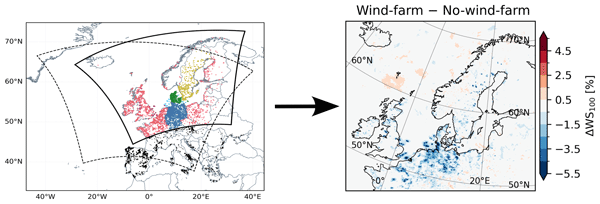
We evaluated how operating wind farms influence the atmosphere in numerical weather prediction using two wind farm parameterizations in the HARMONIE-AROME model, applied by over 10 European weather services. Accurate yield forecasts require including both onshore and offshore turbines. Wind turbines slightly alter near-surface temperature (<1 K on average). We also present an open-access European wind turbine dataset combining multiple data sources.
Johanne Kristine Haandbæk Øelund, Jens Hesselbjerg Christensen, Amalie Renée Hartvig Jensen, and Hans Holger Hundborg Koss
EGUsphere, https://doi.org/10.5194/egusphere-2026-4081, https://doi.org/10.5194/egusphere-2026-4081, 2026
This preprint is open for discussion and under review for Weather and Climate Dynamics (WCD).
Short summary
Short summary
Climate change may intensify storms, but its effect on wind inside cities, where buildings reshape airflow, was unclear. We used computer simulations of a historic Copenhagen district over a range of storm strengths. Average winds rose steadily in a consistent pattern, but gusts behaved differently, growing disproportionately strong in weaker storms before leveling off in severe ones. This shows future wind risk cannot be judged from average winds alone, a key lesson for planning safer cities.
Tugba Ozturk, Dominic Matte, and Jens Hesselbjerg Christensen
EGUsphere, https://doi.org/10.5194/egusphere-2026-3793, https://doi.org/10.5194/egusphere-2026-3793, 2026
This preprint is open for discussion and under review for Weather and Climate Dynamics (WCD).
Short summary
Short summary
This study examined whether future changes in extreme precipitation can be estimated from the increase in global temperature. The results show that some rainfall measures consistently follow warming, whereas the most extreme events are influenced more strongly by changes in large-scale weather patterns. These findings demonstrate that the usefulness of scaling varies among rainfall extremes and provide a stronger physical basis for interpreting future changes in precipitation.
Larissa Nora van der Laan, Ask Palnum Knudsen, Camilla Snowman Andresen, and Jens Hesselbjerg Christensen
EGUsphere, https://doi.org/10.5194/egusphere-2026-3720, https://doi.org/10.5194/egusphere-2026-3720, 2026
This preprint is open for discussion and under review for Climate of the Past (CP).
Short summary
Short summary
Ocean sediment cores drilled from the seafloor off West Greenland contain important information about 2000 years of warm Atlantic water flow. However, their timescales are uncertain by centuries. We tested two computer algorithms that align these records with a well-known Greenland ice core. This improves our sediment records for use in understanding past ocean variability in that region over the past 200 years.
Lara C. Mercier, Hilla Afargan-Gerstman, Matthew D. K. Priestley, Jens H. Christensen, and Daniela I. V. Domeisen
EGUsphere, https://doi.org/10.5194/egusphere-2026-1805, https://doi.org/10.5194/egusphere-2026-1805, 2026
Preprint archived
Short summary
Short summary
The study examines how extreme extratropical cyclones in the North Atlantic will change in a warming climate using historical and future projections of CMIP6 models. It shows that while near-surface temperature gradients are weakening, increased moisture is likely to make future storms more intense, suggesting a shift toward moisture-driven dynamics. Our findings provide new insights for improving long-term climate adaptation and risk management for high-impact weather in the midlatitudes.
Jana Fischereit, Henrik Vedel, Xiaoli Guo Larsén, Natalie E. Theeuwes, Gregor Giebel, and Eigil Kaas
Geosci. Model Dev., 17, 2855–2875, https://doi.org/10.5194/gmd-17-2855-2024, https://doi.org/10.5194/gmd-17-2855-2024, 2024
Short summary
Short summary
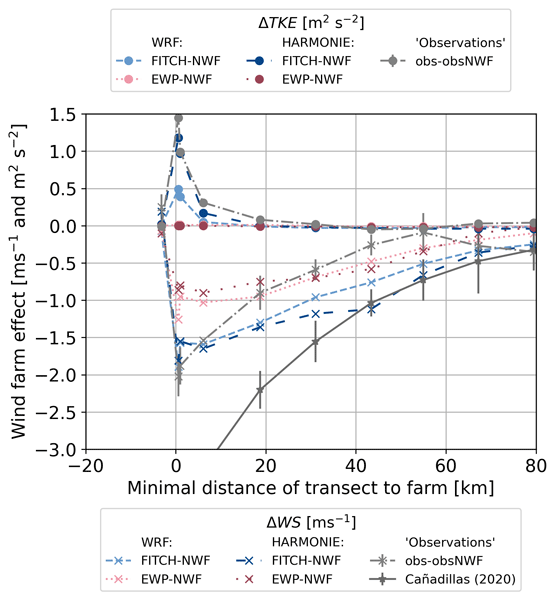
Wind farms impact local wind and turbulence. To incorporate these effects in weather forecasting, the explicit wake parameterization (EWP) is added to the forecasting model HARMONIE–AROME. We evaluate EWP using flight data above and downstream of wind farms, comparing it with an alternative wind farm parameterization and another weather model. Results affirm the correct implementation of EWP, emphasizing the necessity of accounting for wind farm effects in accurate weather forecasting.
Eva Sebok, Hans Jørgen Henriksen, Ernesto Pastén-Zapata, Peter Berg, Guillaume Thirel, Anthony Lemoine, Andrea Lira-Loarca, Christiana Photiadou, Rafael Pimentel, Paul Royer-Gaspard, Erik Kjellström, Jens Hesselbjerg Christensen, Jean Philippe Vidal, Philippe Lucas-Picher, Markus G. Donat, Giovanni Besio, María José Polo, Simon Stisen, Yvan Caballero, Ilias G. Pechlivanidis, Lars Troldborg, and Jens Christian Refsgaard
Hydrol. Earth Syst. Sci., 26, 5605–5625, https://doi.org/10.5194/hess-26-5605-2022, https://doi.org/10.5194/hess-26-5605-2022, 2022
Short summary
Short summary
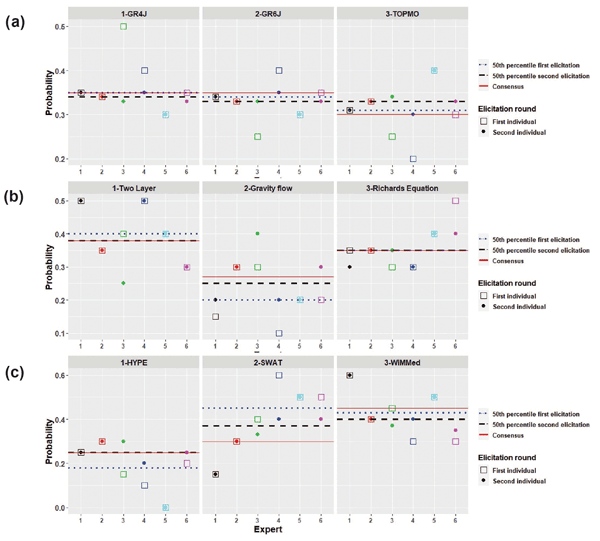
Hydrological models projecting the impact of changing climate carry a lot of uncertainty. Thus, these models usually have a multitude of simulations using different future climate data. This study used the subjective opinion of experts to assess which climate and hydrological models are the most likely to correctly predict climate impacts, thereby easing the computational burden. The experts could select more likely hydrological models, while the climate models were deemed equally probable.
Erika Médus, Emma D. Thomassen, Danijel Belušić, Petter Lind, Peter Berg, Jens H. Christensen, Ole B. Christensen, Andreas Dobler, Erik Kjellström, Jonas Olsson, and Wei Yang
Nat. Hazards Earth Syst. Sci., 22, 693–711, https://doi.org/10.5194/nhess-22-693-2022, https://doi.org/10.5194/nhess-22-693-2022, 2022
Short summary
Short summary
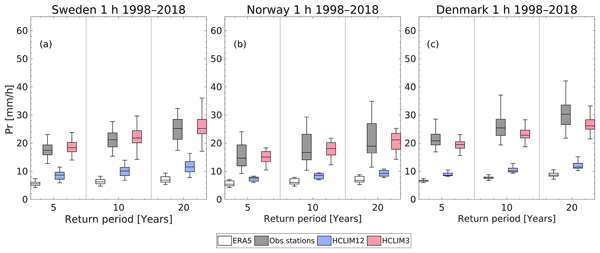
We evaluate the skill of a regional climate model, HARMONIE-Climate, to capture the present-day characteristics of heavy precipitation in the Nordic region and investigate the added value provided by a convection-permitting model version. The higher model resolution improves the representation of hourly heavy- and extreme-precipitation events and their diurnal cycle. The results indicate the benefits of convection-permitting models for constructing climate change projections over the region.
Cited articles
Bengtsson, L., I., H. K., and Keenlyside, N.: Will extratropical storms intensify in a warmer climate, J. Climate, 22, 2276–2301, https://doi.org/10.1175/2008JCLI2678.1, 2009. a
Bengtsson, L., Andrae, U., Aspelien, T., Batrak, Y., Calvo, J., De Roy, W., Gleeson, E., Hansen-Sass, B., Homleid, M., Hortal, M., Ivarsson, K., Lenderink, G., Niemelä, S., Nielsen, C. P., Onvlee, J., Rontu, L., Samuelsson, P., Munoz, D. S., Subias, A., Tijm, S., Toll, V., Yang, X., and Køltzow, M.: The HARMONIE-AROME Model Configuration in the ALADINE-HIRLAM NWP System, Mon. Weather Rev., 145, 1919–1935, 2017. a, b
Brogli, R., Heim, C., Mensch, J., Sørland, S. L., and Schär, C.: The pseudo-global-warming (PGW) approach: methodology, software package PGW4ERA5 v1.1, validation, and sensitivity analyses, Geosci. Model Dev., 16, 907–926, https://doi.org/10.5194/gmd-16-907-2023, 2023. a
Catto, J. L.: Extratropical cyclone classification and its use in climate studies, Rev. Geophys., 54, 486–520, https://doi.org/10.1002/2016RG000519, 2016. a, b
Christensen, J. H. and Christensen, O. B.: Severe summertime flooding in Europe, Nature, 421, 805, https://doi.org/10.1038/421805a, 2003. a
Ciullo, A., Martius, O., Strobl, E., and Bresch, D. N.: A framework for building climate storylines based on downward counterfactuals: The case of the European Union solidarity fund, Climate Risk Management, 33, 100349, https://doi.org/10.1016/j.crm.2021.100349, 2021. a
Donat, M. G., Leckebusch, G. C., Wild, S., and Ulbrich, U.: Future changes in European winter storm losses and extreme wind speeds inferred from GCM and RCM multi-model simulations, Nat. Hazards Earth Syst. Sci., 11, 1351–1370, https://doi.org/10.5194/nhess-11-1351-2011, 2011a. a
Donat, M. G., Pardowitz, T., Leckebusch, G. C., Ulbrich, U., and Burghoff, O.: High-resolution refinement of a storm loss model and estimation of return periods of loss-intensive storms over Germany, Nat. Hazards Earth Syst. Sci., 11, 2821–2833, https://doi.org/10.5194/nhess-11-2821-2011, 2011b. a
European Centre for Medium-Range Weather Forecasts (ECMWF): cfgrib: Python interface to map GRIB files to xarray, version 0.9.10.4, GitHub [code], https://github.com/ecmwf/cfgrib (last access: 25 July 2025), 2023a. a
European Centre for Medium-Range Weather Forecasts (ECMWF): ecCodes: ECMWF encoding/decoding software library for GRIB and BUFR formats, version 1.5.0, GitHub [code], https://github.com/ecmwf/eccodes (last access: 25 July 2025), 2023b. a
Eady, E.: Long Waves and Cyclone Waves, Tellus, 1, 1–71, https://doi.org/10.1111/j.2153-3490.1949.tb01265.x, 1949. a
Ermis, S., Leach, N. J., Lott, F. C., Sparrow, S. N., and Weisheimer, A.: Event attribution of a midlatitude windstorm using ensemble weather forecasts, Environmental research: Climate, 3, https://doi.org/10.1088/2752-5295/ad4200, 2024. a
Federer, M., Papritz, L., Sprenger, M., and Grams, C. M.: Synoptic perspective on the conversion and maintenance of local available potential energy in extratropical cyclones, Weather Clim. Dynam., 6, 211–230, https://doi.org/10.5194/wcd-6-211-2025, 2025. a
Feser, F., Barcikowska, M., Krueger, O., Schenk, F., Weisse, R., and Xia, L.: Storminess over the North Atlantic and northwestern Europe – A review, Q. J. Roy. Meteor. Soc., 141, 350–382, https://doi.org/10.1002/qj.2364, 2015. a
Fink, A. H., Pohle, S., Pinto, J. G., and Knippertz, P.: Diagnosing the influence of diabatic processes on the explosive deepening of extratropical cyclones, Geophys. Res. Lett., 39, https://doi.org/10.1029/2012GL051025, 2012. a
Fischer, E. M. and Knutti, R.: Anthropogenic contribution to global occurrence of heavy-precipitation and high-temperature extremes, Nat. Clim. Change, 5, 560–565, 2015. a
Gliksman, D., Averbeck, P., Becker, N., Gardiner, B., Goldberg, V., Grieger, J., Handorf, D., Haustein, K., Karwat, A., Knutzen, F., Lentink, H. S., Lorenz, R., Niermann, D., Pinto, J. G., Queck, R., Ziemann, A., and Franzke, C. L. E.: Review article: A European perspective on wind and storm damage – from the meteorological background to index-based approaches to assess impacts, Nat. Hazards Earth Syst. Sci., 23, 2171–2201, https://doi.org/10.5194/nhess-23-2171-2023, 2023. a, b
Grinsted, A., Ditlevsen, P., and Christensen, J.: Normalized US hurricane damage estimates using area of total destruction, P. Natl. Acad. Sci. USA, 48, https://doi.org/10.1073/pnas.1912277116, 2019. a
Hawkins, E., Compo, G. P., and Sardeshmukh, P. D.: ESD Ideas: Translating historical extreme weather events into a warmer world, Earth Syst. Dynam., 14, 1081–1084, https://doi.org/10.5194/esd-14-1081-2023, 2023. a
Hersbach, H., Bell, B., Berrisford, P., Hirahara, S., Horányi, A., Muñoz-Sabater, J., Nicolas, J., Peubey, C., Radu, R., Schepers, D., Simmons, A., Soci, C., Abdalla, S., Abellan, X., Balsamo, G., Bechtold, P., Biavati, G., Bidlot, J., Bonavita, M., De Chiara, G., Dahlgren, P., Dee, D., Diamantakis, M., Dragani, R., Flemming, J., Forbes, R., Fuentes, M., Geer, A., Haimberger, L., Healy, S., Hogan, R. J., Hólm, E., Janisková, M., Keeley, S., Laloyaux, P., Lopez, P., Lupu, C., Radnoti, G., de Rosnay, P., Rozum, I., Vamborg, F., Villaume, S., and Thépaut, J.-N.: The ERA5 global reanalysis, Q. J. Roy. Meteor. Soc., 146, 1999–2049, https://doi.org/10.1002/qj.3803, 2020. a
Hibino, K., Takayabu, I., Wakazuki, Y., and Ogata, T.: Physical responses of convective heavy rainfall to future warming condition: Case study of the Hiroshima event, Front. Earth Sci., 6, 35, https://doi.org/10.3389/feart.2018.00035, 2018. a, b
Hoyer, S. and Hamman, J.: xarray: N-D labeled arrays and datasets in Python, version 2023.7.0, J. Open Res. Softw., 5, https://doi.org/10.5334/jors.148, 2023. a
IPCC: Climate Scenarios and Model Experiments, Chap. 4, 140–200, Cambridge University Press, https://doi.org/10.1017/9781009157896.006, 2021a. a
IPCC: Weather and Climate Extreme Events in a Changing Climate, Chap. 11, 1513–1766, Cambridge University Press, https://doi.org/10.1017/9781009157896.013, 2021b. a
IPCC: Weather and Climate Extreme Events in a Changing Climate, in: Climate Change 2021: The Physical Science Basis. Contribution of Working Group I to the Sixth Assessment Report of the Intergovernmental Panel on Climate Change, edited by: Seneviratne, S. I., Zhang, X., Adnan, M., Badi, W., Dereczynski, C., Di Luca, A., Ghosh, S., Iskandar, I., Kossin, J., Lewis, S., Otto, F., Pinto, I., Satoh, M., Vicente-Serrano, S. M., Wehner, M., and Zhou, B., IPCC, 6, 1513–1765, https://doi.org/10.1017/9781009157896.013, 2021c. a
Klawa, M. and Ulbrich, U.: A model for the estimation of storm losses and the identification of severe winter storms in Germany, Nat. Hazards Earth Syst. Sci., 3, 725–732, https://doi.org/10.5194/nhess-3-725-2003, 2003. a, b
Laurila, T. K., Gregow, H., Cornér, J., and Sinclair, V. A.: Characteristics of extratropical cyclones and precursors to windstorms in northern Europe, Weather Clim. Dynam., 2, 1111–1130, https://doi.org/10.5194/wcd-2-1111-2021, 2021. a
Leckebusch, G. C., Renggli, D., and Ulbrich, U.: Development and application of an objective storm severity measure for the Northeast Atlantic region, Meteorol. Z., 17, 575–587, https://doi.org/10.1127/0941-2948/2008/0323, 2008. a
Li, M., Woollings, T., Hodges, K., and Masato, G.: Extratropical cyclones in a warmer, moister climate: A recent Atlantic analogue, Geophys. Res. Lett., 41, 8594–8601, https://doi.org/10.1002/2014GL062186, 2014. a
Lindsey, R. and Dahlmann, L.: Climate change: global temperature, https://www.climate.gov/news-features/understanding-climate/climate-change-global-temperature, last access: 8 January 2025. a
Little, A. S., Priestley, M. D. K., and Catto, J. L.: Future increased risk from extratropical windstorms in northern Europe, Nat. Commun., 14, 4434, https://doi.org/10.1038/s41467-023-40102-6, 2023. a, b
Lorenz, R., Becker, N., Gardiner, B., Ulbrich, U., Hanewinkel, M., and Schmitz, B.: Tree fall along railway lines: modelling the impact of wind and other meteorological factors, Nat. Hazards Earth Syst. Sci., 25, 2179–2196, https://doi.org/10.5194/nhess-25-2179-2025, 2025. a
Lynn, B. A. and Stathopoulos, T.: Wind-induced fatigue on low metal buildings., J. Struct. Eng., 11, 826–839, 1985. a
Nielsen, N. W. and Sass, B. H.: A numerical, high-resolution study of the life cycle of the severe storm over Denmark on 3 December 1999, Tellus A, 55A, 338–351, https://doi.org/10.3402/tellusa.v55i4.12100, 2003. a, b
Nilsson, C., Goyette, S., and Bärring, L.: Relating forest damage data to the wind field from high-resolution RCM simulations: Case study of Anatol striking Sweden in December 1999, Global Planet. Change, 57, 161–176, https://doi.org/10.1016/j.gloplacha.2006.11.011, 2007. a
Philip, S., Kew, S., van Oldenborgh, G. J., Otto, F., Vautard, R., van der Wiel, K., King, A., Lott, F., Arrighi, J., Singh, R., and van Aalst, M.: A protocol for probabilistic extreme event attribution analyses, Adv. Stat. Clim. Meteorol. Oceanogr., 6, 177–203, https://doi.org/10.5194/ascmo-6-177-2020, 2020. a
Prahl, B. F., Rybski, D., Kropp, J. P., Burghoff, O., and Held, H.: Applying stochastic small-scale damage functions to German winter storms, Geophys. Res. Lett., 39, https://doi.org/10.1029/2012GL050961, 2012. a
Priestley, M. D. K. and Catto, J. L.: Future changes in the extratropical storm tracks and cyclone intensity, wind speed, and structure, Weather Clim. Dynam., 3, 337–360, https://doi.org/10.5194/wcd-3-337-2022, 2022. a
Ruosteenoja, K., Vihma, T., and Venäläinen, A.: Projected Changes in European and North Atlantic Seasonal Wind Climate Derived from CMIP5 Simulations, J. Climate, 32, 6467–6490, https://doi.org/10.1175/JCLI-D-19-0023.1, 2019. a
Schär, C., Frei, C., Lüthi, D., and Davies, H. C.: Surrogate climate-change scenarios for regional climate models, Geophys. Res. Lett., 23, 669–672, https://doi.org/10.1029/96GL00265, 1996. a
Severino, L. G., Kropf, C. M., Afargan-Gerstman, H., Fairless, C., de Vries, A. J., Domeisen, D. I. V., and Bresch, D. N.: Projections and uncertainties of winter windstorm damage in Europe in a changing climate, Nat. Hazards Earth Syst. Sci., 24, 1555–1578, https://doi.org/10.5194/nhess-24-1555-2024, 2024. a
Shepherd, T., Boyd, E., Calel, R., Chapman, S. C., Dessai, S., Dima-West, I. M., Fowler, H. J., James, R., Maraun, D., Martius, O., Senior, C. A., Sobel, A. H., Stainforth, D. A., Tett, S. F. B., Trendberth, K. E., van der Hurk, B. J. J. M., Watkins, N. W., Wilby, R. L., and Zenghelis, D. A.: Storylines: an alternative approach to representing uncertainty in physical aspects of climate change., Clim. Change, 151, 555–571, https://doi.org/10.1007/s10584-018-2317-9, 2018. a
Shepherd, T. G.: Storyline approach to the construction of regional climate change information, P. Roy. Soc. A, 475, 20190013, https://doi.org/10.1098/rspa.2019.0013, 2019. a
Sillmann, J., Shepherd, T. G., van den Hurk, B., Hazeleger, W., Martius, O., Slingo, J., and Zscheischler, J.: Event-Based Storylines to Address Climate Risk, Earth's Future, 9, e2020EF001783, https://doi.org/10.1029/2020EF001783, 2021. a
Souto-Ceccon, P. E., Montes, J., Duo, E., Ciavola, P., Fernández-Montblanc, T., and Armaroli, C.: A European database of resources on coastal storm impacts, Earth Syst. Sci. Data, 17, 1041–1054, https://doi.org/10.5194/essd-17-1041-2025, 2025. a
The WASA Group: Changing waves and storms in the Northeast Atlantic?, B. Am. Meteorol. Soc., 79, 741–760, https://doi.org/10.1175/1520-0477(1998)079<0741:CWASIT>2.0.CO;2, 1998. a
Trenberth, K. E., Fasullo, J. T., and Shepherd, T. G.: Attribution of climate extreme events, Nat. Clim. Change, 5, 725–730, https://doi.org/10.1038/NCLIMATE2657, 2015. a
Ulbrich, U., Fink, A. H., Klawa, M., and Pinto, J. G.: Three extreme storms over Europe in December 1999, Weather, 56, 70–80, https://doi.org/10.1002/j.1477-8696.2001.tb06540.x, 2001. a, b, c, d
Ulbrich, U., Leckebusch, G. C., and Pinto, J. G.: Extra-tropical cyclones in the present and future climate: a review, Theor. Appl. Climatol., 96, 117–131, https://doi.org/10.1007/s00704-008-0083-8, 2009. a, b
Voldborg, H.: Vredens julemåned, Vejret, 82, 1–7, 2000. a
Wang, J., Liu, Y., and Zhang, Z.: Fatigue Damage and Reliability Assessment of Wind Turbine Structure During Service Utilizing Real-Time Monitoring Data, Buildings, 14, https://doi.org/10.3390/buildings14113453, 2024. a
WMO, W. M. O.: International meteorological vocabulary, 2nd edn., World Meteorological Organization, Geneva, Switzerland, ISBN 978-92-63-02182-3, 1992. a
Woth, K., Weisse, R., and von Storch, H.: Climate change and North Sea storm surge extremes: an ensemble study of storm surge extremes expected in a changed climate projected by four different regional climate models., Ocean Dynam., 56, 3–15, https://doi.org/10.1007/s10236-005-0024-3, 2005. a
Short summary
This study explores how a powerful storm like Anatol, which hit Denmark in 1999, could change in a warmer future climate. Using a weather model, the storm was simulated under future temperature conditions. Results show stronger winds affecting larger areas for longer periods. A new index was introduced to measure storm severity. The findings highlight the growing risks to infrastructure and the need for better storm preparedness.
This study explores how a powerful storm like Anatol, which hit Denmark in 1999, could change in...


Altmetrics
Final-revised paper
Preprint