
Articles | Volume 25, issue 2
https://doi.org/10.5194/nhess-25-929-2025
© Author(s) 2025. This work is distributed under
the Creative Commons Attribution 4.0 License.
the Creative Commons Attribution 4.0 License.
https://doi.org/10.5194/nhess-25-929-2025
© Author(s) 2025. This work is distributed under
the Creative Commons Attribution 4.0 License.
the Creative Commons Attribution 4.0 License.
Review article
| 
28 Feb 2025
Review article |
| 28 Feb 2025
| 28 Feb 2025
Review article: A scoping review of human factors in avalanche decision-making

CARE (Center for Avalanche Research and Education), UiT The Arctic University of Norway, Tromsø, Norway
Department of Psychology, Faculty of Health Sciences, UiT The Arctic University of Norway, Tromsø, Norway
Rebecca A. Hetland
Department of Community Medicine, Faculty of Health Sciences, UiT The Arctic University of Norway, Tromsø, Norway
Tarjei Tveito Skille
CARE (Center for Avalanche Research and Education), UiT The Arctic University of Norway, Tromsø, Norway
Department of Psychology, Faculty of Health Sciences, UiT The Arctic University of Norway, Tromsø, Norway
Andrea Mannberg
CARE (Center for Avalanche Research and Education), UiT The Arctic University of Norway, Tromsø, Norway
School of Business and Economics, Faculty of Biosciences, Fisheries and Economics, UiT The Arctic University of Norway, Tromsø, Norway
Related authors
Audun Hetland, Olav K. Myksvoll, Tarjei Westerlund, Andrea Mannberg, and Rebecca A. Hetland
Nat. Hazards Earth Syst. Sci., 26, 4353–4355, https://doi.org/10.5194/nhess-26-4353-2026, https://doi.org/10.5194/nhess-26-4353-2026, 2026
Short summary
Short summary
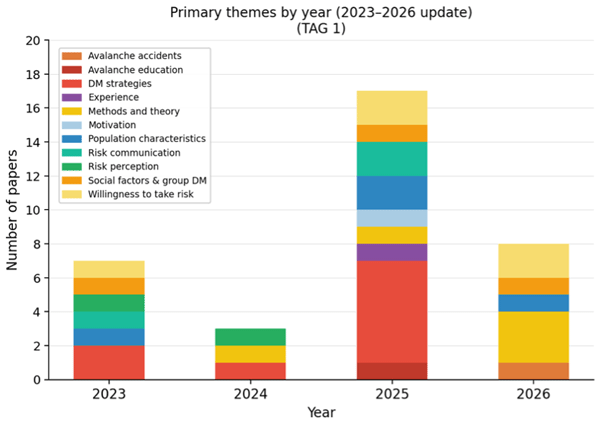
Every year, people are caught in avalanches they themselves triggered, and most had some safety training. This study asked what research has learned about how people make decisions in avalanche terrain. We reviewed 35 recent studies and found growth concentrated in decision strategies and methods, with cognitive bias research notably absent. The findings point toward causal research designs and field-based education that meets recreationists where they actually are in the mountains.
This article is included in the Encyclopedia of Geosciences
Håvard B. Toft, John Sykes, Andrew Schauer, Jordy Hendrikx, and Audun Hetland
Nat. Hazards Earth Syst. Sci., 24, 1779–1793, https://doi.org/10.5194/nhess-24-1779-2024, https://doi.org/10.5194/nhess-24-1779-2024, 2024
Short summary
Short summary
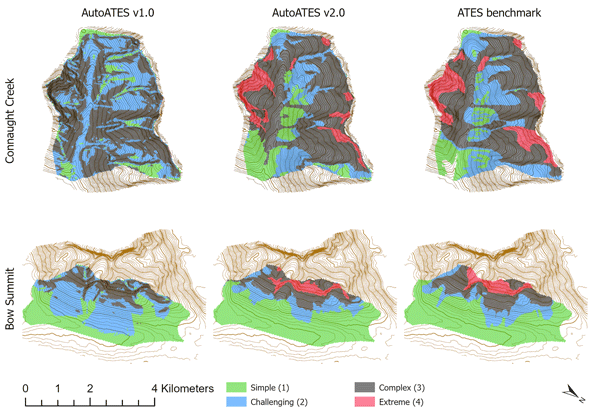
Manual Avalanche Terrain Exposure Scale (ATES) mapping is time-consuming and inefficient for large-scale applications. The updated algorithm for automated ATES mapping overcomes previous limitations by including forest density data, improving the avalanche runout estimations in low-angle runout zones, accounting for overhead exposure and open-source software. Results show that the latest version has significantly improved its performance.
This article is included in the Encyclopedia of Geosciences
Audun Hetland, Olav K. Myksvoll, Tarjei Westerlund, Andrea Mannberg, and Rebecca A. Hetland
Nat. Hazards Earth Syst. Sci., 26, 4353–4355, https://doi.org/10.5194/nhess-26-4353-2026, https://doi.org/10.5194/nhess-26-4353-2026, 2026
Short summary
Short summary
Every year, people are caught in avalanches they themselves triggered, and most had some safety training. This study asked what research has learned about how people make decisions in avalanche terrain. We reviewed 35 recent studies and found growth concentrated in decision strategies and methods, with cognitive bias research notably absent. The findings point toward causal research designs and field-based education that meets recreationists where they actually are in the mountains.
This article is included in the Encyclopedia of Geosciences
Håvard B. Toft, John Sykes, Andrew Schauer, Jordy Hendrikx, and Audun Hetland
Nat. Hazards Earth Syst. Sci., 24, 1779–1793, https://doi.org/10.5194/nhess-24-1779-2024, https://doi.org/10.5194/nhess-24-1779-2024, 2024
Short summary
Short summary
Manual Avalanche Terrain Exposure Scale (ATES) mapping is time-consuming and inefficient for large-scale applications. The updated algorithm for automated ATES mapping overcomes previous limitations by including forest density data, improving the avalanche runout estimations in low-angle runout zones, accounting for overhead exposure and open-source software. Results show that the latest version has significantly improved its performance.
This article is included in the Encyclopedia of Geosciences
Cited articles
Alicke, M. D. and Sedikides, C.: Self-enhancement and self-protection: What they are and what they do, Eur. Rev. Soc. Psychol., 20, 1–48, https://doi.org/10.1080/10463280802613866, 2009.
Anders Ericsson, K.: Deliberate practice and acquisition of expert performance: a general overview, Acad. Emerg. Med., 15, 988–994, 2008.
Baker, J. and McGee, T. K.: Backcountry snowmobilers' avalanche-related information-seeking and preparedness behaviors, Soc. Nat. Resour., 29, 345–356, https://doi.org/10.1080/08941920.2015.1103387, 2016.
Balasubramanian, S. G. and Louvar, J. F.: Study of major accidents and lessons learned, Process Saf. Prog., 21, 237–244, 2002.
Barnes Jr., J. H.: Cognitive biases and their impact on strategic planning, Strateg. Manage. J., 5, 129–137, 1984.
Bartolucci, A., Aquilino, M. C., Bril, L., Duncan, J., and van Steen, T.: Effectiveness of audience segmentation in instructional risk communication: A systematic literature review, Int. J. Disast. Risk Re., 95, 103872, https://doi.org/10.1016/j.ijdrr.2023.103872, 2023.
Berlin, C., Techel, F., Moor, B. K., Zwahlen, M., Hasler, R. M., and Swiss National Cohort study group: Snow avalanche deaths in Switzerland from 1995 to 2014 – Results of a nation-wide linkage study, PLoS One, 14, e0225735, https://doi.org/10.1371/journal.pone.0225735, 2019.
Bonini, N., Pighin, S., Rettore, E., Savadori, L., Schena, F., Tonini, S., and Tosi, P.: Overconfident people are more exposed to “black swan” events: a case study of avalanche risk, Empir. Econ., 57, 1443–1467, https://doi.org/10.1007/s00181-018-1489-5, 2019.
Bougheas, S., Nieboer, J., and Sefton, M.: Risk-taking in social settings: Group and peer effects, J. Econ. Behav. Organ., 92, 273–283, 2013.
Cartwright, D.: Determinants of scientific progress: The case of research on the risky shift, Am. Psychol., 28, 222, https://doi.org/10.1037/h0034445, 1973.
Cedergren, A. and Petersen, K.: Prerequisites for learning from accident investigations – A cross-country comparison of national accident investigation boards, Safety Sci., 49, 1238–1245, 2011.
Ciocoiu, C. N. and Neicu, D.: Education and Professional Training in the Field of Risk Management, Economia Seria Management, 10, 12–26, 2007.
Croft, J.: The Lessons to be Learned from Incidents and Accidents, in: Current trends in radiation protection, EDP Sciences, 149–164, https://doi.org/10.1051/978-2-86883-725-7.c015, 2020.
Croskerry, P., Singhal, G., and Mamede, S. ilvia: Cognitive debiasing 1: origins of bias and theory of debiasing, BMJ Qual. Saf., 22, ii58–ii64, 2013.
Della Porta, D. and Keating, M. (Eds.): Approaches and methodologies in the social sciences: A pluralist perspective, Cambridge University Press, ISBN 9780511801938, https://doi.org/10.1017/CBO9780511801938, 2008.
Dohmen, T., Falk, A., Huffman, D., Sunde, U., Schupp, J., and Wagner, G. G.: Individual risk attitudes: Measurement, determinants, and behavioral consequences, J. Eur. Econ. Assoc., 9, 522–550, 2011.
Dohmen, T. Quercia, S., and Willrodt, J.: Willingness to Take Risk: The Role of Risk Conception and Optimism, IZA Discussion Paper No. 11642, https://doi.org/10.2139/ssrn.3209739, 2018.
Ebert, P. A. and Morreau, M.: Safety in numbers: how social choice theory can inform avalanche risk management, Journal of Adventure Education and Outdoor Learning, 23, 340–356, 2023.
Engeset, R. V., Pfuhl, G., Landrø, M., Mannberg, A., and Hetland, A.: Communicating public avalanche warnings – what works?, Nat. Hazard. Earth Sys., 18, 2537–2559, https://doi.org/10.5194/nhess-18-2537-2018, 2018.
Fischhoff, B.: Risk perception and communication, in: Oxford Textbook of Global Public Health, Oxford University Press, 893–906, ISBN 9780203140710, 2015.
Fisher, K. C., Haegeli, P., and Mair, P.: Exploring the avalanche bulletin as an avenue for continuing education by including learning interventions, Journal of Outdoor Recreation and Tourism, 37, 100472, https://doi.org/10.1016/j.jort.2021.100472, 2022.
Fruhaüf, A., Hardy, W. A., Pfoestl, D., Hoellen, F.-G., and Kopp, M.: A qualitative approach on motives and aspects of risks in freeriding, Front. Psychol., 8, 1998, https://doi.org/10.3389/fpsyg.2017.01998, 2017.
Frühauf, A., Anewanter, P., Hagenauer, J., Marterer, N., and Kopp, M.: Freeriding – Only a need for thrill?: Comparing different motives and behavioural aspects between slope skiers and freeride skiers, J. Sci. Med. Sport, 22, S44–S49, 2019.
Frühauf, A., Zenzmaier, J., and Kopp, M.: Does age matter? A qualitative comparison of motives and aspects of risk in adolescent and adult freeriders, J. Sports Sci. Med., 19, 112–120, 2020.
Furman, N., Shooter, W., and Schumann, S.: The roles of heuristics, avalanche forecast, and risk propensity in the decision making of backcountry skiers, Leisure Sci., 32, 453–469, 2010.
Gigerenzer, G. and Gaissmaier, W.: Heuristic decision making, Annu. Rev. Psychol., 62, 451–482, 2011.
Glik, D. C.: Risk Communication for Public Health Emergencies, Annu. Rev. Publ. Health, 28, 33–54, 2007.
Greene, K., Hendrikx, J., and Johnson, J.: The impact of avalanche education on risk perception, confidence, and decision-making among backcountry skiers, Leisure Sci., 47, 113–133, https://doi.org/10.1080/01490400.2022.2062075, 2022.
Grimsdottir, H. and McClung, D.: Avalanche risk during backcountry skiing – An analysis of risk factors, Nat. Hazards, 39, 127–153, https://doi.org/10.1007/s11069-005-5227-x, 2006.
Haegeli, P., Gunn, M., and Haider, W.: Identifying a High-Risk Cohort in a Complex and Dynamic Risk Environment: Out-of-bounds Skiing – An Example from Avalanche Safety, Prev. Sci., 13, 562–573, https://doi.org/10.1007/s11121-012-0282-5, 2012.
Haegeli, P., Falk, M., Procter, E., Zweifel, B., Jarry, F., Logan, S., Kronholm, K., Biskupiè, M., and Brugger, H.: The effectiveness of avalanche airbags, Resuscitation, 85, 1197–1203, 2014.
Haegeli, P., Clair, A. S., McNeil, K., Mannberg, A., and Hetland, A.: Reflections on How to Improve the Contribution of Social Science Research to Avalanche Safety Practices, in: Proceedings of the 2023 International Snow Science Workshop, October 2023, Banf, USA, 8–13, https://arc.lib.montana.edu/snow-science/objects/ISSW2023_O3.01.pdf (last access: 12 February 2025), 2023.
Hallandvik, L., Andresen, M. S., and Aadland, E.: Decision-making in avalanche terrain–How does assessment of terrain, reading of avalanche forecast and environmental observations differ by skiers' skill level?, Journal of Outdoor Recreation and Tourism, 20, 45–51, 2017.
Hammond, J. S., Keeney, R. L., and Raiffa, H.: The hidden traps in decision making, Harvard Business Rev., 76, 47–58, 1998.
Hart, P.: Irving L. Janis' victims of groupthink, Polit. Psychol., 12, 247–278., https://doi.org/10.2307/3791464, 1991.
Hertwig, R. and Erev, I.: The description–experience gap in risky choice, Trends Cogn. Sci., 13, 517–523, 2009.
Herzog, T.: Research Methods in the Social Sciences, Harper Collins, New York, NY, ISBN 0673991067, 1996.
Hetland, A.: Literature review, OSF [data set], https://doi.org/10.17605/OSF.IO/U9YDM, 2024.
Hetland, A., Vittersø, J., Wie, S. O. B., Kjelstrup, E., Mittner, M., and Dahl, T. I.: Skiing and thinking about it: moment-to-moment and retrospective analysis of emotions in an extreme sport, Front. Psychol., 9, 971, https://doi.org/10.3389/fpsyg.2018.00971, 2018.
Hetland, A., Skille, T. T., Mannberg, A., Kristensen, T., and Hjelm, I.: Buried alive: A qualitative study of avalanche survivors' learning experience after an avalanche accident, in: International Snow Science Workshop, September 2024, Tromsø, Norway, https://arc.lib.montana.edu/snow-science/objects/ISSW2024_O11.8.pdf (last access: 12 February 2025), 2024.
Hetschko, C. and Preuss, M.: Income in jeopardy: How losing employment affects the willingness to take risks, J. Econ. Psychol., 79, 102175, https://doi.org/10.1016/j.joep.2019.05.005, 2020.ÿ
Hicks, S. and Brown, S.: Perceptions of risk, International Review of Victimology, 19, 249–267, 2013.
Hirschberger, G., Florian, V., Mikulincer, M., Goldenberg, J. L., and Pyszczynski, T.: Gender differences in the willingness to engage in risky behavior: a terror management perspective, Death Stud., 26, 117–141, 2002.
Hogarth, R. M., Lejarraga, T., and Soyer, E.: The two settings of kind and wicked learning environments, Curr. Dir. Psychol. Sci., 24, 379–385, 2015.
Hornby, O., Roderique-Davies, G., Heirene, R., Thorkildsen, E., Bradbury, S., Rowlands, I., Goodison, E., Gill, J., and Shearer, D.: What factors explain extreme sport participation? A systematic review, Frontiers in Sports and Active Living, 6, 1403499, https://doi.org/10.3389/fspor.2024.1403499, 2024.
Hovden, J., Størseth, F., and Tinmannsvik, R. K.: Multilevel learning from accidents – Case studies in transport, Safety Sci., 49, 98–105, 2011.
Isen, A. M. and Patrick, R.: The effect of positive feelings on risk taking: When the chips are down, Organ. Behav. Hum. Perf., 31, 194–202, 1983.
Jackman, P. C., Hawkins, R. M., Burke, S. M., Swann, C., and Crust, L.: The psychology of mountaineering: a systematic review, Int. Rev. Sport Exerc. Psychol., 16, 27–65, 2023.
Jekich, B. M., Drake, B. D., Nacht, J. Y., Nichols, A., Ginde, A. A., and Davis, C. B.: Avalanche Fatalities in the United States: A Change in Demographics, Wilderness Environ. Med., 27, 46–52, https://doi.org/10.1016/j.wem.2015.11.004, 2016.
Joffe, H.: Risk: From perception to social representation, Br. J. Soc. Psychol., 42, 55–73, 2003.
Johnson, J, and Hendrikx, J.: Using Citizen Science to Document Terrain Use and Decision-Making of Backcountry Users, Citizen Science: Theory and Practice, 6, 8, https://doi.org/10.5334/cstp.333, 2021.
Johnson, J., Haegeli, P., Hendrikx, J., and Savage, S.: Accident causes and organizational culture among avalanche professionals, Journal of Outdoor Recreation and Tourism, 13, 49–56, 2016.
Johnson, J., Mannberg, A., Hendrikx, J., Hetland, A., and Stephensen, M.: Rethinking the heuristic traps paradigm in avalanche education: Past, present and future, Cogent Social Sciences, 6, 1807111, https://doi.org/10.1080/23311886.2020.1807111, 2020.
Kahneman, D. and Tversky, A.: Prospect theory: An analysis of decision under risk, in: Handbook of the fundamentals of financial decision making: Part I, World Scientific, 99–127, https://doi.org/10.2307/1914185, 2013.
Keeney, R. L. and von Winterfeldt, D.: Improving Risk Communication, Risk Anal., 6, 417–424, 1986.
Kerr, J. H. and Houge Mackenzie, S.: Multiple motives for participating in adventure sports, Psychology of Sport and Exercise, 13, 649–657, https://doi.org/10.1016/j.psychsport.2012.04.002, 2012.
Kerr, N. L. and Tindale, R. S.: Group performance and decision making, Annu. Rev. Psychol., 55, 623–655, 2004.
Kleindorfer, P. R.: Reflections on Decision Making Under Uncertainty, University of Pennsylvania, https://doi.org/10.2139/ssrn.1310239, 2008.
Knäuper, B., Kornik, R., Atkinson, K., Guberman, C., and Aydin, C.: Motivation influences the underestimation of cumulative risk, Pers. Soc. Psychol. B., 31, 1511–1523, 2005.
Kopp, M., Wolf, M., Ruedl, G., and Burtscher, M.: Differences in Sensation Seeking Between Alpine Skiers, Snowboarders and Ski Tourers, J. Sports Sci. Med., 15, 11–16, 2016.
Kroon, M. B., Hart, P., and Van Kreveld, D.: Managing group decision making processes: Individual versus collective accountability and groupthink, Int. J. Confl. Manage., 2, 91–115, 1991.
Kruglanski, A. W. and Ajzen, I.: Bias and error in human judgment, Eur. J. Soc. Psychol., 13, 1–44, 1983.
Kugler, T., Kausel, E. E., and Kocher, M. G.: Are groups more rational than individuals? A review of interactive decision making in groups, WiRes. Cogn. Sci., 3, 471–482, 2012.
Landrø, M., Hetland, A., Engeset, R. V., and Pfuhl, G.: Avalanche decision-making frameworks: Factors and methods used by experts, Cold Reg. Sci. Technol., 170, 102897, https://doi.org/10.1016/j.coldregions.2019.102897, 2020a.
Landrø, M., Pfuhl, G., Engeset, R., Jackson, M., and Hetland, A.: Avalanche decision-making frameworks: Classification and description of underlying factors, Cold Reg. Sci. Technol., 169, 102903, https://doi.org/10.1016/j.coldregions.2019.102903, 2020b.
Leiter, A. M.: The sense of snow–Individuals' perception of fatal avalanche events, J. Environ. Psychol., 31, 361–372, 2011.
Lindberg, A.-K., Hansson, S. O., and Rollenhagen, C.: Learning from accidents – What more do we need to know?, Safety Sci., 48, 714–721, 2010.
Lipkus, I. M. and Hollands, J. G.: The Visual Communication of Risk, JNCI-J. Natl. Cancer I., 1999, 149–163, 1999.
Løland, S. and Hällgren, M.: `Where to ski?': an ethnography of how guides make sense while planning, Leisure Stud., 42, 866–882, 2023.
Løland, S. and Hällgren, M.: Negotiating the gray zone: Ski guiding routine dynamics, Ann.f Tourism Res., 110, 103858, https://doi.org/10.1016/j.annals.2024.103858, 2025.
Mækelæ, M. J., Klevjer, K., Westbrook, A., Eby, N. S., Eriksen, R., and Pfuhl, G.: Is it cognitive effort you measure? Comparing three task paradigms to the Need for Cognition scale, PLoS One, 18, e0290177, https://doi.org/10.1371/journal.pone.0290177, 2023.
Malone, T. W. and Bernstein, M. S.: Handbook of collective intelligence, MIT Press, ISBN 9780262545846, 2022.
Mannberg, A., Hendrikx, J., Landrø, M., and Stefan, M. A.: Who's at risk in the backcountry? Effects of individual characteristics on hypothetical terrain choices, J. Environ. Psychol., 59, 46–53, 2018.
Mannberg, A., Hendrikx, J., Johnson, J., and Hetland, A.: Powder fever and its impact on decision-making in avalanche terrain, Int. J. Env. Res. Pub. He., 18, 9496, https://doi.org/10.3390/ijerph18189496, 2021a.
Mannberg, A., Hendrikx, J., and Johnson, J.: Risky positioning–social aspirations and risk-taking behaviour in avalanche terrain, Leisure Stud., 40, 495–512, 2021b.
Manson, B.: Understanding risk in an emergency management context, J. Business Contin. Emerg. Plan., 12, 27–39, 2018.
Mathews, A. and Bradle, B.: Mood and the self-reference bias in recall, Behav. Res. Ther., 21, 233–239, https://doi.org/10.1016/0005-7967(83)90204-8, 1983.
Maytorena, E., Winch, G. M., Freeman, J., and Kiely, T.: The Influence of Experience and Information Search Styles on Project Risk Identification Performance, IEEE T. Eng. Manage., 54, 315–326, 2007.
McCammon, I.: Evidence of heuristic traps in recreational avalanche accidents, in: 2002 International Snow Science Workshop, Penticton, BC, Canada, https://arc.lib.montana.edu/snow-science/item/837 (last access: 12 February 2025), 2002.
Michaelsen, B., Stewart-Patterson, I., Rolland, C. G., Hetland, A., and Engeset, R. V.: Behavior in avalanche terrain: an exploratory study of illegal snowmobiling in Norway, Int. J. Env. Res. Pub. He., 19, 6040, https://doi.org/10.3390/ijerph19106040, 2022.
Montibeller, G. and von Winterfeldt, D.: Cognitive and Motivational Biases in Decision and Risk Analysis, Risk Anal., 35, 1230–1251, 2015.
Moura, R., Beer, M., Patelli, E., Lewis, J., and Knoll, F.: Learning from accidents: Interactions between human factors, technology and organisations as a central element to validate risk studies, Safety Sci., 99, 196–214, 2017.
Ng, P., Smith, W. R., Wheeler, A., and McIntosh, S. E.: Advanced Avalanche Safety Equipment of Backcountry Users: Current Trends and Perceptions, Wilderness Environ. Med., 26, 417–421, https://doi.org/10.1016/j.wem.2015.03.029, 2015.
Nichols, T. B., Hawley, A. C., Smith, W. R., Wheeler III, A. R., and McIntosh, S. E.: Avalanche Safety Practices Among Backcountry Skiers and Snowboarders in Jackson Hole in 2016, Wilderness Environ. Med., 29, 493–498, https://doi.org/10.1016/j.wem.2018.05.004, 2018.
Ove Hansson, S.: Decision Making Under Great Uncertainty, Philos. Soc. Sci., 26, 369–386, 1996.
Page, C. E., Atkins, D., Shockley, L. W., and Yaron, M.: Avalanche deaths in the United States: a 45 year analysis, Wilderness Environ. Med., 10, 146–151, https://doi.org/10.1580/1080-6032(1999)010[0146:Aditus]2.3.Co;2, 1999.
Peitzsch, E., Boilen, S., Logan, S., Birkeland, K., and Greene, E.: Research note: How old are the people who die in avalanches? A look into the ages of avalanche victims in the United States (1950–2018), Journal of Outdoor Recreation and Tourism, 29, 100255, https://doi.org/10.1016/j.jort.2019.100255, 2020.
Pfeifer, C.: On probabilities of avalanches triggered by alpine skiers. An empirically driven decision strategy for backcountry skiers based on these probabilities, Nat. Hazards, 48, 425–438, https://doi.org/10.1007/s11069-008-9270-2, 2009.
Plank, A.: The hidden risk in user-generated content: An investigation of ski tourers' revealed risk-taking behavior on an online outdoor sports platform, Tourism Manage., 55, 289–296, https://doi.org/10.1016/j.tourman.2016.02.013, 2016.
Polasky, S., Carpenter, S. R., Folke, C., and Keeler, B.: Decision-making under great uncertainty: environmental management in an era of global change, Trends Ecol. Evol., 26, 398–404, 2011.
Pratt, J. W.: Risk aversion in the small and in the large, in: Uncertainty in economics, Elsevier, 59–79, https://doi.org/10.1016/B978-0-12-214850-7.50010-3, 1978.
Pronin, E.: Perception and misperception of bias in human judgment, Trends Cogn. Sci., 11, 37–43, 2007.
Raue, M., Streicher, B., Lermer, E., and Frey, D.: Being active when judging risks: bodily states interfere with accurate risk analysis, J. Risk Res., 20, 445–462, https://doi.org/10.1080/13669877.2015.1057206, 2017.
Reale, C., Salwei, M. E., Militello, L. G., Weinger, M. B., Burden, A., Sushereba, C., Torsher, L. C., Andreae, M. H., Gaba, D. M., and McIvor, W. R.: Decision-making during high-risk events: a systematic literature review, Journal of Cognitive Engineering and Decision Making, 17, 188–212, 2023.
Saly, D., Hendrikx, J., Birkeland, K. W., Challender, S., and Johnson, J.: Using time lapse photography to document terrain preferences of backcountry skiers, Cold Reg. Sci. Technol., 172, 102994, https://doi.org/10.1016/j.coldregions.2020.102994, 2020.
Savage, L.: An empirical investigation into the effect of psychological perceptions on the willingness-to-pay to reduce risk, J. Risk Uncertainty, 6, 75–90, 1993.
Schweizer, J. and Lütschg, M.: Characteristics of human-triggered avalanches, Cold Reg. Sci. Technol., 33, 147–162, 2001.
Sharifpour, M., Walters, G., and Ritchie, B. W.: The mediating role of sensation seeking on the relationship between risk perceptions and travel behavior, Tourism Analysis, 18, 543–557, 2013.
Silverton, N. A., McIntosh, S. E., and Kim, H. S.: Avalanche safety practices in Utah, Wilderness Environ. Med., 18, 264–270, https://doi.org/10.1580/06-weme-or-049r2.1, 2007.
Silverton, N. A., McIntosh, S. E., and Kim, H. S.: Risk Assessment in Winter Backcountry Travel, Wilderness Environ. Med., 20, 269–274, https://doi.org/10.1580/08-weme-or-209r1.1, 2009.
Sjöberg, L.: The methodology of risk perception research, Qual. Quant., 34, 407–418, 2000.
Sjöoberg, L.: Factors in Risk Perception, Risk Anal., 20, 1–12, 2000.
Slovic, P.: Perception of Risk, Science, 236, 280–285, 1987.
Slovic, P., Finucane, M. L., Peters, E., and MacGregor, D. G.: The affect heuristic, Eur. J. Oper. Res., 177, 1333–1352, 2007.
Sole, A. E., Emery, C. A., Hagel, B. E., and Morrongiello, B. A.: Risk Taking in Avalanche Terrain: A Study of the Human Factor Contribution, Clin. J. Sport Med., 20, 445–451, https://doi.org/10.1097/JSM.0b013e3181fc0a6d, 2010.
Soule, B., Reynier, V., Lefevre, B., and Boutroy, E.: Who is at risk in the French mountains? Profiles of the accident victims in outdoor sports and mountain recreation, J. Mt. Sci., 14, 1490–1499, 2017.
Stalker, K.: Managing Risk and Uncertainty in Social Work, J. Soc. Work, 3, 211–233, 2003.
Stasser, G. and Titus, W.: Pooling of unshared information in group decision making: Biased information sampling during discussion., J. Pers. Soc. Psychol., 48, 1467, https://doi.org/10.1037/0022-3514.48.6.1467, 1985.
Stephensen, M. B., Martiny-Huenger, T., and Schulze, C.: Confidence in complex risk judgments: the roles of uncertainty, experience, and affect, OSF, https://doi.org/10.31234/osf.io/gk7xc, 2021a.
Stephensen, M. B., Schulze, C., Landrø, M., Hendrikx, J., and Hetland, A.: Should I judge safety or danger? Perceived risk depends on the question frame, J. Exp. Psychol.: Appl., 27, 485, https://doi.org/10.1037/xap0000354, 2021b.
Sterchi, R. and Haegeli, P.: A method of deriving operation-specific ski run classes for avalanche risk management decisions in mechanized skiing, Nat. Hazards Earth Syst. Sci., 19, 269–285, https://doi.org/10.5194/nhess-19-269-2019, 2019.
Stewart-Patterson, I.: Measuring decision expertise in commercial ski guiding in a more meaningful way, Journal of Outdoor Recreation and Tourism, 13, 44–48, https://doi.org/10.1016/j.jort.2015.11.009, 2016.
Sunstein, C. R. and Hastie, R.: Four Failures of Deliberating Groups, The University of Chicago, https://doi.org/10.2139/ssrn.1121400, 2008.
Sykes, J., Hendrikx, J., Johnson, J., and Birkeland, K. W.: Combining GPS tracking and survey data to better understand travel behavior of out-of-bounds skiers, Appl. Geogr., 122, 102261, https://doi.org/10.1016/j.apgeog.2020.102261, 2020.
Thomas, D. L. and Diener, E.: Memory accuracy in the recall of emotions, J. Pers. Soc. Psychol., 59, 291–297, https://doi.org/10.1037/0022-3514.59.2.291, 1990.
Thumlert, S. and Haegeli, P.: Describing the severity of avalanche terrain numerically using the observed terrain selection practices of professional guides, Nat. Hazards, 91, 89–115, https://doi.org/10.1007/s11069-017-3113-y, 2017.
Tøstesen, G. and Langseth, T.: Freeride Skiing – risk-taking, recognition, and moral boundaries, Frontiers in Sports and Active Living, 3, 650564, https://doi.org/10.3389/fspor.2021.650564, 2021.
Tricco, A. C., Lillie, E., Zarin, W., O'Brien, K. K., Colquhoun, H., Levac, D., Moher, D., Peters, M. D., Horsley, T., and Weeks, L.: PRISMA extension for scoping reviews (PRISMA-ScR): checklist and explanation, Ann. Intern. Med., 169, 467–473, 2018.
Verplanken, B. and Aarts, H.: Habit, attitude, and planned behaviour: is habit an empty construct or an interesting case of goal-directed automaticity?, Eur. Rev. Soc. Psychol., 10, 101–134, 1999.
Wachinger, G., Renn, O., Begg, C., and Kuhlicke, C.: The Risk Perception Paradox – Implications for Governance and Communication of Natural Hazards, Risk Anal., 33, 1049–1065, 2012.
Walcher, M., Haegeli, P., and Fuchs, S.: Risk of death and major injury from natural winter hazards in helicopter and snowcat skiing in Canada, Wilderness Environ. Med., 30, 251–259, 2019.
Walker, E. and Latosuo, E.: Gendered decision-making practices in Alaska's dynamic mountain environments? A study of professional mountain guides, Journal of Outdoor Recreation and Tourism, 13, 18–22, https://doi.org/10.1016/j.jort.2015.11.010, 2016.
Wickens, C. D., Keller, J. W., and Shaw, C.: Human factors in high-altitude mountaineering, J. Hum. Perform. Ext. Environ., 12, 1–19, https://doi.org/10.7771/2327-2937.1065, 2015.
Williams, D. J. and Noyes, J. M.: How does our perception of risk influence decision-making? Implications for the design of risk information, Theoretical Issues in Ergonomics Science, 8, 1–35, 2007.
Witting, M., Filimon, S., and Kevork, S.: Carry along or not? Decision-making on carrying standard avalanche safety gear among ski tourers in a German touring region, Safety Sci., 143, 105406, https://doi.org/10.1016/j.ssci.2021.105406, 2021.
Woodside, A. G.: Informal Group Influence on Risk Taking, J. Marketing Res., 9, 223–225, 1972.
Yudkowsky, E.: Cognitive biases potentially affecting judgment of global risks, Global Catastrophic Risks, Oxford Academic, 91–119, ISBN 9780199606504, 2008.
Zajchowski, C. A. B., Brownlee, M. T. J., and Furman, N. N.: The Dialectical Utility of Heuristic Processing in Outdoor Adventure Education, Journal of Outdoor Recreation Education and Leadership, 8, 119–135, https://doi.org/10.18666/jorel-2016-v8-i2-7697, 2016.
Zweifel, B. and Haegeli, P.: A qualitative analysis of group formation, leadership and decision making in recreation groups traveling in avalanche terrain, Journal of Outdoor Recreation and Tourism, 5–6, 17–26, https://doi.org/10.1016/j.jort.2014.03.001, 2014.
Zweifel, B., Procter, E., Techel, F., Strapazzon, G., and Boutellier, R.: Risk of Avalanche Involvement in Winter Backcountry Recreation: The Advantage of Small Groups, Wilderness Environ. Med., 27, 203–210, https://doi.org/10.1016/j.wem.2015.12.001, 2016.
Short summary
Research on human factors in avalanche decision-making has become increasingly popular in the past 2 decades. The studies span a wide range of disciplines and are published in a variety of journals. To provide an overview of this literature, this study provides a systematic scoping review of human factors in avalanche decision-making. A total of 70 papers fulfilled the search criteria. We extracted data and sorted the papers according to their main themes.
Research on human factors in avalanche decision-making has become increasingly popular in the...


Altmetrics
Final-revised paper
Preprint