
Articles | Volume 25, issue 5
https://doi.org/10.5194/nhess-25-1769-2025
© Author(s) 2025. This work is distributed under
the Creative Commons Attribution 4.0 License.
the Creative Commons Attribution 4.0 License.
https://doi.org/10.5194/nhess-25-1769-2025
© Author(s) 2025. This work is distributed under
the Creative Commons Attribution 4.0 License.
the Creative Commons Attribution 4.0 License.
Research article
| 
28 May 2025
Research article |
| 28 May 2025
| 28 May 2025
An appraisal of the value of simulated weather data for quantifying coastal flood hazard in the Netherlands
KNMI, P.O. Box 201, 3730 AE, De Bilt, the Netherlands
Henk van den Brink
KNMI, P.O. Box 201, 3730 AE, De Bilt, the Netherlands
Related authors
Iris Keizer, Dewi Le Bars, Cees de Valk, André Jüling, Roderik van de Wal, and Sybren Drijfhout
Ocean Sci., 19, 991–1007, https://doi.org/10.5194/os-19-991-2023, https://doi.org/10.5194/os-19-991-2023, 2023
Short summary
Short summary
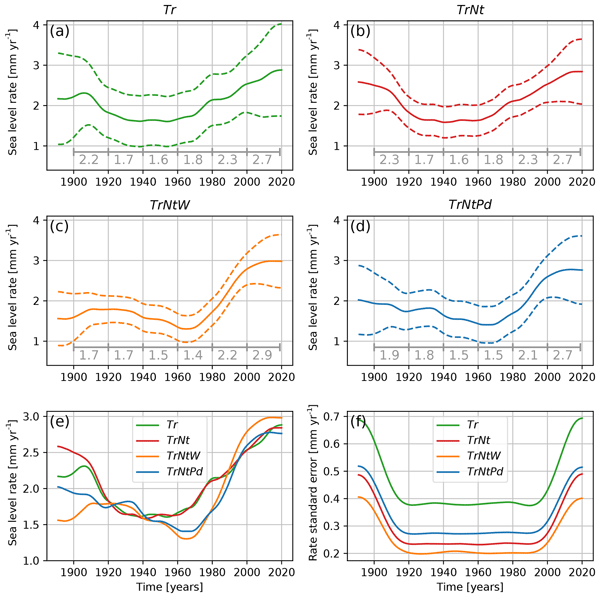
Using tide gauge observations, we show that the acceleration of sea-level rise (SLR) along the coast of the Netherlands started in the 1960s but was masked by wind field and nodal-tide variations. This finding aligns with global SLR observations and expectations based on a physical understanding of SLR related to global warming.
Iris Keizer, Dewi Le Bars, Cees de Valk, André Jüling, Roderik van de Wal, and Sybren Drijfhout
Ocean Sci., 19, 991–1007, https://doi.org/10.5194/os-19-991-2023, https://doi.org/10.5194/os-19-991-2023, 2023
Short summary
Short summary
Using tide gauge observations, we show that the acceleration of sea-level rise (SLR) along the coast of the Netherlands started in the 1960s but was masked by wind field and nodal-tide variations. This finding aligns with global SLR observations and expectations based on a physical understanding of SLR related to global warming.
Cited articles
Baart, F., Bakker, M. A. J., van Dongeren, A., den Heijer, C., van Heteren, S., Smit, M. W. J., van Koningsveld, M., and Pool, A.: Using 18th century storm-surge data from the Dutch Coast to improve the confidence in flood-risk estimates, Nat. Hazards Earth Syst. Sci., 11, 2791–2801, https://doi.org/10.5194/nhess-11-2791-2011, 2011. a
Baatsen, M., Haarsma, R. J., Van Delden, A. J., and De Vries, H.: Severe autumn storms in future western Europe with a warmer Atlantic Ocean, Clim. Dynam., 45, 949–964, 2015. a
Bardet, L., Duluc, C.-M., Rebour, V., and L'Her, J.: Regional frequency analysis of extreme storm surges along the French coast, Nat. Hazards Earth Syst. Sci., 11, 1627–1639, https://doi.org/10.5194/nhess-11-1627-2011, 2011. a
Belmonte Rivas, M. and Stoffelen, A.: Characterizing ERA-Interim and ERA5 surface wind biases using ASCAT, Ocean Sci., 15, 831–852, https://doi.org/10.5194/os-15-831-2019, 2019. a
Bengtsson, L., Hodges, K.I., and Keenlyside, N.: Will extratropical storms intensify in a warmer climate?, J. Climate, 22, 2276–2301, 2009. a
Bevacqua, E., Suarez-Gutierrez, L., Jézéquel, A., Lehner, F., Vrac, M., Yiou, P., and Zscheischler, J.: Advancing research on compound weather and climate events via large ensemble model simulations, Nat. Commun., 14, 2145, https://doi.org/10.1038/s41467-023-37847-5, 2023. a
Bousquet, N. and Bernardara, P.: Extreme value theory with applications to natural hazards, Springer International Publishing, https://doi.org/10.1007/978-3-030-74942-2, 2021. a
Boutle, I. A., Beare, R. J., Belcher, S. E., Brown, A. R., and Plant, R. S.: The moist boundary layer under a mid-latitude weather system, Bound.-Lay. Meteorol., 134, 367–386, 2010. a
Boutle, I. A., Belcher, S. E., and Plant, R. S.: Friction in mid‐latitude cyclones: an Ekman‐PV mechanism, Atmos. Sci. Lett., 16, 103–109, 2015. a
Catto, J. L., Shaffrey, L. C., and Hodges, K. I.: Can climate models capture the structure of extratropical cyclones?, J. Climate, 23, 1621–1635, 2010. a
Coles, S.: An Introduction to Statistical Modelling of Extreme Values, Springer Texts in Statistics, Springer-Verlag London, https://doi.org/10.1007/978-1-4471-3675-0, 2001. a
Cook, N.J.: Towards better estimation of extreme wind, J. Wind Eng. Ind. Aerodyn., 9, 295–323, 1982. a
Curcic, M. and Haus, B. K.: Revised estimates of ocean surface drag in strong winds, Geophys. Res. Lett., 47, e2020GL087647, https://doi.org/10.1029/2020GL087647, 2020. a, b, c
Dee, D. P., Uppala, S. M., Simmons, A. J., Berrisford, P., Poli, P., Kobayashi, S., Andrae, U., Balmaseda, M. A., Balsamo, G., Bauer, P., Bechtold, P., Beljaars, A. C. M., van de Berg, L., Bidlot, J., Bormann, N., Delsol, C., Dragani, R., Fuentes, M., Geer, A. J., Haimberger, L., Healy, S. B., Hersbach, H., Holm, E. V., Isaksen, L., Kallberg, P., Kohler, M., Matricardi, M., McNally, A. P., Monge-Sanz, B. M., Morcrette, J.-J., Park, B.-K., Peubey, C., de Rosnay, P., Tavolato, C., Thépaut, J.-N., and Vitart, F.: The ERA-interim reanalysis: configuration and performance of the data assimilation system, Q. J. Roy. Meteor. Soc., 137, 553–597, 2011. a
de Haan, L. D. and Zhou, C.: Bootstrapping Extreme Value Estimators, J. Am. Stat. Assoc., 119, 382–393, 2022. a
de Valk, C.: Approximation of high quantiles from intermediate quantiles, Extremes, 19, 661–686, 2016. a
de Valk, C.: ceesfdevalk/EVTools: EVTools1.0, Zenodo [code], https://doi.org/10.5281/zenodo.15480857, 2025. a
de Valk, C. F. and van den Brink, H. W.: Comparison of tail models and data for extreme value analysis of high tide water levels along the Dutch coast, Report WR-23-01, KNMI, De Bilt, https://www.knmi.nl/knmi-bibliotheek/publicaties/wetenschappelijk-rapport (last access: 26 May 2025), 2023a. a, b, c, d, e
de Valk, C. F. and van den Brink, H. W.: Update van de statistiek van extreme zeewaterstand en wind op basis van meetgegevens en modelsimulaties, Report TR-406, KNMI, De Bilt, https://www.knmi.nl/knmi-bibliotheek/publicaties/technisch-rapport (last access: 26 May 2025), 2023b (in Dutch). a
Dillingh, D., De Haan, L., Helmers, R., Können, G. P., and Van Malde, J.: De basispeilen langs de Nederlandse kust, Statistisch onderzoek, Report DGW-93.023, Rijkswaterstaat Dienst Getijdewateren, https://open.rijkswaterstaat.nl/open-overheid/onderzoeksrapporten (last access: 26 May 2025), 1993. a, b, c
Ferro, C. A. and Segers, J.: Inference for clusters of extreme values, J. Roy. Stat. Soc. B, 6, 545–556, 2003. a
Gerritsen, H.: What happened in 1953? The Big Flood in the Netherlands in retrospect, Philos. T. Roy. Soc. A, 363, 1271–1291, 2005. a
Graf, M. A., Wernli, H., and Sprenger, M.: Objective classification of extratropical cyclogenesis, Q. J. Roy. Meteor. Soc., 143, 1047–1061, 2017. a
Groeneweg, J., Beckers, J., and Gautier, C.: A probabilistic model for the determination of hydraulic boundary conditions in a dynamic coastal system, International Conference on Coastal Engineering (ICCE2010), 30 June–5 July 2010, Shanghai, China, https://doi.org/10.9753/icce.v32.waves.38, 2010. a
Gründemann, G. J., Zorzetto, E., Beck, H. E., Schleiss, M., Van de Giesen, N., Marani, M., and van der Ent, R. J.: Extreme precipitation return levels for multiple durations on a global scale, J. Hydrol., 621, 129558, https://doi.org/10.1016/j.jhydrol.2023.129558, 2023. a
Hamdi, Y., Bardet, L., Duluc, C.-M., and Rebour, V.: Use of historical information in extreme-surge frequency estimation: the case of marine flooding on the La Rochelle site in France, Nat. Hazards Earth Syst. Sci., 15, 1515–1531, https://doi.org/10.5194/nhess-15-1515-2015, 2015. a
Harris, R. I.: Generalised Pareto methods for wind extremes – useful tool or mathematical mirage?, J. Wind Eng. Ind. Aerodyn., 93, 341–360, 2005. a
Hersbach, H., Bell, B., Berrisford, P., Hirahara, S., Horányi, A., Muñoz‐Sabater, J., Nicolas, J., Peubey, C., Radu, R., Schepers, D., Simmons, A., Soci, C., Abdalla, S., Abellan, X., Balsamo, G., Bechtold, P., Biavati, G., Bidlot, J., Bonavita, M., De Chiara, G., Dahlgren, P., Dee, D., Diamantakis, M., Dragani, R., Flemming, J., Forbes, R., Fuentes, M., Geer, A., Haimberger, L., Healy, S., Hogan, R.J., Holm, E., Janiskova, M., Keeley, S., Laloyaux, P., Lopez, P., Lupu, C., Radnoti, G., de Rosnay, P., Rozum, I., Vamborg, F., Villaume, S., and Thépaut, J.-N.: The ERA5 global reanalysis, Q. J. Roy. Meteor. Soc., 146, 1999–2049, 2020. a, b
Hersbach, H., Bell, B., Berrisford, P., Biavati, G., Horányi, A., Muñoz Sabater, J., Nicolas, J., Peubey, C., Radu, R., Rozum, I., Schepers, D., Simmons, A., Soci, C., Dee, D., and Thépaut, J.-N.: ERA5 hourly data on single levels from 1940 to present, Copernicus Climate Change Service (C3S) Climate Data Store (CDS) [data set], https://doi.org/10.24381/cds.adbb2d47, 2023. a
Hicks, S. D.: Tide and current glossary, US Department of Commerce, National Oceanic and Atmospheric Administration, National Ocean Service, https://play.google.com/books/reader?id=c_gHAQAAIAAJ&pg=GBS.PP4 (last access: 26 May 2025), 1989. a
Hosking, J. R. M. and Wallis, J. R.: Regional frequency analysis, Cambridge University Press, ISBN 9780521430456, 1997. a
Jonkman, S. N., Voortman, H. G., Klerk, W. J., and van Vuren, S.: Developments in the management of flood defences and hydraulic infrastructures in the Netherlands, in: Life-Cycle of Engineering Systems: Emphasis on Sustainable Civil Infrastructure, CRC Press, 65–78, https://doi.org/10.1080/15732479.2018.1441317, 2016. a
Jung, T., Miller, M. J., Palmer, T. N., Towers, P., Wedi, N., Achuthavarier, D., Adams, J. M., Altshuler, E. L., Cash, B. A., Kinter III, J. L., and Marx, L.: High-resolution global climate simulations with the ECMWF model in Project Athena: Experimental design, model climate, and seasonal forecast skill, J. Climate, 25, 3155–3172, 2012. a, b
Kalverla, P., Steeneveld, G. J., Ronda, R., and Holtslag, A. A.: Evaluation of three mainstream numerical weather prediction models with observations from meteorological mast IJmuiden at the North Sea, Wind Energy, 22, 34–48, 2019. a
Kelder, T., Müller, M., Slater, L. J., Marjoribanks, T. I., Wilby, R. L., Prudhomme, C., Bohlinger, P., Ferranti, L., and Nipen, T.: Using UNSEEN trends to detect decadal changes in 100-year precipitation extremes, npj Clim. Atmos. Sci., 3, 47, https://doi.org/10.1038/s41612-020-00149-4, 2020. a
Kelder, T., Wanders, N., van der Wiel, K., Marjoribanks, T. I., Slater, L. J., Wilby, R. I., and Prudhomme, C.: Interpreting extreme climate impacts from large ensemble simulations – are they unseen or unrealistic?, Environ. Res. Lett., 17, 044052, https://doi.org/10.1088/1748-9326/ac5cf4, 2022a. a, b
Kelder, T., Marjoribanks, T. I., Slater, L. J., Prudhomme, C., Wilby, R. L., Wagemann, J., and Dunstone, N.: An open workflow to gain insights about low‐likelihood high‐impact weather events from initialized predictions, Meteorol. Appl., 29, e2065, https://doi.org/10.1002/met.2065, 2022b. a
KNMI: KNW-CSV-TS version 1.0, KNMI [data set], https://dataplatform.knmi.nl/dataset/knw-csv-ts-1-0, last access: 26 May 2025a. a
KNMI: KNW-CSV-TS-UPDATE version 1.0, KNMI [data set], https://dataplatform.knmi.nl/dataset/knw-csv-ts-update-1-0, last access: 26 May 2025b. a
KNMI: Uurgegevens van het weer in Nederland, KNMI [data set], https://www.knmi.nl/nederland-nu/klimatologie/uurgegevens, last access: 26 May 2025c. a
Kok, M., Kolen, B., Steenbergen, J., Tánczos, I., Slomp, R., and Jongejan, R. B.: Risk-informed flood protection in the Netherlands, in: Twenty-Sixth International Congress on Large Dams/Vingt-Sixième Congrès International des Grands Barrages, 4–6 July 2018, Vienna, Austria, Q103, 642–655, ISBN 9780429465086, 2018. a
Künsch, H. R.: The jackknife and the bootstrap for general stationary observations, Ann. Stat., 17, 1217–1241, 1989. a
Leadbetter, M. R.: Extremes and local dependence in stationary sequences, Kobenhavns Universitet Institute of Mathematical Statistics, https://doi.org/10.1007/BF00532484, 1982. a, b
Leadbetter, M. R.: On a basis for Peaks over Threshold modeling, Stat. Probabil. Lett., 12, 357–362, 1991. a
Leadbetter, M. R., Lindgren, G., and Rootzén, H.: Extremes and Related Properties of Random Sequences and Processes, Springer, https://doi.org/10.1007/978-1-4612-5449-2, 1983. a, b, c
Litvinova, S. and Silvapulle, M. J.: Bootstrapping tail statistics: tail quantile process, Hill estimator, and confidence intervals for high-quantiles of heavy tailed distributions (No. 12/18), Monash University, Department of Econometrics and Business Statistics, ISSN 1440-771X, 2018. a
Litvinova, S. and Silvapulle, M. J.: Consistency of full-sample bootstrap for estimating high quantile, tail probability and tail index, arXiv [preprint], https://doi.org/10.48550/arXiv.2004.12639, 27 April 2020. a
Lorenz, E. N.: The predictability of a flow which possesses many scales of motion, Tellus, 21, 289–307, 1969. a
Makin, V. K., Kudryavtsev, V. N., and Mastenbroek, C.: Drag of the sea surface, Bound.-Lay. Meteorol.,, 73, 159–182, 1995. a
Parkes, B. and Demeritt, D.: Defining the hundred year flood: A Bayesian approach for using historic data to reduce uncertainty in flood frequency estimates, J. Hydrol., 540, 1189–1208, 2016. a
Priestley, M. D. and Catto, J. L.: Improved representation of extratropical cyclone structure in HighResMIP models, Geophys. Res. Lett., 49, e2021GL096708, https://doi.org/10.1029/2021GL096708, 2020. a
Ramon, J., Lledó, L., Torralba, V., Soret, A., and Doblas‐Reyes, F. J.: What global reanalysis best represents near‐surface winds?, Q. J. Roy. Meteor. Soc., 145, 3236–3251, 2019. a
Reis Jr., D. S. and Stedinger, J. R.: Bayesian MCMC flood frequency analysis with historical information, J. Hydrol., 313, 97–116, 2005. a
Ruff, F. and Pfahl, S.: Global estimates of 100-year return values of daily precipitation from ensemble weather prediction data, Nat. Hazards Earth Syst. Sci., 24, 2939–2952, https://doi.org/10.5194/nhess-24-2939-2024, 2024. a
Sainsbury, E. M., Schiemann, R. K., Hodges, K. I., Shaffrey, L. C., Baker, A. J., and Bhatia, K. T.: How important are post‐tropical cyclones for European windstorm risk?, Geophys. Res. Lett., 47, e2020GL089853, https://doi.org/10.1029/2020GL089853, 2020. a
Seiler, C.: A climatological assessment of intense extratropical cyclones from the potential vorticity perspective, J. Climate, 32, 2369–2380, 2019. a
Sterl, A., van den Brink, H., de Vries, H., Haarsma, R., and van Meijgaard, E.: An ensemble study of extreme storm surge related water levels in the North Sea in a changing climate, Ocean Sci., 5, 369–378, https://doi.org/10.5194/os-5-369-2009, 2009. a
Tessler, Z. D., Vörösmarty, C. J., Grossberg, M., Gladkova, I., Aizenman, H., Syvitski, J. P., and Foufoula-Georgiou, E.: Profiling risk and sustainability in coastal deltas of the world, Science, 349, 638–643, 2015. a
van den Brink, H. W. and de Goederen, S.: Recurrence intervals for the closure of the Dutch Maeslant surge barrier, Ocean Sci., 13, 691–701, https://doi.org/10.5194/os-13-691-2017, 2017. a
van den Brink, H. W. and Können, G. P.: The statistical distribution of meteorological outliers, Geophys. Res. Lett., 35, L23702, https://doi.org/10.1029/2008GL035967, 2008. a, b
van den Brink, H. W. and Können, G. P.: Estimating 10000-year return values from short time series, Int. J. Climatol., 31, 115–126, 2011. a
van den Brink, H. W., Können,, G. P., Opsteegh, J. D., van Oldenborgh, G. J., and Burgers, G.: Improving 10−4-year surge level estimates using data of the ECMWF seasonal prediction system, Geophys. Res. Lett., 31, L17210, https://doi.org/10.1029/2004GL020610, 2004. a
van den Brink, H. W., Können,, G. P., Opsteegh, J. D., van Oldenborgh, G. J., and Burgers, G.: Estimating return periods of extreme events from ECMWF seasonal forecast ensembles, Int. J. Climatol., 25, 1345–1354, 2005. a
van Dorland, R., Beersma, J., Bessembinder, J., Bloemendaal, N., van den Brink, H., Brotons Blanes, M., Drijfhout, S., Groenland, R., Haarsma, R., Homan, C., Keizer, I., Krikken, F., Le Bars, D., Lenderink, G., van Meijgaard, E., Meirink, J. F., Overbeek, B., Reerink, T., Selten, F., Severijns, C., Siegmund, P., Sterl, A., de Valk, C., van Velthoven, P., de Vries, H., van Weele, M., Wichers Schreur, B., and van der Wiel, K.: KNMI National Climate Scenarios 2023 for the Netherlands, Report WR23-02, KNMI, 2023. a
Van Gelder, P. H. A. J. M.: A new statistical model for extreme water levels along the Dutch coast, Stochastic Hydraulics, 96, 243–249, 1996. a
Ward, P. J., Couasnon, A., Eilander, D., Haigh, I. D., Hendry, A., Muis, S., Veldkamp, T. I., Winsemius, H. C., and Wahl, T.: Dependence between high sea-level and high river discharge increases flood hazard in global deltas and estuaries, Environ. Res. Lett., 13, 084012, https://doi.org/10.1088/1748-9326/aad400, 2018. a
Ward, P. J., Blauhut, V., Bloemendaal, N., Daniell, J. E., de Ruiter, M. C., Duncan, M. J., Emberson, R., Jenkins, S. F., Kirschbaum, D., Kunz, M., Mohr, S., Muis, S., Riddell, G. A., Schäfer, A., Stanley, T., Veldkamp, T. I. E., and Winsemius, H. C.: Review article: Natural hazard risk assessments at the global scale, Nat. Hazards Earth Syst. Sci., 20, 1069–1096, https://doi.org/10.5194/nhess-20-1069-2020, 2020. a
Wernli, H. and Gray, S. L.: The importance of diabatic processes for the dynamics of synoptic-scale extratropical weather systems – a review, Weather Clim. Dynam., 5, 1299–1408, https://doi.org/10.5194/wcd-5-1299-2024, 2024. a
Wieringa, J. and Rijkoort, P. J.: Windklimaat van Nederland, Staatsuitgeverij, Den Haag, ISBN 9012044669, 1983. a
Wijnant, I. L., Marseille, G. J., Stoffelen, A., van den Brink, H. W., and Stepek, A.: Validation of KNW atlas with scatterometer winds, Technical Report TR-353, KNMI, https://www.knmi.nl/knmi-bibliotheek/publicaties/technisch-rapport (last access: 26 May 2025), 2015. a
Wijnant, I. L., van Ulft, B., van Stratum, B., Barkmeijer, J. Onvlee, J., de Valk, C., Knoop, S., Kok, S., Marseille, G. J., Klein Baltink, H., and Stepek, A.: The Dutch Offshore Wind Atlas (DOWA): description of the dataset, Technical Report TR-380, KNMI, https://www.knmi.nl/knmi-bibliotheek/publicaties/technisch-rapport (last access: 26 May 2025), 2019. a, b
Wood, S. N.: Inference and computation with generalized additive models and their extensions, Test, 29, 307–339, 2020. a
Wood, S. N., Pya, N., and Säfken, B.: Smoothing parameter and model selection for general smooth models, J. Am. Stat. Assoc., 111, 1548–1563, 2016. a
Woodworth, P. L., Hunter, J. R., Marcos, M., Caldwell, P., Menéndez, M., and Haigh, I.: Towards a global higher‐frequency sea level dataset, Geosci. Data J., 3, 50–59, 2016. a
Wu, J.: Wind-stress coefficients over sea surface from breeze to hurricane, J. Geophys. Res., 87, 9704–9706, 1982. a
Xiang, Y., Chen, J., Li, L., Peng, T., and Yin, Z.: Evaluation of eight global precipitation datasets in hydrological modeling, Remote Sens., 13, 2831, https://doi.org/10.3390/rs13142831, 2021. a
Zhang, F., Sun, Y. Q., Magnusson, L., Buizza, R., Lin, S.-J., Chen, J.-H., and Emanuel, K.: What is the predictability limit of midlatitude weather?, J. Atmos. Sci., 76, 1077–1091, 2019. a
Zijl, F., Zijlker, T., Laan, S., and Groenenboom, J.: DCSM-FM 100m: a sixth-generation model for the NW European Shelf, Report 11208054-004-ZKS-0002, Deltares, Delft, https://publications.deltares.nl/11208054_004_0002.pdf (last access: 21 May 2025), 2022. a
Short summary
Estimates of the risk posed by rare and catastrophic weather events are often derived from relatively short measurement records, which renders them highly uncertain. We investigate if (and by how much) this uncertainty can be reduced by making use of large datasets of simulated weather. More specifically, we focus on coastal flood hazard in the Netherlands and on the challenge of estimating the once in 10 million years coastal water level and wind stress as accurately as possible.
Estimates of the risk posed by rare and catastrophic weather events are often derived from...


Altmetrics
Final-revised paper
Preprint