Articles | Volume 25, issue 5
https://doi.org/10.5194/nhess-25-1719-2025
© Author(s) 2025. This work is distributed under
the Creative Commons Attribution 4.0 License.
https://doi.org/10.5194/nhess-25-1719-2025
© Author(s) 2025. This work is distributed under
the Creative Commons Attribution 4.0 License.
The unique features in the 4 d widespread extreme rainfall event over North China in July 2023
Jinfang Yin
CORRESPONDING AUTHOR
State Key Laboratory of Severe Weather Meteorological Science and Technology, Chinese Academy of Meteorological Sciences, Beijing 100081, China
Research Centre for Disastrous Weather over Hengduan Mountains & Low-Latitude Plateau, China Meteorological Administration (CMA), Kunming 650034, China
Shigatse National Climatological Observatory, CMA, Shigatse 857000, China
Feng Li
State Key Laboratory of Severe Weather Meteorological Science and Technology, Chinese Academy of Meteorological Sciences, Beijing 100081, China
Mingxin Li
State Key Laboratory of Severe Weather Meteorological Science and Technology, Chinese Academy of Meteorological Sciences, Beijing 100081, China
Rudi Xia
State Key Laboratory of Severe Weather Meteorological Science and Technology, Chinese Academy of Meteorological Sciences, Beijing 100081, China
Xinghua Bao
State Key Laboratory of Severe Weather Meteorological Science and Technology, Chinese Academy of Meteorological Sciences, Beijing 100081, China
Jisong Sun
State Key Laboratory of Severe Weather Meteorological Science and Technology, Chinese Academy of Meteorological Sciences, Beijing 100081, China
Xudong Liang
State Key Laboratory of Severe Weather Meteorological Science and Technology, Chinese Academy of Meteorological Sciences, Beijing 100081, China
Related authors
Chongjian Liu, Jinfang Yin, Xiaomin Wei, Xiaogong Sun, and Guofu Zhu
EGUsphere, https://doi.org/10.5194/egusphere-2026-2981, https://doi.org/10.5194/egusphere-2026-2981, 2026
This preprint is open for discussion and under review for Nonlinear Processes in Geophysics (NPG).
Short summary
Short summary
The numerical weather prediction (NWP) is facing the challenge of development bottleneck, and this article, via a comprehensive review on application of catastrophe theory to the atmospheric science for revealing the fundamental logic why the physics-based NWP methodology would be about to approach its end with some remedial measures suggested for avoiding its finality to occur, might be helpful to promote the enhancement of NWP forecasting accuracy so as to break its development bottleneck.
Jinfang Yin, Xudong Liang, Hong Wang, and Haile Xue
Geosci. Model Dev., 15, 771–786, https://doi.org/10.5194/gmd-15-771-2022, https://doi.org/10.5194/gmd-15-771-2022, 2022
Short summary
Short summary
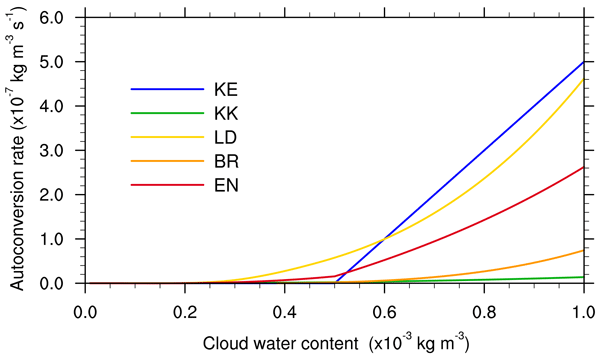
An ensemble (EN) approach was designed to improve autoconversion (ATC) from cloud water to rainwater in cloud microphysics schemes. One unique feature of the EN approach is that the ATC rate is a mean value based on the calculations from several widely used ATC schemes. The ensemble approach proposed herein appears to help improve the representation of cloud and precipitation processes in weather and climate models.
Chongjian Liu, Jinfang Yin, Xiaomin Wei, Xiaogong Sun, and Guofu Zhu
EGUsphere, https://doi.org/10.5194/egusphere-2026-2981, https://doi.org/10.5194/egusphere-2026-2981, 2026
This preprint is open for discussion and under review for Nonlinear Processes in Geophysics (NPG).
Short summary
Short summary
The numerical weather prediction (NWP) is facing the challenge of development bottleneck, and this article, via a comprehensive review on application of catastrophe theory to the atmospheric science for revealing the fundamental logic why the physics-based NWP methodology would be about to approach its end with some remedial measures suggested for avoiding its finality to occur, might be helpful to promote the enhancement of NWP forecasting accuracy so as to break its development bottleneck.
Jinfang Yin, Xudong Liang, Yanxin Xie, Feng Li, Kaixi Hu, Lijuan Cao, Feng Chen, Haibo Zou, Feng Zhu, Xin Sun, Jianjun Xu, Geli Wang, Ying Zhao, and Juanjuan Liu
Earth Syst. Sci. Data, 15, 2329–2346, https://doi.org/10.5194/essd-15-2329-2023, https://doi.org/10.5194/essd-15-2329-2023, 2023
Short summary
Short summary
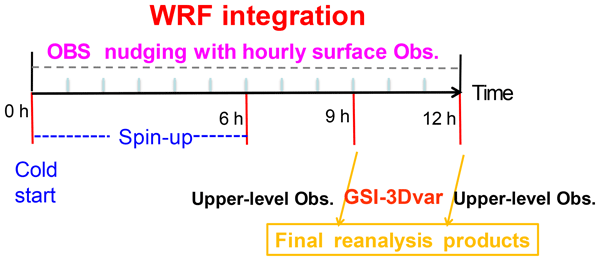
A collection of regional reanalysis datasets has been produced. However, little attention has been paid to East Asia, and there are no long-term, physically consistent regional reanalysis data available. The East Asia Reanalysis System was developed using the WRF model and GSI data assimilation system. A 39-year (1980–2018) reanalysis dataset is available for the East Asia region, at a high temporal (of 3 h) and spatial resolution (of 12 km), for mesoscale weather and regional climate studies.
Haoran Li, Dmitri Moisseev, Yali Luo, Liping Liu, Zheng Ruan, Liman Cui, and Xinghua Bao
Hydrol. Earth Syst. Sci., 27, 1033–1046, https://doi.org/10.5194/hess-27-1033-2023, https://doi.org/10.5194/hess-27-1033-2023, 2023
Short summary
Short summary
A rainfall event that occurred at Zhengzhou on 20 July 2021 caused tremendous loss of life and property. This study compares different KDP estimation methods as well as the resulting QPE outcomes. The results show that the selection of the KDP estimation method has minimal impact on QPE, whereas the inadequate assumption of rain microphysics and unquantified vertical air motion may explain the underestimated 201.9 mm h−1 record.
Jinfang Yin, Xudong Liang, Hong Wang, and Haile Xue
Geosci. Model Dev., 15, 771–786, https://doi.org/10.5194/gmd-15-771-2022, https://doi.org/10.5194/gmd-15-771-2022, 2022
Short summary
Short summary
An ensemble (EN) approach was designed to improve autoconversion (ATC) from cloud water to rainwater in cloud microphysics schemes. One unique feature of the EN approach is that the ATC rate is a mean value based on the calculations from several widely used ATC schemes. The ensemble approach proposed herein appears to help improve the representation of cloud and precipitation processes in weather and climate models.
Cited articles
Bao, X., Sun, J., Yin, J., Gao, X., Li, F., Liang, X., Gu, H., Xia, R., Li, M., Wu, C., and Feng, J.: What Caused the Differences between the July 2023 and August 1996 Extreme Rainfall Events in North China under Similar Synoptic Background?, J. Meteorol. Res.-PRC, 38, 861–879, https://doi.org/10.1007/s13351-024-3192-0, 2024.
Bowden, J. H., Otte, T. L., Nolte, C. G., and Otte, M. J.: Examining Interior Grid Nudging Techniques Using Two-Way Nesting in the WRF Model for Regional Climate Modeling, J. Climate, 25, 2805–2823, https://doi.org/10.1175/JCLI-D-11-00167.1, 2012.
Chen, Q., Fan, J., Hagos, S., Gustafson Jr., W. I., and Berg, L. K.: Roles of wind shear at different vertical levels: Cloud system organization and properties, J. Geophys. Res.-Atmos., 120, 6551–6574, https://doi.org/10.1002/2015JD023253, 2015.
Ding, Y.: A case study on the excessively severe rainstrom in Honan province, early in August, 1975, Scientia Atmospherica Sinica, 2, 276–289, 1978 (in Chinese).
Dudhia, J.: Numerical Study of Convection Observed during the Winter Monsoon Experiment Using a Mesoscale Two-Dimensional Model, J. Atmos. Sci., 46, 3077–3107, https://doi.org/10.1175/1520-0469(1989)046<3077:NSOCOD>2.0.CO;2, 1989.
Feng, W. and Cheng, L.: Nonhydrostatic numerical simulation for the “96.8” extraordinary rainstorm and the developing structure of mesoscale system, J. Meteorol. Res., 16, 423–440, 2002.
Fowler, H. J., Blenkinsop, S., Green, A., and Davies, P. A.: Precipitation extremes in 2023, Nature Reviews Earth & Environment, 5, 250–252, https://doi.org/10.1038/s43017-024-00547-9, 2024.
Fu, J., Quan, W., Mai, Z., Luo, Q., Chen, T., Li, X., Xu, X., Zhu, W., Hua, S., and Han, X.: Preliminary study on the refined characteristics of rainfall intensity and dynamic and thermodynamic conditions in the July 2023 severe torrential rain in north China, Meteorological Monthly, 49, 1435–1450, https://doi.org/10.7519/j.issn.1000-0526.2023.112701, 2023 (in Chinese with English abstract).
Gao, Z., Zhang, J., Yu, M., Liu, Z., Yin, R., Zhou, S., Zong, L., Ning, G., Xu, X., Guo, Y., Wei, H., and Yang, Y.: Role of Water Vapor Modulation From Multiple Pathways in the Occurrence of a Record-Breaking Heavy Rainfall Event in China in 2021, Earth and Space Science, 9, e2022EA002357, https://doi.org/10.1029/2022EA002357, 2022.
Gao, X., Sun, J., Yin, J., Abulikemu, A., Wu, C., Liang, X., and Xia, R.: The impact of mountain-plain thermal contrast on precipitation distributions during the “23⋅7” record-breaking heavy rainfall over North China, Atmos. Res., 310, 107582, https://doi.org/10.1016/j.atmosres.2024.107582, 2024.
Hirata, H. and Kawamura, R.: Scale interaction between typhoons and the North Pacific subtropical high and associated remote effects during the Baiu/Meiyu season, J. Geophys. Res.-Atmos., 119, 5157–5170, https://doi.org/10.1002/2013JD021430, 2014.
Hong, S.-Y., Dudhia, J., and Chen, S.-H.: A Revised Approach to Ice Microphysical Processes for the Bulk Parameterization of Clouds and Precipitation, Mon. Weather Rev., 132, 103–120, https://doi.org/10.1175/1520-0493(2004)132<0103:ARATIM>2.0.CO;2, 2004.
Hu, G., Lu, M.-H., Reynolds, D., Wang, H.-K., Chen, X., Liu, W.-C., Zhu, F., Wu, X.-W., Xia, F., Xie, M.-C., Cheng, X.-N., Lim, K.-S., Zhai, B.-P., and Chapman, J.: Long-term seasonal forecasting of a major migrant insect pest: the brown planthopper in the Lower Yangtze River Valley, J. Pest Sci., 92, 417–428, https://doi.org/10.1007/s10340-018-1022-9, 2019.
Jiménez, P. A., Dudhia, J., González-Rouco, J. F., Navarro, J., Montávez, J. P., and García-Bustamante, E.: A Revised Scheme for the WRF Surface Layer Formulation, Mon. Weather Rev., 140, 898–918, https://doi.org/10.1175/MWR-D-11-00056.1, 2012.
Kain, J. S.: The Kain–Fritsch Convective Parameterization: An Update, J. Appl. Meteorol., 43, 170–181, https://doi.org/10.1175/1520-0450(2004)043<0170:TKCPAU>2.0.CO;2, 2004.
Li, H., Yin, J., and Kumjian, M.: ZDR Backwards Arc: Evidence of Multi-Directional Size Sorting in the Storm Producing 201.9 mm Hourly Rainfall, Geophys. Res. Lett., 51, e2024GL109192, https://doi.org/10.1029/2024GL109192, 2024.
Li, M., Sun, J., Li, F., Wu, C., Xia, R., Bao, X., Yin, J., and Liang, X.: Precipitation Evolution from Plain to Mountains during the July 2023 Extreme Heavy Rainfall Event in North China, J. Meteorol. Res.-PRC, 38, 635–651, https://doi.org/10.1007/s13351-024-3182-2, 2024.
Lin, Y.-H. and Wu, C.-C.: Remote Rainfall of Typhoon Khanun (2017): Monsoon Mode and Topographic Mode, Mon. Weather Rev., 149, 733–752, https://doi.org/10.1175/MWR-D-20-0037.1, 2021.
Mao, J., Ping, F., Yin, L., and Qiu, X.: A Study of Cloud Microphysical Processes Associated With Torrential Rainfall Event Over Beijing, J. Geophys. Res.-Atmos., 123, 8768–8791, https://doi.org/10.1029/2018JD028490, 2018.
Meng, Z., Zhang, F., Luo, D., Tan, Z., Fang, J., Sun, J., Shen, X., Zhang, Y., Wang, S., Han, W., Zhao, K., Zhu, L., Hu, Y., Xue, H., Ma, Y., Zhang, L., Nie, J., Zhou, R., Li, S., Liu, H., and Zhu, Y.: Review of Chinese atmospheric science research over the past 70 years: Synoptic meteorology, Sci. China Earth Sci., 62, 1946–1991, https://doi.org/10.1007/s11430-019-9534-6, 2019.
Mlawer, E. J., Taubman, S. J., Brown, P. D., Iacono, M. J., and Clough, S. A.: Radiative transfer for inhomogeneous atmospheres: RRTM, a validated correlated-k model for the longwave, J. Geophys. Res.-Atmos., 102, 16663–16682, https://doi.org/10.1029/97JD00237, 1997.
National Centers for Environmental Prediction, National Centers for Environmental Prediction, National Weather Service, NOAA, and U.S. Department of Commerce: NCEP FNL Operational Model Global Tropospheric Analyses, continuing from July 1999, Research Data Archive at the National Center for Atmospheric Research, Computational and Information Systems Laboratory [data set], https://doi.org/10.5065/D6M043C6, 2000.
NCAR: WRF Model, GitHub [code], https://github.com/wrf-model/WRF/releases, last access: 1 August 2024.
Pucik, T., Groenemeijer, P., and Tsonevsky, I.: Vertical wind shear and convective storms, ECMWF Technical Memoranda no. 879, https://doi.org/10.21957/z0b3t5mrv, 2021.
Rao, C., Chen, G., and Ran, L.: Effects of Typhoon In-Fa (2021) and the Western Pacific Subtropical High on an Extreme Heavy Rainfall Event in Central China, J. Geophys. Res.-Atmos., 128, e2022JD037924, https://doi.org/10.1029/2022JD037924, 2023.
Rotunno, R., Klemp, J., and Weisman, M.: A Theory for Strong, Long-Lived Squall Lines, J. Atmos. Sci., 45, 463–485, https://doi.org/10.1175/1520-0469(1988)045<0463:ATFSLL>2.0.CO;2, 1988.
Schumacher, R. S. and Rasmussen, K. L.: The formation, character and changing nature of mesoscale convective systems, Nature Reviews Earth & Environment, 1, 300–314, https://doi.org/10.1038/s43017-020-0057-7, 2020.
Stauffer, D. R., Seaman, N. L., and Binkowski, F. S.: Use of Four-Dimensional Data Assimilation in a Limited-Area Mesoscale Model Part II: Effects of Data Assimilation within the Planetary Boundary Layer, Mon. Weather Rev., 119, 734–754, https://doi.org/10.1175/1520-0493(1991)119<0734:UOFDDA>2.0.CO;2, 1991.
Sun, J., Qi, L., and Zhao, S.: A study on mesoscale convective systems of the severe heavy rainfall in north China by “9608” typhoon, Acta Meteorologica Sinica, 64, 57–71, https://doi.org/10.11676/qxxb2006.006, 2006 (in Chinese with English abstract).
Sun, Y., Zhong, Z., Yi, L., Li, T., Chen, M., Wan, H., Wang, Y., and Zhong, K.: Dependence of the relationship between the tropical cyclone track and western Pacific subtropical high intensity on initial storm size: A numerical investigation, J. Geophys. Res.-Atmos., 120, 11451–411467, https://doi.org/10.1002/2015JD023716, 2015.
Tewari, M., Chen, F., Wang, W., Dudhia, J., LeMone, M. A., Mitchell, K., Ek, M., Gayno, G., Wegiel, J., and Cuenca, R. H.: Implementation and verification of the unified NOAH land surface model in the WRF model, in: 20th Conference on Weather Analysis and Forecasting/16th Conference on Numerical Weather Prediction, Seattle, USA, 10–15 January 2004, 11–15, https://ams.confex.com/ams/84Annual/techprogram/paper_69061.htm. (last access: 30 April 2025), 2004.
Thompson, G., Field, P. R., Rasmussen, R. M., and Hall, W. D.: Explicit Forecasts of Winter Precipitation Using an Improved Bulk Microphysics Scheme. Part II: Implementation of a New Snow Parameterization, Mon. Weather Rev., 136, 5095–5115, https://doi.org/10.1175/2008MWR2387.1, 2008.
Wang, Y., Wang, Y., and Fudeyasu, H.: The Role of Typhoon Songda (2004) in Producing Distantly Located Heavy Rainfall in Japan, Mon. Weather Rev., 137, 3699–3716, https://doi.org/10.1175/2009MWR2933.1, 2009.
Xia, R., Ruan, Y., Sun, J., Liang, X., Li, F., Wu, C., Li, J., Yin, J., Bao, X., Li, M., and Gao, X.: Distinct Mechanisms Governing Two Types of Extreme Hourly Rainfall Rates in the Mountain Foothills of North China During the Passage of a Typhoon Remnant Vortex from July 30 to August 1, 2023, Adv. Atmos. Sci., 42, 761–779, https://doi.org/10.1007/s00376-024-4064-3, 2025.
Xia, R. and Zhang, D.-L.: An Observational Analysis of Three Extreme Rainfall Episodes of 19–20 July 2016 along the Taihang Mountains in North China, Mon. Weather Rev., 147, 4199–4220, https://doi.org/10.1175/MWR-D-18-0402.1, 2019.
Xu, H. and Li, X.: Torrential rainfall processes associated with a landfall of Typhoon Fitow (2013): A three-dimensional WRF modeling study, J. Geophys. Res.-Atmos., 122, 6004–6024, https://doi.org/10.1002/2016JD026395, 2017.
Xu, H., Zhang, D., and Li, X.: The Impacts of Microphysics and Terminal Velocities of Graupel/Hail on the Rainfall of Typhoon Fitow (2013) as Seen From the WRF Model Simulations With Several Microphysics Schemes, J. Geophys. Res.-Atmos., 126, e2020JD033940, https://doi.org/10.1029/2020JD033940, 2021.
Xu, H., Li, X., Yin, J., and Zhang, D.: Predecessor Rain Events in the Yangtze River Delta Region Associated with South China Sea and Northwest Pacific Ocean (SCS-WNPO) Tropical Cyclones, Adv. Atmos. Sci., 40, 1021–1042, https://doi.org/10.1007/s00376-022-2069-3, 2023a.
Xu, H., Zhao, D., Yin, J., Duan, Y., Gao, W., Li, Y., and Zhou, L.: Indirect Effects of Binary Typhoons on an Extreme Rainfall Event in Henan Province, China From 19 to 21 July 2021. 3. Sensitivities to Microphysics Schemes, J. Geophys. Res.-Atmos., 128, e2022JD037936, https://doi.org/10.1029/2022JD037936, 2023b.
Yang, L., Liu, M., Smith, J. A., and Tian, F.: Typhoon Nina and the August 1975 Flood over Central China, J. Hydrometeorol., 18, 451–472, https://doi.org/10.1175/JHM-D-16-0152.1, 2017.
Yin, J., Wang, D., Liang, Z., Liu, C., Zhai, G., and Wang, H.: Numerical Study of the Role of Microphysical Latent Heating and Surface Heat Fluxes in a Severe Precipitation Event in the Warm Sector over Southern China, Asia-Pacific J. Atmos. Sci., 54, 77–90, https://doi.org/10.1007/s13143-017-0061-0, 2018.
Yin, J., Zhang, D.-L., Luo, Y., and Ma, R.: On the Extreme Rainfall Event of 7 May 2017 Over the Coastal City of Guangzhou. Part I: Impacts of Urbanization and Orography, Mon. Weather Rev., 148, 955–979, https://doi.org/10.1175/MWR-D-19-0212.1, 2020.
Yin, J., Liang, X., Wang, H., and Xue, H.: Representation of the autoconversion from cloud to rain using a weighted ensemble approach: a case study using WRF v4.1.3, Geosci. Model Dev., 15, 771–786, https://doi.org/10.5194/gmd-15-771-2022, 2022a.
Yin, J., Gu, H., Yu, M., Bao, X., Xie, Y., and Liang, X.: Synergetic Roles of Dynamic and Cloud Microphysical Processes in Extreme Short-Term Rainfall: A Case Study, Q. J. Roy. Meteor. Soc., 148, 3660–3676, https://doi.org/10.1002/qj.4380, 2022b.
Yin, J., Gu, H., Liang, X., Yu, M., Sun, J., Xie, Y., Li, F., and Wu, C.: A Possible Dynamic Mechanism for Rapid Production of the Extreme Hourly Rainfall in Zhengzhou City on 20 July 2021, J. Meteorol. Res.-PRC, 36, 6–25, https://doi.org/10.1007/s13351-022-1166-7, 2022c.
Short summary
A persistent severe rainfall event occurred over North China in July 2023, which was regarded as one of the most extreme episodes globally during that year. The extreme rainfall was significantly underestimated by forecasters at that time. Flooding from this event affected 1.3 million people, causing severe human casualties and economic losses. We examined the convective initiation and subsequent persistent heavy rainfall based on simulations with the Weather Research and Forecasting model.
A persistent severe rainfall event occurred over North China in July 2023, which was regarded as...
Altmetrics
Final-revised paper
Preprint