
Editor(s): Timothy Tiggeloven (CMCC Foundation - Euro-Mediterranean Center on Climate Change, Italy), Kelley De Polt (Max Planck Institute for Biogeochemistry, Germany), Christopher White (University of Strathclyde, United Kingdom), Marc van den Homberg (University of Twente, The Netherlands), Erick Mas (Tohoku University, Japan), Samira Pfeiffer (United Nations University, Germany), Lara Smale (British Geological Survey, United Kingdom), and Luca Piciullo (Norwegian Geotechnical Institute, Norway)
20 Oct 2026
Integrating satellite-based soil moisture within a rainfall-runoff database for operational flood forecasting in Mediterranean catchments
EGUsphere, 2026
Preprint under review for NHESS (discussion: open, 0 comments)
20 Oct 2026
A standardized rainfall extremity index for equitable flash-flood warning in South Korea
EGUsphere, 2026
Preprint under review for NHESS (discussion: open, 0 comments)
02 Oct 2026
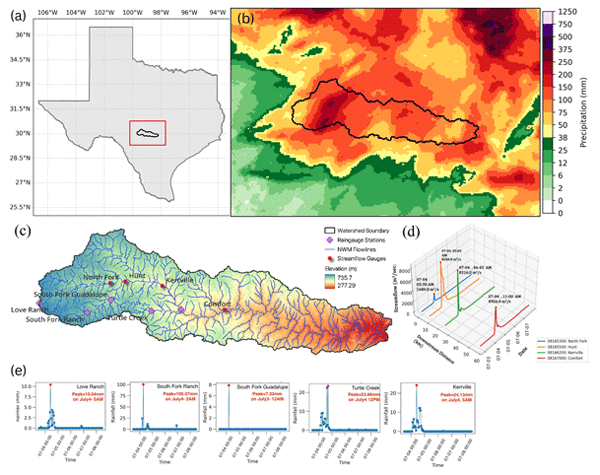
Brief communication: Rise of the Guadalupe River – a multifaceted post event analysis of 4 July 2025, flood in Central Texas
Nat. Hazards Earth Syst. Sci., 26, 4753–4762, 2026
15 Sep 2026
Beyond the flood map: an open-source framework for forecasting cascading impacts of natural hazards on people and essential services
EGUsphere, 2026
Preprint under review for NHESS (discussion: open, 4 comments)
21 Aug 2026
ALERT: A Scalable Cloud-Native Framework for Satellite Rainfall-Driven Landslide Early Warning in Data-Scarce Regions
EGUsphere, 2026
Preprint under review for NHESS (discussion: final response, 2 comments)
04 Aug 2026
Flood nowcasting based on deep learning and radar rainfall estimates: A reliable and efficient framework for diverse flood regimes
EGUsphere, 2026
Preprint under review for NHESS (discussion: final response, 2 comments)
30 Jul 2026
Evaluating the performance of a numerical weather prediction model for precipitation and temperature in Luxembourg and the Greater Region: insights from WRF and WRFDA 3D-VAR
EGUsphere, 2026
Revised manuscript under review for NHESS (discussion: final response, 4 comments)
21 Jul 2026
Selection of onset of acceleration points and failure time prediction of landslides based on ground-based radar
EGUsphere, 2026
Revised manuscript under review for NHESS (discussion: final response, 5 comments)
08 Jul 2026
Development of a National-Scale Rip Current Forecast for Aotearoa New Zealand
EGUsphere, 2026
Revised manuscript accepted for NHESS (discussion: final response, 5 comments)
26 Jun 2026
Uncertainty of Rainfall Forecasts for Impact-Based Flood Warning in the Cagayan River Basin, Philippines
EGUsphere, 2026
Revised manuscript under review for NHESS (discussion: final response, 6 comments)
10 Jun 2026
Lithosphere–Coversphere–Atmosphere–Ionosphere Coupling with the 2023 Turkey Earthquake Doublet: A Deviation–Time–Space–Frequency Analysis
EGUsphere, 2026
Revised manuscript under review for NHESS (discussion: final response, 7 comments)
19 May 2026
From Forecast to Alert: Designing an AI-Driven Flood Early Warning System for the White Volta Basin Using Open Satellite Data
EGUsphere, 2026
Revised manuscript accepted for NHESS (discussion: final response, 6 comments)
12 May 2026
Reducing False Alarms in Small-Scale Slope Early Warning Systems via Deep Learning-Driven Asynchronous Displacement and Rainfall Data Fusion
EGUsphere, 2026
Revised manuscript accepted for NHESS (discussion: final response, 4 comments)
29 Apr 2026
Review article: Rainfall-Induced Landslide Early Warning System: Advances, Gaps, and Perspectives
EGUsphere, 2026
Revised manuscript accepted for NHESS (discussion: final response, 4 comments)
14 Apr 2026
Modeling the potential hazard of wildfires under the influence of climatic, vegetative and anthropogenic factors in the Andean and Amazonian regions of Peru
EGUsphere, 2026
Preprint under review for NHESS (discussion: final response, 5 comments)