
the Creative Commons Attribution 4.0 License.
the Creative Commons Attribution 4.0 License.
 | 10 Mar 2026
Understanding the combined mental health impacts of flooding and COVID-19 in Hue City, Central Vietnam
Paul Hudson
Annegret H. Thieken
Philip Bubeck
Experiencing severe flooding tends to negatively impact mental health, creating a significant public health issue. Moreover, extreme events can co-occur, magnifying potential impacts. Insights into the combined impact of co-occurring disasters on mental health, such as floods and COVID-19, are, however, largely lacking. We addressed this research gap by conducting 400 face-to-face interviews in October 2023 in Hue City, Vietnam, where residents faced simultaneous flooding and COVID-19 in 2020.
The respondents' mental health was assessed using the Kessler psychological distress scale (K6), revealing that 20 % of the respondents experienced mental health distress, while 80 % did not report such distress. Binary logistic regression models demonstrated that among twelve flood stressors, facing “livelihood difficulties”, “seeing dead human bodies”, and “being rescued” relate significantly to mental distress. Meanwhile “impacts on individual health” and “interrupted education” are the two significant COVID-19 stressors. These five factors stay significant when combined. Additionally, a multivariable regression model revealed the combined effects of flood and COVID-19 when comparing the ORs of four groups ranging from “No flood stress and No Covid stress” to “Flood stress and Covid stress”. The effect size is largest for those who experienced flood and COVID-19 impacts, followed by those who suffered only floods and those who faced only COVID-19, with the smallest effect size.
These findings underline the need to address public health problems caused by multiple risks, which is still a significant gap in developing countries. Furthermore, psychological impacts could be reduced by providing additional support to at-risk communities, like managing human remains, rehearsing evacuation plans, preventing school closures, and setting up public health infrastructure for psychological assistance.
- Article
(4475 KB) - Full-text XML
- BibTeX
- EndNote


Among climate-related hazards, flooding is the most disruptive and costly disaster experienced worldwide (IPCC, 2021a; Liu et al., 2024). From 1990 to 2022, 4713 flood events were recorded in 168 countries, killing 218 353 people, with the region of Southeast Asia having a high proportion of deaths, with 33 %, and causing an economic loss of USD 1.3 trillion (Liu et al., 2024). Besides causing significant numbers of human casualties, floods are causing damage to infrastructure, property, and agricultural livelihoods (UNDRR, 2020; Buchenrieder et al., 2021). There has been a global increase in the number of affected people and assets in flood-prone areas (UNISDR, 2011; de Moel et al., 2015), which, when combined with a projected increase in the magnitude and frequency of hazards from climate change (IPCC, 2021b), indicates growing threats (IPCC, 2023).
In addition to the monetary and physical flood damage, there is significant evidence of both short-term and long-term flood impacts on psychological well-being (Paranjothy et al., 2011; Arshad et al., 2020; Tunstall et al., 2006; Abass et al., 2022; Butler et al., 2018; Arshad et al., 2020; Hudson et al., 2019). Long-lasting mental health disorders such as post-traumatic stress disorder (PTSD), anxiety, and depression have higher incident rates post-flood (Stanke et al., 2012; Zenker et al., 2024). IPCC (2023) reports also project that flooding in Asia will significantly impact human well-being. Therefore, the effects of flooding on mental health are being increasingly recognized and must be proactively integrated into risk management, as it has been largely neglected (Berry et al., 2018; Gifford and Gifford, 2016). Furthermore, the mental health impacts of flooding have been studied in high-income countries; it is crucial to recognize that flooding also has profound mental health effects on poor people in low-income countries as well (Asim et al., 2022).
The need to understand the public health consequences of flooding is complicated by the observation that people can face or experience multiple hazards that may cause cumulative impacts rather than only floods. A prominent situation was the COVID-19 pandemic, which occurred simultaneously with other disasters in many places in 2020. It was a global crisis in health systems and economies worldwide, occurring with socio-environmental changes, causing compound effects, emphasizing the urgent need for an integrated and intersectoral approach to understanding and addressing risks and impacts of such crises on the most vulnerable populations (UNDRR, 2019).
The co-occurrence of floods and COVID-19 is a typical multi-hazard event (Gill et al., 2022; Simonovic et al., 2021). While the flood impacts on mental health are considerable and long-lasting (Ogunbode et al., 2019; Bubeck et al., 2025), a systematic review of health sector responses to the coincidence of disasters and COVID-19 is underreported and under-evaluated (Sedighi et al., 2021). Compared to 478 studies on the prevalence of PTSD among flood survivors reviewed by Golitaleb et al. (2022) from 2015 to 2021, a few examples highlight cumulative impact assessments for multiple risks in combination with floods. Sohrabizadeh et al. (2021) reviewed and found thirteen studies addressing the co-occurrence of COVID-19 and natural hazards in general. Seven reported the simultaneous occurrence of COVID-19 and climatic events like floods, hurricanes, tornadoes, and southwest monsoons in South Asian countries. Only two of these seven articles examined the health consequences of co-occurring floods and the pandemic, namely Vikas (2020) and Guo et al. (2020). Vikas (2020) studied the potential risks when monsoons in Southeast Asia trigger floods during COVID-19, which may prevent the healthcare system from being prepared for the disease. The author emphasized the necessity of a mitigation action plan for COVID-19 during the monsoons. Meanwhile, Guo et al. (2020) mentioned possible flood impacts during the pandemic in China. They drew attention to the necessity of urgent actions to prevent the health and livelihood consequences of flooding during the COVID-19 pandemic. However, none of these articles examines the combined impacts of floods and pandemics on mental health.
Furthermore, to be more certain about this research gap, we conducted a further search on the Web of Science and PubMed databases using the strings: “flood”, “COVID-19”, AND “mental health” in December 2023 (see Appendix A, Table A1); we found 52 articles in the Web of Science and 55 articles in PubMed. By scanning the titles and abstracts, the duplicated results were removed. There were 18 relevant articles, but only seven recently explored the compounding impacts of flood and COVID-19 on affected people's mental health (Podubinski and Glenister, 2021; Callender et al., 2022; Agyapong et al., 2022; Rocha et al., 2021; Agyapong et al., 2021; Liang et al., 2023; Izumi and Shaw, 2022), meaning that our research will contribute significantly to this field. Agyapong et al. (2021) focused on the cumulative impacts on mental health after wildfire, flooding and COVID-19 on Fort McMurray school board staff and other employees in Canada, and they concluded that affected groups suffered psychological morbidity differently. Podubinski and Glenister (2021) provided insights into the mental health of Australian workers during the initial COVID-19 outbreak, with an additional focus on whether previous disaster exposure and effects from that disaster are risk factors for increased psychological distress. They found that higher stress symptoms were associated with having disaster impacts, added to COVID-19. In the meantime, Rocha et al. (2021) aimed to address the effects of natural disasters on the mental health of Filipinos during the COVID-19 pandemic, with the conclusion that the simultaneous existence of natural disasters and the pandemic has caused devastating and detrimental effects on the mental health of Filipinos. Also, Agyapong et al. (2022) found that cumulative trauma from multiple disasters, including COVID-19, has increased the mental health burden on residents of Fort McMurray in Canada. Callender et al. (2022) assessed the economic and mental health impacts of COVID-19 in the presence of previous exposure to flood events caused by Hurricane Harvey in the US. They found that multiple crises can jointly and cumulatively shape health and well-being. Izumi and Shaw (2022) examined the effects of COVID-19 and natural hazards, including floods, in countries like India, Japan, the Philippines, and the USA, concluding that the confluence of COVID-19 and natural hazards caused compounded impacts and challenges to mental health. Lastly, Liang et al. (2023) identified the latent profiles of psychological status and acceptance of change among Henan residents in China who have been cumulatively exposed to floods and the COVID-19 pandemic. They found that the additive effects of the floods with COVID-19 have a predictive effect on psychological state. From this literature review, we found that the research on the cumulative impacts of co-occurring disasters is still limited, and the seven mentioned works used different methods and scales for assessment; none used the K6 scale as a screening tool. Therefore, we want to contribute novelty to these research gaps by surveying the cumulative impacts of flooding and COVID-19 on the mental health of at-risk communities in Hue City. The K6 scale appears to be a proper choice for comparisons across countries and regions, as it is a widely used screening scale for mental health issues in the general adult population (Kessler et al., 2002). According to Wojujutari and Idemudia (2024), who worked on “Consistency as the Currency in Psychological Measures: A Reliability Generalization Meta-Analysis of Kessler Psychological Distress Scale (K-10 and K-6)”, the scales were adapted into multiple languages, including English, Chinese, Swahili, Farsi, Indonesian, Japanese, Hindi, and Portuguese, reflecting their global applicability and adaptability. For the K-6, their results revealed high internal consistency (mean α=0.84, 95 % CI [0.80,0.88]). Reliability varied across populations and languages. The K-6 scale showed a high reliability among outpatients (α=0.89) and the general population (α=0.87). The authors concluded that the K6 is a reliable tool for measuring psychological distress in both general and clinical groups. Its high reliability and adaptability make it valuable in clinical practice and research. It is recommended to use and adapt to mental health assessments, with attention to cultural and language considerations. In addition, in the article “Screening for Serious Mental Illness in the General Population” by Kessler et al. (2003), the authors showed that the K6 is a robust tool for screening for Serious Mental Illness and concluded that it is crucial for clinical studies and clinical epidemiology.
Our research question is: Does the co-occurrence of floods and COVID-19 have combined impacts on mental health? We used the K6 scale distress to examine and answer the research question in the case study conducted in Hue City (which used to be Thua Thien Hue province before 13 January 2025), Vietnam. This city faced COVID-19's first wave in January 2020 and the second wave in July 2020, leading to social isolation until December 2020, with hard lockdowns and restrictions in many communities (Nguyen et al., 2021). In October 2020, Hue City faced typhoons, floods, and landslides. Therefore, local people suffered uncertainty, fear of infection, distress, grief, and loneliness (Nguyen et al., 2021).
The research results draw attention to the combined mental health impacts of multiple disasters and provide a better understanding of how these have become increasingly common in recent years. Our findings give important insights to direct relevant stakeholders to preparedness, address public health issues in this context, and identify risk factors that exacerbate psychological distress to offer thoughtful solutions to mitigate impacts.
Vietnam is a developing country in Asia (UN, 2024). It is located in the tropical region and is one of the most vulnerable countries to climate change impacts worldwide, including hydro-meteorological hazards such as severe storms, cyclones, typhoons, floods, and landslides (CFE-DM, 2021). About 70 % of Vietnam residents live in coastal communities and, as such, are highly exposed to intensifying storms and floods (CFE-DM, 2021). Floods cause this country's most significant economic loss, accounting for 97 % of average annual losses from hazards (WB and ADB, 2021). Especially in 2020, when a storm triggered massive floods in Central Vietnam, people suffered heavy losses, including damage to people, shelters, and property (IFRC, 2022). 357 people were killed or missing, and 876 were injured. Storms and floods that occur in a row are considered the most terrible disasters affecting Central Vietnam in the past 100 years (IFRC, 2022).
Located in coastal Central Vietnam (Fig. 1), Hue City is especially prone to frequent and severe coastal, pluvial, and fluvial flooding due to its location, the river system and tropical monsoon climate, with a rainy season occurrence from August to December (Tran et al., 2008). Additionally, the city suffers from typhoons that frequently make landfall in this area with massive rain during the rainy season (Tran et al., 2008). In recent decades, Thua Thien Hue province has faced several devastating floods. While the region has annual small to moderate floods with minor impacts, the occasional major to historic floods has had severe consequences for people, the economy, infrastructure, and the environment (Sett et al., 2025). Local stakeholders and households identified the floods of 1999, 2020, and 2023 as historical events (Vietnam Disaster and Dyke Management Authority, 2019; Man Nhi, 2023; Sett et al., 2025; JBA Risk Management, 2020). The most severe recent flood was the historic 1999 event, caused by heavy rainfall in Hue that lasted 10 d and reached 3063 mm in the city center (Villegas, 2004). This resulted in 793 deaths, damaged more than 870 000 houses, and severely affected households in Hue and infrastructure (IFRC, 1999). The exceptional flood in 2020 occurred from early October to mid-November, resulting from nine consecutive major storms, including typhoons that impacted Central Vietnam (DMPTC, 2021), bringing heavy rainfall – 2747 mm recorded in Hue and up to 5226 mm in the mountainous upstream areas (WATEC, 2024; Nguyen et al., 2022) – and leading to riverine and flash floods as well as landslides in some regions (IFRC, 2020). These floods left two people dead, two missing, and one injured in the central city of Hue, according to the city's Civil Defence Steering Committee (Vietnam News, 2020). The 2023 flood was also recognized as the “worst in a decade” (Vo, 2023). The city centre recorded up to 2858 mm of rainfall, and more than 4135 mm in the mountainous upstream regions (WATEC, 2024; Nguyen et al., 2022), nearly reaching the historic levels of the 1999 floods (Sett et al., 2025). This means Hue people have been subjected to flood risk physically or mentally, as analyzed by Sett et al. (2024). With respect to flood risk, 2020 exemplifies this vulnerable situation. Widespread flooding and landslides caused severe damage and loss of life in Hue City in 2020, with 31 people dead, 11 people missing, and a total economic damage of USD 45 million (Van Dinh, 2020). Tran and Vilas (2011), Hudson et al. (2021), and French et al. (2019) stated that flood impacts on mental and physical health may be long-lasting and affect households for years after the flood events, especially in areas with frequent flooding like Hue City.

Figure 1Study sites.
In addition to severe floods in 2020, the COVID-19 pandemic brought many difficulties to the public health, research, and medical communities worldwide, including Vietnam (WHO, 2020). According to WHO (2022b), 455 million cases and over 6 million deaths were recorded by mid-March 2022. In Vietnam in general and Hue City in particular, COVID-19 cases increased in January 2020, and people faced social isolation from February to December 2020 (Nguyen et al., 2021) caused by hard lockdowns and restrictions in many communities. This situation resulted in the cessation of livelihood activities, the closure of schools and offices, family separations, and travel restrictions. Vietnam controlled the first wave in April 2020, but a second wave of infections occurred in July 2020. Immediately after managing the second wave of COVID-19, Hue City encountered typhoons, floods, and landslides from 10 October until the end of the month. During and after these disaster events, social distancing measures were enforced until December 2020 (Nguyen et al., 2021), causing negative impacts on the psychological state of those affected (Peteet, 2020).
Our surveys on the combined effects of floods and COVID-19 were conducted in two coastal communes in Hue City, namely Hai Duong and Quang Loi (see Fig. 1). Due to their location, these communes face flood and storm hazards yearly. In 2020, both municipalities were also affected by COVID-19 and the nationwide measures to contain the pandemic. Hai Duong commune has belonged administratively to Hue City since 2021. It is located along the coastline between the lagoon and the East Sea, with a total area of 9693 km2 and a population of 8190 (as of 2021). The residents in this commune face coastal erosion, storms, floods, and drought annually and are also severely affected by the extreme floods of 2020. Quang Loi commune is located in the northeast of Quang Dien district, along the lagoon, and occupies 32.32 km2 with a population of 6247 people (Tran et al., 2021).
3.1 Data collection
KOBOToolbox (https://www.kobotoolbox.org, last access: 23 November 2023), created by the Harvard Humanitarian Initiative, is an open-source collection of tools for data collection and analysis in humanitarian crises and challenging settings. It was used to conduct 400 face-to-face surveys in the two coastal communes of Hai Duong and Quang Loi from 6 to 30 October 2023. With this sample size, we consider 400 participants a reasonable number to represent the population, based on Taro Yamane's (1967) formula, given an estimated population of 500 000 in the lagoon area (Nguyen and Bao, 2025) and a desired 95 % confidence level. The questionnaires focused on psychological distress, personality traits, flood impacts, and COVID-19 impacts on affected people. Regarding the sampling method, the survey team went through the commune and randomly selected every third household along the village lanes for a face-to-face interview. If a household denied the interview, the respective household was skipped, and the household next to it was chosen. The trained and experienced local enumerators continued until 200 interviews per commune were completed. All of the 400 questionnaires were collected for analysis.
3.2 Measuring psychological distress (K6)
The respondents' mental health was assessed using the Kessler Psychological Distress Scale (K6), a widely used brief screening scale to assess non-specific psychological distress (Kessler et al., 2002). The K6 asks respondents how often six symptoms occurred in the 30 d before the interview: (1) feeling nervous, (2) hopeless, (3) restlessness or fidgety, (4) feeling worthless, (5) feeling depressed, and (6) that everything was an effort (Kessler et al., 2002). The answers for each question range from 0 to 4, assigning “none of the time”, “a little of the time”, “some of the time”, “most of the time”, or “all of the time”, respectively. From that, the total score of the six symptoms ranges from zero to 24, with a higher score indicating a higher mental health distress. The K6 is widely used and has demonstrated promising results in various contexts of population-based health surveys (Prochaska et al., 2012) and has been assessed by the WHO (Kessler et al., 2010). For example, it was employed to screen for psychological distress in the Australian National Survey of Mental Health and Well-Being (Furukawa et al., 2003), to examine serious mental illness in the general population (Kessler et al., 2003), to assess any disorder in the community mental health surveys as a cautionary note (Veldhuizen et al., 2007), to serve as a screening instrument for Iranian University Students (Dadfar et al., 2018), and to study Indian Americans regarding the severity of mood disorders (Mitchell and Beals, 2011). The K6 is confirmed to be a reliable tool for screening adult psychological distress with panic disorder, generalized anxiety disorder, bipolar disorder, and schizophrenia (Umucu et al., 2022; Wijeratne et al., 2011). In Vietnam, Kawakami et al. (2020) researched internal consistency reliability, construct validity, and item response characteristics of the Kessler 6 scale among hospital nurses. They concluded that the K6 Vietnamese version is a reliable and valid instrument to measure psychological distress for their targeted group.
In our research context, for the first time, we used K6 to screen the mental health status of affected people three years after the events, to capture the mental health status of respondents. Some people may be concerned that the recall of affected people may change over time as the collective memory decays (Song et al., 2021). We argue that the K6 scale indeed captures the last 30 d, and it is well known that both flooding and COVID-19 can have a long-lasting effect on mental health (Uchida et al., 2023). The K6 is not affected by the recall period and can help identify the significance of changes in psychological distress over time and evaluate the effectiveness of interventions for psychological distress (Chilver et al., 2023; Uchida et al., 2023). Regarding the stressors potentially affected by recall bias, we argue that COVID-19 and the flood event were highly impactful for the respondents, and, based on our experience, we did not observe problems with respondents' recall.
To classify the psychological distress level of respondents, we use cut-off points derived from the literature (Prochaska et al., 2012). The standard cut-off points are <5 for “no mental health distress”, ≥5 and <13 for “moderate mental distress”, and ≥13 for “severe mental health distress” (Prochaska et al., 2012). Prochaska et al. (2012) determined the validity of the standard cut-off points for a sample in the US, which analyzed 50 880 adult participants in a 2007 California Health Interview Survey. Their findings indicate that the optimal cut-off points identified through the receiver operating characteristic curve analysis are consistent across various ethnic and racial groups. They advocate for the expansion and analysis of the K6 scale to measure and examine the associated factors with moderate mental distress. Min and Lee (2015) also justified that these cut-off points are proposed for Korean seniors and that the K6 is a valid and reliable screening tool.
3.3 Variable selection
Our study has four variable groups: (1) dependent variables, (2) flood stressors, (3) COVID-19 stressors and (4) contextual variables. The variable domains were selected based on the literature review and the local context, reflecting the specific disaster situation in 2020 in Hue City. Regarding flood stressors, we considered what affected people suffered and their safety. As stated by Lee et al. (2020) and Du et al. (2010), adverse mental health status caused by disasters is generally due to a combination of physical health problems, financial losses, and community or social disruption; hence, we include the main factors comprising home damage, livelihood difficulties, food and water shortage, unsanitary conditions and disrupted medicine/medical care. These factors were asked in separate questions in the flood section. For people's safety during the flood, as mentioned by McKenzie et al. (2022), being flooded may cause physical injury, property damage, evacuation or resettlement, and severe disruption, all of which are expected consequences referred to as primary stressors. In the specific case of Hue City, the local context that affects mental health was mentioned in the research by Sett et al. (2024), that mental health impacts could directly stem from seeing dead bodies, being injured and being infected by diseases due to poor sanitation conditions. For a detailed description of all variables included in this study and statistical models, please see Appendix B, Table B1.
Regarding COVID-19 impacts, questions were adopted from the survey of CSO (2020) on the social implications of the pandemic. Our questions focused on COVID-19 information access, individual diagnosis of COVID-19, and the effects of COVID-19 on jobs/livelihoods and financial obligations, health, social ties, interrupted education, household stress, and home violence. We also asked about the impacts of restrictions during the pandemic. Some other researchers included these factors in their studies as well; for example, Xiong et al. (2020), Mathew (2021), and Wiedemann et al. (2022) considered health status, married status, age, household income, and quarantine status. Mathew (2021) and Chen et al. (2020) also added fear of infection as a risk factor. Chen et al. (2020) included “study online” in their risk factor analysis. Béland et al. (2021) and Piquero et al. (2021) examined family stress and domestic violence during the COVID-19 outbreak, especially.
Contextual variables typically include sociodemographic factors associated with adverse mental health impacts after the flood. Depending on the research focus, these variables could be age, gender, educational status, current work status, annual household income, and housing status (French et al., 2019; Lee et al., 2020; Fitzgerald et al., 2020; Graham et al., 2019; Asim et al., 2022; Adams and Nyantakyi-Frimpong, 2021; Gousse-Lessard et al., 2023). In our study, we ran single binary regression models for each variable. We found that current work status, average household income, and housing status do not affect respondents' mental health status. Also, to compare flood and COVID-19 aspects, we chose age, gender, and education as control variables.
3.4 Statistical methods
After selecting variable groups, descriptive statistics were used to provide an overview of the demographics and characteristics of the sample. Then, mental health prevalence was investigated to see the percentage of respondents facing mental health distress using the K6 scale score and the above cut-off points (Kessler et al., 2002). Classifying mental health status includes three levels: no mental health distress, moderate mental distress and severe mental health distress, and presented as a category variable. A new dummy variable of psychological distress was created by combining moderate and severe mental proportions as Yes (1) and No (0) for “No mental health” to capture the difference between groups, here, those with psychological distress and others without, and for later use in binary logistic regression models.
Later, the relation of mental health distress with the explanatory variables was tested to find out if the contextual and risk factors influence mental health status in different ways. Three logistic regression models examined mental health risk factors (see Table 3). The model M-Flood examines the influence of twelve flood stressors on the respondents, for example, home damage, livelihood difficulties, food and water shortage, etc. Of these, five were category variables; seven others were in dummy format. To be identical, we changed the five category variables to dummy variables by creating a value of “0” (No) for the answer categories “none”, “a little” and “some”, and a value of “1” (Yes) for “a lot” and “extreme”. The M-COVID-19 examined the influence of six COVID-19 stressors on the mental distress of the respondents, including the impacts on individual health, someone's health and social maintenance, etc. (Table 2). The value of “0” (No) was created from original values from “Not at all”, “A little” and “Somewhat”, while the value of “1” (Yes) was made from “A lot” and “Extremely”. Building upon M-Flood and M-COVID-19, the model M-Mixed examined the change of influence of flood and COVID-19 stressors on the psychological distress of affected people when entered into a model simultaneously. Only significant variables in M-Flood and M-COVID-19 with p values < 0.1 were selected for M-Mixed.
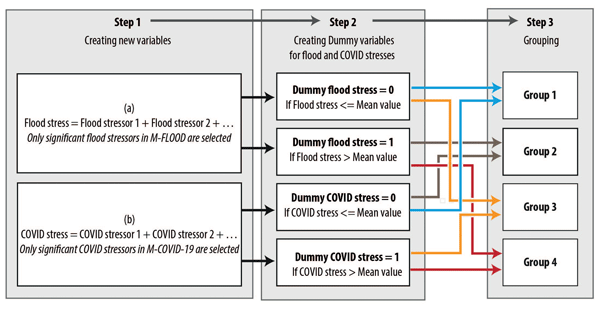
Lastly, the combined impacts of direct flood and COVID-19 stressors on mental health were investigated by grouping respondents into different categories. Hence, the fourth model (M-Combined) was run as a multivariable logistic regression for mental health status. To explore the combined impact of floods and COVID-19 on the mental health distress experienced by individuals affected by both disaster and the pandemic, we adopted the grouping method by Fitzgerald et al. (2020) who examined the cumulative flood exposure via probable depression among business owners who were flooded and evacuated during the 2017 flood event in Australia. In our research, four groups were created: Group (1) comprised of respondents reporting “NO flood stress and NO Covid stress”, Group (2) reporting “Flood stress and NO COVID stress”, Group (3) reporting “NO flood stress and COVID stress”, and Group (4) reporting “Flood stress and COVID stress”. The groups were created as shown in Fig. 2. Dummy variables were designed to capture those respondents who faced flood or COVID stressors. Their ORs were compared to find evidence of combined impacts.

Figure 2Creating groups for examining the combined impacts of flood and COVID-19 on mental health distress:
Step 1: Summing up all significant flood stressors in M-FLOOD to create a variable (a) “Flood stress” AND Summing up all significant COVID-19 stressors in M2 to create the variable (b) “COVID stress”.
Step 2: Creating dummy variables for flood and COVID stressors by using the mean values of “Flood stress” and “COVID stress”.
Step 3: Creating the four groups.
Figure 2 shows that the dummy variables were created using the mean values (Cox and Schechter, 2019; Cox, 2018) to sum up the significant stressors of both flood and COVID-19. Firstly, a general “flood stress” was created by summing up the three significant variables in M-Flood as (a):
From (a), we had the variable “Flood stress” with the values Min=0, Max=3 and Mean∼0.8. We created a dummy variable for this with “0 = No flood stress” if “Flood stress” ≤0.8 and “1 = Yes, flood stress” if “Flood stressor” >0.8.
Secondly, we created the general COVID-19 stressor based on the two significant variables from M-COVID-19 as (b):
From (b), we had the variable “COVID-19 stress” with the values Min=0, Max=2, and Mean ∼0.3. Then, we created a dummy variable with “0 = No COVID stress” if “COVID-19 stress” ≤ 0.3 and “1 = Yes, COVID stress” if “COVID-19 stressor” > 0.3. In the next step, we used the two new dummy variables to group them into four: (1) NO flood stress and NO COVID stress, (2) Flood stress and NO COVID stress, (3) NO flood stress and COVID stress, and (4) Flood stress and COVID stress.
All regression models report effect sizes as ORs with a 95 % confidence interval for bootstrapping. The OR represents the likelihood of an outcome occurring due to a specific exposure compared to the possibility of the outcome occurring without that exposure (Szumilas, 2010). The odds ratio can also be used to justify whether a particular risk factor takes effect for a specific outcome and to compare the influence of several risk factors for that outcome (Szumilas, 2010). An OR of 1 means that the risk factor does not affect the odds of the outcome occurring, ceteris paribus; an OR>1 means that the risk factor is associated with higher odds of the outcome occurring; and an OR<1 implies that a risk factor is associated with lower odds of the outcome occurring.
4.1 Sample Characteristics
As demonstrated in Table 1, respondents (n=400) comprise almost equal numbers of women (53.2 %) and men (46.8 %). Overall, the gender proportion matches well with the province's population (TTH Statistic Office, 2022), which shows that females make up 50.1 % of the population and males 49.9 %. The mean age of the sample is 49 years; the youngest respondent is 17 years old, and the oldest is 87 years old. Also, for average age, our sample belongs to the working age group, which covers 53 % of the province's population (as of 2022) (TTH Statistic Office, 2022). Regarding education, 84 % of our sample are literate, meaning they have at least a primary school degree. This ratio is slightly lower than the provincial average, with 89.4 % of people aged 15 and above in rural areas being literate (TTH Statistic Office, 2022). In addition, the data shows a wide range of average income levels. The respondents have a wide range of average monthly incomes. The highest proportion belongs to the group with “> VND 3–4 million per month”, with 14.8 %. Generally, this result does not reflect the average income reported by the Statistics Office of the TTH province, which is VND 4.7 million per month per person (as of 2023) (TTH Statistic Office, 2022; PPC-TTH, 2023). The reason could be the sensitivity of the question; people usually hesitate to talk about their income, so they choose not to answer it or report a lower income.

Regarding flood risk experience, Table 2 shows a significant proportion of respondents who faced flood and pandemic impacts. More than 97 % were affected by flood events in 2020. Of these, Quang Loi had more people who experienced flood events in 2020, with 98.9 % of respondents. 19.5 % of respondents from both communities are still burdened by this flood, with responses from “A lot” to “Extremely”. Quang Loi had more people suffering “A lot” in the flood of 2020, with 55 respondents, while Hai Duong had only two. Among the three top significant flood stressors, “livelihood difficulties” occupy the largest proportion with 56.5 % in the two communities, followed by “being rescued” and “seeing dead human bodies” with 24.4 % and 19.2 %, respectively. Again, Quang Loi has a much higher percentage of these stressors than Hai Duong.
Table 2Number of people affected by flood and COVID-19 in 2020. N = number of respondents.

Regarding COVID-19, 41.6 % of respondents were directly affected by the pandemic, meaning they tested positive for COVID-19 or were suspected of infection but were never tested. Of these, Quang Loi commune has more people affected, with 50 % of respondents, whereas Hai Duong has 30 %. The pandemic continues to burden many people in these two communes. In particular, Quang Loi has more people answering that COVID-19 still burdens them significantly (i.e., choosing the three highest answer categories). The two significant COVID-19 risk factors, like “impacts of COVID-19 on your health” and “interrupted education”, have considerable effects on people, with 36 % and 15.8 %, respectively. More people in Quang Loi faced individual health problems, while more people in Hai Duong faced interrupted education constraints.
4.2 Mental health status
Figure 3 reports the descriptive results for the six symptoms of the K6 scale. Nervousness is reported most often, with 32.3 % of the respondents choosing the two highest answering categories. Restlessness follows this with 10.6 %. The remaining four symptoms have a similar proportion, around 5.1 %–5.6 % across these categories. Nervousness and restlessness are also more frequent than other symptoms in the category “A little of the time” with 38.5 % and 32 %, respectively, and more than double the least frequent symptom, hopelessness. Hopelessness is the least frequent symptom overall, with the highest percentage for “None of the time” and the lowest number in the remaining categories.

In terms of prevalence, using standard cut-off points, we found that 0.8 % of the respondents show severe mental distress, while nearly 19.2 % show moderate levels, and 80 % show no indication of mental health distress.
The widely used Kessler K6 non-specific distress scale screens for severe mental illness, defined as a K6 score ≥13, estimated to afflict about 6 % of US adults. The K6, as currently used, fails to capture individuals struggling with more moderate mental distress that nonetheless warrants mental health intervention. They provide a cut-off for “moderate” mental distress, which we use and which is appropriate for your research question. Since the severe group is too small, the prevalence shows only 0.8 %. It is too small to analyze as a group. Combining this group with the moderate group refined the analysis by comparing the presence of stress with no experience at all, providing a more precise comparison (Perez-Valero et al., 2021). Prochaska et al. (2012) also indicated that the K6 is necessary to detect, examine, and quantify the correlates of moderate distress, given its clinical relevance. Therefore, the new proportion becomes 80 % and 20 % for “Yes” and “No”, respectively. Then, we generated a new dummy variable for mental health status with the values “1” = “Yes” and “0” = “No”. It is used for the binary logistic regression models M-Flood, M-Covid, and M-Mixed.
4.3 Mental health in relation to risk factors
Table 3 provides the results of the three logistic models, M-Flood, M-COVID-19, and M-Mixed. The multivariable logistic regression M-Combined examines the combined impacts of flood and COVID-19 (Table 3).
Table 3Results of binary logistic models M-Flood, M-COVID-19 and M-Mixed. The values in bold and italics are significant odd ratios.

* p value < 0.10, ** p value < 0.05, *** p value < 0.01, **** p value < 0.001. ORs are adjusted with the contextual variables: Gender, Age and Education.
4.3.1 Flood model (M-Flood)
M-Flood shows the ORs of these twelve stressors, three of which are greater than one and statistically significant, including “Seeing dead human bodies” during or after the flood with the highest ORs of 4.93 (p value < 0.001), followed by “Livelihood difficulties” with OR of 2.39 (p value < 0.05), and lowest one “Being rescued” with OR is 2.17 (p value < 0.1). So, among direct flood stressors, “Seeing dead human bodies” has the highest effect on mental health. No significant effect is found for the rest of the factors, including “Home damage”, “Food and water shortage”, “Suffered unsanitary condition”, “Suffered medicine/medical care”, “Being Evacuated”, “Being seriously injured or ill”, “Family members/close friends are injured/ill”, “Unsure of the safety of family members or close friends”, and “Loss of family members or close friends in the flood”. Regarding contextual variables, only “Gender” is significant in this model with the OR of 0.61 (p value < 0.1).
4.3.2 COVID-19 model (M-COVID-19)
Similar to the flood stressors, direct impacts on mental health distress caused by COVID-19 were explored. The main potential impacts we used are on individual health, someone's health, social maintenance, interrupted education, household stress, and domestic violence. The regression models (see Table 2) show that only two of them are significant, of which the impact of COVID-19 on “individual health” is more substantial with OR=4.55 (p value < 0.01) than “interrupted education”, which has OR=3.03 (p value < 0.01). However, “interrupted education” has a smaller CI, indicating a higher precision of the OR. Like M-Flood, the M-COVID-19 shows that women are more impacted by COVID-19 stressors since “Gender” has an OR=0.62 (p value < 0.1).
4.3.3 Mixed stressors (M-Mixed)
M-Mixed was developed from M-Flood and M-COVID-19 by adding three significant flood stressors: “Seeing dead human bodies”, “Livelihood difficulties” and “Being rescued”; and two significant COVID-19 stressors: “impacts on individual health” and “interrupted education”. All significant variables from M-Flood and M-COVID-19 remain significant in the M-Mixed. The results show the changes in ORs in different ways. For the flood domain, the OR of “Seeing dead human bodies” increases significantly, from 4.93 to 8.67. While ORs of “Livelihood difficulties” and “Being rescued” slightly decrease from 2.37 to 2.00 and 2.17 to 1.93, respectively, the p-value level remains the same as M-Flood and M-COVID-19. However, the 95 % CI of these two variables becomes slightly smaller than M-flood, indicating higher precision.
For the COVID-19 domain, changes in ORs are also shown. The OR of the impact on “individual health” reduced by two, from 4.55 to 2.50, and the p value indicates less significance, from <0.01 to <0.05, while the 95 % CI becomes much smaller from 1.45–14.27 to 1.15–5.45, meaning OR has higher precision. However, “interrupted education” had a higher effect, with the OR almost doubled, from 3.03 to 5.67, with the exact p value, but a much broader 95 % CI, from 1.35–6.80 to 1.88–17.11, indicating a less precise OR.
Regarding the contextual variables, it is shown in Table 2 that in M-Flood, M-COVID-19 and M-Mixed, “Gender” is significant with OR<1, p values < 0.1, and 95 % CI does not change much, indicating that women are slightly strongly influenced by flood and COVID-19 in their mental health. Only in M-Mixed, “Age” becomes significant with OR at 1.087339 (p value < 0.05, 95 % CI: 0.86–1.38). This means some age groups were more affected than others when we mixed all risk factors into one model. There is no effect for “Education” in all three models.
4.3.4 Combined impacts (M-Combined)
Finally, four groups were created using the methods described in Fig. 2 to understand the combined impacts of floods and COVID-19. Group (1) “NO flood stress and NO COVID stress” has 119 people (37.54 %), group (2) “Flood stress and NO COVID stress” has 120 people (37.85 %), group (3) “NO flood stress and COVID stress” has 23 people (7.26 %), and group (4) “Flood stress and Covid stress” has 55 people (17.35 %). Then, we run a multivariable logistic regression model to find the different mental health suffering (K6) among those four groups, together with contextual variables. The outcome presented in Table 4 reveals interesting information about the combined impact. The OR of the group (1) is the model's base. The ORs were demonstrated with group (1) as the base; group (3), who only faced COVID-19, had the lowest OR at 2.83 (p value < 0.1). This was followed by group (2), which suffered flooding only, with an OR of 5.47 (p value < 0.001). Notably, in group (4), showing people who experienced both flooding and COVID-19, the OR is highest at 9.67 (p value < 0.001) (Table 4).
Table 4ORs of the combined impacts of Flood and COVID-19 on the mental health status of respondents in four groups. Values in bold and italics are highlighting the significance of Contextual Variables.

In model M-Combined, the two contextual variables are significant, including “Gender” with an OR of 0.52 and p value < 0.05, and “Age” with an OR of 1.02 and p value < 0.1. This indicates that women are at higher risk than men and that the different age groups experience varying levels of effect by the co-occurrence of flood and COVID-19.
5.1 Prevalence rates
Our results confirmed that mental health distress exists among respondents who were exposed to various floods and COVID-19 impacts. The prevalence of 20 % of respondents with psychological distress demonstrates the effects on vulnerable communities. Even though other research reviewed by Cruz et al. (2020) and Golitaleb et al. (2022) have used different methods and tools for psychological illness assessment, and few of them used mental health distress as the focus (Butler et al., 2018); our results are consistent with their findings with similar prevalence. As reviewed by Golitaleb et al. (2022), all the relevant studies from 2015 to the middle of 2020 showed that the PTSD prevalence after a flood is high in all age groups. With the research conducted after around two to three years, the typical rate of PTSD is almost 20 %. Another review by Cruz et al. (2020) in the UK for the prevalence of depression, anxiety, and PTSD in populations exposed to extreme weather events until 12 December 2019; in 17 studies, it was found that within 12 months following extreme weather events, the rate is 19.8 % for anxiety, 21.35 % for depression, and 30.36 % for PTSD.
The findings on COVID-19's impacts on psychological illness in various groups are also confirmed. WHO (2022a) stated that the pandemic has had severe effects on the mental health and well-being of people around the world. UN (2020) released a policy brief on the need for action on COVID-19 and mental health, mentioning the high rate of mental health distress in some countries, like 35 % in China, 60 % in Iran and 40 % in the US. At the country level, Fernández et al. (2020) discovered distress caused by COVID-19 in Argentina, with participants reporting symptoms of phobic anxiety (41.3 %), anxiety (31.8 %), depression (27.5 %), and general distress (27.1 %).
Regarding similar studies on Vietnam, Duong et al. (2020) surveyed 1385 respondents and found that 36 % of them experienced psychological distress, 24 % depression, 14 % anxiety, and 22 % stress. Hung et al. (2024) conducted a cross-sectional study among 125 COVID-19 patients in a centralized quarantined Ho Chi Minh City community. They revealed that the prevalence of depression, anxiety, and stress among patients with COVID-19 was 14 %, 21 %, and 20 %, respectively. Recently, after 4 years, Hoa et al. (2024) found that among 1596 participants in Northern Vietnam, the prevalence of depression, anxiety, sleep disturbance, and cognitive impairment was 9 %, 17 %, 23 %, and 6 %, respectively. In Thua Thien Hue, we found one relevant research by Tran et al. (2024), which explored the impact of the COVID-19 pandemic on returnee migrant workers' income, psychological well-being, and daily life expenses. Their results revealed that reduced income increases the stress of affected people.
From all the mentioned results, our research fills in the research gap on the mental health distress of flood and COVID-19 victims, and the 20 % prevalence result is comparable to that of other research. Therefore, it contributes to an overall picture of mental health issues in Vietnam and also points out the more vulnerable groups and areas for mental health distress. Since then, it has drawn public concern, and the attention of policymakers for supporting policies and action plans to reduce the psychological impacts of simultaneous disasters and pandemics.
5.2 Risk factors/stressors
Various types of research have shown that floods have profound effects on the mental health of affected people, including frequently flooded areas and developing countries (Callender et al., 2022; Asim et al., 2019; Fitzgerald et al., 2020; Cruz et al., 2020; Ede et al., 2022; WHO, 2011). Our M-Flood and M-COVID-19 results find the most significant direct stressors that affect psychological illness caused by floods or the COVID-19 pandemic. Three out of twelve flood factors are significant in M-Flood, including “Seeing dead human bodies” with the highest OR, followed by “Livelihood difficulties” and “being rescued”. These three stressors are mentioned or analyzed in other studies by Makwana (2019), Abass et al. (2022) and Dai et al. (2016), indicating that the psychological vulnerabilities of the sufferers may be followed by displacement of the family, death of a loved one, and socio-economic loss, etc. According to NeuroLaunch (2024), the long-term consequences of seeing dead bodies could be PTSD, depression, persistent sadness and helplessness, which have profound impacts on individual lives, relationships, and daily activities. Chapple and Ziebland (2010) proved that interviewed bereaved relatives who saw dead bodies had significantly higher levels of distress and anxiety than those who did not.
Additionally, Tunstall et al. (2006) found that evacuation or rescue and disruption could add more stress to the mental health of affected people. Lamond et al. (2015) added that moving and financial constraints may cause severe mental health issues. These findings raise concerns about livelihood support and rescue planning. Notably, managing the dead remains of individuals who have died in disasters is an important issue. There are some guidelines for this situation, but only to help first responders ensure that the dead are treated (with dignity) and their subsequent identification and for outbreak prevention (ICRC, 2018; WHO, 2019). In our case study, seeing dead bodies directly or indirectly is associated with the dignity of a dead person and the distress of survivors. Looking back at 2020, some photos of search areas with bodies were circulated in the mass media and on social media. This should be managed differently because it could lead to profound impacts on the mental health of relatives and other viewers.
Interestingly, we found interaction among stressors from the M-Mixed when they were put together in one model. It is shown in Table 3 that in both domains of flood and COVID-19, among five direct stressors, including “Seeing dead human bodies”, “Livelihood difficulties”, “Being rescued”, “Covid-19 impact on individual health”, and “interrupted education”, two of them had more potent effects on mental health distress with much higher ORs, which are: “seeing dead human bodies” and “interrupted education”, while three other stressors had decreased ORs. This situation was explained by Schneiderman et al. (2005), that multiple facets of stress can work together and be more potent than a single facet. The association of psychosocial stressors with illness depends on the types, numbers, and periods of the stressors (Schneiderman et al., 2005). It reminds us of a comprehensive assessment of mental health that considers all potential risk factors in a given situation of co-occurrence, allowing for a more concise focus on support for the victims.
5.3 Combined mental health impacts
A key question of the current paper is whether there is a cumulative impact from the two disasters. Our findings clearly reveal that the combined impacts of flooding and COVID-19 on mental health distress are profound in the model M-Combined (Table 4). It shows the highest OR for those who suffered COVID-19 and floods in 2020, compared to flood victims and COVID-19 patients. These results match the few other studies on the combined effects of the coincidence of disasters such as floods and COVID-19 on psychological distress. As concluded by Izumi and Shaw (2022), the co-occurrence of COVID-19 and natural hazards had extensive and compounding impacts and challenges on the mental health status of affected people. Another example is Callender et al. (2022), who examined the cumulative effects of the flood caused by Hurricane Harvey, along with income loss due to COVID-19 in the US. They concluded that multiple crises have joint impacts on mental health and well-being. In particular, their research found that for those whom Harvey severely affected, the odds ratio of having more severe anxiety during the pandemic is 5.14 (4.02–6.58) times greater than among registrants for whom Harvey had no meaningful impact. In another research by Podubinski and Glenister (2021), it was similarly revealed that affected people have higher stress symptoms associated with having suffered a disaster in addition to COVID-19. So, our findings on the impacts of floods and COVID-19 on the psychological distress of affected individuals are feasible and consistent with previous studies. Furthermore, from our case study, we have valuable contributions to examining the co-effects of floods and the COVID-19 pandemic on mental distress, such as screening the prevalence, identifying the risk factors and their interaction, exploring the need for support from at-risk groups and suggesting prevention solutions.
This research was conducted in Thua Thien Hue province, Central Vietnam, to examine the impacts of flooding and COVID-19 on the mental health of victims. It highlighted the combined impacts of these multiple risks in 2020. KOBO toolbox was used to collect 400 face-to-face surveys in the two communes, focusing mainly on the K6 scale screening tool for the mental health status of affected people and the direct flooding and COVID-19 stressors that local people suffered. Binary logistic regressions and multivariable regression models were used to predict the magnitude of the influence of risk factors on the dependent variable, in this case, the mental health status of respondents via ORs. The research findings align with other relevant studies and make novel contributions to the research topic, with the interesting result of the combined impact of multiple risks. The K6 scale results confirm that psychological distress exists in the affected communities. Concerning flooding, “livelihood difficulties”, “being rescued” and “seeing dead human bodies” are three significant direct stressors that affect the mental health status of affected people, whereas “individual health” and “interrupted education” are the two main risk factors of COVID-19. These five stressors significantly varied when mixed in one model, proving that they interact with each other. Some of them have higher ORs, while others have lower ORs, compared to the models for flood or COVID-19 only. Moreover, the combined impacts of flood and COVID-19 on the psychological illness of victims proved to be significant. The M-Combined model, which compared groups with different exposure to flooding and/or COVID stressors, shows us the highest ORs of those who suffered flood and COVID-19 impacts in 2020.
These findings help address public health problems resulting from multiple risks rather than focusing on a single risk. First, it draws the attention of relevant stakeholders to a systematic mental health assessment and care service for vulnerable groups and areas, which are still limited in developing countries. Second, the findings highlight the need for support policies and action plans to reduce the psychological impacts of the coincidence of disasters and pandemics. It is necessary to provide additional support to at-risk communities. Lastly, it suggests that some interventions or solutions need to be carefully implemented during and after disasters to prevent or mitigate mental health distress. For example, human remains should be well managed, not only for outbreak prevention but also for protecting the dignity of the deceased and preventing additional distress for the surviving dependents. Rescue plans need to be rehearsed and well-communicated in at-risk communities. Other systematic interventions causing large-scale effects, like school closures, must be carefully assessed. For future research, it is necessary to investigate this topic over time (longitudinal study), across different areas and groups to better understand the variation and cumulative impacts of concurrent disasters on mental health, enabling more effective response and prevention activities. Also, it would be helpful to have more studies on the need for support, solutions, and interventions, such as establishing public health records for social memory and infrastructure after devastating events, to improve psychological assistance as part of multi-risk management.


Data is available from the authors upon reasonable request.
TDMP: writing original and final drafts, research design, methodology, formal analysis, investigation, conceptualization. PH: writing – review and editing, methodology, conceptualization. AHT: writing – review and editing, supervising, and funding acquisition. PB: writing – review and editing, methodology, conceptualization, supervising, and funding acquisition.
The contact author has declared that none of the authors has any competing interests.
Publisher's note: Copernicus Publications remains neutral with regard to jurisdictional claims made in the text, published maps, institutional affiliations, or any other geographical representation in this paper. The authors bear the ultimate responsibility for providing appropriate place names. Views expressed in the text are those of the authors and do not necessarily reflect the views of the publisher.
We also thank the Centre for Social Research and Development for carrying out the data collection activities. Special thanks go to Beate Swanson for proofreading the article and Ute Dolezal and Christina Schmidt for editing the figures in this article. Lastly, we thank the local authorities and participants in Thua Thien Hue province (Hue city from 1 January 2025) for their support.
This research has been supported by the Deutscher Akademischer Austauschdienst (grant no. 91819848).
This paper was edited by Olga Petrucci and reviewed by two anonymous referees.
Abass, K., Gyasi, R. M., Katey, D., Frempong, F., and Garsonu, E. K.: Flood exposure and psychological distress among Ghanaian adults in flood-prone settings, Sci. Total Environ., 835, 155481, https://doi.org/10.1016/j.scitotenv.2022.155481, 2022.
Adams, E. A. and Nyantakyi-Frimpong, H.: Stressed, anxious, and sick from the floods: A photovoice study of climate extremes, differentiated vulnerabilities, and health in Old Fadama, Accra, Ghana, Health Place, 67, 102500, https://doi.org/10.1016/j.healthplace.2020.102500 2021.
Agyapong, B., Eboreime, E., Shalaby, R., Pazderka, H., Obuobi-Donkor, G., Adu, M. K., Mao, W., Oluwasina, F., Owusu, E., Greenshaw, A. J., and Agyapong, V. I. O.: Mental Health Impacts of Wildfire, Flooding and COVID-19 on Fort McMurray School Board Staff and Other Employees: A Comparative Study, Int. J. Env. Res. Pub. He., 19, https://doi.org/10.3390/ijerph19010435, 2021.
Agyapong, B., Shalaby, R., Eboreime, E., Obuobi-Donkor, G., Owusu, E., Adu, M. K., Mao, W., Oluwasina, F., and Agyapong, V. I. O.: Cumulative trauma from multiple natural disasters increases mental health burden on residents of Fort McMurray, Eur. J. Psychotraumato., 13, 2059999, https://doi.org/10.1080/20008198.2022.2059999, 2022.
Agyapong, B., Eboreime, E., Shalaby, R., Pazderka, H., Obuobi-Donkor, G., Adu, M., Mao, W., Oluwasina, F., Owusu, E., Greenshaw, A., and Agyapong, V.: Mental Health Impacts of Wildfire, Flooding and COVID-19: on educators: A Comparative Study, Eur. Psychiatr., 66, S949–S950, https://doi.org/10.1192/j.eurpsy.2023.2013, 2023.
Arshad, M., Mughal, M. K., Giallo, R., and Kingston, D.: Predictors of child resilience in a community-based cohort facing flood as natural disaster, BMC Psychiatry, 20, 543, https://doi.org/10.1186/s12888-020-02944-y, 2020.
Asim, M., Mekkodathil, A., Sathian, B., Elayedath, R., N, R. K., Simkhada, P., and van Teijlingen, E.: Post-Traumatic Stress Disorder among the Flood Affected Population in Indian Subcontinent, Nepal Journal of Epidemiology, 9, 755–758, https://doi.org/10.3126/nje.v9i1.24003, 2019.
Asim, M., Sathian, B., van Teijlingen, E., Mekkodathil, A. A., Babu, M. G. R., Rajesh, E., N, R. K., Simkhada, P., and Banerjee, I.: A survey of Post-Traumatic Stress Disorder, Anxiety and Depression among Flood Affected Populations in Kerala, India, Nepal Journal of Epidemiology, 12, 1203–1214, https://doi.org/10.3126/nje.v12i2.46334, 2022.
Béland, L.-P., Brodeur, A., Haddad, J., and Mikola, D.: Determinants of Family Stress and Domestic Violence: Lessons from the COVID-19 Outbreak, Canadian public policy, Analyse de Politiques, 47, 439–459, https://doi.org/10.3138/cpp.2020-119, 2021.
Berry, H. L., Waite, T. D., Dear, K. B. G., Capon, A. G., and Murray, V.: The case for systems thinking about climate change and mental health, Nat. Clim. Change, 8, 282290, https://doi.org/10.1038/s41558-018-0102-4, 2018.
Bubeck, P., Rrokaj, S., and Molinari, D.: Screening for Mental Distress Following the 2022 Marche Floods in Italy: A Comparative Study Using the Kessler Distress Scale in Directly Affected Individuals and a Control Group, J. Flood Risk Manage., 18, https://doi.org/10.1111/jfr3.70167, 2025.
Buchenrieder, G., Brandl, J., and Balgah, A. R.: The Perception of Flood Risks: A Case Study of Babessi in Rural Cameroon, Int. J. Disaster Risk Sci., 12, 1–21, https://doi.org/10.1007/s13753-021-00345-7, 2021.
Butler, C., Walker-Springett, K., and Adger, W. N.: Narratives of recovery after floods: Mental health, institutions, and intervention, Soc. Sci. Med., 216, 67–73, https://doi.org/10.1016/j.socscimed.2018.09.024, 2018.
Callender, R., Canales, J. M., Avendano, C., Craft, E., Ensor, K. B., and Miranda, M. L.: Economic and mental health impacts of multiple adverse events: Hurricane Harvey, other flooding events, and the COVID-19 pandemic, Environ. Res., 214, 114020, https://doi.org/10.1016/j.envres.2022.114020, 2022.
CFE-DM: Vietnam disaster management reference handbooks, https://reliefweb.int/report/viet-nam/disaster-management-reference-handbook-vietnam-december-2021 (last access: 10 April 2025), 2021.
Chapple, A. and Ziebland, S.: Viewing the body after bereavement due to a traumatic death: qualitative study in the UK, BMJ (Clinical research edn.), 340, c2032, https://doi.org/10.1136/bmj.c2032, 2010.
Chen, S., Cheng, Z., and Wu, J.: Risk factors for adolescents' mental health during the COVID-19 pandemic: a comparison between Wuhan and other urban areas in China, Globalization Health, 16, 96, https://doi.org/10.1186/s12992-020-00627-7, 2020.
Chilver, M. R., Burns, R. A., Botha, F., and Butterworth, P.: Comparing estimates of psychological distress using 7 d and 30 d recall periods: Does it make a difference?, PloS one, 18, e0295535, https://doi.org/10.1371/journal.pone.0295535, 2023.
Cox, N. J.: Speaking Stata: From Rounding to Binning, The Stata Journal: Promoting Communications on Statistics and Stata, 18, 741–754, https://doi.org/10.1177/1536867X1801800311, 2018.
Cox, N. J. and Schechter, C. B.: Speaking Stata: How best to generate indicator or dummy variables, The Stata Journal: Promoting Communications on Statistics and Stata, 19, 246–259, https://doi.org/10.1177/1536867X19830921, 2019.
Cruz, J., White, P. C. L., Bell, A., and Coventry, P. A.: Effect of Extreme Weather Events on Mental Health: A Narrative Synthesis and Meta-Analysis for the UK, Int. J. Env. Res. Pub. He., 17, https://doi.org/10.3390/ijerph17228581, 2020.
CSO: Social_Impact_of_COVID-19_questionnaire, https://www. cso.ie/en/media/csoie/methods/socialimpactofcovid-19onwomenandmen/Social_Impact_of_COVID-19_questionnaire.pdf (last access: 29 September 2023), 2020.
Dadfar, M., Lester, D., Momeni, S. N., and Roshanpajouh, M.: The Kessler Psychological Distress Scale (K6) as a Screening Instrument: a Study of Iranian University Students, Ann. Depress. Anxiety, 5, 1097, https://austinpublishinggroup.com/depression-anxiety/fulltext/depression-v5-id1097.pdf (last access: 15 October 2024), 2018.
Dai, W., Chen, L., Tan, H., Wang, J., Lai, Z., Kaminga, A. C., Li, Y., and Liu, A.: Association between social support and recovery from post-traumatic stress disorder after flood: a 13–14 year follow-up study in Hunan, China, BMC Public Health, 16, 194, https://doi.org/10.1186/s12889-016-2871-x, 2016.
de Moel, H., Jongman, B., Kreibich, H., Merz, B., Penning-Rowsell, E., and Ward, P. J.: Flood risk assessments at different spatial scales, Mitig. Adapt. Strat. Gl., 20, 865–890, https://doi.org/10.1007/s11027-015-9654-z, 2015.
DMPTC: Disaster Information Data Base, http://www.dmc.gov.vn/disaster-infomation-pt32.html?lang=en-US (last access: 20 December 2025), 2021.
Du, W., FitzGerald, G. J., Clark, M., and Hou, X.-Y.: Health impacts of floods, Prehospital and Disaster Medicine, 25, 265–272, https://doi.org/10.1017/s1049023x00008141, 2010.
Duong, N. C., Khanh, Le Nguyen Bao, T., Thi Lan Nguyen, P., Vo Van, T., Phung Lam, T., Pham Gia, A., Anuratpanich, L., and Vo Van, B.: Psychological Impacts of COVID-19 During the First Nationwide Lockdown in Vietnam: Web-Based, Cross-Sectional Survey Study, JMIR Formative Research, 4, e24776, https://doi.org/10.2196/24776, 2020.
Ede, M. O., Adene, F. M., Okeke, C. I., Mezieobi, D. I., Isiwu, E. N., and Abdullahi, Y.: The Effect of Rational Emotive Behaviour Therapy on Post-Traumatic Depression in Flood Victims, J. Rat.-Emo. Cognitive-Behav. Ther., 40, 124–143, https://doi.org/10.1007/s10942-021-00401-7, 2022.
Feng, B., Bian, H., Zhang, K., Meng, C., Gong, X., Ma, X., Su, C., Zhou, M., Xu, J., Zhang, W., Zhang, X., Zhou, Y., and Shang, D.: The workload change and depression among emergency medical staff after the open policy during COVID-19: a cross-sectional survey in Shandong, China, Frontiers in Public health, 11, 1281787, https://doi.org/10.3389/fpubh.2023.1281787, 2023.
Fernández, R. S., Crivelli, L., Guimet, N. M., Allegri, R. F., and Pedreira, M. E.: Psychological distress associated with COVID-19 quarantine: Latent profile analysis, outcome prediction and mediation analysis, J. Affect. Disorders, 277, 75–84, https://doi.org/10.1016/j.jad.2020.07.133, 2020.
Fitzgerald, K. C., Pit, S. W., Rolfe, M., McKenzie, J., Matthews, V., Longman, J., and Bailie, R.: Cross sectional analysis of depression amongst Australian rural business owners following cyclone-related flooding, J. Occup. Med. Toxicol., 15, 12, https://doi.org/10.1186/s12995-020-00264-1, 2020.
Flood, T., McFadden, S., and Shepherd, P.: The impact of COVID-19 on the mental health of radiography staff and managers in Northern Ireland, UK: The radiography managers' perspective, Radiography, 28, S27–S34, https://doi.org/10.1016/j.radi.2022.06.011, 2022.
French, C. E., Waite, T. D., Armstrong, B., Rubin, G. J., Beck, C. R., and Oliver, I.: Impact of repeat flooding on mental health and health-related quality of life: a cross-sectional analysis of the English National Study of Flooding and Health, BMJ Open, 9, e031562, https://doi.org/10.1136/bmjopen-2019-031562, 2019.
Furukawa, T. A., Kessler, R. C., Slade, T., and Andrews, G.: The performance of the K6 and K10 screening scales for psychological distress in the Australian National Survey of Mental Health and Well-Being, Psychol. Med., 33, 357–362, https://doi.org/10.1017/S0033291702006700, 2003.
Gifford, E. and Gifford, R.: The largely unacknowledged impact of climate change on mental health, B. Atom. Sci., 72, 292–297, https://doi.org/10.1080/00963402.2016.1216505, 2016.
Gill, J. C., Duncan, M., Ciurean, R., et al.: MYRIAD-EU D1.2 Handbook of Multi hazard, Multi-Risk Definitions and Concepts: H2020 MYRIAD-EU Project, grant agreement number 101003276, 2022.
Golitaleb, M., Mazaheri, E., Bonyadi, M., and Sahebi, A.: Prevalence of Post-traumatic Stress Disorder After Flood: A Systematic Review and Meta-Analysis, Frontiers in Psychiatry, 13, 890671, https://doi.org/10.3389/fpsyt.2022.890671, 2022.
Gousse-Lessard, A.-S., Gachon, P., Lessard, L., Vermeulen, V., Boivin, M., Maltais, D., Landaverde, E., Généreux, M., Motulsky, B., and Le Beller, J.: Intersectoral approaches: the key to mitigating psychosocial and health consequences of disasters and systemic risks, Disaster Prev. Manag., 32, 74–99, https://doi.org/10.1108/DPM-09-2022-0190, 2023.
Graham, H., White, P., Cotton, J., and McManus, S.: Flood- and Weather-Damaged Homes and Mental Health: An Analysis Using England's Mental Health Survey, Int. J. Env. Res. Pub. He., 16, https://doi.org/10.3390/ijerph16183256, 2019.
Guo, Y., Wu, Y., Wen, B., Huang, W., Ju, K., Gao, Y., and Li, S.: Floods in China, COVID-19, and climate change, The Lancet Planetary Health, 4, e443–e444, https://doi.org/10.1016/S2542-5196(20)30203-5, 2020.
Hoa, N. T., van Tuan, N., Thu Ha, T. T., Thanh Long, N., Yen, N. H., Tung, V. S., Thang, T. T., Ha An, T. T., Le Thien, C., Le Thu Ha, T., and Le Hoan, T.: The long-term impact of the COVID-19 pandemic on mental health and quality of life: a retrospective cohort study in northern Vietnam, Ital. J. Med., 18, https://doi.org/10.4081/itjm.2024.1809, 2024.
Hudson, P., Pham, M., and Bubeck, P.: An evaluation and monetary assessment of the impact of flooding on subjective well-being across genders in Vietnam, Climate and Development, 11, 623–637, https://doi.org/10.1080/17565529.2019.1579698, 2019.
Hudson, P., Pham, M., Hagedoorn, L., Thieken, A., Lasage, R., and Bubeck, P.: Self-stated recovery from flooding: Empirical results from a survey in Central Vietnam, J. Flood Risk Manage., 14, https://doi.org/10.1111/jfr3.12680, 2021.
Hung, D. V., Thao, P. N., Lang, H. N., Le Thu, T., Tai, P. T., Toan, P. Q., van Nhat, D., Tien, N. X., Le Chi, D., and Thuan, D. D.: Mental health impact on patients with COVID-19 in the community under a long period of full lockdown in Vietnam, J. Int. Med. Res., 52, 3000605231221087, https://doi.org/10.1177/03000605231221087, 2024.
ICRC: Management of Dead Bodies after Disasters: A Field Manual for First Responders, https://www.icrc.org/en/publication/ 0880-management-dead-bodies-after-disasters-field-manual-first-responders (last access: 13 November 2024), 2018.
IFRC: Vietnam: Floods, Appeal no. 32/99, 25 November 1999, International Federation of Red Cross And Red Crescent Societies, https://www.ifrc.org/docs/appeals/99/3299.pdf (last access: 13 November 2024), 1999.
IFRC: Operation Update Report, Vietnam: Floods, International Federation of Red Cross And Red Crescent Societies, https://adore.ifrc.org/Download.aspx?FileId=380049 (last access: 13 November 2024), 2020.
IFRC: Final Report, Vietnam: Floods (31 March 2022), https://adore.ifrc.org/Download.aspx?FileId=510033 (last access: 13 November 2024), 2022.
IPCC: Climate Change 2021 – The Physical Science Basis: Contribution of Working Group I to the Sixth Assessment Report of the Intergovernmental Panel on Climate Change, https://doi.org/10.1017/9781009157896, 2021a.
IPCC: Weather and Climate Extreme Events in a Changing Climate, 1513–1766, https://doi.org/10.1017/9781009157896.013, 2021b.
IPCC: Climate Change 2023: Synthesis Report. Contribution of Working Groups I, II and III to the Sixth Assessment Report of the Intergovernmental Panel on Climate Change, edited by: Core Writing Team, Lee, H., and Romero, J., IPCC, Geneva, Switzerland, https://doi.org/10.59327/IPCC/AR6-9789291691647, 2023.
Izumi, T. and Shaw, R.: A multi-country comparative analysis of the impact of COVID-19 and natural hazards in India, Japan, the Philippines, and USA, Int. J. Disast. Risk Re., 73, 102899, https://doi.org/10.1016/j.ijdrr.2022.102899 2022.
JBA Risk Management: Vietnam floods: A tale of six cyclones, https://www.jbarisk.com/products-services/event-response/vietnam-floods/ (last access: 28 January 2026), 2020.
Jing, G. P. and Katz, C. L.: An update on psychotic spectrum disorders and disasters, Curr. Opin. Psychiatr., 34, 211–215, https://doi.org/10.1097/YCO.0000000000000700, 2021
Kawakami, N., Thi Thu Tran, T., Watanabe, K., Imamura, K., Thanh Nguyen, H., Sasaki, N., Kuribayashi, K., Sakuraya, A., Thuy Nguyen, Q., Thi Nguyen, N., Minh Bui, T., Thi Huong Nguyen, G., Minas, H., and Tsutsumi, A.: Internal consistency reliability, construct validity, and item response characteristics of the Kessler 6 scale among hospital nurses in Vietnam, PloS one, 15, e0233119, https://doi.org/10.1371/journal.pone.0233119, 2020.
Kessler, R. C., Andrews, G., Colpe, L. J., Hiripi, E., Mroczek, D. K., Normand, S. L. T., Walters, E. E., and Zaslavsky, A. M.: Short screening scales to monitor population prevalences and trends in non-specific psychological distress, Psychol. Med., 32, 959–976, https://doi.org/10.1017/s0033291702006074, 2002.
Kessler, R. C., Barker, P. R., Colpe, L. J., Epstein, J. F., Gfroerer, J. C., Hiripi, E., Howes, M. J., Normand, S.-L. T., Manderscheid, R. W., Walters, E. E., and Zaslavsky, A. M.: Screening for serious mental illness in the general population, Arch. Gen. Psychiat., 60, 184–189, https://doi.org/10.1001/archpsyc.60.2.184, 2003.
Kessler, R. C., Green, J. G., Gruber, M. J., Sampson, N. A., Bromet, E., Cuitan, M., Furukawa, T. A., Gureje, O., Hinkov, H., Hu, C.-Y., Lara, C., Lee, S., Mneimneh, Z., Myer, L., Oakley-Browne, M., Posada-Villa, J., Sagar, R., Viana, M. C., and Zaslavsky, A. M.: Screening for serious mental illness in the general population with the K6 screening scale: results from the WHO World Mental Health (WMH) survey initiative, Int. J. Meth. Psych. Res., 19, 4–22, https://doi.org/10.1002/mpr.310, 2010.
Kumar, A. and Somani, A.: Dealing with Corona virus anxiety and OCD, Asian Journal of Psychiatry, 51, 102053, https://doi.org/10.1016/j.ajp.2020.102053, 2020.
Lamond, J. E., Joseph, R. D., and Proverbs, D. G.: An exploration of factors affecting the long term psychological impact and deterioration of mental health in flooded households, Environmental Research, 140, 325–334, https://doi.org/10.1016/j.envres.2015.04.008, 2015.
Lee, J., Perera, D., Glickman, T., and Taing, L.: Water-related disasters and their health impacts: A global review, Progress in Disaster Science, 8, 100123, https://doi.org/10.1016/j.pdisas.2020.100123, 2020.
Liang, Y., Zhao, Y., Ji, W., Bian, X., and Xi, J.: Latent profiles of psychological status among populations cumulatively exposed to a flood and the recurrence of the COVID-19 pandemic in China, Int. J. Disast. Risk Re., 85, 103520, https://doi.org/10.1016/j.ijdrr.2022.103520, 2023.
Liu, Q., Du, M., Wang, Y., Deng, J., Yan, W., Qin, C., Liu, M., and Liu, J.: Global, regional and national trends and impacts of natural floods, 1990–2022, B. World Health Organ., 102, 410–420, https://doi.org/10.2471/BLT.23.290243, 2024.
Makwana, N.: Disaster and its impact on mental health: A narrative review, Journal of Family Medicine and Primary Care, 8, 3090–3095, https://doi.org/10.4103/jfmpc.jfmpc_893_19, 2019.
Man Nhi: Thua Thien Hue is experiencing the worst floods in the past 10 years, https://dantri.com.vn/xa-hoi/thua-thien-hue-hung-
dot-lu-lon-chua-tung-co-trong-10-nam-qua-20231116193741441.htm (last access: 28 January 2026), 2023 (in Vietnamese).
Mathew, D.: Yoga as a potential psychosocial tool: Results from a quasi-experimental single-arm study on victims of flood affected state of Kerala, Advances in Integrative Medicine, 8, 216–219, https://doi.org/10.1016/j.aimed.2021.01.004, 2021.
McKenzie, J. W., Longman, J. M., Bailie, R., Braddon, M., Morgan, G. G., Jegasothy, E., and Bennett-Levy, J.: Insurance Issues as Secondary Stressors Following Flooding in Rural Australia-A Mixed Methods Study, Int. J. Env. Res. Pub. He., 19, https://doi.org/10.3390/ijerph19116383, 2022.
Min, J. W. and Lee, S. H.: Validation of the K6/K10 Scales of Psychological Distress and Their Optimal Cutoff Scores for Older Koreans, Int. J. Aging Hum. Dev., 80, 264–282, https://doi.org/10.1177/0091415015590316, 2015.
Mitchell, C. M. and Beals, J.: The utility of the Kessler Screening Scale for Psychological Distress (K6) in two American Indian communities, Psychol. Assessment, 23, 752–761, https://doi.org/10.1037/a0023288, 2011.
NeuroLaunch: Psychological Impact of Finding a Dead Body: Coping with Trauma and Recovery: Trauma Psychology, https://neurolaunch.com/psychological-impact-of-finding-a-dead-body/?utm_content = cmp-true (last access: 8 January 2025), 2024.
Nguyen, H. S., Phan, H. T., Le, P. C. L., Nguyen, T. M. H., and Doan, X. T.: Weather complexions causing diluvial rains in Thua Thien Hue province in 2020, Hue University Journal of Science: Earth Science and Environment, 131, 149162, https://csdlkhoahoc.hueuni.edu.vn/data/2024/7/6519-Article_Text-31346-1-10-20240409.pdf (last access: 30 January 2026), 2022 (in Vietnamese).
Nguyen, H. T. D. and Bao, C. H.: Solutions for Developing the Tam Giang Lagoon-Hue in the Context of Climate Change, Springer, Cham, 747, 681–688, https://doi.org/10.1007/978-3-032-04645-1_79, 2025.
Nguyen, H. T. D., van Nguyen, C., Pham, C., Nguyen, T. P., Le, C. H. C., Pham, T. N., and Tran, T. A. N.: Rural Communication in the Covid-19 Pandemic: an Empirical Analysis from Thua Thien Hue Province, Central Vietnam, Journal of Contemporary Eastern Asia, 21, 33–42, https://doi.org/10.17477/jcea.2022.21.1.033, 2021.
Ogunbode, C. A., Böhm, G., Capstick, S. B., Demski, C., Spence, A., and Tausch, N.: The resilience paradox: flooding experience, coping and climate change mitigation intentions, Clim. Policy, 19, 703–715, https://doi.org/10.1080/14693062.2018.1560242, 2019.
Paranjothy, S., Gallacher, J., Amlôt, R., Rubin, G. J., Page, L., Baxter, T., Wight, J., Kirrage, D., McNaught, R., and Palmer, S. R.: Psychosocial impact of the summer 2007 floods in England, BMC Public Health, 11, 145, https://doi.org/10.1186/1471-2458-11-145, 2011.
Perez-Valero, E., Lopez-Gordo, M. A., and Vaquero-Blasco, M. A.: EEG-based multi-level stress classification with and without smoothing filter, Biomed. Signal Proces., 69, 102881, https://doi.org/10.1016/j.bspc.2021.102881, 2021.
Peteet, J. R.: COVID-19 Anxiety, J. Relig. Health, 59, 2203–2204, https://doi.org/10.1007/s10943-020-01041-4, 2020.
Piquero, A. R., Jennings, W. G., Jemison, E., Kaukinen, C., and Knaul, F. M.: Domestic violence during the COVID-19 pandemic – Evidence from a systematic review and meta-analysis, J. Crim. Just., 74, 101806, https://doi.org/10.1016/j.jcrimjus.2021.101806, 2021.
Podubinski, T. and Glenister, K. M.: The Pandemic Is Not Occurring in a Vacuum: The Impact of COVID-19 and Other Disasters on Workforce Mental Health in Australia, Disaster Med. Public, 17, e25, https://doi.org/10.1017/dmp.2021.238, 2021.
PPC-TTH: Population and Labour in Thua Thien Hue provicne, https://hue.gov.vn/en-us/Home/Economy-and-social-affairs/Details/tb/Population-and-labor-488533#:~:text=The total number of labor,Multi-dimensional poverty rate (%): 1,4 (last access: 8 January 2025), 2023 (in Vietnamese).
Prochaska, J. J., Sung, H.-Y., Max, W., Shi, Y., and Ong, M.: Validity study of the K6 scale as a measure of moderate mental distress based on mental health treatment need and utilization, Int. J. Meth. Psych. Res., 21, 88–97, https://doi.org/10.1002/mpr.1349, 2012.
Rocha, I. C. N., Dos Santos Costa, A. C., Islam, Z., Jain, S., Goyal, S., Mohanan, P., Essar, M. Y., and Ahmad, S.: Typhoons During the COVID-19 Pandemic in the Philippines: Impact of a Double Crises on Mental Health, Disaster Med. Public, 16, 1–4, https://doi.org/10.1017/dmp.2021.140, 2021.
Schneiderman, N., Ironson, G., and Siegel, S. D.: Stress and health: psychological, behavioral, and biological determinants, Annu. Rev. Clin. Psycho., 1, 607–628, https://doi.org/10.1146/annurev.clinpsy.1.102803.144141, 2005.
Sedighi, T., Varga, L., Hosseinian-Far, A., and Daneshkhah, A.: Economic Evaluation of Mental Health Effects of Flooding Using Bayesian Networks, Int. J. Env. Re. Pub. He., 18, https://doi.org/10.3390/ijerph18147467, 2021.
Sett, D., Trinh, T. P., Wasim, T., Ortiz-Vargas, A., Nguyen, D. G. C., Büche, K., Assmann, A., Nguyen, H. K. L., Walz, Y., Souvignet, M., Bachofer, F., Vu, T. B., Garschagen, M., and Hagenlocher, M.: Advancing understanding of the complex nature of flood risks to inform comprehensive risk management: Findings from an urban region in Central Vietnam, Int. J. Disast. Risk Re., 110, 104652, https://doi.org/10.1016/j.ijdrr.2024.104652, 2024.
Sett, D., Waldschmidt, F., Büche, K., Vargas, O. A., Behre, E., Souvignet, M., Vu, B. T., Obaitor, S. O., Schinkel, U., Walz, Y., Garschagen, M., Nguyen, D. G. C., Nguyen, H. K. L., Bachofer, F., and Hagenlocher, M.: Flood risks in Hue, Central Viet Nam: An assessment of flood hazards, exposures, vulnerabilities, root causes and impacts, United Nations University Institute for Environment and Human Security (UNU-EHS), Bonn, Germany, https://doi.org/10.53324/QZLT4709, 2025.
Shakespeare-Finch, J., Bowen-Salter, H., Cashin, M., Badawi, A., Wells, R., Rosenbaum, S., and Steel, Z.: COVID-19: An Australian Perspective, J. Loss Trauma, 25, 662672, https://doi.org/10.1080/15325024.2020.1780748, 2020.
Sheehan, M. C.: 2021 Climate and Health Review – Uncharted Territory: Extreme Weather Events and Morbidity, Int. J. Health Serv., 52, 189200, https://doi.org/10.1177/00207314221082452, 2022.
Simonovic, S. P., Kundzewicz, Z. W., and Wright, N.: Floods and the COVID-19 pandemic-A new double hazard problem, WIREs Water, 8, e1509, https://doi.org/10.1002/wat2.1509, 2021.
Sohrabizadeh, S., Yousefian, S., Bahramzadeh, A., and Vaziri, M. H.: A systematic review of health sector responses to the coincidence of disasters and COVID-19, BMC Public Health, 21, https://doi.org/10.1186/s12889-021-10806-9, 2021.
Song, S., Wang, S., Fu, B., Dong, Y., Liu, Y., Chen, H., and Wang, Y.: Improving representation of collective memory in socio-hydrological models and new insights into flood risk management, J. Flood Risk Manage., 14, https://doi.org/10.1111/jfr3.12679, 2021.
Stanke, C., Murray, V., Amlôt, R., Nurse, J., and Williams, R.: The effects of flooding on mental health: Outcomes and recommendations from a review of the literature, PLoS Currents, 30, e4f9f1fa9c3cae, https://doi.org/10.1371/4f9f1fa9c3cae, 2012.
Szumilas, M.: Explaining Odds Ratios, J. Can. Acad. Child Adolesc. Psychiatry, 19, 227–229, 2010.
Tran, C. U., van Le, N., Duong, N. P., Le, T. H. P., Hoang, D. H., Le, V. L., Le, T. T., and Tran, N.: The roles of ecotourism income improvement and natural resources protection in Tam Giang Lagoon of Quang Loi commune, Quang Dien district, Thua Thien Hue province, HueUni-JARD, 130, https://doi.org/10.26459/hueunijard.v129i3C.6138, 2021.
Tran, D. N., Ching, J., Kafu, C., Wachira, J., Koros, H., Venkataramani, M., Said, J., Pastakia, S. D., Galárraga, O., and Genberg, B. L.: Interruptions to HIV Care Delivery During Pandemics and Natural Disasters: A Qualitative Study of Challenges and Opportunities From Frontline Healthcare Providers in Western Kenya, Journal of the International Association of Providers of AIDS Care, 22, 23259582231152041, https://doi.org/10.1177/23259582231152041, 2023.
Tran, N. T. A., Le, S. T. H., Bond, J., Mazancova, J., Hoang, H. D., and Nguyen, D. T.: Exploring the Impact of the COVID-19 Pandemic on Returnee Migrant Workers' Income, Psychological Well-Being, and Daily Life Expenses: A Case Study in Thua Thien Hue Province, JPSS, 32, 554–574, https://doi.org/10.25133/JPSSv322024.033, 2024.
Tran, P., Marincioni, F., Shaw, R., Sarti, M., and Le, V. A.: Flood risk management in Central Viet Nam: challenges and potentials, Nat. Hazards, 46, 119–138, https://doi.org/10.1007/s11069-007-9186-2, 2008.
Tran, T. T. and Vilas, N.: Adaptation to flood risks in Ho Chi Minh City, Vietnam, IJCCSM, 3, 61–73, https://doi.org/10.1108/17568691111107943, 2011.
TTH Statistic Office: Thua Thien Hue Statistical Yearbook, https://drive.google.com/file/d/1YA7gIxKr4TjMcQWDphL9Up KpFrWGmrXd/view (last access: 24 October 2025), 2022.
Tunstall, S., Tapsell, S., Green, C., Floyd, P., and George, C.: The health effects of flooding: Social research results from England and Wales, J. Water Health, 4, 365–380, https://doi.org/10.2166/WH.2006.031, 2006.
Uchida, H., Kuroiwa, C., Ohki, S., Takahashi, K., Tsuchiya, K., Kikuchi, S., and Hirao, K.: Assessing the Smallest Detectable Change of the Kessler Psychological Distress Scale Score in an Adult Population in Japan, Psychology Research and Behavior Management, 16, 2647–2654, https://doi.org/10.2147/PRBM.S417446, 2023.
Umucu, E., Fortuna, K., Jung, H., Bialunska, A., Lee, B., Mangadu, T., Storm, M., Ergun, G., Mozer, D. A., and Brooks, J.: A National Study to Assess Validity and Psychometrics of the Short Kessler Psychological Distress Scale (K6), Rehabil. Couns. Bull., 65, 140–149, https://doi.org/10.1177/00343552211043261, 2022.
UN: COVID-19 and the Need for Action on Mental Health, https://www.un.org/sites/un2.un.org/files/un_policy_brief-covid_and_mental_health_final.pdf (last access: 30 January 2025), 2020.
UN: World Economic Situation and Prospects 2024, ISBN: 978-92-1-002979-7, 2024.
UNDRR: Global assessment report on disaster risk reduction, https://gar.undrr.org/sites/default/files/reports/2019-05/full_gar_report.pdf (last access: 8 January 2025), 2019.
UNDRR: Human costs of disasters: An overview of the last 20 years (2000–2019), https://www.preventionweb.net/files/74124_humancostofdisasters20002019reportu.pdf (last access: 8 January 2025), 2020.
UNISDR: Revealing risk, Redefining development, ISBN 978-92-1-132030-5, 2011.
Van Dinh: Thua Thien Hue province: Heavy damage caused by floods and storm, https://baotainguyenmoitruong.vn/thua-thien-hue-mua-lu-bao-gay-thiet-hai-nang-ne-317622.html (last access: 18 December 2024), 2020 (in Vietnamese).
Veldhuizen, S., Cairney, J., Kurdyak, P., and Streiner, D. L.: The sensitivity of the K6 as a screen for any disorder in community mental health surveys: a cautionary note, Canadian Journal of Psychiatry-Revue Canadienne de Psychiatrie, 52, 256–259, https://doi.org/10.1177/070674370705200408, 2007.
Vietnam Disaster and Dyke Management Authority: Flood in 1999, 20 years ago: Unforgettable story, lessons learnt remain forever, https://phongchongthientai.mard.gov.vn/en/Pages/flood-in-1999-20-year-ago-unforgetable-story-lessons-learnt-left- forever.aspx (last access: 10 January 2026), 2019.
Vietnam News: Four dead or missing after exceptionally heavy flooding in Hu?, Vietnam News, 30 October 2020, https://vietnamnews.vn/society/1728495/four-dead-or-missing-after-exceptionally-heavy-flooding-in-hue.html (last access: 28 January 2026), 2020.
Vikas: The Southwest Monsoon During COVID-19 Pandemic: A Potential Concern, Asia-Pac. J. Public He., 32, 374–375, https://doi.org/10.1177/1010539520944729, 2020.
Villegas, P.: Flood Modelling in Perfume River Basin, Hue Province, Vietnam, International Institute for Geo-information Science and Earth Observation, Master of Science in Water Resource and Environmental Management, Enschede, The Netherlands, 2004.
Vo, T.: Thua Thien-Hue floods worst in a decade, VNExpress International, 17 November 2023, https://e.vnexpress.net/news/news/environment/thua-thien-hue-floods-worstin-a-decade-4678254.html, (last access: 28 January 2026), 2023.
WATEC: VRAIN: Specialized Rain Measurement System, VRain Open API, https://www.vrain.vn/landing (last access: 30 January 2026), 2024.
WB and ADB: Climate Risk Country Profile: Vietnam, https:// climateknowledgeportal.worldbank.org/sites/default/files/2021-04/15077-Vietnam%20Country%20Profile-WEB.pdf (last access: 8 January 2025), 2021.
WHO: Disaster Risk Management for Health: Mental health and psychosocial support, https://www.who.int/publications/ i/item/disaster-risk-management-for-health-mental-health-and-psychosocial-support (last access: 18 December 2024), 2011.
WHO: Emergencies: Management of dead bodies, https://www.who.int/news-room/questions-and-answers/item/emergencies-management-of-dead-bodies (last access: 18 December 2024), 2019.
WHO: COVID-19 in Viet Nam Situation Report 24, World Health Organisation, https://www.who.int/vietnam/ internal-publications-detail/covid-19-in-viet-nam-situation- report-24 (last access: 12 April 2024), 2020.
WHO: Mental Health and COVID-19: Early evidence of the pandemic's impact, https://www.who.int/publications/i/item/WHO-2019-nCoV-Sci_Brief-Mental_health-2022.1 (last access: 13 February 2025), 2022a.
WHO: Weekly epidemiological update on COVID-19 – 15 March 2022, https://www.who.int/publications/m/item/weekly-epidemiological-update-on-covid-19---15-march-2022 (last access: 13 February 2025), 2022b.
Wiedemann, A., Stochl, J., Neufeld, S. A. S., Fritz, J., Bhatti, J., Hook, R. W., Goodyer, I. M., Dolan, R. J., Bullmore, E. T., Chamberlain, S. R., Fonagy, P., Perez, J., and Jones, P. B.: The impact of the initial COVID-19 outbreak on young adults' mental health: a longitudinal study of risk and resilience factors, Scientific Reports, 12, 16659, https://doi.org/10.1038/s41598-022-21053-2, 2022.
Wijeratne, L. T., Williams, S. S., Rodrigo, M. D., Peris, M., Kawamura, N., and Wickremasinghe, A. R.: Validation of Kessler's psychological distress scale among the Sinhalese population in Sri Lanka, South Asian Journal of Psychiatry, https://www.saarcpsychiatry.com/view?chapter=c14 (last access: 16 February 2024), 2011.
Wojujutari, A. K. and Idemudia, E. S.: Consistency as the Currency in Psychological Measures: A Reliability Generalization Meta-Analysis of Kessler Psychological Distress Scale (K-10 and K-6), Depression and Anxiety, 2024, 3801950, https://doi.org/10.1155/2024/3801950, 2024.
Xiong, J., Lipsitz, O., Nasri, F., Lui, L. M. W., Gill, H., Phan, L., Chen-Li, D., Iacobucci, M., Ho, R., Majeed, A., and McIntyre, R. S.: Impact of COVID-19 pandemic on mental health in the general population: A systematic review, J. Affect. Disorders, 277, 55–64, https://doi.org/10.1016/j.jad.2020.08.001, 2020.
Yamane, T.: Statistics: An Introductory Analysis, 2nd edn., Harper and Row, New York, ISBN-13 978-0063565715, 1967.
Zenker, M.-L., Bubeck, P., and Thieken, A. H.: Always on my mind: indications of post-traumatic stress disorder among those affected by the 2021 flood event in the Ahr valley, Germany, Nat. Hazards Earth Syst. Sci., 24, 2837–2856, https://doi.org/10.5194/nhess-24-2837-2024, 2024.
Zhai, X. and Lange, E.: The Influence of Covid-19 on Perceived Health Effects of Wetland Parks in China, Wetlands, 41, 101, https://doi.org/10.1007/s13157-021-01505-7, 2021.
Zhang, Y. and Jia, X.: When fate hands you lemons: A moderated moderation model of bullying victimization and psychological distress among Chinese adolescents during floods and the COVID-19 pandemic, Front. Psychol., 14, 1010408, https://doi.org/10.3389/fpsyg.2023.1010408, 2023.