
Articles | Volume 22, issue 3
https://doi.org/10.5194/nhess-22-713-2022
© Author(s) 2022. This work is distributed under
the Creative Commons Attribution 4.0 License.
the Creative Commons Attribution 4.0 License.
Special issue:
https://doi.org/10.5194/nhess-22-713-2022
© Author(s) 2022. This work is distributed under
the Creative Commons Attribution 4.0 License.
the Creative Commons Attribution 4.0 License.
Research article
| 
07 Mar 2022
Research article |
| 07 Mar 2022
| 07 Mar 2022
The role of morphodynamics in predicting coastal flooding from storms on a dissipative beach with sea level rise conditions
Coastal Geology and Sedimentology Group, Institute of Geosciences,
Kiel University, Kiel, Germany
Research Group in Natural and Exact Sciences – GICNEX, Department of
Natural and Exact Sciences, Universidad de la Costa, Barranquilla, Atlántico, Colombia
Luis J. Otero Díaz
Research Group in Geosciences – GEO4, Department of Physics and
Geosciences, Universidad del Norte, Barranquilla, Atlántico, Colombia
Silvio R. Ospino-Ortiz
Research Group in Geosciences – GEO4, Department of Physics and
Geosciences, Universidad del Norte, Barranquilla, Atlántico, Colombia
Centro de Investigación de Ingeniería de Cormagdalena –
CIIC, Barranquilla, Atlántico, Colombia
Alec Torres-Freyermuth
Coastal Processes and Engineering Laboratory – LIPC, Engineering
Institute, Universidad Nacional Autónoma de México (UNAM), Sisal, Yucatán, Mexico
Related authors
Janek Greskowiak, Rena Meyer, Jairo Cueto, Nico Skibbe, Anja Reckhardt, Thomas Günther, Stephan L. Seibert, Kai Schwalfenberg, Dietmar Pommerin, Mike Müller-Petke, and Gudrun Massmann
Hydrol. Earth Syst. Sci., 29, 7127–7147, https://doi.org/10.5194/hess-29-7127-2025, https://doi.org/10.5194/hess-29-7127-2025, 2025
Short summary
Short summary
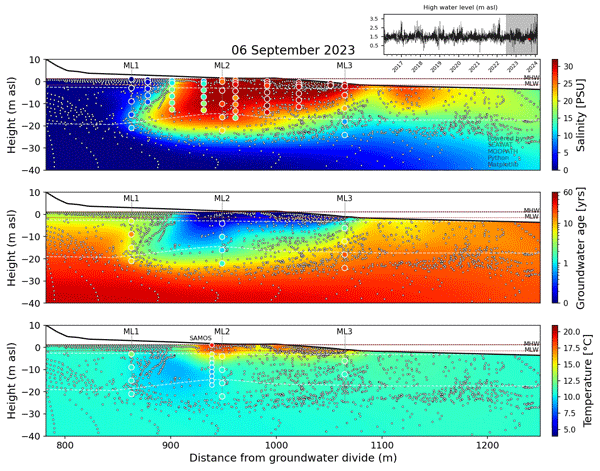
Mixing of fresh groundwater and circulating seawater below beaches triggers water-rock chemical reactions and may affect coastal water quality. The subsurface of so-called high-energy beaches that are exposed to high tides, waves and storm floods are understudied as monitoring under these conditions is difficult. For the first time, this study quantifies the subsurface flow and mixing processes of a high-energy beach with the help of computer simulations based on an extensive set of field data.
Janek Greskowiak, Rena Meyer, Jairo Cueto, Nico Skibbe, Anja Reckhardt, Thomas Günther, Stephan L. Seibert, Kai Schwalfenberg, Dietmar Pommerin, Mike Müller-Petke, and Gudrun Massmann
Hydrol. Earth Syst. Sci., 29, 7127–7147, https://doi.org/10.5194/hess-29-7127-2025, https://doi.org/10.5194/hess-29-7127-2025, 2025
Short summary
Short summary
Mixing of fresh groundwater and circulating seawater below beaches triggers water-rock chemical reactions and may affect coastal water quality. The subsurface of so-called high-energy beaches that are exposed to high tides, waves and storm floods are understudied as monitoring under these conditions is difficult. For the first time, this study quantifies the subsurface flow and mixing processes of a high-energy beach with the help of computer simulations based on an extensive set of field data.
Alec Torres-Freyermuth, Gabriela Medellín, Jorge A. Kurczyn, Roger Pacheco-Castro, Jaime Arriaga, Christian M. Appendini, María Eugenia Allende-Arandía, Juan A. Gómez, Gemma L. Franklin, and Jorge Zavala-Hidalgo
Nat. Hazards Earth Syst. Sci., 22, 4063–4085, https://doi.org/10.5194/nhess-22-4063-2022, https://doi.org/10.5194/nhess-22-4063-2022, 2022
Short summary
Short summary
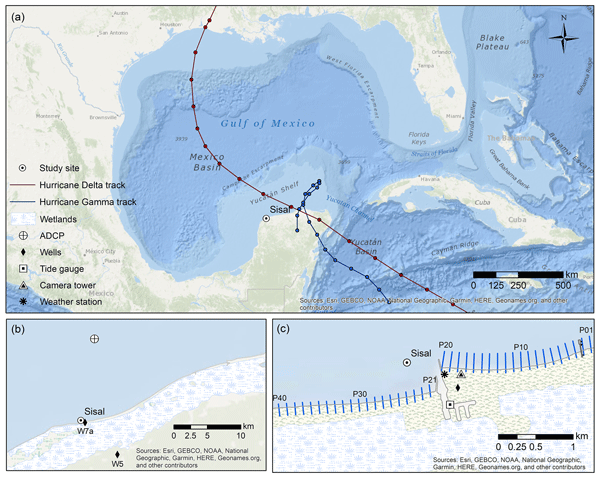
Barrier islands in tropical regions are prone to coastal flooding and erosion during hurricane events. The Yucatán coast was impacted by hurricanes Gamma and Delta. Inner shelf, coastal, and inland observations were acquired. Beach morphology changes show alongshore gradients. Flooding occurred on the back barrier due to heavy inland rain and the coastal aquifer's confinement. Modeling systems failed to reproduce the coastal hydrodynamic response due to uncertainties in the boundary conditions.
Cited articles
Aagaard, T. and Greenwood, B.: Suspended sediment transport and the role of
infragravity waves in a barred surf zone, Mar. Geol., 118, 23–48,
https://doi.org/10.1016/0025-3227(94)90111-2, 1994.
Andrade, C. A., Thomas, Y. F., Lerma, A. N., Durand, P., and Anselme, B.:
Coastal Flooding Hazard Related to Swell Events in Cartagena de Indias,
Colombia, J. Coastal Res., 290, 1126–1136, https://doi.org/10.2112/JCOASTRES-D-12-00028.1, 2013.
Appendini, C. M., Torres-Freyermuth, A., Salles, P., López-González,
P., and Mendoza, E. T.: Wave climate and trends for the Gulf of Mexico and
Caribbean Sea: A 30-Yr wave hindcast, J. Climate, 27, 1619–1632,
https://doi.org/10.1175/JCLI-D-13-00206.1, 2014.
Beach, R. A. and Sternberg, R. W.: Infragravity Driven Suspended Sediment Transport in the Swash, Inner and Outer-Surf Zone, Proceedings Coastal Sediments, ASCE, New York, USA, 114–128, 1991.
Bernal, G., Osorio, A. F., Urrego, L., Peláez, D., Molina, E., Zea, S.,
Montoya, R. D., and Villegas, N.: Occurrence of energetic extreme oceanic
events in the Colombian Caribbean coasts and some approaches to assess their
impact on ecosystems, J. Marine Syst., 164, 85–100, https://doi.org/10.1016/j.jmarsys.2016.08.007, 2016.
Bertin, X., Li, K., Roland, A., Zhang, Y. J., Breilh, J. F., and Chaumillon, E.: A modeling-based analysis of the flooding associated with Xynthia,
central Bay of Biscay, Coast. Eng., 94, 80–89, https://doi.org/10.1016/j.coastaleng.2014.08.013, 2014.
Booij, N., Ris, R. C., and Holthuijsen, L. H.: A third-generation wave model
for coastal regions: 1. Model description and validation, J. Geophys. Res.-Oceans, 104, 7649–7666, https://doi.org/10.1029/98JC02622, 1999.
Boyden, P., Casella, E., Daly, C., and Rovere, A.: Hurricane Matthew in
2100: effects of extreme sea level rise scenarios on a highly valued coastal
area (Palm Beach, FL, USA), Geo-Mar. Lett., 41, 43, https://doi.org/10.1007/s00367-021-00715-6, 2021.
Carter, T. G., Liu, P. L. F., and Mei, C. C.: Mass transport by waves and
offshore sand bed-forms, J. Waterway. Div.-ASCE, 99, 165–183,
1973.
Chawla, A., Spindler, D. M., and Tolman, H. L.: Validation of a thirty year
wave hindcast using the Climate Forecast System Reanalysis winds, Ocean
Model., 70, 189–206, https://doi.org/10.1016/j.ocemod.2012.07.005, 2013.
Christensen, B. B., Drønen, N., Klagenberg, P., Jensen, J., Deigaard, R.,
and Sørensen, P.: Multiscale modelling of coastal flooding, in:
Proceedings of 7th International Conference for Coastal Dynamics, 24–28 June 203, Arcachon Convention Centre, France, Springer, 339–350, 2013.
Ciavola, P., Ferreira, O., Haerens, P., van Koningsveld, M., and Armaroli,
C.: Storm impacts along European coastlines. Part 2: Lessons learned from
the MICORE project, Environ. Sci. Policy, 14, 924–933, 2011.
Conde-Frias, M., Otero, L., Restrepo, J. C., Ortiz-Royero, J. C., Ruiz, J.,
and Osorio, A. F.: Swash Oscillations in a Microtidal Dissipative Beach,
J. Coastal Res., 336, 1408–1422, https://doi.org/10.2112/JCOASTRES-D-16-00147.1, 2017.
Cooper, J. A. G, Masseling, G., Coco, G., Short, A., Castelle, B., Rogers, K., Anthony, E., Green, A. N., Kelley, J. T., Pilkey, O. H., and Jackson, D. W. T.: Sandy beaches can survive sea-level rise, Nat. Clim. Change, 10, 993–995, https://doi.org/10.1038/s41558-020-00934-2, 2020.
Cueto, J. and Otero, L.: Morphodynamic response to extreme wave events of
microtidal dissipative and reflective beaches, Appl. Ocean Res., 101,
102283, https://doi.org/10.1016/j.apor.2020.102283, 2020.
De Santiago, I., Morichon, D., Abadie, S., Reniers, A. J. H. M., and Liria,
P.: A comparative study of models to predict storm impact on beaches,
Nat. Hazards, 87, 843–865, https://doi.org/10.1007/s11069-017-2830-6, 2017.
Dissanayake, P., Brown, J., and Karunarathna, H.: Modelling storm-induced
beach/dune evolution: Sefton coast, Liverpool Bay, UK., Mar. Geol., 357,
225–242, https://doi.org/10.1016/j.margeo.2014.07.013, 2014.
Elsayed, S. and Oumeraci, H.: Combined Modelling of Coastal Barrier
Breaching and Induced Flood Propagation Using XBeach, Hydrology, 3, 32,
https://doi.org/10.3390/hydrology3040032, 2016.
Enríquez, A. R., Marcos, M., Falqués, A., and Roelvink, D.:
Assessing beach and dune erosion and vulnerability under sea level rise: A
Case study in the Mediterranean Sea, Frontiers in Marine Science, 6, 4,
https://doi.org/10.3389/fmars.2019.00004, 2019.
Fiedler, J. W., Smit, P. B., Brodie, K. L., McNinch, J., and Guza, R. T.:
Numerical modeling of wave runup on steep and mildly sloping natural
beaches, Coast. Eng., 131, 106–113, https://doi.org/10.1016/j.coastaleng.2017.09.004, 2018.
Guimarães, P. V., Farina, L., Toldo, E., Diaz-Hernandez, G., and
Akhmatskaya, E.: Numerical simulation of extreme wave runup during storm
events in Tramandaí Beach, Rio Grande do Sul, Brazil, Coast. Eng., 95, 171–180, https://doi.org/10.1016/j.coastaleng.2014.10.008, 2015.
Harley, M. D., Turner, I. L., Kinsela, M. A., and Hanslow, D. J.: Observations of beach recovery in SE Australia following the June 2016 east
coast low, Australasian Coasts and Ports 2017 Conference, 21–23 June 2017, Cains, Queensland, Australia, https://www.researchgate.net/publication/318011521 (last access: 20 June 2021), 2017.
He, Z., Hu, P., Zhao, L., Wu, G., and Pähtz, T.: Modeling of breaching
due to overtopping flow and waves based on coupled flow and sediment
transport, Water (Switzerland), 7, 4283–4304, https://doi.org/10.3390/w7084283, 2015.
Holman, R. A. and Bowen, A. J.: Bars, bumps, and holes: Models for the
generation of complex beach topography, J. Geophys. Res., 87, 457–468, https://doi.org/10.1029/JC087iC01p00457, 1982.
IPCC Climate Change 2021: The Physical Science Basis, Contribution of
Working Group I to the Sixth Assessment Report of the Intergovernmental
Panel on Climate Change, edited by: Masson-Delmotte, V., Zhai, P., Pirani, A., Connors, S. L., Péan, C., Berger, S., Caud, N., Chen, Y., Goldfarb, L., Gomis, M. I., Huang, M., Leitzell, K., Lonnoy, E., Matthews, J. B. R., Maycock, T. K., Waterfield, T., Yelekçi, O., Yu, R., and Zhou, B., Cambridge University Press, https://www.ipcc.ch/report/ar6/wg1/#FullReport, last access: 4 March 2022, in press, 2021.
Izaguirre, C., Méndez, F., Espejo, A., Losada, I., and Reguero, B.: Extreme wave climate changes in Central-South America, Climatic Change, 119, 277–290, https://doi.org/10.1007/s10584-013-0712-9, 2013.
Jiménez, J. A., Sanuy, M., Ballesteros, C., and Valdemoro, H. I.: The
Tordera Delta, a hotspot to storm impacts in the coast northwards of
Barcelona (NW Mediterranean), Coast. Eng., 134, 148–158, https://doi.org/10.1016/j.coastaleng.2017.08.012, 2018.
Kamphuis, J. W.: Physical modeling of coastal processes,
Adv. Coastal Ocean En., 2, 79–114, https://doi.org/10.1142/9789812797575_0002, 1996.
Kron, W.: Coasts: The high-risk areas of the world, Nat. Hazards, 66,
1363–1382, https://doi.org/10.1007/s11069-012-0215-4, 2013.
Luijendijk, A. P., Ranasinghe, R., de Schipper, M. A., Huisman, B. A.,
Swinkels, C. M., Walstra, D. J. R., and Stive, M. J. F.: The initial
morphological response of the Sand Engine: A process-based modelling study,
Coast. Eng., 119, 1–14, https://doi.org/10.1016/j.coastaleng.2016.09.005, 2017.
McCall, R. T., van Thiel de Vries, J. S. M., Plant, N. G., van Dongeren, A.
R., Roelvink, J. A., Thompson, D. M., and Reniers, A. J. H. M.:
Two-dimensional time dependent hurricane overwash and erosion modeling at
Santa Rosa Island, Coast. Eng., 57, 668–683, https://doi.org/10.1016/j.coastaleng.2010.02.006, 2010.
Medellín, G., Brinkkemper, J. A., Torres-Freyermuth, A., Appendini, C. M., Mendoza, E. T., and Salles, P.: Run-up parameterization and beach vulnerability assessment on a barrier island: a downscaling approach, Nat. Hazards Earth Syst. Sci., 16, 167–180, https://doi.org/10.5194/nhess-16-167-2016, 2016.
Nederhoff, C. M., Lodder, Q. J., Boers, M., den Bieman, J. P., and Miller,
J. K.: Modeling the effects of hard structures on dune erosion and overwash,
in: Proceedings of Coastal Sediments, https://doi.org/10.1142/9789814689977_0219, 2015.
Nicolae Lerma, A., Pedreros, R., Robinet, A., and Sénéchal, N.:
Simulating wave setup and runup during storm conditions on a complex barred
beach, Coast. Eng., 123, 29–41, https://doi.org/10.1016/j.coastaleng.2017.01.011, 2017.
Orejarena-Rondón, A. F., Sayol, J. M., Marcos, M., Otero, L., Restrepo,
J. C., Hernández-Carrasco, I., and Orfila, A.: Coastal Impacts Driven by
Sea-Level Rise in Cartagena de Indias, Frontiers in Marine Science, 6, 614,
https://doi.org/10.3389/fmars.2019.00614, 2019.
Ortiz-Royero, J. C.: Huracanes y tormentas tropicales en el mar Caribe
colombiano desde 1900, Boletín Científico CIOH, 25, 54–60,
https://doi.org/10.26640/22159045.162, 2007.
Ortiz-Royero, J. C.: Aplicación de un modelo paramétrico de vientos
y un modelo de oleaje espectral para el estudio del oleaje máximo
generado por el huracán Lenny en las costas del Caribe colombiano en
1999, Boletín Científico CIOH, 27, 29–36, https://doi.org/10.26640/01200542.27.29_36, 2009.
Ortiz-Royero, J. C., López, F., Díaz, E., and Bacca, L. F.: Estudio
del Oleaje Generado por el Huracán Joan en la Costa Caribe Colombiana en
1988, Incluyendo a la Isla Andrés, Revista Colombiana de Física, 40, 444–446, https://www.uninorte.edu.co/documents/266486/0/5_Ortiz+et+al_2008.pdf (last access: 20 June 2021), 2008.
Ortiz-Royero, J. C., Otero, L. J., Restrepo, J. C., Ruiz, J., and Cadena, M.: Cold fronts in the Colombian Caribbean Sea and their relationship to extreme wave events, Nat. Hazards Earth Syst. Sci., 13, 2797–2804, https://doi.org/10.5194/nhess-13-2797-2013, 2013.
Ortiz-Royero, J. C., Salcedo, B., and Otero, L. J.: Investigating the
Collapse of the Puerto Colombia Pier (Colombian Caribbean Coast) in March
2009: Methodology for the Reconstruction of Extreme Events and the
Evaluation of their Impact on the Coastal Infrastructure, J. Coastal Res., 294, 291–300, https://doi.org/10.2112/JCOASTRES-D-12-00062.1, 2014.
Osborne, P. and Rooker, G.: Sand Re-Suspension Events in a High Energy
Infragravity Swash Zone, J. Coastal Res., 15, 74–86, https://www.jstor.org/stable/4298916?seq=1 (last access: 20 June 2021), 1999.
Otero, L. J., Ortiz-Royero, J. C., Ruiz-Merchan, J. K., Higgins, A. E., and Henriquez, S. A.: Storms or cold fronts: what is really responsible for the extreme waves regime in the Colombian Caribbean coastal region?, Nat. Hazards Earth Syst. Sci., 16, 391–401, https://doi.org/10.5194/nhess-16-391-2016, 2016.
Pérez, R. A., Ortiz, R. J. C., Bejarano, A. L. F., Otero, D. L.,
Restrepo, L. J. C., and Franco, A. A.: Sea breeze in the Colombian Caribbean
coast, Atmosfera, 31, 389–406, https://doi.org/10.20937/ATM.2018.31.04.06, 2018.
Plomaritis, T. A., Ferreira, Ó., and Costas, S.: Regional assessment of
storm related overwash and breaching hazards on coastal barriers, Coast. Eng., 134, 124–133, https://doi.org/10.1016/j.coastaleng.2017.09.003, 2018.
Poveda, G.: La hidroclimatología de Colombia: una síntesis desde
la escala inter-decadal hasta la escala diurna, Rev. Acad. Colomb. Cienc.,
28, 201–222, 2004.
Ranasinghe, R., Swinkels, C., Luijendijk, A., Roelvink, D., Bosboom, J.,
Stive, M., and Walstra, D. J.: Morphodynamic upscaling with the MORFAC
approach: Dependencies and sensitivities, Coast. Eng., 58,
806–811, https://doi.org/10.1016/j.coastaleng.2011.03.010,
2011.
Rangel-Buitrago, N. G., Anfuso, G., and Williams, A. T.: Coastal erosion
along the Caribbean coast of Colombia: Magnitudes, causes and management,
Ocean and Coastal Management, 114, 129–144, https://doi.org/10.1016/j.ocecoaman.2015.06.024, 2015.
Reguero, B. G., Méndez, F. J., and Losada, I. J.: Variability of
multivariate wave climate in Latin America and the Caribbean, Global Planet. Change, 100, 70–84, https://doi.org/10.1016/j.gloplacha.2012.09.005, 2013.
Restrepo, J. C., Otero, L., Casas, A. C., Henao, A., and Gutiérrez, J.:
Shoreline changes between 1954 and 2007 in the marine protected area of the
Rosario Island Archipelago (Caribbean of Colombia), Ocean Coast. Manage., 69, 133–142, https://doi.org/10.1016/j.ocecoaman.2012.07.027, 2012.
Restrepo, J. C., Schrottke, K., Traini, C., Ortíz, J. C., Orejarena,
A., Otero, L., Higgins, A., and Marriaga, L.: Sediment Transport and
Geomorphological Change in a High-Discharge Tropical Delta (Magdalena River,
Colombia): Insights from a Period of Intense Change and Human Intervention
(1990–2010), J. Coastal Res., 319, 575–589, https://doi.org/10.2112/JCOASTRES-D-14-00263.1, 2016.
Roelvink, D., Reniers, A., van Dongeren, A., van Thiel de Vries, J., McCall,
R., and Lescinski, J.: Modelling storm impacts on beaches, dunes and barrier
islands, Coast. Eng., 56, 1133–1152, https://doi.org/10.1016/j.coastaleng.2009.08.006, 2009.
Ruessink, B. G., Kleinhans, M. G., and van den Beukel, P. G. L.:
Observations of swash under highly dissipative conditions, J. Geophys. Res.-Oceans, 103, 3111–3118, https://doi.org/10.1029/97JC02791, 1998.
Ruggiero, P.: Wave run-up on a high-energy dissipative beach, J. Geophys. Res., 109, C06025, https://doi.org/10.1029/2003JC002160, 2004.
Ruju, A., Lara, J. L., and Losada, I. J.: Numerical analysis of run-up
oscillations under dissipative conditions, Coast. Eng., 86, 45–56,
https://doi.org/10.1016/j.coastaleng.2014.01.010, 2014.
Sallenger, A. H.: Storm impact scale for barrier islands, J. Coast. Res., 16, 890–895, https://doi.org/10.1002/2014JC010093, 2000.
Sanuy, M. and Jiménez, J.: Sensitivity of Storm-Induced Hazards in a
Highly Curvilinear Coastline to Changing Storm Directions. The Tordera Delta
Case (NW Mediterranean), Water, 11, 747, https://doi.org/10.3390/w11040747, 2019.
Schambach, L., Grilli, A. R., Grilli, S. T., Hashemi, M. R., and King, J.
W.: Assessing the impact of extreme storms on barrier beaches along the
Atlantic coastline: Application to the southern Rhode Island coast, Coast. Eng., 133, 26–42, https://doi.org/10.1016/j.coastaleng.2017.12.004, 2018.
Senechal, N., Coco, G., Bryan, K. R., and Holman, R. A.: Wave runup during
extreme storm conditions, J. Geophys. Res., 116, C07032, https://doi.org/10.1029/2010JC006819, 2011.
Sills, G. L., Asce, M., Vroman, N. D., Wahl, R. E., and Schwanz, N. T.:
Overview of New Orleans Levee Failures: Lessons Learned and Their Impact on
National Levee Design and Assessment, J. Geotech. Geoenviron. Eng., 134, 556–565, https://doi.org/10.1061/(ASCE)1090-0241(2008)134:5(556), 2008.
Stockdon, H. F., Thompson, D. M., Plant, N. G., and Long, J. W.: Evaluation
of wave runup predictions from numerical and parametric models, Coast. Eng., 92, 1–11, https://doi.org/10.1016/j.coastaleng.2014.06.004, 2014.
Torres, R. R. and Tsimplis, M. N.: Seasonal sea level cycle in the
Caribbean Sea, J. Geophys. Res.-Oceans, 117, C07011, https://doi.org/10.1029/2012JC008159, 2012.
van Rijn, L. C., Walstra, D. J. R., Grasmeijer, B., Sutherland, J., Pan, S.,
and Sierra, J. P.: The predictability of cross-shore bed evolution of sandy
beaches at the time scale of storms and seasons using process-based Profile
models, Coast. Eng., 47, 295–327, https://doi.org/10.1016/S0378-3839(02)00120-5, 2003.
van Thiel De Vries, J. S. M., van Gent, M. R. A., Walstra, D. J. R., and
Reniers, A. J. H. M.: Analysis of dune erosion processes in large-scale
flume experiments, Coast. Eng., 55, 1028–1040, 2007.
Vega, M.: Comparación de metodologías de refinamiento de escala de
reanálisis de oleaje, Universidad del Norte repository, http://manglar.uninorte.edu.co/handle/10584/7943#page=1 (last access: 20 June 2021), 2017.
XBeach: XBeach Open Source Community, https://oss.deltares.nl/web/xbeach/, last access: 4 March 2022.
Wu, W., Altinakar, M., Al-Riffai, M., and Bergman, N.: Earthen Embankment
Breaching, J. Hydraul. Eng., 137, 1549–1564, https://doi.org/10.1061/(ASCE)HY.1943-7900.0000498, 2011.
Short summary
We investigate the importance of morphodynamics on flooding estimation during storms with sea level rise conditions on a microtidal beach. XBeach and SWAN were the numerical models used to test several case studies. The results indicate that numerical modeling of flooding should be approached by considering morphodynamics; ignoring them can underestimate flooding by ~ 15 %. Moreover, beach erosion and flooding are intensified by sea level rise and high tides in ~ 69 % and ~ 65 %, respectively.
We investigate the importance of morphodynamics on flooding estimation during storms with sea...


Special issue
Altmetrics
Final-revised paper
Preprint